

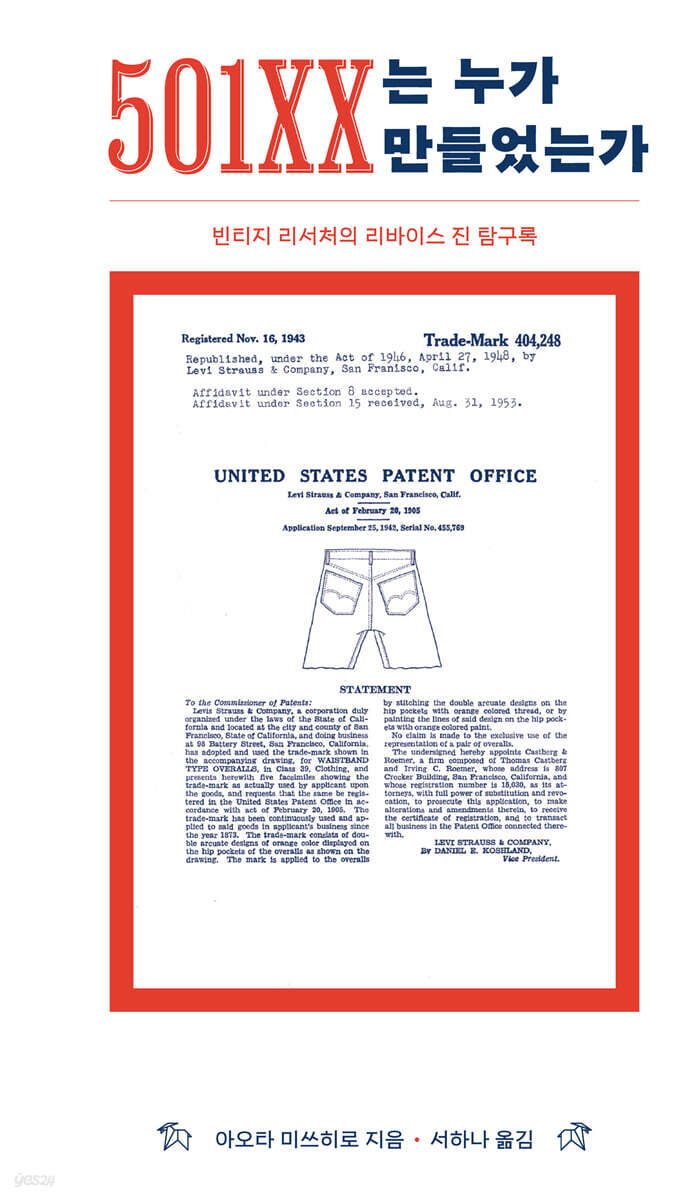
Who made 501XX?
 |
Description
Book Introduction
Levi's 501 jeans have been loved for their enduring and explosive vitality since their invention in 1873.
Did you know that Levi Strauss, the founder of the company and known as the father of jeans, wasn't actually involved in the creation of jeans?
501XX, which started out as a special workwear, a pair of sturdy jeans with copper rivets that wouldn't rip even if two horses ran in opposite directions, has now become a magical material that establishes style through the interpretation and application of each wearer.
As a person goes through daily movements and ages, the history of adventures he has seen and experienced is faithfully accumulated, and the 'clothes' are sometimes as amazingly optimized for our minds as our bodies.
Aota, a diehard 501 fan and dedicated vintage researcher, collected and categorized various hidden historical materials (even Levi's job advertisements) and organized them into a single book.
We learn more about Levi's than we ever knew before: facts we never knew, facts we probably never need to know, facts we can wear without knowing, but which make us look at them a second time because we know them: the tiny details of the jeans, the small curves in the fabric, the subtle colors of the stitching.
Perhaps you will discover entirely new aspects of something you vaguely liked, and only then will you truly know it, and yet still, or even more, like it.
This affection will be a treasure trove, as we sense 150 years of history in just one piece of clothing.
Did you know that Levi Strauss, the founder of the company and known as the father of jeans, wasn't actually involved in the creation of jeans?
501XX, which started out as a special workwear, a pair of sturdy jeans with copper rivets that wouldn't rip even if two horses ran in opposite directions, has now become a magical material that establishes style through the interpretation and application of each wearer.
As a person goes through daily movements and ages, the history of adventures he has seen and experienced is faithfully accumulated, and the 'clothes' are sometimes as amazingly optimized for our minds as our bodies.
Aota, a diehard 501 fan and dedicated vintage researcher, collected and categorized various hidden historical materials (even Levi's job advertisements) and organized them into a single book.
We learn more about Levi's than we ever knew before: facts we never knew, facts we probably never need to know, facts we can wear without knowing, but which make us look at them a second time because we know them: the tiny details of the jeans, the small curves in the fabric, the subtle colors of the stitching.
Perhaps you will discover entirely new aspects of something you vaguely liked, and only then will you truly know it, and yet still, or even more, like it.
This affection will be a treasure trove, as we sense 150 years of history in just one piece of clothing.
- You can preview some of the book's contents.
Preview
Publisher's Review
This book is a personal investigation into Levi's jeans.
…I compiled the information I gathered from patents, trademarks, newspaper advertisements of the time, and catalogs that I was lucky enough to obtain, without relying on publicly available sources.
This book covers a period of approximately 100 years, from the 1870s to the 1970s.
That is, the story from the time when blue jeans are believed to have been created to the time when the dyeing method for denim fabric changed.
When it comes to vintage jeans, it has to be Levi's 501.
All chapters except Chapter 1 cover the evolution of manufacturing and specifications centered around the 501.
? In the text
Translator's Note - The Faces Behind Truth
Translating this book into Korean allowed me to see how blue jeans evolved over the course of a century from workwear overalls to today's 501XX jeans, and to see the path that the company Levi's took through its founder, Levi Strauss, and tailor, Jacob Davis.
The journey was quite interesting.
And it was only when I took a step back and looked at those writings to write the “Translator’s Note” that I realized that there was something missing.
The fact is that this book contains countless stories of 'labor'.
This may seem obvious, considering that Jin started out as a worker's overalls.
The original riveted jeans originated from a woman's request.
A woman came to Jacob, a tailor, to ask him to make her a pair of sturdy work pants because her husband's pants were worn out.
Jacob then made a pair of very strong trousers by attaching copper rivets to thick twill, and this was spread among the grooms and surveyors.
Later, Jacob and Levi joined hands and created the basic jeans we wear today.
After that, Levi's grew by setting up a factory and pursuing mass production.
From then on, advertisements for sewing machine operators began to appear in the newspapers.
Initially, the advertisement recruited a small number of skilled workers, such as ten or fifty, but as production increased and the number of factories increased, the production process was subdivided and young workers were recruited, chanting “Girls!”
"Who Made 501XX?" is a book in which job advertisements spanning 100 years of history consistently appear throughout the book.
The images on pages 110-111 allow us to see the scene of such labor with our own eyes.
A view of the Levi's factory around 1897, when the product number 501 appeared.
The screen is filled with two men (presumably Levi and Jacob) who can only be seen through a loupe, and 500 women who are sewing overalls with all their might.
Just as clothing making was traditionally a woman's job, it was also women who took charge of the production of overalls.
And behind that labor are the historical events of the Gold Rush (1848), which brought workers and immigrants to the city, as well as the changes in distribution based on the opening of the transcontinental railroad in 1867, and the industrial changes brought about by the spread of electricity in the 1890s.
In addition, there are various stories of labor scattered throughout the book.
Levi's produced children's overalls because children were an important labor source at the time, and during World War II, a woman was in charge of applying red paint instead of orange thread for the Accuate stitch due to government restrictions on materials, and during the Great Depression, when cheap Asian workers were in conflict with unemployed white workers, Levi's leaflets had the phrase "Home Industries" printed on them.
Discovering such traces reminds me that there are invisible faces behind everything I wear, eat, and use.
The sweaty faces of those who lived hundreds of years ago, years and months ago, and even just yesterday.
In this way, this book has become established as a history of labor in addition to the history of industrial products that the author spoke of.
Editor's Note - Who was the first to know how to tie a rivet?
What if there was a single garment that embodies pop stars and blue-collar workers, politicians and rappers, artisans and businessmen alike? While editing a book detailing a garment that has captivated countless generations since its birth in California in 1873, the 501XX was nowhere to be seen as a fashion item.
The reason why jeans can be both a product of labor and a product of capital, a symbol of fashion and a ready-made product, is not because the inventor of jeans had a great historical mission, nor because the businessmen who led the jeans business were great pioneers.
These jeans just didn't die, they survived.
That long life has only brought him to meet many people and pass through many eras.
But like a cat that has lived a million lives, these jeans have died a million times and been reborn a million times, met countless owners and lived a colorful life, and if nothing happens, they will be reborn a million more times in the future.
My father, a typist, my grandmother, a repairman, and my great-grandfather, a cowboy, all look great in these jeans, even though my pupils are bathed in blue light.
No one has ever asked me, but if you were to ask, "What is the real 501 to you?" I would say the answer is copper rivets.
I can't say how engraved it is, what the font is, what size it is, how worn it is, or what the gloss level is, but before reading this book, I thought the arcuate stitch and the two horse mark were the symbols of the 501, and I think they can't be beat with copper rivets.
The first copper rivet, installed by tailor Jacob in a part of the fabric that was prone to tearing when in contact with the pocket.
These rivets prevent the owner of the trousers from throwing them away.
May the pants live long, and may the owner of the pants live long as the owner of the pants.
I'd rather have a caring friend who can mend my torn pockets than a pair of invincible jeans that won't rip even if two horses run in opposite directions holding each other's ends.
Wouldn't you like to have a friend who makes jeans, who worries about your future and prepares for it even before it falls apart? Someone who secures the pockets that will become ours long before we even choose our pants.
The person who found the right place for the pants and their owner.
He is the one who created 501XX.
Designer's Note
Several elements were immediately decided upon by Gott's suggestion to maintain the same specifications as the Blue Note Collector's Guide, printed in two colors and at the same size.
I thought there were no other colors to choose from besides the denim's purple and the red of the Red Tab.
While digging through old materials, I saw photos of various versions of the 501XX, each of which was different.
The product number and size information stamped on the pre-made patch were in an uneven position, and the spacing of the printed material was uneven.
The spacing and shape of the arcuate stitches were not consistent, which I found particularly attractive.
This is where the overall mood of the book comes from.
Considering that you will be reading a long text, the spacing in the text was made comfortable, but fixed-width fonts were used for punctuation marks, Roman letters, numbers, and weapon styles to create a neat text field.
The plate number style also provides a difference in the width of the chapter number and image number (e.g. 〔?-?〕).
(There was also an intention to make it look like the ground was rivet-studded here and there.) A lot of effort was put into creating a sparse impression.
In particular, when two punctuation marks are placed in a row, the spacing between them widens as if there were a space, which is even more satisfying.
Meanwhile, the default font, Normalgojitgu, was so perfect for this book that my pupils shook as soon as I saw it (should I say it was tailored to San Francisco?).
At the editor's suggestion along the way, the red tab red was changed to a copper rivet color (see 'Editor's Note'), which I readily agreed to as it was a reasonable suggestion, considering that rivets were a key element in creating Levi's reputation.
This book contains a lot of material that would be difficult to find elsewhere, so I tried to enlarge the illustrations as much as possible.
In the process, the order of arrangement was different from the original book, and the plate numbers had to be changed accordingly.
The number of pages has also increased considerably compared to the original (the original is a national edition, i.e. 272 pages in A5 format).
I would like to express my deepest gratitude to the editors who chose to go through the hassle of checking each and every design revision instead of requesting it, and to the management team who decided to bear the increased production costs.
…I compiled the information I gathered from patents, trademarks, newspaper advertisements of the time, and catalogs that I was lucky enough to obtain, without relying on publicly available sources.
This book covers a period of approximately 100 years, from the 1870s to the 1970s.
That is, the story from the time when blue jeans are believed to have been created to the time when the dyeing method for denim fabric changed.
When it comes to vintage jeans, it has to be Levi's 501.
All chapters except Chapter 1 cover the evolution of manufacturing and specifications centered around the 501.
? In the text
Translator's Note - The Faces Behind Truth
Translating this book into Korean allowed me to see how blue jeans evolved over the course of a century from workwear overalls to today's 501XX jeans, and to see the path that the company Levi's took through its founder, Levi Strauss, and tailor, Jacob Davis.
The journey was quite interesting.
And it was only when I took a step back and looked at those writings to write the “Translator’s Note” that I realized that there was something missing.
The fact is that this book contains countless stories of 'labor'.
This may seem obvious, considering that Jin started out as a worker's overalls.
The original riveted jeans originated from a woman's request.
A woman came to Jacob, a tailor, to ask him to make her a pair of sturdy work pants because her husband's pants were worn out.
Jacob then made a pair of very strong trousers by attaching copper rivets to thick twill, and this was spread among the grooms and surveyors.
Later, Jacob and Levi joined hands and created the basic jeans we wear today.
After that, Levi's grew by setting up a factory and pursuing mass production.
From then on, advertisements for sewing machine operators began to appear in the newspapers.
Initially, the advertisement recruited a small number of skilled workers, such as ten or fifty, but as production increased and the number of factories increased, the production process was subdivided and young workers were recruited, chanting “Girls!”
"Who Made 501XX?" is a book in which job advertisements spanning 100 years of history consistently appear throughout the book.
The images on pages 110-111 allow us to see the scene of such labor with our own eyes.
A view of the Levi's factory around 1897, when the product number 501 appeared.
The screen is filled with two men (presumably Levi and Jacob) who can only be seen through a loupe, and 500 women who are sewing overalls with all their might.
Just as clothing making was traditionally a woman's job, it was also women who took charge of the production of overalls.
And behind that labor are the historical events of the Gold Rush (1848), which brought workers and immigrants to the city, as well as the changes in distribution based on the opening of the transcontinental railroad in 1867, and the industrial changes brought about by the spread of electricity in the 1890s.
In addition, there are various stories of labor scattered throughout the book.
Levi's produced children's overalls because children were an important labor source at the time, and during World War II, a woman was in charge of applying red paint instead of orange thread for the Accuate stitch due to government restrictions on materials, and during the Great Depression, when cheap Asian workers were in conflict with unemployed white workers, Levi's leaflets had the phrase "Home Industries" printed on them.
Discovering such traces reminds me that there are invisible faces behind everything I wear, eat, and use.
The sweaty faces of those who lived hundreds of years ago, years and months ago, and even just yesterday.
In this way, this book has become established as a history of labor in addition to the history of industrial products that the author spoke of.
Editor's Note - Who was the first to know how to tie a rivet?
What if there was a single garment that embodies pop stars and blue-collar workers, politicians and rappers, artisans and businessmen alike? While editing a book detailing a garment that has captivated countless generations since its birth in California in 1873, the 501XX was nowhere to be seen as a fashion item.
The reason why jeans can be both a product of labor and a product of capital, a symbol of fashion and a ready-made product, is not because the inventor of jeans had a great historical mission, nor because the businessmen who led the jeans business were great pioneers.
These jeans just didn't die, they survived.
That long life has only brought him to meet many people and pass through many eras.
But like a cat that has lived a million lives, these jeans have died a million times and been reborn a million times, met countless owners and lived a colorful life, and if nothing happens, they will be reborn a million more times in the future.
My father, a typist, my grandmother, a repairman, and my great-grandfather, a cowboy, all look great in these jeans, even though my pupils are bathed in blue light.
No one has ever asked me, but if you were to ask, "What is the real 501 to you?" I would say the answer is copper rivets.
I can't say how engraved it is, what the font is, what size it is, how worn it is, or what the gloss level is, but before reading this book, I thought the arcuate stitch and the two horse mark were the symbols of the 501, and I think they can't be beat with copper rivets.
The first copper rivet, installed by tailor Jacob in a part of the fabric that was prone to tearing when in contact with the pocket.
These rivets prevent the owner of the trousers from throwing them away.
May the pants live long, and may the owner of the pants live long as the owner of the pants.
I'd rather have a caring friend who can mend my torn pockets than a pair of invincible jeans that won't rip even if two horses run in opposite directions holding each other's ends.
Wouldn't you like to have a friend who makes jeans, who worries about your future and prepares for it even before it falls apart? Someone who secures the pockets that will become ours long before we even choose our pants.
The person who found the right place for the pants and their owner.
He is the one who created 501XX.
Designer's Note
Several elements were immediately decided upon by Gott's suggestion to maintain the same specifications as the Blue Note Collector's Guide, printed in two colors and at the same size.
I thought there were no other colors to choose from besides the denim's purple and the red of the Red Tab.
While digging through old materials, I saw photos of various versions of the 501XX, each of which was different.
The product number and size information stamped on the pre-made patch were in an uneven position, and the spacing of the printed material was uneven.
The spacing and shape of the arcuate stitches were not consistent, which I found particularly attractive.
This is where the overall mood of the book comes from.
Considering that you will be reading a long text, the spacing in the text was made comfortable, but fixed-width fonts were used for punctuation marks, Roman letters, numbers, and weapon styles to create a neat text field.
The plate number style also provides a difference in the width of the chapter number and image number (e.g. 〔?-?〕).
(There was also an intention to make it look like the ground was rivet-studded here and there.) A lot of effort was put into creating a sparse impression.
In particular, when two punctuation marks are placed in a row, the spacing between them widens as if there were a space, which is even more satisfying.
Meanwhile, the default font, Normalgojitgu, was so perfect for this book that my pupils shook as soon as I saw it (should I say it was tailored to San Francisco?).
At the editor's suggestion along the way, the red tab red was changed to a copper rivet color (see 'Editor's Note'), which I readily agreed to as it was a reasonable suggestion, considering that rivets were a key element in creating Levi's reputation.
This book contains a lot of material that would be difficult to find elsewhere, so I tried to enlarge the illustrations as much as possible.
In the process, the order of arrangement was different from the original book, and the plate numbers had to be changed accordingly.
The number of pages has also increased considerably compared to the original (the original is a national edition, i.e. 272 pages in A5 format).
I would like to express my deepest gratitude to the editors who chose to go through the hassle of checking each and every design revision instead of requesting it, and to the management team who decided to bear the increased production costs.
GOODS SPECIFICS
- Date of issue: November 15, 2024
- Page count, weight, size: 432 pages | 120*205*30mm
- ISBN13: 9791189519803
- ISBN10: 1189519801
You may also like
카테고리
korean


korean

![GQ KOREA Mark (Monthly): December [2025]](http://librairie.coreenne.fr/cdn/shop/files/8ef265dbbfbf186523ed75ba7319009d.jpg?v=1765340328&width=3840)


