

The usefulness of pictures
 |
Description
Book Introduction
“Starry Night,” “The Creation of Adam,” “A Sunday Afternoon on the Island of La Grande Jatte,” “Icarus”…
Life Drawings That Make Me a Better Person
In the 1990s, artist Bob Ross, known as “Happy Artist, Uncle Bob,” said this.
“Darkness and light, light and darkness.
There should always be these two in a picture.
If you add light to light, you get nothing.
Adding darkness to darkness is the same thing.
“Life is like that too.” As he said, our lives too must have both light and dark.
Life can't always be good, nor can it always be difficult.
Just as the saying goes, "The darker the night, the brighter the stars shine," it is only through hardship that we can realize how precious happiness is, and it is only through sorrow that we can realize the preciousness of joy.
The same goes for paintings born from the brushes of painters hundreds of years ago.
Even the countless genius painters who seem great today were just people who experienced ups and downs and struggled to overcome despair in their own lives.
Their paintings are full of the joys and sorrows of life.
For this reason, 『The Usefulness of Painting』 was born to lead to an active interaction of 'encountering' paintings, rather than simply a passive act of 'seeing' with the eyes.
This book is divided into four major parts, and talks about how to find hope in life amid despair, the solitude and emptiness that are sometimes necessary in life, the question of what is most valuable in life, and how to fill life with happiness and joy.
Through paintings that fully embody the struggles of life and the answers they offer, various artists have left behind, you will encounter universal human suffering and joy, love and hate, and reflections on life and death.
The author says that while touring numerous museums in Europe and seeing countless paintings, he felt as if he had discovered not just a single masterpiece, but a common trajectory in the artist's life and in the lives of all people.
The fact that all lives seemed different, yet at the same time, the same, and the moment I realized that, I realized the true 'usefulness of painting'.
It was the realization that painting is life itself, and that it provides us with deep inspiration and an opportunity to reflect on life.
The 22 paintings introduced in this book were not selected solely based on their art historical value or popular appeal.
Instead, I chose paintings that were either a condensation of the artist's values toward life or that contained the artist's own deep insight into the inner and outer world.
I hope that looking at these paintings together will provide an opportunity to ask yourself what emotions you feel from them and what meaning they can bring to your life.
These pictures may not provide the complete answer, but they will at least help you on your way to finding it.
Life Drawings That Make Me a Better Person
In the 1990s, artist Bob Ross, known as “Happy Artist, Uncle Bob,” said this.
“Darkness and light, light and darkness.
There should always be these two in a picture.
If you add light to light, you get nothing.
Adding darkness to darkness is the same thing.
“Life is like that too.” As he said, our lives too must have both light and dark.
Life can't always be good, nor can it always be difficult.
Just as the saying goes, "The darker the night, the brighter the stars shine," it is only through hardship that we can realize how precious happiness is, and it is only through sorrow that we can realize the preciousness of joy.
The same goes for paintings born from the brushes of painters hundreds of years ago.
Even the countless genius painters who seem great today were just people who experienced ups and downs and struggled to overcome despair in their own lives.
Their paintings are full of the joys and sorrows of life.
For this reason, 『The Usefulness of Painting』 was born to lead to an active interaction of 'encountering' paintings, rather than simply a passive act of 'seeing' with the eyes.
This book is divided into four major parts, and talks about how to find hope in life amid despair, the solitude and emptiness that are sometimes necessary in life, the question of what is most valuable in life, and how to fill life with happiness and joy.
Through paintings that fully embody the struggles of life and the answers they offer, various artists have left behind, you will encounter universal human suffering and joy, love and hate, and reflections on life and death.
The author says that while touring numerous museums in Europe and seeing countless paintings, he felt as if he had discovered not just a single masterpiece, but a common trajectory in the artist's life and in the lives of all people.
The fact that all lives seemed different, yet at the same time, the same, and the moment I realized that, I realized the true 'usefulness of painting'.
It was the realization that painting is life itself, and that it provides us with deep inspiration and an opportunity to reflect on life.
The 22 paintings introduced in this book were not selected solely based on their art historical value or popular appeal.
Instead, I chose paintings that were either a condensation of the artist's values toward life or that contained the artist's own deep insight into the inner and outer world.
I hope that looking at these paintings together will provide an opportunity to ask yourself what emotions you feel from them and what meaning they can bring to your life.
These pictures may not provide the complete answer, but they will at least help you on your way to finding it.
- You can preview some of the book's contents.
Preview
index
The introductory text is a mirror reflecting life.
Part 1.
The darker the night, the brighter the stars shine. A picture to look at when you feel like giving up.
The Miracle That Happens When We Face It Instead of Avoiding It│Munch, "The Scream"
"When one door closes, another opens." │ Frida, Roots
One Thing You Must Never Forget Even in the Deepest Despair│Van Gogh, "Starry Night"
The painter who dreamed of the coexistence of light and darkness│Caravaggio, David with the Head of Goliath
To Transcend Limitations and Discrimination│Artemisia, Self-Portrait as an Allegory of Painting
Part 2.
There is nothing to throw away in life. A picture to see when you are lonely.
The Quickest Way to Peace│Rousseau, The Sleeping Gypsy
Why Silent Introspection Matters│Friedrich, Wanderer Above the Sea of Fog
Realizing the finiteness of life is the next step. │ Holbein, The Ambassadors
Whenever I feel alone despite having many friends│Seurat, “A Sunday Afternoon on the Island of La Grande Jatte”
The Power of a Longing Heart│Dürer, Praying Hands
How to Stay Unwavering Between Ideal and Reality│Raphael, The School of Athens
Part 3.
What is truly valuable is invisible. A picture to look at when you want to broaden your horizons.
What it takes to truly understand others│Rembrandt, The Return of the Prodigal Son
Asking the Essence of Love│Klimt, "The Kiss"
The Painter of Happiness│Dufy, "Open Window at Nice"
What We Must Sow and Cultivate in Life│Millet, The Sower
The Power of Seeing Things as They Are│Monet, "Water Lilies"
The most precious things in life are right next to you│Renoir, "Girls Playing the Piano"
Part 4.
Life is a process of discovering the joy of endurance. The picture you see when you fill yourself with happiness.
What Makes Humans Human in the Age of Artificial Intelligence│Michelangelo, The Creation of Adam
Things You Only See When You Break Free from the Path Set by Others│Matisse, “Icarus”
You have to look closely to see it.│Degas, "Ballet Rehearsal on Stage"
“A nation that forgets its past has no future.”│Muha, “Slavic Epic Series No.
1〉
If you give new meaning to the same thing every day│Velázquez, Las Meninas
The Power of Painting to Turn Everyday Life into Art
References
Part 1.
The darker the night, the brighter the stars shine. A picture to look at when you feel like giving up.
The Miracle That Happens When We Face It Instead of Avoiding It│Munch, "The Scream"
"When one door closes, another opens." │ Frida, Roots
One Thing You Must Never Forget Even in the Deepest Despair│Van Gogh, "Starry Night"
The painter who dreamed of the coexistence of light and darkness│Caravaggio, David with the Head of Goliath
To Transcend Limitations and Discrimination│Artemisia, Self-Portrait as an Allegory of Painting
Part 2.
There is nothing to throw away in life. A picture to see when you are lonely.
The Quickest Way to Peace│Rousseau, The Sleeping Gypsy
Why Silent Introspection Matters│Friedrich, Wanderer Above the Sea of Fog
Realizing the finiteness of life is the next step. │ Holbein, The Ambassadors
Whenever I feel alone despite having many friends│Seurat, “A Sunday Afternoon on the Island of La Grande Jatte”
The Power of a Longing Heart│Dürer, Praying Hands
How to Stay Unwavering Between Ideal and Reality│Raphael, The School of Athens
Part 3.
What is truly valuable is invisible. A picture to look at when you want to broaden your horizons.
What it takes to truly understand others│Rembrandt, The Return of the Prodigal Son
Asking the Essence of Love│Klimt, "The Kiss"
The Painter of Happiness│Dufy, "Open Window at Nice"
What We Must Sow and Cultivate in Life│Millet, The Sower
The Power of Seeing Things as They Are│Monet, "Water Lilies"
The most precious things in life are right next to you│Renoir, "Girls Playing the Piano"
Part 4.
Life is a process of discovering the joy of endurance. The picture you see when you fill yourself with happiness.
What Makes Humans Human in the Age of Artificial Intelligence│Michelangelo, The Creation of Adam
Things You Only See When You Break Free from the Path Set by Others│Matisse, “Icarus”
You have to look closely to see it.│Degas, "Ballet Rehearsal on Stage"
“A nation that forgets its past has no future.”│Muha, “Slavic Epic Series No.
1〉
If you give new meaning to the same thing every day│Velázquez, Las Meninas
The Power of Painting to Turn Everyday Life into Art
References
Detailed image

Into the book
“$5.6 million! That’s the highest price ever paid for a piece of Central or South American art!” In May 2006, a shocking event occurred at Sotheby’s auction house in New York.
Frida Kahlo's work, "Roots," one of the most important figures in 20th-century Mexico, was sold for the highest price among Central and South American artworks at Sotheby's auction.
The winning bid was $5,616,000, equivalent to approximately 6.5 billion won at the exchange rate at the time.
(syncopation)
"Roots" is considered a work that maturely expresses the results of pain and emotional anguish.
This work visually expresses pain, healing, and reflection on the essence of existence.
Through Frida, we can understand how art sublimated suffering and became a tool for exploring one's own existence and identity.
Here's how:
First, let's express the pain.
Let's find ways to sublimate our pain through art or other creative activities, like Frida.
Suffering will become a nutrient that helps us gain a deeper understanding of our existence and essence.
Second, let's explore purpose.
Let's focus on finding our own purpose and the process of moving toward that purpose.
Because exploring the meaning and purpose of life is an important task in life.
Third, try to accept the situation.
Frida accepted her physical illness and disability as an important part of her identity.
Accepting his physical limitations, he found a message of regeneration and recovery even in his pain.
This will be an opportunity to reflect on what I need to acknowledge in order to accept my mental and physical circumstances.
“Why would I need legs when I have wings?” Frida says this even when one of her legs is eventually amputated.
Even when suffering comes, we should not blindly avoid it or fear it, but rather use it as an opportunity to grow and transcend ourselves.
--- From "When one door closes, another one opens"
This work is said to have been commissioned by Jean de Dinteville, the French ambassador who went to England on a diplomatic mission during the turbulent history of Europe and who is also the model for the painting (left).
He came with the difficult task of protecting French national interests and preventing England from breaking with Roman Catholicism, but ultimately failed to achieve his goal.
This is because Henry VIII severed ties with the Pope in Rome by issuing the Acts of Supremacy in 1534, based on the support of the reform-minded clergy, nobles, and gentry.
At this time, there were two officials who refused the decree of incorporation until the end: Thomas More, Henry VIII's closest confidant and Lord Chancellor, and Bishop John Fisher.
Both men were executed.
This is why Holbein hid the crucifix, a symbol of Catholicism, in the curtain at the top left of the painting.
It's similar to why I used various symbols in my paintings.
--- From "You must realize the finiteness of life to have a next step"
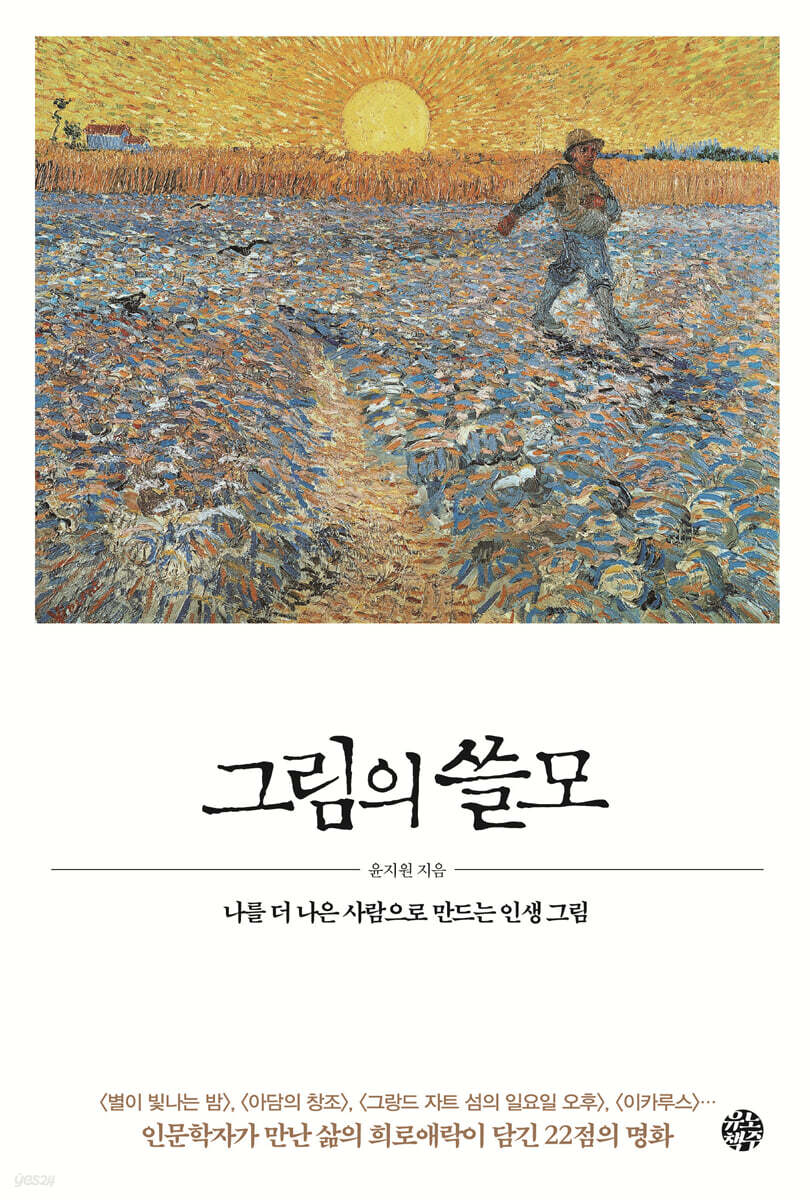
The year 1850, when The Sower was painted, was immediately after the Revolution of 1848.
In this context, some critics interpreted Millet to have conveyed a revolutionary message in this painting.
Because the farmer's powerful movements and dignified posture seemed to sow the seeds of revolution.
Conservative critics criticized the work for its overly heroic portrayal of the working class.
Although Millet claimed he did not intend this political interpretation, the controversy serves as a powerful example of the work's symbolism and contemporary significance.
This incident demonstrates how a work of art can be interpreted in various ways within the context of its time, and the gap between the artist's intention and the audience's interpretation.
However, not all reactions were negative.
Théodore Rousseau, a fellow Barbizon School painter, was a strong advocate of Millet's work, praising it for its truthful portrayal of the relationship between nature and humanity.
Charles Baudelaire, a famous poet and art critic, also discovered 'modernity' in Millet's work and highly praised him for truthfully capturing contemporary life.
Despite the initial negative reaction, The Sower gained recognition over time.
This work later became established as a representative work of realist art and had a great influence on later painters, including Van Gogh.
In particular, Van Gogh was such an ardent fan that he wrote in a letter that “Millet’s work is like the Bible,” and he was particularly impressed by “The Sower,” copying and reinterpreting the work several times.
--- From "What You Need to Sow and Grow in Life"
Michelangelo had countless disagreements with the Pope throughout his career, between artistic freedom and the Pope's demands.
The Pope wanted more ornate and religious symbolism, but Michelangelo stuck to his philosophical vision and wanted to portray the relationship between humans and God from a more humanistic perspective.
Rather than simply decorating the ceiling, I worked with the intention of exploring human dignity and essence through the human body.
The work on the Sistine Chapel ceiling continued for a long time, four years.
Michelangelo spent most of his time on the cramped platform, his head tilted back and looking up at the ceiling.
This left his neck and back in excruciating pain, and his eyes were plagued by paint droplets and dust.
Despite this, Michelangelo did not put down his brush.
Even in pain, he expressed his thoughts on his own destiny and the nature of humanity on canvas.
He later wrote in a letter to his friend Giovanni da Pistoia:
“My beard points to the sky, my neck is bent, and my chest is curved like a bow.
“The brush kept falling on my face, and I looked like a monster from Lombardy.”
Frida Kahlo's work, "Roots," one of the most important figures in 20th-century Mexico, was sold for the highest price among Central and South American artworks at Sotheby's auction.
The winning bid was $5,616,000, equivalent to approximately 6.5 billion won at the exchange rate at the time.
(syncopation)
"Roots" is considered a work that maturely expresses the results of pain and emotional anguish.
This work visually expresses pain, healing, and reflection on the essence of existence.
Through Frida, we can understand how art sublimated suffering and became a tool for exploring one's own existence and identity.
Here's how:
First, let's express the pain.
Let's find ways to sublimate our pain through art or other creative activities, like Frida.
Suffering will become a nutrient that helps us gain a deeper understanding of our existence and essence.
Second, let's explore purpose.
Let's focus on finding our own purpose and the process of moving toward that purpose.
Because exploring the meaning and purpose of life is an important task in life.
Third, try to accept the situation.
Frida accepted her physical illness and disability as an important part of her identity.
Accepting his physical limitations, he found a message of regeneration and recovery even in his pain.
This will be an opportunity to reflect on what I need to acknowledge in order to accept my mental and physical circumstances.
“Why would I need legs when I have wings?” Frida says this even when one of her legs is eventually amputated.
Even when suffering comes, we should not blindly avoid it or fear it, but rather use it as an opportunity to grow and transcend ourselves.
--- From "When one door closes, another one opens"
This work is said to have been commissioned by Jean de Dinteville, the French ambassador who went to England on a diplomatic mission during the turbulent history of Europe and who is also the model for the painting (left).
He came with the difficult task of protecting French national interests and preventing England from breaking with Roman Catholicism, but ultimately failed to achieve his goal.
This is because Henry VIII severed ties with the Pope in Rome by issuing the Acts of Supremacy in 1534, based on the support of the reform-minded clergy, nobles, and gentry.
At this time, there were two officials who refused the decree of incorporation until the end: Thomas More, Henry VIII's closest confidant and Lord Chancellor, and Bishop John Fisher.
Both men were executed.
This is why Holbein hid the crucifix, a symbol of Catholicism, in the curtain at the top left of the painting.
It's similar to why I used various symbols in my paintings.
--- From "You must realize the finiteness of life to have a next step"
The year 1850, when The Sower was painted, was immediately after the Revolution of 1848.
In this context, some critics interpreted Millet to have conveyed a revolutionary message in this painting.
Because the farmer's powerful movements and dignified posture seemed to sow the seeds of revolution.
Conservative critics criticized the work for its overly heroic portrayal of the working class.
Although Millet claimed he did not intend this political interpretation, the controversy serves as a powerful example of the work's symbolism and contemporary significance.
This incident demonstrates how a work of art can be interpreted in various ways within the context of its time, and the gap between the artist's intention and the audience's interpretation.
However, not all reactions were negative.
Théodore Rousseau, a fellow Barbizon School painter, was a strong advocate of Millet's work, praising it for its truthful portrayal of the relationship between nature and humanity.
Charles Baudelaire, a famous poet and art critic, also discovered 'modernity' in Millet's work and highly praised him for truthfully capturing contemporary life.
Despite the initial negative reaction, The Sower gained recognition over time.
This work later became established as a representative work of realist art and had a great influence on later painters, including Van Gogh.
In particular, Van Gogh was such an ardent fan that he wrote in a letter that “Millet’s work is like the Bible,” and he was particularly impressed by “The Sower,” copying and reinterpreting the work several times.
--- From "What You Need to Sow and Grow in Life"
Michelangelo had countless disagreements with the Pope throughout his career, between artistic freedom and the Pope's demands.
The Pope wanted more ornate and religious symbolism, but Michelangelo stuck to his philosophical vision and wanted to portray the relationship between humans and God from a more humanistic perspective.
Rather than simply decorating the ceiling, I worked with the intention of exploring human dignity and essence through the human body.
The work on the Sistine Chapel ceiling continued for a long time, four years.
Michelangelo spent most of his time on the cramped platform, his head tilted back and looking up at the ceiling.
This left his neck and back in excruciating pain, and his eyes were plagued by paint droplets and dust.
Despite this, Michelangelo did not put down his brush.
Even in pain, he expressed his thoughts on his own destiny and the nature of humanity on canvas.
He later wrote in a letter to his friend Giovanni da Pistoia:
“My beard points to the sky, my neck is bent, and my chest is curved like a bow.
“The brush kept falling on my face, and I looked like a monster from Lombardy.”
--- From "What Makes Humans Human in the Age of Artificial Intelligence"
Publisher's Review
“Art comforts those who are hurt by life.”
Vincent van Gogh
Austrian painter Gustav Klimt said, “Art is the line around your thoughts.”
What does this mean? It seems to imply that art inevitably reflects the consciousness, or thoughts, of its creator.
What forms a person's thoughts and values is the depth of the life he or she has lived, step by step.
In that case, the countless paintings left behind by countless artists are also filled with the unique values and perspectives on life that each person possesses.
There are incidents and accidents in it that we can empathize with even if we have not experienced them ourselves, and sometimes there are experiences that are so similar to modern life that we cannot ignore them.
The 22 paintings in “The Usefulness of Painting” were created in different eras and cultural spheres.
Yet, within it, universal human values live and breathe, and the wisdom of life shines like stars.
These paintings sometimes serve as mirrors that help me reflect on my life, and sometimes as windows that help me develop new eyes to see the world.
It can go beyond a simple drawing and help you recognize your current self more clearly, and further serve as a hint when you seek an answer to the question, “How should I live?”
Be courageous like Van Gogh and strong like Frida.
This book is not intended to present a definitive conclusion, but rather a new starting point.
I hope the pictures and text contained herein will serve as a starting point for reflection and exploration of life.
After looking at the painting, I would like you to ask yourself what you thought and felt, and what meaning it brought to your life.
(Introductory text)
In our rapidly changing modern society, we often forget to take time for deep thought and appreciation.
But the experience of standing before a painting and looking at it slowly and deeply gives us the space to stop and think for a moment.
It could be seen as an experience similar to meditation.
To provide you with this precious moment of experience, this book is divided into four major parts.
In the first part, we will look at how to find a ray of light that illuminates life in the midst of frustration, despair, and sadness through Munch's "The Scream," Frida Kahlo's "Roots," Van Gogh's "Starry Night," Caravaggio's "David with the Head of Goliath," and Artemisia's "Self-Portrait as an Allegory of Painting."
In the second part, we will look at Henri Rousseau's The Sleeping Gypsy, Caspar Friedrich's Wanderer Above the Sea of Fog, Hans Holbein's The Ambassadors, Georges Seurat's A Sunday Afternoon on the Island of La Grande Jatte, Albrecht Dürer's Praying Hands, and Raphael's The School of Athens to understand the necessity of solitude and emptiness, as well as an unwavering heart, which will help us experience joy more deeply.
In the third part, we will examine what is truly valuable in life based on the messages conveyed by paintings such as Rembrandt's The Return of the Prodigal Son, Klimt's The Kiss, Raoul Dufy's The Open Window at Nice, Millet's The Sower, Monet's Water Lilies, and Auguste Renoir's The Piano Girls.
The fourth part features Michelangelo's The Creation of Adam, Henri Matisse's Icarus, Edgar Degas's Ballet Rehearsal on Stage, and Alphonse Maria Mucha's Sleeve Epic No.
1』, through Diego Velazquez's 『Las Meninas』, you will get hints on how to live life and where to find the essence of life.
The question of how to live and what to value in life remains unchanged, both in the past and present.
Art doesn't provide answers, but it can help you find them.
After closing the last page, I hope that you will look back on your life through the 22 paintings in "The Usefulness of Painting" and give new meaning to your own life trajectory.
Vincent van Gogh
Austrian painter Gustav Klimt said, “Art is the line around your thoughts.”
What does this mean? It seems to imply that art inevitably reflects the consciousness, or thoughts, of its creator.
What forms a person's thoughts and values is the depth of the life he or she has lived, step by step.
In that case, the countless paintings left behind by countless artists are also filled with the unique values and perspectives on life that each person possesses.
There are incidents and accidents in it that we can empathize with even if we have not experienced them ourselves, and sometimes there are experiences that are so similar to modern life that we cannot ignore them.
The 22 paintings in “The Usefulness of Painting” were created in different eras and cultural spheres.
Yet, within it, universal human values live and breathe, and the wisdom of life shines like stars.
These paintings sometimes serve as mirrors that help me reflect on my life, and sometimes as windows that help me develop new eyes to see the world.
It can go beyond a simple drawing and help you recognize your current self more clearly, and further serve as a hint when you seek an answer to the question, “How should I live?”
Be courageous like Van Gogh and strong like Frida.
This book is not intended to present a definitive conclusion, but rather a new starting point.
I hope the pictures and text contained herein will serve as a starting point for reflection and exploration of life.
After looking at the painting, I would like you to ask yourself what you thought and felt, and what meaning it brought to your life.
(Introductory text)
In our rapidly changing modern society, we often forget to take time for deep thought and appreciation.
But the experience of standing before a painting and looking at it slowly and deeply gives us the space to stop and think for a moment.
It could be seen as an experience similar to meditation.
To provide you with this precious moment of experience, this book is divided into four major parts.
In the first part, we will look at how to find a ray of light that illuminates life in the midst of frustration, despair, and sadness through Munch's "The Scream," Frida Kahlo's "Roots," Van Gogh's "Starry Night," Caravaggio's "David with the Head of Goliath," and Artemisia's "Self-Portrait as an Allegory of Painting."
In the second part, we will look at Henri Rousseau's The Sleeping Gypsy, Caspar Friedrich's Wanderer Above the Sea of Fog, Hans Holbein's The Ambassadors, Georges Seurat's A Sunday Afternoon on the Island of La Grande Jatte, Albrecht Dürer's Praying Hands, and Raphael's The School of Athens to understand the necessity of solitude and emptiness, as well as an unwavering heart, which will help us experience joy more deeply.
In the third part, we will examine what is truly valuable in life based on the messages conveyed by paintings such as Rembrandt's The Return of the Prodigal Son, Klimt's The Kiss, Raoul Dufy's The Open Window at Nice, Millet's The Sower, Monet's Water Lilies, and Auguste Renoir's The Piano Girls.
The fourth part features Michelangelo's The Creation of Adam, Henri Matisse's Icarus, Edgar Degas's Ballet Rehearsal on Stage, and Alphonse Maria Mucha's Sleeve Epic No.
1』, through Diego Velazquez's 『Las Meninas』, you will get hints on how to live life and where to find the essence of life.
The question of how to live and what to value in life remains unchanged, both in the past and present.
Art doesn't provide answers, but it can help you find them.
After closing the last page, I hope that you will look back on your life through the 22 paintings in "The Usefulness of Painting" and give new meaning to your own life trajectory.
GOODS SPECIFICS
- Date of issue: November 25, 2024
- Page count, weight, size: 320 pages | 588g | 152*224*18mm
- ISBN13: 9791171830695
- ISBN10: 1171830696
You may also like
카테고리
korean


korean

![GQ KOREA Mark (Monthly): December [2025]](http://librairie.coreenne.fr/cdn/shop/files/8ef265dbbfbf186523ed75ba7319009d.jpg?v=1765340328&width=3840)


