

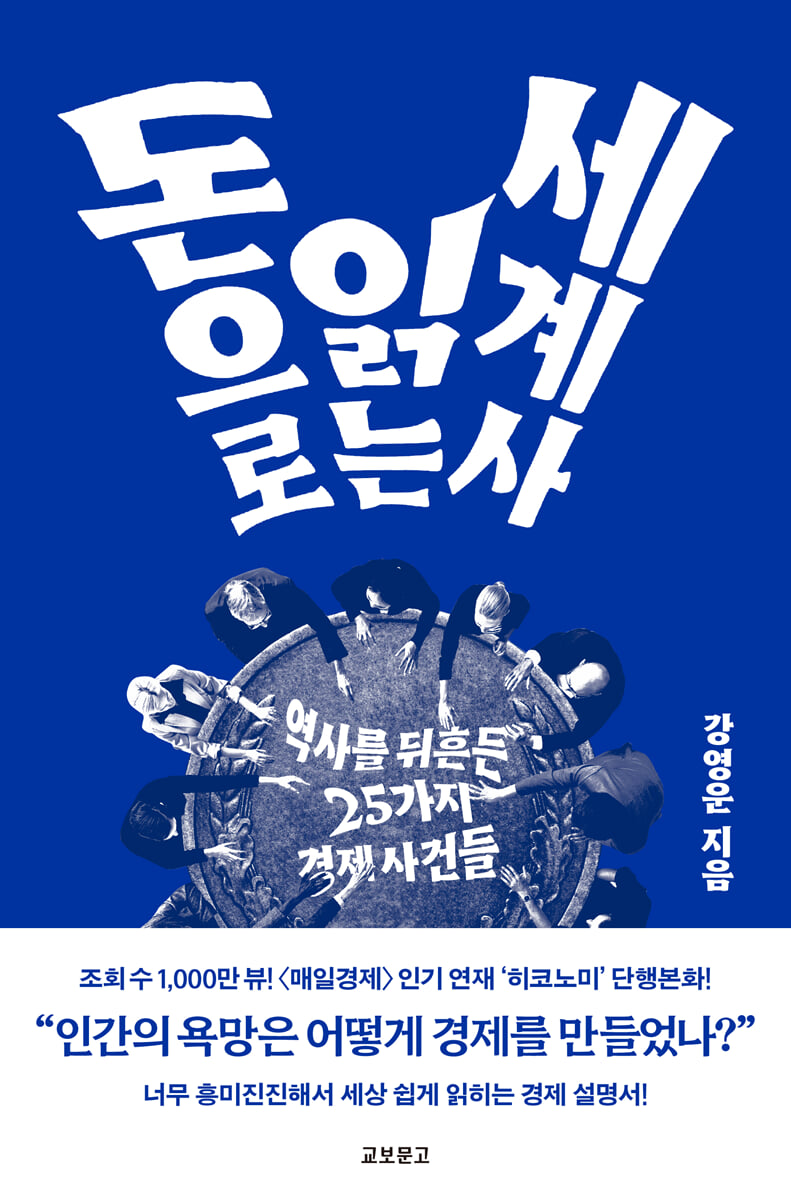
World History Through Money
 |
Description
Book Introduction
The economy is intertwined in the most dramatic moment in world history!
Currency, banking, taxes, stocks… feudalism, mercantilism, the gold standard, protectionism, inflation… futures trading, options contracts, emerging markets… .
As we delve into history, we find obstacles that can make us rigid, even with just words.
This is precisely the economics part, and when we think about the enormous complexity of the modern economy, we sometimes fear that it might be an area of expertise beyond our reach.
A reporter for an economic newspaper began to wonder if there was a way to alleviate these concerns, and began a series of articles that made it easier to learn about economics using interesting historical events and figures as material.
The "Hikonomi" corner, a combination of "history" and "economy," quickly gained popularity and contributed to his projects reaching 10 million cumulative views.
The article was compiled and published as 『Reading World History with Money』.
Currency, banking, taxes, stocks… feudalism, mercantilism, the gold standard, protectionism, inflation… futures trading, options contracts, emerging markets… .
As we delve into history, we find obstacles that can make us rigid, even with just words.
This is precisely the economics part, and when we think about the enormous complexity of the modern economy, we sometimes fear that it might be an area of expertise beyond our reach.
A reporter for an economic newspaper began to wonder if there was a way to alleviate these concerns, and began a series of articles that made it easier to learn about economics using interesting historical events and figures as material.
The "Hikonomi" corner, a combination of "history" and "economy," quickly gained popularity and contributed to his projects reaching 10 million cumulative views.
The article was compiled and published as 『Reading World History with Money』.
- You can preview some of the book's contents.
Preview
index
Part 1: The Economic History of Survival
1.
The incident that led to the Knights Templar becoming the origin of banking
2.
Venice, a financial city, if you look closely
3.
The Netherlands stood up to imperial Spain through accounting
4.
Second sons in an era when the eldest son inherited everything
5.
The golden age of trade, built through stealing and defending
Part 2: The Economic History of Paradox
6.
A new Britain created by crisis
7.
The Fallen British Aristocracy, the Dollar Princess, and Globalization
8.
Why isn't John II in British history?
9.
Love changed religion, and religion changed economics.
10.
The future of a country with only money and no industry
11.
The Great Fire Changed London Inside and Out
12.
Metal type, something that existed in Europe but not in Joseon
Part 3: The Economic History of Giants
13.
The Sun King's reign is divided into the pre- and post-Colbert eras.
14.
Keynes's prescription for a laissez-faire economy
15.
Hayek: The economy must still be free
16.
The national hero who first created the income tax, the enemy of office workers
17.
Gresham's ability to win the favor of three other monarchs, including his mother
Part 4: The Economic History of Bubbles
18.
Until paper replaced gold and silver
19.
The story of how a genius opened his eyes to Namhae Company and cut his nose.
20.
Pin bubble flower, tulip with option contract
21.
People who made money by taking advantage of other countries' independence
Part 5: The Economic History of Food
22.
The difference between alliance and collusion shown by the herring
23.
The price to pay for butter
24.
Salt on the Pillars of the Great Revolution
25.
The Adventures of Those Who Left Because They Had No Potatoes
1.
The incident that led to the Knights Templar becoming the origin of banking
2.
Venice, a financial city, if you look closely
3.
The Netherlands stood up to imperial Spain through accounting
4.
Second sons in an era when the eldest son inherited everything
5.
The golden age of trade, built through stealing and defending
Part 2: The Economic History of Paradox
6.
A new Britain created by crisis
7.
The Fallen British Aristocracy, the Dollar Princess, and Globalization
8.
Why isn't John II in British history?
9.
Love changed religion, and religion changed economics.
10.
The future of a country with only money and no industry
11.
The Great Fire Changed London Inside and Out
12.
Metal type, something that existed in Europe but not in Joseon
Part 3: The Economic History of Giants
13.
The Sun King's reign is divided into the pre- and post-Colbert eras.
14.
Keynes's prescription for a laissez-faire economy
15.
Hayek: The economy must still be free
16.
The national hero who first created the income tax, the enemy of office workers
17.
Gresham's ability to win the favor of three other monarchs, including his mother
Part 4: The Economic History of Bubbles
18.
Until paper replaced gold and silver
19.
The story of how a genius opened his eyes to Namhae Company and cut his nose.
20.
Pin bubble flower, tulip with option contract
21.
People who made money by taking advantage of other countries' independence
Part 5: The Economic History of Food
22.
The difference between alliance and collusion shown by the herring
23.
The price to pay for butter
24.
Salt on the Pillars of the Great Revolution
25.
The Adventures of Those Who Left Because They Had No Potatoes
Detailed image
Into the book
For commerce to develop, there must be financiers who serve as its blood vessels.
There were as many bankers as merchants in Venice.
In the Rialto Market, the heart of the city, bankers sat at wooden tables lending money.
The English word 'bank', which means bank today, is derived from the ancient Italian word 'banco', which means a wooden table.
--- p.27
Henry VIII did not leave Catholic monasteries alone.
He ordered the abolition of monasteries across the country.
It was a place that collected money from citizens and supplied it to the Vatican, and helped the drain of national wealth.
It was a building that had no meaning anymore unless you believed in Catholicism.
The abolition of the monasteries had more than just religious implications.
The landowners who received the monastic lands carried out large-scale agriculture and commerce.
They fenced off the monastery property and drove out the peasants who had been working on the monastery land.
It was an enclosure movement.
Farmers who lost their lands moved to the cities and became wage laborers.
The seeds of capitalism were sprouting.
In universities, more and more students were studying secular subjects instead of theology, and the squares were filled with merchants selling rare goods.
It was a place where priests used to sell indulgences.
--- p.107
Gutenberg made money by printing indulgences along with the Bible using metal type.
The great event that became the starting point of the Reformation was caused by metal type.
Businessman Fust was uneasy.
Because even though the promised date had arrived, Gutenberg seemed unwilling to pay the money.
Contact was lukewarm, and the letter demanding repayment was from the Hamheung branch.
I didn't even know how much he was earning.
Fust eventually brought his case before the Archbishopric of Mainz in 1456.
From Gutenberg's perspective, he was embroiled in litigation as soon as he started his metal type business.
The court's decision was clear.
“Gutenberg must repay Fust the principal plus interest.”
--- p.137
What he particularly noticed was the bills of exchange used by Dutch merchants.
While merchants in other countries traded with gold or silver coins, which were heavy and difficult to store, Dutch merchants exchanged goods easily using paper bills of exchange.
It was a system in which payments were guaranteed by economically sound and stable banks.
There was no need to struggle to move heavy gold coins onto the ship.
It meant that one more item could be loaded into the space occupied by the gold coin.
Due to the limited quantity of gold coins, paper money, such as bills of exchange, was like a thousand horses to merchants who wanted to trade but could not.
Payment innovations like credit cards, which are now commonplace in modern times, were also taking place in modern Netherlands.
Finance was becoming the lifeblood of the real economy.
--- p.212
Although it was an exorbitant price, citizens had to buy it 'by crying and eating salt'.
Because the government forced the purchase.
Living wasn't the end.
Salt could not be used freely as it was forced to be used only for salting meat and making cheese.
Because salt was so expensive, people used to shake off the salt from herring and recycle it, but this was also banned.
It meant that the government should buy more salt.
The task force would frequently raid the kitchens of private homes.
The people resisted the 'salt tyranny' in various ways.
There were as many bankers as merchants in Venice.
In the Rialto Market, the heart of the city, bankers sat at wooden tables lending money.
The English word 'bank', which means bank today, is derived from the ancient Italian word 'banco', which means a wooden table.
--- p.27
Henry VIII did not leave Catholic monasteries alone.
He ordered the abolition of monasteries across the country.
It was a place that collected money from citizens and supplied it to the Vatican, and helped the drain of national wealth.
It was a building that had no meaning anymore unless you believed in Catholicism.
The abolition of the monasteries had more than just religious implications.
The landowners who received the monastic lands carried out large-scale agriculture and commerce.
They fenced off the monastery property and drove out the peasants who had been working on the monastery land.
It was an enclosure movement.
Farmers who lost their lands moved to the cities and became wage laborers.
The seeds of capitalism were sprouting.
In universities, more and more students were studying secular subjects instead of theology, and the squares were filled with merchants selling rare goods.
It was a place where priests used to sell indulgences.
--- p.107
Gutenberg made money by printing indulgences along with the Bible using metal type.
The great event that became the starting point of the Reformation was caused by metal type.
Businessman Fust was uneasy.
Because even though the promised date had arrived, Gutenberg seemed unwilling to pay the money.
Contact was lukewarm, and the letter demanding repayment was from the Hamheung branch.
I didn't even know how much he was earning.
Fust eventually brought his case before the Archbishopric of Mainz in 1456.
From Gutenberg's perspective, he was embroiled in litigation as soon as he started his metal type business.
The court's decision was clear.
“Gutenberg must repay Fust the principal plus interest.”
--- p.137
What he particularly noticed was the bills of exchange used by Dutch merchants.
While merchants in other countries traded with gold or silver coins, which were heavy and difficult to store, Dutch merchants exchanged goods easily using paper bills of exchange.
It was a system in which payments were guaranteed by economically sound and stable banks.
There was no need to struggle to move heavy gold coins onto the ship.
It meant that one more item could be loaded into the space occupied by the gold coin.
Due to the limited quantity of gold coins, paper money, such as bills of exchange, was like a thousand horses to merchants who wanted to trade but could not.
Payment innovations like credit cards, which are now commonplace in modern times, were also taking place in modern Netherlands.
Finance was becoming the lifeblood of the real economy.
--- p.212
Although it was an exorbitant price, citizens had to buy it 'by crying and eating salt'.
Because the government forced the purchase.
Living wasn't the end.
Salt could not be used freely as it was forced to be used only for salting meat and making cheese.
Because salt was so expensive, people used to shake off the salt from herring and recycle it, but this was also banned.
It meant that the government should buy more salt.
The task force would frequently raid the kitchens of private homes.
The people resisted the 'salt tyranny' in various ways.
--- p.282
Publisher's Review
Henry VIII of the Tudor dynasty of England had an affair with Anne Boleyn, the queen's maid, and even changed the state religion from Catholicism to the Church of England in order to marry her.
However, the love he had won soon cooled down and he hanged Anne Boleyn to marry another woman. The story is still famous enough to be consumed as various content.
But if you look behind the scenes, you see a completely different history.
Henry VIII initiated the Reformation in order to marry, and as a result, a series of events unfolded, including the enclosure movement, the rise of mercantilism, war, and currency reform.
In this way, author Kang Young-un believes that all of human history can be looked at anew through the lens of economics.
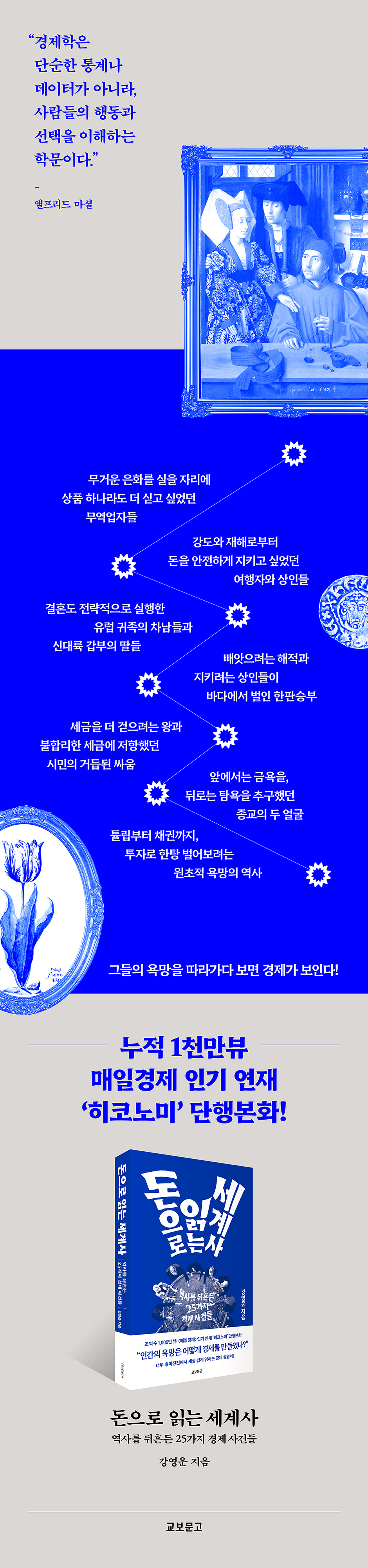
Because, as the great economist Alfred Marshall, also known as the founder of microeconomics, said, “Economics is not simply statistics or data, but the study of people’s behavior and choices.”
A look into humanity's pursuit of wealth reveals the history of the economy.
Unlike existing economic history books that begin with the economy and money, "World History Through Money" examines the economy through human desire.
All discoveries and inventions in the world emerged from human needs, and the economy is no exception.
Money was created to facilitate the exchange of what we have in abundance and what we lack, and banks were created to use this money more efficiently and store it safely.
Some people need more money for their business, while others already have money but want to make more money, which is why they start investing.
Trade developed as people across the seas wanted to trade with others, and pirates appeared to take possessions by force. They tried to protect these possessions and expand further, reaching even the continent.
Merchants' efforts to profit from innovative technologies spread them across the globe, and when war disrupted trade, new industrial innovations arose internally.
Human desire explains so much.
And within it all that we know about the modern economy was born.
As we follow the flow of one person's desire, or the universal desire of humanity, through this book, we arrive at a great historical turning point.
As you explore historical events with interest, economic common sense naturally follows.
It is not easy to capture the vast flow of economic history in a single book.
Rather than trying to cover everything from ancient barter to modern cryptocurrencies in this book, the author focused on making it accessible to readers who may not readily understand economics.
That is why the story is mainly about the 16th to 19th centuries, when the concepts of the modern economy began to take shape, such as the gold standard, mercantilism, and the birth of banks, stocks, and bonds.
As we move from the darkness of medieval feudalism, a time when the insurmountable barriers of social class were clear, to the modern era, when every individual's desire began to stir for wealth, the history seen from the perspective of 'money' is new and dynamic.
Taxes, currency, stocks, banking… A global history of everything related to money.
This vivid and moving history is divided into five themes in 『World History Through Money』.
Part 1: The Economic History of Survival contains the events that created the economic foundation as people struggled to survive.
We explore the first banking system born from pilgrimage, the city-state that invented bonds to prepare for war, and the decline of the aristocracy brought about by primogeniture to secure the nation.
Part 2, The Paradox of Economic History, deals with the irony of history in which crisis became the starting point of success.
We explore the Magna Carta, born in protest against a king who imposed excessive taxes; the story of how Henry VIII's religious reforms, undertaken to remarry his mistress, became the seed of economic growth; the downfall of Spain, which discovered a vast silver mine but instead fell into the trap of inflation; and the light and dark sides of the West and East, which invented metal movable type around the same time.
Part 3 features the giants of economic history.
The main characters include Thomas Gresham, who established the stock exchange and economics school in England in the 16th century; Colbert, who led mercantilism in 17th-century France; William Pitt, who first created the income tax that became the basis of the national economy in the 19th century; and Keynes and Hayek, who laid the foundation for modern economics in the 20th century.
In Part 4, we examine the 'bubble' events that permeate investment history.
From familiar events like the South Sea Company, the Mississippi Company, and the tulip mania to various independent bonds from Greece to South America, it covers the history of bubbles created by people's desire to make a quick buck through investment.
In the final part 5, we look at the economy from a slightly different perspective, through the lens of ‘food.’
It covers events such as the Hanseatic League and the Reformation, which involved meat and butter, which were forbidden by religion, and examines the impact of the discriminatory salt tax on the French Revolution, and reveals how food has shaken economic history.
The pursuit of a more leisurely life, a stable life, and a life without worrying about three meals a day is a primal desire.
Humans pursue such stability, and further, they pursue wealth.
Wealth flows back to power, and that desire ultimately changes history.
The economy is intertwined in one of the most dramatic moments in world history.
However, the love he had won soon cooled down and he hanged Anne Boleyn to marry another woman. The story is still famous enough to be consumed as various content.
But if you look behind the scenes, you see a completely different history.
Henry VIII initiated the Reformation in order to marry, and as a result, a series of events unfolded, including the enclosure movement, the rise of mercantilism, war, and currency reform.
In this way, author Kang Young-un believes that all of human history can be looked at anew through the lens of economics.
Because, as the great economist Alfred Marshall, also known as the founder of microeconomics, said, “Economics is not simply statistics or data, but the study of people’s behavior and choices.”
A look into humanity's pursuit of wealth reveals the history of the economy.
Unlike existing economic history books that begin with the economy and money, "World History Through Money" examines the economy through human desire.
All discoveries and inventions in the world emerged from human needs, and the economy is no exception.
Money was created to facilitate the exchange of what we have in abundance and what we lack, and banks were created to use this money more efficiently and store it safely.
Some people need more money for their business, while others already have money but want to make more money, which is why they start investing.
Trade developed as people across the seas wanted to trade with others, and pirates appeared to take possessions by force. They tried to protect these possessions and expand further, reaching even the continent.
Merchants' efforts to profit from innovative technologies spread them across the globe, and when war disrupted trade, new industrial innovations arose internally.
Human desire explains so much.
And within it all that we know about the modern economy was born.
As we follow the flow of one person's desire, or the universal desire of humanity, through this book, we arrive at a great historical turning point.
As you explore historical events with interest, economic common sense naturally follows.
It is not easy to capture the vast flow of economic history in a single book.
Rather than trying to cover everything from ancient barter to modern cryptocurrencies in this book, the author focused on making it accessible to readers who may not readily understand economics.
That is why the story is mainly about the 16th to 19th centuries, when the concepts of the modern economy began to take shape, such as the gold standard, mercantilism, and the birth of banks, stocks, and bonds.
As we move from the darkness of medieval feudalism, a time when the insurmountable barriers of social class were clear, to the modern era, when every individual's desire began to stir for wealth, the history seen from the perspective of 'money' is new and dynamic.
Taxes, currency, stocks, banking… A global history of everything related to money.
This vivid and moving history is divided into five themes in 『World History Through Money』.
Part 1: The Economic History of Survival contains the events that created the economic foundation as people struggled to survive.
We explore the first banking system born from pilgrimage, the city-state that invented bonds to prepare for war, and the decline of the aristocracy brought about by primogeniture to secure the nation.
Part 2, The Paradox of Economic History, deals with the irony of history in which crisis became the starting point of success.
We explore the Magna Carta, born in protest against a king who imposed excessive taxes; the story of how Henry VIII's religious reforms, undertaken to remarry his mistress, became the seed of economic growth; the downfall of Spain, which discovered a vast silver mine but instead fell into the trap of inflation; and the light and dark sides of the West and East, which invented metal movable type around the same time.
Part 3 features the giants of economic history.
The main characters include Thomas Gresham, who established the stock exchange and economics school in England in the 16th century; Colbert, who led mercantilism in 17th-century France; William Pitt, who first created the income tax that became the basis of the national economy in the 19th century; and Keynes and Hayek, who laid the foundation for modern economics in the 20th century.
In Part 4, we examine the 'bubble' events that permeate investment history.
From familiar events like the South Sea Company, the Mississippi Company, and the tulip mania to various independent bonds from Greece to South America, it covers the history of bubbles created by people's desire to make a quick buck through investment.
In the final part 5, we look at the economy from a slightly different perspective, through the lens of ‘food.’
It covers events such as the Hanseatic League and the Reformation, which involved meat and butter, which were forbidden by religion, and examines the impact of the discriminatory salt tax on the French Revolution, and reveals how food has shaken economic history.
The pursuit of a more leisurely life, a stable life, and a life without worrying about three meals a day is a primal desire.
Humans pursue such stability, and further, they pursue wealth.
Wealth flows back to power, and that desire ultimately changes history.
The economy is intertwined in one of the most dramatic moments in world history.
GOODS SPECIFICS
- Date of issue: August 8, 2025
- Page count, weight, size: 304 pages | 530g | 145*220*18mm
- ISBN13: 9791170612896
- ISBN10: 117061289X
You may also like
카테고리
korean


korean

![GQ KOREA Mark (Monthly): December [2025]](http://librairie.coreenne.fr/cdn/shop/files/8ef265dbbfbf186523ed75ba7319009d.jpg?v=1765340328&width=3840)


