

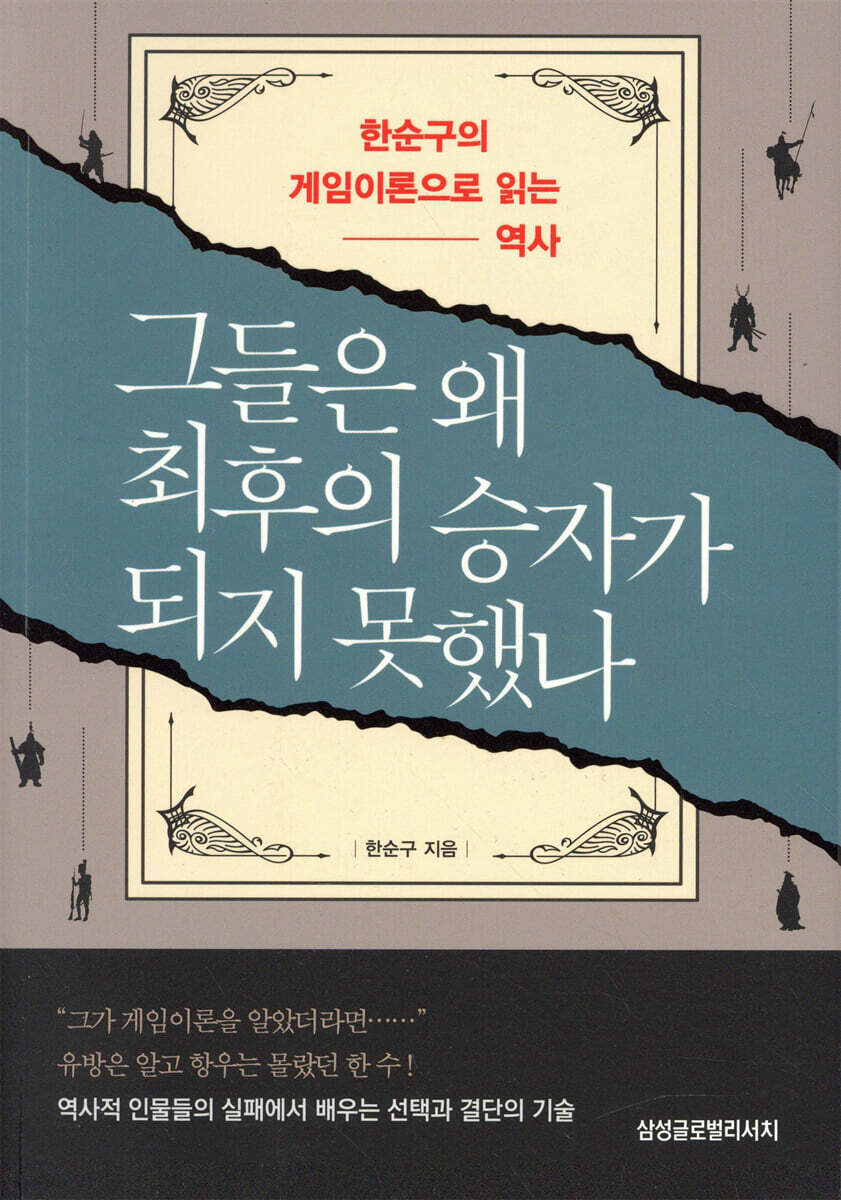
Why didn't they become the ultimate winners?
 |
Description
Book Introduction
A Special History Lesson from an Economist
From Xiang Yu to Gorbachev
13 Historical Events Reinterpreted Through Game Theory
Here are some famous losers.
They left a significant mark on history, but for various reasons, they were not the ultimate victors.
Some people made bad choices, and some suffered shocking betrayals.
I lost to weaker opponents whom I thought I couldn't even compete with, and I also lost despite giving it my all.
The reason is even more curious because most of them are outstanding people who have been recognized for their outstanding abilities.
Professor Han Soon-gu applies game theory to analyze what choices they should have made.
Would history have changed if they had known game theory? They say there are no hypotheticals in history, but it's still fun to imagine.
What's interesting is that the agony of historical figures facing choices and decisions is not something that happened long ago.
The concerns of historical figures and the advice the author offers are relevant to today's organizational life.
This book allows you to learn game theory and strategic thinking skills while having fun reading history.
From Xiang Yu to Gorbachev
13 Historical Events Reinterpreted Through Game Theory
Here are some famous losers.
They left a significant mark on history, but for various reasons, they were not the ultimate victors.
Some people made bad choices, and some suffered shocking betrayals.
I lost to weaker opponents whom I thought I couldn't even compete with, and I also lost despite giving it my all.
The reason is even more curious because most of them are outstanding people who have been recognized for their outstanding abilities.
Professor Han Soon-gu applies game theory to analyze what choices they should have made.
Would history have changed if they had known game theory? They say there are no hypotheticals in history, but it's still fun to imagine.
What's interesting is that the agony of historical figures facing choices and decisions is not something that happened long ago.
The concerns of historical figures and the advice the author offers are relevant to today's organizational life.
This book allows you to learn game theory and strategic thinking skills while having fun reading history.
- You can preview some of the book's contents.
Preview
index
| Introduction | History and Game Theory Make It Look Newer
Chapter 1: The Theory of "Non-Cooperative Games" and the Fate of Xiang Yu
“Why don’t the subordinates I appointed fight for me?”
Chapter 2: "Backward Induction," a Game Theory I'd Like to Teach Hanshin
“I do all the work, so why does someone else get promoted?”
Chapter 3: If Rome Had Known the Concepts of 'Core' and 'Shapley Value'
“The world has changed, but what if we leave the standards and systems the same?”
Chapter 4: Emperor Taizong of Tang and the "Hold-Up" Problem
“What is the best answer to deciding on a successor?”
Chapter 5: The Secret to the Unification of the Three Kingdoms: A Look at the "Moral Hazard in Teams" Theory
“Why do the strong lose to the weak?”
Chapter 6: The Kamakura Shogunate's Mistakes and the "Reputation Game" Strategy
“How can one small mistake lead to a huge downfall?”
Chapter 7: The Game Theory of Collusion and Betrayal
“Why did you get betrayed by someone you trusted?”
Chapter 8: The "Bandwagon Effect" Revealed in the Battle of Sekigahara
“Why do people two-timing?”
Chapter 9: The Battle of Osaka Castle: The Game Order That Determined the Victory and Defeat
“Will you be the first mover or the second mover?”
Chapter 10: The Cases Injo and Joseon Missed and the "Mixed Strategy"
“Why did a right-handed boxer fail when he used his right hand?”
Chapter 11: The Agency Problem and the Conditions of Victory: Seen Through Napoleon
“Why do organizations that empower subordinates succeed?”
Chapter 12: The Deadline Problem: Examining the Civil War
“How did he, a renowned general, end up choosing the worst strategy?”
Chapter 13: Gorbachev and the "Torai Strategy"
“What strategies should a good person use to avoid failure?”
Chapter 1: The Theory of "Non-Cooperative Games" and the Fate of Xiang Yu
“Why don’t the subordinates I appointed fight for me?”
Chapter 2: "Backward Induction," a Game Theory I'd Like to Teach Hanshin
“I do all the work, so why does someone else get promoted?”
Chapter 3: If Rome Had Known the Concepts of 'Core' and 'Shapley Value'
“The world has changed, but what if we leave the standards and systems the same?”
Chapter 4: Emperor Taizong of Tang and the "Hold-Up" Problem
“What is the best answer to deciding on a successor?”
Chapter 5: The Secret to the Unification of the Three Kingdoms: A Look at the "Moral Hazard in Teams" Theory
“Why do the strong lose to the weak?”
Chapter 6: The Kamakura Shogunate's Mistakes and the "Reputation Game" Strategy
“How can one small mistake lead to a huge downfall?”
Chapter 7: The Game Theory of Collusion and Betrayal
“Why did you get betrayed by someone you trusted?”
Chapter 8: The "Bandwagon Effect" Revealed in the Battle of Sekigahara
“Why do people two-timing?”
Chapter 9: The Battle of Osaka Castle: The Game Order That Determined the Victory and Defeat
“Will you be the first mover or the second mover?”
Chapter 10: The Cases Injo and Joseon Missed and the "Mixed Strategy"
“Why did a right-handed boxer fail when he used his right hand?”
Chapter 11: The Agency Problem and the Conditions of Victory: Seen Through Napoleon
“Why do organizations that empower subordinates succeed?”
Chapter 12: The Deadline Problem: Examining the Civil War
“How did he, a renowned general, end up choosing the worst strategy?”
Chapter 13: Gorbachev and the "Torai Strategy"
“What strategies should a good person use to avoid failure?”
Detailed image

Into the book
Let's not forget that the subordinates I promoted follow me not because they are grateful for the favor of the promotion, but because I have the power to promote them again in the future.
Then, we can avoid a miserable fate like Xiang Yu's.
---From "Chapter 1: Theory of 'Non-Cooperative Games' and the Fate of Xiang Yu"
The story of Tosagupen already contains the answer to what Hanshin should have done.
If he had won the battle but not dealt a decisive blow and kept Xiang Yu alive, Liu Bang, who was afraid of Xiang Yu, would have kept Han Xin, the only general who could defeat Xiang Yu, by his side and treated him favorably.
This strategy was the best for Hanshin.
---「Chapter 2: Game Theory I Want to Teach Hanshin: Backward Induction」
The Silla royal family, comprised of Kim Chun-chu, Kim Yu-sin, and Queen Seondeok, was a desperate team whose future would be in jeopardy if the team collapsed due to their own circumstances.
So, even without being told to do so, each person worked hard and, together, did their best.
---From Chapter 5: The Secret to the Unification of the Three Kingdoms as Seen Through the Theory of Moral Laxity in Teams
It's a sad truth, but the cold, hard calculations of game theory tell us that comrades who have shared life and death with us through difficult times are very likely to suddenly turn into enemies when they finally achieve great success.
This is why it is not always possible to be happy when an organization finally achieves success after a long struggle.
That is precisely the time when we must prepare in advance for the betrayal of our colleagues who have suffered together with us until now.
---From "Chapter 7: The Game Theory of Collusion and Betrayal"
The biggest topic in economics is to instill a sense of ownership in its members.
Of course, this is not just a topic of economics, but a topic of discussion for all organizations.
So how can we instill in every member of an organization a sense of ownership? I'd like to find some clues in the French Revolution.
Then, we can avoid a miserable fate like Xiang Yu's.
---From "Chapter 1: Theory of 'Non-Cooperative Games' and the Fate of Xiang Yu"
The story of Tosagupen already contains the answer to what Hanshin should have done.
If he had won the battle but not dealt a decisive blow and kept Xiang Yu alive, Liu Bang, who was afraid of Xiang Yu, would have kept Han Xin, the only general who could defeat Xiang Yu, by his side and treated him favorably.
This strategy was the best for Hanshin.
---「Chapter 2: Game Theory I Want to Teach Hanshin: Backward Induction」
The Silla royal family, comprised of Kim Chun-chu, Kim Yu-sin, and Queen Seondeok, was a desperate team whose future would be in jeopardy if the team collapsed due to their own circumstances.
So, even without being told to do so, each person worked hard and, together, did their best.
---From Chapter 5: The Secret to the Unification of the Three Kingdoms as Seen Through the Theory of Moral Laxity in Teams
It's a sad truth, but the cold, hard calculations of game theory tell us that comrades who have shared life and death with us through difficult times are very likely to suddenly turn into enemies when they finally achieve great success.
This is why it is not always possible to be happy when an organization finally achieves success after a long struggle.
That is precisely the time when we must prepare in advance for the betrayal of our colleagues who have suffered together with us until now.
---From "Chapter 7: The Game Theory of Collusion and Betrayal"
The biggest topic in economics is to instill a sense of ownership in its members.
Of course, this is not just a topic of economics, but a topic of discussion for all organizations.
So how can we instill in every member of an organization a sense of ownership? I'd like to find some clues in the French Revolution.
---From Chapter 11: The 'Agency Problem' and the Conditions of Victory as Seen Through Napoleon
Publisher's Review
How Economists Read History
“Economics, which I have studied my entire life, and game theory in particular, is a discipline that systematically and deeply studies the ‘strategies’ and ‘choices’ that people plan and execute.
In other words, it is a field of study that aims to help people make the most advantageous decision by presenting all available information at a crossroads.
After studying this for a long time, I developed the habit of analyzing the decisions made by historical figures at critical moments using the logic of game theory.
Furthermore, I began to question why certain historical figures made such wrong decisions.” - From the “Preface”
There are many different ways to read history.
A novelist can use his imagination to add dramatic fun, and a scientist can follow the stages of scientific development and reinterpret history through scientific eyes.
So how does an economist read history? The author of this book, an economist and game theory expert, rereads history through game theory.
The protagonists of the 13 incidents in this book are those who lost a war or experienced failure in running a country.
However, the author says that throughout history, even bad decisions that ended in great failure were rarely 100% wrong.
The people who made that decision were outstanding figures who will be remembered by history, and 99% of the time it was the right choice, but due to a 1% flawed judgment caused by factors they failed to consider, they were recorded in history books as people who made a huge mistake.
What was the one move they missed? The author pairs each incident with game theory to analyze the reasons for its failure, explaining what they should have done to win.
If they could turn back time and follow the author's analysis, would they be the ultimate winners?
A Move Xiang Yu Missed: The "Non-Cooperative Game" Theory
According to the logic of 'non-cooperative game' theory, people easily forget past favors but are sensitive to future benefits.
Therefore, we should not bestow grace too easily or too quickly.” - From “Chapter 1: Theory of ‘Non-Cooperative Games’ and the Fate of Xiang Yu”
As you work in an organization, there are times when you have to help your colleagues or subordinates with their work or promotions.
Although I didn't necessarily expect anything in return, it's understandable that I had hopes that I would be able to receive help from that person later.
But these expectations are often completely wrong.
When I ask for help, instead of helping me, he actually goes against my will or helps my competitor.
The same thing happened to Xiang Yu, the ruler of the Chinese state of Chu, 2,200 years ago.
He was betrayed by his subordinates who had saved his life and appointed him king, and he ended up dying.
Why did this happen?
The author explains the tragedy of Xiang Yu by applying the theory of 'non-cooperative games'.
Non-cooperative games are a theory advocated by Professor John Nash, the real-life protagonist of the movie "A Beautiful Mind," which states that all decisions are made in a direction in which individuals pursue only their own interests.
Clearly, they were the ones appointed by Xiang Yu to become kings, but they did not help Xiang Yu and fought on Liu Bang's side because they had already been rewarded with the position of king and had nothing more to receive from Xiang Yu, but they expected that if Liu Bang defeated Xiang Yu and rewarded him again, they could receive even greater rewards.
Perhaps Xiang Yu failed to realize that his subordinates were loyal not because he was grateful for the promotion, but because he had the power to promote them again in the future.
Therefore, the advice the author gives to Xiang Yu is that after destroying the Qin Dynasty, he should have delayed the awarding of rewards as much as possible and focused on internal discipline.
If Xiang Yu had understood the logic of non-cooperative game theory, he would not have died lamenting, “Why don’t the subordinates I appointed fight for me?”
In addition, the book includes the author's prescriptions for reversing failures along with various game theories.
In the case of Hanshin, who fought for the breasts but was abandoned in a landslide, the theory of 'backward induction', which states that one must predict future events and determine present actions, is applied. In the case of Oda Nobunaga, who was shocked by a close associate's betrayal just before the unification of Japan, the theory of game theory, which analyzes when collusion breaks down, is applied to advise on what they should have done to achieve ultimate victory.
Their worries are ongoing
“(…) I began to think that the choices and decisions made by historical figures were not something that happened long ago, but something that is still happening today as I go about my daily life and make decisions with others in organizations.
For example, one meeting I attended last week involved discussions similar to those of Emperor Napoleon, who was deciding whether or not to attack Russia, and another meeting this week felt like Namhansanseong Fortress during the Second Manchu Invasion of Korea.
“I am talking about Namhansanseong Fortress during the Byeongjahoran, where there was a heated debate over whether to surrender to the Qing army or fight to the end.” - From the “Preface”
This book describes past events experienced by historical figures, but their concerns are not in the past tense, but in the present tense.
The struggles the characters endured and the advice the author offers are equally relevant to today's organizational life.
The process by which the weakest Silla, not Goguryeo or Baekje, unified the three kingdoms is explained using the theory of 'moral hazard in teams', and the story of Napoleon is expanded to 'ownership' and 'agency problems', which are two of the most important issues to be addressed in modern organizations.
This is why this book cannot be viewed as just a historical story.
As befitting an author with a wide range of interests, if you immerse yourself in historical narratives, following the author's skillful interplay of relevant examples from sports and science, as well as his skillful handling of official and unofficial history, you will begin to see clues to resolving the interpersonal relationships and organizational challenges that await you today.
Finally, if you were to choose a historical figure who would be the master of game theory? The author chooses Yu Bang.
Yoo Bang, who possessed an outstanding ability to tolerate, placed outstanding talents in the right positions and effectively resolved conflicts among his subordinates, leading them to be loyal to one another.
After gaining the world, he created a system and rules to match.
That is why Liu Bang, the son of a poor farmer from the countryside, was able to unify China, beating out Xiang Yu, who came from a prominent family, and the Han Dynasty founded by Liu Bang became the country that ruled unified China for the longest period.
The author commented that this breast is a strategist worthy of receiving the Nobel Prize in Economics for game theory and is a model answer to game theory.
“Economics, which I have studied my entire life, and game theory in particular, is a discipline that systematically and deeply studies the ‘strategies’ and ‘choices’ that people plan and execute.
In other words, it is a field of study that aims to help people make the most advantageous decision by presenting all available information at a crossroads.
After studying this for a long time, I developed the habit of analyzing the decisions made by historical figures at critical moments using the logic of game theory.
Furthermore, I began to question why certain historical figures made such wrong decisions.” - From the “Preface”
There are many different ways to read history.
A novelist can use his imagination to add dramatic fun, and a scientist can follow the stages of scientific development and reinterpret history through scientific eyes.
So how does an economist read history? The author of this book, an economist and game theory expert, rereads history through game theory.
The protagonists of the 13 incidents in this book are those who lost a war or experienced failure in running a country.
However, the author says that throughout history, even bad decisions that ended in great failure were rarely 100% wrong.
The people who made that decision were outstanding figures who will be remembered by history, and 99% of the time it was the right choice, but due to a 1% flawed judgment caused by factors they failed to consider, they were recorded in history books as people who made a huge mistake.
What was the one move they missed? The author pairs each incident with game theory to analyze the reasons for its failure, explaining what they should have done to win.
If they could turn back time and follow the author's analysis, would they be the ultimate winners?
A Move Xiang Yu Missed: The "Non-Cooperative Game" Theory
According to the logic of 'non-cooperative game' theory, people easily forget past favors but are sensitive to future benefits.
Therefore, we should not bestow grace too easily or too quickly.” - From “Chapter 1: Theory of ‘Non-Cooperative Games’ and the Fate of Xiang Yu”
As you work in an organization, there are times when you have to help your colleagues or subordinates with their work or promotions.
Although I didn't necessarily expect anything in return, it's understandable that I had hopes that I would be able to receive help from that person later.
But these expectations are often completely wrong.
When I ask for help, instead of helping me, he actually goes against my will or helps my competitor.
The same thing happened to Xiang Yu, the ruler of the Chinese state of Chu, 2,200 years ago.
He was betrayed by his subordinates who had saved his life and appointed him king, and he ended up dying.
Why did this happen?
The author explains the tragedy of Xiang Yu by applying the theory of 'non-cooperative games'.
Non-cooperative games are a theory advocated by Professor John Nash, the real-life protagonist of the movie "A Beautiful Mind," which states that all decisions are made in a direction in which individuals pursue only their own interests.
Clearly, they were the ones appointed by Xiang Yu to become kings, but they did not help Xiang Yu and fought on Liu Bang's side because they had already been rewarded with the position of king and had nothing more to receive from Xiang Yu, but they expected that if Liu Bang defeated Xiang Yu and rewarded him again, they could receive even greater rewards.
Perhaps Xiang Yu failed to realize that his subordinates were loyal not because he was grateful for the promotion, but because he had the power to promote them again in the future.
Therefore, the advice the author gives to Xiang Yu is that after destroying the Qin Dynasty, he should have delayed the awarding of rewards as much as possible and focused on internal discipline.
If Xiang Yu had understood the logic of non-cooperative game theory, he would not have died lamenting, “Why don’t the subordinates I appointed fight for me?”
In addition, the book includes the author's prescriptions for reversing failures along with various game theories.
In the case of Hanshin, who fought for the breasts but was abandoned in a landslide, the theory of 'backward induction', which states that one must predict future events and determine present actions, is applied. In the case of Oda Nobunaga, who was shocked by a close associate's betrayal just before the unification of Japan, the theory of game theory, which analyzes when collusion breaks down, is applied to advise on what they should have done to achieve ultimate victory.
Their worries are ongoing
“(…) I began to think that the choices and decisions made by historical figures were not something that happened long ago, but something that is still happening today as I go about my daily life and make decisions with others in organizations.
For example, one meeting I attended last week involved discussions similar to those of Emperor Napoleon, who was deciding whether or not to attack Russia, and another meeting this week felt like Namhansanseong Fortress during the Second Manchu Invasion of Korea.
“I am talking about Namhansanseong Fortress during the Byeongjahoran, where there was a heated debate over whether to surrender to the Qing army or fight to the end.” - From the “Preface”
This book describes past events experienced by historical figures, but their concerns are not in the past tense, but in the present tense.
The struggles the characters endured and the advice the author offers are equally relevant to today's organizational life.
The process by which the weakest Silla, not Goguryeo or Baekje, unified the three kingdoms is explained using the theory of 'moral hazard in teams', and the story of Napoleon is expanded to 'ownership' and 'agency problems', which are two of the most important issues to be addressed in modern organizations.
This is why this book cannot be viewed as just a historical story.
As befitting an author with a wide range of interests, if you immerse yourself in historical narratives, following the author's skillful interplay of relevant examples from sports and science, as well as his skillful handling of official and unofficial history, you will begin to see clues to resolving the interpersonal relationships and organizational challenges that await you today.
Finally, if you were to choose a historical figure who would be the master of game theory? The author chooses Yu Bang.
Yoo Bang, who possessed an outstanding ability to tolerate, placed outstanding talents in the right positions and effectively resolved conflicts among his subordinates, leading them to be loyal to one another.
After gaining the world, he created a system and rules to match.
That is why Liu Bang, the son of a poor farmer from the countryside, was able to unify China, beating out Xiang Yu, who came from a prominent family, and the Han Dynasty founded by Liu Bang became the country that ruled unified China for the longest period.
The author commented that this breast is a strategist worthy of receiving the Nobel Prize in Economics for game theory and is a model answer to game theory.
GOODS SPECIFICS
- Date of issue: May 15, 2023
- Page count, weight, size: 328 pages | 564g | 150*215*20mm
- ISBN13: 9788976331243
- ISBN10: 8976331249
You may also like
카테고리
korean


korean

![GQ KOREA Mark (Monthly): December [2025]](http://librairie.coreenne.fr/cdn/shop/files/8ef265dbbfbf186523ed75ba7319009d.jpg?v=1765340328&width=3840)


