

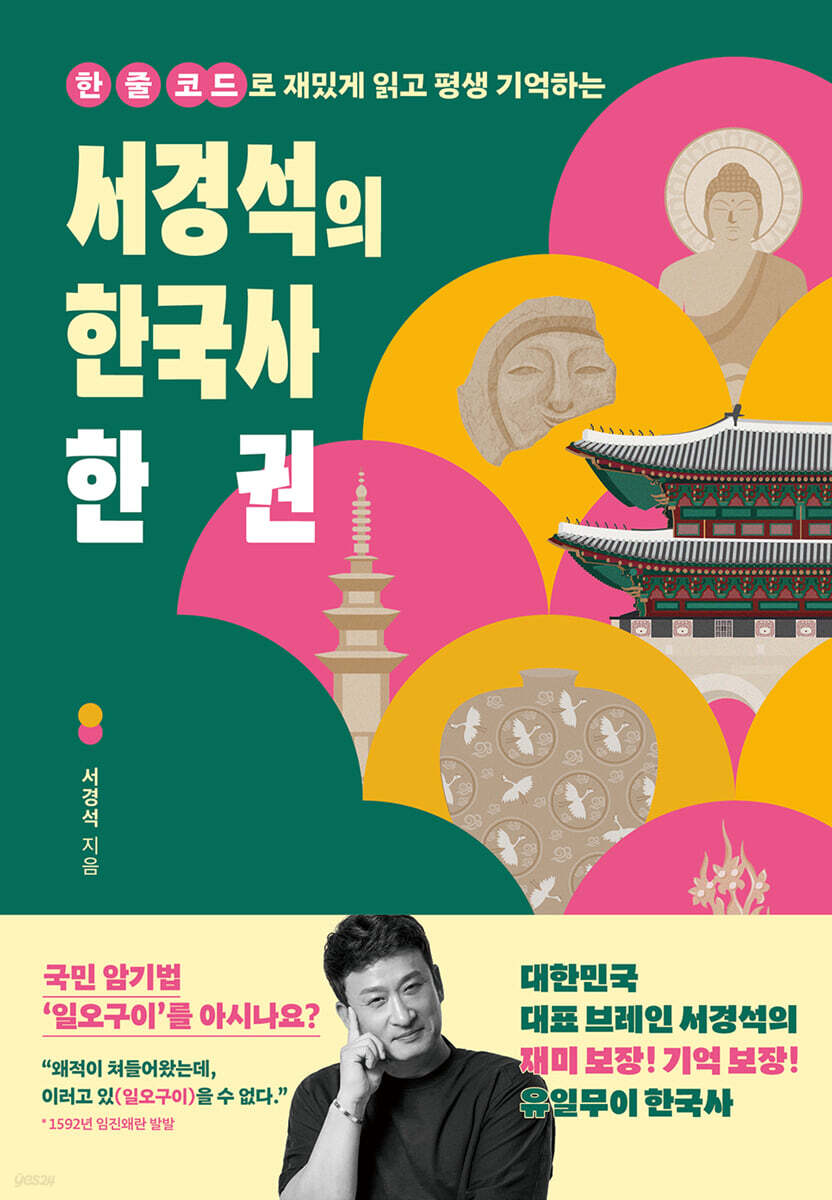
Seo Kyung-seok's Korean History in One Volume
 |
Description
Book Introduction
- A word from MD
-
Korean history that you will remember for a lifetime once you read it.Is Korean history so full of things to memorize that it's hard to keep up? To shatter this perception, author Seo Kyung-seok, a new "Korean history storyteller," has stepped forward.
The author uses his unique ability to convey Korean history in an engaging way, effectively conveying Korean history knowledge to readers by summarizing key points in "one-line code."
August 1, 2025. History PD Ahn Hyun-jae
Bring about a new wind
The emergence of a NEW Korean history storyteller!
South Korea's representative brain, Seo Kyung-seok, tells us
Korean history: a fun read that you'll remember for a lifetime
Broadcaster Seo Kyung-seok, who has been loved by many for nearly 30 years for his witty remarks, brilliant mind, and friendly and kind demeanor, now greets readers for the first time as a "storyteller of Korean history."
Even after becoming a star broadcaster, Seo Kyung-seok, a self-proclaimed god of study, has continuously challenged himself with new studies and achieved remarkable achievements, such as obtaining a Level 2 Korean Language Instructor qualification, passing the real estate agent exam, and receiving a perfect score on the Korean History Proficiency Test.
For over ten years, he has dreamed of becoming a "Korean history storyteller" who introduces our history to people in an interesting way, and has been steadily studying Korean history.
And as a result of his long-held dream, he published a Korean history book titled “Seo Kyung-seok’s Korean History in One Volume,” which is infused with his unique storytelling and humor.
This book carefully selects the major events that all Koreans must know from the long and extensive history of Korea, from prehistoric times to the present.
The author fully utilizes his unique storytelling skills, developed over decades of experience communicating and connecting with the public, to explain difficult and complex Korean history in an entertaining way, mixing in appropriate examples and witty humor.
Also, as befitting a god of study, the author has included a 'one-line code' containing his know-how to ensure that the Korean history stories covered quickly do not evaporate from your mind.
As you ponder this humorous code, you will naturally come to know key scenes in Korean history, and you will be able to enjoy the pleasure of reading and remembering them.
Exciting comics, various photos, and chronological tables are also placed throughout to help readers understand our history more easily and deeply.
I highly recommend this book to readers who have always wanted to become familiar with Korean history but are unsure of where and how to begin, and to readers who want to firmly grasp Korean history, which is both the destiny and essential liberal arts of Koreans.
The emergence of a NEW Korean history storyteller!
South Korea's representative brain, Seo Kyung-seok, tells us
Korean history: a fun read that you'll remember for a lifetime
Broadcaster Seo Kyung-seok, who has been loved by many for nearly 30 years for his witty remarks, brilliant mind, and friendly and kind demeanor, now greets readers for the first time as a "storyteller of Korean history."
Even after becoming a star broadcaster, Seo Kyung-seok, a self-proclaimed god of study, has continuously challenged himself with new studies and achieved remarkable achievements, such as obtaining a Level 2 Korean Language Instructor qualification, passing the real estate agent exam, and receiving a perfect score on the Korean History Proficiency Test.
For over ten years, he has dreamed of becoming a "Korean history storyteller" who introduces our history to people in an interesting way, and has been steadily studying Korean history.
And as a result of his long-held dream, he published a Korean history book titled “Seo Kyung-seok’s Korean History in One Volume,” which is infused with his unique storytelling and humor.
This book carefully selects the major events that all Koreans must know from the long and extensive history of Korea, from prehistoric times to the present.
The author fully utilizes his unique storytelling skills, developed over decades of experience communicating and connecting with the public, to explain difficult and complex Korean history in an entertaining way, mixing in appropriate examples and witty humor.
Also, as befitting a god of study, the author has included a 'one-line code' containing his know-how to ensure that the Korean history stories covered quickly do not evaporate from your mind.
As you ponder this humorous code, you will naturally come to know key scenes in Korean history, and you will be able to enjoy the pleasure of reading and remembering them.
Exciting comics, various photos, and chronological tables are also placed throughout to help readers understand our history more easily and deeply.
I highly recommend this book to readers who have always wanted to become familiar with Korean history but are unsure of where and how to begin, and to readers who want to firmly grasp Korean history, which is both the destiny and essential liberal arts of Koreans.
- You can preview some of the book's contents.
Preview
index
[Part 1 | Prehistoric Times]
ㆍStone Age: Beginning to make tools out of stone
Neolithic: Agriculture is a revolution
Bronze and Iron: The Beginning of Class and War
[Part 2 | Gojoseon and the Iron Age]
ㆍGojoseon: The first country to settle on the Korean Peninsula
Buyeo, Goguryeo, Okjeo, Dongye, and Samhan: various individualistic states
[Part 3 | The Three Kingdoms and Gaya]
Goguryeo: An icon of bravery boasting the strongest military
Baekje: A cultural powerhouse that was ranked first
ㆍSilla: Representative of a country with a long history of development
ㆍGaya: If you have to go, go, if you have to go, go!
[Part 4 | North-South States and Later Three Kingdoms]
Unified Silla: The Great Operation to Become True One
ㆍBalhae: The East Sea Kingdom boasting the largest territory in history
Later Baekje and Later Goguryeo: Aristocrats Found New Nations
[Part 5 | Goryeo]
Early Goryeo: The Beginning of the 500-Year Goryeo Dynasty
ㆍMid-Goryeo period: Various turmoils occurring both inside and outside the country
ㆍThe era of military power: Now, let us begin the era of military power.
ㆍYuan Intervention: Goryeo becomes the son-in-law of the Yuan Dynasty?
Late Goryeo Dynasty: The Conquest of Liaodong, That's the Problem
[Part 6 | Joseon]
Early Joseon Dynasty: 200 years of peace in the Confucian state of Joseon
The Imjin War and the Byeongja War: Wars that shook Joseon history to its core.
Late Joseon Dynasty: Political upheaval and the emergence of a genius king
[Part 7 | Modern Times]
Opening of Ports, Enlightenment, and Reform: Dark Shadows Casting Over the Korean Peninsula
ㆍNational Sovereignty and Resistance: A Painful but Humiliating History We Must Know
ㆍJapanese Occupation and the Provisional Government of the Republic of Korea: Our Roots Firmly Grown Despite Oppression
Independence movements at home and abroad: A fierce and noble struggle for independence
[Part 8 | Modern]
Liberation~1950s: The turbulent liberation and division
ㆍ1960s-1970s: Dictatorship and Resistance
ㆍ1980s: Citizens' Cries for Democracy
ㆍSince the 1990s: Our history, the closest to now
Photo source
ㆍStone Age: Beginning to make tools out of stone
Neolithic: Agriculture is a revolution
Bronze and Iron: The Beginning of Class and War
[Part 2 | Gojoseon and the Iron Age]
ㆍGojoseon: The first country to settle on the Korean Peninsula
Buyeo, Goguryeo, Okjeo, Dongye, and Samhan: various individualistic states
[Part 3 | The Three Kingdoms and Gaya]
Goguryeo: An icon of bravery boasting the strongest military
Baekje: A cultural powerhouse that was ranked first
ㆍSilla: Representative of a country with a long history of development
ㆍGaya: If you have to go, go, if you have to go, go!
[Part 4 | North-South States and Later Three Kingdoms]
Unified Silla: The Great Operation to Become True One
ㆍBalhae: The East Sea Kingdom boasting the largest territory in history
Later Baekje and Later Goguryeo: Aristocrats Found New Nations
[Part 5 | Goryeo]
Early Goryeo: The Beginning of the 500-Year Goryeo Dynasty
ㆍMid-Goryeo period: Various turmoils occurring both inside and outside the country
ㆍThe era of military power: Now, let us begin the era of military power.
ㆍYuan Intervention: Goryeo becomes the son-in-law of the Yuan Dynasty?
Late Goryeo Dynasty: The Conquest of Liaodong, That's the Problem
[Part 6 | Joseon]
Early Joseon Dynasty: 200 years of peace in the Confucian state of Joseon
The Imjin War and the Byeongja War: Wars that shook Joseon history to its core.
Late Joseon Dynasty: Political upheaval and the emergence of a genius king
[Part 7 | Modern Times]
Opening of Ports, Enlightenment, and Reform: Dark Shadows Casting Over the Korean Peninsula
ㆍNational Sovereignty and Resistance: A Painful but Humiliating History We Must Know
ㆍJapanese Occupation and the Provisional Government of the Republic of Korea: Our Roots Firmly Grown Despite Oppression
Independence movements at home and abroad: A fierce and noble struggle for independence
[Part 8 | Modern]
Liberation~1950s: The turbulent liberation and division
ㆍ1960s-1970s: Dictatorship and Resistance
ㆍ1980s: Citizens' Cries for Democracy
ㆍSince the 1990s: Our history, the closest to now
Photo source
Detailed image

Into the book
When we talk about the person who founded Gojoseon, we often call him ‘Dangun.’
However, I hope that those of you who are reading this book will develop the habit of calling him ‘Dangun Wanggeom’ by adding two letters to the end.
Because 'Dangun' means a priest, that is, a person who performs religious rites, and 'Wanggeom' means a ruler, that is, a person who conducts politics.
So, just by looking at the words ‘Dangun Wanggeom’, you can tell that one person was involved in both ancestral rites and politics.
Yes, that's right.
Gojoseon was a society of unity between the imperial and imperial dynasties.
--- p.30
The name of a king is given after the king dies.
So, just by looking at the name, you can get a hint about what the king did.
Any king whose name includes the character "성" (成) means that he has accomplished something great.
King Seongjong of Goryeo did the same.
King Seongjong of Joseon, whom we will meet soon, is also a person of great achievement.
This letter is usually attached to the name of the king who established the national system.
--- p.96
Have you heard the story of Joo Cho-wi-wang (走肖爲王)? If you combine the two characters for Joo Cho (走肖), you get Jo Gwang-jo's surname, Jo (趙).
The story goes that a bug ate a leaf, and the shape of the bite was the words “주초위왕,” which means “the Jo clan will become king.”
The Gimyo Incident was the event that resulted in the death of Jo Gwang-jo and the exile of many scholars due to the plot of the Hun-gu faction and King Jungjong's distrust.
When I first debuted, one of my catchphrases was, "It has such a profound meaning!" At the time, anyone who saw the leaf with the "Juchowiwang" inscribed on it must have exclaimed, "What a strange thing!"
--- p.153
In the palace, there was a tent called Yuak that was used when it rained.
This was something only the king could use, but Heo Jeok, who was the Prime Minister at the time, took this musical instrument for a family banquet without permission.
King Sukjong, enraged by this, took measures such as expelling the Namin faction, including Heo Jeok and Yun Hyu, and promoting the Seoin faction.
At this time, the Seoin faction, which dominated politics, showed signs of being divided again into the hard-line Noron faction and the moderate Soron faction.
This incident, in which the Nam-in faction was forced to resign due to the reckless and evil actions of Heo Jeok, is called the Gyeongsin Hwan-guk.
However, I hope that those of you who are reading this book will develop the habit of calling him ‘Dangun Wanggeom’ by adding two letters to the end.
Because 'Dangun' means a priest, that is, a person who performs religious rites, and 'Wanggeom' means a ruler, that is, a person who conducts politics.
So, just by looking at the words ‘Dangun Wanggeom’, you can tell that one person was involved in both ancestral rites and politics.
Yes, that's right.
Gojoseon was a society of unity between the imperial and imperial dynasties.
--- p.30
The name of a king is given after the king dies.
So, just by looking at the name, you can get a hint about what the king did.
Any king whose name includes the character "성" (成) means that he has accomplished something great.
King Seongjong of Goryeo did the same.
King Seongjong of Joseon, whom we will meet soon, is also a person of great achievement.
This letter is usually attached to the name of the king who established the national system.
--- p.96
Have you heard the story of Joo Cho-wi-wang (走肖爲王)? If you combine the two characters for Joo Cho (走肖), you get Jo Gwang-jo's surname, Jo (趙).
The story goes that a bug ate a leaf, and the shape of the bite was the words “주초위왕,” which means “the Jo clan will become king.”
The Gimyo Incident was the event that resulted in the death of Jo Gwang-jo and the exile of many scholars due to the plot of the Hun-gu faction and King Jungjong's distrust.
When I first debuted, one of my catchphrases was, "It has such a profound meaning!" At the time, anyone who saw the leaf with the "Juchowiwang" inscribed on it must have exclaimed, "What a strange thing!"
--- p.153
In the palace, there was a tent called Yuak that was used when it rained.
This was something only the king could use, but Heo Jeok, who was the Prime Minister at the time, took this musical instrument for a family banquet without permission.
King Sukjong, enraged by this, took measures such as expelling the Namin faction, including Heo Jeok and Yun Hyu, and promoting the Seoin faction.
At this time, the Seoin faction, which dominated politics, showed signs of being divided again into the hard-line Noron faction and the moderate Soron faction.
This incident, in which the Nam-in faction was forced to resign due to the reckless and evil actions of Heo Jeok, is called the Gyeongsin Hwan-guk.
--- p.174~175
Publisher's Review
“Nice to meet you for the first time.
“I am Seo Kyung-seok, the ‘Korean History Storyteller.’”
A Justified Challenge from Seo Kyung-seok, the Next Generation Korean History Storyteller
A new star has appeared in the world of history! The protagonist is none other than Seo Kyung-seok, a synonym for erudition. He not only earned top honors at the Korea Military Academy, graduated from Seoul National University, passed the Certified Real Estate Brokerage Exam, often called the "CSAT for adults," and became the first broadcaster to score a perfect score on the Korean History Proficiency Test.
Seo Kyung-seok's extraordinary affection for Korean history is not something that started yesterday or today.
He has long shown his interest and love for our history through various media, such as appearing on MBC's "Exclamation Point" program "Great Heritage 74434" (2006), which publicized the reality of our cultural assets being taken overseas and worked to recover them, and KBS's "Heavenly Collection" (2017), which introduced the hidden stories and value of our cultural assets.
In 2024, he announced that he would begin his long-held dream of becoming a "Korean history storyteller" and uploaded a Korean history video filled with original storytelling and wit on his YouTube channel, "So Gyeongseok," which received a great response.
He then solidified his position as a storyteller of Korean history by donating his talents to various organizations, including the Mapo Welfare Center and the National Human Rights Commission, and has now come to readers with "Seo Kyung-seok's Korean History in One Volume," which condenses his efforts and know-how into one volume.
The Strange Story Related to the Strange Writings Engraved on a Leaf
"The Gyeongsin Hwan-guk, caused by a reckless subject"
A delightful Korean history imprinted on the eyes, mind, and heart through unique storytelling.
The greatest appeal of this book, which richly covers our history from prehistoric times to modern times, chronologically tracing the flow of major events, lies in the author's exceptional storytelling ability, developed through nearly 30 years of communication with the public.
The author has displayed a variety of wit and sense to enable readers to understand the causes and consequences of historical events that are difficult to understand just by hearing their names, such as the Muosahwa, Gapjasahwa, Gyeongsinhwanguk, and Gisahwanguk, and to ensure that the names of the events and the stories match well.
Also, historical terms, which are notoriously difficult to understand due to their many Chinese characters, are explained one by one in an easy-to-understand manner, so that you don't even need to look them up in a separate dictionary. When dealing with political or military history, which is somewhat difficult to relate to, examples close to our daily lives are used, and appropriate humor is mixed in to make the description as exciting as watching a historical drama.
However, as it is a book about history, it was reviewed by Yeom Myeong-hun, an author who has published numerous historical novels and is a current middle and high school history teacher, so it did not compromise on accuracy and expertise.
“These tricky terms can be summarized in just one line?”
Let's boost your confidence in Korean history with the special corner 'One-Line Code'!
The author became a hot topic when he revealed on a broadcast an episode in which he remembered the year 1592, the year the Japanese invasions of Korea broke out during his school days, as “The Japanese have invaded, and we can’t just stand by like this (Il-o-gui).”
Even this complex and difficult Korean history becomes a different kind of fun when touched by Seo Kyung-seok's hands.
The special corner 'One-Line Code', which uses the first letters of the main characters of Mucheon, Cheokhwa, Dangung, Gwahama, and Ban-eopi, which are characteristics of Dongye, an Iron Age state, as "Going to Dan-gwa-ban with a friend and a book," and likens Seo Hui, Yang Gyu, and Gang Gam-chan, who were active in the Goryeo-Khitan War, to "Generals of the Seoyang River" in the song "The Maiden of the Soyang River," helps you firmly hold on to the knowledge of Korean history that is easily forgotten as soon as you turn around.
In addition, we have included humorous one-panel cartoons, various image materials, and a special section that organizes the years of important events, so that readers can completely understand the entire history of Korea from beginning to end without giving up.
Korean history is something that, as a Korean, I would be ashamed to not know, and it is like an eternal homework that I would like to master properly someday.
Let's have a good laugh with "Seo Kyung-seok's Korean History in One Volume" and take the time to properly imprint our history in our minds.
“I am Seo Kyung-seok, the ‘Korean History Storyteller.’”
A Justified Challenge from Seo Kyung-seok, the Next Generation Korean History Storyteller
A new star has appeared in the world of history! The protagonist is none other than Seo Kyung-seok, a synonym for erudition. He not only earned top honors at the Korea Military Academy, graduated from Seoul National University, passed the Certified Real Estate Brokerage Exam, often called the "CSAT for adults," and became the first broadcaster to score a perfect score on the Korean History Proficiency Test.
Seo Kyung-seok's extraordinary affection for Korean history is not something that started yesterday or today.
He has long shown his interest and love for our history through various media, such as appearing on MBC's "Exclamation Point" program "Great Heritage 74434" (2006), which publicized the reality of our cultural assets being taken overseas and worked to recover them, and KBS's "Heavenly Collection" (2017), which introduced the hidden stories and value of our cultural assets.
In 2024, he announced that he would begin his long-held dream of becoming a "Korean history storyteller" and uploaded a Korean history video filled with original storytelling and wit on his YouTube channel, "So Gyeongseok," which received a great response.
He then solidified his position as a storyteller of Korean history by donating his talents to various organizations, including the Mapo Welfare Center and the National Human Rights Commission, and has now come to readers with "Seo Kyung-seok's Korean History in One Volume," which condenses his efforts and know-how into one volume.
The Strange Story Related to the Strange Writings Engraved on a Leaf
"The Gyeongsin Hwan-guk, caused by a reckless subject"
A delightful Korean history imprinted on the eyes, mind, and heart through unique storytelling.
The greatest appeal of this book, which richly covers our history from prehistoric times to modern times, chronologically tracing the flow of major events, lies in the author's exceptional storytelling ability, developed through nearly 30 years of communication with the public.
The author has displayed a variety of wit and sense to enable readers to understand the causes and consequences of historical events that are difficult to understand just by hearing their names, such as the Muosahwa, Gapjasahwa, Gyeongsinhwanguk, and Gisahwanguk, and to ensure that the names of the events and the stories match well.
Also, historical terms, which are notoriously difficult to understand due to their many Chinese characters, are explained one by one in an easy-to-understand manner, so that you don't even need to look them up in a separate dictionary. When dealing with political or military history, which is somewhat difficult to relate to, examples close to our daily lives are used, and appropriate humor is mixed in to make the description as exciting as watching a historical drama.
However, as it is a book about history, it was reviewed by Yeom Myeong-hun, an author who has published numerous historical novels and is a current middle and high school history teacher, so it did not compromise on accuracy and expertise.
“These tricky terms can be summarized in just one line?”
Let's boost your confidence in Korean history with the special corner 'One-Line Code'!
The author became a hot topic when he revealed on a broadcast an episode in which he remembered the year 1592, the year the Japanese invasions of Korea broke out during his school days, as “The Japanese have invaded, and we can’t just stand by like this (Il-o-gui).”
Even this complex and difficult Korean history becomes a different kind of fun when touched by Seo Kyung-seok's hands.
The special corner 'One-Line Code', which uses the first letters of the main characters of Mucheon, Cheokhwa, Dangung, Gwahama, and Ban-eopi, which are characteristics of Dongye, an Iron Age state, as "Going to Dan-gwa-ban with a friend and a book," and likens Seo Hui, Yang Gyu, and Gang Gam-chan, who were active in the Goryeo-Khitan War, to "Generals of the Seoyang River" in the song "The Maiden of the Soyang River," helps you firmly hold on to the knowledge of Korean history that is easily forgotten as soon as you turn around.
In addition, we have included humorous one-panel cartoons, various image materials, and a special section that organizes the years of important events, so that readers can completely understand the entire history of Korea from beginning to end without giving up.
Korean history is something that, as a Korean, I would be ashamed to not know, and it is like an eternal homework that I would like to master properly someday.
Let's have a good laugh with "Seo Kyung-seok's Korean History in One Volume" and take the time to properly imprint our history in our minds.
GOODS SPECIFICS
- Date of issue: July 15, 2025
- Page count, weight, size: 308 pages | 488g | 147*210*18mm
- ISBN13: 9791165703523
- ISBN10: 1165703521
You may also like
카테고리
korean


korean

![GQ KOREA Mark (Monthly): December [2025]](http://librairie.coreenne.fr/cdn/shop/files/8ef265dbbfbf186523ed75ba7319009d.jpg?v=1765340328&width=3840)


