

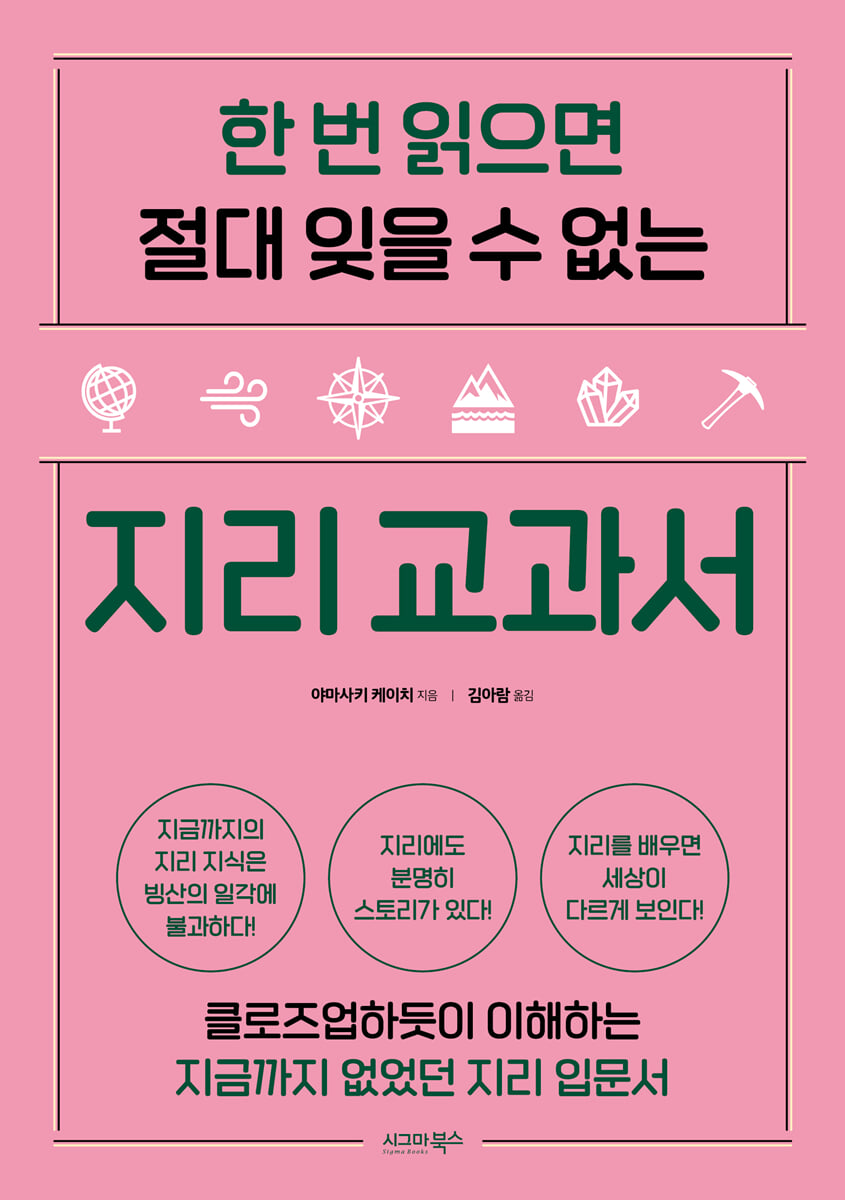
A geography textbook you'll never forget once you read it.
 |
Description
Book Introduction
Understanding as if in close-up
The first introductory geography book ever
Geography has a strong image as a subject that requires simple memorization.
Of course, some memorization is necessary, but just memorizing things blindly doesn't mean you've truly studied geography.
Geography is broadly divided into regional geography corresponding to 'ji' and systematic geography corresponding to 'ri'.
Among these, systematic geography deals with the fundamental principles and reasons of geography, such as the formation of topography and climate.
However, existing geography books lack explanations of systematic geography.
This book is a new introductory book on geography that focuses on systematic geography, which can be considered the foundation of geography, and provides explanations with abundant pictorial material.
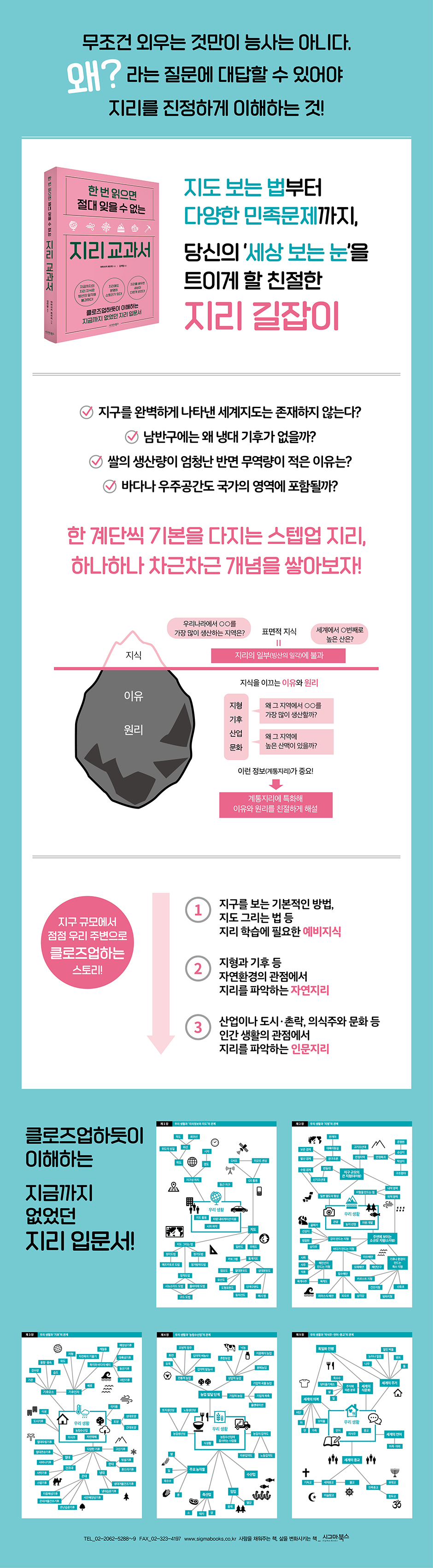
As we follow the larger story of geography, starting from the scale of the Earth and gradually zooming in on our surroundings, we will realize that what we knew about geography so far is just the tip of the iceberg!
The first introductory geography book ever
Geography has a strong image as a subject that requires simple memorization.
Of course, some memorization is necessary, but just memorizing things blindly doesn't mean you've truly studied geography.
Geography is broadly divided into regional geography corresponding to 'ji' and systematic geography corresponding to 'ri'.
Among these, systematic geography deals with the fundamental principles and reasons of geography, such as the formation of topography and climate.
However, existing geography books lack explanations of systematic geography.
This book is a new introductory book on geography that focuses on systematic geography, which can be considered the foundation of geography, and provides explanations with abundant pictorial material.
As we follow the larger story of geography, starting from the scale of the Earth and gradually zooming in on our surroundings, we will realize that what we knew about geography so far is just the tip of the iceberg!
- You can preview some of the book's contents.
Preview
index
[Entering] Geography has a story!
[Homeroom ①] Why Geography Feels Difficult
[Homeroom ②] Let's learn geography through stories!
Chapter 1 Geographic Information and Maps
[Summary of this chapter] How to obtain the information needed to study geography
[Round Earth] Places on Earth indicated by latitude and longitude
[The nature of hypocrisy] The reason for drawing the regression line
[Longitude and Time Difference] Countries where the date changes early
[Various Projections ① Orthographic Projection] A Projection Appropriate for Navigational Charts that Supported the History of Exploration
[Various Projections ② Static Projection] Sine Curve, Ellipse, and Split: Three Characteristic Projections
[Various projections ③ Azimuth projection] A projection that accurately measures distance and direction from the center.
[General and Thematic Maps] Various geographic information drawn on maps
[Statistical Map] A map showing numbers or ratios essential for geography learning.
[GIS and Remote Sensing] Maps Using Everyday Information Technology
Chapter 2 Topography
[Summary of this chapter] The ever-changing terrain created by the forces of nature
[Large and small terrain] The various large and small terrains surrounding us
Plate tectonics: Plate movement believed to be the driving force behind continental drift
[Convergent boundary of a tectonic plate] A boundary where plates collide to form volcanoes or mountain ranges.
[Divergent and Conservative Boundaries] Cracks in the Earth that appear where the boundaries diverge and diverge
[Earthquakes and Volcanoes] Earthquakes and volcanoes frequently occur in volcanic zones.
[Shingijosandae] Shingijosandae, where the earth is actively moving
[Geogi Osondae] The Geogi Osondae, which retains the influence of past Oson movements.
[Stable Landmass] The oldest stable landmass
[The spiritual power that creates terrain] The spiritual power that creates terrain on and off the Earth
[Alluvial plain] Alluvial plain created by rivers
[Terrains created by rivers ① Valleys] Valleys and river terraces frequently seen in the upper reaches of rivers
[Terrain created by rivers ② Fan-shaped landforms] Fan-shaped landforms commonly found near mountain ranges
[Topography created by rivers ③ Floodplain] A plain created by repeated floods since ancient times.
[Terrains Create Landforms ④ Delta] Various Shapes of Deltas Forming in Estuaries
[Land] Land used for new towns, golf courses, and orchards
[Landscapes shaped by coastal currents] A beautiful coastline shaped by coastal currents and sand.
[Sandy and rocky coasts] Coastal terrain with diverse features
[Flooded Coast] Flooding creates complex coastlines.
[Isu Coast] The tidal action that creates a straight coastline
[Coral Reefs] Beautiful coral reefs that form in shallow tropical waters.
[Glacial landform] Landforms created by glaciers that cut the surface with powerful force.
[Terrain due to dryness] Various desert terrains other than sand dunes
[Karst topography] A terrain with many pits formed by limestone dissolving in water.
Chapter 3 Climate
[Summary of this chapter] The core of geography learning that impacts many fields
[Climate Elements and Climate Factors] Data that characterizes climate and factors that change it.
[Various Climate Factors] Why the North and South Poles are Cold and the Equator is Hot
[Wind caused by latitude] Why the westerly wind is called the west wind
[Seasonal Changes] Seasonal Changes Caused by the Axis Tilt
[Climate by Terrain and Elevation] Why Mountain Weather is Unpredictable
[Layout of Continents and Oceans] The temperature difference between the continents and oceans that creates monsoons
[The action of ocean currents] The action of ocean currents that circulate the Earth on a large scale.
[World Climate Classification] Köppen's Climate Classification Classifying the World's Climates
[14 climate categories] Climates are further classified by precipitation or temperature trends.
[Vegetation] Vegetation differences used as a basis for climatic classification
[Tropical Climate (A)] A mild winter is the standard for the tropics.
[3 Tropical Climates] Lush Tropical Rainforests and Wildlife Treasures
[Arid Climate (B)] A vast arid zone that covers a quarter of the world's land area.
[Two dry climates] A desert climate where grass does not grow and a steppe climate where grass grows
[Temperate Climate (C)] A climate that is good for living with a large population
[Mediterranean climate and temperate winter dry climate] Two contrasting climate types: 'winter rain' and 'summer rain'
[Warm and humid climate and west coast maritime climate] A warm and livable climate that supports a large population.
[Cold climate (D)] A climate with a large temperature difference between long, cold winters and short summers.
[Cold humid climate and cold winter dry climate] The lowest temperature on land where humans live is -67.8℃.
[Climate (E)] A world of extreme cold where trees cannot grow
[Alpine Climate (H)] A climate unique to alpine areas that cannot be classified by temperature or precipitation.
[Soil] Soil closely related to climate and vegetation
[Local wind] A sharp local wind with many names
[Climate Change and Urban Climate] The Earth's Changing, Not Eternal, Climate
Chapter 4 Agriculture, Forestry and Fisheries
[Summary of this chapter] Industries that form the foundation of human life
[Cultivation Limits and Productivity/Intensity] Various Indicators for Understanding Agriculture
[Traditional Agriculture] Self-sufficient agriculture rooted in the local culture and environment
[Commercial Agriculture] Agriculture developed primarily in Europe for the purpose of selling products.
[Corporate Agriculture] Global Agriculture Run by Giant Corporations
[Main Crop Profile ① Rice] Rice is cultivated as a staple food, mainly in Asia.
[Major Crop Profile ② Wheat] Wheat, a strong international commodity
[Major Crop Profile ③ Corn] A Key Player in the Global Diet
[Major Crop Profile ④ Soybean] A multipurpose crop with many uses beyond food.
[Other Crop Profiles] Various crops used in daily life, including tuberous vegetables, staple foods, and industrial raw materials.
Livestock Distribution Influenced by Religion
Forestry: Forest resources that require balance between exports and the environment
[Fisheries] Growing demand for fishery resources alongside diversified diets.
Chapter 5 Energy and Mineral Resources
[Summary of this chapter] Energy and mineral resources essential for industrial development
[Primary and Secondary Energy] Various Energy Sources in Life
[Energy Revolution] Energy Use Changing with the Times
[Energy Resource ① Oil] A representative energy resource used for various purposes.
[Energy Resource ② Coal] A 'black diamond' created by the carbonization of ancient plants.
[Energy Resource ③ Natural Gas] Demand for "Combustible Gas" is Growing
[World Power] Different Power Generation Methods in Different Countries
[Mineral Resources] Various mineral resources used as materials for various industrial products.
Chapter 6 Industry
[Summary of this chapter] Our convenient life supported by industry
[Light and Heavy Industry] Industrial activities that create added value from raw materials.
[The Evolution of Industry] Industry evolved from homes to wholesalers, factories, and machines.
[Labor-intensive and capital-intensive industries] Intensity also used in industrial classification
[Industrial Location Story] A Place to Build a Factory that Will Generate Profits
[Light Industry ① Textile Industry] A representative light industry often used as the first step toward industrialization.
[Light Industry ② Food Industry] An important industry that accounts for a certain percentage in any country.
[Light Industry ③ Pulp, Paper, Publishing, Printing, and Ceramics] Light industry that produces various everyday items.
[Heavy Industry ① Petrochemical Industry] A representative example of heavy chemical industry that requires large-scale factories
[Heavy Industry ② Steel Industry] Metals used in all kinds of materials that support global industry.
[Heavy Industry ③ Aluminum Industry] Aluminum is a metal with many advantages, but its production requires a large amount of electricity.
[Heavy Industry ④ General Machinery and Electrical Machinery] An industry that manufactures the convenient machines that overflow into our daily lives.
[Transportation Machinery ① Automobile Industry] A high value-added industry with numerous large corporations.
[Transportation Machinery ② Shipbuilding] Ships actively produced in East Asian countries
[Transportation Machinery ③ Aviation and Space Industry] The Aviation Industry, Where Cutting-Edge Technology Is Implemented
[Advanced Technology Industry] Advanced technology industry where research institutes and companies collaborate
[Content Industry] The Content Industry Responsible for the Leisure of People Around the World
Chapter 7 Distribution and Consumption
[Summary of this chapter] Transportation and logistics connecting people and countries
[Characteristics of transportation] Transportation methods that are distinguished and used according to their purpose.
[Trade] Different trade policies depending on whether it is free trade or protectionism.
[Leisure and Tourism] Tourism demand related to long-term vacations
[Commercial] Everyday industries that connect sellers and buyers
Chapter 8 Population and Villages and Cities
[Summary of this chapter] Cities and villages, the stages of our lives
[World Population] Population growth after World War II, known as the population explosion.
[Population Transition] A Population Transition Model from "Dasan Dasa" to "Sosan Sosa"
[Population Pyramid] Population composition of a country or region as seen through a population pyramid
Population Composition by Industry: Population Composition Changes by Industry
[Social Growth/Decrease] Population Migration and Its Concerns
[Immigration and Refugees] Immigrants and Refugees Moving Across Borders
[Settlement formation] A settlement that forms where people gather.
[Village Form] A village with various expressions depending on the era and location.
[City] A city with various functions such as politics, commerce, and industry.
[Urban Structure] Internal and external urban structures appearing in large cities
[Urban Issues] Various problems arising from urban development
Chapter 9: Food, Clothing, Shelter, Language, and Religion
[Summary of this chapter] Diverse lifestyles rooted in climate and local customs
Clothing around the world: Clothing influenced by the natural and social environment
[World Food Cultures] The Easiest Way to Experience Other Cultures: World Cuisine
[Housing Around the World] Housing Made from Various Materials, from Wood to Brick, Rock, and Ice
[Languages of the World] The numerous languages that exist around the world
[World Religions] Religions that have greatly influenced world history
[Language and Religion Distribution in Europe] The Language and Religion Distribution That Brought Diversity to Europe
Chapter 10: The State and Its Territory
[Summary of this chapter] The state, the basic unit that constitutes modern society
[The Three Elements of a State] The Structure of the State, the Foundation of Our Society
[National Classification] National styles classified by politics, economy, and ethnicity
[National Territory] The sovereignty of the nation extending to the sea and the sky
[Borders] Borders between countries with many conflicts
[Ethnicity and Ethnic Issues] The Causes of Ethnic Issues Existing Around the World
[Various Ethnic Issues] Ethnic issues around the world that bring about many tragedies
[Multicultural Coexistence and International Cooperation] Mutual Respect: Essential for Resolving War
[Various national integration] Groups of countries formed by region or continent
[UN] The international peace organization faces a mountain of challenges.
Coming out
[Appendix] How to Read a Topographic Map
[Homeroom ①] Why Geography Feels Difficult
[Homeroom ②] Let's learn geography through stories!
Chapter 1 Geographic Information and Maps
[Summary of this chapter] How to obtain the information needed to study geography
[Round Earth] Places on Earth indicated by latitude and longitude
[The nature of hypocrisy] The reason for drawing the regression line
[Longitude and Time Difference] Countries where the date changes early
[Various Projections ① Orthographic Projection] A Projection Appropriate for Navigational Charts that Supported the History of Exploration
[Various Projections ② Static Projection] Sine Curve, Ellipse, and Split: Three Characteristic Projections
[Various projections ③ Azimuth projection] A projection that accurately measures distance and direction from the center.
[General and Thematic Maps] Various geographic information drawn on maps
[Statistical Map] A map showing numbers or ratios essential for geography learning.
[GIS and Remote Sensing] Maps Using Everyday Information Technology
Chapter 2 Topography
[Summary of this chapter] The ever-changing terrain created by the forces of nature
[Large and small terrain] The various large and small terrains surrounding us
Plate tectonics: Plate movement believed to be the driving force behind continental drift
[Convergent boundary of a tectonic plate] A boundary where plates collide to form volcanoes or mountain ranges.
[Divergent and Conservative Boundaries] Cracks in the Earth that appear where the boundaries diverge and diverge
[Earthquakes and Volcanoes] Earthquakes and volcanoes frequently occur in volcanic zones.
[Shingijosandae] Shingijosandae, where the earth is actively moving
[Geogi Osondae] The Geogi Osondae, which retains the influence of past Oson movements.
[Stable Landmass] The oldest stable landmass
[The spiritual power that creates terrain] The spiritual power that creates terrain on and off the Earth
[Alluvial plain] Alluvial plain created by rivers
[Terrains created by rivers ① Valleys] Valleys and river terraces frequently seen in the upper reaches of rivers
[Terrain created by rivers ② Fan-shaped landforms] Fan-shaped landforms commonly found near mountain ranges
[Topography created by rivers ③ Floodplain] A plain created by repeated floods since ancient times.
[Terrains Create Landforms ④ Delta] Various Shapes of Deltas Forming in Estuaries
[Land] Land used for new towns, golf courses, and orchards
[Landscapes shaped by coastal currents] A beautiful coastline shaped by coastal currents and sand.
[Sandy and rocky coasts] Coastal terrain with diverse features
[Flooded Coast] Flooding creates complex coastlines.
[Isu Coast] The tidal action that creates a straight coastline
[Coral Reefs] Beautiful coral reefs that form in shallow tropical waters.
[Glacial landform] Landforms created by glaciers that cut the surface with powerful force.
[Terrain due to dryness] Various desert terrains other than sand dunes
[Karst topography] A terrain with many pits formed by limestone dissolving in water.
Chapter 3 Climate
[Summary of this chapter] The core of geography learning that impacts many fields
[Climate Elements and Climate Factors] Data that characterizes climate and factors that change it.
[Various Climate Factors] Why the North and South Poles are Cold and the Equator is Hot
[Wind caused by latitude] Why the westerly wind is called the west wind
[Seasonal Changes] Seasonal Changes Caused by the Axis Tilt
[Climate by Terrain and Elevation] Why Mountain Weather is Unpredictable
[Layout of Continents and Oceans] The temperature difference between the continents and oceans that creates monsoons
[The action of ocean currents] The action of ocean currents that circulate the Earth on a large scale.
[World Climate Classification] Köppen's Climate Classification Classifying the World's Climates
[14 climate categories] Climates are further classified by precipitation or temperature trends.
[Vegetation] Vegetation differences used as a basis for climatic classification
[Tropical Climate (A)] A mild winter is the standard for the tropics.
[3 Tropical Climates] Lush Tropical Rainforests and Wildlife Treasures
[Arid Climate (B)] A vast arid zone that covers a quarter of the world's land area.
[Two dry climates] A desert climate where grass does not grow and a steppe climate where grass grows
[Temperate Climate (C)] A climate that is good for living with a large population
[Mediterranean climate and temperate winter dry climate] Two contrasting climate types: 'winter rain' and 'summer rain'
[Warm and humid climate and west coast maritime climate] A warm and livable climate that supports a large population.
[Cold climate (D)] A climate with a large temperature difference between long, cold winters and short summers.
[Cold humid climate and cold winter dry climate] The lowest temperature on land where humans live is -67.8℃.
[Climate (E)] A world of extreme cold where trees cannot grow
[Alpine Climate (H)] A climate unique to alpine areas that cannot be classified by temperature or precipitation.
[Soil] Soil closely related to climate and vegetation
[Local wind] A sharp local wind with many names
[Climate Change and Urban Climate] The Earth's Changing, Not Eternal, Climate
Chapter 4 Agriculture, Forestry and Fisheries
[Summary of this chapter] Industries that form the foundation of human life
[Cultivation Limits and Productivity/Intensity] Various Indicators for Understanding Agriculture
[Traditional Agriculture] Self-sufficient agriculture rooted in the local culture and environment
[Commercial Agriculture] Agriculture developed primarily in Europe for the purpose of selling products.
[Corporate Agriculture] Global Agriculture Run by Giant Corporations
[Main Crop Profile ① Rice] Rice is cultivated as a staple food, mainly in Asia.
[Major Crop Profile ② Wheat] Wheat, a strong international commodity
[Major Crop Profile ③ Corn] A Key Player in the Global Diet
[Major Crop Profile ④ Soybean] A multipurpose crop with many uses beyond food.
[Other Crop Profiles] Various crops used in daily life, including tuberous vegetables, staple foods, and industrial raw materials.
Livestock Distribution Influenced by Religion
Forestry: Forest resources that require balance between exports and the environment
[Fisheries] Growing demand for fishery resources alongside diversified diets.
Chapter 5 Energy and Mineral Resources
[Summary of this chapter] Energy and mineral resources essential for industrial development
[Primary and Secondary Energy] Various Energy Sources in Life
[Energy Revolution] Energy Use Changing with the Times
[Energy Resource ① Oil] A representative energy resource used for various purposes.
[Energy Resource ② Coal] A 'black diamond' created by the carbonization of ancient plants.
[Energy Resource ③ Natural Gas] Demand for "Combustible Gas" is Growing
[World Power] Different Power Generation Methods in Different Countries
[Mineral Resources] Various mineral resources used as materials for various industrial products.
Chapter 6 Industry
[Summary of this chapter] Our convenient life supported by industry
[Light and Heavy Industry] Industrial activities that create added value from raw materials.
[The Evolution of Industry] Industry evolved from homes to wholesalers, factories, and machines.
[Labor-intensive and capital-intensive industries] Intensity also used in industrial classification
[Industrial Location Story] A Place to Build a Factory that Will Generate Profits
[Light Industry ① Textile Industry] A representative light industry often used as the first step toward industrialization.
[Light Industry ② Food Industry] An important industry that accounts for a certain percentage in any country.
[Light Industry ③ Pulp, Paper, Publishing, Printing, and Ceramics] Light industry that produces various everyday items.
[Heavy Industry ① Petrochemical Industry] A representative example of heavy chemical industry that requires large-scale factories
[Heavy Industry ② Steel Industry] Metals used in all kinds of materials that support global industry.
[Heavy Industry ③ Aluminum Industry] Aluminum is a metal with many advantages, but its production requires a large amount of electricity.
[Heavy Industry ④ General Machinery and Electrical Machinery] An industry that manufactures the convenient machines that overflow into our daily lives.
[Transportation Machinery ① Automobile Industry] A high value-added industry with numerous large corporations.
[Transportation Machinery ② Shipbuilding] Ships actively produced in East Asian countries
[Transportation Machinery ③ Aviation and Space Industry] The Aviation Industry, Where Cutting-Edge Technology Is Implemented
[Advanced Technology Industry] Advanced technology industry where research institutes and companies collaborate
[Content Industry] The Content Industry Responsible for the Leisure of People Around the World
Chapter 7 Distribution and Consumption
[Summary of this chapter] Transportation and logistics connecting people and countries
[Characteristics of transportation] Transportation methods that are distinguished and used according to their purpose.
[Trade] Different trade policies depending on whether it is free trade or protectionism.
[Leisure and Tourism] Tourism demand related to long-term vacations
[Commercial] Everyday industries that connect sellers and buyers
Chapter 8 Population and Villages and Cities
[Summary of this chapter] Cities and villages, the stages of our lives
[World Population] Population growth after World War II, known as the population explosion.
[Population Transition] A Population Transition Model from "Dasan Dasa" to "Sosan Sosa"
[Population Pyramid] Population composition of a country or region as seen through a population pyramid
Population Composition by Industry: Population Composition Changes by Industry
[Social Growth/Decrease] Population Migration and Its Concerns
[Immigration and Refugees] Immigrants and Refugees Moving Across Borders
[Settlement formation] A settlement that forms where people gather.
[Village Form] A village with various expressions depending on the era and location.
[City] A city with various functions such as politics, commerce, and industry.
[Urban Structure] Internal and external urban structures appearing in large cities
[Urban Issues] Various problems arising from urban development
Chapter 9: Food, Clothing, Shelter, Language, and Religion
[Summary of this chapter] Diverse lifestyles rooted in climate and local customs
Clothing around the world: Clothing influenced by the natural and social environment
[World Food Cultures] The Easiest Way to Experience Other Cultures: World Cuisine
[Housing Around the World] Housing Made from Various Materials, from Wood to Brick, Rock, and Ice
[Languages of the World] The numerous languages that exist around the world
[World Religions] Religions that have greatly influenced world history
[Language and Religion Distribution in Europe] The Language and Religion Distribution That Brought Diversity to Europe
Chapter 10: The State and Its Territory
[Summary of this chapter] The state, the basic unit that constitutes modern society
[The Three Elements of a State] The Structure of the State, the Foundation of Our Society
[National Classification] National styles classified by politics, economy, and ethnicity
[National Territory] The sovereignty of the nation extending to the sea and the sky
[Borders] Borders between countries with many conflicts
[Ethnicity and Ethnic Issues] The Causes of Ethnic Issues Existing Around the World
[Various Ethnic Issues] Ethnic issues around the world that bring about many tragedies
[Multicultural Coexistence and International Cooperation] Mutual Respect: Essential for Resolving War
[Various national integration] Groups of countries formed by region or continent
[UN] The international peace organization faces a mountain of challenges.
Coming out
[Appendix] How to Read a Topographic Map
Detailed image
Into the book
During the spring and autumn equinoxes, the sun's rays are directly above the equator.
And the sun shines strongly on the northern hemisphere when it is summer in the northern hemisphere, and shines strongly on the southern hemisphere when it is summer in the southern hemisphere.
The line directly above the sun when it is the summer solstice in the Northern Hemisphere is the Tropic of Cancer, and the line directly above the sun when it is the winter solstice in the Northern Hemisphere (the summer solstice in the Southern Hemisphere) is the Tropic of Capricorn.
When viewed from the Northern Hemisphere, the 'summer equator' is the Tropic of Cancer and the 'winter equator' is the Tropic of Capricorn.
--- 「Chapter 1.
From “Geographic Information and Maps”
Although terrain is referred to as one word, it is actually divided into two major branches.
One is the large-scale landforms on Earth, such as continents, oceans, or mountain ranges like the Himalayas.
The other type is a relatively limited range of landforms, such as valleys, alluvial plains, and deltas, called subduction zones.
--- 「Chapter 2.
From "Terrain"
When it rains, it means there is an updraft there.
The air above is colder than the ground, so as warm air rises, it cools and forms water droplets.
It's similar to the phenomenon of water droplets forming on the outer surface of a cup filled with a cold drink as the surrounding air cools.
Also, as air expands in the lower pressure atmosphere, its temperature decreases.
--- Chapter 3.
From "Climate"
Each crop has its own suitable environment, and basically, the environment of its origin is suitable.
If crops are grown in optimal conditions and then subjected to harsh conditions, such as drought or cold, growth becomes increasingly difficult, and if their limits are exceeded, they cannot grow.
The limits to the area where each crop can be grown are called cultivation limits.
Humanity has a history of overcoming cultivation limitations by bringing water to arid regions and breeding cold-resistant crops.
--- 「Chapter 4.
From “Agriculture, Forestry and Fisheries”
Coal is made from plants that withered or fell in ancient times, accumulated underground, and were slowly carbonized by the heat and pressure of the ground.
Especially in the late Paleozoic era, called the Carboniferous period, 350 to 300 million years ago (shortly before the creation of Pangaea), huge forests of ferns flourished in the tropics and subtropics.
The coal formed in the stratum at that time had sufficient conditions, such as the amount of basic plants and sufficient time to be reborn as high-quality coal, so large-scale coal fields tended to be formed in large numbers during this period.
--- Chapter 5.
Among “Energy and Mineral Resources”
The petrochemical industry is a process industry that requires large-scale factories and equipment.
Another characteristic is that the raw materials are liquid or gas, and are continuously produced through pipes from crude oil to product production.
Most of the related factories are concentrated in one area, and take the form of a kombinat (combined industrial area) with pipes circulating between them like blood vessels.
Because oil is a resource that is exported and imported on a large scale, most large petrochemical plants are located near the sea.
The top producers of petrochemical products are China and the United States.
--- 「Chapter 6.
Among the "Industry"
The items we purchase in retail stores pass through many hands, from the producer to the retailer.
In fact, many wholesalers are sending goods all over the country, out of sight of consumers.
So, looking at the overall commerce, wholesalers' sales are more than twice that of retailers, accounting for about 70% of the overall commerce.
--- Chapter 7.
From “Distribution and Consumption”
The world population is estimated to have been between 200 and 400 million about 2,000 years ago, and about 650 million in the early 18th century.
And now there are 8 billion people, so in the last 300 years, the population has increased by more than 7.3 billion people.
--- Chapter 8.
From “Population and Villages and Cities”
The world's religions are broadly divided into two categories: world religions and ethnic religions.
A world religion is a religion that is widely believed beyond countries or ethnic groups, while an ethnic religion is a religion that is believed primarily within a specific ethnic group.
World religions include Christianity, Islam, and Buddhism, while representative examples of ethnic religions include Judaism and Hinduism.
--- Chapter 9.
From “Food, Clothing, Shelter, Language, and Religion”
When categorizing countries in economic terms, there are capitalist countries, which adopt capitalism as the basic principle of the country, in which capitalists hire workers and companies compete with each other to maximize profits, and socialist countries, which adopt a critical stance toward capitalism and adopt socialism as the national principle, in which the means of production are jointly managed and equal distribution is pursued.
From the late 1980s to the 1990s, most socialist regimes collapsed, and many socialist countries transitioned to capitalism.
And the sun shines strongly on the northern hemisphere when it is summer in the northern hemisphere, and shines strongly on the southern hemisphere when it is summer in the southern hemisphere.
The line directly above the sun when it is the summer solstice in the Northern Hemisphere is the Tropic of Cancer, and the line directly above the sun when it is the winter solstice in the Northern Hemisphere (the summer solstice in the Southern Hemisphere) is the Tropic of Capricorn.
When viewed from the Northern Hemisphere, the 'summer equator' is the Tropic of Cancer and the 'winter equator' is the Tropic of Capricorn.
--- 「Chapter 1.
From “Geographic Information and Maps”
Although terrain is referred to as one word, it is actually divided into two major branches.
One is the large-scale landforms on Earth, such as continents, oceans, or mountain ranges like the Himalayas.
The other type is a relatively limited range of landforms, such as valleys, alluvial plains, and deltas, called subduction zones.
--- 「Chapter 2.
From "Terrain"
When it rains, it means there is an updraft there.
The air above is colder than the ground, so as warm air rises, it cools and forms water droplets.
It's similar to the phenomenon of water droplets forming on the outer surface of a cup filled with a cold drink as the surrounding air cools.
Also, as air expands in the lower pressure atmosphere, its temperature decreases.
--- Chapter 3.
From "Climate"
Each crop has its own suitable environment, and basically, the environment of its origin is suitable.
If crops are grown in optimal conditions and then subjected to harsh conditions, such as drought or cold, growth becomes increasingly difficult, and if their limits are exceeded, they cannot grow.
The limits to the area where each crop can be grown are called cultivation limits.
Humanity has a history of overcoming cultivation limitations by bringing water to arid regions and breeding cold-resistant crops.
--- 「Chapter 4.
From “Agriculture, Forestry and Fisheries”
Coal is made from plants that withered or fell in ancient times, accumulated underground, and were slowly carbonized by the heat and pressure of the ground.
Especially in the late Paleozoic era, called the Carboniferous period, 350 to 300 million years ago (shortly before the creation of Pangaea), huge forests of ferns flourished in the tropics and subtropics.
The coal formed in the stratum at that time had sufficient conditions, such as the amount of basic plants and sufficient time to be reborn as high-quality coal, so large-scale coal fields tended to be formed in large numbers during this period.
--- Chapter 5.
Among “Energy and Mineral Resources”
The petrochemical industry is a process industry that requires large-scale factories and equipment.
Another characteristic is that the raw materials are liquid or gas, and are continuously produced through pipes from crude oil to product production.
Most of the related factories are concentrated in one area, and take the form of a kombinat (combined industrial area) with pipes circulating between them like blood vessels.
Because oil is a resource that is exported and imported on a large scale, most large petrochemical plants are located near the sea.
The top producers of petrochemical products are China and the United States.
--- 「Chapter 6.
Among the "Industry"
The items we purchase in retail stores pass through many hands, from the producer to the retailer.
In fact, many wholesalers are sending goods all over the country, out of sight of consumers.
So, looking at the overall commerce, wholesalers' sales are more than twice that of retailers, accounting for about 70% of the overall commerce.
--- Chapter 7.
From “Distribution and Consumption”
The world population is estimated to have been between 200 and 400 million about 2,000 years ago, and about 650 million in the early 18th century.
And now there are 8 billion people, so in the last 300 years, the population has increased by more than 7.3 billion people.
--- Chapter 8.
From “Population and Villages and Cities”
The world's religions are broadly divided into two categories: world religions and ethnic religions.
A world religion is a religion that is widely believed beyond countries or ethnic groups, while an ethnic religion is a religion that is believed primarily within a specific ethnic group.
World religions include Christianity, Islam, and Buddhism, while representative examples of ethnic religions include Judaism and Hinduism.
--- Chapter 9.
From “Food, Clothing, Shelter, Language, and Religion”
When categorizing countries in economic terms, there are capitalist countries, which adopt capitalism as the basic principle of the country, in which capitalists hire workers and companies compete with each other to maximize profits, and socialist countries, which adopt a critical stance toward capitalism and adopt socialism as the national principle, in which the means of production are jointly managed and equal distribution is pursued.
From the late 1980s to the 1990s, most socialist regimes collapsed, and many socialist countries transitioned to capitalism.
--- 「Chapter 10.
From “The State and Its Territory”
From “The State and Its Territory”
Publisher's Review
Step-up geography that builds the basics step by step,
Let's build up the concepts one by one!
Let's break down the word 'geography' letter by letter.
In geography, 'ji' refers to regional geography and 'ri' refers to systematic geography.
Regional geography explores specific information about a specific region, such as, "Which region in our country produces the most ○○?" or "What is the ○th highest mountain in the world?", while systematic geography deals with the fundamental principles and reasons of geography, such as the formation of topography and climate.
So, to master geography, shouldn't we first thoroughly lay the foundation of systematic geography? However, few geography books on the market offer a thorough explanation of systematic geography, and many simply list the basics.
"A Geography Textbook You'll Never Forget Once You Read It" is a new introductory geography book that explains the entire field of systematic geography based on a grand narrative and abundant illustrations.
The author, a Japanese teacher and YouTuber with over 30 million cumulative YouTube views, emphasizes that geography also has a distinct "story."
The Earth we live on has terrain and climate, and above the terrain and climate there is industry.
Cities and villages are formed on top of it, and people's lives and countries exist based on it.
The main plot of the geographic story is to start with a large-scale event on a global scale and gradually close in on our surroundings.
If you follow this flow well, you will be able to easily understand geography concepts that used to feel difficult and complicated.
From how to read a map to various ethnic issues,
Open your 'eyes to see the world'
Friendly Geography Guide
The geography story unfolding in this book is broadly divided into three areas.
First, Chapter 1 covers the preliminary knowledge required for studying geography.
It introduces basic methods of viewing the Earth from an objective point of view as if looking at it from afar, as well as methods of drawing maps (projections).
Chapters 2 and 3 then discuss 'physical geography', which is a type of systematic geography that understands geography from the perspective of natural phenomena such as topography and climate.
Chapter 2 explains the formation of landforms and the diverse terrain with many changes, and Chapter 3 explains the formation of climate and the so-called Köppen climate classification, which is divided into 14 types.
Chapters 4 through 10 cover ‘human geography’ within systematic geography.
Human geography is a field that understands geography from the perspective of human activities such as the formation of industries, cities and villages, and lifestyle culture.
Chapters 4 through 7 focus on industries such as agriculture, forestry, and fisheries, energy, mineral resources, industry, transportation, and commerce, while Chapter 8 and onward shed light on social structures such as population, cities, villages, lifestyles, and countries and national groups.
After reading "A Geography Textbook You'll Never Forget Once You Read It," you'll be able to look at your familiar school or work routes with interest, thinking, "There are a lot of rice paddies here because they're back wetlands of floodplains," or "There are a lot of orchards here because it's a floating island."
The geography we know so far is just the tip of the iceberg.
By following the grand story of geography through this book and gaining a multifaceted understanding of it, your perspective on the world will change.
Let's build up the concepts one by one!
Let's break down the word 'geography' letter by letter.
In geography, 'ji' refers to regional geography and 'ri' refers to systematic geography.
Regional geography explores specific information about a specific region, such as, "Which region in our country produces the most ○○?" or "What is the ○th highest mountain in the world?", while systematic geography deals with the fundamental principles and reasons of geography, such as the formation of topography and climate.
So, to master geography, shouldn't we first thoroughly lay the foundation of systematic geography? However, few geography books on the market offer a thorough explanation of systematic geography, and many simply list the basics.
"A Geography Textbook You'll Never Forget Once You Read It" is a new introductory geography book that explains the entire field of systematic geography based on a grand narrative and abundant illustrations.
The author, a Japanese teacher and YouTuber with over 30 million cumulative YouTube views, emphasizes that geography also has a distinct "story."
The Earth we live on has terrain and climate, and above the terrain and climate there is industry.
Cities and villages are formed on top of it, and people's lives and countries exist based on it.
The main plot of the geographic story is to start with a large-scale event on a global scale and gradually close in on our surroundings.
If you follow this flow well, you will be able to easily understand geography concepts that used to feel difficult and complicated.
From how to read a map to various ethnic issues,
Open your 'eyes to see the world'
Friendly Geography Guide
The geography story unfolding in this book is broadly divided into three areas.
First, Chapter 1 covers the preliminary knowledge required for studying geography.
It introduces basic methods of viewing the Earth from an objective point of view as if looking at it from afar, as well as methods of drawing maps (projections).
Chapters 2 and 3 then discuss 'physical geography', which is a type of systematic geography that understands geography from the perspective of natural phenomena such as topography and climate.
Chapter 2 explains the formation of landforms and the diverse terrain with many changes, and Chapter 3 explains the formation of climate and the so-called Köppen climate classification, which is divided into 14 types.
Chapters 4 through 10 cover ‘human geography’ within systematic geography.
Human geography is a field that understands geography from the perspective of human activities such as the formation of industries, cities and villages, and lifestyle culture.
Chapters 4 through 7 focus on industries such as agriculture, forestry, and fisheries, energy, mineral resources, industry, transportation, and commerce, while Chapter 8 and onward shed light on social structures such as population, cities, villages, lifestyles, and countries and national groups.
After reading "A Geography Textbook You'll Never Forget Once You Read It," you'll be able to look at your familiar school or work routes with interest, thinking, "There are a lot of rice paddies here because they're back wetlands of floodplains," or "There are a lot of orchards here because it's a floating island."
The geography we know so far is just the tip of the iceberg.
By following the grand story of geography through this book and gaining a multifaceted understanding of it, your perspective on the world will change.
GOODS SPECIFICS
- Date of issue: October 19, 2023
- Page count, weight, size: 356 pages | 570g | 148*210*21mm
- ISBN13: 9791168621756
- ISBN10: 1168621755
You may also like
카테고리
korean


korean

![GQ KOREA Mark (Monthly): December [2025]](http://librairie.coreenne.fr/cdn/shop/files/8ef265dbbfbf186523ed75ba7319009d.jpg?v=1765340328&width=3840)


