

World History Read Backwards
 |
Description
Book Introduction
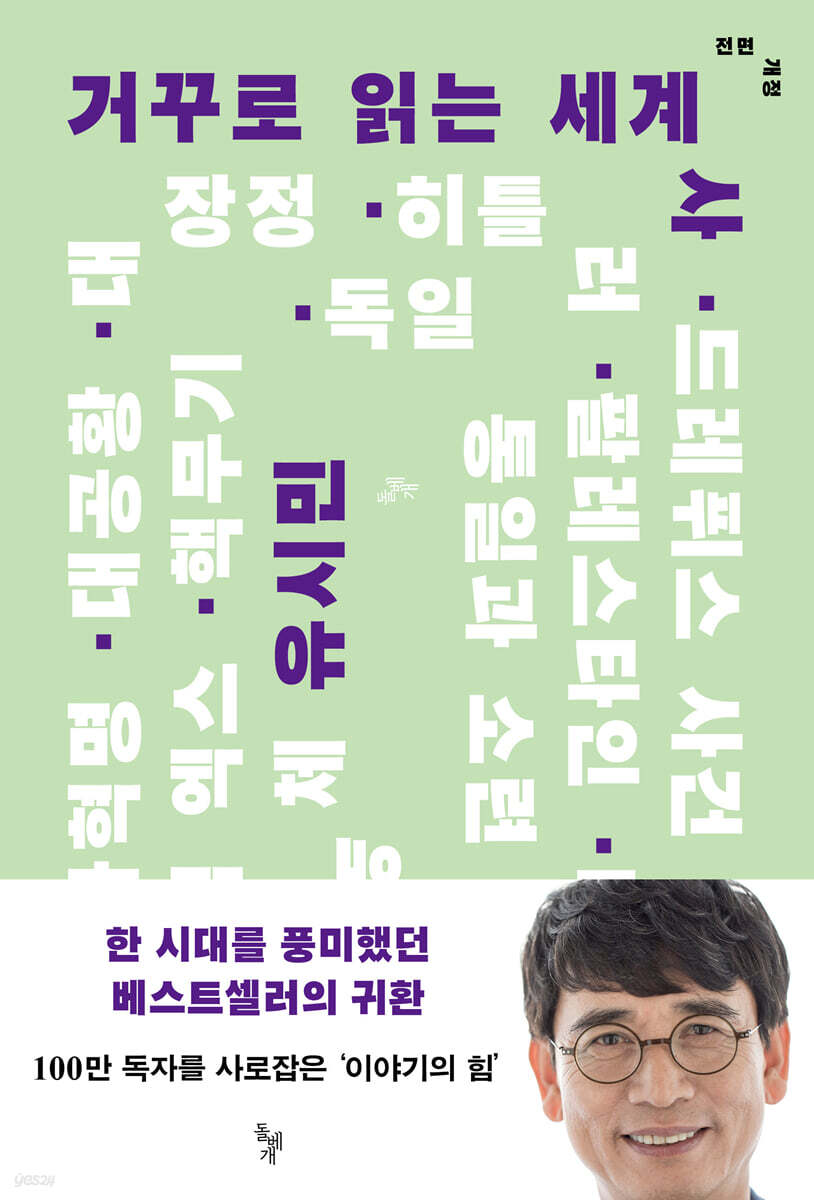
The return of a bestseller that took an era by storm The Power of Storytelling That Captivated a Million Readers Yu Si-min's "World History Read Backwards," which has been a steady bestseller since its first publication in 1988, has been published with a new look after going out of print. This is a "new" book that meticulously supplements information accumulated over 30 years, changes interpretations of events, and rewrites without leaving a single sentence the same, to the point where the expression "completely revised" becomes meaningless. However, the reason I used the same title is because I did not completely get rid of the ‘backwards reading attitude’ that was seen in the first edition. We tried to balance the biased view of the world and gave weight to some cases that are still neglected. 『Reading World History Backwards』 holds great significance for Yoo Si-min as a ‘first’ in many ways. This is the first book that gave me the title of 'author', the first book to become a bestseller in a short period of time, and the book that stayed with readers for the longest time. This is also the starting point of the 'Yoo Si-min's History Trilogy', which led to 'My Modern Korean History 1959-2020' (Dolbegae, 2021) and 'History of History' (Dolbegae, 2018), which introduced Yoo Si-min, a knowledge retailer, to the public. In these days when the lifespan of books is getting shorter and shorter, I want to give meaning to the fact that a book published 33 years ago has survived without losing its vitality. The book that once dominated an era as the intellectual rebellion of young people in their 20s, as a supplementary textbook for middle and high school students, and as a required liberal arts textbook for college students—where will it go from here? I sincerely hope it will once again pass the test of time. |
- You can preview some of the book's contents.
Preview
index
Preface: Republishing an Old Book
1 The Dreyfus Affair: The Dawn of the 20th Century
The Traitor Dreyfus | The Truth Discovered by Colonel Picard | Émile Zola's Accusation | Legal Conclusion | Political Solution | The Age of Intellectuals
2 The Sarajevo Incident: A Spark That Set the Desert ablaze
The Gunshots of Sarajevo | The Civil War in Europe | The First World War | Imperialism That Swallowed the Moon
3 The Russian Revolution: The Reckless Rush of Beautiful Ideals
At Finland Station | Bloody Sunday and the Potemkin Mutiny | From Healthy Dictatorship to State Administration and Revolution | Lenin, the Fighter | The Bolshevik Revolution | The Fall of Icarus
4 The Great Depression: The Bankruptcy of the Laissez-Faire Market Economy
New York's 'Terrible Thursday' | Oranges Overstock, Starving Children | Roosevelt and Hitler | The Keynesian Revolution | The Legacy of the Great Depression
5 The Long March: The Myth of the Birth of the People's Republic of China
The Eighth Hero of Unification | The Fated Rival | The Red Army's Escape | Crossing the Yangtze | The War of the Earth | The Xi'an Incident | The Continent Turned Red | New Democracy
6 Hitler: The Alliance of All Evil
Weimar Republic | Mein Kampf | World War II | The Holocaust | The Vulgarity of Evil
7 Palestine: A Land of Tragedy and Tears
The Stage of Tragedy | The Stars of Drama | The Jewish Army's 'Ethnic Cleansing' | The Middle East War and the PLO | Arafat in New York | The Endless Cycle of Terror and War
8 Vietnam: The Last National Liberation War
A Nation That Would Not Surrender | A Man Called Ho Chi Minh | The First Vietnam War | France's Betrayal, America's Intervention | The Second Vietnam War | The Pentagon Papers | After the War
9 Malcolm X: Black Prometheus
Muhammad Ali | The Jim Crow Era | Malcolm X and Martin Luther King | Integration and Segregation | Assassinations | Racial Inequality in America
10 Nuclear Weapons: The Revenge of Energy
Women's Peace Camp | War and Science | Nuclear Bombs | Ballistic Missiles | Cuban Crisis | A Nuclear-Free World
11 German Unification and the Dissolution of the Soviet Union: The End of the 20th Century
The Berlin Wall | The End of the Socialist World | Mikhail Gorbachev | The Dark History of the Soviet Union | The Dismal Failure of the Great Experiment | Freikauf
Epilogue: Unknown Future
Time in History | Tribal Instinct | Alan Turing | The Fourth Industrial Revolution | 100 Years Later
References
Search
1 The Dreyfus Affair: The Dawn of the 20th Century
The Traitor Dreyfus | The Truth Discovered by Colonel Picard | Émile Zola's Accusation | Legal Conclusion | Political Solution | The Age of Intellectuals
2 The Sarajevo Incident: A Spark That Set the Desert ablaze
The Gunshots of Sarajevo | The Civil War in Europe | The First World War | Imperialism That Swallowed the Moon
3 The Russian Revolution: The Reckless Rush of Beautiful Ideals
At Finland Station | Bloody Sunday and the Potemkin Mutiny | From Healthy Dictatorship to State Administration and Revolution | Lenin, the Fighter | The Bolshevik Revolution | The Fall of Icarus
4 The Great Depression: The Bankruptcy of the Laissez-Faire Market Economy
New York's 'Terrible Thursday' | Oranges Overstock, Starving Children | Roosevelt and Hitler | The Keynesian Revolution | The Legacy of the Great Depression
5 The Long March: The Myth of the Birth of the People's Republic of China
The Eighth Hero of Unification | The Fated Rival | The Red Army's Escape | Crossing the Yangtze | The War of the Earth | The Xi'an Incident | The Continent Turned Red | New Democracy
6 Hitler: The Alliance of All Evil
Weimar Republic | Mein Kampf | World War II | The Holocaust | The Vulgarity of Evil
7 Palestine: A Land of Tragedy and Tears
The Stage of Tragedy | The Stars of Drama | The Jewish Army's 'Ethnic Cleansing' | The Middle East War and the PLO | Arafat in New York | The Endless Cycle of Terror and War
8 Vietnam: The Last National Liberation War
A Nation That Would Not Surrender | A Man Called Ho Chi Minh | The First Vietnam War | France's Betrayal, America's Intervention | The Second Vietnam War | The Pentagon Papers | After the War
9 Malcolm X: Black Prometheus
Muhammad Ali | The Jim Crow Era | Malcolm X and Martin Luther King | Integration and Segregation | Assassinations | Racial Inequality in America
10 Nuclear Weapons: The Revenge of Energy
Women's Peace Camp | War and Science | Nuclear Bombs | Ballistic Missiles | Cuban Crisis | A Nuclear-Free World
11 German Unification and the Dissolution of the Soviet Union: The End of the 20th Century
The Berlin Wall | The End of the Socialist World | Mikhail Gorbachev | The Dark History of the Soviet Union | The Dismal Failure of the Great Experiment | Freikauf
Epilogue: Unknown Future
Time in History | Tribal Instinct | Alan Turing | The Fourth Industrial Revolution | 100 Years Later
References
Search
Detailed image
Publisher's Review
How has the world changed over the past 100 years?
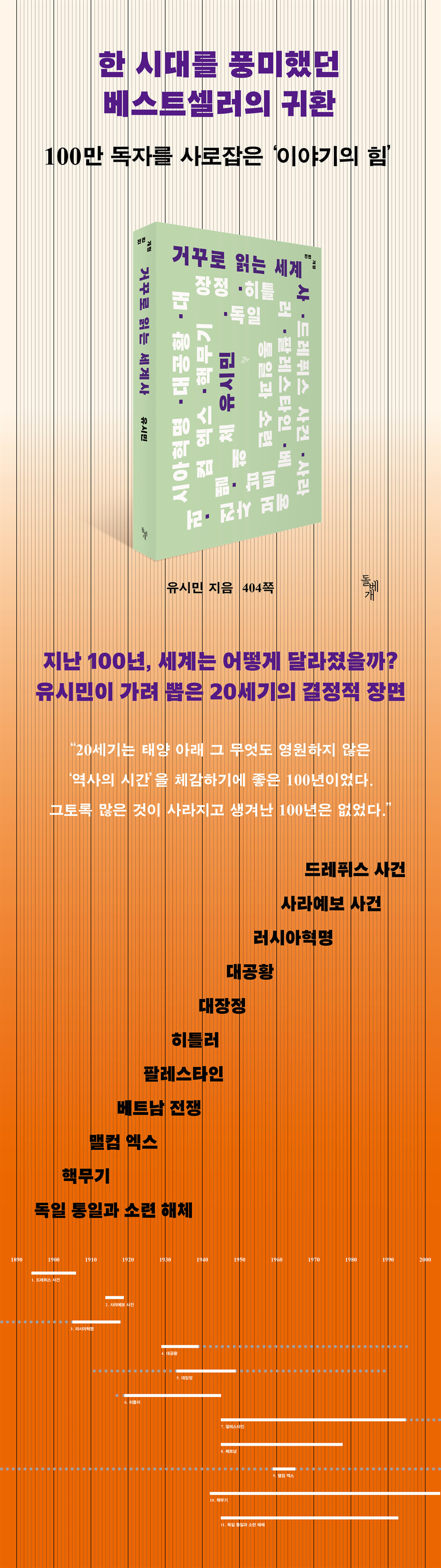
Yoo Si-min's Picks for the Defining Scenes of the 20th Century
If I had to describe the difference between the revised edition and the first edition in one word, it would be '20th century.'
If the late 1980s, when the first edition was written, was the height of the 20th century, now it has already passed the 20th century.
Looking back on the 20th century and looking forward to the 21st century, we now have the time to select events that are deemed significant.
The 20th century was a time when more things disappeared and new things emerged than ever before.
The 20th century was dominated by two world wars that changed the world landscape, the Bolshevik Revolution, the most significant 'political event'; the development of the atomic bomb, the most significant 'technological event'; and the invention of the digital computer, the most significant 'revolutionary event' (p. 375).
And we, living in the 21st century, are still not free from those incidents.
Events that brought the 20th century to a close, such as the Dreyfus Affair (Chapter 1), the Sarajevo Incident (Chapter 2), and the Russian Revolution (Chapter 3), are indispensable because they allow us to examine the messages beyond the events from various angles.
The issues of Palestine (Chapter 7) and nuclear bombs and weapons (Chapter 10), which were hotly debated at the time of the first edition, are still ongoing, so it is necessary to understand the changes and issues at stake.
The eleven defining moments that shaped the 20th century each occupy their own spatiotemporal stage, but the familiar realization that they are all connected is confirmed throughout, like a call to action.
The epilogue contains a fairly long account of the belated reflections I felt as I spent the 20th century and the historical perspective that changed without my knowledge.
After seeing off the 20th century, Yoo Si-min confesses that he can no longer easily be optimistic about history.
Although we have benefited from the accelerating development of science and technology and will face even greater changes in the future, Homo sapiens are helpless in the face of climate crisis or nuclear war, and “I do not believe that humans will become gods” (p. 386).
And his calm and reflective sentences lead each of us to ask ourselves what the 20th century was like.
How to see the tilted world correctly
The joy of knowledge that only studying history can provide
Among the reader reviews of 『Reading World History Backwards』, it is easy to find comments that it served as a guide for studying world history.
It is true that this book is faithful to its role as a guide to convey knowledge, as it was written after studying events that occurred around the world to gain a clearer understanding of Korean society and sharing what it learned.
Maybe that's why.
This book is easy and fun.
Knowledge retailer Yoo Si-min's unique storytelling is boldly displayed, and a series of events that took place over a period of 20 years or even over 100 years flow like a movie.
It is no exaggeration to say that this is the first book recommended for studying world history, a subject that is both broad and confusing.
In addition, the completely revised edition includes a separate chronology at the beginning of each chapter to help point out the turning points of the events.
But above all, this book is useful because it attempts to balance the world history that still circulates with a one-sided bias.
For example, Chapter 9 deals with the civil rights movement in the United States and is titled 'Malcolm X'.
The book describes the well-known achievements of Martin Luther King and Malcolm X in parallel, but also commemorates Malcolm's life, which is less well-known than that of King.
Chapter 8 carefully unravels the process of the outbreak of the two Vietnam Wars and the underlying power relations between the United States, France, and North and South Vietnam, but in the conclusion, it emphasizes the image of Korea as a perpetrator of massacres such as the Phong Nhi and Phong Nhat massacres in Vietnam.
As Yoo Si-min says, studying history doesn't bring immediate benefit.
Nevertheless, the reason I placed 'history' at the center of reading and writing books is because there is a joy of insight and knowledge that can only be gained through that process.
I wanted to share once again the value that no technology can replace, so I refined the book that was published 33 years ago. Isn't it time for us to experience it for ourselves?
Yoo Si-min's Picks for the Defining Scenes of the 20th Century
If I had to describe the difference between the revised edition and the first edition in one word, it would be '20th century.'
If the late 1980s, when the first edition was written, was the height of the 20th century, now it has already passed the 20th century.
Looking back on the 20th century and looking forward to the 21st century, we now have the time to select events that are deemed significant.
The 20th century was a time when more things disappeared and new things emerged than ever before.
The 20th century was dominated by two world wars that changed the world landscape, the Bolshevik Revolution, the most significant 'political event'; the development of the atomic bomb, the most significant 'technological event'; and the invention of the digital computer, the most significant 'revolutionary event' (p. 375).
And we, living in the 21st century, are still not free from those incidents.
Events that brought the 20th century to a close, such as the Dreyfus Affair (Chapter 1), the Sarajevo Incident (Chapter 2), and the Russian Revolution (Chapter 3), are indispensable because they allow us to examine the messages beyond the events from various angles.
The issues of Palestine (Chapter 7) and nuclear bombs and weapons (Chapter 10), which were hotly debated at the time of the first edition, are still ongoing, so it is necessary to understand the changes and issues at stake.
The eleven defining moments that shaped the 20th century each occupy their own spatiotemporal stage, but the familiar realization that they are all connected is confirmed throughout, like a call to action.
The epilogue contains a fairly long account of the belated reflections I felt as I spent the 20th century and the historical perspective that changed without my knowledge.
After seeing off the 20th century, Yoo Si-min confesses that he can no longer easily be optimistic about history.
Although we have benefited from the accelerating development of science and technology and will face even greater changes in the future, Homo sapiens are helpless in the face of climate crisis or nuclear war, and “I do not believe that humans will become gods” (p. 386).
And his calm and reflective sentences lead each of us to ask ourselves what the 20th century was like.
How to see the tilted world correctly
The joy of knowledge that only studying history can provide
Among the reader reviews of 『Reading World History Backwards』, it is easy to find comments that it served as a guide for studying world history.
It is true that this book is faithful to its role as a guide to convey knowledge, as it was written after studying events that occurred around the world to gain a clearer understanding of Korean society and sharing what it learned.
Maybe that's why.
This book is easy and fun.
Knowledge retailer Yoo Si-min's unique storytelling is boldly displayed, and a series of events that took place over a period of 20 years or even over 100 years flow like a movie.
It is no exaggeration to say that this is the first book recommended for studying world history, a subject that is both broad and confusing.
In addition, the completely revised edition includes a separate chronology at the beginning of each chapter to help point out the turning points of the events.
But above all, this book is useful because it attempts to balance the world history that still circulates with a one-sided bias.
For example, Chapter 9 deals with the civil rights movement in the United States and is titled 'Malcolm X'.
The book describes the well-known achievements of Martin Luther King and Malcolm X in parallel, but also commemorates Malcolm's life, which is less well-known than that of King.
Chapter 8 carefully unravels the process of the outbreak of the two Vietnam Wars and the underlying power relations between the United States, France, and North and South Vietnam, but in the conclusion, it emphasizes the image of Korea as a perpetrator of massacres such as the Phong Nhi and Phong Nhat massacres in Vietnam.
As Yoo Si-min says, studying history doesn't bring immediate benefit.
Nevertheless, the reason I placed 'history' at the center of reading and writing books is because there is a joy of insight and knowledge that can only be gained through that process.
I wanted to share once again the value that no technology can replace, so I refined the book that was published 33 years ago. Isn't it time for us to experience it for ourselves?
GOODS SPECIFICS
- Publication date: October 29, 2021
- Page count, weight, size: 404 pages | 582g | 153*225*30mm
- ISBN13: 9791191438406
- ISBN10: 1191438406
You may also like
카테고리
korean


korean

![GQ KOREA Mark (Monthly): December [2025]](http://librairie.coreenne.fr/cdn/shop/files/8ef265dbbfbf186523ed75ba7319009d.jpg?v=1765340328&width=3840)


