

Fish do not exist
 |
Description
Book Introduction
- A word from MD
- Sometimes, when I read science books, I have this thought.
“Wow, it’s so beautiful.” And I’m not even reading literature.
I was amazed again and again while reading “Fish Does Not Exist.”
Even if someone other than me reads it, it will be full of sentences that I would want to read again and again.
I also recommend it to those who think science is difficult.
- Kim Yu-ri, MD of Natural Sciences
Lulu Miller, winner of the Peabody Award, the 'Pulitzer Prize of broadcasting'
A wondrous and shocking debut about love, chaos, and scientific obsession!
Lulu Miller, a Peabody Award-winning science journalist known as the "Pulitzer Prize of broadcasting," has won numerous accolades for her remarkable non-fiction book, "There Are No Fish," which has been selected as one of the "Best Books of 2020" by several media outlets.
This book, which follows the life of a 19th-century scientist who was obsessed with bringing order to the natural world, takes readers into the midst of chaos and raises questions about the order of life we have believed in.
“It is an undeniable fact that fish do not exist.
So what else are we getting wrong?”
For some people, this question may have no bearing on their lives.
But for those who strive to get closer to the "true relationships" that see the world, this book will surely provide surprising inspiration and a broad perspective that is not biased to either side.
A wondrous and shocking debut about love, chaos, and scientific obsession!
Lulu Miller, a Peabody Award-winning science journalist known as the "Pulitzer Prize of broadcasting," has won numerous accolades for her remarkable non-fiction book, "There Are No Fish," which has been selected as one of the "Best Books of 2020" by several media outlets.
This book, which follows the life of a 19th-century scientist who was obsessed with bringing order to the natural world, takes readers into the midst of chaos and raises questions about the order of life we have believed in.
“It is an undeniable fact that fish do not exist.
So what else are we getting wrong?”
For some people, this question may have no bearing on their lives.
But for those who strive to get closer to the "true relationships" that see the world, this book will surely provide surprising inspiration and a broad perspective that is not biased to either side.
- You can preview some of the book's contents.
Preview
index
prolog
1.
The boy with his head in the stars
2.
The Prophet of an Island
3.
Interlude without God
4.
chase the tail
5.
Origins in a Glass Jar
6.
Smash
7.
Indestructible
8.
About deception
9.
The most bitter thing in the world
10.
A place of true horror
11.
ladder
12.
dandelion
13.
Deus Ex Machina
Epilogue
A few words about the illustrations
A few words about change
Acknowledgements
annotation
1.
The boy with his head in the stars
2.
The Prophet of an Island
3.
Interlude without God
4.
chase the tail
5.
Origins in a Glass Jar
6.
Smash
7.
Indestructible
8.
About deception
9.
The most bitter thing in the world
10.
A place of true horror
11.
ladder
12.
dandelion
13.
Deus Ex Machina
Epilogue
A few words about the illustrations
A few words about change
Acknowledgements
annotation
Into the book
My father taught me that 'chaos' is our only ruler.
The great vortex of chaos, the unchecked force, is what created us by chance and what could destroy us at any moment.
“Chaos doesn’t care about any of us.
Our dreams, our intentions, our noblest actions.
“Never forget.”
--- p.55
David believed that even though Darwin had done away with God, his pursuit was still noble.
He continued his quest for the highest blueprint that would reveal the form of nature's ladder, the way all animals and plants are interconnected and ranked.
(…) David believed that examining the anatomy of fish in detail was a way to discover our true creation story, what experiments in life were necessary to create humans.
So what he was doing was looking for clues written in the accidental mistakes and successes of other creatures that could potentially help humanity progress further.
--- p.76
There are real things in this world.
Things that exist even if we don't name them.
Would a fish care if a taxonomist walked over it, picked it up, and called it a “fish”?
A fish is still a fish, with or without a name… .
--- p.95
He was looking for clues in the bones and internal organs of the fish.
Clues as to which creatures gave birth to which creatures, clues as to the direction in which life flows, clues as to the experiments necessary to create humans, and perhaps even clues as to the secrets to improving people.
--- p.105
We know very well that the world is a fundamentally cold place.
We live this way, knowing that no matter how hard we try, success is not guaranteed, that we must compete against hundreds of thousands of others, that we are defenseless against nature, and that everything we love will eventually be destroyed.
But one small lie can round off those sharp edges, help us push through life's trials, and sometimes even lead to unexpected victories.
--- p.141~142
This caution, humility, and respect for the complexities of ecology, which are beyond human comprehension, are in fact very ancient.
This is a philosophical concept sometimes called the “dandelion principle.”
In some situations, dandelions are considered a weed to be weeded out, but in others, they are considered a valuable medicinal herb to be cultivated.
--- p.189
When Darwin came along and exposed the idea of divine plan as a myth, David accepted that the creatures of Earth had come into existence by chance.
But I've been trying to figure out a way to maintain the idea of a hierarchy of perfection.
He said to himself:
It is not God, but time that creates the forms of life.
The slow ticking of time creates more fit, more intelligent, and more morally evolved forms of life.
--- p.204~205
There is never a single way to rank organisms in nature.
To be hung up on one hierarchy is to miss the bigger picture, the intricate truth of nature, of the “total organization of life.”
The job of good science is to try to see beyond the lines we have “conveniently” drawn in nature, to recognize that every living thing you gaze upon has complexities you will never understand.
--- p.227
This is exactly what we have been doing with fish.
They lumped so many subtle differences under the single word “fish.”
--- p.240
When I gave up on fish, I finally got what I was looking for all along.
I got the promise that good things were waiting for me.
It's not that I deserve those good things.
It's not because I tried to get it.
Because good things, like destruction and loss, are also part of chaos.
Life on the other side of death.
Growth, the flip side of corruption.
The best way to never miss those good things, those gifts, those tricks that made me squint my eyes at the desolation and see it more clearly, is to admit, at every moment, that I have no idea what I'm looking at.
In the midst of chaos that comes like a landslide, everything is examined with curiosity and suspicion.
The great vortex of chaos, the unchecked force, is what created us by chance and what could destroy us at any moment.
“Chaos doesn’t care about any of us.
Our dreams, our intentions, our noblest actions.
“Never forget.”
--- p.55
David believed that even though Darwin had done away with God, his pursuit was still noble.
He continued his quest for the highest blueprint that would reveal the form of nature's ladder, the way all animals and plants are interconnected and ranked.
(…) David believed that examining the anatomy of fish in detail was a way to discover our true creation story, what experiments in life were necessary to create humans.
So what he was doing was looking for clues written in the accidental mistakes and successes of other creatures that could potentially help humanity progress further.
--- p.76
There are real things in this world.
Things that exist even if we don't name them.
Would a fish care if a taxonomist walked over it, picked it up, and called it a “fish”?
A fish is still a fish, with or without a name… .
--- p.95
He was looking for clues in the bones and internal organs of the fish.
Clues as to which creatures gave birth to which creatures, clues as to the direction in which life flows, clues as to the experiments necessary to create humans, and perhaps even clues as to the secrets to improving people.
--- p.105
We know very well that the world is a fundamentally cold place.
We live this way, knowing that no matter how hard we try, success is not guaranteed, that we must compete against hundreds of thousands of others, that we are defenseless against nature, and that everything we love will eventually be destroyed.
But one small lie can round off those sharp edges, help us push through life's trials, and sometimes even lead to unexpected victories.
--- p.141~142
This caution, humility, and respect for the complexities of ecology, which are beyond human comprehension, are in fact very ancient.
This is a philosophical concept sometimes called the “dandelion principle.”
In some situations, dandelions are considered a weed to be weeded out, but in others, they are considered a valuable medicinal herb to be cultivated.
--- p.189
When Darwin came along and exposed the idea of divine plan as a myth, David accepted that the creatures of Earth had come into existence by chance.
But I've been trying to figure out a way to maintain the idea of a hierarchy of perfection.
He said to himself:
It is not God, but time that creates the forms of life.
The slow ticking of time creates more fit, more intelligent, and more morally evolved forms of life.
--- p.204~205
There is never a single way to rank organisms in nature.
To be hung up on one hierarchy is to miss the bigger picture, the intricate truth of nature, of the “total organization of life.”
The job of good science is to try to see beyond the lines we have “conveniently” drawn in nature, to recognize that every living thing you gaze upon has complexities you will never understand.
--- p.227
This is exactly what we have been doing with fish.
They lumped so many subtle differences under the single word “fish.”
--- p.240
When I gave up on fish, I finally got what I was looking for all along.
I got the promise that good things were waiting for me.
It's not that I deserve those good things.
It's not because I tried to get it.
Because good things, like destruction and loss, are also part of chaos.
Life on the other side of death.
Growth, the flip side of corruption.
The best way to never miss those good things, those gifts, those tricks that made me squint my eyes at the desolation and see it more clearly, is to admit, at every moment, that I have no idea what I'm looking at.
In the midst of chaos that comes like a landslide, everything is examined with curiosity and suspicion.
--- p.263~264
Publisher's Review
A Best Book of 2020 by The Washington Post, Book Riot, National Public Radio (NPR), Chicago Tribune, and Smithsonian!
Lulu Miller, winner of the Peabody Award, the 'Pulitzer Prize of broadcasting'
A wondrous and shocking debut about love, chaos, and scientific obsession!
Lulu Miller, a Peabody Award-winning science journalist known as the "Pulitzer Prize of broadcasting," has won numerous accolades for her remarkable non-fiction book, "There Are No Fish," a bestseller that has been named one of the "Best Books of 2020" by several media outlets.
This book, which follows the life of a 19th-century scientist who was obsessed with bringing order to the natural world, takes readers into the midst of chaos and raises questions about the order of life we have believed in.
“It is an undeniable fact that fish do not exist.
So what else are we getting wrong?”
For some people, this question may have no bearing on their lives.
But for those who strive to get closer to the "true relationships" that see the world, this book will surely provide surprising inspiration and a broad perspective that is not biased to either side.
If fish don't exist, what else do we still know about this world? What categories are about to collapse? Could clouds be living beings? Who knows?
They say it rains diamonds on Neptune.
That's true.
Scientists figured that out just a few years ago.
The longer we examine the world, the stranger it will become.
Page 265
Even if we don't name it
There are real things in this world.
Within the vast structure of the world called "Fish Does Not Exist," the book depicts a free-spirited journey that overturns our notions about "what kind of beings fish (and we) are."
The author, who had lost love and thought his life was over, accidentally met David Stan Jordan and was fascinated by his fearless attitude in the face of chaos, and began to trace his life.
This is because the author also believed that in this world, “chaos is not a question of ‘if it happens,’ but a question of ‘when it happens,’” and that no one can escape this truth.
But Jordan's story takes readers to places they never expected, and soon enough, it leaves us with a shocking shock that leaves us wide-eyed.
Told in an intimate and unique way by Lulu Miller, this book is a story of scientific struggles, love, loss, and chaos.
It further shows how beliefs sustain us, but also how they can become detrimental.
As you delve into the questions in this book one by one, you, the reader, will encounter a deeper and more special secret of life hidden behind them.
Now I finally found a rebuttal to my father.
“We are important.
We matter!” Human beings matter in real and concrete ways to this planet, to society, and to each other.
This is not a lie.
It's not a lame excuse, nor is it a sin.
That was Darwin's belief! Conversely, it is false to simply say we are unimportant and then insist on that assertion.
It's too gloomy, too rigid, and too short-sighted.
To put it in the harshest terms, it is unscientific.
Page 228
Through a lens of amazingly interesting science stories
Tenaciously uncovering the hidden order of life
David Starr Jordan, former president of Stanford University, was a 19th-century biologist (taxonomist) who dedicated his life to uncovering the relationships between all living things, which branch out like a giant tree of life, and how they are interconnected.
The number of fish he discovered and named himself amounted to nearly one-fifth of all fish known to mankind at the time.
But the more he uncovered of the hidden Tree of Life, the more persistently the universe interfered with his work.
His numerous collections were destroyed by a lightning-caused fire, and the subsequent 1906 San Francisco earthquake sent over a thousand fish species tumbling to the ground in glass jars.
In an instant, all the achievements he had built up were shattered.
Most people would have given up in despair after going through something like this.
So what about Jordan? He scanned the debris of destruction strewn across his feet, picked up any fish he could identify, and then went on to build his collection.
This time, he even introduced an ingenious and innovative method, which he firmly believed would protect the specimens he had discovered against the chaos of the world.
When author Lulu Miller first heard this anecdote, she thought Jordan was a fool and saw it as a warning against arrogance or a rejection of the order of life.
Then suddenly, I became curious about Jordan.
Perhaps he was not a reckless person, but a lesson that taught us how to navigate adversity and ultimately overcome it.
What Miller discovered about Jordan's life—including a mysterious death and a startling theory that would change the world—completely reshaped his understanding of the order of the universe.
The idea that salvation may lie in the things we have so-called underestimated.
"Fish Doesn't Exist" offers a prescription for hope that good things await even amidst destruction and loss, encouraging readers to examine all objects amidst chaos with curiosity and skepticism, allowing them to see them more clearly.
If fish don't exist, what else are we getting wrong? As the daughter of a scientist, it took me a long time to realize this, but when I give up on fish, I realize science itself is flawed.
I realize that science is not the torch that illuminates the truth, as I always thought, but rather a blunt instrument that can cause a lot of destruction along the way.
Page 267
Part biography, part memoir, part scientific adventure, "There Are No Fish" offers a whole new way to look at the world through the lens of science.
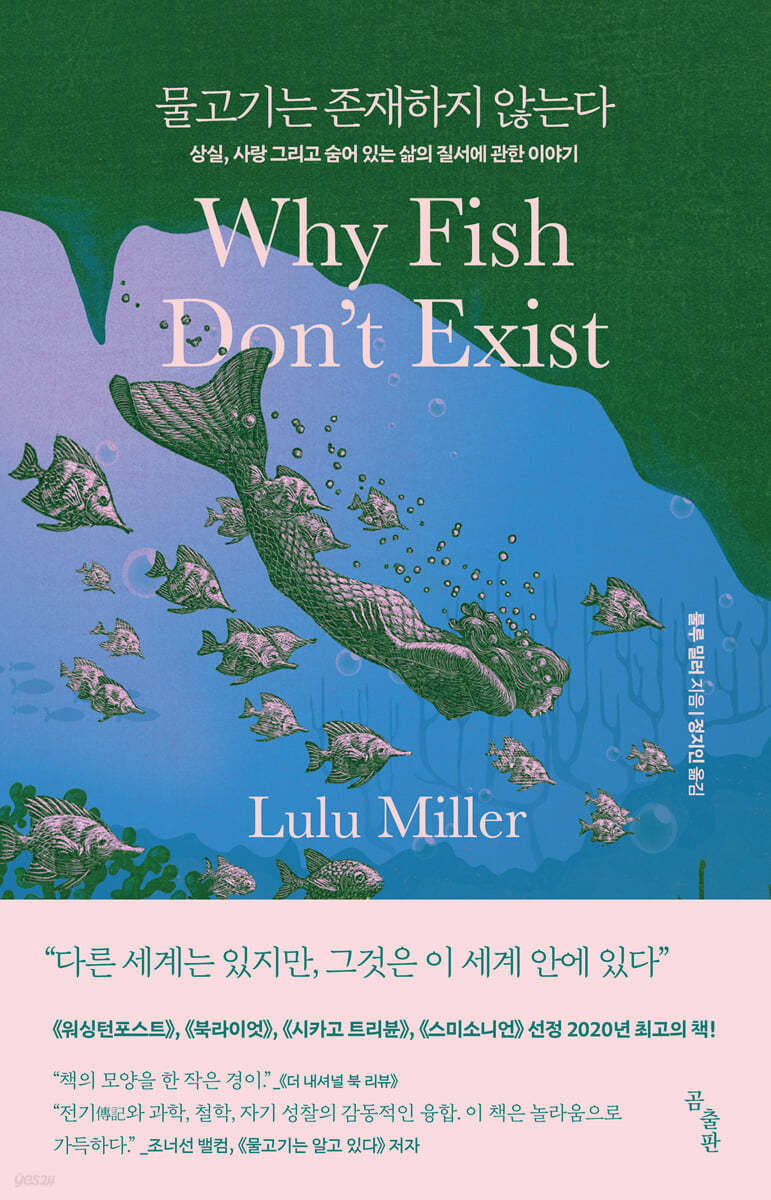
In particular, the unique and elaborate illustrations included in each chapter give the book a mysterious yet grotesque feeling, as if holding a 19th-century scientific text in one's hands.
"Fish Don't Exist," which can also be read as a fable about a life that endures steadfastly in a world where chaos always triumphs, will provide an unforgettable experience that stimulates our thoughts and makes us realize the hidden truths of life.
“I was captivated by Miller’s book, which took us into a strange abyss we had never imagined.” _The New York Times
“A truly fascinating book.
Miller's story was so captivating that I read it in one sitting.” _The Wall Street Journal
“A completely captivating and mesmerizing book.” _The Oprah Magazine
“A small wonder in the shape of a book.” _The National Book Review
“It’s clever.
“A unique and wonderful book!” _Kirkus Reviews
“This book has the thrill of a mystery novel, but it is also a philosophical commentary on the human quest to create order out of chaos.”
_〈Library Journal〉
Lulu Miller, winner of the Peabody Award, the 'Pulitzer Prize of broadcasting'
A wondrous and shocking debut about love, chaos, and scientific obsession!
Lulu Miller, a Peabody Award-winning science journalist known as the "Pulitzer Prize of broadcasting," has won numerous accolades for her remarkable non-fiction book, "There Are No Fish," a bestseller that has been named one of the "Best Books of 2020" by several media outlets.
This book, which follows the life of a 19th-century scientist who was obsessed with bringing order to the natural world, takes readers into the midst of chaos and raises questions about the order of life we have believed in.
“It is an undeniable fact that fish do not exist.
So what else are we getting wrong?”
For some people, this question may have no bearing on their lives.
But for those who strive to get closer to the "true relationships" that see the world, this book will surely provide surprising inspiration and a broad perspective that is not biased to either side.
If fish don't exist, what else do we still know about this world? What categories are about to collapse? Could clouds be living beings? Who knows?
They say it rains diamonds on Neptune.
That's true.
Scientists figured that out just a few years ago.
The longer we examine the world, the stranger it will become.
Page 265
Even if we don't name it
There are real things in this world.
Within the vast structure of the world called "Fish Does Not Exist," the book depicts a free-spirited journey that overturns our notions about "what kind of beings fish (and we) are."
The author, who had lost love and thought his life was over, accidentally met David Stan Jordan and was fascinated by his fearless attitude in the face of chaos, and began to trace his life.
This is because the author also believed that in this world, “chaos is not a question of ‘if it happens,’ but a question of ‘when it happens,’” and that no one can escape this truth.
But Jordan's story takes readers to places they never expected, and soon enough, it leaves us with a shocking shock that leaves us wide-eyed.
Told in an intimate and unique way by Lulu Miller, this book is a story of scientific struggles, love, loss, and chaos.
It further shows how beliefs sustain us, but also how they can become detrimental.
As you delve into the questions in this book one by one, you, the reader, will encounter a deeper and more special secret of life hidden behind them.
Now I finally found a rebuttal to my father.
“We are important.
We matter!” Human beings matter in real and concrete ways to this planet, to society, and to each other.
This is not a lie.
It's not a lame excuse, nor is it a sin.
That was Darwin's belief! Conversely, it is false to simply say we are unimportant and then insist on that assertion.
It's too gloomy, too rigid, and too short-sighted.
To put it in the harshest terms, it is unscientific.
Page 228
Through a lens of amazingly interesting science stories
Tenaciously uncovering the hidden order of life
David Starr Jordan, former president of Stanford University, was a 19th-century biologist (taxonomist) who dedicated his life to uncovering the relationships between all living things, which branch out like a giant tree of life, and how they are interconnected.
The number of fish he discovered and named himself amounted to nearly one-fifth of all fish known to mankind at the time.
But the more he uncovered of the hidden Tree of Life, the more persistently the universe interfered with his work.
His numerous collections were destroyed by a lightning-caused fire, and the subsequent 1906 San Francisco earthquake sent over a thousand fish species tumbling to the ground in glass jars.
In an instant, all the achievements he had built up were shattered.
Most people would have given up in despair after going through something like this.
So what about Jordan? He scanned the debris of destruction strewn across his feet, picked up any fish he could identify, and then went on to build his collection.
This time, he even introduced an ingenious and innovative method, which he firmly believed would protect the specimens he had discovered against the chaos of the world.
When author Lulu Miller first heard this anecdote, she thought Jordan was a fool and saw it as a warning against arrogance or a rejection of the order of life.
Then suddenly, I became curious about Jordan.
Perhaps he was not a reckless person, but a lesson that taught us how to navigate adversity and ultimately overcome it.
What Miller discovered about Jordan's life—including a mysterious death and a startling theory that would change the world—completely reshaped his understanding of the order of the universe.
The idea that salvation may lie in the things we have so-called underestimated.
"Fish Doesn't Exist" offers a prescription for hope that good things await even amidst destruction and loss, encouraging readers to examine all objects amidst chaos with curiosity and skepticism, allowing them to see them more clearly.
If fish don't exist, what else are we getting wrong? As the daughter of a scientist, it took me a long time to realize this, but when I give up on fish, I realize science itself is flawed.
I realize that science is not the torch that illuminates the truth, as I always thought, but rather a blunt instrument that can cause a lot of destruction along the way.
Page 267
Part biography, part memoir, part scientific adventure, "There Are No Fish" offers a whole new way to look at the world through the lens of science.
In particular, the unique and elaborate illustrations included in each chapter give the book a mysterious yet grotesque feeling, as if holding a 19th-century scientific text in one's hands.
"Fish Don't Exist," which can also be read as a fable about a life that endures steadfastly in a world where chaos always triumphs, will provide an unforgettable experience that stimulates our thoughts and makes us realize the hidden truths of life.
“I was captivated by Miller’s book, which took us into a strange abyss we had never imagined.” _The New York Times
“A truly fascinating book.
Miller's story was so captivating that I read it in one sitting.” _The Wall Street Journal
“A completely captivating and mesmerizing book.” _The Oprah Magazine
“A small wonder in the shape of a book.” _The National Book Review
“It’s clever.
“A unique and wonderful book!” _Kirkus Reviews
“This book has the thrill of a mystery novel, but it is also a philosophical commentary on the human quest to create order out of chaos.”
_〈Library Journal〉
GOODS SPECIFICS
- Publication date: December 17, 2021
- Page count, weight, size: 300 pages | 480g | 135*210*20mm
- ISBN13: 9791189327156
- ISBN10: 1189327155
You may also like
카테고리
korean


korean

![GQ KOREA Mark (Monthly): December [2025]](http://librairie.coreenne.fr/cdn/shop/files/8ef265dbbfbf186523ed75ba7319009d.jpg?v=1765340328&width=3840)


