

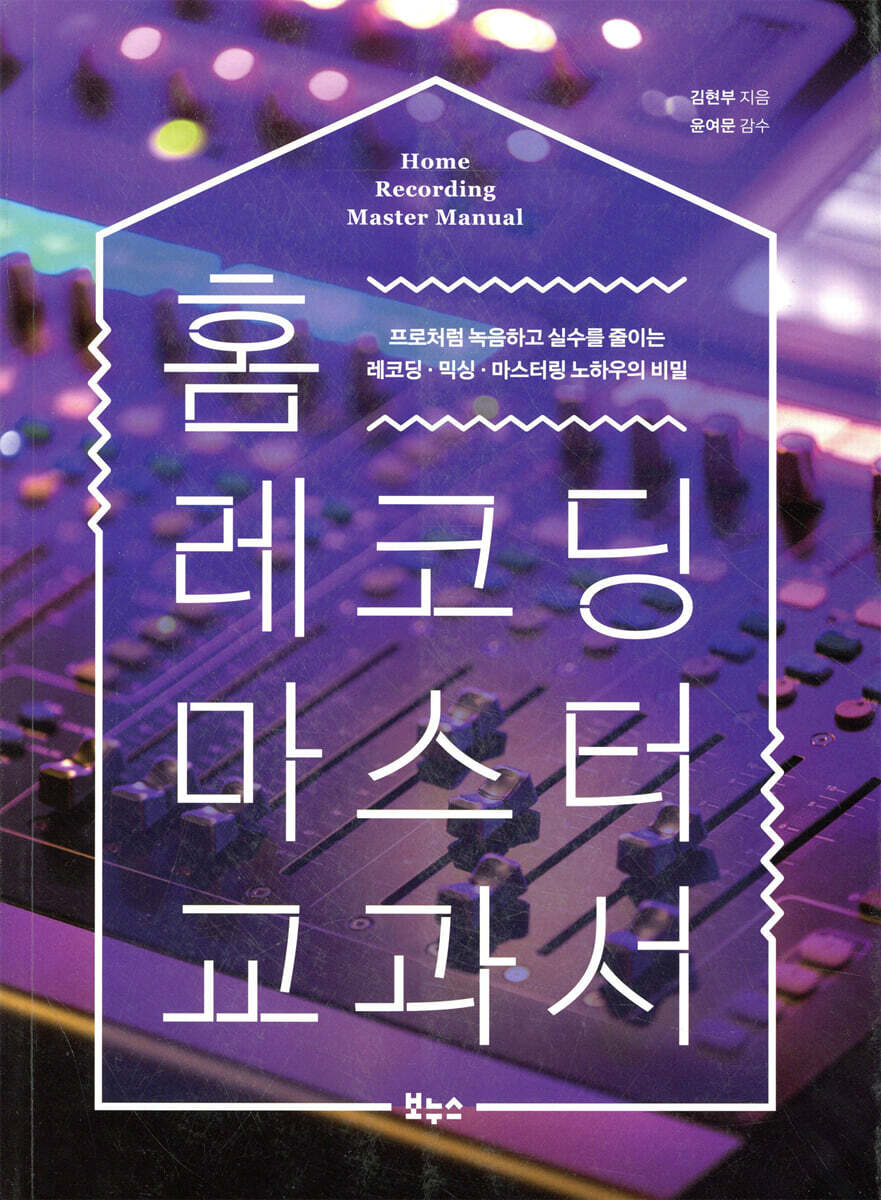
Home Recording Mastering Textbook
 |
Description
Book Introduction
This is a guide for those who want to try the unfamiliar and difficult task of home recording.
We will teach you how to understand the characteristics of home recording and how to make the most of your equipment and programs.
I tried to give a concept-oriented explanation rather than a method for using a specific program.
Therefore, it helps you learn how to use programs or equipment that you are seeing for the first time without difficulty.
This book proceeds by working through each task one by one using real multi-track examples.
The book is filled with the author's know-how and advice, providing access to a wealth of skills and experiences that can only be gained through field experience.
We will teach you how to understand the characteristics of home recording and how to make the most of your equipment and programs.
I tried to give a concept-oriented explanation rather than a method for using a specific program.
Therefore, it helps you learn how to use programs or equipment that you are seeing for the first time without difficulty.
This book proceeds by working through each task one by one using real multi-track examples.
The book is filled with the author's know-how and advice, providing access to a wealth of skills and experiences that can only be gained through field experience.
- You can preview some of the book's contents.
Preview
index
Introduction : Understanding the Characteristics of Home Recording and Making the Most of Your Equipment
Part 1 recording
01 Sound conversion process
From Sound to Sound | The Identity of Sound: Air Vibrations | Microphones: Converting Air Vibrations into Electricity | Audio Interfaces that Amplify Microphone Levels | From Analog to Digital, from Digital to Analog | About Headphones and Speakers
02 Acoustics in my room
Listen to the sounds in your room | Check for echoes in your room | The best way to block out noise | Use a reflection filter
03 Digital Common Sense and Computer Optimization for Home Recording
Recording before the computer age | Computer advancements and digital recording | Sample rates and bit depth | Optimizing computers and their specifications
04 Audio Interface
The Role of an Audio Interface | What Does a Converter Do? | Understanding Microphone Preamplifiers | Number of Input and Output Channels | Types of Connection Terminals
05 Monitoring System
Which monitoring system is best? | A system with a flat frequency response | The human ear cannot hear all frequencies consistently | Speakers, headphones, or earphones: which one to choose?
06 How to Choose a Microphone
What's the Right Microphone for Home Recording? | What's a Dynamic Microphone? | What's a Condenser Microphone? | How Does a Microphone Pick Up Sound? | Other Microphone Features | Microphone Accessories
07 Recording Level Setting
Let's start recording! | Equipment isn't really important | People who don't distinguish between music and sound quality | Between noise and recording | Getting away from noise
08 Vocal Recording - Record Your Voice
Things to consider before recording vocals | How to choose a microphone | How to position your microphone | Preventing popping | Addressing excessive sibilance | Avoiding unwanted echo | Shock mounts that absorb vibration | Using reverb | Precautions when recording rap vocals
09 Getting to Know Your Acoustic Guitar Before Recording
Let's first understand the characteristics of acoustic guitars | How sound is produced from acoustic guitars | Classification of acoustic guitars by size | Classification of acoustic guitars by shape | Classification of acoustic guitars by material
10 Recording Acoustic Guitar
Precautions for Recording Acoustic Guitar | Acoustic Guitar Tone | Line Recording of Acoustic Guitar
11 DI
Learn about Box
DI
The Birth of the Box | DI
Box Features
12 Electric Guitar and Bass Guitar - Recording Bass and Electric Guitar at Home
Types and Features of Pickups | About Pedalboards | Understanding Reamps | Understanding Your Equipment's Output Stage | Recording Bass Guitar
13 Recording the Saxophone
How to Reduce Echoes in Your Home Recording Space | Characteristics of Saxophone Tone | Installing a Microphone on Your Saxophone | Criteria for Choosing a Microphone | Understanding Saxophone Structure and Tone for Recording
14 Recording Cajon and Percussion Instruments
About the cajon | When to use the cajon for home recording | The structure of the cajon | Setting up a microphone | How to use two microphones | When to check phase | Choosing a microphone
15 Recording drums
Things to know before recording drums | Recording drums with one microphone | Recording drums with two microphones | Recording drums with three microphones | Stereo microphone technique | Recording drums with four microphones | How to improve your drum recordings
16 Setting up your DAW for recording
What is a Digital Audio Workstation? | Creating a Project | Recording Track Information
17 Recording Track Settings
Setting Up a Recording Track | Setting Up a Reverb Track and Sending a Vocal Signal
Part 2 recording
01 What is mixing?
What you need to know before mixing | Understanding mixing concepts | Why mixing is difficult | What makes a good mix? | Train your hearing
02 All About Mixing, Balance
Minimum Monitoring System Specifications | Balance: The Beginning and Completion of an Audio Mix | Preparing to Mix | Getting Started with Mixing
03 Subgrouping using buses and oxes
Before Grouping | Creating a Group
04 Drum Mixing (1)
Full-fledged drum mixing | Mixing the kick drum | Mixing the snare drum | Setting drum reverb | Mixing hi-hats | Overhead and room mics | Adding toms | Sample drums for the interlude | The benefits of drum summing
05 Drum Mixing (2)
Let's revisit the drum track | Compressor or EQ: Which comes first? | Understanding drum tone
06 Drum Mixing (3)
Handling Tom Toms | Setting the Gate | Controlling SPL with a Compressor | Tom Toms and Reverb | Setting Tom Tom 2 | Setting Floor Toms | Re-balancing
07 Drum Mixing (4)
Hi-hats and Cymbals | Adjusting Hi-hat Levels | Cymbals and Overheads | Balancing | Reverb Settings
08 Drum Mixing (5)
Finishing the Drum Mix | Bus Processing and Parallel Processing | Finishing the Drum Mix
09 Mixing the Bass Guitar
Bass Characteristics You Need to Know Before Mixing | Full-Fledged Bass Mixing
10 Mixing Piano and Keyboard Instruments
Before Mixing Keyboard Instruments | Mixing Piano Tracks | Mixing Synth Tracks
11 Mixing Acoustic and Electric Guitars
Before Mixing Guitar Tracks | Mixing Guitar Tracks
12 Guitar Amp Simulations and Pedalboard Effects
DI
Mixing Guitar Tracks Recorded with Box | Explore Amp Simulations | Explore Guitar Pedalboard Plug-ins | Find the Right Amp and Effects for the Job
13 Vocal Mixing: Editing and Vocal Tuning
Clean Up Your Vocal Tracks | Get Started with Vocal Tuning
14 Vocal Compression and Equalization
Vocal editing and tuning essential before vocal mixing | Starting vocal track mixing with dynamics | Working with the gain stage | EQ first or compressor first? | Plug-in usage order for vocal tracks | Vocal compression and EQ | Questions to ask yourself while mixing vocals
15 About Vocal Reverb
The Role of Vocal Reverb | Finding the Right Reverb for Your Mix | Learn More About Reverb
16 Delay, pitch shift, saturation and parallel processing
How to Use Delay in Various Ways | How to Use Pitch Shift | Creating Rich Sounds with Saturation | Parallel Processing of Vocal Tracks | Finishing Up Vocal Mixing
17 Improving the Perfection of Mixing
The Virtuous Mixing Process | Which Plug-ins Should You Use? | Train Your Ears for Great Mixing | Developing a Genre-Specific Sonic Sense | Developing Frequency Response Sensitivity | The Secret to Greater Focus
Part 3 Mastering
01 What is Mastering?
Before you begin mastering in earnest | What is mastering? | Key concepts of mastering | What makes mastering-grade plugins different? | The mastering process
02 Mid/Side Processing and Mastering
Can I control the sound in the middle? | The practicalities of mid/side processing | How to improve the perfection of mastering work
Conclusion _ DAW, Embracing Analog
Appendix _ Music Distribution Channels and Revenue Structure
Learn about 'distributors' and music source brokers | Music | Jacket images | Artist images | Album introduction, press releases, credits | Music distribution structure | What if I wrote a song? | What if I sang or played an instrument? | I'd love to hear my song on TV! | Can I hear my song on YouTube?
Search
Part 1 recording
01 Sound conversion process
From Sound to Sound | The Identity of Sound: Air Vibrations | Microphones: Converting Air Vibrations into Electricity | Audio Interfaces that Amplify Microphone Levels | From Analog to Digital, from Digital to Analog | About Headphones and Speakers
02 Acoustics in my room
Listen to the sounds in your room | Check for echoes in your room | The best way to block out noise | Use a reflection filter
03 Digital Common Sense and Computer Optimization for Home Recording
Recording before the computer age | Computer advancements and digital recording | Sample rates and bit depth | Optimizing computers and their specifications
04 Audio Interface
The Role of an Audio Interface | What Does a Converter Do? | Understanding Microphone Preamplifiers | Number of Input and Output Channels | Types of Connection Terminals
05 Monitoring System
Which monitoring system is best? | A system with a flat frequency response | The human ear cannot hear all frequencies consistently | Speakers, headphones, or earphones: which one to choose?
06 How to Choose a Microphone
What's the Right Microphone for Home Recording? | What's a Dynamic Microphone? | What's a Condenser Microphone? | How Does a Microphone Pick Up Sound? | Other Microphone Features | Microphone Accessories
07 Recording Level Setting
Let's start recording! | Equipment isn't really important | People who don't distinguish between music and sound quality | Between noise and recording | Getting away from noise
08 Vocal Recording - Record Your Voice
Things to consider before recording vocals | How to choose a microphone | How to position your microphone | Preventing popping | Addressing excessive sibilance | Avoiding unwanted echo | Shock mounts that absorb vibration | Using reverb | Precautions when recording rap vocals
09 Getting to Know Your Acoustic Guitar Before Recording
Let's first understand the characteristics of acoustic guitars | How sound is produced from acoustic guitars | Classification of acoustic guitars by size | Classification of acoustic guitars by shape | Classification of acoustic guitars by material
10 Recording Acoustic Guitar
Precautions for Recording Acoustic Guitar | Acoustic Guitar Tone | Line Recording of Acoustic Guitar
11 DI
Learn about Box
DI
The Birth of the Box | DI
Box Features
12 Electric Guitar and Bass Guitar - Recording Bass and Electric Guitar at Home
Types and Features of Pickups | About Pedalboards | Understanding Reamps | Understanding Your Equipment's Output Stage | Recording Bass Guitar
13 Recording the Saxophone
How to Reduce Echoes in Your Home Recording Space | Characteristics of Saxophone Tone | Installing a Microphone on Your Saxophone | Criteria for Choosing a Microphone | Understanding Saxophone Structure and Tone for Recording
14 Recording Cajon and Percussion Instruments
About the cajon | When to use the cajon for home recording | The structure of the cajon | Setting up a microphone | How to use two microphones | When to check phase | Choosing a microphone
15 Recording drums
Things to know before recording drums | Recording drums with one microphone | Recording drums with two microphones | Recording drums with three microphones | Stereo microphone technique | Recording drums with four microphones | How to improve your drum recordings
16 Setting up your DAW for recording
What is a Digital Audio Workstation? | Creating a Project | Recording Track Information
17 Recording Track Settings
Setting Up a Recording Track | Setting Up a Reverb Track and Sending a Vocal Signal
Part 2 recording
01 What is mixing?
What you need to know before mixing | Understanding mixing concepts | Why mixing is difficult | What makes a good mix? | Train your hearing
02 All About Mixing, Balance
Minimum Monitoring System Specifications | Balance: The Beginning and Completion of an Audio Mix | Preparing to Mix | Getting Started with Mixing
03 Subgrouping using buses and oxes
Before Grouping | Creating a Group
04 Drum Mixing (1)
Full-fledged drum mixing | Mixing the kick drum | Mixing the snare drum | Setting drum reverb | Mixing hi-hats | Overhead and room mics | Adding toms | Sample drums for the interlude | The benefits of drum summing
05 Drum Mixing (2)
Let's revisit the drum track | Compressor or EQ: Which comes first? | Understanding drum tone
06 Drum Mixing (3)
Handling Tom Toms | Setting the Gate | Controlling SPL with a Compressor | Tom Toms and Reverb | Setting Tom Tom 2 | Setting Floor Toms | Re-balancing
07 Drum Mixing (4)
Hi-hats and Cymbals | Adjusting Hi-hat Levels | Cymbals and Overheads | Balancing | Reverb Settings
08 Drum Mixing (5)
Finishing the Drum Mix | Bus Processing and Parallel Processing | Finishing the Drum Mix
09 Mixing the Bass Guitar
Bass Characteristics You Need to Know Before Mixing | Full-Fledged Bass Mixing
10 Mixing Piano and Keyboard Instruments
Before Mixing Keyboard Instruments | Mixing Piano Tracks | Mixing Synth Tracks
11 Mixing Acoustic and Electric Guitars
Before Mixing Guitar Tracks | Mixing Guitar Tracks
12 Guitar Amp Simulations and Pedalboard Effects
DI
Mixing Guitar Tracks Recorded with Box | Explore Amp Simulations | Explore Guitar Pedalboard Plug-ins | Find the Right Amp and Effects for the Job
13 Vocal Mixing: Editing and Vocal Tuning
Clean Up Your Vocal Tracks | Get Started with Vocal Tuning
14 Vocal Compression and Equalization
Vocal editing and tuning essential before vocal mixing | Starting vocal track mixing with dynamics | Working with the gain stage | EQ first or compressor first? | Plug-in usage order for vocal tracks | Vocal compression and EQ | Questions to ask yourself while mixing vocals
15 About Vocal Reverb
The Role of Vocal Reverb | Finding the Right Reverb for Your Mix | Learn More About Reverb
16 Delay, pitch shift, saturation and parallel processing
How to Use Delay in Various Ways | How to Use Pitch Shift | Creating Rich Sounds with Saturation | Parallel Processing of Vocal Tracks | Finishing Up Vocal Mixing
17 Improving the Perfection of Mixing
The Virtuous Mixing Process | Which Plug-ins Should You Use? | Train Your Ears for Great Mixing | Developing a Genre-Specific Sonic Sense | Developing Frequency Response Sensitivity | The Secret to Greater Focus
Part 3 Mastering
01 What is Mastering?
Before you begin mastering in earnest | What is mastering? | Key concepts of mastering | What makes mastering-grade plugins different? | The mastering process
02 Mid/Side Processing and Mastering
Can I control the sound in the middle? | The practicalities of mid/side processing | How to improve the perfection of mastering work
Conclusion _ DAW, Embracing Analog
Appendix _ Music Distribution Channels and Revenue Structure
Learn about 'distributors' and music source brokers | Music | Jacket images | Artist images | Album introduction, press releases, credits | Music distribution structure | What if I wrote a song? | What if I sang or played an instrument? | I'd love to hear my song on TV! | Can I hear my song on YouTube?
Search
Detailed image

Publisher's Review
For aspiring musicians and professionals
Recording, Mixing, and Mastering Guide
It's the golden age of auditions.
There are so many audition programs like 'Show Me the Money', 'Unknown Singer', and 'Tomorrow is Miss Trot' that it's almost overwhelming.
Practical music departments have been springing up like mushrooms in universities over the past few years.
There are many people who want to make a living from music, but what's interesting is that there are also more and more people who want to make music in their own personal spaces rather than in professional recording studios.
In the past, if you wanted to work on an album, you had to find a professional recording studio.
We recorded with large, expensive equipment and did the mixing and mastering.
Working on an album has always been a grand and expensive undertaking.
Then, with the advent of Digital Audio Workstations, also known as DAWs, it became possible to work on albums in places other than large studios.
With a computer and some equipment, I can work on the music I want, wherever and whenever I want, and even distribute it to internet cloud sites.
This is an era where anyone with a passion for music can become a musician.
Thanks to this background, interest in home recording has grown and more people are trying it.
But just doing home recording and doing it right are two entirely different things.
So, how can we make good home recordings?
Never be overwhelmed by unfamiliar home recordings
Home recording tips that will make you sound like a pro just by following along.
《Home Recording Mastering Textbook》 serves as a compass for those lost in the forest of recording, mixing, and mastering.
The author, who studied music engineering and composition at Berklee College of Music and New York University, constantly tells people who are starting out in home recording to "don't panic."
No one knows everything from the beginning and is good at it.
The author suggests that we slowly explore home recording together.
Using real multi-track files as examples (available for free download online), the author walks you through the entire process, from recording to mastering.
The goal is to learn the core concepts of recording, mixing, and mastering by solving specific problems yourself, without making the mistake of getting lost in technical terminology and theoretical explanations.
This book explains everything from a concept-centric perspective, which prevents it from becoming a user manual for a specific program or plugin.
When faced with a problem, the author always explains what the problem is and what needs to be solved.
Here's how to use the program:
The author says that as long as you have a solid grasp of the concepts and principles, it doesn't matter what programs and equipment you currently have.
Rather than buying new equipment or programs to solve a specific problem, it's more realistic and efficient to think about how to use the equipment and programs you already have.
Like a pro in your corner studio!
From recording to mastering, finish like a pro.
If you're just starting out with home recording or don't have much experience, you'll probably find that home recording is harder than you think.
Of course, there is nothing wrong with the equipment or program.
You need to understand the characteristics of home recording and work efficiently accordingly.
You need to learn how to take advantage of the advantages of home recording and minimize its disadvantages.
First, it's important to recognize the differences between professional recording studios and home recording studios.
There are several differences, but the noise issue is the most noticeable.
Compared to professional recording studios, home recording locations are plagued by a tremendous amount of noise.
If we can solve this problem alone, the quality of home recording will improve significantly.
The book explains how to check the sound before starting a home recording project and how to minimize noise problems.
Once you understand the characteristics of your workspace and have addressed any issues, you'll want to learn about the types and characteristics of microphones and audio interfaces you'll use for recording.
To overcome the shortcomings of a poor working environment, it is necessary to more accurately understand and utilize the characteristics of each piece of equipment.
After looking at the recording equipment and monitoring system, we begin the actual recording.
Of course, it goes without saying that you should know the recording level settings in detail beforehand.
Afterwards, the book goes into detail about each recording process, from vocals to guitar, bass, saxophone, cajon, drums, etc. (and also looks at the characteristics of each instrument), and naturally moves on to the post-processing of mixing and mastering.
Learn how to set up recording tracks, understand the concept of mixing, and try to understand mixing balance.
Once you master subgrouping, you will gain the knowledge necessary to mix each instrument, including vocals.
For example, you can learn guitar amp simulation and pedal board effects, vocal editing and tuning, vocal compressors and equalizers, reverb, delay, saturation, parallel processing, and more.
Part 3, which covers mastering, is shorter than Parts 1 and 2, which cover recording and mixing.
However, it covers the core concepts of what mastering is, teaches mid/side processing, and 'don't ask, mastering' secrets, so it's a real help to both those who need to master right away and those who are learning mastering for the first time.
A veteran sound engineer teaches
Home recording practical experience and skills
《Home Recording Mastery Textbook》 is of great help to both those who are just starting out with home recording and those who don't have much experience with home recording.
This is because the author personally guides you through the entire process from recording to mastering, and even includes solutions to problems encountered along the way.
Naturally, the author's experience and know-how are generously incorporated into this entire process.
Throughout the book, readers can find tips and advice derived from the author's extensive field experience. The author's message to readers throughout the book can be summarized in two points:
First, you must fully understand the concepts and how to use the tools needed for home recording, including programs and equipment.
In particular, if you learn how to use it with a concept-centered approach, you will not be surprised when faced with a problem for the first time, but will be able to calmly come up with solutions one by one. You will also be able to quickly learn how to use unfamiliar programs or equipment without much difficulty.
Second, don't be tied to tools and work mechanically, but keep asking yourself 'why you want to do this'.
For example, avoid using the equalizer manually every time.
You have to ask yourself why you want to equalize now.
Remember the original purpose of the equalizer, which was to change the tone, and keep asking yourself if what you are trying to do is appropriate.
This questioning process may seem so obvious, but it can surprisingly provide hints that can help prevent many problems or even provide solutions to problems that have already occurred.
Focus on concepts, learn how to properly use the tools needed for home recording, and continue to ask productive questions without forgetting the purpose of the work.
If you consistently work on your music while following these two tips from "Home Recording Mastery Textbook," even the seemingly difficult task of home recording will not be an insurmountable obstacle.
This book is a great guide for anyone with a passion for music.
Recording, Mixing, and Mastering Guide
It's the golden age of auditions.
There are so many audition programs like 'Show Me the Money', 'Unknown Singer', and 'Tomorrow is Miss Trot' that it's almost overwhelming.
Practical music departments have been springing up like mushrooms in universities over the past few years.
There are many people who want to make a living from music, but what's interesting is that there are also more and more people who want to make music in their own personal spaces rather than in professional recording studios.
In the past, if you wanted to work on an album, you had to find a professional recording studio.
We recorded with large, expensive equipment and did the mixing and mastering.
Working on an album has always been a grand and expensive undertaking.
Then, with the advent of Digital Audio Workstations, also known as DAWs, it became possible to work on albums in places other than large studios.
With a computer and some equipment, I can work on the music I want, wherever and whenever I want, and even distribute it to internet cloud sites.
This is an era where anyone with a passion for music can become a musician.
Thanks to this background, interest in home recording has grown and more people are trying it.
But just doing home recording and doing it right are two entirely different things.
So, how can we make good home recordings?
Never be overwhelmed by unfamiliar home recordings
Home recording tips that will make you sound like a pro just by following along.
《Home Recording Mastering Textbook》 serves as a compass for those lost in the forest of recording, mixing, and mastering.
The author, who studied music engineering and composition at Berklee College of Music and New York University, constantly tells people who are starting out in home recording to "don't panic."
No one knows everything from the beginning and is good at it.
The author suggests that we slowly explore home recording together.
Using real multi-track files as examples (available for free download online), the author walks you through the entire process, from recording to mastering.
The goal is to learn the core concepts of recording, mixing, and mastering by solving specific problems yourself, without making the mistake of getting lost in technical terminology and theoretical explanations.
This book explains everything from a concept-centric perspective, which prevents it from becoming a user manual for a specific program or plugin.
When faced with a problem, the author always explains what the problem is and what needs to be solved.
Here's how to use the program:
The author says that as long as you have a solid grasp of the concepts and principles, it doesn't matter what programs and equipment you currently have.
Rather than buying new equipment or programs to solve a specific problem, it's more realistic and efficient to think about how to use the equipment and programs you already have.
Like a pro in your corner studio!
From recording to mastering, finish like a pro.
If you're just starting out with home recording or don't have much experience, you'll probably find that home recording is harder than you think.
Of course, there is nothing wrong with the equipment or program.
You need to understand the characteristics of home recording and work efficiently accordingly.
You need to learn how to take advantage of the advantages of home recording and minimize its disadvantages.
First, it's important to recognize the differences between professional recording studios and home recording studios.
There are several differences, but the noise issue is the most noticeable.
Compared to professional recording studios, home recording locations are plagued by a tremendous amount of noise.
If we can solve this problem alone, the quality of home recording will improve significantly.
The book explains how to check the sound before starting a home recording project and how to minimize noise problems.
Once you understand the characteristics of your workspace and have addressed any issues, you'll want to learn about the types and characteristics of microphones and audio interfaces you'll use for recording.
To overcome the shortcomings of a poor working environment, it is necessary to more accurately understand and utilize the characteristics of each piece of equipment.
After looking at the recording equipment and monitoring system, we begin the actual recording.
Of course, it goes without saying that you should know the recording level settings in detail beforehand.
Afterwards, the book goes into detail about each recording process, from vocals to guitar, bass, saxophone, cajon, drums, etc. (and also looks at the characteristics of each instrument), and naturally moves on to the post-processing of mixing and mastering.
Learn how to set up recording tracks, understand the concept of mixing, and try to understand mixing balance.
Once you master subgrouping, you will gain the knowledge necessary to mix each instrument, including vocals.
For example, you can learn guitar amp simulation and pedal board effects, vocal editing and tuning, vocal compressors and equalizers, reverb, delay, saturation, parallel processing, and more.
Part 3, which covers mastering, is shorter than Parts 1 and 2, which cover recording and mixing.
However, it covers the core concepts of what mastering is, teaches mid/side processing, and 'don't ask, mastering' secrets, so it's a real help to both those who need to master right away and those who are learning mastering for the first time.
A veteran sound engineer teaches
Home recording practical experience and skills
《Home Recording Mastery Textbook》 is of great help to both those who are just starting out with home recording and those who don't have much experience with home recording.
This is because the author personally guides you through the entire process from recording to mastering, and even includes solutions to problems encountered along the way.
Naturally, the author's experience and know-how are generously incorporated into this entire process.
Throughout the book, readers can find tips and advice derived from the author's extensive field experience. The author's message to readers throughout the book can be summarized in two points:
First, you must fully understand the concepts and how to use the tools needed for home recording, including programs and equipment.
In particular, if you learn how to use it with a concept-centered approach, you will not be surprised when faced with a problem for the first time, but will be able to calmly come up with solutions one by one. You will also be able to quickly learn how to use unfamiliar programs or equipment without much difficulty.
Second, don't be tied to tools and work mechanically, but keep asking yourself 'why you want to do this'.
For example, avoid using the equalizer manually every time.
You have to ask yourself why you want to equalize now.
Remember the original purpose of the equalizer, which was to change the tone, and keep asking yourself if what you are trying to do is appropriate.
This questioning process may seem so obvious, but it can surprisingly provide hints that can help prevent many problems or even provide solutions to problems that have already occurred.
Focus on concepts, learn how to properly use the tools needed for home recording, and continue to ask productive questions without forgetting the purpose of the work.
If you consistently work on your music while following these two tips from "Home Recording Mastery Textbook," even the seemingly difficult task of home recording will not be an insurmountable obstacle.
This book is a great guide for anyone with a passion for music.
GOODS SPECIFICS
- Publication date: June 10, 2021
- Page count, weight, size: 450 pages | 1,146g | 188*257*24mm
- ISBN13: 9788964945018
- ISBN10: 8964945018
You may also like
카테고리
korean


korean

![GQ KOREA Mark (Monthly): December [2025]](http://librairie.coreenne.fr/cdn/shop/files/8ef265dbbfbf186523ed75ba7319009d.jpg?v=1765340328&width=3840)


