

Walden
 |
Description
Book Introduction
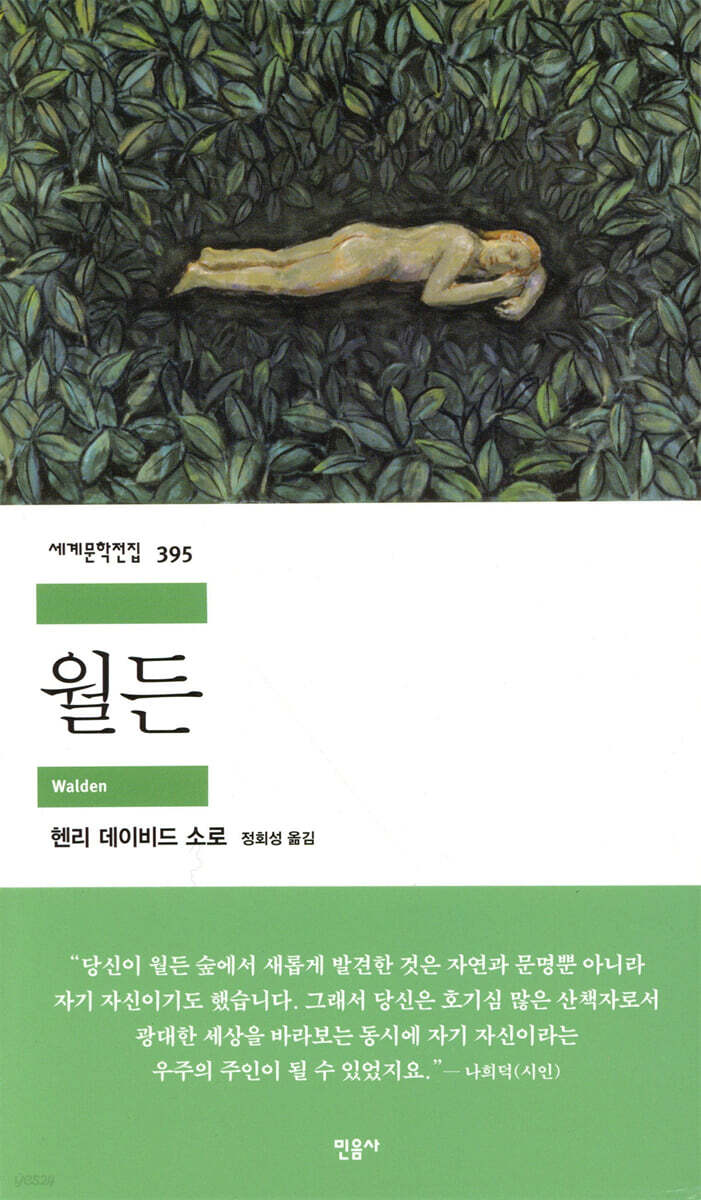
A thinker who went into the forest in search of the essence of life, a classic among the classics of our time. The world of Walden, guided by poet, essayist, and naturalist Thoreau Translator Jeong Hoe-seong's life's work in translation is finally being published in Minumsa's World Literature Collection, "Walden"! A great experiment in the forest by poet, essayist, naturalist, and ecologist Henry David Thoreau. The immortal classic "Walden," which has had a profound influence on countless thinkers and writers around the world, including Mahatma Gandhi, Robert Frost, and Marcel Proust, has been published as volume 395 in Minumsa's World Literature Collection. "Walden," a collection of eighteen essays that Thoreau wrote about what he saw, felt, and realized at Walden Pond over two years, two months, and two days, was published on August 9, 1854, under the title "Walden, or Life in the Woods." Although it did not garner much attention at the time of its publication, it gained recognition as a masterpiece of American literature that explored the laws and beauty of nature and pursued truth through deep contemplation in the 20th century, attracting readers. It was soon translated into various languages, and now, in the 21st century, it is read as a classic by people all over the world. Feeling that he had no other way to live and think than in nature, Thoreau went into the woods near Walden Pond in 1845, built a log cabin, cultivated the fields with his own hands, and practiced a self-sufficient life away from civilization. As was the case at Walden Pond, Thoreau lived frugally in real life. Thoreau emphasizes a simple life and advises that no matter what failures you have had so far, you should not be troubled, but rather live a free and independent life doing what you truly want to do. Walden is a diary and farm journal of Thoreau's daily life, and an essay of reflection on his experiences as a thinker and free man. Thoreau is a thinker who personally experimented with what humans feel and gain when living in the forest with the least amount of money and simple worldly things, and he is also an ecologist and natural scientist who closely observed the creatures of the forest. |
- You can preview some of the book's contents.
Preview
index
Economy 7
Where I Lived and Why I Lived There 120
Reading 148
Sound 165
Solitude 191
Visitors 206
Bean Field 227
Village 246
Lake 255
Baker Farm 292
Higher Law 305
Animal Neighbors 323
Heating 343
Former Residents and Winter Visitors 367
Winter Animals 390
Winter Lake 406
Spring 429
Conclusion 457
Commentary on the work 480
Author's Chronology 497
Where I Lived and Why I Lived There 120
Reading 148
Sound 165
Solitude 191
Visitors 206
Bean Field 227
Village 246
Lake 255
Baker Farm 292
Higher Law 305
Animal Neighbors 323
Heating 343
Former Residents and Winter Visitors 367
Winter Animals 390
Winter Lake 406
Spring 429
Conclusion 457
Commentary on the work 480
Author's Chronology 497
Detailed image

Into the book
The very first day I began to live in the woods, that is, to spend my nights there as well as my days, happened to be July 4, 1845, Independence Day.
At that time, the house was not yet finished, so it was difficult to survive the winter.
It was barely enough to keep out the rain, and there was no plastering or chimney erected.
The walls were nothing but rough, weather-stained planks with wide gaps between them, making it cold at night.
--- p.126
Both place and time have changed, and I live closer to that part of the universe and that period in history that most fascinates me.
The place where I lived was as far from the world as the countless spaces that astronomers observe every night.
We habitually imagine that there is a rare and delightful place somewhere behind Cassiopeia's chair, far from the noise and commotion, in some remote corner of the celestial realm.
--- p.130
My first summer in the forest, I couldn't read a book.
I tilled the soybean field.
No, sometimes it was even better than that.
There were times when I didn't want to sacrifice the beauty of the present moment for work, whether mental or physical.
I want to leave plenty of room in my life.
--- p.166
People often say to me:
“I think it would be very lonely there.
“Don’t you want to be close to people on rainy or snowy days, especially on nights like that?” I want to respond to these people like this.
This entire Earth we live on is just a dot in the universe.
Our surveying instruments can't even measure the width of that star, so how far apart do you think the two people who live farthest from that star are? Why do you think I'd be lonely?
--- pp.196-197
There are three chairs in my house.
One is for solitude, one is for friendship, and one is for socializing.
When unexpectedly many guests came, there were only three chairs to put out, but most of the time, they stood instead of sat, making efficient use of the room.
It's surprising how many men and women can fit in such a small house.
I have taken twenty-five or thirty souls, together with their bodies, under my roof at one time, and I have never once parted ways feeling suffocated by the cramped space.
--- pp.206-207
Decorating a line of poetry beautifully
That's not my dream.
Than to live beside Walden
There is no way to get closer to God and heaven.
I am your pebbly shore
It's a gentle breeze passing over you.
In my hollow palm
You have the water and sand of Walden.
Your deepest place
In my opinion, it is the highest.
--- p.282
After a quiet winter night, I woke up from a dream where I was asked the same questions as what, how, when, and where, and tried to answer them, feeling it was futile.
Fortunately, nature, the treasure trove of all living things, was looking out my window with a calm and contented face as the dawn began.
Although the lips of nature did not ask any questions, I realized that nature and sunlight were the answers to the questions.
--- p.406
The earth is not a bookcase, layered and studied by geologists and archaeologists, nor is it merely a fragment of dead history; it is a living poem in itself, like the leaves that emerge before flowers and fruits.
In other words, it is not a land of fossils, but a living, moving land.
Compared to the great life that forms the backbone of the earth, all plant and animal life is nothing more than a parasitic existence.
--- p.441
Through my experiments, I have learned at least the following:
The point is that as we each confidently move toward our dreams and strive to live the life we imagine, we will achieve success we never expected.
In the process, you may forget precious things and cross invisible boundaries.
New, universal, and more progressive laws will take hold around us and within us.
Or perhaps the old laws will be expanded and interpreted in a more progressive way to our advantage, and we will be recognized and live as beings of a higher level.
As we simplify our lives, the laws of the universe will become simpler in proportion to our simplification. Loneliness will no longer be loneliness, poverty will no longer be poverty, and weakness will no longer be weakness.
Even if you build a castle in the air, your work will not be in vain.
Because that is where the pavilion should be.
Now all that remains is to build the foundation to support the pavilion.
--- pp.463-464
No matter how miserable life is, accept it and live on.
Don't ignore me and don't curse me.
What's wrong is you, not life.
Even when you are at your richest, your life can seem at its poorest.
Those who find fault with everything will find fault with everything even in heaven.
Love your life even if it is poor.
--- p.470
The light that blinds us is darkness to us.
Dawn comes only when we are awake.
You can expect more dawns in the future.
The sun is nothing more than a star that rises in the morning.
At that time, the house was not yet finished, so it was difficult to survive the winter.
It was barely enough to keep out the rain, and there was no plastering or chimney erected.
The walls were nothing but rough, weather-stained planks with wide gaps between them, making it cold at night.
--- p.126
Both place and time have changed, and I live closer to that part of the universe and that period in history that most fascinates me.
The place where I lived was as far from the world as the countless spaces that astronomers observe every night.
We habitually imagine that there is a rare and delightful place somewhere behind Cassiopeia's chair, far from the noise and commotion, in some remote corner of the celestial realm.
--- p.130
My first summer in the forest, I couldn't read a book.
I tilled the soybean field.
No, sometimes it was even better than that.
There were times when I didn't want to sacrifice the beauty of the present moment for work, whether mental or physical.
I want to leave plenty of room in my life.
--- p.166
People often say to me:
“I think it would be very lonely there.
“Don’t you want to be close to people on rainy or snowy days, especially on nights like that?” I want to respond to these people like this.
This entire Earth we live on is just a dot in the universe.
Our surveying instruments can't even measure the width of that star, so how far apart do you think the two people who live farthest from that star are? Why do you think I'd be lonely?
--- pp.196-197
There are three chairs in my house.
One is for solitude, one is for friendship, and one is for socializing.
When unexpectedly many guests came, there were only three chairs to put out, but most of the time, they stood instead of sat, making efficient use of the room.
It's surprising how many men and women can fit in such a small house.
I have taken twenty-five or thirty souls, together with their bodies, under my roof at one time, and I have never once parted ways feeling suffocated by the cramped space.
--- pp.206-207
Decorating a line of poetry beautifully
That's not my dream.
Than to live beside Walden
There is no way to get closer to God and heaven.
I am your pebbly shore
It's a gentle breeze passing over you.
In my hollow palm
You have the water and sand of Walden.
Your deepest place
In my opinion, it is the highest.
--- p.282
After a quiet winter night, I woke up from a dream where I was asked the same questions as what, how, when, and where, and tried to answer them, feeling it was futile.
Fortunately, nature, the treasure trove of all living things, was looking out my window with a calm and contented face as the dawn began.
Although the lips of nature did not ask any questions, I realized that nature and sunlight were the answers to the questions.
--- p.406
The earth is not a bookcase, layered and studied by geologists and archaeologists, nor is it merely a fragment of dead history; it is a living poem in itself, like the leaves that emerge before flowers and fruits.
In other words, it is not a land of fossils, but a living, moving land.
Compared to the great life that forms the backbone of the earth, all plant and animal life is nothing more than a parasitic existence.
--- p.441
Through my experiments, I have learned at least the following:
The point is that as we each confidently move toward our dreams and strive to live the life we imagine, we will achieve success we never expected.
In the process, you may forget precious things and cross invisible boundaries.
New, universal, and more progressive laws will take hold around us and within us.
Or perhaps the old laws will be expanded and interpreted in a more progressive way to our advantage, and we will be recognized and live as beings of a higher level.
As we simplify our lives, the laws of the universe will become simpler in proportion to our simplification. Loneliness will no longer be loneliness, poverty will no longer be poverty, and weakness will no longer be weakness.
Even if you build a castle in the air, your work will not be in vain.
Because that is where the pavilion should be.
Now all that remains is to build the foundation to support the pavilion.
--- pp.463-464
No matter how miserable life is, accept it and live on.
Don't ignore me and don't curse me.
What's wrong is you, not life.
Even when you are at your richest, your life can seem at its poorest.
Those who find fault with everything will find fault with everything even in heaven.
Love your life even if it is poor.
--- p.470
The light that blinds us is darkness to us.
Dawn comes only when we are awake.
You can expect more dawns in the future.
The sun is nothing more than a star that rises in the morning.
--- p.479
Publisher's Review
▶ What you discovered anew in Walden Forest was not only nature and civilization, but also yourself.
So you could be a curious walker, looking out over the vast world, and at the same time be the master of your own universe.
─ Na Hee-deok (poet)
▶ Walden asks us, who tilt our heads at the words to live simply and not be greedy,
How can we live a truly free and happy life?
─ Jeong Hoe-seong (translator)
■ Thoreau, the philosopher who entered the forest for a wise and sound life and freedom
If you simplify your life, even loneliness and poverty become fertilizer for inner growth.
There are three chairs in my house.
One is for solitude, one for friendship, and one for socializing. (p. 206)
A great experiment in the forest by poet, essayist, naturalist, and ecologist Henry David Thoreau.
The immortal classic "Walden," which has had a profound influence on countless thinkers and writers around the world, including Mahatma Gandhi, Robert Frost, and Marcel Proust, has been published as volume 395 in Minumsa's World Literature Collection.
"Walden," a collection of eighteen essays that Thoreau wrote about what he saw, felt, and realized at Walden Pond over two years, two months, and two days, was published on August 9, 1854, under the title "Walden, or Life in the Woods."
Although it did not garner much attention at the time of its publication, it gained recognition as a masterpiece of American literature that explored the laws and beauty of nature and pursued truth through deep contemplation in the 20th century, attracting readers. It was soon translated into various languages, and now, in the 21st century, it is read as a classic by people all over the world.
Translator Jeong Hoe-seong, who translated this Minumsa World Literature Collection 『Walden』, has translated many gems of English and American literature, including George Orwell's 『1984』, Ken Kesey's 『One Flew Over the Cuckoo's Nest』, and John Steinbeck's 『East of Eden』. In 2012, he was selected as a winner of the 2012 IBBY (International Board on Books for Young People) Honor List Translation category for 『Pigman』, and is recognized as a leading translator in the field of English and American literature.
Translator Jeong Hoe-seong recalled that translating Walden was by no means an easy task, citing the book's "breathtakingly long and complex sentences, a mixture of symbols, satire, and metaphors, and many nonverbal elements that defy simple transfer from language to language."
Translator Jeong Hoe-seong devoted all his energy to translating Walden, which is like a mountain beyond a mountain. He approached the translation with the mindset that even if he could not move a mountain, he would try to move a single rock on the way to Walden.
"Walden" is the precious fruit of translator Jeong Hoe-seong's life of translation.
Thoreau said his reason for going to Walden Pond was “neither to live in poverty nor to live in luxury.
“I wanted to do personal work without being disturbed by anyone as much as possible,” he said, referring to the writing of “A Week on the Concord and Merrimack Rivers.”
But the more fundamental reason Thoreau went to Walden Pond was that he wanted to realize what the main purpose of life was and what goods and means were truly necessary to live, and that he wanted to wake up his neighbors by crowing vigorously like a morning rooster perched on a perch, thereby opening up the possibility of a wise and wholesome life.
Soro says:
I went into the forest because I wanted to live life as I intended, with only the essential facts of life before me.
It was because I wanted to see if I could fully master life's lessons on my own, and when I died, I wanted to discover that I hadn't lived in vain. (p. 135)
Thoreau sought answers to the questions of what is essential and true in life, and what should be given meaning and value in the natural world of Walden.
As much as he loved nature, Thoreau chose to live as a natural person in nature, so he observed nature in detail and recorded it meticulously in this book.
Thoreau celebrated the beauty and grandeur of nature by structuring his life at Walden Pond into the seasons of spring, summer, fall, winter, and spring again.
Thoreau looked with affectionate eyes at every blade of grass growing on the roadside, every bird in the forest, and every small fish swimming in the lake.
He also carefully observed the movement of the clouds, the shape of the waves on the lake, and the thickness of the fog covering them.
By doing so, he was able to discern when flowers bloom and leaves change color, when the ice on the lake freezes and melts, and when snow falls.
Freedom comes from voluntary poverty and a self-sufficient life in harmony with nature.
Humans are a part of nature, and life should be lived according to one's own intentions.
I didn't want to live a life that wasn't life because life was too precious to me.
I never wanted to back down unless it was absolutely necessary.
I wanted to live deeply, even for just a moment, and absorb the essence of life. (p. 135)
What does it mean to live freely?
Soro speaks metaphorically:
“We cannot be impartial and wise observers of human life unless we look at it from the superior point of what is called voluntary poverty.” Thoreau believes that in order to know what is important in life and live freely, we must see through the essential facts of life from the point of view of “voluntary poverty.”
For Thoreau, the essential facts of life are neither in a vacuum beyond human reach nor in abstract thought.
It is about living a simple, humble, and self-sufficient life in harmony with nature.
Thoreau argues that to live a truly free life, one must first live simply and live the life one believes is right, according to one's own intentions.
Let's simplify and simplify again.
Instead of eating three meals a day, eat only one if necessary, and instead of eating 100 different foods, be content with five.
Let's reduce other things by the same ratio. (Page 136)
Feeling that he had no other way to live and think than in nature, Thoreau went into the woods near Walden Pond in 1845, built a log cabin, cultivated the fields with his own hands, and practiced a self-sufficient life away from civilization.
As was the case at Walden Pond, Thoreau lived frugally in real life.
Thoreau emphasizes a simple life and advises that no matter what failures you have had so far, you should not be troubled, but rather live a free and independent life doing what you truly want to do.
Walden is a diary and farm journal of Thoreau's daily life, and an essay of reflection on his experiences as a thinker and free man.
Thoreau is a thinker who personally experimented with what humans feel and gain when living in the forest with the least amount of money and simple worldly things, and he is also an ecologist and natural scientist who closely observed the creatures of the forest.
■ Soro, who left behind the teachings he learned from nature, the eternal teacher, in his poems and essays.
In an age where consumption is a virtue, is today, overflowing with material goods, happier than the days of the thieves?
The shallow river of time may flow away, but eternity remains.
I want to drink water from deeper places.
I want to fish in the sky where stars are laid out like pebbles. (p. 147)
Thoreau published numerous poems and essays during his lifetime.
The amount of writing he left behind is so great that the exact volume is unknown, but the diary alone is thirty-nine volumes and over 4,000 pages.
However, Thoreau only published two books during his lifetime: A Week on the Concord and Merrimack Rivers and Walden.
The rest were compiled by his sister Sophia and editors after his death and published one by one.
Thoreau consistently repeated the routine of taking walks through forests, fields, lakes, and rivers, reading Eastern and Western classics, and writing poetry and essays, including diaries.
Whether it was a diary, a poem, or an essay, Thoreau's writings are filled with the extensive knowledge and intimate philosophy he had accumulated throughout his life.
His writings were published in leading literary magazines of the time, and the voluminous diaries he wrote from 1837, when he graduated from college, until his death were published in 1906, and along with Walden, they still have a large readership today.
Will Thoreau's words, which reject the logic of desire pursued by consumer society and live in harmony with nature, with minimal labor and only the necessities, still apply in our time?
Compared to the times when Soro lived, the times, environment, and lifestyle have all changed.
In Thoreau's time, America, based on Puritanism, considered it a virtue to live a life of diligence, frugality, and moderation.
However, such traditions could not be continued, and as we crossed the threshold of the 20th century, we were swept away by the wave of capitalism and entered an era where consumption became a way of life and a habit.
Nowadays, it is even said without hesitation that consumption is a virtue.
In the 21st century, terms like material, capital, civilization, convenience, and development have become part of our daily lives.
But is our era happier and freer than the era of Soro?
Could it be that the Earth is suffering from climate change and humanity is suffering from pandemics, a consequence of our unconditional trust and reliance on material things and civilization?
If you find it difficult to readily answer these questions, you should read the story told by Thoreau, Walden.
For us, who are too busy competing and pressed for time to reflect on ourselves, Walden, which fully captures the life of Thoreau, who cherished nature and placed absolute value on freedom and happiness, is a book that serves as a comma for this era.
This book asks those of us who tilt our heads at the advice to live simply and not be greedy.
How can we live a truly free and happy life?
― Jeong Hoe-seong, from “Commentary on the Work”
So you could be a curious walker, looking out over the vast world, and at the same time be the master of your own universe.
─ Na Hee-deok (poet)
▶ Walden asks us, who tilt our heads at the words to live simply and not be greedy,
How can we live a truly free and happy life?
─ Jeong Hoe-seong (translator)
■ Thoreau, the philosopher who entered the forest for a wise and sound life and freedom
If you simplify your life, even loneliness and poverty become fertilizer for inner growth.
There are three chairs in my house.
One is for solitude, one for friendship, and one for socializing. (p. 206)
A great experiment in the forest by poet, essayist, naturalist, and ecologist Henry David Thoreau.
The immortal classic "Walden," which has had a profound influence on countless thinkers and writers around the world, including Mahatma Gandhi, Robert Frost, and Marcel Proust, has been published as volume 395 in Minumsa's World Literature Collection.
"Walden," a collection of eighteen essays that Thoreau wrote about what he saw, felt, and realized at Walden Pond over two years, two months, and two days, was published on August 9, 1854, under the title "Walden, or Life in the Woods."
Although it did not garner much attention at the time of its publication, it gained recognition as a masterpiece of American literature that explored the laws and beauty of nature and pursued truth through deep contemplation in the 20th century, attracting readers. It was soon translated into various languages, and now, in the 21st century, it is read as a classic by people all over the world.
Translator Jeong Hoe-seong, who translated this Minumsa World Literature Collection 『Walden』, has translated many gems of English and American literature, including George Orwell's 『1984』, Ken Kesey's 『One Flew Over the Cuckoo's Nest』, and John Steinbeck's 『East of Eden』. In 2012, he was selected as a winner of the 2012 IBBY (International Board on Books for Young People) Honor List Translation category for 『Pigman』, and is recognized as a leading translator in the field of English and American literature.
Translator Jeong Hoe-seong recalled that translating Walden was by no means an easy task, citing the book's "breathtakingly long and complex sentences, a mixture of symbols, satire, and metaphors, and many nonverbal elements that defy simple transfer from language to language."
Translator Jeong Hoe-seong devoted all his energy to translating Walden, which is like a mountain beyond a mountain. He approached the translation with the mindset that even if he could not move a mountain, he would try to move a single rock on the way to Walden.
"Walden" is the precious fruit of translator Jeong Hoe-seong's life of translation.
Thoreau said his reason for going to Walden Pond was “neither to live in poverty nor to live in luxury.
“I wanted to do personal work without being disturbed by anyone as much as possible,” he said, referring to the writing of “A Week on the Concord and Merrimack Rivers.”
But the more fundamental reason Thoreau went to Walden Pond was that he wanted to realize what the main purpose of life was and what goods and means were truly necessary to live, and that he wanted to wake up his neighbors by crowing vigorously like a morning rooster perched on a perch, thereby opening up the possibility of a wise and wholesome life.
Soro says:
I went into the forest because I wanted to live life as I intended, with only the essential facts of life before me.
It was because I wanted to see if I could fully master life's lessons on my own, and when I died, I wanted to discover that I hadn't lived in vain. (p. 135)
Thoreau sought answers to the questions of what is essential and true in life, and what should be given meaning and value in the natural world of Walden.
As much as he loved nature, Thoreau chose to live as a natural person in nature, so he observed nature in detail and recorded it meticulously in this book.
Thoreau celebrated the beauty and grandeur of nature by structuring his life at Walden Pond into the seasons of spring, summer, fall, winter, and spring again.
Thoreau looked with affectionate eyes at every blade of grass growing on the roadside, every bird in the forest, and every small fish swimming in the lake.
He also carefully observed the movement of the clouds, the shape of the waves on the lake, and the thickness of the fog covering them.
By doing so, he was able to discern when flowers bloom and leaves change color, when the ice on the lake freezes and melts, and when snow falls.
Freedom comes from voluntary poverty and a self-sufficient life in harmony with nature.
Humans are a part of nature, and life should be lived according to one's own intentions.
I didn't want to live a life that wasn't life because life was too precious to me.
I never wanted to back down unless it was absolutely necessary.
I wanted to live deeply, even for just a moment, and absorb the essence of life. (p. 135)
What does it mean to live freely?
Soro speaks metaphorically:
“We cannot be impartial and wise observers of human life unless we look at it from the superior point of what is called voluntary poverty.” Thoreau believes that in order to know what is important in life and live freely, we must see through the essential facts of life from the point of view of “voluntary poverty.”
For Thoreau, the essential facts of life are neither in a vacuum beyond human reach nor in abstract thought.
It is about living a simple, humble, and self-sufficient life in harmony with nature.
Thoreau argues that to live a truly free life, one must first live simply and live the life one believes is right, according to one's own intentions.
Let's simplify and simplify again.
Instead of eating three meals a day, eat only one if necessary, and instead of eating 100 different foods, be content with five.
Let's reduce other things by the same ratio. (Page 136)
Feeling that he had no other way to live and think than in nature, Thoreau went into the woods near Walden Pond in 1845, built a log cabin, cultivated the fields with his own hands, and practiced a self-sufficient life away from civilization.
As was the case at Walden Pond, Thoreau lived frugally in real life.
Thoreau emphasizes a simple life and advises that no matter what failures you have had so far, you should not be troubled, but rather live a free and independent life doing what you truly want to do.
Walden is a diary and farm journal of Thoreau's daily life, and an essay of reflection on his experiences as a thinker and free man.
Thoreau is a thinker who personally experimented with what humans feel and gain when living in the forest with the least amount of money and simple worldly things, and he is also an ecologist and natural scientist who closely observed the creatures of the forest.
■ Soro, who left behind the teachings he learned from nature, the eternal teacher, in his poems and essays.
In an age where consumption is a virtue, is today, overflowing with material goods, happier than the days of the thieves?
The shallow river of time may flow away, but eternity remains.
I want to drink water from deeper places.
I want to fish in the sky where stars are laid out like pebbles. (p. 147)
Thoreau published numerous poems and essays during his lifetime.
The amount of writing he left behind is so great that the exact volume is unknown, but the diary alone is thirty-nine volumes and over 4,000 pages.
However, Thoreau only published two books during his lifetime: A Week on the Concord and Merrimack Rivers and Walden.
The rest were compiled by his sister Sophia and editors after his death and published one by one.
Thoreau consistently repeated the routine of taking walks through forests, fields, lakes, and rivers, reading Eastern and Western classics, and writing poetry and essays, including diaries.
Whether it was a diary, a poem, or an essay, Thoreau's writings are filled with the extensive knowledge and intimate philosophy he had accumulated throughout his life.
His writings were published in leading literary magazines of the time, and the voluminous diaries he wrote from 1837, when he graduated from college, until his death were published in 1906, and along with Walden, they still have a large readership today.
Will Thoreau's words, which reject the logic of desire pursued by consumer society and live in harmony with nature, with minimal labor and only the necessities, still apply in our time?
Compared to the times when Soro lived, the times, environment, and lifestyle have all changed.
In Thoreau's time, America, based on Puritanism, considered it a virtue to live a life of diligence, frugality, and moderation.
However, such traditions could not be continued, and as we crossed the threshold of the 20th century, we were swept away by the wave of capitalism and entered an era where consumption became a way of life and a habit.
Nowadays, it is even said without hesitation that consumption is a virtue.
In the 21st century, terms like material, capital, civilization, convenience, and development have become part of our daily lives.
But is our era happier and freer than the era of Soro?
Could it be that the Earth is suffering from climate change and humanity is suffering from pandemics, a consequence of our unconditional trust and reliance on material things and civilization?
If you find it difficult to readily answer these questions, you should read the story told by Thoreau, Walden.
For us, who are too busy competing and pressed for time to reflect on ourselves, Walden, which fully captures the life of Thoreau, who cherished nature and placed absolute value on freedom and happiness, is a book that serves as a comma for this era.
This book asks those of us who tilt our heads at the advice to live simply and not be greedy.
How can we live a truly free and happy life?
― Jeong Hoe-seong, from “Commentary on the Work”
GOODS SPECIFICS
- Publication date: November 12, 2021
- Page count, weight, size: 516 pages | 570g | 132*225*25mm
- ISBN13: 9788937463952
- ISBN10: 8937463954
You may also like
카테고리
korean


korean

![GQ KOREA Mark (Monthly): December [2025]](http://librairie.coreenne.fr/cdn/shop/files/8ef265dbbfbf186523ed75ba7319009d.jpg?v=1765340328&width=3840)


