

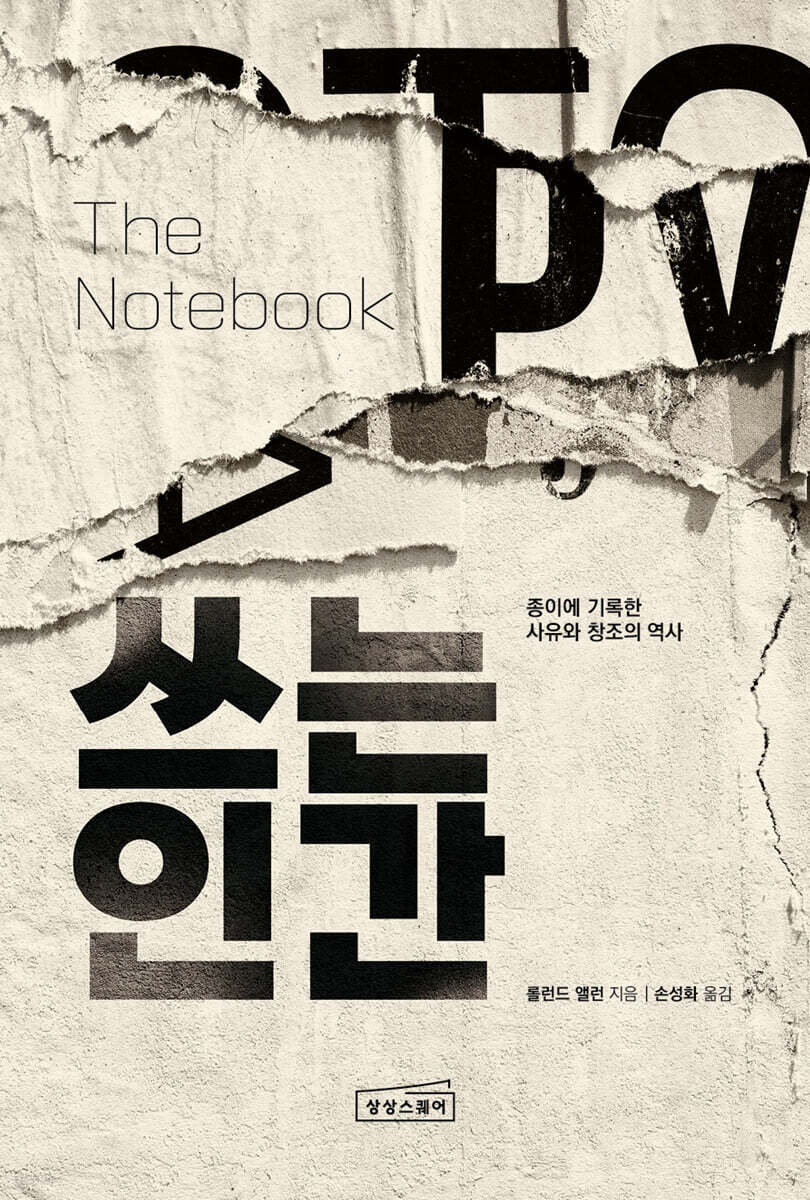
Writing human
 |
Description
Book Introduction
The greatest ideas written in the simplest tools
The first history book about the notebook that changed the world
The New Yorker's Book of the Year, The Globe and Mail's Top 100 Books of 2024!
Notebooks and pens are always available to everyone, everywhere.
But where did this essential tool originate? How did it revolutionize our lives? And how can the act of writing transform us? "The Writing Human" proves that a notebook is not simply a recording tool, but a creative space that organizes and expands human thoughts, a companion to contemplation.
In this voluminous history, paper historian Roland Allen reveals how the notebook became one of the most versatile tools for human creative thinking.
It tells the stories of notebooks from Leonardo da Vinci, Rembrandt, Isaac Newton, Marie Curie, Geoffrey Chaucer, Henry James, Virginia Woolf, Bob Dylan, and countless others.
It introduces how Charles Darwin organized his theory of evolution in a small pocket notebook, and how Agatha Christie conceived and recorded countless murders in an old exercise book. It also reveals how people as diverse as chefs, kings, sailors, fishermen, musicians, engineers, politicians, explorers, and mathematicians used notebooks to shape the world's civilizations and cultures.
From medieval wax tablets and ledgers, to Renaissance notebooks, artists' sketchbooks, scientists' lab notebooks, and modern bullet journals and electronic spreadsheets, the diverse forms and functions of notebooks are vividly illustrated with examples and stories.
In an age when the act of reading and writing and the reflections on reasoning are more urgent than ever, "The Writing Man" is a masterpiece that offers a new perspective on the meaning and value of records.
The first history book about the notebook that changed the world
The New Yorker's Book of the Year, The Globe and Mail's Top 100 Books of 2024!
Notebooks and pens are always available to everyone, everywhere.
But where did this essential tool originate? How did it revolutionize our lives? And how can the act of writing transform us? "The Writing Human" proves that a notebook is not simply a recording tool, but a creative space that organizes and expands human thoughts, a companion to contemplation.
In this voluminous history, paper historian Roland Allen reveals how the notebook became one of the most versatile tools for human creative thinking.
It tells the stories of notebooks from Leonardo da Vinci, Rembrandt, Isaac Newton, Marie Curie, Geoffrey Chaucer, Henry James, Virginia Woolf, Bob Dylan, and countless others.
It introduces how Charles Darwin organized his theory of evolution in a small pocket notebook, and how Agatha Christie conceived and recorded countless murders in an old exercise book. It also reveals how people as diverse as chefs, kings, sailors, fishermen, musicians, engineers, politicians, explorers, and mathematicians used notebooks to shape the world's civilizations and cultures.
From medieval wax tablets and ledgers, to Renaissance notebooks, artists' sketchbooks, scientists' lab notebooks, and modern bullet journals and electronic spreadsheets, the diverse forms and functions of notebooks are vividly illustrated with examples and stories.
In an age when the act of reading and writing and the reflections on reasoning are more urgent than ever, "The Writing Man" is a masterpiece that offers a new perspective on the meaning and value of records.
- You can preview some of the book's contents.
Preview
index
Introduction
Chapter 1: The Mediterranean region, 1000 BC–AD 1250, before the emergence of notes
Chapter 2: The invention of red, white, and cloth ledger accounting, Provence and Florence, 1299
Chapter 3: Sketchbook with light brush strokes in a small booklet, Florence, 1300-1500
Chapter 4: Ricorda, Ricordan, and the Notes from the House of Cibaldone, Florence, 1300–1500
Chapter 5: The Book of Michael of Rhodes, Alexandria, Venice, 1434
Chapter 6: Wicked Wives and Mouths Stopped with Wool: Notes on the Way to England, 1372–1517
Chapter 7: Singing with LHD 244 chords, Bologna, circa 1450-1600
Chapter 8: “Alas, at this rate, I shall never get anything done!” Two note-takers, Italy, 1455–1519
Chapter 9: Oh, the pain and toil of recording what others have said! Secret Records, 1512–present
Chapter 10: East and West Flow from One Entrance to Another: World Ocean, 1519–1522
Chapter 11: The King of Herrings, Fish Book, Netherlands, 1570
Chapter 12: A Foolish Dutch Fashion Friendship Note, Northern Europe, 1645
Chapter 13: Observations on the Gem Industries, Germany and Italy, 1598
Chapter 14: "Don't Let Them Stay Long" Travelers and Their Notes, 1470–present
Chapter 15: The Mathematics of the Discarded Book, Lincolnshire, 1612
Chapter 16: A Tale of Two Notes Fouquet and Colbert, Paris, 1661–1680
Chapter 17: “Eighteenpence and a Table Book” Table Books, England and the Netherlands, 1520s–1670s
Chapter 18: The Journey Recorded in the Albatross Journal: From London to Amoy, 1699
Chapter 19: “In My Opinion,” Notes of Naturalists, 1551–1859
Chapter 20: One Way to Immortality: Diaries and Journals, 1600–Present
Chapter 21: "You Are Accurate" Police Notebook, 1829–present
Chapter 22: "Yes, It's Better for the Dentist to Die" Author's Notes, 1894–present
Chapter 23: Recipe Book for Preserving and Cooking, 1639–present
Chapter 24: Express Yourself: Self-Care Journaling, 1968–Present
Chapter 25: The Blue, Green, Red, and Yellow Campaigns in Florida, 1977–2003
Chapter 26: A Non-Trivial Climate Diary, 1850s–Present
Chapter 27: Attention Deficit Bullet Journaling, Brooklyn, 2010
Chapter 28: In Search of Lost Time: Patient Diaries, 1952–Present
Chapter 29: Nothing on Earth Reveals Our Unique Character, Notes Study, 1883–Present
Chapter 30: Observing Artists in Different Brain Regions, 2022
Conclusion: Otto always carries a notebook. Expanded Mind, 1938–present
Notes and References
Acknowledgements
Chapter 1: The Mediterranean region, 1000 BC–AD 1250, before the emergence of notes
Chapter 2: The invention of red, white, and cloth ledger accounting, Provence and Florence, 1299
Chapter 3: Sketchbook with light brush strokes in a small booklet, Florence, 1300-1500
Chapter 4: Ricorda, Ricordan, and the Notes from the House of Cibaldone, Florence, 1300–1500
Chapter 5: The Book of Michael of Rhodes, Alexandria, Venice, 1434
Chapter 6: Wicked Wives and Mouths Stopped with Wool: Notes on the Way to England, 1372–1517
Chapter 7: Singing with LHD 244 chords, Bologna, circa 1450-1600
Chapter 8: “Alas, at this rate, I shall never get anything done!” Two note-takers, Italy, 1455–1519
Chapter 9: Oh, the pain and toil of recording what others have said! Secret Records, 1512–present
Chapter 10: East and West Flow from One Entrance to Another: World Ocean, 1519–1522
Chapter 11: The King of Herrings, Fish Book, Netherlands, 1570
Chapter 12: A Foolish Dutch Fashion Friendship Note, Northern Europe, 1645
Chapter 13: Observations on the Gem Industries, Germany and Italy, 1598
Chapter 14: "Don't Let Them Stay Long" Travelers and Their Notes, 1470–present
Chapter 15: The Mathematics of the Discarded Book, Lincolnshire, 1612
Chapter 16: A Tale of Two Notes Fouquet and Colbert, Paris, 1661–1680
Chapter 17: “Eighteenpence and a Table Book” Table Books, England and the Netherlands, 1520s–1670s
Chapter 18: The Journey Recorded in the Albatross Journal: From London to Amoy, 1699
Chapter 19: “In My Opinion,” Notes of Naturalists, 1551–1859
Chapter 20: One Way to Immortality: Diaries and Journals, 1600–Present
Chapter 21: "You Are Accurate" Police Notebook, 1829–present
Chapter 22: "Yes, It's Better for the Dentist to Die" Author's Notes, 1894–present
Chapter 23: Recipe Book for Preserving and Cooking, 1639–present
Chapter 24: Express Yourself: Self-Care Journaling, 1968–Present
Chapter 25: The Blue, Green, Red, and Yellow Campaigns in Florida, 1977–2003
Chapter 26: A Non-Trivial Climate Diary, 1850s–Present
Chapter 27: Attention Deficit Bullet Journaling, Brooklyn, 2010
Chapter 28: In Search of Lost Time: Patient Diaries, 1952–Present
Chapter 29: Nothing on Earth Reveals Our Unique Character, Notes Study, 1883–Present
Chapter 30: Observing Artists in Different Brain Regions, 2022
Conclusion: Otto always carries a notebook. Expanded Mind, 1938–present
Notes and References
Acknowledgements
Detailed image

Into the book
I don't need to explain what a Moleskine notebook looks like.
But you probably haven't considered how persistently that design communicates its message to the 'modern nomad'.
The simple black cover looks sturdy and luxurious, almost like leather at first glance.
It's a non-standard size, about 2 centimeters narrower than the familiar A5 paper, so it can fit into a jacket pocket.
Rounded corners, which require a process that incurs significant additional production costs, also play a role, and are also the reason why the corners of the inner paper do not fold.
The combination of the elastic band and the unusually heavy, hard cardboard cover gives it the impression of a notebook definitely made for travel.
The height of the cover edge and the inside of the book are aligned so that it can never be confused with a paper book.
--- From "Entering"
In the years after 1244, before paper became readily available, Italian merchants used parchment ledgers to record their transactions.
But when paper ledgers were first introduced, they discovered that they were a superior product.
Parchment allows ink to dry on the surface, while paper allows ink to soak into it.
As a result, parchment can be neatly scraped off and rewritten, leaving the record open to future revision (leaving room for fraud), whereas paper becomes a permanent medium.
For similar reasons, ledgers were always grouped together as ledgers.
In other words, items that could be inserted and removed individually could be easily manipulated, but numbered ledgers were difficult to falsify.
This means that merchants can delegate tasks to subordinates or branches without fear of embezzlement.
This allowed traders to expand their business scope.
--- From "Red Ledger, White Ledger, and Cloth Ledger"
The church's insistence on parchment would have slowed down the pace at which our young artist worked.
Because of its physical properties, parchment was a frustrating medium for quick sketching.
(Omitted) In comparison, paper can be used without any preparation, and lines drawn with a stylus, pen, chalk, or charcoal are maintained well without being erased.
Thin parallel lines could be drawn to add shading or depth.
(Omitted) Moreover, thanks to cheap paper that cost one-tenth of the price of parchment, artists could “draw something every day without fail.”
The advantages of all these materials naturally lead to the great advantages of sketchbooks.
In other words, the quality of preparation an artist can put into a work has been greatly improved.
The generous space afforded by the hundreds of sheets of paper allowed the artist to not only sketch privately, but also plan and revise the painting before committing to the final subject, design, composition, and execution.
--- From "A Light Touch in a Small Booklet"
Vespasian, Pozzo, and their colleagues, funded by wealthy patrons like Cosimo de' Medici, scoured monasteries across Europe, seeking out rare classical texts that had survived the Dark Ages, creating a steady supply of beautiful manuscripts filled with fresh translations, rediscoveries, and new literary works.
The presence of the Papal Palace in Florence for many years also attracted scholars to the city.
The new libraries and bookstores were the center of a culture where bookworms met and discussed what they had read, stimulating a rich intellectual life.
This advanced literacy undoubtedly had a profound influence on European culture, adding intellectual weight to the Renaissance.
--- From "Ricorda, Ricordan, Cibaldone"
About 6,000 sheets (or 13,000 pages) have survived, which experts estimate represents about a quarter of the original manuscript.
This means that Leonardo filled his notebooks at a rate of about 1,000 pages per year.
He did this by covering it all with various sketches, illustrations, and his signature mirror writing, to the point of being obsessive.
“At some point I figured it out.
If you collect them all together and add them up, it is clear that he wrote about 50 academic volumes.
“He never took a break,” says Professor Kemp.
--- From “Ah, if this keeps up, I won’t be able to finish anything!”
“Hey, get a little notebook and write it down right away every time I tell you something.
There is only one way to become a pilot, and that is to memorize this entire river.
“You just have to know it like ABC.” Soon Clemons had “a notebook literally crammed with the names of cities, ‘ports of call,’ sandbars, islands, bends, straightaways, and so on.” And he was well on his way to becoming a pilot.
Even as Mark Twain, he maintained this habit of writing everything down.
Including when the concise yet pithy digression that made him one of the most popular writers of his time flashed through his mind.
--- From “Don’t let them stay too long”
He began writing notes from both ends simultaneously.
I did that by flipping the note over.
Therefore, the latter part of the note is written upside down.
As was common practice at the time, Newton divided his notes into linguistically interesting snippets of information and practical ideas.
--- From the "Discarded Ledger"
This type of material has now become of immense importance.
In other words, European companies were desperate to find the fastest and safest route to their destinations.
Well-managed diaries provided raw data that could be compiled over time into a single, comprehensive picture of what to expect around the world over a given season.
This confidential information gave any captain setting out on a voyage an advantage over others.
It warns of extreme winds, seasonal storms, currents, tides, rocks, etc.
Meanwhile, his back-country sponsors and employers could predict his movements and thus anticipate his profits, and consequently, insurers could better assess the risks involved.
--- From "Albatross"
Although he often returned with a cumbersome load of fossils, rock specimens, and the remains of interesting wildlife, Darwin carried as little luggage as possible on these short journeys.
I only took one book to read (usually Milton's Paradise Lost) and one notebook.
This minimalist approach meant that each of the 15 field notebooks contained a wide range of information.
In other words, anything that caught Darwin's eye went in.
As a result, official geological observations are interspersed with records of his route, his expenses, the people he met, and so on.
Darwin named each notebook after the place where he first used it.
So, if you look at the paper labels he attached to his notebook, you can see the extensive journey that the Royal Navy HMS Beagle made.
--- From “In My Opinion”
It has become clear that police officers' field notes will become central to future investigations.
They recorded witness statements, described the crime scene, and preserved details such as vehicle license plates.
Existing cases from the 19th and early 20th centuries, filled with various instances of illegal activity and arrests, are a rich source of information for historians.
--- From “You are correct”
Valerie devoted herself to her notebooks, which numbered 28,000 pages, to the point where she called them her “true oeuvre.”
Over the course of 50 years, he woke up at 5:00 AM every day and spent private time for intellectual training, filling 261 volumes of his study books.
He wrote, doodled, drew and painted on art, memory, language, literature, mathematics (and his own unique psychology).
While struggling to record every idea as accurately as possible.
In terms of tenacious obsession, few could rival Valerie except Leonardo da Vinci.
Agatha Christie used cheap school notebooks and wrote with whatever she could get her hands on.
So, with a pencil, fountain pen, or ballpoint pen.
Christie had no way of organizing her notebooks, and the 73 notebooks she left behind, containing notes for 58 of the 66 mystery novels she wrote, are terribly disorganized.
There are only five instances where a novel and a notebook correspond one-to-one.
That is, almost every notebook contains notes on five or six works.
Christie admitted that she usually kept "about six volumes close by," so any given novel would probably have at least that many notes scattered among several notebooks, though the actual number is twelve.
--- From ““Yeah, it would be better for the dentist to die.””
Meanwhile, Benjamin Franklin is famous for keeping a daily notebook to record his progress toward "moral perfection."
He also kept ledgers, marking weekly charts with black dots any "faults" that violated the twelve virtues, from "temperance" to "chastity."
Then, after hearing from a Quaker friend that he was “generally considered arrogant,” he added a thirteenth virtue to strive for.
It was 'humility'.
But you probably haven't considered how persistently that design communicates its message to the 'modern nomad'.
The simple black cover looks sturdy and luxurious, almost like leather at first glance.
It's a non-standard size, about 2 centimeters narrower than the familiar A5 paper, so it can fit into a jacket pocket.
Rounded corners, which require a process that incurs significant additional production costs, also play a role, and are also the reason why the corners of the inner paper do not fold.
The combination of the elastic band and the unusually heavy, hard cardboard cover gives it the impression of a notebook definitely made for travel.
The height of the cover edge and the inside of the book are aligned so that it can never be confused with a paper book.
--- From "Entering"
In the years after 1244, before paper became readily available, Italian merchants used parchment ledgers to record their transactions.
But when paper ledgers were first introduced, they discovered that they were a superior product.
Parchment allows ink to dry on the surface, while paper allows ink to soak into it.
As a result, parchment can be neatly scraped off and rewritten, leaving the record open to future revision (leaving room for fraud), whereas paper becomes a permanent medium.
For similar reasons, ledgers were always grouped together as ledgers.
In other words, items that could be inserted and removed individually could be easily manipulated, but numbered ledgers were difficult to falsify.
This means that merchants can delegate tasks to subordinates or branches without fear of embezzlement.
This allowed traders to expand their business scope.
--- From "Red Ledger, White Ledger, and Cloth Ledger"
The church's insistence on parchment would have slowed down the pace at which our young artist worked.
Because of its physical properties, parchment was a frustrating medium for quick sketching.
(Omitted) In comparison, paper can be used without any preparation, and lines drawn with a stylus, pen, chalk, or charcoal are maintained well without being erased.
Thin parallel lines could be drawn to add shading or depth.
(Omitted) Moreover, thanks to cheap paper that cost one-tenth of the price of parchment, artists could “draw something every day without fail.”
The advantages of all these materials naturally lead to the great advantages of sketchbooks.
In other words, the quality of preparation an artist can put into a work has been greatly improved.
The generous space afforded by the hundreds of sheets of paper allowed the artist to not only sketch privately, but also plan and revise the painting before committing to the final subject, design, composition, and execution.
--- From "A Light Touch in a Small Booklet"
Vespasian, Pozzo, and their colleagues, funded by wealthy patrons like Cosimo de' Medici, scoured monasteries across Europe, seeking out rare classical texts that had survived the Dark Ages, creating a steady supply of beautiful manuscripts filled with fresh translations, rediscoveries, and new literary works.
The presence of the Papal Palace in Florence for many years also attracted scholars to the city.
The new libraries and bookstores were the center of a culture where bookworms met and discussed what they had read, stimulating a rich intellectual life.
This advanced literacy undoubtedly had a profound influence on European culture, adding intellectual weight to the Renaissance.
--- From "Ricorda, Ricordan, Cibaldone"
About 6,000 sheets (or 13,000 pages) have survived, which experts estimate represents about a quarter of the original manuscript.
This means that Leonardo filled his notebooks at a rate of about 1,000 pages per year.
He did this by covering it all with various sketches, illustrations, and his signature mirror writing, to the point of being obsessive.
“At some point I figured it out.
If you collect them all together and add them up, it is clear that he wrote about 50 academic volumes.
“He never took a break,” says Professor Kemp.
--- From “Ah, if this keeps up, I won’t be able to finish anything!”
“Hey, get a little notebook and write it down right away every time I tell you something.
There is only one way to become a pilot, and that is to memorize this entire river.
“You just have to know it like ABC.” Soon Clemons had “a notebook literally crammed with the names of cities, ‘ports of call,’ sandbars, islands, bends, straightaways, and so on.” And he was well on his way to becoming a pilot.
Even as Mark Twain, he maintained this habit of writing everything down.
Including when the concise yet pithy digression that made him one of the most popular writers of his time flashed through his mind.
--- From “Don’t let them stay too long”
He began writing notes from both ends simultaneously.
I did that by flipping the note over.
Therefore, the latter part of the note is written upside down.
As was common practice at the time, Newton divided his notes into linguistically interesting snippets of information and practical ideas.
--- From the "Discarded Ledger"
This type of material has now become of immense importance.
In other words, European companies were desperate to find the fastest and safest route to their destinations.
Well-managed diaries provided raw data that could be compiled over time into a single, comprehensive picture of what to expect around the world over a given season.
This confidential information gave any captain setting out on a voyage an advantage over others.
It warns of extreme winds, seasonal storms, currents, tides, rocks, etc.
Meanwhile, his back-country sponsors and employers could predict his movements and thus anticipate his profits, and consequently, insurers could better assess the risks involved.
--- From "Albatross"
Although he often returned with a cumbersome load of fossils, rock specimens, and the remains of interesting wildlife, Darwin carried as little luggage as possible on these short journeys.
I only took one book to read (usually Milton's Paradise Lost) and one notebook.
This minimalist approach meant that each of the 15 field notebooks contained a wide range of information.
In other words, anything that caught Darwin's eye went in.
As a result, official geological observations are interspersed with records of his route, his expenses, the people he met, and so on.
Darwin named each notebook after the place where he first used it.
So, if you look at the paper labels he attached to his notebook, you can see the extensive journey that the Royal Navy HMS Beagle made.
--- From “In My Opinion”
It has become clear that police officers' field notes will become central to future investigations.
They recorded witness statements, described the crime scene, and preserved details such as vehicle license plates.
Existing cases from the 19th and early 20th centuries, filled with various instances of illegal activity and arrests, are a rich source of information for historians.
--- From “You are correct”
Valerie devoted herself to her notebooks, which numbered 28,000 pages, to the point where she called them her “true oeuvre.”
Over the course of 50 years, he woke up at 5:00 AM every day and spent private time for intellectual training, filling 261 volumes of his study books.
He wrote, doodled, drew and painted on art, memory, language, literature, mathematics (and his own unique psychology).
While struggling to record every idea as accurately as possible.
In terms of tenacious obsession, few could rival Valerie except Leonardo da Vinci.
Agatha Christie used cheap school notebooks and wrote with whatever she could get her hands on.
So, with a pencil, fountain pen, or ballpoint pen.
Christie had no way of organizing her notebooks, and the 73 notebooks she left behind, containing notes for 58 of the 66 mystery novels she wrote, are terribly disorganized.
There are only five instances where a novel and a notebook correspond one-to-one.
That is, almost every notebook contains notes on five or six works.
Christie admitted that she usually kept "about six volumes close by," so any given novel would probably have at least that many notes scattered among several notebooks, though the actual number is twelve.
--- From ““Yeah, it would be better for the dentist to die.””
Meanwhile, Benjamin Franklin is famous for keeping a daily notebook to record his progress toward "moral perfection."
He also kept ledgers, marking weekly charts with black dots any "faults" that violated the twelve virtues, from "temperance" to "chastity."
Then, after hearing from a Quaker friend that he was “generally considered arrogant,” he added a thirteenth virtue to strive for.
It was 'humility'.
--- Among "blue, green, red, yellow"
Publisher's Review
The simplest tool that changed the world's way of thinking, the epic journey of notes!
Great civilizations and cultures created by tools of record and thought
Paper, which was widely used because it was cheap, convenient, and light during the early days of civilization, has now become a rare commodity.
People express themselves by touching screens and typing on keyboards.
The act of writing something by hand using a writing instrument has become something of an out-of-the-ordinary thing.
But still, creative and high-achieving people keep their own notes and records.
What's the paradoxical reason? Paper culture expert Roland Allen began keeping his own journal and diary in 2002.
In the process, I discovered that my daily life became happier and better, and that even web designers who produce digital results use notes as an essential tool.
He asks questions as he observes how various lists, diagrams, and sketches that seemed like doodles turn into wonderfully brilliant ideas and results.
What is the connection between notebooks and creativity? What role have notebooks played in culture and industry? What can someone's notebooks tell us? Why does the act of keeping a diary lead to mental satisfaction? How important and meaningful is writing in our daily lives? Did the physical limitations of notebooks paradoxically make them more useful than the limitations of digital devices? Where did notebooks actually originate? Who invented them?
The records of his search for answers to these questions were also piled up in colorful notebooks.
Each notebook contains over a thousand pages of notes, passages selected from dozens of books, lists of hundreds of note-takers, various histories, biographies, memoirs, summaries of numerous academic papers and scientific journals, and interviews with various scholars and relevant figures.
"The Writing Human" is a book that contains the process of finding this question and answer.
This masterpiece is the first record of what the act of writing by hand on paper means and what it has changed.
As Europeans explored farther afield, published more books, traded more goods, produced more documents, and generally made their lives more complex, they were able to make sense of their world by categorizing information into manageable chunks.
As records became more abundant as information and as a starting point for literature and art, civilization gradually expanded from the most intimate and smallest units.
The merchant's ledger enabled sophisticated businesses to develop, Cibaldone played a significant role in the popularity of Tuscan literature, and the Album Amicorum gave physical form to the friendship of young students.
Notes initially originate from social and cultural networks and then reinforce those networks.
Darwin observed, questioned, and judged what he saw, scribbling notes hastily on the pages of a very small notebook.
By the time he boarded the Beagle, he had transformed these random notes into a systematic scientific record and evocatively detailed diary of nearly 2,000 pages.
After that, he refined the ideas of the famous book, “On the Origin of Species,” which brought innovation to the history of science.
It's a great result that sprouted from a bunch of field notes.
Chatwin used notes in the same way writers have for hundreds of years.
Like Boccaccio, he accumulated layers of knowledge by taking notes on his extensive reading, and like Petrarch, he developed the habit of revision and revision.
Like William Wooster, he connected the physical reality of the landscape with the stories told by local people.
Like Daniel Defoe, he added fun to the first-person narrative by using entries written in notes.
Like countless other writers, I used notebooks to capture unexpected encounters, record impressions, and train myself to choose the right expressions on the spot.
Even after Pablo Picasso's death in 1973, a steady stream of studies, preliminary works, and sketchbooks continued to emerge, leading one critic to remark that he "seemed to be continuing his artistic activities even after his death."
The material in these notes does not simply demonstrate an artist's compulsive hoarding tendencies; it fully reveals a revolutionary creative process and evolution.
No. 1 painted in 1907.
42 shows the evolution of “Les Demoiselles d’Avignon” and how far Picasso’s painting style was moving away from the tradition of figurative painting.
Bartók left Budapest with his friend Zoltan Kodály and went deep into the farmlands and mountains of the Carpathian Mountains.
He sought out peasants, shepherds, swineherds, and their families, and drew out Hungarian, Romanian, and Slovak songs, recording their melodies in red leather-bound music notebooks.
During this expedition, Bartok transcribed about 1,000 folk song melodies.
The sixteen volumes of notes are filled with rich music outside the classical tradition.
These field investigations and subsequent analyses led him to be considered the world's first ethnomusicologist.
Director Coppola consulted his own notes rather than the final script.
This notebook contains notes on how he discovered the film's theme, how he deconstructed and constructed the script and the film, and how he was able to transform a commercial novel into the masterpiece that is "The Godfather," a creative and important process in itself.
A diary containing one's inner thoughts has added value as a record of significant historical scenes and turning points.
Many of the diarists during World War II were Jewish.
Viktor Klemperer, who was already in his fifties when Hitler came to power, details the thirteen years of persecution he endured as a Jewish citizen.
Klemperer was also one of those Jewish citizens.
He documented this growing oppression in detail for 13 years.
His diaries, published in three volumes in the 1960s, became a major source on the Nazi era.
Numerous other buried testimonies were unearthed at Auschwitz only in 1981, adding detail and resonance to the still-incredible reality of ethnic cleansing.
This is a representative example of an individual's record expanding into a testimony of history.
“Extraordinary possibilities born from trivial things.”
Use it enough.
Then the note will change the brain.
“Keep a diary.
There is a line in the movie that says, “Then someday it will keep you.”
Just as planning for the future makes you a more efficient person, documenting your life is beneficial to your emotional state.
Keeping a personal journal serves as a form of mindfulness.
Simply observing your own behavior can help you do better.
Numerous neuroscience studies have demonstrated that paper notebooks are advantageous, particularly effective, study tools compared to digital tools.
Students who take notes in lectures on their laptops are less focused and have poorer memory than those who write with pen and paper.
This is partly because the internet provides distractions, but also because keyboard typing is more geared towards transcribing what you hear.
True learning and creation occur when we encode new information into our memories, summarize it, and create conceptual maps tailored to our individual brains and personalities.
Using your muscles can help you encode memories better.
Not only the tactile and sensory properties of the paper itself, but also the fixed position of the record on the surface have an effect.
On the other hand, the records on the screen may scroll away or disappear altogether.
These factors ultimately lead to “deeper and more robust” cognitive processes.
Even though companies like Apple, Google, and Evernote have poured billions into product development, our best cognitive tools were invented hundreds of years ago.
The fashion and comfort of writing can be explained in the same way.
The effort involved in copying a significant amount of literature changes the way a scribe understands and empathizes with that text.
When transcribing a poem or letter, the writer inevitably has to read it several times, paying close attention to the finer details of word choice and word order.
As a result, they enjoy “a more intimate and meaningful experience than they could have with the text they purchased.”
The meaningful effort of copying a text leads to the result of truly enjoying the text and making it your own.
The physical properties of my fingertips and the paper combine to create a more vivid experience.
The bullet journal, invented by Ryder Carroll, was a product of deprivation. He needed a tool to organize the scattered and disorganized thought processes of people suffering from ADHD.
“Things just come and go in my head.
Constantly.
Because of this, I can't move forward.
Having a concept and actually developing that concept are two different things.
My thought process is much improved when I have tools to process my thoughts and put them somewhere else.
So, journaling is an opportunity for me to communicate my thoughts, something I don't naturally have." As Ryder carefully explored ways to manage his ADHD, he found himself thinking longer and more intensely.
Like Florentine accountants, Renaissance artists, and early modern scientists, Rider came to understand the notebook as a crucial tool of the mind, a means of transforming intangible ideas into more concrete and clear written concepts.
In the age of AI and digital overload, this humble tool is more important than ever.
Bullet points can help alleviate ADHD, journaling can help alleviate PTSD symptoms, and patient journals can help ease the trauma of those waking up from comas.
Even in today's digital age, the act of writing by hand has a positive impact on concentration, self-reflection, and mental health, enriching and enriching life.
This is an example that proves how the everyday act of moving a pen on paper can have a practical effect.
A notebook is the smallest and closest space for thinking.
It is not just a simple record, but serves as a 'mental laboratory' where thoughts are organized and developed.
The act of writing stimulates creativity.
The very act of writing by hand activates the brain and leads to new ideas and connections.
Notes are tools that organize life.
We record and organize our daily lives and identities in various forms, such as diaries, household account books, cookbooks, and work notes.
Historical figures also refined their great ideas and developed innovative apologies through their notebooks.
Even in the digital age, notes are still relevant.
Analog notes are effective for mental health, concentration, and emotional regulation, and are an important tool that enables human thinking.
In "The Writer," a book filled with authenticity and time, Roland Allen sheds new light on the value of notes through history, culture, and examples.
It once again conveys and confirms the value of the act of 'writing' to those who want to think creatively, write, and reflect on and record their lives.
The act of writing is a communication with the world and a way to leave behind a history of one's life.
The act of writing on paper will change the way we think and feel, making us more creative, more productive, and ultimately, happier.
And take note.
In a small booklet that you must always carry, written with light pen, and carefully preserved.
The shape, posture, and position of the object are so infinite that they cannot be preserved in memory alone.
So keep these sketches as your guide and teacher.
- Leonardo da Vinci
Great civilizations and cultures created by tools of record and thought
Paper, which was widely used because it was cheap, convenient, and light during the early days of civilization, has now become a rare commodity.
People express themselves by touching screens and typing on keyboards.
The act of writing something by hand using a writing instrument has become something of an out-of-the-ordinary thing.
But still, creative and high-achieving people keep their own notes and records.
What's the paradoxical reason? Paper culture expert Roland Allen began keeping his own journal and diary in 2002.
In the process, I discovered that my daily life became happier and better, and that even web designers who produce digital results use notes as an essential tool.
He asks questions as he observes how various lists, diagrams, and sketches that seemed like doodles turn into wonderfully brilliant ideas and results.
What is the connection between notebooks and creativity? What role have notebooks played in culture and industry? What can someone's notebooks tell us? Why does the act of keeping a diary lead to mental satisfaction? How important and meaningful is writing in our daily lives? Did the physical limitations of notebooks paradoxically make them more useful than the limitations of digital devices? Where did notebooks actually originate? Who invented them?
The records of his search for answers to these questions were also piled up in colorful notebooks.
Each notebook contains over a thousand pages of notes, passages selected from dozens of books, lists of hundreds of note-takers, various histories, biographies, memoirs, summaries of numerous academic papers and scientific journals, and interviews with various scholars and relevant figures.
"The Writing Human" is a book that contains the process of finding this question and answer.
This masterpiece is the first record of what the act of writing by hand on paper means and what it has changed.
As Europeans explored farther afield, published more books, traded more goods, produced more documents, and generally made their lives more complex, they were able to make sense of their world by categorizing information into manageable chunks.
As records became more abundant as information and as a starting point for literature and art, civilization gradually expanded from the most intimate and smallest units.
The merchant's ledger enabled sophisticated businesses to develop, Cibaldone played a significant role in the popularity of Tuscan literature, and the Album Amicorum gave physical form to the friendship of young students.
Notes initially originate from social and cultural networks and then reinforce those networks.
Darwin observed, questioned, and judged what he saw, scribbling notes hastily on the pages of a very small notebook.
By the time he boarded the Beagle, he had transformed these random notes into a systematic scientific record and evocatively detailed diary of nearly 2,000 pages.
After that, he refined the ideas of the famous book, “On the Origin of Species,” which brought innovation to the history of science.
It's a great result that sprouted from a bunch of field notes.
Chatwin used notes in the same way writers have for hundreds of years.
Like Boccaccio, he accumulated layers of knowledge by taking notes on his extensive reading, and like Petrarch, he developed the habit of revision and revision.
Like William Wooster, he connected the physical reality of the landscape with the stories told by local people.
Like Daniel Defoe, he added fun to the first-person narrative by using entries written in notes.
Like countless other writers, I used notebooks to capture unexpected encounters, record impressions, and train myself to choose the right expressions on the spot.
Even after Pablo Picasso's death in 1973, a steady stream of studies, preliminary works, and sketchbooks continued to emerge, leading one critic to remark that he "seemed to be continuing his artistic activities even after his death."
The material in these notes does not simply demonstrate an artist's compulsive hoarding tendencies; it fully reveals a revolutionary creative process and evolution.
No. 1 painted in 1907.
42 shows the evolution of “Les Demoiselles d’Avignon” and how far Picasso’s painting style was moving away from the tradition of figurative painting.
Bartók left Budapest with his friend Zoltan Kodály and went deep into the farmlands and mountains of the Carpathian Mountains.
He sought out peasants, shepherds, swineherds, and their families, and drew out Hungarian, Romanian, and Slovak songs, recording their melodies in red leather-bound music notebooks.
During this expedition, Bartok transcribed about 1,000 folk song melodies.
The sixteen volumes of notes are filled with rich music outside the classical tradition.
These field investigations and subsequent analyses led him to be considered the world's first ethnomusicologist.
Director Coppola consulted his own notes rather than the final script.
This notebook contains notes on how he discovered the film's theme, how he deconstructed and constructed the script and the film, and how he was able to transform a commercial novel into the masterpiece that is "The Godfather," a creative and important process in itself.
A diary containing one's inner thoughts has added value as a record of significant historical scenes and turning points.
Many of the diarists during World War II were Jewish.
Viktor Klemperer, who was already in his fifties when Hitler came to power, details the thirteen years of persecution he endured as a Jewish citizen.
Klemperer was also one of those Jewish citizens.
He documented this growing oppression in detail for 13 years.
His diaries, published in three volumes in the 1960s, became a major source on the Nazi era.
Numerous other buried testimonies were unearthed at Auschwitz only in 1981, adding detail and resonance to the still-incredible reality of ethnic cleansing.
This is a representative example of an individual's record expanding into a testimony of history.
“Extraordinary possibilities born from trivial things.”
Use it enough.
Then the note will change the brain.
“Keep a diary.
There is a line in the movie that says, “Then someday it will keep you.”
Just as planning for the future makes you a more efficient person, documenting your life is beneficial to your emotional state.
Keeping a personal journal serves as a form of mindfulness.
Simply observing your own behavior can help you do better.
Numerous neuroscience studies have demonstrated that paper notebooks are advantageous, particularly effective, study tools compared to digital tools.
Students who take notes in lectures on their laptops are less focused and have poorer memory than those who write with pen and paper.
This is partly because the internet provides distractions, but also because keyboard typing is more geared towards transcribing what you hear.
True learning and creation occur when we encode new information into our memories, summarize it, and create conceptual maps tailored to our individual brains and personalities.
Using your muscles can help you encode memories better.
Not only the tactile and sensory properties of the paper itself, but also the fixed position of the record on the surface have an effect.
On the other hand, the records on the screen may scroll away or disappear altogether.
These factors ultimately lead to “deeper and more robust” cognitive processes.
Even though companies like Apple, Google, and Evernote have poured billions into product development, our best cognitive tools were invented hundreds of years ago.
The fashion and comfort of writing can be explained in the same way.
The effort involved in copying a significant amount of literature changes the way a scribe understands and empathizes with that text.
When transcribing a poem or letter, the writer inevitably has to read it several times, paying close attention to the finer details of word choice and word order.
As a result, they enjoy “a more intimate and meaningful experience than they could have with the text they purchased.”
The meaningful effort of copying a text leads to the result of truly enjoying the text and making it your own.
The physical properties of my fingertips and the paper combine to create a more vivid experience.
The bullet journal, invented by Ryder Carroll, was a product of deprivation. He needed a tool to organize the scattered and disorganized thought processes of people suffering from ADHD.
“Things just come and go in my head.
Constantly.
Because of this, I can't move forward.
Having a concept and actually developing that concept are two different things.
My thought process is much improved when I have tools to process my thoughts and put them somewhere else.
So, journaling is an opportunity for me to communicate my thoughts, something I don't naturally have." As Ryder carefully explored ways to manage his ADHD, he found himself thinking longer and more intensely.
Like Florentine accountants, Renaissance artists, and early modern scientists, Rider came to understand the notebook as a crucial tool of the mind, a means of transforming intangible ideas into more concrete and clear written concepts.
In the age of AI and digital overload, this humble tool is more important than ever.
Bullet points can help alleviate ADHD, journaling can help alleviate PTSD symptoms, and patient journals can help ease the trauma of those waking up from comas.
Even in today's digital age, the act of writing by hand has a positive impact on concentration, self-reflection, and mental health, enriching and enriching life.
This is an example that proves how the everyday act of moving a pen on paper can have a practical effect.
A notebook is the smallest and closest space for thinking.
It is not just a simple record, but serves as a 'mental laboratory' where thoughts are organized and developed.
The act of writing stimulates creativity.
The very act of writing by hand activates the brain and leads to new ideas and connections.
Notes are tools that organize life.
We record and organize our daily lives and identities in various forms, such as diaries, household account books, cookbooks, and work notes.
Historical figures also refined their great ideas and developed innovative apologies through their notebooks.
Even in the digital age, notes are still relevant.
Analog notes are effective for mental health, concentration, and emotional regulation, and are an important tool that enables human thinking.
In "The Writer," a book filled with authenticity and time, Roland Allen sheds new light on the value of notes through history, culture, and examples.
It once again conveys and confirms the value of the act of 'writing' to those who want to think creatively, write, and reflect on and record their lives.
The act of writing is a communication with the world and a way to leave behind a history of one's life.
The act of writing on paper will change the way we think and feel, making us more creative, more productive, and ultimately, happier.
And take note.
In a small booklet that you must always carry, written with light pen, and carefully preserved.
The shape, posture, and position of the object are so infinite that they cannot be preserved in memory alone.
So keep these sketches as your guide and teacher.
- Leonardo da Vinci
GOODS SPECIFICS
- Date of issue: June 25, 2025
- Page count, weight, size: 544 pages | 796g | 152*224*26mm
- ISBN13: 9791194368311
- ISBN10: 119436831X
You may also like
카테고리
korean


korean

![GQ KOREA Mark (Monthly): December [2025]](http://librairie.coreenne.fr/cdn/shop/files/8ef265dbbfbf186523ed75ba7319009d.jpg?v=1765340328&width=3840)


