

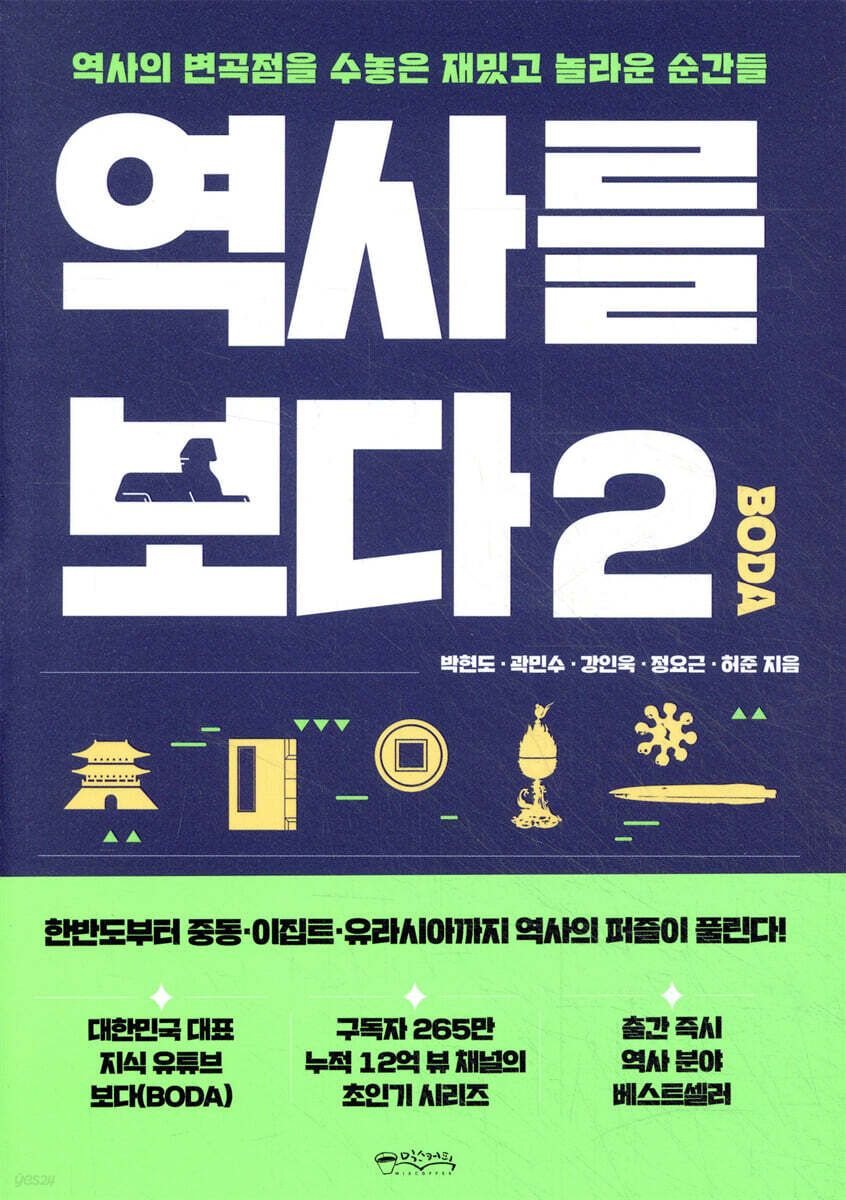
See History 2
 |
Description
Book Introduction
“One scene changed civilization, one choice shaped history!”
A journey to a decisive moment in history
An Amazing Journey of Intellectual Exploration
★ Korea's representative knowledge YouTuber, BODA ★
★ Super popular series with 2.65 million subscribers and 1.25 billion cumulative views ★
★ Avengers of History, from the Korean Peninsula to the Middle East, Egypt, and Eurasia ★
★ An instant history bestseller! ★
The well-known series 'See History' from BODA, Korea's leading knowledge channel boasting 2.65 million subscribers and 1.25 billion cumulative views, has come to us in its second volume.
From the mystery of the Tripitaka Koreana solved after 800 years, to the identity of the giant cockroach depicted in the ancient Egyptian Book of the Dead, to the question, "Would modern people have been able to communicate with each other in the past?", this book travels across the Korean Peninsula, Egypt, the Middle East, and Eurasia, thoroughly answering historical questions we never knew existed.
It is even more special because it contains not only the storytelling of vast amounts of data, but also the warm perspective of conveying the wisdom of the ancients, presented in a fun and accessible way by knowledgeable authorities.
『Looking at History 2』 goes beyond a simple history textbook.
We've filled in the in-depth content that wasn't covered in the video, refined it with more accurate expressions, and placed vivid photos and illustrations in the right places to help with intuitive understanding.
The engaging storytelling will add to the immersion, creating an experience that feels like time travel.
You can look forward to a book armed with a different depth and charm than the video.
A journey to a decisive moment in history
An Amazing Journey of Intellectual Exploration
★ Korea's representative knowledge YouTuber, BODA ★
★ Super popular series with 2.65 million subscribers and 1.25 billion cumulative views ★
★ Avengers of History, from the Korean Peninsula to the Middle East, Egypt, and Eurasia ★
★ An instant history bestseller! ★
The well-known series 'See History' from BODA, Korea's leading knowledge channel boasting 2.65 million subscribers and 1.25 billion cumulative views, has come to us in its second volume.
From the mystery of the Tripitaka Koreana solved after 800 years, to the identity of the giant cockroach depicted in the ancient Egyptian Book of the Dead, to the question, "Would modern people have been able to communicate with each other in the past?", this book travels across the Korean Peninsula, Egypt, the Middle East, and Eurasia, thoroughly answering historical questions we never knew existed.
It is even more special because it contains not only the storytelling of vast amounts of data, but also the warm perspective of conveying the wisdom of the ancients, presented in a fun and accessible way by knowledgeable authorities.
『Looking at History 2』 goes beyond a simple history textbook.
We've filled in the in-depth content that wasn't covered in the video, refined it with more accurate expressions, and placed vivid photos and illustrations in the right places to help with intuitive understanding.
The engaging storytelling will add to the immersion, creating an experience that feels like time travel.
You can look forward to a book armed with a different depth and charm than the video.
- You can preview some of the book's contents.
Preview
index
Entering_
Telling a historical story that no one was interested in
Chapter 1: Crucial Scenes That Marked a Turning Point in History
The majesty of the Nile, the flower of Egyptian civilization
The Cultural Revolution that set China back 4,000 years
Lands that are difficult to occupy, like a hurdle
Why the borders of Africa and the Middle East are so sharp
The story of how a single banned book shook the nation.
How Genghis Khan Conquered Half the World
The mystery of the Tripitaka Koreana solved after 800 years
Subscribers' first curiosity
Part 2: The Unsolvable Mystery
The Bermuda Triangle, the most mysterious place on Earth
The identity of a noble relic that no one can deny
Why does the Sphinx have a human face but an animal body?
The identity of the giant cockroach depicted in the Book of the Dead
The Unsolved Secret of Pyramid Building Technology
The Full Story of Costa Rica's Las Bolas Mystery
Controversies Surrounding the Baghdad Battery
Subscribers' second question
Chapter 3: The Importance of Things That Made World History
National treasures discovered by chance
How to determine the value of an artifact
How to create a portrait of a great man you've never seen before
The Suez Canal, Egypt's main source of income
The Power of UNESCO's World Documentary Heritage
History books and forgeries are only a sheet of paper apart.
Subscribers' third question
Chapter 4: Tracing the Diverse Origins
The origin of our country's bronze chopsticks
When did humans start using paper?
Pseudoarchaeologists' interpretations of the Sphinx
Updating the discourse on the Orient
About slavery in our country's history
Map surveying technology that has existed since ancient times
An ancient sea network that could have been navigated without a compass
The importance of physiognomy since ancient times
Subscribers' fourth question
Chapter 5: Stories We Never Knew
Egypt, where 99% of the population lives in 5% of the territory
The bewildering culture of a sparsely populated area
Stories of unrecognized countries not on the map
Cats that lived in close relationships with humans
Innovative ways to prevent war
Subscribers' Fifth Curiosity
Chapter 6: The Unbearable Lightness of Historical Curiosity
Why the Bow Was an Irreplaceable Weapon
If modern people went back in time, would they be able to communicate?
Why there is no bridge between Africa and Europe
Why Humans Had to Eat Foods That Were Hard to Eat
The reason for the global phenomenon of sanicide
Subscribers' Sixth Question
Telling a historical story that no one was interested in
Chapter 1: Crucial Scenes That Marked a Turning Point in History
The majesty of the Nile, the flower of Egyptian civilization
The Cultural Revolution that set China back 4,000 years
Lands that are difficult to occupy, like a hurdle
Why the borders of Africa and the Middle East are so sharp
The story of how a single banned book shook the nation.
How Genghis Khan Conquered Half the World
The mystery of the Tripitaka Koreana solved after 800 years
Subscribers' first curiosity
Part 2: The Unsolvable Mystery
The Bermuda Triangle, the most mysterious place on Earth
The identity of a noble relic that no one can deny
Why does the Sphinx have a human face but an animal body?
The identity of the giant cockroach depicted in the Book of the Dead
The Unsolved Secret of Pyramid Building Technology
The Full Story of Costa Rica's Las Bolas Mystery
Controversies Surrounding the Baghdad Battery
Subscribers' second question
Chapter 3: The Importance of Things That Made World History
National treasures discovered by chance
How to determine the value of an artifact
How to create a portrait of a great man you've never seen before
The Suez Canal, Egypt's main source of income
The Power of UNESCO's World Documentary Heritage
History books and forgeries are only a sheet of paper apart.
Subscribers' third question
Chapter 4: Tracing the Diverse Origins
The origin of our country's bronze chopsticks
When did humans start using paper?
Pseudoarchaeologists' interpretations of the Sphinx
Updating the discourse on the Orient
About slavery in our country's history
Map surveying technology that has existed since ancient times
An ancient sea network that could have been navigated without a compass
The importance of physiognomy since ancient times
Subscribers' fourth question
Chapter 5: Stories We Never Knew
Egypt, where 99% of the population lives in 5% of the territory
The bewildering culture of a sparsely populated area
Stories of unrecognized countries not on the map
Cats that lived in close relationships with humans
Innovative ways to prevent war
Subscribers' Fifth Curiosity
Chapter 6: The Unbearable Lightness of Historical Curiosity
Why the Bow Was an Irreplaceable Weapon
If modern people went back in time, would they be able to communicate?
Why there is no bridge between Africa and Europe
Why Humans Had to Eat Foods That Were Hard to Eat
The reason for the global phenomenon of sanicide
Subscribers' Sixth Question
Detailed image

Into the book
The straight borders that look like they were drawn with a ruler were all created by Western powers.
Normal borders are not straight, but rather crooked.
This is because the border is usually defined by mountains, rivers, and seas.
This is called a 'natural environmental border'.
On the other hand, many of the Middle Eastern countries have straight borders.
This is called a 'geometric border'.
In the late 19th and early 20th centuries, Western powers needed to develop sources of cheap raw materials and markets for their products.
The Middle East came into their sights.
Thus, a fierce battle is waged over the Middle East, especially Africa.
On November 15, 1884, as tensions between the Western powers were rising, a conference was held in Berlin under the leadership of Otto von Bismarck, then Chancellor of the German Empire.
Through the 'Berlin Conference' held until February 26th of the following year, fourteen countries with interests in the Western powers' scramble for Africa gathered to divide up African colonies.
As a result, the borders of many African countries have a bizarre appearance, almost straight.
This is called the 'Partition of Africa'.
Artificially created borders have caused various conflicts.
In the Middle East, various tribes have long shared their own cultures, but they have ended up indiscriminately mixing with each other.
--- From "Chapter 1: Decisive Scenes that Marked a Turning Point in History"
From the 1940s to the 21st century, countless ships and planes have disappeared in the Bermuda Triangle.
It happened particularly intensively until the 1970s.
That's because planes flying from the US can't go south unless they pass through the Bermuda Triangle.
In particular, John F. Kennedy Center, which can be said to be the gateway to New York, the capital of the world,
It's no exaggeration to say that heading south from Kennedy International Airport means passing through the Bermuda Triangle.
It is a major maritime and air traffic hub, so there is a huge amount of traffic.
A similar example is the case of the Tu-154, a passenger plane manufactured by the former Soviet aircraft manufacturer Tupolev, which had a particularly high number of accidents, to the point that it was nicknamed the "flying coffin" in the West.
But if you look closely, it's not because of a defect in the aircraft itself, but because the Tu-154 was the most produced and operated.
Of course, there were many accidents caused by carelessness and mistakes.
So, excluding the statistics of the most manufactured and operated aircraft, it is no exaggeration to say that it is the most stable aircraft overall.
I also flew the Tu-154 countless times during my study abroad.
Likewise, it is safe to say that there are no actual mysteries discovered in the Bermuda Triangle.
It's not a mystery, but statistically, the Bermuda Triangle has such a high volume of traffic that accidents are bound to happen.
--- From "Chapter 2: The Mystery That Seems Unsolvable"
The Baekje Gilt-Bronze Incense Burner, a national treasure that is considered the greatest masterpiece of Baekje metal crafts and even the greatest masterpiece of ancient Korea, was discovered by great coincidence.
In 1993, construction of a parking lot was carried out for tourists visiting the Buyeo Royal Tombs, one of the UNESCO World Heritage Sites, the Baekje Historic Areas.
In the process, the field was plowed and a parking lot was dug up, and a bronze incense burner was discovered in a mud puddle.
Pieces of fabric were found around the incense burner, and it is believed that these pieces of fabric may have been wrapped around the incense burner.
After further investigation, it was discovered that the incense burner was found in a wooden water container in the workshop of a temple built by the royal family during the Baekje period.
Scholars speculate that it was hastily hidden as Baekje's destruction was imminent due to an attack by the Tang-Silla allied forces.
If it had not been discovered by chance, I believe that one of the greatest national treasures in Korean history would still be buried somewhere in the ground, or if discovered at some point, it would be in an incomplete state.
It's a truly remarkable coincidence.
--- From "Chapter 3: The Importance of Things That Made Up World History"
In the Mediterranean world, the Minoan civilization, which began in Crete around 2000 BC, and the civilizations of Egypt, Mesopotamia, the Levant, Greece, and Mycenaean continued to interact.
It's easy to think that the civilizations surrounding the Mediterranean would have interacted with each other, but the Mediterranean is a much larger sea than the Yellow Sea west of the Korean Peninsula.
So, it was never easy to communicate.
Sailing along the coast was the usual and common way of navigation, but aren't there many islands in the Mediterranean?
Especially in the case of Crete, it is very far from the mainland.
Still, I went back and forth to Crete quite often.
If you look at the traces of that exchange, it is dynamic.
Although there is no specific, clear documentary evidence, it can be confirmed through related artifacts.
As artifacts have been continuously excavated over a long period of time, it can be assumed that this Mediterranean network was continuously used in various regions, not just the aforementioned ones.
It's hard to imagine that a compass, especially a proper compass, would have been used for practical purposes in BC.
In that respect, I also believe that in ancient times, it would have been possible to form a fairly extensive maritime network even without a compass.
--- From "Chapter 4: Tracing Various Origins"
Among the 203 countries, there are political entities that are not considered countries by the UN standards.
For example, the Vatican and Palestine are representative examples. Both countries are UN observers (non-member states that do not have formal seats in the UN but participate in meetings and activities).
There is also the case of the Democratic People's Republic of Korea, or North Korea.
In our country, North Korea is not defined as a country.
Article 3 of the Constitution of the Republic of Korea stipulates that “the territory of the Republic of Korea shall consist of the Korean Peninsula and its adjacent islands.”
But by the UN's standards, North Korea is a state.
South Korea and North Korea joined the UN simultaneously in 1991.
North Korea is clearly a member of the United Nations.
On the other hand, North Korea did not recognize South Korea as a country until 2023, but did so in 2024.
And in the case of the Republic of China, or Taiwan, although it is not a member of the United Nations, it has been recognized by some UN member states.
Several countries, including Kosovo, are in similar situations.
On the other hand, countries like the People's Republic of China, Israel, Ukraine, and Armenia are legitimate UN member states, but they have not been recognized by some UN member states.
--- From "Chapter 5 Stories We Never Knew"
I think that even if I go to the Goryeo Dynasty, I will be able to communicate quickly with just a little effort.
I spoke with Koryo-saram, a group of Koreans who migrated to the Primorsky Krai region starting in the 19th century.
At first, of course, you have no idea what he is talking about.
If you take away all the context and context and look at each pronunciation separately, you will never know.
Isn't it true that we don't understand words individually by separating each phoneme, but rather understand them as a whole and in context?
I think that if we try to understand the meaning of the Goryeo Dynasty language as a whole and in context, we can understand it.
Since Goryeo was a multi-ethnic country, it wouldn't have been awkward for various languages to be mixed together.
In the case of the Silk Road, dozens of languages are standard, and even completely different language families are mixed together.
But, looking into any records or historical facts, I have never seen anything that shows that they couldn't communicate with each other and couldn't sell goods.
Of course, there would have been an interpreter.
Normal borders are not straight, but rather crooked.
This is because the border is usually defined by mountains, rivers, and seas.
This is called a 'natural environmental border'.
On the other hand, many of the Middle Eastern countries have straight borders.
This is called a 'geometric border'.
In the late 19th and early 20th centuries, Western powers needed to develop sources of cheap raw materials and markets for their products.
The Middle East came into their sights.
Thus, a fierce battle is waged over the Middle East, especially Africa.
On November 15, 1884, as tensions between the Western powers were rising, a conference was held in Berlin under the leadership of Otto von Bismarck, then Chancellor of the German Empire.
Through the 'Berlin Conference' held until February 26th of the following year, fourteen countries with interests in the Western powers' scramble for Africa gathered to divide up African colonies.
As a result, the borders of many African countries have a bizarre appearance, almost straight.
This is called the 'Partition of Africa'.
Artificially created borders have caused various conflicts.
In the Middle East, various tribes have long shared their own cultures, but they have ended up indiscriminately mixing with each other.
--- From "Chapter 1: Decisive Scenes that Marked a Turning Point in History"
From the 1940s to the 21st century, countless ships and planes have disappeared in the Bermuda Triangle.
It happened particularly intensively until the 1970s.
That's because planes flying from the US can't go south unless they pass through the Bermuda Triangle.
In particular, John F. Kennedy Center, which can be said to be the gateway to New York, the capital of the world,
It's no exaggeration to say that heading south from Kennedy International Airport means passing through the Bermuda Triangle.
It is a major maritime and air traffic hub, so there is a huge amount of traffic.
A similar example is the case of the Tu-154, a passenger plane manufactured by the former Soviet aircraft manufacturer Tupolev, which had a particularly high number of accidents, to the point that it was nicknamed the "flying coffin" in the West.
But if you look closely, it's not because of a defect in the aircraft itself, but because the Tu-154 was the most produced and operated.
Of course, there were many accidents caused by carelessness and mistakes.
So, excluding the statistics of the most manufactured and operated aircraft, it is no exaggeration to say that it is the most stable aircraft overall.
I also flew the Tu-154 countless times during my study abroad.
Likewise, it is safe to say that there are no actual mysteries discovered in the Bermuda Triangle.
It's not a mystery, but statistically, the Bermuda Triangle has such a high volume of traffic that accidents are bound to happen.
--- From "Chapter 2: The Mystery That Seems Unsolvable"
The Baekje Gilt-Bronze Incense Burner, a national treasure that is considered the greatest masterpiece of Baekje metal crafts and even the greatest masterpiece of ancient Korea, was discovered by great coincidence.
In 1993, construction of a parking lot was carried out for tourists visiting the Buyeo Royal Tombs, one of the UNESCO World Heritage Sites, the Baekje Historic Areas.
In the process, the field was plowed and a parking lot was dug up, and a bronze incense burner was discovered in a mud puddle.
Pieces of fabric were found around the incense burner, and it is believed that these pieces of fabric may have been wrapped around the incense burner.
After further investigation, it was discovered that the incense burner was found in a wooden water container in the workshop of a temple built by the royal family during the Baekje period.
Scholars speculate that it was hastily hidden as Baekje's destruction was imminent due to an attack by the Tang-Silla allied forces.
If it had not been discovered by chance, I believe that one of the greatest national treasures in Korean history would still be buried somewhere in the ground, or if discovered at some point, it would be in an incomplete state.
It's a truly remarkable coincidence.
--- From "Chapter 3: The Importance of Things That Made Up World History"
In the Mediterranean world, the Minoan civilization, which began in Crete around 2000 BC, and the civilizations of Egypt, Mesopotamia, the Levant, Greece, and Mycenaean continued to interact.
It's easy to think that the civilizations surrounding the Mediterranean would have interacted with each other, but the Mediterranean is a much larger sea than the Yellow Sea west of the Korean Peninsula.
So, it was never easy to communicate.
Sailing along the coast was the usual and common way of navigation, but aren't there many islands in the Mediterranean?
Especially in the case of Crete, it is very far from the mainland.
Still, I went back and forth to Crete quite often.
If you look at the traces of that exchange, it is dynamic.
Although there is no specific, clear documentary evidence, it can be confirmed through related artifacts.
As artifacts have been continuously excavated over a long period of time, it can be assumed that this Mediterranean network was continuously used in various regions, not just the aforementioned ones.
It's hard to imagine that a compass, especially a proper compass, would have been used for practical purposes in BC.
In that respect, I also believe that in ancient times, it would have been possible to form a fairly extensive maritime network even without a compass.
--- From "Chapter 4: Tracing Various Origins"
Among the 203 countries, there are political entities that are not considered countries by the UN standards.
For example, the Vatican and Palestine are representative examples. Both countries are UN observers (non-member states that do not have formal seats in the UN but participate in meetings and activities).
There is also the case of the Democratic People's Republic of Korea, or North Korea.
In our country, North Korea is not defined as a country.
Article 3 of the Constitution of the Republic of Korea stipulates that “the territory of the Republic of Korea shall consist of the Korean Peninsula and its adjacent islands.”
But by the UN's standards, North Korea is a state.
South Korea and North Korea joined the UN simultaneously in 1991.
North Korea is clearly a member of the United Nations.
On the other hand, North Korea did not recognize South Korea as a country until 2023, but did so in 2024.
And in the case of the Republic of China, or Taiwan, although it is not a member of the United Nations, it has been recognized by some UN member states.
Several countries, including Kosovo, are in similar situations.
On the other hand, countries like the People's Republic of China, Israel, Ukraine, and Armenia are legitimate UN member states, but they have not been recognized by some UN member states.
--- From "Chapter 5 Stories We Never Knew"
I think that even if I go to the Goryeo Dynasty, I will be able to communicate quickly with just a little effort.
I spoke with Koryo-saram, a group of Koreans who migrated to the Primorsky Krai region starting in the 19th century.
At first, of course, you have no idea what he is talking about.
If you take away all the context and context and look at each pronunciation separately, you will never know.
Isn't it true that we don't understand words individually by separating each phoneme, but rather understand them as a whole and in context?
I think that if we try to understand the meaning of the Goryeo Dynasty language as a whole and in context, we can understand it.
Since Goryeo was a multi-ethnic country, it wouldn't have been awkward for various languages to be mixed together.
In the case of the Silk Road, dozens of languages are standard, and even completely different language families are mixed together.
But, looking into any records or historical facts, I have never seen anything that shows that they couldn't communicate with each other and couldn't sell goods.
Of course, there would have been an interpreter.
--- From "Chapter 6: The Unbearable Lightness of Historical Curiosity"
Publisher's Review
"The confusing history is now clearly explained."
The Avengers of History tell us
Moments of enlightenment and reversal
The so-called 'Avengers of History' were mobilized, including Jeong Yo-geun from the Korean Peninsula, Park Hyeon-do from the Middle East, Kwak Min-su from Egypt, and Kang In-wook from Eurasia.
Here, Heo Jun, the MC of a history program representing Korea, joins us.
BODA's super popular series 'See History', which debuted in August 2023, has established itself as 'trusted history content', recording over 80 million views and over 60,000 comments in just over two years.
The secret to its popularity is its stellar cast, interesting themes and materials, smooth and engaging presentation, rich content, and lively editing.
In particular, Professor Jeong Yo-geun, an authority on Goryeo history, has joined the new 『Seeing History 2』 series, providing a deeper and broader historical perspective.
Stories not covered in the video, enriched with content, will quench the intellectual thirst of readers.
History is not simply a list of facts from the past.
While it stimulates our intellectual exploration with weighty questions like, “Did the Cultural Revolution really set China back 4,000 years?” and “Is the discourse on the Orient being updated?”, it also raises innocent and whimsical questions like, “Did cats really live in close relationships with humans?” and “If modern people went back in time, would they have been able to communicate?”
The Avengers of History will provide clear and accurate answers based on engaging storytelling and sharp historical insight.
As Professor Park Hyeon-do revealed in the introduction of the book, Islam, Egypt, Eurasia, and even Goryeo history are so-called "neglected fields of study," not only unpopular but also virtually unknown. However, the fact that they have been compiled into a video and book form is not only a core part that we must know, but also proof that the ground is finally being created for the "periphery" to have a place in our historical community.
This book consists of a total of six chapters.
Chapter 1 examines crucial moments that marked turning points in history, such as the story of how a single banned book shook a nation, or the story of Genghis Khan, who conquered half the world.
Chapter 2 delves into the mysteries of the Bermuda Triangle, the Sphinx, the pyramids, and Las Bolas, which seem unsolvable but are still unsolvable.
Chapter 3 considers the importance of artifacts that shaped world history.
Chapter 4 traces the origins of various items related to human history, such as paper, maps, and bronze chopsticks.
Chapter 5 tells stories of unrecognized countries and unpopulated areas that we had not previously known about.
In Chapter 6, we hear answers to seemingly light but heavy historical questions, such as difficult-to-eat foods and the phenomenon of scenicide.
The Avengers of History tell us
Moments of enlightenment and reversal
The so-called 'Avengers of History' were mobilized, including Jeong Yo-geun from the Korean Peninsula, Park Hyeon-do from the Middle East, Kwak Min-su from Egypt, and Kang In-wook from Eurasia.
Here, Heo Jun, the MC of a history program representing Korea, joins us.
BODA's super popular series 'See History', which debuted in August 2023, has established itself as 'trusted history content', recording over 80 million views and over 60,000 comments in just over two years.
The secret to its popularity is its stellar cast, interesting themes and materials, smooth and engaging presentation, rich content, and lively editing.
In particular, Professor Jeong Yo-geun, an authority on Goryeo history, has joined the new 『Seeing History 2』 series, providing a deeper and broader historical perspective.
Stories not covered in the video, enriched with content, will quench the intellectual thirst of readers.
History is not simply a list of facts from the past.
While it stimulates our intellectual exploration with weighty questions like, “Did the Cultural Revolution really set China back 4,000 years?” and “Is the discourse on the Orient being updated?”, it also raises innocent and whimsical questions like, “Did cats really live in close relationships with humans?” and “If modern people went back in time, would they have been able to communicate?”
The Avengers of History will provide clear and accurate answers based on engaging storytelling and sharp historical insight.
As Professor Park Hyeon-do revealed in the introduction of the book, Islam, Egypt, Eurasia, and even Goryeo history are so-called "neglected fields of study," not only unpopular but also virtually unknown. However, the fact that they have been compiled into a video and book form is not only a core part that we must know, but also proof that the ground is finally being created for the "periphery" to have a place in our historical community.
This book consists of a total of six chapters.
Chapter 1 examines crucial moments that marked turning points in history, such as the story of how a single banned book shook a nation, or the story of Genghis Khan, who conquered half the world.
Chapter 2 delves into the mysteries of the Bermuda Triangle, the Sphinx, the pyramids, and Las Bolas, which seem unsolvable but are still unsolvable.
Chapter 3 considers the importance of artifacts that shaped world history.
Chapter 4 traces the origins of various items related to human history, such as paper, maps, and bronze chopsticks.
Chapter 5 tells stories of unrecognized countries and unpopulated areas that we had not previously known about.
In Chapter 6, we hear answers to seemingly light but heavy historical questions, such as difficult-to-eat foods and the phenomenon of scenicide.
GOODS SPECIFICS
- Date of issue: July 30, 2025
- Page count, weight, size: 314 pages | 500g | 148*210*18mm
- ISBN13: 9791170436577
- ISBN10: 1170436579
You may also like
카테고리
korean


korean

![GQ KOREA Mark (Monthly): December [2025]](http://librairie.coreenne.fr/cdn/shop/files/8ef265dbbfbf186523ed75ba7319009d.jpg?v=1765340328&width=3840)


