

The Art of Loving
 |
Description
Book Introduction
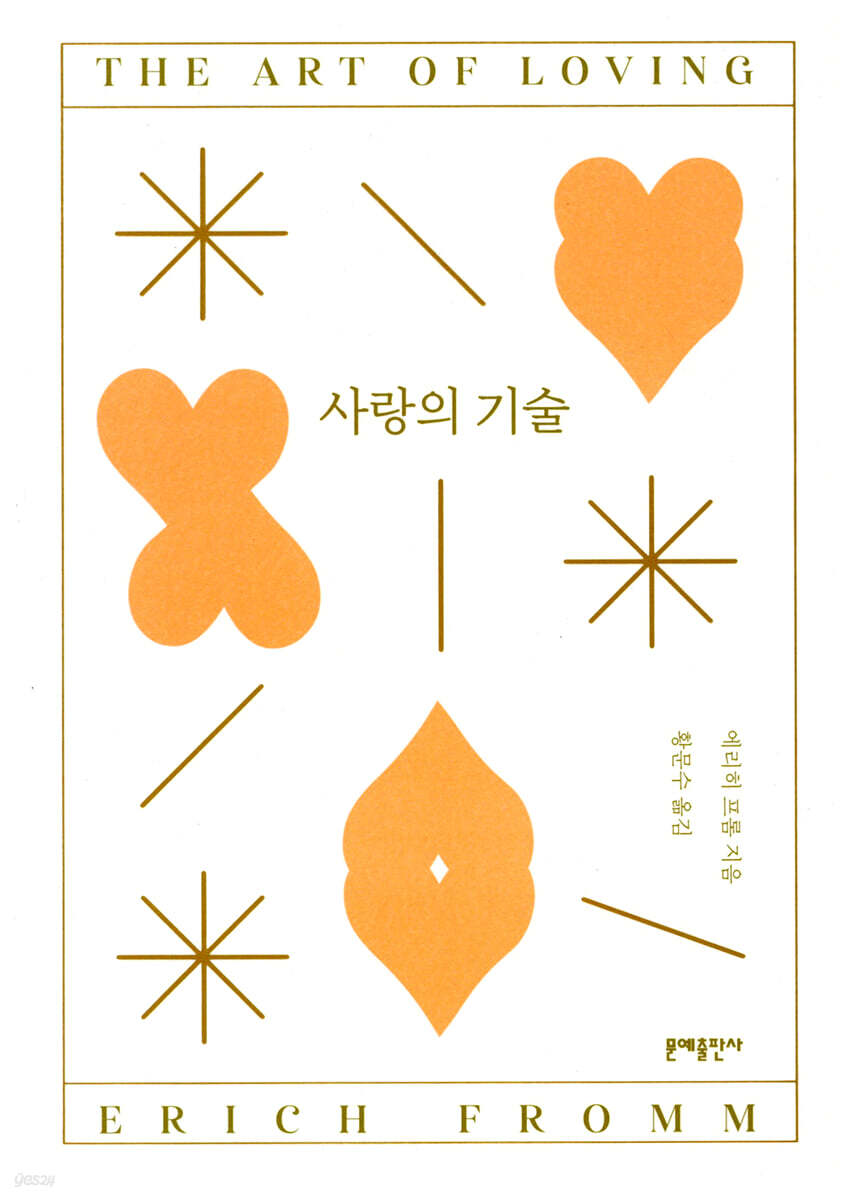
In “The Art of Loving,” Erich Fromm poses a question about love, an eternal topic of conversation for humanity.
This question posed by Fromm continues to provide many readers with an opportunity to seriously reflect on the meaning of love, even though more than 60 years have passed since the publication of The Art of Loving.
Since its first publication in 1956, The Art of Loving has been translated into 34 languages and sold millions of copies worldwide, establishing itself as a representative steady seller and modern classic of our time.
Is "love" a technology? In "The Art of Loving," German-born psychoanalyst and social philosopher Erich Fromm poses a question about love, a perennial topic of conversation for humanity.
This question posed by Fromm has provided many readers with an opportunity to seriously reflect on the meaning of love, even now, more than 60 years after the publication of The Art of Loving.
The sheer impact of "The Art of Loving" on so many readers is evident in the fact that it has been translated into 34 languages since its first publication in 1956 and has sold millions of copies worldwide, establishing it as a representative steady seller of our time and a modern classic.
Munye Publishing House has published a revised edition of “The Art of Love” with a new cover.
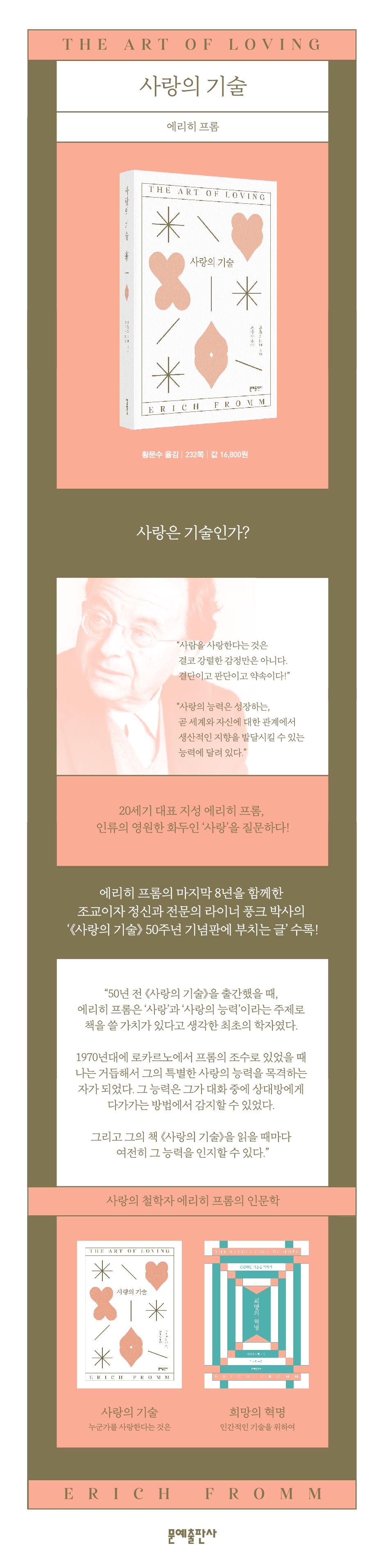
This book includes [The Life and Love of Erich Fromm] written to commemorate the 50th anniversary of The Art of Loving by Dr. Rainer Funk, who received his degree with a thesis on Erich Fromm's social psychology and ethics, was Fromm's last assistant, and the sole administrator of the copyright and posthumous literature related to Fromm's works, and published the Fromm Complete Works.
Dr. Rainer Funk, who witnessed Fromm's final days, tells the readers in this afterword about Fromm's life, how Fromm loved and how he lived out what he talked about in his books.
This question posed by Fromm continues to provide many readers with an opportunity to seriously reflect on the meaning of love, even though more than 60 years have passed since the publication of The Art of Loving.
Since its first publication in 1956, The Art of Loving has been translated into 34 languages and sold millions of copies worldwide, establishing itself as a representative steady seller and modern classic of our time.
Is "love" a technology? In "The Art of Loving," German-born psychoanalyst and social philosopher Erich Fromm poses a question about love, a perennial topic of conversation for humanity.
This question posed by Fromm has provided many readers with an opportunity to seriously reflect on the meaning of love, even now, more than 60 years after the publication of The Art of Loving.
The sheer impact of "The Art of Loving" on so many readers is evident in the fact that it has been translated into 34 languages since its first publication in 1956 and has sold millions of copies worldwide, establishing it as a representative steady seller of our time and a modern classic.
Munye Publishing House has published a revised edition of “The Art of Love” with a new cover.
This book includes [The Life and Love of Erich Fromm] written to commemorate the 50th anniversary of The Art of Loving by Dr. Rainer Funk, who received his degree with a thesis on Erich Fromm's social psychology and ethics, was Fromm's last assistant, and the sole administrator of the copyright and posthumous literature related to Fromm's works, and published the Fromm Complete Works.
Dr. Rainer Funk, who witnessed Fromm's final days, tells the readers in this afterword about Fromm's life, how Fromm loved and how he lived out what he talked about in his books.
- You can preview some of the book's contents.
Preview
index
preface
1 Is love a skill?
2 Theory of Love
3 The Collapse of Love in Modern Western Society
4. The Practice of Love
Americas
On the 50th Anniversary of Publication: The Life and Love of Erich Fromm
Translator's Note
1 Is love a skill?
2 Theory of Love
3 The Collapse of Love in Modern Western Society
4. The Practice of Love
Americas
On the 50th Anniversary of Publication: The Life and Love of Erich Fromm
Translator's Note
Detailed image
Into the book
Those expecting a handy guide to the art of love will be disappointed when they read this book.
This is because the intention of this book is to show that love is not a sentiment that anyone can easily indulge in, regardless of the level of maturity they have reached.
This book seeks to awaken readers to the fact that no matter how hard they try to love, they are bound to fail unless they actively develop their entire personality in a productive direction, and that personal love cannot succeed unless they have the ability to love their neighbors, and without true humility, courage, faith, and discipline.
In cultures where the above-mentioned qualities are rare, acquiring the ability to love may be very difficult.
Or you could ask yourself how many people you know who truly love you.
But just because love is difficult, we should not avoid recognizing this difficulty and even exploring the conditions for reaching love.
--- pp.4~5
Is love a skill? If it is, then love requires knowledge and effort.
Or is love a joyful emotion we experience by chance, something everyone can experience if they're lucky? This little book is premised on the view that "love is a skill," but most modern people, of course, believe love is a joyful emotion.
This does not mean that modern people do not consider love important.
Modern people long for love, watch countless movies that tell happy and unhappy love stories, and listen to hundreds of trivial songs about love.
But few people think that there is anything to be learned about love.
--- p.13
Any theory of love must begin with anthropology, that is, with human existentialism.
We find love, or something similar to love, in animals, but animal attachment is only part of their instinctive apparatus.
But in the case of humans, we can only see remnants of this instinctive mechanism at work.
What is essential to human existence is the fact that man has escaped from the animal kingdom, from the world of instinctive adaptation, and has transcended nature—though he can never abandon it.
Humans are a part of nature.
--- p.23
Envy, jealousy, ambition, and all kinds of greed are passions.
But love is an action, an exercise of human power, and this power can only be exercised in free circumstances, never as a result of coercion.
Love is not a passive emotion, but an activity.
Love is about 'participating', not 'falling in'.
If we were to speak of the active nature of love in the most general way, we could say that love is inherently 'giving' and not 'receiving'.
--- p.42
Modern man is alienated from himself, his fellow men, and nature.
He transforms into a commodity and experiences his life force as an investment that can bring maximum profit under current market conditions.
Human relationships become fundamentally alienated, automaton-like, with each person seeking his or her own safety by being with the crowd, and thus there is no distinction between individuals in thought, feeling, or action.
Everyone tries to be with others as much as possible, but everyone is deeply lonely, and is subject to deep uncertainty, anxiety, and guilt, which inevitably result when the state of separation is not overcome.
--- p.126
There can be no 'division of labor' between love for oneself and love for others.
Conversely, loving others becomes a condition for loving oneself.
If we take these insights seriously, we will in fact experience a dramatic, if not a conventional, transformation in our social relationships.
This is because the intention of this book is to show that love is not a sentiment that anyone can easily indulge in, regardless of the level of maturity they have reached.
This book seeks to awaken readers to the fact that no matter how hard they try to love, they are bound to fail unless they actively develop their entire personality in a productive direction, and that personal love cannot succeed unless they have the ability to love their neighbors, and without true humility, courage, faith, and discipline.
In cultures where the above-mentioned qualities are rare, acquiring the ability to love may be very difficult.
Or you could ask yourself how many people you know who truly love you.
But just because love is difficult, we should not avoid recognizing this difficulty and even exploring the conditions for reaching love.
--- pp.4~5
Is love a skill? If it is, then love requires knowledge and effort.
Or is love a joyful emotion we experience by chance, something everyone can experience if they're lucky? This little book is premised on the view that "love is a skill," but most modern people, of course, believe love is a joyful emotion.
This does not mean that modern people do not consider love important.
Modern people long for love, watch countless movies that tell happy and unhappy love stories, and listen to hundreds of trivial songs about love.
But few people think that there is anything to be learned about love.
--- p.13
Any theory of love must begin with anthropology, that is, with human existentialism.
We find love, or something similar to love, in animals, but animal attachment is only part of their instinctive apparatus.
But in the case of humans, we can only see remnants of this instinctive mechanism at work.
What is essential to human existence is the fact that man has escaped from the animal kingdom, from the world of instinctive adaptation, and has transcended nature—though he can never abandon it.
Humans are a part of nature.
--- p.23
Envy, jealousy, ambition, and all kinds of greed are passions.
But love is an action, an exercise of human power, and this power can only be exercised in free circumstances, never as a result of coercion.
Love is not a passive emotion, but an activity.
Love is about 'participating', not 'falling in'.
If we were to speak of the active nature of love in the most general way, we could say that love is inherently 'giving' and not 'receiving'.
--- p.42
Modern man is alienated from himself, his fellow men, and nature.
He transforms into a commodity and experiences his life force as an investment that can bring maximum profit under current market conditions.
Human relationships become fundamentally alienated, automaton-like, with each person seeking his or her own safety by being with the crowd, and thus there is no distinction between individuals in thought, feeling, or action.
Everyone tries to be with others as much as possible, but everyone is deeply lonely, and is subject to deep uncertainty, anxiety, and guilt, which inevitably result when the state of separation is not overcome.
--- p.126
There can be no 'division of labor' between love for oneself and love for others.
Conversely, loving others becomes a condition for loving oneself.
If we take these insights seriously, we will in fact experience a dramatic, if not a conventional, transformation in our social relationships.
--- p.183
Publisher's Review
Loving someone is
Not just intense emotions,
It is a resolution, a judgment, and a promise!
― The 5th edition of "The Art of Loving" published.
― Dr. Rainer Funk, who was with Erich Fromm during his final days
An essay commemorating the 50th anniversary of The Art of Loving
Is "love" a technology? In "The Art of Loving," German-born psychoanalyst and social philosopher Erich Fromm poses a question about love, a perennial topic of conversation for humanity.
This question posed by Fromm has provided many readers with an opportunity to seriously reflect on the meaning of love, even now, more than 60 years after the publication of The Art of Loving.
The sheer impact of "The Art of Loving" on so many readers is evident in the fact that it has been translated into 34 languages since its first publication in 1956 and has sold millions of copies worldwide, establishing it as a representative steady seller of our time and a modern classic.
Munye Publishing House has published a revised edition of “The Art of Love” with a new cover.
What it takes to succeed in love
Fromm approaches love from the perspective of 'technology' rather than the realm of 'emotions' as is commonly thought of.
Everyone longs for love, but loving is becoming increasingly difficult.
In human relationships, in social relationships, in the relationship between husband and wife, and between lovers, ‘love’ has disappeared and ‘custom’ and ‘calculation’ have taken its place.
As Fromm points out, the fact that modern society is governed by the principles of market exchange and that human value has ultimately become nothing more than economic exchange value can be said to be an external cause that has exhausted human love.
In addition to external factors, Fromm delves into the individual's unconscious to uncover the reasons for the loss of the ability to love.
Fromm diagnoses that the loss of love is caused by the loss of human beings' true self.
However, metaphysical delusions, religious sermons, and moral teachings alone are not enough to overcome this loss of self, that is, the loss of the ability to love.
Even if we restore faith in ourselves, others, and humanity, and cry out for love for all humanity, and even if everyone sincerely sympathizes with this cry, that alone will not overcome the absence of love.
But the more we try to love, the more we fail in love, the more we become separated from others, the more isolated we become, and the more we feel a deep loneliness.
Ultimately, the failure to love creates a fear of people and a rush to rationalize to cover up one's own incompetence.
In a state of separation, anxiety and loneliness are feared, but there is no way out of this state.
That is why love becomes a technical problem rather than a natural one.
Modern society and humans have become too complex and sophisticated to give the easy answer that love is a God-given ability and that we can practice love by acting according to our feelings.
Therefore, now, technology is desperately needed to restore love.
Fromm says that the reason we fail in love, even though we strive to love and want to love truly, giving our all, is because of the immaturity of our skills.
In “The Art of Loving,” Fromm sharply explored this point and explained the art of loving from a psychoanalytic perspective.
Fromm wants to say in this book that unless we actively develop our entire personality and move it in a productive direction, no matter how hard we try to love, we are bound to fail, and that personal love cannot succeed unless we have the ability to love our neighbors, and without true humility, courage, faith, and discipline.
In addition to the theory of love and the techniques for practicing love, "The Art of Loving" also contains sharp criticism and outlook on modern civilization and society by Erich Fromm, a prominent psychoanalyst.
Includes a tribute to Dr. Rainer Funk's 50th anniversary edition.
This book also includes “The Life and Love of Erich Fromm” written to commemorate the 50th anniversary of “The Art of Loving” by Dr. Rainer Funk, who received his degree with a thesis on Erich Fromm’s social psychology and ethics, was Fromm’s last assistant, and is the sole custodian of the copyright and posthumous literature related to Fromm’s writings, and published the Fromm Collection.
Dr. Rainer Funk, who witnessed Fromm's final days, tells the readers in this afterword about Fromm's life, how Fromm loved and how he lived out what he talked about in his books.
Not just intense emotions,
It is a resolution, a judgment, and a promise!
― The 5th edition of "The Art of Loving" published.
― Dr. Rainer Funk, who was with Erich Fromm during his final days
An essay commemorating the 50th anniversary of The Art of Loving
Is "love" a technology? In "The Art of Loving," German-born psychoanalyst and social philosopher Erich Fromm poses a question about love, a perennial topic of conversation for humanity.
This question posed by Fromm has provided many readers with an opportunity to seriously reflect on the meaning of love, even now, more than 60 years after the publication of The Art of Loving.
The sheer impact of "The Art of Loving" on so many readers is evident in the fact that it has been translated into 34 languages since its first publication in 1956 and has sold millions of copies worldwide, establishing it as a representative steady seller of our time and a modern classic.
Munye Publishing House has published a revised edition of “The Art of Love” with a new cover.
What it takes to succeed in love
Fromm approaches love from the perspective of 'technology' rather than the realm of 'emotions' as is commonly thought of.
Everyone longs for love, but loving is becoming increasingly difficult.
In human relationships, in social relationships, in the relationship between husband and wife, and between lovers, ‘love’ has disappeared and ‘custom’ and ‘calculation’ have taken its place.
As Fromm points out, the fact that modern society is governed by the principles of market exchange and that human value has ultimately become nothing more than economic exchange value can be said to be an external cause that has exhausted human love.
In addition to external factors, Fromm delves into the individual's unconscious to uncover the reasons for the loss of the ability to love.
Fromm diagnoses that the loss of love is caused by the loss of human beings' true self.
However, metaphysical delusions, religious sermons, and moral teachings alone are not enough to overcome this loss of self, that is, the loss of the ability to love.
Even if we restore faith in ourselves, others, and humanity, and cry out for love for all humanity, and even if everyone sincerely sympathizes with this cry, that alone will not overcome the absence of love.
But the more we try to love, the more we fail in love, the more we become separated from others, the more isolated we become, and the more we feel a deep loneliness.
Ultimately, the failure to love creates a fear of people and a rush to rationalize to cover up one's own incompetence.
In a state of separation, anxiety and loneliness are feared, but there is no way out of this state.
That is why love becomes a technical problem rather than a natural one.
Modern society and humans have become too complex and sophisticated to give the easy answer that love is a God-given ability and that we can practice love by acting according to our feelings.
Therefore, now, technology is desperately needed to restore love.
Fromm says that the reason we fail in love, even though we strive to love and want to love truly, giving our all, is because of the immaturity of our skills.
In “The Art of Loving,” Fromm sharply explored this point and explained the art of loving from a psychoanalytic perspective.
Fromm wants to say in this book that unless we actively develop our entire personality and move it in a productive direction, no matter how hard we try to love, we are bound to fail, and that personal love cannot succeed unless we have the ability to love our neighbors, and without true humility, courage, faith, and discipline.
In addition to the theory of love and the techniques for practicing love, "The Art of Loving" also contains sharp criticism and outlook on modern civilization and society by Erich Fromm, a prominent psychoanalyst.
Includes a tribute to Dr. Rainer Funk's 50th anniversary edition.
This book also includes “The Life and Love of Erich Fromm” written to commemorate the 50th anniversary of “The Art of Loving” by Dr. Rainer Funk, who received his degree with a thesis on Erich Fromm’s social psychology and ethics, was Fromm’s last assistant, and is the sole custodian of the copyright and posthumous literature related to Fromm’s writings, and published the Fromm Collection.
Dr. Rainer Funk, who witnessed Fromm's final days, tells the readers in this afterword about Fromm's life, how Fromm loved and how he lived out what he talked about in his books.
GOODS SPECIFICS
- Date of issue: September 1, 2019
- Page count, weight, size: 232 pages | 328g | 140*198*18mm
- ISBN13: 9788931011623
- ISBN10: 8931011628
You may also like
카테고리
korean


korean

![GQ KOREA Mark (Monthly): December [2025]](http://librairie.coreenne.fr/cdn/shop/files/8ef265dbbfbf186523ed75ba7319009d.jpg?v=1765340328&width=3840)


