

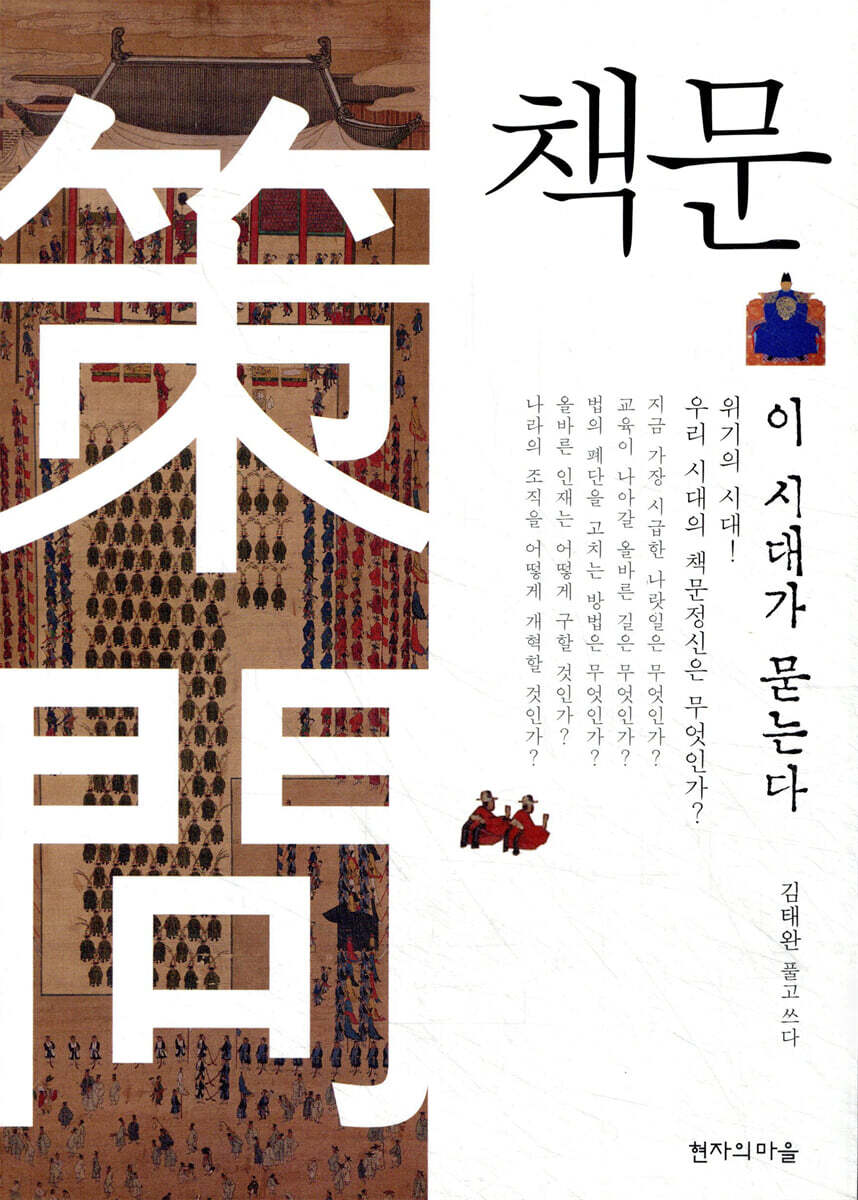
Book Moon: This era asks
 |
Description
Book Introduction
Book Moon: 13 Fundamental Policies for the Nation and People in Times of Crisis
『Bookmun, This Era Asks』 is a declaration of war from Joseon Dynasty scholars toward the world, but it cannot be read as a simple declaration of war.
The unique problem awareness of this book lies in the fact that the scholars' countermeasures presented in this book can be read as principled solutions to the social problems of lack of communication and contradiction that our times must address.
『Bookmun, This Era Asks』 was published in 2004 and was selected as a notable humanities book of the year, making it a significant work that marked a turning point in the humanities publishing market at the time.
But why has the author republished this book now, eleven years later? It is none other than the author's long-standing struggle to present the right direction for history and the responsibility of intellectuals in today's Korean society, a society plagued by lack of communication and principle, and spiraling toward historical regression.
South Korea is now facing a time of crisis.
Citizens are anxious about the unprecedented danger that may strike them at any time, and they are struggling to take care of their own lives.
The sinister air of MERS lingers ominously across the country, and even though 304 precious lives were lost in the surreal disaster of the Sewol ferry disaster, not a single leader takes responsibility.
The country's top leader aspires to be a 'leader for only half the people,' and the country operates solely for the benefit of a small ruling elite and conglomerates.
So, what meaning and value does the "spirit of cheokmun" hold in our time? Confucius said that by mastering the old and understanding the new, one can become a teacher. So, how can we interpret cheokmun, an ancient artifact of the Joseon Dynasty, with new meaning and value today? Reading cheokmun from the Joseon Dynasty, one cannot help but be astonished at how the cheokmun, its themes and policies, so closely resemble today's pressing issues and concerns.
So, Confucius's sermon, "On-go-ji-shin", still resonates with us like thunder.
The book asks us:
What are the challenges of the times we live in?
And what should we do to solve this problem?
『Bookmun, This Era Asks』 is a declaration of war from Joseon Dynasty scholars toward the world, but it cannot be read as a simple declaration of war.
The unique problem awareness of this book lies in the fact that the scholars' countermeasures presented in this book can be read as principled solutions to the social problems of lack of communication and contradiction that our times must address.
『Bookmun, This Era Asks』 was published in 2004 and was selected as a notable humanities book of the year, making it a significant work that marked a turning point in the humanities publishing market at the time.
But why has the author republished this book now, eleven years later? It is none other than the author's long-standing struggle to present the right direction for history and the responsibility of intellectuals in today's Korean society, a society plagued by lack of communication and principle, and spiraling toward historical regression.
South Korea is now facing a time of crisis.
Citizens are anxious about the unprecedented danger that may strike them at any time, and they are struggling to take care of their own lives.
The sinister air of MERS lingers ominously across the country, and even though 304 precious lives were lost in the surreal disaster of the Sewol ferry disaster, not a single leader takes responsibility.
The country's top leader aspires to be a 'leader for only half the people,' and the country operates solely for the benefit of a small ruling elite and conglomerates.
So, what meaning and value does the "spirit of cheokmun" hold in our time? Confucius said that by mastering the old and understanding the new, one can become a teacher. So, how can we interpret cheokmun, an ancient artifact of the Joseon Dynasty, with new meaning and value today? Reading cheokmun from the Joseon Dynasty, one cannot help but be astonished at how the cheokmun, its themes and policies, so closely resemble today's pressing issues and concerns.
So, Confucius's sermon, "On-go-ji-shin", still resonates with us like thunder.
The book asks us:
What are the challenges of the times we live in?
And what should we do to solve this problem?
- You can preview some of the book's contents.
Preview
index
To read the book: The Book, the Test of the Times
Chapter 1: How to Implement Good Politics
Book: How to Correct the Abuses of Law (Sejong)
Countermeasure: We must learn from historical examples (Seong Sam-mun)
You must open the door and listen to the truth (Shin Suk-ju)
Listen to even the most insignificant opinions (Lee Seok-hyung)
Inside the Book: Seong Sam-mun and Shin Suk-ju, Plum Blossoms and Sukju Vegetables
Chapter 2: Principles of Fair Talent Recruitment
Book: How to Recruit Talent (Sejong)
Countermeasure: Take advantage of the strengths and compensate for the weaknesses (Kang Hee-maeng)
Inside the Book: Like a Pavilion with Feet in a Pond
Chapter 3: Politics that Keeps Promises to the End
Book: How to achieve good politics from beginning to end (Jungjong)
Countermeasure: When times are easy, think of the difficulty; when you begin, think of the end (punishment).
Inside the Book: The Story of Daksil Village and Chungjaegong Gwonbeol
How to implement politics in chapter 4 or more
Book: What should we strive for to achieve the ideal politics of the past in an age like today? (Jungjong)
Countermeasure: Only when administration comes from a true heart can it be effective and discipline be upheld (Jo Gwang-jo)
Inside the Book: Jo Gwang-jo, a Sad Memories of Frustrated Reform
Chapter 5: How to Eradicate the Harmful Effects of Alcohol
Book: Discuss the Harmful Effects of Alcohol (Jungjong)
Countermeasure: Drink alcohol appropriately and in moderation (Kim Gu)
If you truly practice moderation and restraint, you won't have to worry about drinking alcohol (Yoon Ja-im)
Inside the Book: King Jungjong and Kim Gu Meet Privately Late at Night
Chapter 6 Qualities of a Diplomat
Book: What Qualities Should a Diplomat Have? (Jungjong)
Countermeasure: Virtue should be prioritized over talent (Kim Ui-jeong)
Inside the Book: Joseon, China, South Korea, and the United States
Chapter 7: Recruiting Talent for a Rich and Strong Nation
Book: What should a king do to avoid ruining his country? (Myeongjong)
Countermeasure: Seek the truth and identify the villains (No Jin)
Inside the Book: Traces of the Sahwa, In Search of the Gentleman
Chapter 8: The Path to Proper Education
Book: What Path Should Education Take? (Myeongjong)
Countermeasure: The truth of learning must please the heart (Jojongdo)
Inside the Book: The Supreme Task of Confucian Intellectuals, Politics, and Education
Chapter 9 Government Organization Reform Plan
Book: How to Reform the Administration of the Six Ministries (Myeongjong)
Countermeasure: Politics ultimately depends on people (Kim Hyo-won)
Inside the Book: The Runner's Master Plan
Chapter 10: Governing the Nation in Troubled Times
Book: Conquest or Peace? (Gwanghaegun)
Countermeasure: Conquest depends on force, peace depends on the situation (Park Gwang-jeon)
Inside the Book: The Fate of Civilization Chosen by Joseon
Chapter 11: Overcoming National Crisis
Book: How can we save this country from its current crisis? (Gwanghaegun)
Countermeasure: We must reform the ten superficial policies (Jo Wi-han)
Inside the Book: Killing King Gwanghae
Chapter 12: Leadership
Book Question: What is the most urgent national matter now? (Gwanghaegun)
Countermeasure: The nation's illness lies with you, the king (Im Sook-young)
Inside the Book: Dangerous Remarks and the Anguish of King Gwanghae
Chapter 13: The Transience of Life
Book: What is the cause of the sadness of New Year's Eve? (Gwanghaegun)
Countermeasure: Life is as short as a flint fire (Lee Myung-han)
Inside the Book: The Sorrow of New Year's Eve
Review: A Book of Books, a Voice to the King and the World
Chapter 1: How to Implement Good Politics
Book: How to Correct the Abuses of Law (Sejong)
Countermeasure: We must learn from historical examples (Seong Sam-mun)
You must open the door and listen to the truth (Shin Suk-ju)
Listen to even the most insignificant opinions (Lee Seok-hyung)
Inside the Book: Seong Sam-mun and Shin Suk-ju, Plum Blossoms and Sukju Vegetables
Chapter 2: Principles of Fair Talent Recruitment
Book: How to Recruit Talent (Sejong)
Countermeasure: Take advantage of the strengths and compensate for the weaknesses (Kang Hee-maeng)
Inside the Book: Like a Pavilion with Feet in a Pond
Chapter 3: Politics that Keeps Promises to the End
Book: How to achieve good politics from beginning to end (Jungjong)
Countermeasure: When times are easy, think of the difficulty; when you begin, think of the end (punishment).
Inside the Book: The Story of Daksil Village and Chungjaegong Gwonbeol
How to implement politics in chapter 4 or more
Book: What should we strive for to achieve the ideal politics of the past in an age like today? (Jungjong)
Countermeasure: Only when administration comes from a true heart can it be effective and discipline be upheld (Jo Gwang-jo)
Inside the Book: Jo Gwang-jo, a Sad Memories of Frustrated Reform
Chapter 5: How to Eradicate the Harmful Effects of Alcohol
Book: Discuss the Harmful Effects of Alcohol (Jungjong)
Countermeasure: Drink alcohol appropriately and in moderation (Kim Gu)
If you truly practice moderation and restraint, you won't have to worry about drinking alcohol (Yoon Ja-im)
Inside the Book: King Jungjong and Kim Gu Meet Privately Late at Night
Chapter 6 Qualities of a Diplomat
Book: What Qualities Should a Diplomat Have? (Jungjong)
Countermeasure: Virtue should be prioritized over talent (Kim Ui-jeong)
Inside the Book: Joseon, China, South Korea, and the United States
Chapter 7: Recruiting Talent for a Rich and Strong Nation
Book: What should a king do to avoid ruining his country? (Myeongjong)
Countermeasure: Seek the truth and identify the villains (No Jin)
Inside the Book: Traces of the Sahwa, In Search of the Gentleman
Chapter 8: The Path to Proper Education
Book: What Path Should Education Take? (Myeongjong)
Countermeasure: The truth of learning must please the heart (Jojongdo)
Inside the Book: The Supreme Task of Confucian Intellectuals, Politics, and Education
Chapter 9 Government Organization Reform Plan
Book: How to Reform the Administration of the Six Ministries (Myeongjong)
Countermeasure: Politics ultimately depends on people (Kim Hyo-won)
Inside the Book: The Runner's Master Plan
Chapter 10: Governing the Nation in Troubled Times
Book: Conquest or Peace? (Gwanghaegun)
Countermeasure: Conquest depends on force, peace depends on the situation (Park Gwang-jeon)
Inside the Book: The Fate of Civilization Chosen by Joseon
Chapter 11: Overcoming National Crisis
Book: How can we save this country from its current crisis? (Gwanghaegun)
Countermeasure: We must reform the ten superficial policies (Jo Wi-han)
Inside the Book: Killing King Gwanghae
Chapter 12: Leadership
Book Question: What is the most urgent national matter now? (Gwanghaegun)
Countermeasure: The nation's illness lies with you, the king (Im Sook-young)
Inside the Book: Dangerous Remarks and the Anguish of King Gwanghae
Chapter 13: The Transience of Life
Book: What is the cause of the sadness of New Year's Eve? (Gwanghaegun)
Countermeasure: Life is as short as a flint fire (Lee Myung-han)
Inside the Book: The Sorrow of New Year's Eve
Review: A Book of Books, a Voice to the King and the World
Into the book
“The mind is the foundation of politics, and law is the instrument of politics.” All change comes from the mind, and all politics is done from the mind.
If those above us keep this mindset and apply the law, what difficulties will there be in governing? The wise kings of old simply governed their countries in this way.
A country has one person as its master, and a king has his mind as his master.
We must nurture and cultivate our minds before they can be expressed outwardly, and we must reflect on them carefully when they are just beginning to sprout.
In this way, even if all the affairs of the country are extremely complicated, they can be managed one by one, and even if there are many officials, each and every one can be managed.
Therefore, all things are to be governed by the mind of the King.
--- From "Chapter 1: How to Implement Proper Politics, Seong Sam-moon's Countermeasures"
The fundamental thing is to recruit talented people and entrust them with work.
If you don't employ the right people, or if you employ them but don't follow their instructions, or if you follow their instructions but don't put your heart into it, what good will it do even if you change the law a hundred times a day? That's why God said that resolving the four evils depends on how you employ people.
---From "Chapter 1: How to Implement Proper Politics, Shin Suk-ju's Countermeasures"
“The problem with the world is not that we cannot eliminate its evils, but that we have no way to save it.
“The problem is not that there is no way to save, but that the opinion is not adopted.”
---From "Chapter 1: How to Implement Proper Politics, Lee Seok-hyung's Countermeasures"
Historical evaluations can vary greatly depending on the era and the historian's perspective.
Therefore, one can freely 'excuse' Prince Suyang or Shin Suk-ju, defending their situation or positively evaluating their judgment and choices.
But legends tell the truth, and history interprets facts.
So, whether it is Mrs. Yun's suicide, the origin of the host plant, or the various tales of the six loyal ministers, they all reveal the truth of life that the people think and desire.
---From Chapter 1, 'Into the Book'
No one in the world is completely talented, but anyone can develop their talents if they are put in the right position.
No one can do everything, so a competent person is someone who can do things well.
If you discard your shortcomings and embrace your strengths, you can use both greedy and honest people.
But if you only point out flaws and expose only faults, even a wise and capable person cannot escape.
So can we say that some people can write and some people cannot?
---From "Chapter 2: Principles of Fair Talent Recruitment, Kang Hee-maeng's Countermeasures"
A monarch must think about why he must have a big heart.
We must cherish and nurture our minds before they sprout, and when they sprout, we must reflect on them and examine them, so as not to be enslaved to things and the body.
When things are easy, think of the difficulties, and start small to achieve great things.
When you start, think about when you will finish, and if you start well, you must finish well.
If we maintain this mindset from beginning to end, our subjects and people will be happy, and our country will be well-governed and peaceful for a long time.
---From "Chapter 3: Politics that Keeps Promises to the End, Measures to Punish Power"
Only when all things come from this true heart can administration be effective, discipline be upright, and laws not be limited to legal provisions.
If Your Majesty regards discipline and laws as trivial matters, and instead regards the profound mind and sincere Way as of no immediate use in reality and does not strive for them, this is like looking for water in a mountain and wood in water; in the end, you will achieve no effect.
This is the essence and law of discipline.
---From "How to Realize Politics of Chapter 4 or More, Jo Gwang-jo's Countermeasures"
People generally know that alcohol is made for rituals, not for fun and enjoyment, and that it is meant to be drunk at feasts, not to get drunk all over the place.
In this regard, if we each have the will and keep to our limits, alcohol will not invade our hearts.
Then, desires will not arise on their own, and the harmful effects of alcohol will not be able to harm or injure my body, so I can naturally purify my body.
In this way, the people will worship goodness instead of wine, and love righteousness instead of wine.
---From "Chapter 5: How to Eradicate the Harmful Effects of Alcohol, Kim Gu's Countermeasures"
If we know that sacrifices are made to repay the fundamentals, we should teach people to use alcohol reverently and hold sacrifices. If we know that feasts are made for harmony, we should teach people to use alcohol for harmony and hold feasts.
The teaching of treating relatives kindly should be added to the drinking to promote harmony with fellow countrymen, and the teaching of respect should be passed down between the king and his subjects.
---From "Chapter 5: How to Eradicate the Harmful Effects of Alcohol, Yoon Ja-im's Countermeasures"
The ancients did not approve of trying to achieve something even though it was against reason.
Trusting in one's talents and handling matters may seem like completing the nation's diplomatic mission, but in reality, it is degrading the nation's prestige.
So adults did not value talent.
A person of noble conduct is not shaken by the concerns of life and death, even when faced with the changes of the world.
He is not distracted by success or failure, but only follows orders, firmly holding on to justice.
---From "Chapter 6: Qualifications of a Diplomat, Kim Ui-jeong's Countermeasures"
Your Majesty, you must preach the truth to enlighten your mind and explore the truth to fully develop your true nature.
In this way, you must discern between the treachery and honesty of your subjects and examine the source of their safety.
Also, you must be as careful as you were when you first decided to do something, and rule it brightly and purely, without any flaws or entanglements.
Then the country will prosper greatly and the people will be greatly happy.
---From "Chapter 7: Recruiting Talented Personnel and Countermeasures for the Wealth and Strength of the Nation"
It doesn't ask whether the talent and skill are adequate or not, or whether the person is wise or not.
Rather, by forcing countless people into competition at once and then hiring them based on a roughly established set of rules without question, does this truly teach the virtues of courtesy, humility, and mutual compromise? This is precisely the primary reason why schools are declining and failing to thrive.
---From "Chapter 8, The Path to Proper Education, and Steering Measures"
The wisdom of a prime minister is a sign of the nation's rise and fall, so how could we not choose him with utmost care? However, he must be entrusted with important authority and treated with the utmost respect.
We must strive to emulate the example of those who reorganized official positions, delegated tasks, and did not disrupt the Nine Principles of State Management [Nine Classics].
We should avoid those who are not virtuous, but we should follow the example of Yi Yun who helped King Tang.
Only then will each of the six ministers have a suitable person for their position, so that all government affairs will be governed and not in disarray.
---From "Chapter 9 Government Organization Reform Plan, Kim Hyo-won's Countermeasures"
By subduing, we can put an end to the chaos that is disturbing the country, and by making peace, we can return to the desire for virtue. In other words, there is a way to stop external enemies by subduing those who need to be subdued and making peace with those who need to be reconciled.
However, the principle of conquest lies in assessing strength, and the art of peace lies in examining the situation.
---From "Chapter 10: National Management in Troubled Times, Park Gwang-jeon's Countermeasures"
You must achieve revival with sincerity, take revenge with sincerity, recruit talented people with sincerity, and appoint generals with sincerity.
Moreover, if we employ talented individuals, cultivate ourselves, train soldiers, and love our people with sincerity, there will be no need to discuss policies that will restore and renew our lost national strength.
---From "Chapter 11: National Crisis Relief Measures, Jo Wi-han Measures"
No matter how much the court officials praise Your Majesty's virtues, Your Majesty, do not believe them.
No matter how much I praise Your Majesty's achievements, Your Majesty, do not be deceived.
Reject the treacherous actions of trying to please the king, and reject the treacherous discussions of raising the title.
If you diligently cultivate yourself and practice politics, you will increasingly acquire the lofty and bright wisdom that covers all things like the sky, and you will increasingly acquire the broad and great virtue that embraces all things and allows them to live like a mountain.
Also, the body will reach a state like Yao and Shun, and the country will become like the world of Yao and Shun.
---From "Chapter 12: Leadership of Leaders, Im Sook-young's Countermeasures"
There are people who are physically fit but lack luck, and there are people who are talented but lack opportunities.
A person who holds office in a foreign land easily develops resentment, and a scholar of good character has many regrets.
Even the falling leaves on a clear autumn day are scary, so the feeling of staying up all night on New Year's Eve will naturally be even more intense.
However, it is people who regret the passing of time, not time that regrets the passing of people.
Whether in the past or today, lamenting the passage of time is a futile thought.
If those above us keep this mindset and apply the law, what difficulties will there be in governing? The wise kings of old simply governed their countries in this way.
A country has one person as its master, and a king has his mind as his master.
We must nurture and cultivate our minds before they can be expressed outwardly, and we must reflect on them carefully when they are just beginning to sprout.
In this way, even if all the affairs of the country are extremely complicated, they can be managed one by one, and even if there are many officials, each and every one can be managed.
Therefore, all things are to be governed by the mind of the King.
--- From "Chapter 1: How to Implement Proper Politics, Seong Sam-moon's Countermeasures"
The fundamental thing is to recruit talented people and entrust them with work.
If you don't employ the right people, or if you employ them but don't follow their instructions, or if you follow their instructions but don't put your heart into it, what good will it do even if you change the law a hundred times a day? That's why God said that resolving the four evils depends on how you employ people.
---From "Chapter 1: How to Implement Proper Politics, Shin Suk-ju's Countermeasures"
“The problem with the world is not that we cannot eliminate its evils, but that we have no way to save it.
“The problem is not that there is no way to save, but that the opinion is not adopted.”
---From "Chapter 1: How to Implement Proper Politics, Lee Seok-hyung's Countermeasures"
Historical evaluations can vary greatly depending on the era and the historian's perspective.
Therefore, one can freely 'excuse' Prince Suyang or Shin Suk-ju, defending their situation or positively evaluating their judgment and choices.
But legends tell the truth, and history interprets facts.
So, whether it is Mrs. Yun's suicide, the origin of the host plant, or the various tales of the six loyal ministers, they all reveal the truth of life that the people think and desire.
---From Chapter 1, 'Into the Book'
No one in the world is completely talented, but anyone can develop their talents if they are put in the right position.
No one can do everything, so a competent person is someone who can do things well.
If you discard your shortcomings and embrace your strengths, you can use both greedy and honest people.
But if you only point out flaws and expose only faults, even a wise and capable person cannot escape.
So can we say that some people can write and some people cannot?
---From "Chapter 2: Principles of Fair Talent Recruitment, Kang Hee-maeng's Countermeasures"
A monarch must think about why he must have a big heart.
We must cherish and nurture our minds before they sprout, and when they sprout, we must reflect on them and examine them, so as not to be enslaved to things and the body.
When things are easy, think of the difficulties, and start small to achieve great things.
When you start, think about when you will finish, and if you start well, you must finish well.
If we maintain this mindset from beginning to end, our subjects and people will be happy, and our country will be well-governed and peaceful for a long time.
---From "Chapter 3: Politics that Keeps Promises to the End, Measures to Punish Power"
Only when all things come from this true heart can administration be effective, discipline be upright, and laws not be limited to legal provisions.
If Your Majesty regards discipline and laws as trivial matters, and instead regards the profound mind and sincere Way as of no immediate use in reality and does not strive for them, this is like looking for water in a mountain and wood in water; in the end, you will achieve no effect.
This is the essence and law of discipline.
---From "How to Realize Politics of Chapter 4 or More, Jo Gwang-jo's Countermeasures"
People generally know that alcohol is made for rituals, not for fun and enjoyment, and that it is meant to be drunk at feasts, not to get drunk all over the place.
In this regard, if we each have the will and keep to our limits, alcohol will not invade our hearts.
Then, desires will not arise on their own, and the harmful effects of alcohol will not be able to harm or injure my body, so I can naturally purify my body.
In this way, the people will worship goodness instead of wine, and love righteousness instead of wine.
---From "Chapter 5: How to Eradicate the Harmful Effects of Alcohol, Kim Gu's Countermeasures"
If we know that sacrifices are made to repay the fundamentals, we should teach people to use alcohol reverently and hold sacrifices. If we know that feasts are made for harmony, we should teach people to use alcohol for harmony and hold feasts.
The teaching of treating relatives kindly should be added to the drinking to promote harmony with fellow countrymen, and the teaching of respect should be passed down between the king and his subjects.
---From "Chapter 5: How to Eradicate the Harmful Effects of Alcohol, Yoon Ja-im's Countermeasures"
The ancients did not approve of trying to achieve something even though it was against reason.
Trusting in one's talents and handling matters may seem like completing the nation's diplomatic mission, but in reality, it is degrading the nation's prestige.
So adults did not value talent.
A person of noble conduct is not shaken by the concerns of life and death, even when faced with the changes of the world.
He is not distracted by success or failure, but only follows orders, firmly holding on to justice.
---From "Chapter 6: Qualifications of a Diplomat, Kim Ui-jeong's Countermeasures"
Your Majesty, you must preach the truth to enlighten your mind and explore the truth to fully develop your true nature.
In this way, you must discern between the treachery and honesty of your subjects and examine the source of their safety.
Also, you must be as careful as you were when you first decided to do something, and rule it brightly and purely, without any flaws or entanglements.
Then the country will prosper greatly and the people will be greatly happy.
---From "Chapter 7: Recruiting Talented Personnel and Countermeasures for the Wealth and Strength of the Nation"
It doesn't ask whether the talent and skill are adequate or not, or whether the person is wise or not.
Rather, by forcing countless people into competition at once and then hiring them based on a roughly established set of rules without question, does this truly teach the virtues of courtesy, humility, and mutual compromise? This is precisely the primary reason why schools are declining and failing to thrive.
---From "Chapter 8, The Path to Proper Education, and Steering Measures"
The wisdom of a prime minister is a sign of the nation's rise and fall, so how could we not choose him with utmost care? However, he must be entrusted with important authority and treated with the utmost respect.
We must strive to emulate the example of those who reorganized official positions, delegated tasks, and did not disrupt the Nine Principles of State Management [Nine Classics].
We should avoid those who are not virtuous, but we should follow the example of Yi Yun who helped King Tang.
Only then will each of the six ministers have a suitable person for their position, so that all government affairs will be governed and not in disarray.
---From "Chapter 9 Government Organization Reform Plan, Kim Hyo-won's Countermeasures"
By subduing, we can put an end to the chaos that is disturbing the country, and by making peace, we can return to the desire for virtue. In other words, there is a way to stop external enemies by subduing those who need to be subdued and making peace with those who need to be reconciled.
However, the principle of conquest lies in assessing strength, and the art of peace lies in examining the situation.
---From "Chapter 10: National Management in Troubled Times, Park Gwang-jeon's Countermeasures"
You must achieve revival with sincerity, take revenge with sincerity, recruit talented people with sincerity, and appoint generals with sincerity.
Moreover, if we employ talented individuals, cultivate ourselves, train soldiers, and love our people with sincerity, there will be no need to discuss policies that will restore and renew our lost national strength.
---From "Chapter 11: National Crisis Relief Measures, Jo Wi-han Measures"
No matter how much the court officials praise Your Majesty's virtues, Your Majesty, do not believe them.
No matter how much I praise Your Majesty's achievements, Your Majesty, do not be deceived.
Reject the treacherous actions of trying to please the king, and reject the treacherous discussions of raising the title.
If you diligently cultivate yourself and practice politics, you will increasingly acquire the lofty and bright wisdom that covers all things like the sky, and you will increasingly acquire the broad and great virtue that embraces all things and allows them to live like a mountain.
Also, the body will reach a state like Yao and Shun, and the country will become like the world of Yao and Shun.
---From "Chapter 12: Leadership of Leaders, Im Sook-young's Countermeasures"
There are people who are physically fit but lack luck, and there are people who are talented but lack opportunities.
A person who holds office in a foreign land easily develops resentment, and a scholar of good character has many regrets.
Even the falling leaves on a clear autumn day are scary, so the feeling of staying up all night on New Year's Eve will naturally be even more intense.
However, it is people who regret the passing of time, not time that regrets the passing of people.
Whether in the past or today, lamenting the passage of time is a futile thought.
---From "Chapter 13 The Transience of Life, Lee Myung-han's Countermeasures"
Publisher's Review
1.
Book Moon: 13 Fundamental Policies for the Nation and People in Times of Crisis
『Bookmun, This Era Asks』 is a declaration of war from Joseon Dynasty scholars toward the world, but it cannot be read as a simple declaration of war.
The unique problem awareness of this book lies in the fact that the scholars' countermeasures presented in this book can be read as principled solutions to the social problems of lack of communication and contradiction that our times must address.
『Bookmun, This Era Asks』 was published in 2004 and was selected as a notable humanities book of the year, making it a significant work that marked a turning point in the humanities publishing market at the time.
But why has the author republished this book now, eleven years later? It is none other than the author's long-standing struggle to present the right direction for history and the responsibility of intellectuals in today's Korean society, a society plagued by lack of communication and principle, and spiraling toward historical regression.
South Korea is now facing a time of crisis.
Citizens are anxious about the unprecedented danger that may strike them at any time, and they are struggling to take care of their own lives.
The sinister air of MERS lingers ominously across the country, and even though 304 precious lives were lost in the surreal disaster of the Sewol ferry disaster, not a single leader takes responsibility.
The country's top leader aspires to be a 'leader for only half the people,' and the country operates solely for the benefit of a small ruling elite and conglomerates.
Our society is currently dominated by neoliberal ideology, with a small ruling elite monopolizing power and monopolizing state affairs. As a result, the country has become a place where a small number of large corporations and vested power groups expand and reproduce their profits.
The public nature of politics has disappeared, and economic justice is being openly ignored and neglected.
Politicians repeat baseness, vulgarity, and shamelessness as if they are waiting for the citizens to tire of them and give up.
In order to maintain power, pass it on, and pursue profit, both morality and common sense are abandoned.
Our politics doesn't even try to put forward a cause.
If you leave the alcohol to boil without filtering it, it will overflow.
Public sentiment is seething internally.
So, what meaning and value does the "spirit of cheokmun" hold in our time? Confucius said that by mastering the old and understanding the new, one can become a teacher. So, how can we interpret cheokmun, an ancient artifact of the Joseon Dynasty, with new meaning and value today? Reading cheokmun from the Joseon Dynasty, one cannot help but be astonished at how the cheokmun, its themes and policies, so closely resemble today's pressing issues and concerns.
So, Confucius's sermon, "On-go-ji-shin", still resonates with us like thunder.
Ji Kangzi, the real power holder of the state of Lu at the time of Confucius, asked Confucius about politics.
Confucius answered.
“Politics is the act of correcting.” Politics is the act of correcting.
It is an act of fairly distributing the interests of each member of a political community, fairly adjudicating disputes, and fairly guaranteeing rights.
It is the work of straightening what is tilted, setting right what is crooked, making straight what is crooked, and dividing what is uneven.
The book asks us:
What are the challenges of the times we live in?
And what should we do to solve this problem?
2.
What kind of book is "Bookmun, This Age Asks"?
13 Questions and Solutions for Patriotism that Transcends Time!
The 13 strategies that Joseon scholars used 500 years ago to answer the king's questions are still valid today.
No, in a way, the fundamental solutions to the running of the country, the hiring of talented people, and the corruption of state affairs are far more principled and chilling than the current measures, to the point of embarrassing the king.
The book presents effective and appropriate measures to resolve the current chaos in Korean politics and society, from how to correct legal abuses to politics that upholds its promises, the qualities of diplomats and the right direction for education, and even how to overcome national crises and the leadership of leaders. These measures are presented without reservation through the scholars' own perspectives.
Sometimes, when I see their principled flexibility in pointing out what was right and what was wrong from the king's perspective, I am forced to symbolically compare the "politics for the people" and "government management with an eye to the future" currently being practiced in our country to how unprincipled and old-fashioned the government is.
During the reign of King Sejong, which can be called the Renaissance of Joseon, the measures taken by Seong Sang-mun and Shin Suk-ju to emphasize the importance of public opinion for the realization of true rule of law, and Kang Hui-maeng's timely measures regarding the principle of appointing talented people, give us an idea of why the reign of King Sejong was an era of vibrant public opinion and open communication.
Furthermore, Jo Gwang-jo's policy of 'administration will be effective and discipline will be maintained only when the government is run with a true heart' in response to King Jungjong's letter asking for the realization of an ideal government is enough to fully show the aspect of a moralist.
In addition, we can clearly feel the traces of a determined scholar in the attitude of Im Suk-yeong, who rebukes King Gwanghaegun's report asking where the nation's worries lie, saying, "King, you are the cause of the nation's worries."
"Into the Book" is a human story of a scholar, penetrating with meaning and entertainment, highlighting the author's historical awareness.
If this book had simply been compiled as a collection of 16 scholars' responses to the royal decree of five kings (Sejong, Jungjong, Myeongjong, Seonjo, and Gwanghaegun), readers might not have been able to feel anything other than the harsh and gloomy scenes of the past.
However, the author has added a human storytelling element called 'Into the Book' to the dry atmosphere of this serious and tense book, thereby upgrading the quality of the book from a stiff report to an interesting and meaningful history and humanities book.
The author sheds light on the different lives of Seong Sam-mun and Shin Suk-ju, raising the question, "Should Shin Suk-ju really be recorded in history only as a traitor?" He also focuses on the human Jo Gwang-jo by depicting the childhood of the Confucian scholar Jo Gwang-jo and introducing his relationship with the Yasana Gatbachi, who whipped a woman who loved him.
In addition, by introducing the punishment of authority, the author brings to mind the beautiful scenery of Banchon village during his childhood through Daksil village in Bonghwa, Gyeongbuk, and by retracing the traces of the purges during the reign of King Myeongjong, he explains the background of why King Myeongjong had to work so hard for organizational reform.
In addition, it reveals the relationship between Confucian politics and education as a master plan of Confucianism, and the human side of King Gwanghaegun, who was forced to conduct uneasy state affairs throughout his reign due to his weak political foundation, and also presents what Joseon's diplomacy and tributary relations were like.
Through this, the author exquisitely weaves together his unique historical perspective and autobiographical growth story in a way that readers can easily understand, creating a unique historical philosophy book that is both entertaining and meaningful.
Beautiful and accurate research and writing for modern people, as well as cultural heritage materials stamped with foot prints.
The virtue of this book is, above all, the author's accurate and eloquent reinterpretation of the classics in a way that is easy for modern readers to read and understand.
The author completely revised and reinterpreted the previously published text, eliminating excessive Chinese translation and excessive use of commas that disrupt the flow of reading, and focusing on a natural sentence flow so that readers can read the book as if water is flowing and understand it immediately.
In addition, we have carefully added footnotes at the end of each chapter to help readers who wish to know more about the content of the text in detail understand the context through historical sources and accurate interpretation of literature as much as possible.
In addition, we broke away from the existing books that mainly used photos of related ancient books and tried to capture the realism of the site by visiting the cultural heritage sites of scholars in person and taking photos of existing shrines, Confucian schools, and cultural heritage sites.
In addition, in order to get a glimpse into the scholarly spirit of these determined scholars, I wanted to present the writings they left behind as photographic materials.
3.
What is a bookmark?
What kind of past exam is the book?
This book is a compilation of essays selected from among the essays and answers given in the final stage of the Daegwa, a high-ranking civil service examination in the Joseon Dynasty, that are still meaningful to people today.
The book is a question of the times.
It is a test given by the times.
A question is posed that is related to the most urgent issue of the time, and the examinee submits a solution to the problem by drawing on his or her historical awareness, political philosophy, and liberal arts knowledge.
Thus, the Book of Power is a test that asks about the ideology and philosophy of power, as well as the ability and vision for exercising power, of a person who holds power and will exercise it.
Therefore, regardless of the life they led, the numerous civil servants who led the Joseon Dynasty, at least when taking the first step toward becoming a government official, wrote books to reflect on the times and history they lived in as a government official and their worldview as a scholar-official.
What is the problem that the book deals with?
The issues addressed in this book encompass all the pressing issues facing society, including politics, culture, institutional reform, personnel management, public security and national defense, diplomacy, education, and organizational innovation.
In response to these social issues, young intellectuals and scholars boldly proposed solutions based on political principles and scholarly convictions.
The main purpose of the petition they submitted was to call for reflection on power and resolution of social contradictions.
Most of the scholars who submitted their petitions and entered the government service were quickly absorbed into the power group, repeating the paradox that those who called for the elimination of old evils became the targets of elimination. However, at least at the first hurdle of entering the government service, they took on the task of the times as intellectuals of a society.
Why do we need books in times of crisis?
The eras covered in this book are the reigns of King Sejong, King Jungjong, King Myeongjong, King Seonjo, and King Gwanghaegun.
Sejong was faced with the task of establishing the Joseon Dynasty, which was established as a result of reforming the socio-economic contradictions of the previous dynasty, and of clearing up the aftereffects of the internal power struggle that arose during the process of consolidating the system, and of laying the political, social, economic, and cultural foundations of the new dynasty.
King Jungjong, who gained power through a coup, was tasked with resolving the nation's problems, almost to the level of reconstruction, such as the collapse of the people's livelihood, corruption of power, and breakdown of social discipline brought about by the tyranny of King Yeonsangun.
However, since the majority of the forces that led King Jungjong's rebellion were themselves targets of liquidation, they could not help but come into conflict with the new forces that were trying to uphold the ideology of the rebellion in name and reality.
King Myeongjong was a monarch who ruled Joseon during a period of transition from politics led by the Hun-gu faction to politics led by the Sarim faction.
Through the Muosahwa and Gapjasahwa that occurred during the reign of King Yeonsangun, the Gimyosahwa that occurred during the reign of King Jungjong, and the Eulsasahwa that occurred during the reign of King Myeongjong, the Sarim expanded their foothold in politics based on their academics, theories, and the economic foundation of rural society, and finally came to lead politics during the reign of King Seonjo.
The regency of Queen Munjeong and the long-term tyranny of Yun Won-hyeong and his followers resulted in a social consensus that a new society should be opened up under the leadership of conscientious intellectuals.
Seonjo inherited power in Joseon, facing the task of resolving social contradictions and rebuilding the nation at a time when the political and economic contradictions of Joseon society were fully exposed two centuries after its founding.
The Imjin War, a seven-year war between Joseon and Japan, with the intervention of the Ming Dynasty, became a watershed moment that divided Joseon into early and late periods.
By suppressing the Japanese invasions through the intervention of the Ming Dynasty and the sacrifices of the civilian, government, and military forces, King Seonjo barely managed to preserve the fortunes of Joseon, which had been fading away like a candle in the wind.
King Gwanghae had the task of resolving the Imjin War through the division of the Joseon Dynasty and settling Joseon in the face of the shocking international situation in which the rulers of the Chinese continent were changing.
King Gwanghaegun and his era pose questions to us about the meaning of history in many ways.
They had to endure the diplomatic strategies of a weak nation struggling to survive in the midst of a powerful nation, the fragile authority of those in power mired in disputes over legitimacy and legitimacy, and the negative impact on the political world of the incompetence and corruption of the supporters who formed the foundation of power.
In times of crisis like this, kings who desperately wanted books and strategies to navigate the times were preoccupied with finding fundamental solutions that would determine the fate of the nation through the new elites who would shoulder the future. In response, young scholars, as scholars, risked their lives to present their visions for running the country.
Book Moon: 13 Fundamental Policies for the Nation and People in Times of Crisis
『Bookmun, This Era Asks』 is a declaration of war from Joseon Dynasty scholars toward the world, but it cannot be read as a simple declaration of war.
The unique problem awareness of this book lies in the fact that the scholars' countermeasures presented in this book can be read as principled solutions to the social problems of lack of communication and contradiction that our times must address.
『Bookmun, This Era Asks』 was published in 2004 and was selected as a notable humanities book of the year, making it a significant work that marked a turning point in the humanities publishing market at the time.
But why has the author republished this book now, eleven years later? It is none other than the author's long-standing struggle to present the right direction for history and the responsibility of intellectuals in today's Korean society, a society plagued by lack of communication and principle, and spiraling toward historical regression.
South Korea is now facing a time of crisis.
Citizens are anxious about the unprecedented danger that may strike them at any time, and they are struggling to take care of their own lives.
The sinister air of MERS lingers ominously across the country, and even though 304 precious lives were lost in the surreal disaster of the Sewol ferry disaster, not a single leader takes responsibility.
The country's top leader aspires to be a 'leader for only half the people,' and the country operates solely for the benefit of a small ruling elite and conglomerates.
Our society is currently dominated by neoliberal ideology, with a small ruling elite monopolizing power and monopolizing state affairs. As a result, the country has become a place where a small number of large corporations and vested power groups expand and reproduce their profits.
The public nature of politics has disappeared, and economic justice is being openly ignored and neglected.
Politicians repeat baseness, vulgarity, and shamelessness as if they are waiting for the citizens to tire of them and give up.
In order to maintain power, pass it on, and pursue profit, both morality and common sense are abandoned.
Our politics doesn't even try to put forward a cause.
If you leave the alcohol to boil without filtering it, it will overflow.
Public sentiment is seething internally.
So, what meaning and value does the "spirit of cheokmun" hold in our time? Confucius said that by mastering the old and understanding the new, one can become a teacher. So, how can we interpret cheokmun, an ancient artifact of the Joseon Dynasty, with new meaning and value today? Reading cheokmun from the Joseon Dynasty, one cannot help but be astonished at how the cheokmun, its themes and policies, so closely resemble today's pressing issues and concerns.
So, Confucius's sermon, "On-go-ji-shin", still resonates with us like thunder.
Ji Kangzi, the real power holder of the state of Lu at the time of Confucius, asked Confucius about politics.
Confucius answered.
“Politics is the act of correcting.” Politics is the act of correcting.
It is an act of fairly distributing the interests of each member of a political community, fairly adjudicating disputes, and fairly guaranteeing rights.
It is the work of straightening what is tilted, setting right what is crooked, making straight what is crooked, and dividing what is uneven.
The book asks us:
What are the challenges of the times we live in?
And what should we do to solve this problem?
2.
What kind of book is "Bookmun, This Age Asks"?
13 Questions and Solutions for Patriotism that Transcends Time!
The 13 strategies that Joseon scholars used 500 years ago to answer the king's questions are still valid today.
No, in a way, the fundamental solutions to the running of the country, the hiring of talented people, and the corruption of state affairs are far more principled and chilling than the current measures, to the point of embarrassing the king.
The book presents effective and appropriate measures to resolve the current chaos in Korean politics and society, from how to correct legal abuses to politics that upholds its promises, the qualities of diplomats and the right direction for education, and even how to overcome national crises and the leadership of leaders. These measures are presented without reservation through the scholars' own perspectives.
Sometimes, when I see their principled flexibility in pointing out what was right and what was wrong from the king's perspective, I am forced to symbolically compare the "politics for the people" and "government management with an eye to the future" currently being practiced in our country to how unprincipled and old-fashioned the government is.
During the reign of King Sejong, which can be called the Renaissance of Joseon, the measures taken by Seong Sang-mun and Shin Suk-ju to emphasize the importance of public opinion for the realization of true rule of law, and Kang Hui-maeng's timely measures regarding the principle of appointing talented people, give us an idea of why the reign of King Sejong was an era of vibrant public opinion and open communication.
Furthermore, Jo Gwang-jo's policy of 'administration will be effective and discipline will be maintained only when the government is run with a true heart' in response to King Jungjong's letter asking for the realization of an ideal government is enough to fully show the aspect of a moralist.
In addition, we can clearly feel the traces of a determined scholar in the attitude of Im Suk-yeong, who rebukes King Gwanghaegun's report asking where the nation's worries lie, saying, "King, you are the cause of the nation's worries."
"Into the Book" is a human story of a scholar, penetrating with meaning and entertainment, highlighting the author's historical awareness.
If this book had simply been compiled as a collection of 16 scholars' responses to the royal decree of five kings (Sejong, Jungjong, Myeongjong, Seonjo, and Gwanghaegun), readers might not have been able to feel anything other than the harsh and gloomy scenes of the past.
However, the author has added a human storytelling element called 'Into the Book' to the dry atmosphere of this serious and tense book, thereby upgrading the quality of the book from a stiff report to an interesting and meaningful history and humanities book.
The author sheds light on the different lives of Seong Sam-mun and Shin Suk-ju, raising the question, "Should Shin Suk-ju really be recorded in history only as a traitor?" He also focuses on the human Jo Gwang-jo by depicting the childhood of the Confucian scholar Jo Gwang-jo and introducing his relationship with the Yasana Gatbachi, who whipped a woman who loved him.
In addition, by introducing the punishment of authority, the author brings to mind the beautiful scenery of Banchon village during his childhood through Daksil village in Bonghwa, Gyeongbuk, and by retracing the traces of the purges during the reign of King Myeongjong, he explains the background of why King Myeongjong had to work so hard for organizational reform.
In addition, it reveals the relationship between Confucian politics and education as a master plan of Confucianism, and the human side of King Gwanghaegun, who was forced to conduct uneasy state affairs throughout his reign due to his weak political foundation, and also presents what Joseon's diplomacy and tributary relations were like.
Through this, the author exquisitely weaves together his unique historical perspective and autobiographical growth story in a way that readers can easily understand, creating a unique historical philosophy book that is both entertaining and meaningful.
Beautiful and accurate research and writing for modern people, as well as cultural heritage materials stamped with foot prints.
The virtue of this book is, above all, the author's accurate and eloquent reinterpretation of the classics in a way that is easy for modern readers to read and understand.
The author completely revised and reinterpreted the previously published text, eliminating excessive Chinese translation and excessive use of commas that disrupt the flow of reading, and focusing on a natural sentence flow so that readers can read the book as if water is flowing and understand it immediately.
In addition, we have carefully added footnotes at the end of each chapter to help readers who wish to know more about the content of the text in detail understand the context through historical sources and accurate interpretation of literature as much as possible.
In addition, we broke away from the existing books that mainly used photos of related ancient books and tried to capture the realism of the site by visiting the cultural heritage sites of scholars in person and taking photos of existing shrines, Confucian schools, and cultural heritage sites.
In addition, in order to get a glimpse into the scholarly spirit of these determined scholars, I wanted to present the writings they left behind as photographic materials.
3.
What is a bookmark?
What kind of past exam is the book?
This book is a compilation of essays selected from among the essays and answers given in the final stage of the Daegwa, a high-ranking civil service examination in the Joseon Dynasty, that are still meaningful to people today.
The book is a question of the times.
It is a test given by the times.
A question is posed that is related to the most urgent issue of the time, and the examinee submits a solution to the problem by drawing on his or her historical awareness, political philosophy, and liberal arts knowledge.
Thus, the Book of Power is a test that asks about the ideology and philosophy of power, as well as the ability and vision for exercising power, of a person who holds power and will exercise it.
Therefore, regardless of the life they led, the numerous civil servants who led the Joseon Dynasty, at least when taking the first step toward becoming a government official, wrote books to reflect on the times and history they lived in as a government official and their worldview as a scholar-official.
What is the problem that the book deals with?
The issues addressed in this book encompass all the pressing issues facing society, including politics, culture, institutional reform, personnel management, public security and national defense, diplomacy, education, and organizational innovation.
In response to these social issues, young intellectuals and scholars boldly proposed solutions based on political principles and scholarly convictions.
The main purpose of the petition they submitted was to call for reflection on power and resolution of social contradictions.
Most of the scholars who submitted their petitions and entered the government service were quickly absorbed into the power group, repeating the paradox that those who called for the elimination of old evils became the targets of elimination. However, at least at the first hurdle of entering the government service, they took on the task of the times as intellectuals of a society.
Why do we need books in times of crisis?
The eras covered in this book are the reigns of King Sejong, King Jungjong, King Myeongjong, King Seonjo, and King Gwanghaegun.
Sejong was faced with the task of establishing the Joseon Dynasty, which was established as a result of reforming the socio-economic contradictions of the previous dynasty, and of clearing up the aftereffects of the internal power struggle that arose during the process of consolidating the system, and of laying the political, social, economic, and cultural foundations of the new dynasty.
King Jungjong, who gained power through a coup, was tasked with resolving the nation's problems, almost to the level of reconstruction, such as the collapse of the people's livelihood, corruption of power, and breakdown of social discipline brought about by the tyranny of King Yeonsangun.
However, since the majority of the forces that led King Jungjong's rebellion were themselves targets of liquidation, they could not help but come into conflict with the new forces that were trying to uphold the ideology of the rebellion in name and reality.
King Myeongjong was a monarch who ruled Joseon during a period of transition from politics led by the Hun-gu faction to politics led by the Sarim faction.
Through the Muosahwa and Gapjasahwa that occurred during the reign of King Yeonsangun, the Gimyosahwa that occurred during the reign of King Jungjong, and the Eulsasahwa that occurred during the reign of King Myeongjong, the Sarim expanded their foothold in politics based on their academics, theories, and the economic foundation of rural society, and finally came to lead politics during the reign of King Seonjo.
The regency of Queen Munjeong and the long-term tyranny of Yun Won-hyeong and his followers resulted in a social consensus that a new society should be opened up under the leadership of conscientious intellectuals.
Seonjo inherited power in Joseon, facing the task of resolving social contradictions and rebuilding the nation at a time when the political and economic contradictions of Joseon society were fully exposed two centuries after its founding.
The Imjin War, a seven-year war between Joseon and Japan, with the intervention of the Ming Dynasty, became a watershed moment that divided Joseon into early and late periods.
By suppressing the Japanese invasions through the intervention of the Ming Dynasty and the sacrifices of the civilian, government, and military forces, King Seonjo barely managed to preserve the fortunes of Joseon, which had been fading away like a candle in the wind.
King Gwanghae had the task of resolving the Imjin War through the division of the Joseon Dynasty and settling Joseon in the face of the shocking international situation in which the rulers of the Chinese continent were changing.
King Gwanghaegun and his era pose questions to us about the meaning of history in many ways.
They had to endure the diplomatic strategies of a weak nation struggling to survive in the midst of a powerful nation, the fragile authority of those in power mired in disputes over legitimacy and legitimacy, and the negative impact on the political world of the incompetence and corruption of the supporters who formed the foundation of power.
In times of crisis like this, kings who desperately wanted books and strategies to navigate the times were preoccupied with finding fundamental solutions that would determine the fate of the nation through the new elites who would shoulder the future. In response, young scholars, as scholars, risked their lives to present their visions for running the country.
GOODS SPECIFICS
- Date of issue: June 15, 2015
- Page count, weight, size: 492 pages | 825g | 148*208*36mm
- ISBN13: 9791195124480
- ISBN10: 1195124481
You may also like
카테고리
korean


korean

![GQ KOREA Mark (Monthly): December [2025]](http://librairie.coreenne.fr/cdn/shop/files/8ef265dbbfbf186523ed75ba7319009d.jpg?v=1765340328&width=3840)


