

Miscellaneous real estate set of modern history
 |
Description
Book Introduction
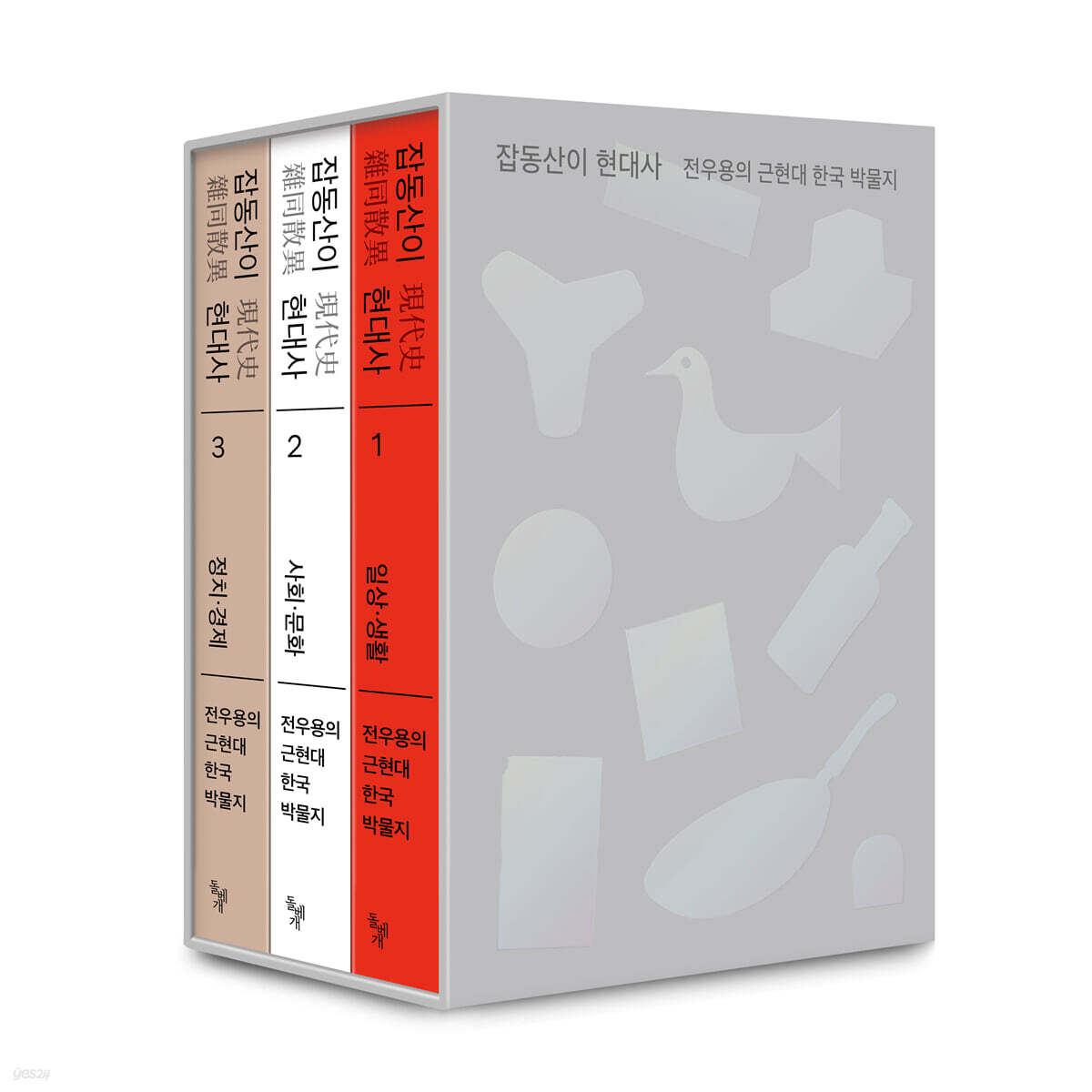
"The Miscellaneous: Modern History": A look into the lifestyles and values of modern Koreans through 281 objects!
Jeon Woo-yong's "The Modern History of Miscellaneous Objects" tells the story of how familiar and trivial objects entered this land and changed our lives.
It is divided into Volume 1 ‘Daily Life’, Volume 2 ‘Society and Culture’, and Volume 3 ‘Politics and Economy’.
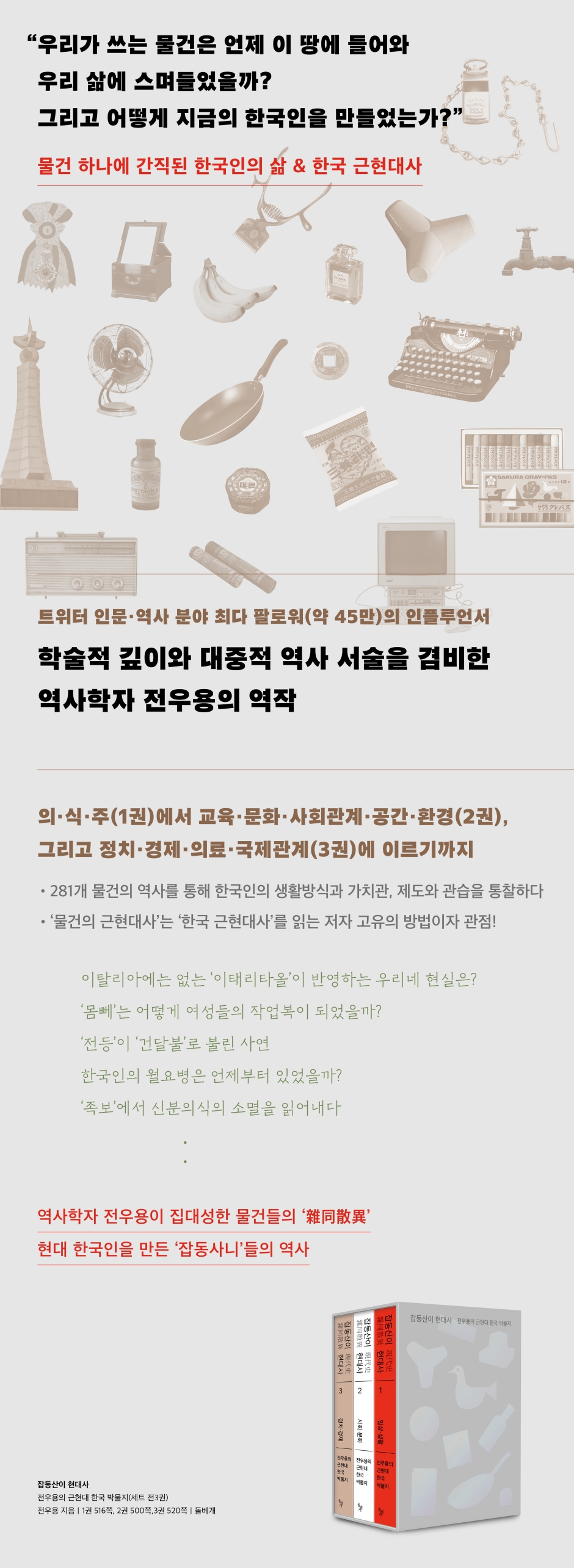
Read about modern and contemporary Korean history through 281 items, ranging from trivial things like everyday food and ordinary objects to buildings, facilities, and documents.
This book explains the history and origins of the goods and depicts the changes in Korean life as a result.
Not only can we look at Korean history from a new perspective through various objects, but by following the history and stories of these objects, we can gain insight into the behavior, habits, and spirit of Koreans, as well as their lifestyles and the history of their evolution.
Jeon Woo-yong's "The Modern History of Miscellaneous Objects" tells the story of how familiar and trivial objects entered this land and changed our lives.
It is divided into Volume 1 ‘Daily Life’, Volume 2 ‘Society and Culture’, and Volume 3 ‘Politics and Economy’.
Read about modern and contemporary Korean history through 281 items, ranging from trivial things like everyday food and ordinary objects to buildings, facilities, and documents.
This book explains the history and origins of the goods and depicts the changes in Korean life as a result.
Not only can we look at Korean history from a new perspective through various objects, but by following the history and stories of these objects, we can gain insight into the behavior, habits, and spirit of Koreans, as well as their lifestyles and the history of their evolution.
- You can preview some of the book's contents.
Preview
index
Volume 1
At the beginning of the book
Chapter 1.
Clean and maintain
1.
Pay attention to your body? Glass mirror
2.
Curing a modern-day disease? Glasses
3.
Slowing Down the Aging Process with Hair Dye
4.
Knowledge-Creating Habits? Toothbrushes and Toothpaste
5.
A short-haired gentleman with a top? A barbershop
6.
Washing your face while standing? Sink
7.
A body free from dirt and odor? Soap
8.
Peeling off the time? Italian towel
9.
A sensory air pollution meter? Shampoo
10.
What covers modern people's skin? Cosmetics
11.
From the scent of the aristocracy to the scent of the masses? Perfume
12.
Hands that don't rub against nature? Nail clippers
13.
Korea's representative health food? Red ginseng
14.
A body that shows off and flaunts? A swimsuit
15.
Winter is no longer a season for barely surviving? Skating
16.
Desire for strength and health? Exercise equipment
Chapter 2.
Eat and taste
17.
Modern people's first food? Powdered milk
18.
From "Ttukbaegi Guts" to "Pot Guts"? Pot
19.
What is the most frequently used item in modern society? A cup
20.
Cold food, cold mind? Refrigerator
21.
Cooking utensils in an age when oil was common? Frying pans
22.
From cooked rice to cooked rice? Electric rice cooker
23.
Is sweetness becoming common? Sugar
24.
Changing the Korean Constitution? Milk
25.
A human who drinks carbonated drinks? Soft drinks
26.
Modern Taste, Savory? MSG
27.
Chemicals absorbed into food? Chemical fertilizers
28.
Korean spicy taste? Red pepper powder
29.
The vegetable that led the change in modern Korean diet? Onions
30.
A table of food permitted to the common people? Royal cuisine
31.
A drink that mediates modern conversation? Coffee
32.
The drink of the enlightened? Beer
33.
A friend of modern Koreans? Diluted soju
34.
Modern summer snack? Ice cream.
35.
Another staple? Flour
36.
Food that replaces rice? Bread
37.
Helping you cross the river of poverty? Sujebi
38.
A culture that traces the traditions and origins of food? Budaejjigae
39.
Opening the Instant Era? Ramen
40.
Leading the Dining Out Culture? Jjajangmyeon
41.
Representative local cuisine? Pyongyang naengmyeon
42.
A taste that can't be thrown away, but has a new name? Danmuji
43.
A taste of the exotic? Banana
44.
Between tradition and barbarism? Bosintang
45.
Factory-produced livestock products? Whole chicken
46.
Dangerous water is living water? Living water
47.
A cookbook that integrates the tastes of modern people?
48.
A Symbol of the Delivery Food Era? The Iron Bag
Chapter 3.
Wear and carry
49.
First greeting? Business card
50.
A wallet that embodies the identity of modern people.
51.
A person's personality melted into a combination of numbers? Resident registration card
52.
A divine providence on your wrist? A wristwatch
53.
Appearance over Inner? Bag
54.
Gentleman's and Lady's Shoes?
55.
The God of the Common People, the God of Memories? Rubber Shoes
56.
Shin who came indoors? Slippers
57.
The fantasy of conquering nature? Hiking boots
58.
Clothing that touches modern people's skin? Knitwear
59.
Modern women's combat uniform? Mompe
60.
Clothes you choose? Ready-to-wear
61.
A uniform that carries both pride and humiliation?
62.
Is it okay if I get embarrassed? Zipper
63.
The symbol of the modern gentleman? The tie
64.
The freedom to reveal my body? Miniskirts
65.
The perfect outfit? Jeans?
66.
A stone that holds divinity? Diamond
67.
Guilt-free luxury? Luxury goods
68.
The desire to look rich? Fake
69.
The quality of handwriting? Fountain pen
Chapter 4.
live and reside
70.
Learning to Love? Love Letters
71.
The union of a prince and princess? Wedding hall
72.
State Interference in Marital Relationships? Marriage Registration
73.
The Book Genealogy That Eliminated Class Consciousness
74.
Personal seal? Seal
75.
Managing a household? Household ledger
76.
Sovereignty of Consumption? Shopping Cart
77.
Natural disinfectant for windows?
78.
Cheap lighting, poor eyesight? Fluorescent lights
79.
The warmth you earned by risking your life? Briquettes
80.
The lower part is gone? Hot water boiler
81.
The era of drinking river water? Tap
82.
A kitchen for every family member? A sink
83.
The original disposable product? Disinfectant
84.
Artificial Intelligence Usurps Nature's Name? Artificial Sebum
85.
Freeing Women from Laundry? Electric Washing Machines
86.
Eliminate odors in your home with a toilet
87.
A throwaway item? Toilet paper.
88.
Eliminate the need to keep the fire burning? Matches
89.
A machine that judges and warns on its own? A fire alarm.
90.
Increase time consumption? Lights
91.
Pavlov's Man? Doorbell
92.
What took the top spot? TV
93.
From chin-up to finger-wagging? Remote control
94.
Automatic fan? Fan
95.
From avoiding the heat to driving it away? Air conditioning
96.
A necessity from the poor past? Military blankets.
97.
A Colonial Legacy? Tatami
98.
What object stays attached to the modern person's body the longest? A chair.
99.
The bed, a symbol of modern privacy
100.
A place that mediates fortune and virtue? Bokdeokbang
101.
A home that created a modern lifestyle and values? An apartment
References
Items covered in the book
Volume 2
At the beginning of the book
Chapter 1.
Learn and enjoy
1.
Hangul: A Unifying Character for Modern Koreans
2.
A guide to modern life? The calendar
3.
Carving discipline into the modern human body? Whistle
4.
A human who voluntarily submits to time? A life planner
5.
The size of the modern world? Dictionary
6.
Everyone's treasure? Cultural heritage
7.
Where did modern socialization begin? Kindergarten.
8.
Where did the imperial subjects and colonial natives come from? The Museum
9.
The Birthplace of Modernity? Bookstores
10.
The standard for right and wrong? Textbooks
11.
Teaching universal human values? Children's books
12.
Declaring the Age of Humanity? Biographies
13.
Modern people's favorite portrait? Banknotes
14.
Bringing imagination to life? Comic books
15.
An era where everyone can write? Pencil
16.
From written text to typed text? Typewriter
17.
The standard for color? Crayons
18.
The thing that determines the lives of modern Koreans? The CSAT exam paper.
19.
Monitoring school life? Report cards
20.
Between the truth and the truth? Camera
21.
Teaching music to children? Phantasm
22.
Living while listening to music? Gramophone
23.
Popular music accompaniment instrument? Guitar
24.
Creating illusions with reality? Projector
25.
The Religious Landscape of Modern Korea: The Cross
26.
Changing your outlook on life and death? Crematorium
Chapter 2.
Hang out and communicate
27.
Ushering in the Information Age? Newspapers
28.
A diploma as an ID card in a meritocratic society?
29.
Mediating expressionless conversations? The telephone
30.
A stronger bond than blood? Phone book
31.
Eliminate the wait? Cell phone
32.
The trade-off between competition and cooperation? Soccer ball
33.
Teaching the relationship between the crowd and the individual? Theater
34.
A place of excitement? A stadium
35.
Opening an era where money is status? Tickets
36.
Hwatu, a game card imbued with the spirit of money?
37.
A modern-day aristocratic pastime? Golf clubs
38.
The Birthplace of Korean Hospitality Culture?
39.
A brothel where sex is traded?
40.
A sound you can ignore? Radio
41.
Amplify one's voice to tens of thousands? Megaphone
42.
Machines that control people? Traffic lights
43.
A machine that plays with humans? An arcade game
44.
Machines that trade with humans? Vending machines
45.
A machine that watches the sky? Radar
46.
Human-like machines? Robots
Chapter 3.
Create and remodel
47.
Knowing Heaven's Will in Advance? Weather Observation Devices
48.
Converting sensations into mechanical numbers? Thermometer
49.
A symbol of the electric age? The utility pole
50.
What is the most produced substance by modern people? Waste.
51.
The material that fills modern living spaces? Plastic.
52.
A prison for nature? A dam
53.
A hole in nature? A tunnel
54.
A precise power distribution map? Intellectual map
55.
A shared vision of the future? A blueprint
56.
The material that covered the world? Cement
57.
Riverside where nature has been erased? River sand
58.
The boundary between land and sea? Tetrapods
59.
Color in modern architecture? Paint
60.
A symbol of development supremacy? A bulldozer
61.
Where public opinion and the public are formed? The plaza.
62.
Community Memory? A Monument
63.
Modern statues? Statues
64.
The Tower of Babel of Capital? Skyscrapers
65.
Nature tamed by the city? Park
66.
Trees that resemble livestock? Street trees
Chapter 4.
Ride and come and go
67.
What do modern people ride most often? Elevators.
68.
Creating a human accustomed to wheels? Bicycle
69.
The thing that started Hyundai? The car
70.
The most inefficient space? The parking lot.
71.
The material that covers modern roads? Asphalt
72.
A message that dominates the cityscape? Signboards
73.
Reduced ability to distinguish between heaven and earth? Road sign
74.
Spending more time outside? Public restrooms
75.
The illusion that the world moves even when you sit still? Train
76.
Force unwanted close contact? City buses
77.
Compressing time? Highway
78.
Making putting out fires someone else's problem? Fire trucks
79.
The Unsung Hero of Modern City Life: The Wheelbarrow
80.
A desire to climb a mountain? Cable car
81.
The night sky spread out on the ground? Neon signs
82.
An underground world conquered by humans? The subway
83.
A flying human? An airplane
84.
A messenger of God working in the sky? A helicopter
85.
Bird's eye or God's eye? Drone
References
Items covered in the book
Volume 3
At the beginning of the book
Chapter 1.
govern and control
1.
A nation that has become a thing? The Taegeukgi
2.
A country you encounter in everyday life? The flagpole
3.
A textbook that fosters grateful citizens? Letters of Consolation
4.
A Single Symbol of the Korean People? Mount Baekdu
5.
A modern history that equates flowers with national identity? Cherry blossoms
6.
Election Posters: A Decisive Sign in the Age of Democracy
7.
A modern-day badge of the bells?
8.
A nationally recognized badge of honor? A medal
9.
What do I need to get permission from the government for? License
10.
A certificate that fails to prove 'human qualifications'? A certificate
11.
A country that complains of injustice? Indictment
12.
A document that punishes a suspect? An arrest warrant.
13.
A document designating a 'model'? A commendation
14.
A document expressing distrust of government institutions?
15.
A substitute for Aura? Handcuffs
16.
A symbol of anti-democratic dictatorship? Tear gas.
17.
A machine that reads an individual's unique identity? A fingerprint reader.
18.
A book that exposes the anti-democratic nature of power? Subversive books
19.
A weapon that attacks the human mind? Leaflets
20.
A machine that watches people? Surveillance cameras
21.
A prop that made history? A pistol
22.
The Olympics: A Barometer of National Power? Gold Medal
23.
Candles, the lights that have become symbols of Korean democracy
24.
A symbol of a divided nation? The Korean flag
25.
Cutting off the connection to the continent? The armistice line fence
26.
A temporary symbol of unification? The Korean Peninsula Flag
Chapter 2.
Develop and adapt
27.
Modern God? Money
28.
A tool for measuring the size of the world? The prototype of weights and measures
29.
Ushering in a True Iron Age? Steel
30.
The protagonist of the modern material world? Oil
31.
Supporting a life of abundance? A sewing machine.
32.
An era of abundant fabric? Powerlooms
33.
A divine weapon acquired by humans? A generator
34.
Electric appliances without wires? Batteries
35.
A weapon of terror against other living beings? Dynamite.
36.
Taking away the cow's work? The cultivator
37.
A device that manipulates humans? A conveyor belt
38.
Ushering in the Semiconductor Era? Transistors
39.
Rubber to cushion the impact of contact
40.
Thin, tough, and synonymous with fake? Nylon
41.
Multipurpose recyclables? Cans
42.
A property certificate subject to public control? A registration certificate
43.
The guardian deity of modern people? The bankbook
44.
Creating a Modern Class System? Credit Cards
45.
What do you think you can trust? Insurance securities
A symbol of an era where there is only money?
46.
The symbol that has taken over the modern world? The trademark
47.
Selling the chance of becoming a millionaire? Lottery tickets
48.
Turning the Public into Philanthropists: The Salvation Army's Charity Pot
49.
Share recognition for the price of a stamp? Christmas Room
50.
The Big Dream of Poor Merchants? A Hole-in-the-Wall Shop
51.
The name Hyundai gave to modern times? Traditional markets
52.
A modern temple? A department store
53.
Sovereignty of Capitalism? Stocks
54.
Exacerbating the "immorality" of wealth? Apartment pre-sale rights
55.
The code that created a bargain-free transaction? Barcode
Chapter 3.
Prevent and treat
56.
A temple or hospital that governs the birth, aging, illness, and death of modern people
57.
Desire for height? Height chart
58.
Extending the lifespan of the elderly? Dentures
59.
A weapon that ruins your face, a medical technique that fixes it? Napalm
60.
Quantifying your body condition? Thermometer
61.
What do modern children fear most? Syringes.
62.
Ushering in an Era of Disease Prevention? Vaccines
63.
Parasite-Free Body? Deworming
64.
DDT, a carcinogen embedded in insect genes?
65.
The medicine that takes away the scholar's odor? Gold gyre
66.
Dongdoseogi-type new drug? Hwalmyeongsu
67.
Reduce your fear of germs? Antibiotics
68.
A substance that turns humans into demons? Drugs
69.
A substance that reduces the sensation of pain? Anesthetics
70.
A machine that lets you see inside your body? An X-ray machine.
71.
The thing that made us fear the insignificant more than the great? The microscope.
72.
Saving a person who is gasping for breath? Oxygen respirator
73.
What item eases the inconvenience of the disabled? A wheelchair.
74.
Lowering the threshold for hospital visits? Health insurance card
75.
Changing the Concept of Bloodlines? Standard Serum
76.
Slim body worship? Diet foods
77.
Controlling Birth? Birth Control Pills
78.
Human or material? Fetus
Chapter 4.
Exchange and move forward
79.
A symbol of a world where many nations compete and coexist? The flags of all nations
80.
The object that revealed the shape of the Earth and the world? The globe
81.
The thing that united the world?
82.
Connecting sea and land routes? Containers
83.
The ID card of world citizens? Passport
84.
Transforming travel from hardship to pleasure? Hotels
85.
A Stamp That Kicks Off the Creation of a Global Village?
86.
Images of the World? Photo Postcards
87.
A foreign flag on the borderline between resentment and longing? The Japanese flag
88.
The Rising Sun Flag: A Symbol of Japanese Militarism and Aggression
89.
The Taegeukgi's counterpart? The Stars and Stripes
90.
Personal computers that connect with the world
91.
Missiles: The Weapon of Modern Man's Fear
92.
What brought "the end of humanity" to the present? The atomic bomb.
93.
God's Eyes on Earth? Satellites
94.
What will change the modern world? Smartphones
95.
What will shape the future? Self-driving cars.
References
Items covered in the book
At the beginning of the book
Chapter 1.
Clean and maintain
1.
Pay attention to your body? Glass mirror
2.
Curing a modern-day disease? Glasses
3.
Slowing Down the Aging Process with Hair Dye
4.
Knowledge-Creating Habits? Toothbrushes and Toothpaste
5.
A short-haired gentleman with a top? A barbershop
6.
Washing your face while standing? Sink
7.
A body free from dirt and odor? Soap
8.
Peeling off the time? Italian towel
9.
A sensory air pollution meter? Shampoo
10.
What covers modern people's skin? Cosmetics
11.
From the scent of the aristocracy to the scent of the masses? Perfume
12.
Hands that don't rub against nature? Nail clippers
13.
Korea's representative health food? Red ginseng
14.
A body that shows off and flaunts? A swimsuit
15.
Winter is no longer a season for barely surviving? Skating
16.
Desire for strength and health? Exercise equipment
Chapter 2.
Eat and taste
17.
Modern people's first food? Powdered milk
18.
From "Ttukbaegi Guts" to "Pot Guts"? Pot
19.
What is the most frequently used item in modern society? A cup
20.
Cold food, cold mind? Refrigerator
21.
Cooking utensils in an age when oil was common? Frying pans
22.
From cooked rice to cooked rice? Electric rice cooker
23.
Is sweetness becoming common? Sugar
24.
Changing the Korean Constitution? Milk
25.
A human who drinks carbonated drinks? Soft drinks
26.
Modern Taste, Savory? MSG
27.
Chemicals absorbed into food? Chemical fertilizers
28.
Korean spicy taste? Red pepper powder
29.
The vegetable that led the change in modern Korean diet? Onions
30.
A table of food permitted to the common people? Royal cuisine
31.
A drink that mediates modern conversation? Coffee
32.
The drink of the enlightened? Beer
33.
A friend of modern Koreans? Diluted soju
34.
Modern summer snack? Ice cream.
35.
Another staple? Flour
36.
Food that replaces rice? Bread
37.
Helping you cross the river of poverty? Sujebi
38.
A culture that traces the traditions and origins of food? Budaejjigae
39.
Opening the Instant Era? Ramen
40.
Leading the Dining Out Culture? Jjajangmyeon
41.
Representative local cuisine? Pyongyang naengmyeon
42.
A taste that can't be thrown away, but has a new name? Danmuji
43.
A taste of the exotic? Banana
44.
Between tradition and barbarism? Bosintang
45.
Factory-produced livestock products? Whole chicken
46.
Dangerous water is living water? Living water
47.
A cookbook that integrates the tastes of modern people?
48.
A Symbol of the Delivery Food Era? The Iron Bag
Chapter 3.
Wear and carry
49.
First greeting? Business card
50.
A wallet that embodies the identity of modern people.
51.
A person's personality melted into a combination of numbers? Resident registration card
52.
A divine providence on your wrist? A wristwatch
53.
Appearance over Inner? Bag
54.
Gentleman's and Lady's Shoes?
55.
The God of the Common People, the God of Memories? Rubber Shoes
56.
Shin who came indoors? Slippers
57.
The fantasy of conquering nature? Hiking boots
58.
Clothing that touches modern people's skin? Knitwear
59.
Modern women's combat uniform? Mompe
60.
Clothes you choose? Ready-to-wear
61.
A uniform that carries both pride and humiliation?
62.
Is it okay if I get embarrassed? Zipper
63.
The symbol of the modern gentleman? The tie
64.
The freedom to reveal my body? Miniskirts
65.
The perfect outfit? Jeans?
66.
A stone that holds divinity? Diamond
67.
Guilt-free luxury? Luxury goods
68.
The desire to look rich? Fake
69.
The quality of handwriting? Fountain pen
Chapter 4.
live and reside
70.
Learning to Love? Love Letters
71.
The union of a prince and princess? Wedding hall
72.
State Interference in Marital Relationships? Marriage Registration
73.
The Book Genealogy That Eliminated Class Consciousness
74.
Personal seal? Seal
75.
Managing a household? Household ledger
76.
Sovereignty of Consumption? Shopping Cart
77.
Natural disinfectant for windows?
78.
Cheap lighting, poor eyesight? Fluorescent lights
79.
The warmth you earned by risking your life? Briquettes
80.
The lower part is gone? Hot water boiler
81.
The era of drinking river water? Tap
82.
A kitchen for every family member? A sink
83.
The original disposable product? Disinfectant
84.
Artificial Intelligence Usurps Nature's Name? Artificial Sebum
85.
Freeing Women from Laundry? Electric Washing Machines
86.
Eliminate odors in your home with a toilet
87.
A throwaway item? Toilet paper.
88.
Eliminate the need to keep the fire burning? Matches
89.
A machine that judges and warns on its own? A fire alarm.
90.
Increase time consumption? Lights
91.
Pavlov's Man? Doorbell
92.
What took the top spot? TV
93.
From chin-up to finger-wagging? Remote control
94.
Automatic fan? Fan
95.
From avoiding the heat to driving it away? Air conditioning
96.
A necessity from the poor past? Military blankets.
97.
A Colonial Legacy? Tatami
98.
What object stays attached to the modern person's body the longest? A chair.
99.
The bed, a symbol of modern privacy
100.
A place that mediates fortune and virtue? Bokdeokbang
101.
A home that created a modern lifestyle and values? An apartment
References
Items covered in the book
Volume 2
At the beginning of the book
Chapter 1.
Learn and enjoy
1.
Hangul: A Unifying Character for Modern Koreans
2.
A guide to modern life? The calendar
3.
Carving discipline into the modern human body? Whistle
4.
A human who voluntarily submits to time? A life planner
5.
The size of the modern world? Dictionary
6.
Everyone's treasure? Cultural heritage
7.
Where did modern socialization begin? Kindergarten.
8.
Where did the imperial subjects and colonial natives come from? The Museum
9.
The Birthplace of Modernity? Bookstores
10.
The standard for right and wrong? Textbooks
11.
Teaching universal human values? Children's books
12.
Declaring the Age of Humanity? Biographies
13.
Modern people's favorite portrait? Banknotes
14.
Bringing imagination to life? Comic books
15.
An era where everyone can write? Pencil
16.
From written text to typed text? Typewriter
17.
The standard for color? Crayons
18.
The thing that determines the lives of modern Koreans? The CSAT exam paper.
19.
Monitoring school life? Report cards
20.
Between the truth and the truth? Camera
21.
Teaching music to children? Phantasm
22.
Living while listening to music? Gramophone
23.
Popular music accompaniment instrument? Guitar
24.
Creating illusions with reality? Projector
25.
The Religious Landscape of Modern Korea: The Cross
26.
Changing your outlook on life and death? Crematorium
Chapter 2.
Hang out and communicate
27.
Ushering in the Information Age? Newspapers
28.
A diploma as an ID card in a meritocratic society?
29.
Mediating expressionless conversations? The telephone
30.
A stronger bond than blood? Phone book
31.
Eliminate the wait? Cell phone
32.
The trade-off between competition and cooperation? Soccer ball
33.
Teaching the relationship between the crowd and the individual? Theater
34.
A place of excitement? A stadium
35.
Opening an era where money is status? Tickets
36.
Hwatu, a game card imbued with the spirit of money?
37.
A modern-day aristocratic pastime? Golf clubs
38.
The Birthplace of Korean Hospitality Culture?
39.
A brothel where sex is traded?
40.
A sound you can ignore? Radio
41.
Amplify one's voice to tens of thousands? Megaphone
42.
Machines that control people? Traffic lights
43.
A machine that plays with humans? An arcade game
44.
Machines that trade with humans? Vending machines
45.
A machine that watches the sky? Radar
46.
Human-like machines? Robots
Chapter 3.
Create and remodel
47.
Knowing Heaven's Will in Advance? Weather Observation Devices
48.
Converting sensations into mechanical numbers? Thermometer
49.
A symbol of the electric age? The utility pole
50.
What is the most produced substance by modern people? Waste.
51.
The material that fills modern living spaces? Plastic.
52.
A prison for nature? A dam
53.
A hole in nature? A tunnel
54.
A precise power distribution map? Intellectual map
55.
A shared vision of the future? A blueprint
56.
The material that covered the world? Cement
57.
Riverside where nature has been erased? River sand
58.
The boundary between land and sea? Tetrapods
59.
Color in modern architecture? Paint
60.
A symbol of development supremacy? A bulldozer
61.
Where public opinion and the public are formed? The plaza.
62.
Community Memory? A Monument
63.
Modern statues? Statues
64.
The Tower of Babel of Capital? Skyscrapers
65.
Nature tamed by the city? Park
66.
Trees that resemble livestock? Street trees
Chapter 4.
Ride and come and go
67.
What do modern people ride most often? Elevators.
68.
Creating a human accustomed to wheels? Bicycle
69.
The thing that started Hyundai? The car
70.
The most inefficient space? The parking lot.
71.
The material that covers modern roads? Asphalt
72.
A message that dominates the cityscape? Signboards
73.
Reduced ability to distinguish between heaven and earth? Road sign
74.
Spending more time outside? Public restrooms
75.
The illusion that the world moves even when you sit still? Train
76.
Force unwanted close contact? City buses
77.
Compressing time? Highway
78.
Making putting out fires someone else's problem? Fire trucks
79.
The Unsung Hero of Modern City Life: The Wheelbarrow
80.
A desire to climb a mountain? Cable car
81.
The night sky spread out on the ground? Neon signs
82.
An underground world conquered by humans? The subway
83.
A flying human? An airplane
84.
A messenger of God working in the sky? A helicopter
85.
Bird's eye or God's eye? Drone
References
Items covered in the book
Volume 3
At the beginning of the book
Chapter 1.
govern and control
1.
A nation that has become a thing? The Taegeukgi
2.
A country you encounter in everyday life? The flagpole
3.
A textbook that fosters grateful citizens? Letters of Consolation
4.
A Single Symbol of the Korean People? Mount Baekdu
5.
A modern history that equates flowers with national identity? Cherry blossoms
6.
Election Posters: A Decisive Sign in the Age of Democracy
7.
A modern-day badge of the bells?
8.
A nationally recognized badge of honor? A medal
9.
What do I need to get permission from the government for? License
10.
A certificate that fails to prove 'human qualifications'? A certificate
11.
A country that complains of injustice? Indictment
12.
A document that punishes a suspect? An arrest warrant.
13.
A document designating a 'model'? A commendation
14.
A document expressing distrust of government institutions?
15.
A substitute for Aura? Handcuffs
16.
A symbol of anti-democratic dictatorship? Tear gas.
17.
A machine that reads an individual's unique identity? A fingerprint reader.
18.
A book that exposes the anti-democratic nature of power? Subversive books
19.
A weapon that attacks the human mind? Leaflets
20.
A machine that watches people? Surveillance cameras
21.
A prop that made history? A pistol
22.
The Olympics: A Barometer of National Power? Gold Medal
23.
Candles, the lights that have become symbols of Korean democracy
24.
A symbol of a divided nation? The Korean flag
25.
Cutting off the connection to the continent? The armistice line fence
26.
A temporary symbol of unification? The Korean Peninsula Flag
Chapter 2.
Develop and adapt
27.
Modern God? Money
28.
A tool for measuring the size of the world? The prototype of weights and measures
29.
Ushering in a True Iron Age? Steel
30.
The protagonist of the modern material world? Oil
31.
Supporting a life of abundance? A sewing machine.
32.
An era of abundant fabric? Powerlooms
33.
A divine weapon acquired by humans? A generator
34.
Electric appliances without wires? Batteries
35.
A weapon of terror against other living beings? Dynamite.
36.
Taking away the cow's work? The cultivator
37.
A device that manipulates humans? A conveyor belt
38.
Ushering in the Semiconductor Era? Transistors
39.
Rubber to cushion the impact of contact
40.
Thin, tough, and synonymous with fake? Nylon
41.
Multipurpose recyclables? Cans
42.
A property certificate subject to public control? A registration certificate
43.
The guardian deity of modern people? The bankbook
44.
Creating a Modern Class System? Credit Cards
45.
What do you think you can trust? Insurance securities
A symbol of an era where there is only money?
46.
The symbol that has taken over the modern world? The trademark
47.
Selling the chance of becoming a millionaire? Lottery tickets
48.
Turning the Public into Philanthropists: The Salvation Army's Charity Pot
49.
Share recognition for the price of a stamp? Christmas Room
50.
The Big Dream of Poor Merchants? A Hole-in-the-Wall Shop
51.
The name Hyundai gave to modern times? Traditional markets
52.
A modern temple? A department store
53.
Sovereignty of Capitalism? Stocks
54.
Exacerbating the "immorality" of wealth? Apartment pre-sale rights
55.
The code that created a bargain-free transaction? Barcode
Chapter 3.
Prevent and treat
56.
A temple or hospital that governs the birth, aging, illness, and death of modern people
57.
Desire for height? Height chart
58.
Extending the lifespan of the elderly? Dentures
59.
A weapon that ruins your face, a medical technique that fixes it? Napalm
60.
Quantifying your body condition? Thermometer
61.
What do modern children fear most? Syringes.
62.
Ushering in an Era of Disease Prevention? Vaccines
63.
Parasite-Free Body? Deworming
64.
DDT, a carcinogen embedded in insect genes?
65.
The medicine that takes away the scholar's odor? Gold gyre
66.
Dongdoseogi-type new drug? Hwalmyeongsu
67.
Reduce your fear of germs? Antibiotics
68.
A substance that turns humans into demons? Drugs
69.
A substance that reduces the sensation of pain? Anesthetics
70.
A machine that lets you see inside your body? An X-ray machine.
71.
The thing that made us fear the insignificant more than the great? The microscope.
72.
Saving a person who is gasping for breath? Oxygen respirator
73.
What item eases the inconvenience of the disabled? A wheelchair.
74.
Lowering the threshold for hospital visits? Health insurance card
75.
Changing the Concept of Bloodlines? Standard Serum
76.
Slim body worship? Diet foods
77.
Controlling Birth? Birth Control Pills
78.
Human or material? Fetus
Chapter 4.
Exchange and move forward
79.
A symbol of a world where many nations compete and coexist? The flags of all nations
80.
The object that revealed the shape of the Earth and the world? The globe
81.
The thing that united the world?
82.
Connecting sea and land routes? Containers
83.
The ID card of world citizens? Passport
84.
Transforming travel from hardship to pleasure? Hotels
85.
A Stamp That Kicks Off the Creation of a Global Village?
86.
Images of the World? Photo Postcards
87.
A foreign flag on the borderline between resentment and longing? The Japanese flag
88.
The Rising Sun Flag: A Symbol of Japanese Militarism and Aggression
89.
The Taegeukgi's counterpart? The Stars and Stripes
90.
Personal computers that connect with the world
91.
Missiles: The Weapon of Modern Man's Fear
92.
What brought "the end of humanity" to the present? The atomic bomb.
93.
God's Eyes on Earth? Satellites
94.
What will change the modern world? Smartphones
95.
What will shape the future? Self-driving cars.
References
Items covered in the book
Detailed image
Publisher's Review
■ The lives of Koreans and modern and contemporary Korean history, captured in a single small object
『The Miscellaneous Realm of Modern History』 deals with the history of 'objects' that have shaped the lives and consciousness of modern Koreans, but its content and narrative do not fall into micro-historical materialism.
We seek to understand how the objects introduced into our society over the course of modern and contemporary Korean history interacted with Koreans to shape their lifestyles and values.
The objects that entered our lives under the conditions of mass production, mass consumption, and technological innovation driven by Westernization, colonialism, and the Industrial Revolution fundamentally changed the lives of Koreans.
As the author says, the transition from an era without electric lights to an era with them, and from an era without refrigerators to an era with them, is as significant as any other historical turning point.
‘Modern and Contemporary History of Objects’ is the author’s unique method and perspective for reading ‘Modern and Contemporary History of Korea.’
The author unfolds the life of Koreans, immersed in a small object, and reveals modern and contemporary Korean history.
■ What kind of objects have created humans and the times, and what kind of era will be created by what kind of objects in the future?
This book seeks to understand the changing people who use objects and the era they create.
Because we spend most of our days interacting with objects, as the characteristics of objects change, the characteristics of the people who use them and the times inevitably change as well.
A person who experiences market life once every five days at most cannot have the same sense as a person who lives with the market on his smartphone.
In this situation, it is natural that the number of ‘market-oriented people’ is increasing.
Examining the origins and history of objects is an interesting and curious activity in itself, but it also helps us understand who we are as people.
In that sense, the history of the "useless miscellaneous items" can be a useful way to understand ourselves and gauge the coming era.
『The Miscellaneous Realm of Modern History』 deals with the history of 'objects' that have shaped the lives and consciousness of modern Koreans, but its content and narrative do not fall into micro-historical materialism.
We seek to understand how the objects introduced into our society over the course of modern and contemporary Korean history interacted with Koreans to shape their lifestyles and values.
The objects that entered our lives under the conditions of mass production, mass consumption, and technological innovation driven by Westernization, colonialism, and the Industrial Revolution fundamentally changed the lives of Koreans.
As the author says, the transition from an era without electric lights to an era with them, and from an era without refrigerators to an era with them, is as significant as any other historical turning point.
‘Modern and Contemporary History of Objects’ is the author’s unique method and perspective for reading ‘Modern and Contemporary History of Korea.’
The author unfolds the life of Koreans, immersed in a small object, and reveals modern and contemporary Korean history.
■ What kind of objects have created humans and the times, and what kind of era will be created by what kind of objects in the future?
This book seeks to understand the changing people who use objects and the era they create.
Because we spend most of our days interacting with objects, as the characteristics of objects change, the characteristics of the people who use them and the times inevitably change as well.
A person who experiences market life once every five days at most cannot have the same sense as a person who lives with the market on his smartphone.
In this situation, it is natural that the number of ‘market-oriented people’ is increasing.
Examining the origins and history of objects is an interesting and curious activity in itself, but it also helps us understand who we are as people.
In that sense, the history of the "useless miscellaneous items" can be a useful way to understand ourselves and gauge the coming era.
GOODS SPECIFICS
- Date of issue: December 8, 2023
- Page count, weight, size: 1,536 pages | 2,250g | 150*215*80mm
- ISBN13: 9791192836416
- ISBN10: 1192836413
You may also like
카테고리
korean


korean

![GQ KOREA Mark (Monthly): December [2025]](http://librairie.coreenne.fr/cdn/shop/files/8ef265dbbfbf186523ed75ba7319009d.jpg?v=1765340328&width=3840)


