

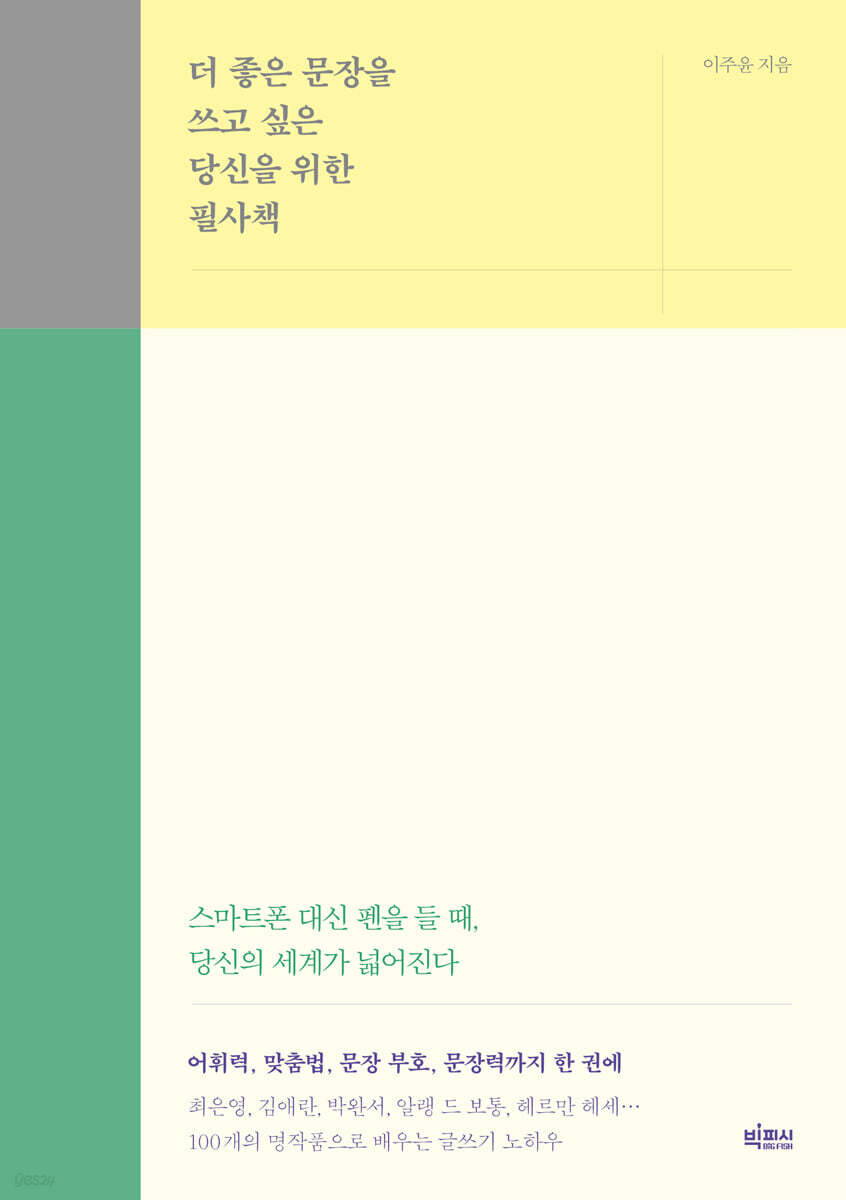
A writing book for those who want to write better sentences
 |
Description
Book Introduction
“When you pick up a pen instead of a smartphone, your world expands.”
From Choi Eun-young, Kim Ae-ran, and Park Wan-seo to Alain de Botton and Hermann Hesse
Writing a manuscript starting with one page a day
Author Lee Ju-yoon, whose books, including “Minimum Literacy for Adults Today” and “Minimum Spelling for Adults Today,” have been chosen by 100,000 readers, has published “A Handwritten Book for Those Who Want to Write Better Sentences,” which contains her own handwritten writing know-how.
Now that we communicate more through text messages, messengers, and emails than ever before, the need for grammar skills to accurately express and achieve what we want is greater than ever.
What better way to cultivate this than by consistently reading and writing?
This book carefully selects 100 works by master writers, from Choi Eun-young, Choi Jin-young, and Kim Ae-ran, who are most loved by readers today, to Park Wan-seo, Park Kyung-ni, Hermann Hesse, and Tolstoy, who are loved across the ages, and organizes them so that you can copy one page a day.
Just by following along, you will feel your vocabulary, literacy, and writing skills improving, and you will also learn how to start writing and what constitutes good writing.
Okay, now it's time to pick up a pen instead of your smartphone.
Let's go into a world of sentences prepared just for me.
From Choi Eun-young, Kim Ae-ran, and Park Wan-seo to Alain de Botton and Hermann Hesse
Writing a manuscript starting with one page a day
Author Lee Ju-yoon, whose books, including “Minimum Literacy for Adults Today” and “Minimum Spelling for Adults Today,” have been chosen by 100,000 readers, has published “A Handwritten Book for Those Who Want to Write Better Sentences,” which contains her own handwritten writing know-how.
Now that we communicate more through text messages, messengers, and emails than ever before, the need for grammar skills to accurately express and achieve what we want is greater than ever.
What better way to cultivate this than by consistently reading and writing?
This book carefully selects 100 works by master writers, from Choi Eun-young, Choi Jin-young, and Kim Ae-ran, who are most loved by readers today, to Park Wan-seo, Park Kyung-ni, Hermann Hesse, and Tolstoy, who are loved across the ages, and organizes them so that you can copy one page a day.
Just by following along, you will feel your vocabulary, literacy, and writing skills improving, and you will also learn how to start writing and what constitutes good writing.
Okay, now it's time to pick up a pen instead of your smartphone.
Let's go into a world of sentences prepared just for me.
- You can preview some of the book's contents.
Preview
index
[Prologue] Gaining strength from beautiful sentences, and writing again to comfort someone.
PART 1.
The Secret to Writing What People Want to Read
The reason why we must reveal ourselves above all else _ Going beyond personal experience to empathy
[001] Moon Yu-seok's essay, "Pleasure Reading"
[002] Choi Eun-young's novel, "A Person Harmless to Me"
[003] Hermann Hesse's novel, Klein and Wagner
[004] Slow Boat Essay, "Gorgor's Outlook on Life"
[005] Kihyungdo's poem, "Mom's Worries"
[006] Jeong Ji-eum's essay, "We All Go Crazy Sometimes"
[007] Seo Yu-mi's novel, "What We Lost"
Writing for Just One Person - Who Should I Write to and Why?
[008] Bonnie Garmus' novel, Lessons in Chemistry 2
[009] Da-Hye Lee's essay, "As I Became an Adult, Greater Confusion Began"
[010] Antoine de Saint-Exupéry's novel, The Little Prince
[011] Kang Won-guk's essay, "The President's Writing"
[012] Won Do's essay, "Anyway, Sister"
[013] Steve Jobs' speech, "2005 Stanford University Commencement Address"
[014] Kakiya Miu's novel, "Now I'm Divorced"
You can't take your eyes off it the moment you start reading - Uses a variety of vocabulary, vivid descriptions, and metaphors.
[015] Shin Kyung-sook's novel, "A Lonely Room"
[016] Eun Hee-kyung's novel, "The Bird's Gift"
[017] Ijeni Poetry, “Whitely Burnt Forest”
[018] Park Kyung-ni's novel, "Land"
[019] Hyun Jin-geon's novel, "Lucky Day"
[020] Franz Kafka's novel, 'The Metamorphosis'
[021] Baek Seok's poem, "Natasha, Me, and the White Donkey"
Imagine the mood you want to write about - once you set the mood, the rest will follow.
[022] Antoine de Saint-Exupéry's novel, The Little Prince
[023] Choi Eun-young's novel, "Shoko's Smile"
[024] Hwang In-chan's poem, "Fig Forest"
[025] Nikos Kazantzakis' novel, Zorba the Greek
[026] Oh Jeong-hee's novel, "Winter Clam"
[027] Jeon Hye-rin's essay, "All This Suffering Again"
[028] Kim Seung-ok's novel, "Seoul, Winter 1964"
[029] O. Henry's novel, The Last Leaf
Words that are okay to have, words that are okay to not have _ How to reduce excessive expressions and fix awkward sentences
[030] Lee Tae-jun's essay, "Strengthening Sentences"
[031] Stephen King's essay, "On Writing"
[032] Lee Seong-bok's Poetry Theory, 『Infinite Flower Book』
[033] Virginia Woolf's essay, 『Prose Selection』
[034] Metaphorical Essay, "Words of Writing"
PART 2.
Preparing to write your first sentence
If you keep writing, you'll eventually reach a point where you can put a period. _ Overcoming the fear of writing
[035] Kim Yu-ri's novel, "A, B, C, A, A, A"
[036] Da-Hye Lee's essay, "The Heart on the Way Home from Work"
[037] Shin Kyung-sook's novel, "Spring Night"
[038] Lewis Carroll's novel, Alice's Adventures in Wonderland
[039] Eugene O'Neill's play, Long Day's Journey into Night
[040] Kim Hyung-soo's essay, "When Does Life Become Art?"
[041] Ma Kwang-su's poem, "A Life That's Nothing Special"
Everything that touches the heart becomes writing _ Finding inspiration for writing from everyday things, from near to far.
[042] Han Su-hee's essay, "The New World of Maxi Pants"
[043] Park Wan-seo's novel, "Who Ate All Those Singa?"
[044] Park Hye-ran's essay, "I've decided to grow old my way."
[045] Yun Dong-ju's poem, "Sparrow"
[046] Gabriel García Márquez's novel, One Hundred Years of Solitude
[047] Osamu Dazai's novel, "Leaves"
[048] Lee Jeong-rim's essay, "The Great Wind Goes Away"
Good sentences without difficult words - Creating your own sentence rules and routines
[049] Kang Shin-jae's novel, "The Young Zelkova Tree"
[050] Park Jong-in's essay, "A Journalist's Writing"
[051] Jinyoung Choi's novel, "Proof of the Sphere"
[052] Kim Ae-ran's essay, "A Name Easy to Forget"
[053] Pablo Neruda's poem, "Poetry"
[054] Kim So-wol's poem, "To Sit Facing a Lamp"
PART 3.
A routine for writing consistently and well
If you don't have time to write, even a one-line diary _ develop one sentence into a piece of writing
[055] Moon Bo-young's essay, "Diary Age"
[056] Kim Yeon-su's essay, "A Novelist's Work"
[057] Anne Frank Essay, 『Anne Frank's Diary』
[058] Henry David Thoreau's essay, Walden
[059] Lee Tae-jun's essay, "Strengthening Sentences"
[060] Avan Turgenev's poem, "Prose Poem"
Let your first writing sit for a day - The power of revision that improves with each revision
[061] Yoon Oh-young's essay, "The Old Man Who Carved Bats"
[062] Kwon Sang-jin's poem, "Revised"
[063] Stefan Zweig's Biography, Zweig's Biography of Balzac
[064] Vincent van Gogh's Letters, "To Theo"
[065] Kim Jeom-seon's essay, "Are my sentences that strange?"
A Writing Routine That Gives Me Strength - A Time That Comforts Me More Than Anyone Else
[066] Metaphorical Essay, "The Front Line of Writing"
[067] Alain de Botton's essay, "Anxiety"
[068] Park Wan-seo's essay, "With a Voice That Resembles Me"
[069] Kang Won-guk's essay, "The President's Writing"
[070] Kim Ji-yeon's novel, "The Sound That Doesn't Make Sense"
[071] Henry David Thoreau's essay, "Walking"
[072] Hermann Hesse's novel, Demian
You can ignore all of this, so just write it down _ How to deal with writing mannerisms
[073] Park Tae-won's novel, "A Day in the Life of Novelist Gubo"
[074] Park Seong-woo's poem, "Spring, Breaking Branches"
[075] Zhuangzi, 『Zhuangzi』
[076] Barbara Abercrombie's essay, "The Beginning of a Writer"
[077] Agotha Kristoff's novel, "Illiteracy"
[078] Paul Auster's novel, The Palace of the Moon
[079] Osamu Dazai's essay, "Leaves"
PART 4.
The Secret to Writing Well, Even After Years
It's okay if there's no such thing as a good lesson _ Be free to follow your hands and heart
[080] Jeon Gwang-yong's novel, "The Kkeoppi-tan Lee"
[081] Jin Eun-young's poem, "Family"
[082] Baek Su-rin's novel, "Dazzling Greetings"
[083] Maria Rilke's poem, "Life"
[084] Antoine de Saint-Exupéry's novel, 'The Land of Men'
Expressing ordinary daily life through unique perspectives using a variety of words in an unfamiliar way
[085] Lee Seong-bok's Poetry Theory, "Discordant Words"
[086] Hwang Hyeon-san's essay, "The Night is a Teacher"
[087] Ernest Hemingway's novel, A Farewell to Arms
[088] Noh Ja-young's letter, "Eternal Parting"
[089] Choi Seung-ja's poem, "Life Study This Summer"
The Power of Short, Intense Messages - A Tool to Reduce Greed and Save Time
[090] Ernest Hemingway's novel, The Old Man and the Sea
[091] Park Gyeong-jong's poem, "Crow"
[092] George Orwell's novel, Animal Farm
[093] Essay, "Boredom"
[094] Lao Tzu, Tao Te Ching
[095] Albert Camus' novel, The Stranger
The ending of a piece is as important as the beginning - the taste of the sumi-sanggwan that gives stability and lingering feeling.
[096] Yang Gui-ja's novel, "Contradiction"
[097] Han Yong-un's poem, "The Ferry and the Pedestrian"
[098] Leo Tolstoy's novel, Resurrection
[099] Lanter Wilson Smith, "This Too Shall Pass"
[100] Hong In-hye's essay, "Even and Even Words"
[Appendix 1] How to Use Punctuation Marks That Confuse You Every Time You Write
[Appendix 2] 400 Commonly Misspelled Words
PART 1.
The Secret to Writing What People Want to Read
The reason why we must reveal ourselves above all else _ Going beyond personal experience to empathy
[001] Moon Yu-seok's essay, "Pleasure Reading"
[002] Choi Eun-young's novel, "A Person Harmless to Me"
[003] Hermann Hesse's novel, Klein and Wagner
[004] Slow Boat Essay, "Gorgor's Outlook on Life"
[005] Kihyungdo's poem, "Mom's Worries"
[006] Jeong Ji-eum's essay, "We All Go Crazy Sometimes"
[007] Seo Yu-mi's novel, "What We Lost"
Writing for Just One Person - Who Should I Write to and Why?
[008] Bonnie Garmus' novel, Lessons in Chemistry 2
[009] Da-Hye Lee's essay, "As I Became an Adult, Greater Confusion Began"
[010] Antoine de Saint-Exupéry's novel, The Little Prince
[011] Kang Won-guk's essay, "The President's Writing"
[012] Won Do's essay, "Anyway, Sister"
[013] Steve Jobs' speech, "2005 Stanford University Commencement Address"
[014] Kakiya Miu's novel, "Now I'm Divorced"
You can't take your eyes off it the moment you start reading - Uses a variety of vocabulary, vivid descriptions, and metaphors.
[015] Shin Kyung-sook's novel, "A Lonely Room"
[016] Eun Hee-kyung's novel, "The Bird's Gift"
[017] Ijeni Poetry, “Whitely Burnt Forest”
[018] Park Kyung-ni's novel, "Land"
[019] Hyun Jin-geon's novel, "Lucky Day"
[020] Franz Kafka's novel, 'The Metamorphosis'
[021] Baek Seok's poem, "Natasha, Me, and the White Donkey"
Imagine the mood you want to write about - once you set the mood, the rest will follow.
[022] Antoine de Saint-Exupéry's novel, The Little Prince
[023] Choi Eun-young's novel, "Shoko's Smile"
[024] Hwang In-chan's poem, "Fig Forest"
[025] Nikos Kazantzakis' novel, Zorba the Greek
[026] Oh Jeong-hee's novel, "Winter Clam"
[027] Jeon Hye-rin's essay, "All This Suffering Again"
[028] Kim Seung-ok's novel, "Seoul, Winter 1964"
[029] O. Henry's novel, The Last Leaf
Words that are okay to have, words that are okay to not have _ How to reduce excessive expressions and fix awkward sentences
[030] Lee Tae-jun's essay, "Strengthening Sentences"
[031] Stephen King's essay, "On Writing"
[032] Lee Seong-bok's Poetry Theory, 『Infinite Flower Book』
[033] Virginia Woolf's essay, 『Prose Selection』
[034] Metaphorical Essay, "Words of Writing"
PART 2.
Preparing to write your first sentence
If you keep writing, you'll eventually reach a point where you can put a period. _ Overcoming the fear of writing
[035] Kim Yu-ri's novel, "A, B, C, A, A, A"
[036] Da-Hye Lee's essay, "The Heart on the Way Home from Work"
[037] Shin Kyung-sook's novel, "Spring Night"
[038] Lewis Carroll's novel, Alice's Adventures in Wonderland
[039] Eugene O'Neill's play, Long Day's Journey into Night
[040] Kim Hyung-soo's essay, "When Does Life Become Art?"
[041] Ma Kwang-su's poem, "A Life That's Nothing Special"
Everything that touches the heart becomes writing _ Finding inspiration for writing from everyday things, from near to far.
[042] Han Su-hee's essay, "The New World of Maxi Pants"
[043] Park Wan-seo's novel, "Who Ate All Those Singa?"
[044] Park Hye-ran's essay, "I've decided to grow old my way."
[045] Yun Dong-ju's poem, "Sparrow"
[046] Gabriel García Márquez's novel, One Hundred Years of Solitude
[047] Osamu Dazai's novel, "Leaves"
[048] Lee Jeong-rim's essay, "The Great Wind Goes Away"
Good sentences without difficult words - Creating your own sentence rules and routines
[049] Kang Shin-jae's novel, "The Young Zelkova Tree"
[050] Park Jong-in's essay, "A Journalist's Writing"
[051] Jinyoung Choi's novel, "Proof of the Sphere"
[052] Kim Ae-ran's essay, "A Name Easy to Forget"
[053] Pablo Neruda's poem, "Poetry"
[054] Kim So-wol's poem, "To Sit Facing a Lamp"
PART 3.
A routine for writing consistently and well
If you don't have time to write, even a one-line diary _ develop one sentence into a piece of writing
[055] Moon Bo-young's essay, "Diary Age"
[056] Kim Yeon-su's essay, "A Novelist's Work"
[057] Anne Frank Essay, 『Anne Frank's Diary』
[058] Henry David Thoreau's essay, Walden
[059] Lee Tae-jun's essay, "Strengthening Sentences"
[060] Avan Turgenev's poem, "Prose Poem"
Let your first writing sit for a day - The power of revision that improves with each revision
[061] Yoon Oh-young's essay, "The Old Man Who Carved Bats"
[062] Kwon Sang-jin's poem, "Revised"
[063] Stefan Zweig's Biography, Zweig's Biography of Balzac
[064] Vincent van Gogh's Letters, "To Theo"
[065] Kim Jeom-seon's essay, "Are my sentences that strange?"
A Writing Routine That Gives Me Strength - A Time That Comforts Me More Than Anyone Else
[066] Metaphorical Essay, "The Front Line of Writing"
[067] Alain de Botton's essay, "Anxiety"
[068] Park Wan-seo's essay, "With a Voice That Resembles Me"
[069] Kang Won-guk's essay, "The President's Writing"
[070] Kim Ji-yeon's novel, "The Sound That Doesn't Make Sense"
[071] Henry David Thoreau's essay, "Walking"
[072] Hermann Hesse's novel, Demian
You can ignore all of this, so just write it down _ How to deal with writing mannerisms
[073] Park Tae-won's novel, "A Day in the Life of Novelist Gubo"
[074] Park Seong-woo's poem, "Spring, Breaking Branches"
[075] Zhuangzi, 『Zhuangzi』
[076] Barbara Abercrombie's essay, "The Beginning of a Writer"
[077] Agotha Kristoff's novel, "Illiteracy"
[078] Paul Auster's novel, The Palace of the Moon
[079] Osamu Dazai's essay, "Leaves"
PART 4.
The Secret to Writing Well, Even After Years
It's okay if there's no such thing as a good lesson _ Be free to follow your hands and heart
[080] Jeon Gwang-yong's novel, "The Kkeoppi-tan Lee"
[081] Jin Eun-young's poem, "Family"
[082] Baek Su-rin's novel, "Dazzling Greetings"
[083] Maria Rilke's poem, "Life"
[084] Antoine de Saint-Exupéry's novel, 'The Land of Men'
Expressing ordinary daily life through unique perspectives using a variety of words in an unfamiliar way
[085] Lee Seong-bok's Poetry Theory, "Discordant Words"
[086] Hwang Hyeon-san's essay, "The Night is a Teacher"
[087] Ernest Hemingway's novel, A Farewell to Arms
[088] Noh Ja-young's letter, "Eternal Parting"
[089] Choi Seung-ja's poem, "Life Study This Summer"
The Power of Short, Intense Messages - A Tool to Reduce Greed and Save Time
[090] Ernest Hemingway's novel, The Old Man and the Sea
[091] Park Gyeong-jong's poem, "Crow"
[092] George Orwell's novel, Animal Farm
[093] Essay, "Boredom"
[094] Lao Tzu, Tao Te Ching
[095] Albert Camus' novel, The Stranger
The ending of a piece is as important as the beginning - the taste of the sumi-sanggwan that gives stability and lingering feeling.
[096] Yang Gui-ja's novel, "Contradiction"
[097] Han Yong-un's poem, "The Ferry and the Pedestrian"
[098] Leo Tolstoy's novel, Resurrection
[099] Lanter Wilson Smith, "This Too Shall Pass"
[100] Hong In-hye's essay, "Even and Even Words"
[Appendix 1] How to Use Punctuation Marks That Confuse You Every Time You Write
[Appendix 2] 400 Commonly Misspelled Words
Detailed image

Publisher's Review
“Your world is as much as you can express.”
The first handwritten book by author Lee Ju-yoon, beloved by 100,000 readers.
I'm trying to explain something, but the right words don't come to mind right away.
I want to express my special feelings right now, but the only words that come to mind are 'wow', 'daebak', and 'crazy'.
Is it because we're constantly using short-form texts and smartphones? They say modern people's literacy is declining, but is there anything I can do about it? If you're wondering these things, consider picking up a pen instead of your smartphone right now.
Author Lee Ju-yoon, who has been loved by 100,000 readers for works such as “Minimum Literacy for Adults Today” and “Minimum Spelling for Adults Today,” has carefully selected 100 works that are perfect for copying to improve spelling, vocabulary, and literacy.
If you follow the author's guide, including various vocabulary definitions, the background of the text, and expressions that make a good sentence different, and slowly write sentences, you will find yourself writing better sentences than yesterday.
Improve vocabulary, literacy, and writing skills
The easiest and most reliable way is transcription.
For readers who wonder, "Can vocabulary and writing skills improve simply by copying?", this book presents step-by-step, specific methods for copying.
[PART 1] explains the 'secret of writing you want to read', that is, what makes a good piece of writing.
It teaches you how to use various vocabulary, how to describe effectively, how to set a target, and how to avoid awkward sentences and write good sentences.
It also explains how personal experiences can resonate.
[PART 2] covers the basics of writing.
It allows you to find inspiration for your writing in everyday life, free from the elements that make you want to write but hesitate.
It also introduces how to write good sentences without using difficult words.
[PART 3] will guide you through the secrets of consistent writing.
If you're stuck for ideas or don't have time, we'll show you how to properly complete even just one sentence, and even create a routine to turn it into a complete piece of writing.
In the final [PART 4], we will explore the secrets of writing that has been read for a long time through various writings called classics.
Even those who are just starting out with handwriting or who enjoy it as a hobby will find that by following the author's friendly guidance and writing carefully, they will not only experience a different handwriting experience than before, but also feel a heightened level of sophistication and refinement.
“The moment you close this book, you become a better person than you were yesterday.”
Time to carefully copy each sentence and look back at my thoughts.
There are things that can only be confirmed by saying them out loud.
There are things that can only be felt by trying them with your own hands.
So, only what I read, digest, speak, and write directly can be my true world.
But in our busy days and daily lives, we don't have enough time to look into our hearts or take care of them.
It's not uncommon to start or end the day with tired words or pessimistic words.
What if I set aside just ten minutes a day for myself? Let's meditate on refined words, beautiful phrases, and profound sentences, and carefully examine my own heart.
If I can feel the joy of a moment of complete devotion, even for a moment, if I can share a foreign language and a different story with someone, I will find myself becoming a little better every day than I was yesterday.
The first handwritten book by author Lee Ju-yoon, beloved by 100,000 readers.
I'm trying to explain something, but the right words don't come to mind right away.
I want to express my special feelings right now, but the only words that come to mind are 'wow', 'daebak', and 'crazy'.
Is it because we're constantly using short-form texts and smartphones? They say modern people's literacy is declining, but is there anything I can do about it? If you're wondering these things, consider picking up a pen instead of your smartphone right now.
Author Lee Ju-yoon, who has been loved by 100,000 readers for works such as “Minimum Literacy for Adults Today” and “Minimum Spelling for Adults Today,” has carefully selected 100 works that are perfect for copying to improve spelling, vocabulary, and literacy.
If you follow the author's guide, including various vocabulary definitions, the background of the text, and expressions that make a good sentence different, and slowly write sentences, you will find yourself writing better sentences than yesterday.
Improve vocabulary, literacy, and writing skills
The easiest and most reliable way is transcription.
For readers who wonder, "Can vocabulary and writing skills improve simply by copying?", this book presents step-by-step, specific methods for copying.
[PART 1] explains the 'secret of writing you want to read', that is, what makes a good piece of writing.
It teaches you how to use various vocabulary, how to describe effectively, how to set a target, and how to avoid awkward sentences and write good sentences.
It also explains how personal experiences can resonate.
[PART 2] covers the basics of writing.
It allows you to find inspiration for your writing in everyday life, free from the elements that make you want to write but hesitate.
It also introduces how to write good sentences without using difficult words.
[PART 3] will guide you through the secrets of consistent writing.
If you're stuck for ideas or don't have time, we'll show you how to properly complete even just one sentence, and even create a routine to turn it into a complete piece of writing.
In the final [PART 4], we will explore the secrets of writing that has been read for a long time through various writings called classics.
Even those who are just starting out with handwriting or who enjoy it as a hobby will find that by following the author's friendly guidance and writing carefully, they will not only experience a different handwriting experience than before, but also feel a heightened level of sophistication and refinement.
“The moment you close this book, you become a better person than you were yesterday.”
Time to carefully copy each sentence and look back at my thoughts.
There are things that can only be confirmed by saying them out loud.
There are things that can only be felt by trying them with your own hands.
So, only what I read, digest, speak, and write directly can be my true world.
But in our busy days and daily lives, we don't have enough time to look into our hearts or take care of them.
It's not uncommon to start or end the day with tired words or pessimistic words.
What if I set aside just ten minutes a day for myself? Let's meditate on refined words, beautiful phrases, and profound sentences, and carefully examine my own heart.
If I can feel the joy of a moment of complete devotion, even for a moment, if I can share a foreign language and a different story with someone, I will find myself becoming a little better every day than I was yesterday.
GOODS SPECIFICS
- Date of issue: August 7, 2024
- Format: Guide to book binding methods for four-sided binding
- Page count, weight, size: 316 pages | 542g | 148*210*20mm
- ISBN13: 9791194033127
- ISBN10: 1194033121
You may also like
카테고리
korean


korean

![GQ KOREA Mark (Monthly): December [2025]](http://librairie.coreenne.fr/cdn/shop/files/8ef265dbbfbf186523ed75ba7319009d.jpg?v=1765340328&width=3840)


