

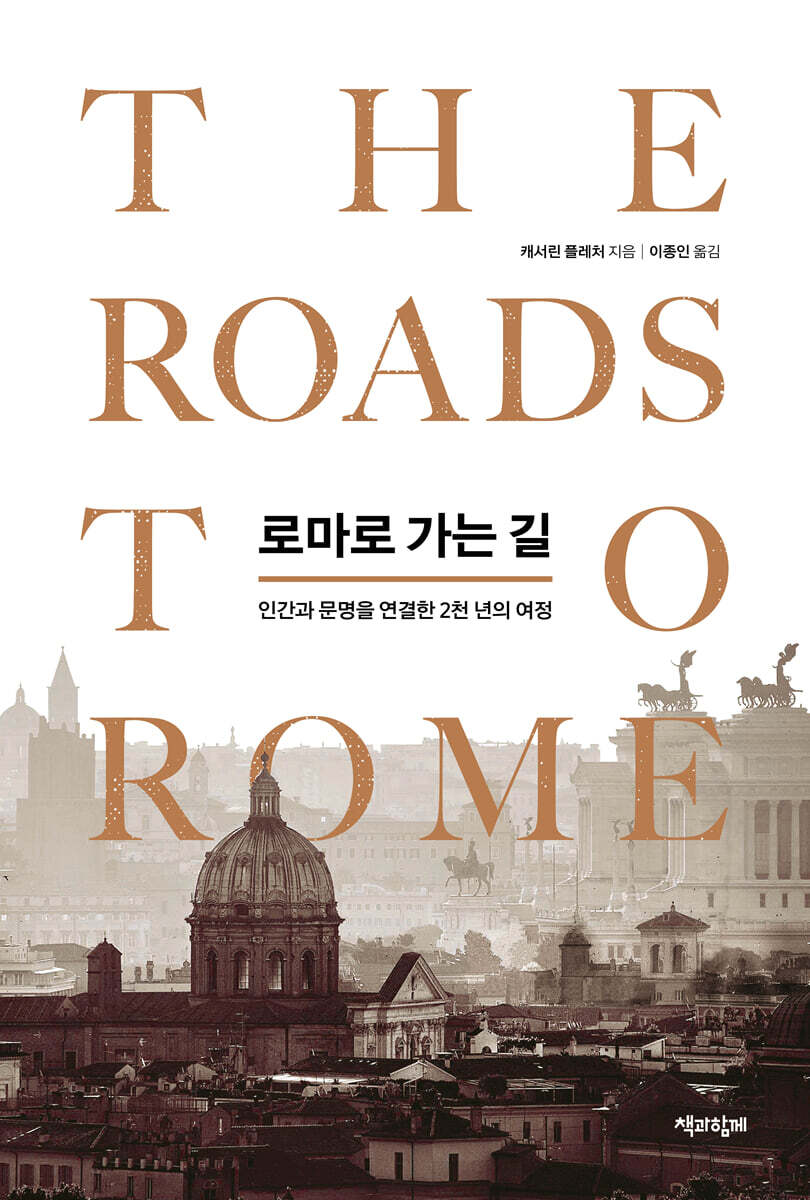
The Road to Rome
 |
Description
Book Introduction
“All roads lead to Rome.”
A vivid compilation of field research across 14 countries
The Root of Western Civilization: The 2,000-Year History of the Roman Empire's Road Network
Ancient Roman roads were not simply infrastructure.
It was the first civilization network created by humans to connect themselves with the world.
On the paved road of stones and earth, imperial armies marched, and merchants, pilgrims, artists, and kings passed by.
And through this road, people met God, transmitted knowledge, and the power of the empire ruled the world through this road.
Catherine Fletcher, a professor at Manchester Metropolitan University and a renowned British historian specializing in Renaissance and early modern European history, traces the history of the 'Roman Road' over two thousand years.
Beginning with the Via Appia, built by Appius Claudius in 312 BC, through the medieval pilgrimage route Via Francigena, Napoleon's military roads, Mussolini's propaganda streets, and today's tourist routes in Rome, Fletcher combines his research and field trips across 14 countries to weave a flowing narrative of the 2,000-year history of European civilization's transformation through roads.
On this path, we encounter the grand legacy of the empire, the boundless curiosity of humanity, and the footsteps of civilization.
This book is not simply a history of the legacy of the Roman Empire.
A humanistic exploration of the heart of Europe, where power and memory, faith and art, domination and resistance intersect, it is a narrative masterpiece that culminates in the insight that “roads are the mirror of civilization, and human footsteps are history.”
Fletcher asks.
“Why are we still walking the Roman roads 1,500 years after the fall of the Roman Empire?” The answer is in this book.
A vivid compilation of field research across 14 countries
The Root of Western Civilization: The 2,000-Year History of the Roman Empire's Road Network
Ancient Roman roads were not simply infrastructure.
It was the first civilization network created by humans to connect themselves with the world.
On the paved road of stones and earth, imperial armies marched, and merchants, pilgrims, artists, and kings passed by.
And through this road, people met God, transmitted knowledge, and the power of the empire ruled the world through this road.
Catherine Fletcher, a professor at Manchester Metropolitan University and a renowned British historian specializing in Renaissance and early modern European history, traces the history of the 'Roman Road' over two thousand years.
Beginning with the Via Appia, built by Appius Claudius in 312 BC, through the medieval pilgrimage route Via Francigena, Napoleon's military roads, Mussolini's propaganda streets, and today's tourist routes in Rome, Fletcher combines his research and field trips across 14 countries to weave a flowing narrative of the 2,000-year history of European civilization's transformation through roads.
On this path, we encounter the grand legacy of the empire, the boundless curiosity of humanity, and the footsteps of civilization.
This book is not simply a history of the legacy of the Roman Empire.
A humanistic exploration of the heart of Europe, where power and memory, faith and art, domination and resistance intersect, it is a narrative masterpiece that culminates in the insight that “roads are the mirror of civilization, and human footsteps are history.”
Fletcher asks.
“Why are we still walking the Roman roads 1,500 years after the fall of the Roman Empire?” The answer is in this book.
- You can preview some of the book's contents.
Preview
index
map
Prologue: The Roman Road Has a Story
Part 1: Indestructible Monuments: 350 BC–500 AD
1 | Romans I Met on the Road
2 | Roads Across the Roman Empire
3 | The Journeys of the Early Christians
Part 2: Saints and Soldiers: 500–1450
4 | Byzantium and the Via Egnatia
5 | Pilgrims and the Via Francigena
6 | The Crusades and the Via Militaris
Part 3: Evidence of the Greatness of the Roman Empire: 1450–1800
7 | Renaissance of the Road
8 | Explorers, Spies, and Priests
9 | Royal Refugees
10 | Grand Tour
Part 4: First the Roads, Then the Railroads: 1800–1900
11 | Napoleon
12 | Romantic People
13 | Americans
14 | New Epic, Old Empire
Part 5: The March to Rome: 1900–Present
15 | Via Mussolini
16 | Viale Adolfo Hitler
17 | Route 7
18 | Roman Holiday
Epilogue: On the Roads of Today
Acknowledgements
Translator's Note
Travel route
References
main
Pictorial source
Search
Prologue: The Roman Road Has a Story
Part 1: Indestructible Monuments: 350 BC–500 AD
1 | Romans I Met on the Road
2 | Roads Across the Roman Empire
3 | The Journeys of the Early Christians
Part 2: Saints and Soldiers: 500–1450
4 | Byzantium and the Via Egnatia
5 | Pilgrims and the Via Francigena
6 | The Crusades and the Via Militaris
Part 3: Evidence of the Greatness of the Roman Empire: 1450–1800
7 | Renaissance of the Road
8 | Explorers, Spies, and Priests
9 | Royal Refugees
10 | Grand Tour
Part 4: First the Roads, Then the Railroads: 1800–1900
11 | Napoleon
12 | Romantic People
13 | Americans
14 | New Epic, Old Empire
Part 5: The March to Rome: 1900–Present
15 | Via Mussolini
16 | Viale Adolfo Hitler
17 | Route 7
18 | Roman Holiday
Epilogue: On the Roads of Today
Acknowledgements
Translator's Note
Travel route
References
main
Pictorial source
Search
Into the book
“All roads lead to Rome.” This is a medieval expression, first recorded in the works of the French poet Alain de Lille.
He wrote nearly a thousand years ago that “a thousand paths lead people to Rome through the ages.”
The English version came about two centuries later, and Geoffrey Chaucer wrote:
“Many roads lead to different people, but all lead to the same destination.” This expression has a broader meaning, but for the ancient Romans it held a literal truth.
--- p.11 From “Prologue│The Roman Road Has a Story”
The exact number of workers involved in the construction of the road network is unknown.
One expert estimated that it would have taken between 25,000 and 36,000 workers to complete the first 185 kilometers of the Via Appia by the five-year deadline.
It was a remarkable feat, given the absence of mechanical equipment.
It is a difficult task to accomplish without sophisticated skills, from land surveyors to stonemasons and manual laborers.
--- p.38 From “Chapter 1│Romans I Met on the Road”
If the apostles' stay in Rome attracted pilgrims, Roman Christians also became pilgrims, traveling to the Holy Land using the empire's road network.
Saint Helena, mother of Constantine, is an early example, who set out on a pilgrimage in 326.
It is difficult to determine to what extent Helena influenced the pilgrimages of others.
However, it is likely that she had a significant influence.
And a few years later, a man we know only as the Pilgrim of Bordeaux made a pilgrimage from western France to the Holy Land.
The travelogue he left behind is much more detailed than the Peutinger Map or the Antonine Itinerary.
It provides detailed information about post stations as well as accommodations that provide a place to sleep, meals, and baths.
--- p.90 From “Chapter 3│The Journey of the Early Christians”
Although I was traveling off the beaten path, the forested hills were enough to remind me of the landscapes pilgrims and crusaders would have encountered.
The valley area of this river is very vulnerable to attacks from above.
This is especially true between Brasov and Bucharest, where the train winds through the Carpathian Mountains.
There are densely forested hills in succession, and behind them, a pine forest unfolds, with no telling what might be hidden there.
Further behind are tall mountains rising up, shrouded in clouds.
--- p.179 From “Chapter 6│The Crusades and the Via Militaris”
Life in Rome is always like this.
Stop anywhere in the city and you'll encounter three layers of stories about the past.
The history of a city is fluid.
You can see Rome through the history of the Popes, through the history of pagans, through stories of persecution, or, like other travelers, create your own story.
By looking at Rome through these three eyes, you can adapt your own story through a series of themes and images left behind by those who have traveled the city before you.
--- p.267 From “Chapter 9│Royal Refugees”
In fact, the French army entered Rome four months later, on February 10, 1798, but the Pope was still alive.
French commander General Berthier made a grand entrance from the north, as many Grand Tour travelers had done.
The only difference is that this time they brought a large army.
The general gave a speech on Capitoline Hill, naming the heroes of the ancient Roman Republic.
He wrote nearly a thousand years ago that “a thousand paths lead people to Rome through the ages.”
The English version came about two centuries later, and Geoffrey Chaucer wrote:
“Many roads lead to different people, but all lead to the same destination.” This expression has a broader meaning, but for the ancient Romans it held a literal truth.
--- p.11 From “Prologue│The Roman Road Has a Story”
The exact number of workers involved in the construction of the road network is unknown.
One expert estimated that it would have taken between 25,000 and 36,000 workers to complete the first 185 kilometers of the Via Appia by the five-year deadline.
It was a remarkable feat, given the absence of mechanical equipment.
It is a difficult task to accomplish without sophisticated skills, from land surveyors to stonemasons and manual laborers.
--- p.38 From “Chapter 1│Romans I Met on the Road”
If the apostles' stay in Rome attracted pilgrims, Roman Christians also became pilgrims, traveling to the Holy Land using the empire's road network.
Saint Helena, mother of Constantine, is an early example, who set out on a pilgrimage in 326.
It is difficult to determine to what extent Helena influenced the pilgrimages of others.
However, it is likely that she had a significant influence.
And a few years later, a man we know only as the Pilgrim of Bordeaux made a pilgrimage from western France to the Holy Land.
The travelogue he left behind is much more detailed than the Peutinger Map or the Antonine Itinerary.
It provides detailed information about post stations as well as accommodations that provide a place to sleep, meals, and baths.
--- p.90 From “Chapter 3│The Journey of the Early Christians”
Although I was traveling off the beaten path, the forested hills were enough to remind me of the landscapes pilgrims and crusaders would have encountered.
The valley area of this river is very vulnerable to attacks from above.
This is especially true between Brasov and Bucharest, where the train winds through the Carpathian Mountains.
There are densely forested hills in succession, and behind them, a pine forest unfolds, with no telling what might be hidden there.
Further behind are tall mountains rising up, shrouded in clouds.
--- p.179 From “Chapter 6│The Crusades and the Via Militaris”
Life in Rome is always like this.
Stop anywhere in the city and you'll encounter three layers of stories about the past.
The history of a city is fluid.
You can see Rome through the history of the Popes, through the history of pagans, through stories of persecution, or, like other travelers, create your own story.
By looking at Rome through these three eyes, you can adapt your own story through a series of themes and images left behind by those who have traveled the city before you.
--- p.267 From “Chapter 9│Royal Refugees”
In fact, the French army entered Rome four months later, on February 10, 1798, but the Pope was still alive.
French commander General Berthier made a grand entrance from the north, as many Grand Tour travelers had done.
The only difference is that this time they brought a large army.
The general gave a speech on Capitoline Hill, naming the heroes of the ancient Roman Republic.
--- p.301 From “Chapter 11│Napoleon”
Publisher's Review
“All roads lead to Rome.”
The Root of Western Civilization: The 2,000-Year History of the Roman Empire's Road Network
Based on field research across 14 countries
A masterpiece that compiles the epics of the paths left by great civilizations.
Ancient Roman roads were not simply infrastructure.
It was the first civilization network created by humans to connect themselves with the world.
On the paved road of stones and earth, imperial armies marched, and merchants, pilgrims, artists, and kings passed by.
And through this road, people met God, transmitted knowledge, and the power of the empire ruled the world through this road.
Catherine Fletcher, a professor at Manchester Metropolitan University and a British historian renowned for her research on Renaissance and early modern European history, traces the history of the 'Roman Road' over two thousand years in 'The Road to Rome'.
Beginning with the Via Appia, built by Appius Claudius in 312 BC, through the medieval pilgrimage route Via Francigena, Napoleon's military roads, Mussolini's propaganda streets, and today's tourist routes in Rome, Fletcher combines his research and field trips across 14 countries to weave a flowing narrative of the 2,000-year history of European civilization's transformation through roads.
On this path, we encounter the grand legacy of the empire, the boundless curiosity of humanity, and the footsteps of civilization.
This book is not simply a history of the legacy of the Roman Empire.
A humanistic exploration of the heart of Europe, where power and memory, faith and art, domination and resistance intersect, it is a narrative masterpiece that culminates in the insight that “roads are the mirror of civilization, and human footsteps are history.”
Immediately after its publication, major media outlets such as the Wall Street Journal and the Financial Times praised the book, calling it “a book that makes you want to walk along the ancient Roman roads” and “a story etched on the map of civilization,” and it offered a new perspective not only to researchers of ancient history and cultural history but also to travelers.
Fletcher asks.
“Why are we still walking the Roman roads 1,500 years after the fall of the Roman Empire?” The answer is in this book.
From the road of conquest to the road of culture
The Time of Civilization Drawn by Roman Roads
The first half of the book examines the birth of Roman roads and the techniques of imperial rule.
It vividly shows how the roads that started from the golden milestone of Augustus and radiated out from the center of the empire became the foundation of administration, military, economy, and religion.
The Via Appia led south to Brindisi, the Via Flaminia north to the Adriatic Sea, and the Via Egnatia stretched to the Balkans and the east.
These roads were the routes through which the Roman legions moved and the networks through which taxes, laws, art and language were disseminated.
Fletcher points out that this road was simultaneously a tool of conquest and a symbol of domination.
The middle part features roads from the Middle Ages and Renaissance.
Even after the empire collapsed, the roads did not disappear.
Pilgrims headed to Rome to visit the tombs of Saints Peter and Paul, and monks built hospitals and lodgings along the way to guard the path of faith.
The footsteps of countless pilgrims who followed the Via Francigena demonstrate the faith and courage of human beings on their way to the 'City of God.'
Later, during the Renaissance, roads were revived as paths of knowledge and art.
Intellectuals such as Goethe, Montaigne, and Byron journeyed to Rome and took the 'road back to the sources of the classics.'
During this period, roads were no longer military infrastructure, but rather a stage for thought and culture, a place where people rediscovered their past.
In the second half, the paths of modernization and war intersect.
In the 19th and early 20th centuries, roads became symbols of industrialization and imperialism.
Napoleon's military roads, Garibaldi's march routes, and the Neo-Roman roads that emerged as symbols of Italian unification were all political symbols of the ambitions of a modern nation.
During Mussolini's fascist era, roads became a stage for propaganda.
In the name of recreating the glory of ancient Rome, he demolished some 130 buildings, converted ancient ruins into propaganda, and built roads on which he held processions, speeches, and parades.
Through this process, Fletcher sharply analyzes how the road becomes transformed into the language of power.
At the end of the book, Fletcher turns his attention to the present path.
Even today, Roman citizens and travelers walk along the Roman streets and encounter two thousand years of history.
Ancient tombs, churches and modern villas stand side by side along the road.
Fletcher describes it as “a landscape in which past and present, myth and everyday life are layered.”
Traces of Rome still remain in the footsteps of tourists, in the city traffic, and on the paths walked by modern people.
A quest that began with childhood memories
Following the eternal traces of the Roman roads
"The Road to Rome" is a book that comes from the author's old memories.
As a child, Fletcher rode in his father's car and saw firsthand the remains of Roman roads that still remain throughout Britain.
My father used to point to the straight road outside the car window and say, “This is the Roman road.”
The impression I made at that time later became the opportunity to ask, “What is a road? Why do Roman roads still exist today?”
As time passed and Fletcher became a historian, one day he discovered a map made in 1896 at his mother's house.
The map showed Roman roads.
Although Roman roads were not in use at the time, cartographers considered them important enough to show on maps.
Nevertheless, we found that the Roman Empire's road network has been studied only from a technical and archaeological perspective, with little research exploring 'how the roads themselves shaped civilization and memory.'
Fletcher combined the analytical skills of a scholar with the curiosity of a traveler to fill that gap.
For many years, I have personally traveled throughout Europe, personally witnessing the traces of the Roman roads, and this book is the result of that journey.
But why have Roman roads maintained such a long-lasting cultural presence across Europe? Partly because the Romans themselves decided it should be that way.
It is with good reason that Claudius called the road "the greatest monument ever built."
The Roman roads were not simple roads.
It was the empire's blood vessel, the conduit through which administration, military, and commerce flowed.
Along this road, soldiers advanced into the provinces, officials spread laws and orders, and merchants transported wine, spices, and iron tools, uniting the Mediterranean world into a single economic sphere.
The milestones, mile markers, and road maintenance regulations erected along the road were evidence of the Roman spirit of order and rule of law etched on the ground.
Technically, Roman roads were ahead of their time.
The multi-layered pavement, drainage system, and straightened route design are the prototypes of modern civil engineering.
Some roads are still sturdy enough to handle vehicles even today, two thousand years later.
Moreover, the roadside markers vividly bore the names of patrons and emperors long after the Romans had disappeared, and the road itself remained a 'stone chronicle' of the empire.
The long history of the Roman road network is astonishing, and its sheer scale demonstrates the power of Rome beyond what any single building can match.
Charles Dickens recalled walking the Roman Road, saying:
“History is engraved on every stone scattered along this road.” He was right.
Roman roads still connect us and remind us of history.
Where learning and travel meet
Living history written on the road
Fletcher personally traveled across 14 countries, observing the traces of Roman roads and documenting how present-day life and memories overlap with the landscapes that once evoked the glory of the empire.
And while adding detailed historical insight through a scholar's perspective, he captured the smells, lights, and street scenes through a traveler's sensibility.
The book is interspersed with stories of old train stations in southern Italy, bus timetables, meals at country inns, and people met on the train.
In this way, historical insight and vivid travelogues make readers feel as if they are traveling with the author.
Fletcher also mixes witty humor and personal observations into his erudite writing style, making for a delightful read.
In Turkey, they mention the Wi-Fi password that requires you to type in "1453" twice, referring to the year the Ottomans captured Constantinople, a year so significant to Turks that the person in charge jokes about using the number twice, or that the statue of Byron in the Villa Borghese is holding a book, but more than half of it has fallen off, so "now it looks like he's holding a sandwich."
There is also a scene where he puts aside his scholarly coolness for a moment and engages in a fight with pigeons that try to snatch away the snacks he is holding while drinking beer on a seaside pier.
These humorous depictions make readers smile, blurring the lines between history and everyday life on the road.
In this way, Fletcher created a humanistic history book that combines the depth of a historical book with the excitement of a travelogue through vivid narrative.
From the roads of the empire to the roads of the world
The Romans' footsteps continue through the ages
The roads paved by the Romans two thousand years ago became the muscle and nerve network of Western civilization, spreading Latin, Roman law, urban structures and administrative systems, art and religion throughout Europe, and as a result, the traces of Rome permeated France, Spain, Britain, the Balkans, and even North Africa and the Middle East.
Without the Roman roads, the culture of medieval monasteries and pilgrimages, the art and exchanges of the Renaissance, and the science and ideas of modern times would not have spread so quickly.
And its influence did not disappear even after the fall of the empire.
Napoleon viewed Rome not simply as a city, but as a symbolic object for expanding French influence and reviving historical glory, and he modeled it after the straightness and rationality of Roman roads.
In this way, the European road system was layered on top of the Roman roads.
Mussolini also used the form of Roman roads as a stage for political propaganda.
Through all these examples, Fletcher says, “Roman roads were not simply a legacy of the past, but a model of modern imagination and power.”
And surprisingly, Roman roads are still in use today.
Parts of the Via Appia are still used as roads connecting southern Rome, and there are also many highways and railways that follow their Roman routes almost exactly.
Tourists visiting Rome can feel the breath of antiquity as they walk along the old roads and discover that two thousand years of time overlap in the city's daily life.
As readers turn the pages, they will realize that Roman roads are not simply relics of the past, but a living cultural landscape.
On the road of two thousand years, we are still going to Rome.
The Root of Western Civilization: The 2,000-Year History of the Roman Empire's Road Network
Based on field research across 14 countries
A masterpiece that compiles the epics of the paths left by great civilizations.
Ancient Roman roads were not simply infrastructure.
It was the first civilization network created by humans to connect themselves with the world.
On the paved road of stones and earth, imperial armies marched, and merchants, pilgrims, artists, and kings passed by.
And through this road, people met God, transmitted knowledge, and the power of the empire ruled the world through this road.
Catherine Fletcher, a professor at Manchester Metropolitan University and a British historian renowned for her research on Renaissance and early modern European history, traces the history of the 'Roman Road' over two thousand years in 'The Road to Rome'.
Beginning with the Via Appia, built by Appius Claudius in 312 BC, through the medieval pilgrimage route Via Francigena, Napoleon's military roads, Mussolini's propaganda streets, and today's tourist routes in Rome, Fletcher combines his research and field trips across 14 countries to weave a flowing narrative of the 2,000-year history of European civilization's transformation through roads.
On this path, we encounter the grand legacy of the empire, the boundless curiosity of humanity, and the footsteps of civilization.
This book is not simply a history of the legacy of the Roman Empire.
A humanistic exploration of the heart of Europe, where power and memory, faith and art, domination and resistance intersect, it is a narrative masterpiece that culminates in the insight that “roads are the mirror of civilization, and human footsteps are history.”
Immediately after its publication, major media outlets such as the Wall Street Journal and the Financial Times praised the book, calling it “a book that makes you want to walk along the ancient Roman roads” and “a story etched on the map of civilization,” and it offered a new perspective not only to researchers of ancient history and cultural history but also to travelers.
Fletcher asks.
“Why are we still walking the Roman roads 1,500 years after the fall of the Roman Empire?” The answer is in this book.
From the road of conquest to the road of culture
The Time of Civilization Drawn by Roman Roads
The first half of the book examines the birth of Roman roads and the techniques of imperial rule.
It vividly shows how the roads that started from the golden milestone of Augustus and radiated out from the center of the empire became the foundation of administration, military, economy, and religion.
The Via Appia led south to Brindisi, the Via Flaminia north to the Adriatic Sea, and the Via Egnatia stretched to the Balkans and the east.
These roads were the routes through which the Roman legions moved and the networks through which taxes, laws, art and language were disseminated.
Fletcher points out that this road was simultaneously a tool of conquest and a symbol of domination.
The middle part features roads from the Middle Ages and Renaissance.
Even after the empire collapsed, the roads did not disappear.
Pilgrims headed to Rome to visit the tombs of Saints Peter and Paul, and monks built hospitals and lodgings along the way to guard the path of faith.
The footsteps of countless pilgrims who followed the Via Francigena demonstrate the faith and courage of human beings on their way to the 'City of God.'
Later, during the Renaissance, roads were revived as paths of knowledge and art.
Intellectuals such as Goethe, Montaigne, and Byron journeyed to Rome and took the 'road back to the sources of the classics.'
During this period, roads were no longer military infrastructure, but rather a stage for thought and culture, a place where people rediscovered their past.
In the second half, the paths of modernization and war intersect.
In the 19th and early 20th centuries, roads became symbols of industrialization and imperialism.
Napoleon's military roads, Garibaldi's march routes, and the Neo-Roman roads that emerged as symbols of Italian unification were all political symbols of the ambitions of a modern nation.
During Mussolini's fascist era, roads became a stage for propaganda.
In the name of recreating the glory of ancient Rome, he demolished some 130 buildings, converted ancient ruins into propaganda, and built roads on which he held processions, speeches, and parades.
Through this process, Fletcher sharply analyzes how the road becomes transformed into the language of power.
At the end of the book, Fletcher turns his attention to the present path.
Even today, Roman citizens and travelers walk along the Roman streets and encounter two thousand years of history.
Ancient tombs, churches and modern villas stand side by side along the road.
Fletcher describes it as “a landscape in which past and present, myth and everyday life are layered.”
Traces of Rome still remain in the footsteps of tourists, in the city traffic, and on the paths walked by modern people.
A quest that began with childhood memories
Following the eternal traces of the Roman roads
"The Road to Rome" is a book that comes from the author's old memories.
As a child, Fletcher rode in his father's car and saw firsthand the remains of Roman roads that still remain throughout Britain.
My father used to point to the straight road outside the car window and say, “This is the Roman road.”
The impression I made at that time later became the opportunity to ask, “What is a road? Why do Roman roads still exist today?”
As time passed and Fletcher became a historian, one day he discovered a map made in 1896 at his mother's house.
The map showed Roman roads.
Although Roman roads were not in use at the time, cartographers considered them important enough to show on maps.
Nevertheless, we found that the Roman Empire's road network has been studied only from a technical and archaeological perspective, with little research exploring 'how the roads themselves shaped civilization and memory.'
Fletcher combined the analytical skills of a scholar with the curiosity of a traveler to fill that gap.
For many years, I have personally traveled throughout Europe, personally witnessing the traces of the Roman roads, and this book is the result of that journey.
But why have Roman roads maintained such a long-lasting cultural presence across Europe? Partly because the Romans themselves decided it should be that way.
It is with good reason that Claudius called the road "the greatest monument ever built."
The Roman roads were not simple roads.
It was the empire's blood vessel, the conduit through which administration, military, and commerce flowed.
Along this road, soldiers advanced into the provinces, officials spread laws and orders, and merchants transported wine, spices, and iron tools, uniting the Mediterranean world into a single economic sphere.
The milestones, mile markers, and road maintenance regulations erected along the road were evidence of the Roman spirit of order and rule of law etched on the ground.
Technically, Roman roads were ahead of their time.
The multi-layered pavement, drainage system, and straightened route design are the prototypes of modern civil engineering.
Some roads are still sturdy enough to handle vehicles even today, two thousand years later.
Moreover, the roadside markers vividly bore the names of patrons and emperors long after the Romans had disappeared, and the road itself remained a 'stone chronicle' of the empire.
The long history of the Roman road network is astonishing, and its sheer scale demonstrates the power of Rome beyond what any single building can match.
Charles Dickens recalled walking the Roman Road, saying:
“History is engraved on every stone scattered along this road.” He was right.
Roman roads still connect us and remind us of history.
Where learning and travel meet
Living history written on the road
Fletcher personally traveled across 14 countries, observing the traces of Roman roads and documenting how present-day life and memories overlap with the landscapes that once evoked the glory of the empire.
And while adding detailed historical insight through a scholar's perspective, he captured the smells, lights, and street scenes through a traveler's sensibility.
The book is interspersed with stories of old train stations in southern Italy, bus timetables, meals at country inns, and people met on the train.
In this way, historical insight and vivid travelogues make readers feel as if they are traveling with the author.
Fletcher also mixes witty humor and personal observations into his erudite writing style, making for a delightful read.
In Turkey, they mention the Wi-Fi password that requires you to type in "1453" twice, referring to the year the Ottomans captured Constantinople, a year so significant to Turks that the person in charge jokes about using the number twice, or that the statue of Byron in the Villa Borghese is holding a book, but more than half of it has fallen off, so "now it looks like he's holding a sandwich."
There is also a scene where he puts aside his scholarly coolness for a moment and engages in a fight with pigeons that try to snatch away the snacks he is holding while drinking beer on a seaside pier.
These humorous depictions make readers smile, blurring the lines between history and everyday life on the road.
In this way, Fletcher created a humanistic history book that combines the depth of a historical book with the excitement of a travelogue through vivid narrative.
From the roads of the empire to the roads of the world
The Romans' footsteps continue through the ages
The roads paved by the Romans two thousand years ago became the muscle and nerve network of Western civilization, spreading Latin, Roman law, urban structures and administrative systems, art and religion throughout Europe, and as a result, the traces of Rome permeated France, Spain, Britain, the Balkans, and even North Africa and the Middle East.
Without the Roman roads, the culture of medieval monasteries and pilgrimages, the art and exchanges of the Renaissance, and the science and ideas of modern times would not have spread so quickly.
And its influence did not disappear even after the fall of the empire.
Napoleon viewed Rome not simply as a city, but as a symbolic object for expanding French influence and reviving historical glory, and he modeled it after the straightness and rationality of Roman roads.
In this way, the European road system was layered on top of the Roman roads.
Mussolini also used the form of Roman roads as a stage for political propaganda.
Through all these examples, Fletcher says, “Roman roads were not simply a legacy of the past, but a model of modern imagination and power.”
And surprisingly, Roman roads are still in use today.
Parts of the Via Appia are still used as roads connecting southern Rome, and there are also many highways and railways that follow their Roman routes almost exactly.
Tourists visiting Rome can feel the breath of antiquity as they walk along the old roads and discover that two thousand years of time overlap in the city's daily life.
As readers turn the pages, they will realize that Roman roads are not simply relics of the past, but a living cultural landscape.
On the road of two thousand years, we are still going to Rome.
GOODS SPECIFICS
- Date of issue: October 20, 2025
- Page count, weight, size: 592 pages | 844g | 152*225*27mm
- ISBN13: 9791194263739
- ISBN10: 1194263739
You may also like
카테고리
korean


korean

![GQ KOREA Mark (Monthly): December [2025]](http://librairie.coreenne.fr/cdn/shop/files/8ef265dbbfbf186523ed75ba7319009d.jpg?v=1765340328&width=3840)


