

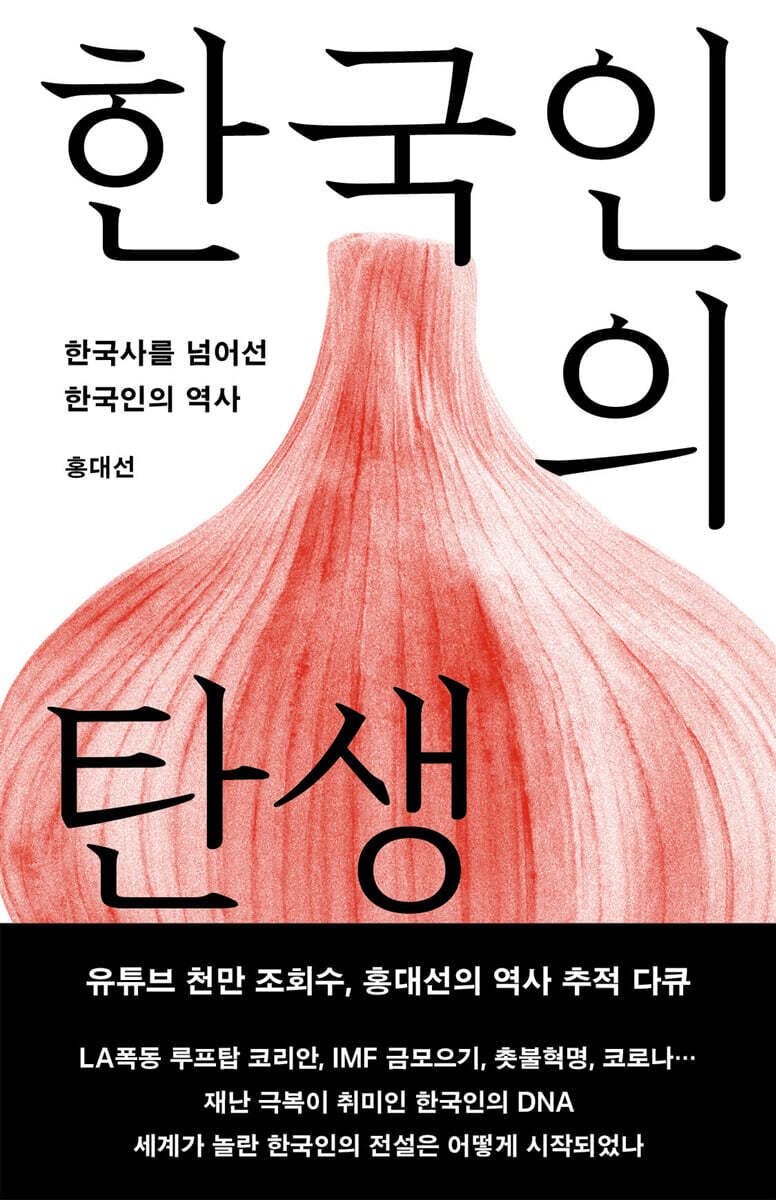
The birth of the Korean people
 |
Description
Book Introduction
Koreans weren't made in a day.
A historical documentary tracing the origins of the Korean people.
LA Riots, Rooftop Koreans, IMF Gold Collection, Candlelight Revolution, Corona…
Koreans' DNA: Overcoming Disasters is Their Hobby
How did the Korean legend that astonished the world begin?
Since Dangun, the ancestors of the Korean people have tried their best to survive under the extreme climate and barren productivity of the Korean Peninsula.
First, on the barren Korean peninsula, Koreans had to eat anything.
To avoid dying from bacterial infection from eating anything, I ate something that was effective against infection.
It's garlic and mugwort.
The 'garlic and mugwort' in the Dangun myth symbolize the Korean people's will to survive no matter what.
For a long time, China has been a troublesome neighbor.
Historians from other countries wonder.
Why wasn't Korea absorbed into China? The Han, Sui, Tang, Khitan, Jurchen, Mongol, and Qing dynasties were all superpowers, roughly the size of the United States and Russia combined. Korea survived by either winning battles against them or by "fighting back and forth."
Perhaps Korea is described like this in the hidden pages of Chinese history.
“Those monopolists!”
On the Korean Peninsula, it was difficult for individuals to survive, and for the nation to survive as well.
In any case, in the process of surviving and reaching the present-day Republic of Korea, many unique characteristics of Koreans were created.
《The Birth of the Korean People》 examines this process through three figures (Dangun, King Hyeonjong of Goryeo, and Jeong Do-jeon) and three keywords (survival, war, and revolution).
Dangun established the foundation for our lives, King Hyeonjong of Goryeo created the Korean people, and Jeong Do-jeon created Korean individuals.
We are their descendants, or the present tense of the three of them.
We invite you to a life of self-understanding, tracing the origins of ourselves and ourselves!
A historical documentary tracing the origins of the Korean people.
LA Riots, Rooftop Koreans, IMF Gold Collection, Candlelight Revolution, Corona…
Koreans' DNA: Overcoming Disasters is Their Hobby
How did the Korean legend that astonished the world begin?
Since Dangun, the ancestors of the Korean people have tried their best to survive under the extreme climate and barren productivity of the Korean Peninsula.
First, on the barren Korean peninsula, Koreans had to eat anything.
To avoid dying from bacterial infection from eating anything, I ate something that was effective against infection.
It's garlic and mugwort.
The 'garlic and mugwort' in the Dangun myth symbolize the Korean people's will to survive no matter what.
For a long time, China has been a troublesome neighbor.
Historians from other countries wonder.
Why wasn't Korea absorbed into China? The Han, Sui, Tang, Khitan, Jurchen, Mongol, and Qing dynasties were all superpowers, roughly the size of the United States and Russia combined. Korea survived by either winning battles against them or by "fighting back and forth."
Perhaps Korea is described like this in the hidden pages of Chinese history.
“Those monopolists!”
On the Korean Peninsula, it was difficult for individuals to survive, and for the nation to survive as well.
In any case, in the process of surviving and reaching the present-day Republic of Korea, many unique characteristics of Koreans were created.
《The Birth of the Korean People》 examines this process through three figures (Dangun, King Hyeonjong of Goryeo, and Jeong Do-jeon) and three keywords (survival, war, and revolution).
Dangun established the foundation for our lives, King Hyeonjong of Goryeo created the Korean people, and Jeong Do-jeon created Korean individuals.
We are their descendants, or the present tense of the three of them.
We invite you to a life of self-understanding, tracing the origins of ourselves and ourselves!
- You can preview some of the book's contents.
Preview
index
Attached to the revised and expanded edition
Introduction: The Mystery of Being Korean
Part 1: Captivated by the Korean Peninsula
Chapter 1 Genesis
Uninvited Guests | Fathers of Fathers | Pure Hybrids | The People of Wormwood and Garlic
Chapter 2: Peace is a Hell of Survival
The Human Diet | The Genes of the "Table" Left Behind by the Struggle for Survival | The Appropriate Ratio of Competition and Sharing | My Gross Side, My Neighbor | The Correlation Between Intelligence and Unhappiness | Han (恨) and Heung (興) | Stimuli That Soothe Fatigue and Fear | A People of Drinking, Song, and Dance | A People of Shamanism | Dangun's Failure to Select a Location
Chapter 3: War is Acid
China is Hell | China and the Chinese | Surviving Hell | Mountain Fortresses are Disease | Living Together and Dying Together | Mountain Fortresses Are Everywhere, Always There | The Rise and Fall of Goguryeo as Seen Through Mountain Fortresses
Chapter 4: War is Shooting
The Economics of Victory: Quality Against Quantity | Bows and Guns, Cold and Hot Weapons | Rooftop Koreans and the Battle of Myeongnyang | Firepower Addiction | A Love-Hate Korean
Chapter 5 War and Peace
Disaster, another name for war | Acid against viruses | Acid battles in squares and streets | The sublime philistine
Part 2: The Birth of a Nation
Chapter 6: Goryeo is Goguryeo
Goguryeo is not a memory, but a reality | The two unifications of the Three Kingdoms: right then, wrong now | The Korean Peninsula and the Central Plains: An Uneasy Coexistence
Chapter 7: The Ugly Man and the Illegitimate Child
The Cursed Child | Kang Jo and Kang Gam-chan | The Worst Enemy Ever | The Eve of Destruction | The Death of a Hero | The Rules of Fighting
Chapter 8: A Scream Erupts on the Battlefield
A Covenant between the Nation and the People | The Empire Strikes Back | The Guizhou Plains | The Kingdom Strikes Back | The Balancer of East Asia | The Birth of the Korean People
Part 3: The Birth of National Character
Chapter 9: The Mandate of Heaven and Revolution
A good country | Revolution is immoral | Failed revolutionaries and country warriors | For the people, by the king and the nobles
Chapter 10 Wages
"Come out, you responsible person!" | The nation exists for me | Petitions and petitions | Impatient people and disloyal voters | Force cannot overcome philosophy.
Chapter 11 By the Four Nobles
From the People's Origin | Divinity and Humanity | What is a Joseon scholar-official? | The Illusion of Silhak | The Underworld and the World, the Art of Transaction | The Contradiction of the Ideal Scholar-official | His Nobility and His Uselessness
Chapter 12 For the People
A Safe World, the Conditions for the People's Livelihood | Joseon, the Nation of Great Food | The Joseon People's Body | The Race to Seoul and the Top | The People's Desire | Filial Piety, the Foundation of Order | Rice and Writing, Hangul
Chapter 13: The Fall of Joseon
The Imjin War and the Byeongja War | Hell descended upon this world | Ideals defeated by reality | Factional politics were right | The Tangpyeong Policy and the collapse of the nation | A civilization overtaken | The time civilization lived in
The Birth of Koreans
The Restless Developed World | The Gene of Centralization | The Small and Medium Enterprises and K-pop | People are Heaven: Communication and Connection | From People-Oriented to Democracy
Outgoing post: Koreans have such a…
References
Special Appendix: A Claim About the Battle of Gwiju
Introduction: The Mystery of Being Korean
Part 1: Captivated by the Korean Peninsula
Chapter 1 Genesis
Uninvited Guests | Fathers of Fathers | Pure Hybrids | The People of Wormwood and Garlic
Chapter 2: Peace is a Hell of Survival
The Human Diet | The Genes of the "Table" Left Behind by the Struggle for Survival | The Appropriate Ratio of Competition and Sharing | My Gross Side, My Neighbor | The Correlation Between Intelligence and Unhappiness | Han (恨) and Heung (興) | Stimuli That Soothe Fatigue and Fear | A People of Drinking, Song, and Dance | A People of Shamanism | Dangun's Failure to Select a Location
Chapter 3: War is Acid
China is Hell | China and the Chinese | Surviving Hell | Mountain Fortresses are Disease | Living Together and Dying Together | Mountain Fortresses Are Everywhere, Always There | The Rise and Fall of Goguryeo as Seen Through Mountain Fortresses
Chapter 4: War is Shooting
The Economics of Victory: Quality Against Quantity | Bows and Guns, Cold and Hot Weapons | Rooftop Koreans and the Battle of Myeongnyang | Firepower Addiction | A Love-Hate Korean
Chapter 5 War and Peace
Disaster, another name for war | Acid against viruses | Acid battles in squares and streets | The sublime philistine
Part 2: The Birth of a Nation
Chapter 6: Goryeo is Goguryeo
Goguryeo is not a memory, but a reality | The two unifications of the Three Kingdoms: right then, wrong now | The Korean Peninsula and the Central Plains: An Uneasy Coexistence
Chapter 7: The Ugly Man and the Illegitimate Child
The Cursed Child | Kang Jo and Kang Gam-chan | The Worst Enemy Ever | The Eve of Destruction | The Death of a Hero | The Rules of Fighting
Chapter 8: A Scream Erupts on the Battlefield
A Covenant between the Nation and the People | The Empire Strikes Back | The Guizhou Plains | The Kingdom Strikes Back | The Balancer of East Asia | The Birth of the Korean People
Part 3: The Birth of National Character
Chapter 9: The Mandate of Heaven and Revolution
A good country | Revolution is immoral | Failed revolutionaries and country warriors | For the people, by the king and the nobles
Chapter 10 Wages
"Come out, you responsible person!" | The nation exists for me | Petitions and petitions | Impatient people and disloyal voters | Force cannot overcome philosophy.
Chapter 11 By the Four Nobles
From the People's Origin | Divinity and Humanity | What is a Joseon scholar-official? | The Illusion of Silhak | The Underworld and the World, the Art of Transaction | The Contradiction of the Ideal Scholar-official | His Nobility and His Uselessness
Chapter 12 For the People
A Safe World, the Conditions for the People's Livelihood | Joseon, the Nation of Great Food | The Joseon People's Body | The Race to Seoul and the Top | The People's Desire | Filial Piety, the Foundation of Order | Rice and Writing, Hangul
Chapter 13: The Fall of Joseon
The Imjin War and the Byeongja War | Hell descended upon this world | Ideals defeated by reality | Factional politics were right | The Tangpyeong Policy and the collapse of the nation | A civilization overtaken | The time civilization lived in
The Birth of Koreans
The Restless Developed World | The Gene of Centralization | The Small and Medium Enterprises and K-pop | People are Heaven: Communication and Connection | From People-Oriented to Democracy
Outgoing post: Koreans have such a…
References
Special Appendix: A Claim About the Battle of Gwiju
Detailed image

Into the book
Who are Koreans? Koreans are children of unfortunate fate and descendants of revolution.
Let's call all of them Koreans (citizens of the Republic of Korea, South Koreans), North Koreans, Zainichi Koreans, Joseonjok (Koreans in China), Koreans (Korea), and Koreans living in the United States.
Who created these Koreans? The first common ancestor we Koreans can point to is our mythical grandfather, Dangun.
There are two more historical, physical ancestors.
First is King Hyeonjong of Goryeo.
Through an all-out war with the Khitans, King Hyeonjong united the people of the Korean Peninsula for the first time under the framework of a single nation.
Next is Sam Bong Jeong Do-jeon, a Confucian scholar and architect of the new state of Joseon.
Jeong Do-jeon created specific characteristics of the Korean people.
History is a spiral of chance and necessity intersecting and continuing.
It is the result of countless people, events, struggles, and successes and frustrations.
Therefore, trying to talk about Korea and Koreans with just three people in mind is a severe compression and leap.
However, the content of this book is not 'everything about Korean history' but 'understanding Koreans'.
---From "Introductory Note: The Mystery of Being Korean"
Dangun failed on two levels.
First is the natural environment.
Korea's four distinct seasons are beautiful to see, but very painful to endure.
There are places that are hotter and colder than Korea.
However, there is no place where the four seasons are forced to have such extreme differences within a year as in Korea.
Koreans do not suffer from differences, but from absolute temperatures.
Taiwan and other parts of southern Asia are hotter in summer.
In terms of winter, some parts of China and Russia are colder.
Even in nearby Japan, like us, there are four distinct seasons and both hot and cold weather occur within a year, but the difference is much milder than on the Korean Peninsula.
South Korea is exposed to similar conditions across most of the Korean Peninsula.
It's really hot in the summer and really cold in the winter.
Koreans have been exposed to extreme climate changes on a regular basis, every year, from ancient times to the present.
The Korean Peninsula's productivity is also hopeless.
More than 70% of the terrain is rugged and varied mountainous.
However, that does not mean that the plains are abundant.
The narrow plains are only slightly more fertile than the mountainous terrain.
The winters on the Korean Peninsula are so harsh that they could be called a cold desert.
---From Chapter 1, Genesis
The statement that Koreans are obsessed with the Korean Peninsula has a double meaning.
Koreans were not formed solely within the land chosen by Dangun.
We cannot explain the archetype of the Korean people without talking about external factors.
Now it is time to talk about Dangun's critical failure.
What else did Dangun fail at?
It's a matter of location.
Dangun chose the wrong neighbor.
Korea's closest neighbor, oldest friend, and formidable enemy is China.
---From Chapter 2, “Peace is a Hell of Survival”
Why wasn't Korea absorbed into China? The process that led to this outcome, a question that puzzles every historian, is one of the keys to unlocking the secrets of the Korean people.
Why didn't Korea perish long ago? In other words, why does Korea exist? Why did it survive China's expansion?
Koreans tend to overlook the fact that they are a war-torn nation.
Because their recent record isn't very good.
Here, recent refers to the period from the Imjin War.
During the Imjin War, Joseon was driven to the brink of destruction by Japan, and during the Byeongja War, the king suffered the humiliation of surrendering to the invading forces within the country he ruled.
The fact that Korea became a Japanese colony at the end of the Russo-Japanese War and was unable to put up a proper resistance will continue to be a source of hurt to Korean pride for a long time to come.
(…) It is natural for current Koreans to have the illusion that the Korean people cannot wage war.
But that's not the case.
It is difficult to find a group among the major peoples of the Eurasian continent that is not a warlike people.
The losers are already gone.
They lost their bloodline and language, and their identity was erased.
This book will not delve into the complex discussion of what a nation is, but if a nation loses at least one of its bloodlines and language, it disappears.
Here, it is okay to change ‘ethnicity’ to ‘race.’
The peninsula is connected to the continent.
It's a different situation from the island.
Comparing with Japan, we can see the situation on the Korean Peninsula more clearly.
---From "Chapter 3 War is an Acid"
The arrows and stones that were fired at the enemy from the mountain fortress, and the missiles of North and South Korea today, have a single genetic identity within the Korean Peninsula.
It's like a small pet dog that fits in one hand is a subspecies of the gray wolf.
Subspecies are creatures that only look different to the eye, but are actually genetically the same species.
It can be said that the people of the Korean Peninsula harbor resentment over the hundred years of loneliness they endured without firepower.
In fact, South Korea has been exploiting North Korea's campaign of terror and destruction to gain world attention.
We have been developing advanced weapons systems behind the scenes, while keeping our mouths shut and acting like crazy.
To foreign eyes, Korea is a strange country that suddenly began producing advanced weapons in the 21st century.
Thanks to North Korea's pretense of being strong, we were able to successfully pretend to be weak, but we can no longer make jokes.
South Korea is now trying to change its attitude and sell weapons overseas.
---From "Chapter 4: War is Shooting"
The country called the Republic of Korea does not run on ideological agreement.
For Koreans, a nation is nothing more than a compromise made to meet practical needs.
Korea runs on collaboration, but that collaboration is always precarious because it's carried out by people who don't like each other.
Therefore, the fatherland is not sacred.
To Koreans, their motherland is an annoying old man who nags at them for no reason.
He mutters, 'When will that old man die?' and he means it.
But in my deeper heart, I am ready to carry you and run to the hospital if you fall.
To Koreans, the country is a tool, but Korea is destiny.
Fate is neither right nor wrong.
It's just something you have to accept.
The fatherland is an unsacred destiny.
Acid defense is a way of accepting fate.
Since war is not their only destiny, Koreans carry out acid defense even in disaster situations.
---From Chapter 5, War and Peace
There are people who treat Silla as a traitor, using the logic that 'they brought in the foreign power Tang Dynasty and destroyed two nation-states.'
Unfortunately, there was no such thing as a national consciousness at that time.
Regret is a choice, but criticism is something to think about.
Likewise, the habit of deliberately turning one's head away, saying, "Goguryeo is just a lost memory," is foolish.
The truth is complex, but only a little complex.
It is true that Silla had a great influence on the formation of the Korean people while maintaining a unified dynasty.
At the same time, it must be acknowledged that Koreans stand on the legacy of Goguryeo more than on that of Silla.
Two boxers meet in a ring, and one of them must win or lose.
However, the painter and welder who met at a construction site should just do their own work and part ways.
Many people think that history is a building, but it is a ring.
There is no formula that says that acknowledging Silla's role means denying Goguryeo's influence, or that choosing a Goguryeo-centered historical perspective automatically means condemning Silla.
---From "Chapter 6: Goryeo is Goguryeo"
Goguryeo defied Chinese power in every way it could.
China tried to punish Goguryeo by mobilizing all means.
The result was unfortunate for both sides.
Of course, the fallen Goguryeo suffered much more.
But if you ask if China didn't suffer losses, the answer is no.
The Sui Dynasty was destroyed as a result of its failed invasion of Goguryeo.
The Tang Dynasty was driven to the brink of destruction after two failures.
If the Tang Dynasty had also fallen, Chinese history would not have been able to avoid a regression of hundreds of years.
So what did China get?
(…) China ended up gaining nothing.
Goguryeo refugees immediately established Balhae to replace Goguryeo.
Ten years after Balhae's fall, Goryeo unified the Three Hans and became the ruler of the Korean Peninsula.
From China's perspective, Goguryeo was never destroyed.
The unnecessary suffering provided valuable lessons to both the Korean Peninsula and the Central Plains.
For China, starting a war on the Korean Peninsula would have been a costly undertaking compared to the gains.
The Korean Peninsula has confirmed that if it continues to the end of its path, it will inevitably face the limits of population and productivity, leading to the downfall of the dynasty.
After conducting an overly expensive experiment, I am convinced that the Korean Peninsula and China have since reached a tacit agreement.
China has decided not to touch the Korean Peninsula as long as it bows its head, and has taken action.
The Korean Peninsula dynasties decided to accept the status of vassal states granted by China and save face, but refused to exercise any real influence.
This compromise is peace in itself.
Therefore, the ruins on which Goryeo arose were not without value.
Goguryeo not only survived death but also came back to life, playing a significant role in bringing peace to the Korean Peninsula.
---From "Chapter 6: Goryeo is Goguryeo"
Yang Gyu's greatness lies not simply in saving the country, or in the fact that he wielded a heavier bow than anyone else, or in the fact that the arrows he shot had the best range and power in East Asia.
Yang Gyu presented what the national spirit is.
Yang Gyu and his soldiers accepted death in order to rescue even one more commoner of Goryeo.
He was loyal to both sides of the state.
One is the dynasty, the other is the people.
This is a philosophy.
It may be common sense in modern times, but it was an extraordinary mentality for a medieval warrior in the 11th century.
There are many heroes in the history of the Goryeo Dynasty, but none are as morally perfect as he is.
Therefore, King Hyeonjong was thrown into the fate of having to provide the correct answer to the question posed by Yang Gyu to his death.
“What are the qualifications for a country?”
---From "Chapter 7: The Ugly Man and the Illegitimate Child"
The nation-state is a structure solidified within the scaffolding of a story.
No matter how strong the genetic identity of Koreans is, there is only a degree of difference compared to other ethnic groups.
Philosophically and scientifically, there is no such thing as a single ethnic group.
A nation is a sand castle built on imagination, but the nation-state that started from the sand castle is not virtual but actually exists.
A nation creates the reality of a nation and a people without any real existence of its own.
The ladder is a framework that existed, and the nation is an existing fiction.
Those who survive against a common enemy become a community.
The story of people of Goguryeo, Baekje, Silla, and Balhae banding together to fight against enemies far more heterogeneous than themselves has a vital force.
The people of the Korean Peninsula suffered together and also shared the memories of victory.
The 200,000 people who gathered in Guizhou will have returned to their hometowns and told the story of victory and overcoming that has now become one.
Yang Gyu's heroic death and Ha Gong-jin's integrity would have become legend.
We would have nodded our heads after hearing the same story and become one group.
The terrible humiliation and fear that King Hyeonjong suffered were shared with the suffering of all Goryeo people.
When the world is saved as a result of nobles on horseback rushing to the rescue of common infantry, that world becomes 'ours'.
Now, going back to the past is completely impossible.
The Korean people were born.
---From "Chapter 8: The Scream that Rises on the Battlefield"
Joseon is not a country where the king privatized the country, but a country where the aristocracy nationalized the king.
But back to the question of ownership, the state was ultimately a property in the name of the king.
Before the modern democratic republic system was introduced, there was no other choice.
Perhaps no expression sums up the democratic system more succinctly and nearly as completely as Abraham Lincoln's Gettysburg Address.
“of the people, by the people, for the people”
The great thing about this saying is that it is so simple and without any lies or omissions.
The Joseon Dynasty system can also be explained with the exact same structure as this sentence.
The sovereign of Joseon was the king, the subject of the revolution was the literati, and the goal of the revolution was the lives of the people.
Therefore, if I were to summarize Joseon in just one sentence, it would be the following:
“Of the king, by the nobles, for the people”
---From "Chapter 9: Mandate of Heaven and Revolution"
Every Korean knows that King Taejong, Yi Bang-won, the fifth son of King Taejo Yi Seong-gye, assassinated Jeong Do-jeon and his followers, ascended to the throne, and became a dictator.
However, the fact that it is a dictatorship by the standards of modern Korea is often overlooked.
Taejong had to live a much more uncomfortable life and bear many more obligations than foreign monarchs of his time, let alone modern dictators.
He succeeded in becoming king and laid the foundation for royal power to compete with divine power.
But in the end, he could not escape the framework of being the king of the country founded by Jeong Do-jeon.
Taejong inherited almost all of Jeong Do-jeon's Joseon design drawings.
Although Jeong Do-jeon was officially a traitor, he was revered as the founder of the Joseon Dynasty's aristocracy throughout the Joseon Dynasty.
Force may kill a philosopher, but it cannot defeat philosophy.
The monarch of Joseon, the 'king's country', was ultimately a noble prisoner imprisoned in a 'country ruled by the aristocrats'.
At the same time, the aristocrats were also destined to become prisoners of the moral code they imposed on themselves.
---From "Chapter 10: The King's Wages"
20th century Korean historians created the word "Silhak" out of thin air due to their complex that Confucianism had been defeated by the practical technology of the West.
They artificially separated ‘boring Confucianism’ from ‘realistic Silhak.’
Then, he claimed, "We also had Silhak scholars," and among the Confucian scholars, he weeded out those who seemed to fit his claim and named them "Silhak scholars."
Finally, the existence of Silhak and Silhak scholars was established as an established theory and included in textbooks.
The term Silhak (實學) contains the almost violent premise that existing Confucianism is a hollow and empty pursuit of dreams.
However, the ‘Silhak scholars’ pursued practicality as ‘Confucian scholars’ themselves.
To tell the truth, Confucianism has never been anything other than practical learning.
---From "Chapter 11: By the Four Nobles"
Korean media content portrays Joseon as an archaic class society.
This is because the Joseon Dynasty's class system is perceived as unreasonable by modern people.
Modern Korean creators and consumers are angry at Joseon.
Koreans are very angry about inequality.
However, conversely, the fact that the very nature of taking equality for granted comes from Joseon is overlooked.
Joseon had communist aspects in its idea that everyone should eat well, but it was very capitalistic in its regard for the human desire for success.
---From "Chapter 12: For the People"
The founders of Joseon show traces of narcissism in their belief that they had built a country that was as close to perfect as possible.
Until the moment the country fell, the Joseon Dynasty scholars lived with the idea that they were civilized people living in the world's most civilized country.
King Sejong, the king of the early Joseon Dynasty, did not hide his pride in creating the most perfect alphabet, discussing the principles of yin and yang in the Hunminjeongeum Haeryebon and Eonhaebon.
The new scholar-officials recognized the founding of Joseon as a turning point in the era, not simply a revolution in which the royal family changed its surname.
For them, the change of Goryeo into Joseon was a historical development.
Although they denied the corruption of Goryeo, they failed to imagine that Joseon could one day become seriously ill like Goryeo.
In Hegelian terms, he believed himself to be the protagonist who had completed the 'end of history', that is, the final stage of historical development from which there was no room for further development.
It was a truly grand ambition, but the result was wrong.
I respect their sense of mission, but what's wrong is wrong.
Ultimately, as Joseon approached its final stages, it began to resemble the Islamic civilization, which believed that God's work had ended with the Prophet Muhammad and was experiencing a long period of stagnation without any evolution in its perception.
---From "Chapter 13: The Fall of Joseon"
This structure, in which experiments that were successful in the United States and in the past in China are being completed on the Korean Peninsula, has a long history.
Korean netizens jokingly call the United States the "Heavenly Fatherland."
The Tian Dynasty refers to the dynasty of the Chinese emperor, the Tianzi.
In Korea, the nickname of Donald Trump, the 45th President of the United States, is 'Twangsang (皇上, His Majesty the Emperor)'.
The Joseon Dynasty scholars called Joseon ‘Little China.’
Although it is smaller in scale than the original, it is a purer and more thorough version of China.
Koreans have long been historically trained to imitate and showcase their work at the center of the world, and later become experts.
Since its liberation from Japanese colonial rule in 1945, South Korea has aimed to become a world-renowned advanced country.
Koreans cannot stand being inferior to others.
Achieving the best results in the world is a survival strategy and social justice.
---From "Conclusion: The Birth of the Korean People"
The Battle of Gwiju was a desperate battle that put the entire fate of the Goryeo nation on the line. It was the only battle in Gang Gam-chan's life that he commanded for the first and last time, and it was a masterpiece of genius.
Despite being a top-ranking civil servant, he was marginalized from politics for a long time. The patriotism, focus, and genius he displayed while leading a 70-year-old man are so extraordinary that it is difficult to find a parallel in Korean history.
If we must criticize the Battle of Gwiju, it is that it does not seem to have assumed a scenario in which things did not go as planned.
Looking at the process and battle situation leading up to the Battle of Gwiju, there is no 'Plan B' that can be activated in case of emergency.
However, this also means that Goryeo was in dire straits at the time, and had no choice but to stake the survival of its nation and people on a single battle plan.
Therefore, criticism is not impossible, but it is meaningless.
Let's call all of them Koreans (citizens of the Republic of Korea, South Koreans), North Koreans, Zainichi Koreans, Joseonjok (Koreans in China), Koreans (Korea), and Koreans living in the United States.
Who created these Koreans? The first common ancestor we Koreans can point to is our mythical grandfather, Dangun.
There are two more historical, physical ancestors.
First is King Hyeonjong of Goryeo.
Through an all-out war with the Khitans, King Hyeonjong united the people of the Korean Peninsula for the first time under the framework of a single nation.
Next is Sam Bong Jeong Do-jeon, a Confucian scholar and architect of the new state of Joseon.
Jeong Do-jeon created specific characteristics of the Korean people.
History is a spiral of chance and necessity intersecting and continuing.
It is the result of countless people, events, struggles, and successes and frustrations.
Therefore, trying to talk about Korea and Koreans with just three people in mind is a severe compression and leap.
However, the content of this book is not 'everything about Korean history' but 'understanding Koreans'.
---From "Introductory Note: The Mystery of Being Korean"
Dangun failed on two levels.
First is the natural environment.
Korea's four distinct seasons are beautiful to see, but very painful to endure.
There are places that are hotter and colder than Korea.
However, there is no place where the four seasons are forced to have such extreme differences within a year as in Korea.
Koreans do not suffer from differences, but from absolute temperatures.
Taiwan and other parts of southern Asia are hotter in summer.
In terms of winter, some parts of China and Russia are colder.
Even in nearby Japan, like us, there are four distinct seasons and both hot and cold weather occur within a year, but the difference is much milder than on the Korean Peninsula.
South Korea is exposed to similar conditions across most of the Korean Peninsula.
It's really hot in the summer and really cold in the winter.
Koreans have been exposed to extreme climate changes on a regular basis, every year, from ancient times to the present.
The Korean Peninsula's productivity is also hopeless.
More than 70% of the terrain is rugged and varied mountainous.
However, that does not mean that the plains are abundant.
The narrow plains are only slightly more fertile than the mountainous terrain.
The winters on the Korean Peninsula are so harsh that they could be called a cold desert.
---From Chapter 1, Genesis
The statement that Koreans are obsessed with the Korean Peninsula has a double meaning.
Koreans were not formed solely within the land chosen by Dangun.
We cannot explain the archetype of the Korean people without talking about external factors.
Now it is time to talk about Dangun's critical failure.
What else did Dangun fail at?
It's a matter of location.
Dangun chose the wrong neighbor.
Korea's closest neighbor, oldest friend, and formidable enemy is China.
---From Chapter 2, “Peace is a Hell of Survival”
Why wasn't Korea absorbed into China? The process that led to this outcome, a question that puzzles every historian, is one of the keys to unlocking the secrets of the Korean people.
Why didn't Korea perish long ago? In other words, why does Korea exist? Why did it survive China's expansion?
Koreans tend to overlook the fact that they are a war-torn nation.
Because their recent record isn't very good.
Here, recent refers to the period from the Imjin War.
During the Imjin War, Joseon was driven to the brink of destruction by Japan, and during the Byeongja War, the king suffered the humiliation of surrendering to the invading forces within the country he ruled.
The fact that Korea became a Japanese colony at the end of the Russo-Japanese War and was unable to put up a proper resistance will continue to be a source of hurt to Korean pride for a long time to come.
(…) It is natural for current Koreans to have the illusion that the Korean people cannot wage war.
But that's not the case.
It is difficult to find a group among the major peoples of the Eurasian continent that is not a warlike people.
The losers are already gone.
They lost their bloodline and language, and their identity was erased.
This book will not delve into the complex discussion of what a nation is, but if a nation loses at least one of its bloodlines and language, it disappears.
Here, it is okay to change ‘ethnicity’ to ‘race.’
The peninsula is connected to the continent.
It's a different situation from the island.
Comparing with Japan, we can see the situation on the Korean Peninsula more clearly.
---From "Chapter 3 War is an Acid"
The arrows and stones that were fired at the enemy from the mountain fortress, and the missiles of North and South Korea today, have a single genetic identity within the Korean Peninsula.
It's like a small pet dog that fits in one hand is a subspecies of the gray wolf.
Subspecies are creatures that only look different to the eye, but are actually genetically the same species.
It can be said that the people of the Korean Peninsula harbor resentment over the hundred years of loneliness they endured without firepower.
In fact, South Korea has been exploiting North Korea's campaign of terror and destruction to gain world attention.
We have been developing advanced weapons systems behind the scenes, while keeping our mouths shut and acting like crazy.
To foreign eyes, Korea is a strange country that suddenly began producing advanced weapons in the 21st century.
Thanks to North Korea's pretense of being strong, we were able to successfully pretend to be weak, but we can no longer make jokes.
South Korea is now trying to change its attitude and sell weapons overseas.
---From "Chapter 4: War is Shooting"
The country called the Republic of Korea does not run on ideological agreement.
For Koreans, a nation is nothing more than a compromise made to meet practical needs.
Korea runs on collaboration, but that collaboration is always precarious because it's carried out by people who don't like each other.
Therefore, the fatherland is not sacred.
To Koreans, their motherland is an annoying old man who nags at them for no reason.
He mutters, 'When will that old man die?' and he means it.
But in my deeper heart, I am ready to carry you and run to the hospital if you fall.
To Koreans, the country is a tool, but Korea is destiny.
Fate is neither right nor wrong.
It's just something you have to accept.
The fatherland is an unsacred destiny.
Acid defense is a way of accepting fate.
Since war is not their only destiny, Koreans carry out acid defense even in disaster situations.
---From Chapter 5, War and Peace
There are people who treat Silla as a traitor, using the logic that 'they brought in the foreign power Tang Dynasty and destroyed two nation-states.'
Unfortunately, there was no such thing as a national consciousness at that time.
Regret is a choice, but criticism is something to think about.
Likewise, the habit of deliberately turning one's head away, saying, "Goguryeo is just a lost memory," is foolish.
The truth is complex, but only a little complex.
It is true that Silla had a great influence on the formation of the Korean people while maintaining a unified dynasty.
At the same time, it must be acknowledged that Koreans stand on the legacy of Goguryeo more than on that of Silla.
Two boxers meet in a ring, and one of them must win or lose.
However, the painter and welder who met at a construction site should just do their own work and part ways.
Many people think that history is a building, but it is a ring.
There is no formula that says that acknowledging Silla's role means denying Goguryeo's influence, or that choosing a Goguryeo-centered historical perspective automatically means condemning Silla.
---From "Chapter 6: Goryeo is Goguryeo"
Goguryeo defied Chinese power in every way it could.
China tried to punish Goguryeo by mobilizing all means.
The result was unfortunate for both sides.
Of course, the fallen Goguryeo suffered much more.
But if you ask if China didn't suffer losses, the answer is no.
The Sui Dynasty was destroyed as a result of its failed invasion of Goguryeo.
The Tang Dynasty was driven to the brink of destruction after two failures.
If the Tang Dynasty had also fallen, Chinese history would not have been able to avoid a regression of hundreds of years.
So what did China get?
(…) China ended up gaining nothing.
Goguryeo refugees immediately established Balhae to replace Goguryeo.
Ten years after Balhae's fall, Goryeo unified the Three Hans and became the ruler of the Korean Peninsula.
From China's perspective, Goguryeo was never destroyed.
The unnecessary suffering provided valuable lessons to both the Korean Peninsula and the Central Plains.
For China, starting a war on the Korean Peninsula would have been a costly undertaking compared to the gains.
The Korean Peninsula has confirmed that if it continues to the end of its path, it will inevitably face the limits of population and productivity, leading to the downfall of the dynasty.
After conducting an overly expensive experiment, I am convinced that the Korean Peninsula and China have since reached a tacit agreement.
China has decided not to touch the Korean Peninsula as long as it bows its head, and has taken action.
The Korean Peninsula dynasties decided to accept the status of vassal states granted by China and save face, but refused to exercise any real influence.
This compromise is peace in itself.
Therefore, the ruins on which Goryeo arose were not without value.
Goguryeo not only survived death but also came back to life, playing a significant role in bringing peace to the Korean Peninsula.
---From "Chapter 6: Goryeo is Goguryeo"
Yang Gyu's greatness lies not simply in saving the country, or in the fact that he wielded a heavier bow than anyone else, or in the fact that the arrows he shot had the best range and power in East Asia.
Yang Gyu presented what the national spirit is.
Yang Gyu and his soldiers accepted death in order to rescue even one more commoner of Goryeo.
He was loyal to both sides of the state.
One is the dynasty, the other is the people.
This is a philosophy.
It may be common sense in modern times, but it was an extraordinary mentality for a medieval warrior in the 11th century.
There are many heroes in the history of the Goryeo Dynasty, but none are as morally perfect as he is.
Therefore, King Hyeonjong was thrown into the fate of having to provide the correct answer to the question posed by Yang Gyu to his death.
“What are the qualifications for a country?”
---From "Chapter 7: The Ugly Man and the Illegitimate Child"
The nation-state is a structure solidified within the scaffolding of a story.
No matter how strong the genetic identity of Koreans is, there is only a degree of difference compared to other ethnic groups.
Philosophically and scientifically, there is no such thing as a single ethnic group.
A nation is a sand castle built on imagination, but the nation-state that started from the sand castle is not virtual but actually exists.
A nation creates the reality of a nation and a people without any real existence of its own.
The ladder is a framework that existed, and the nation is an existing fiction.
Those who survive against a common enemy become a community.
The story of people of Goguryeo, Baekje, Silla, and Balhae banding together to fight against enemies far more heterogeneous than themselves has a vital force.
The people of the Korean Peninsula suffered together and also shared the memories of victory.
The 200,000 people who gathered in Guizhou will have returned to their hometowns and told the story of victory and overcoming that has now become one.
Yang Gyu's heroic death and Ha Gong-jin's integrity would have become legend.
We would have nodded our heads after hearing the same story and become one group.
The terrible humiliation and fear that King Hyeonjong suffered were shared with the suffering of all Goryeo people.
When the world is saved as a result of nobles on horseback rushing to the rescue of common infantry, that world becomes 'ours'.
Now, going back to the past is completely impossible.
The Korean people were born.
---From "Chapter 8: The Scream that Rises on the Battlefield"
Joseon is not a country where the king privatized the country, but a country where the aristocracy nationalized the king.
But back to the question of ownership, the state was ultimately a property in the name of the king.
Before the modern democratic republic system was introduced, there was no other choice.
Perhaps no expression sums up the democratic system more succinctly and nearly as completely as Abraham Lincoln's Gettysburg Address.
“of the people, by the people, for the people”
The great thing about this saying is that it is so simple and without any lies or omissions.
The Joseon Dynasty system can also be explained with the exact same structure as this sentence.
The sovereign of Joseon was the king, the subject of the revolution was the literati, and the goal of the revolution was the lives of the people.
Therefore, if I were to summarize Joseon in just one sentence, it would be the following:
“Of the king, by the nobles, for the people”
---From "Chapter 9: Mandate of Heaven and Revolution"
Every Korean knows that King Taejong, Yi Bang-won, the fifth son of King Taejo Yi Seong-gye, assassinated Jeong Do-jeon and his followers, ascended to the throne, and became a dictator.
However, the fact that it is a dictatorship by the standards of modern Korea is often overlooked.
Taejong had to live a much more uncomfortable life and bear many more obligations than foreign monarchs of his time, let alone modern dictators.
He succeeded in becoming king and laid the foundation for royal power to compete with divine power.
But in the end, he could not escape the framework of being the king of the country founded by Jeong Do-jeon.
Taejong inherited almost all of Jeong Do-jeon's Joseon design drawings.
Although Jeong Do-jeon was officially a traitor, he was revered as the founder of the Joseon Dynasty's aristocracy throughout the Joseon Dynasty.
Force may kill a philosopher, but it cannot defeat philosophy.
The monarch of Joseon, the 'king's country', was ultimately a noble prisoner imprisoned in a 'country ruled by the aristocrats'.
At the same time, the aristocrats were also destined to become prisoners of the moral code they imposed on themselves.
---From "Chapter 10: The King's Wages"
20th century Korean historians created the word "Silhak" out of thin air due to their complex that Confucianism had been defeated by the practical technology of the West.
They artificially separated ‘boring Confucianism’ from ‘realistic Silhak.’
Then, he claimed, "We also had Silhak scholars," and among the Confucian scholars, he weeded out those who seemed to fit his claim and named them "Silhak scholars."
Finally, the existence of Silhak and Silhak scholars was established as an established theory and included in textbooks.
The term Silhak (實學) contains the almost violent premise that existing Confucianism is a hollow and empty pursuit of dreams.
However, the ‘Silhak scholars’ pursued practicality as ‘Confucian scholars’ themselves.
To tell the truth, Confucianism has never been anything other than practical learning.
---From "Chapter 11: By the Four Nobles"
Korean media content portrays Joseon as an archaic class society.
This is because the Joseon Dynasty's class system is perceived as unreasonable by modern people.
Modern Korean creators and consumers are angry at Joseon.
Koreans are very angry about inequality.
However, conversely, the fact that the very nature of taking equality for granted comes from Joseon is overlooked.
Joseon had communist aspects in its idea that everyone should eat well, but it was very capitalistic in its regard for the human desire for success.
---From "Chapter 12: For the People"
The founders of Joseon show traces of narcissism in their belief that they had built a country that was as close to perfect as possible.
Until the moment the country fell, the Joseon Dynasty scholars lived with the idea that they were civilized people living in the world's most civilized country.
King Sejong, the king of the early Joseon Dynasty, did not hide his pride in creating the most perfect alphabet, discussing the principles of yin and yang in the Hunminjeongeum Haeryebon and Eonhaebon.
The new scholar-officials recognized the founding of Joseon as a turning point in the era, not simply a revolution in which the royal family changed its surname.
For them, the change of Goryeo into Joseon was a historical development.
Although they denied the corruption of Goryeo, they failed to imagine that Joseon could one day become seriously ill like Goryeo.
In Hegelian terms, he believed himself to be the protagonist who had completed the 'end of history', that is, the final stage of historical development from which there was no room for further development.
It was a truly grand ambition, but the result was wrong.
I respect their sense of mission, but what's wrong is wrong.
Ultimately, as Joseon approached its final stages, it began to resemble the Islamic civilization, which believed that God's work had ended with the Prophet Muhammad and was experiencing a long period of stagnation without any evolution in its perception.
---From "Chapter 13: The Fall of Joseon"
This structure, in which experiments that were successful in the United States and in the past in China are being completed on the Korean Peninsula, has a long history.
Korean netizens jokingly call the United States the "Heavenly Fatherland."
The Tian Dynasty refers to the dynasty of the Chinese emperor, the Tianzi.
In Korea, the nickname of Donald Trump, the 45th President of the United States, is 'Twangsang (皇上, His Majesty the Emperor)'.
The Joseon Dynasty scholars called Joseon ‘Little China.’
Although it is smaller in scale than the original, it is a purer and more thorough version of China.
Koreans have long been historically trained to imitate and showcase their work at the center of the world, and later become experts.
Since its liberation from Japanese colonial rule in 1945, South Korea has aimed to become a world-renowned advanced country.
Koreans cannot stand being inferior to others.
Achieving the best results in the world is a survival strategy and social justice.
---From "Conclusion: The Birth of the Korean People"
The Battle of Gwiju was a desperate battle that put the entire fate of the Goryeo nation on the line. It was the only battle in Gang Gam-chan's life that he commanded for the first and last time, and it was a masterpiece of genius.
Despite being a top-ranking civil servant, he was marginalized from politics for a long time. The patriotism, focus, and genius he displayed while leading a 70-year-old man are so extraordinary that it is difficult to find a parallel in Korean history.
If we must criticize the Battle of Gwiju, it is that it does not seem to have assumed a scenario in which things did not go as planned.
Looking at the process and battle situation leading up to the Battle of Gwiju, there is no 'Plan B' that can be activated in case of emergency.
However, this also means that Goryeo was in dire straits at the time, and had no choice but to stake the survival of its nation and people on a single battle plan.
Therefore, criticism is not impossible, but it is meaningless.
---From "Special Appendix at the End of the Book: One Argument Regarding the Battle of Gwiju"
Publisher's Review
Korea, the most notable country in the world in the 21st century
A culture and temperament unlike anywhere else in the world… Koreans are a 'special' people.
What made Korea and Koreans what they are today?
A full-fledged historical documentary exploring the birth of the Korean people!
What the heck is garlic!
Now, let me ask you this:
What does garlic mean to Koreans? Why do we eat it so much? Ichiro Suzuki, the Japanese baseball player who dominated the scene for a time, was asked about his impressions of Korea during a friendly match. When asked (apparently jokingly) about his reaction to the question, "The smell of garlic is overwhelming," he quickly became a national embarrassment.
I'm not trying to clarify the pros and cons of the situation, but there's something I want to make clear here.
Why did you say it smells like garlic and not like kimchi?
Although it has become common knowledge, red kimchi with lots of red pepper powder does not have a very long history.
The prevailing view is that it is approximately 100 years old.
In comparison, garlic has a long history, appearing in the Dangun myth, the founding myth of the Korean people.
In fact, the story of 'garlic and mugwort' in the Dangun myth is a bit absurd.
There is no unfair game like this, where an omnivorous bear and a carnivore tiger were asked to survive for 100 days by eating only garlic and mugwort.
From the tiger's perspective, it would be so unfair that his clothes would burst.
Anyway, the origins of Koreans include garlic and mugwort.
It is also important to note that the garlic of that myth is a slightly different plant from the garlic we know today.
Anyway, at some point, Koreans traced back their origins and named the plant that the bear had patiently eaten for 100 days 'garlic'.
It will remain in history for thousands of years, and as many people eat it, its scent will properly permeate the land and air of the Korean Peninsula.
Garlic is no match for kimchi, which has a history of at most two hundred years.
So Ichiro's diagnosis is indeed correct.
Korea is a country where the smell of garlic vibrates.
So what we need to ask is, why garlic, why garlic?
“Allicin, the main component of garlic, has various effects.
However, its main function is to kill bacteria that are harmful to the human body.
Allicin breaks down the protein structure of bacteria.
Koreans appear to have needed allicin to eat everything they could, that is, to deal with the unique and diverse bacteria that cling to various food ingredients.
They eat anything to survive, but they can't afford to die from germs after working so hard to eat.
Garlic is essential in almost every Korean dish, and is used in large quantities.
It is also usually served in a finely chopped form, so that it is essential to eat it.
Koreans' taste buds do not stop at finding garlic delicious.
I'm so obsessed with it that I feel like it's not enough if I don't taste the garlic.
The same goes for mugwort.
Mugwort has anti-infective properties, and when ingested, it helps prevent infections in the intestines, which in turn aids digestion.
Mugwort and garlic are not important in themselves.
“It is important in terms of eating other things.”
Chapter 1, Genesis
Dangun's failed real estate investment
It's a novel story.
Koreans ate garlic to survive.
Why again? It's related to a Korean meme/joke about Dangun (myth) that's been around since the 2000s.
Dangun founded Joseon.
There are some who believe that Gojoseon was founded by Yi Seong-gye, and the term Gojoseon is used to contrast it with Joseon, which was founded by Yi Seong-gye.
There are two Joseon dynasties in our history, and Dangun is the founder of the first Joseon dynasty.
However, I made a serious mistake while founding the country.
21st century Koreans say this about the important means of modern wealth accumulation.
“The biggest real estate investment failure in history!” That’s right.
Dangun is a real estate investment failure.
Why is it a failure?
① Extreme climate: The extreme of seesaw jumping!
Korea's four distinct seasons are beautiful to the eye, but very painful to endure physically.
There are many places that are hotter than Korea, and there are also many places that are colder, but few places have such extreme differences in seasons throughout the year as Korea.
Seoul often boasts colder weather than Moscow, and virtually no other "global metropolis" experiences the same level of heat as Seoul in midsummer.
Koreans live in practically dire conditions, with extremes of heat and cold, and with seasons in between, requiring them to wear everything from thick padded jackets to tank tops, shorts, and even appropriate long-sleeved clothing.
So, author Hong Dae-seon says this.
“People don’t suffer from differences, they suffer from absolute temperatures.”
② Low productivity: So, they cultivate a garden in every nook and cranny.
The Korean Peninsula is also hopeless in terms of land productivity.
More than 70% of the terrain is rugged and varied mountainous.
There is plain land, but it is narrow and only slightly more affluent than the mountainous terrain.
The Korean Peninsula cannot satisfy its hunger for meat through nomadism alone, nor can it satisfy its hunger for vegetables through farming alone.
It's not for nothing that people pick mugwort and stuff.
In such a barren Korean peninsula, Koreans had to eat anything.
I ate things I wouldn't eat in other countries.
I ate anything to survive, so what if I get infected with bacteria and die from it?
Garlic and mugwort have the effect of preventing infection.
The Korean people's will to survive somehow, to try to survive, is the 'garlic and mugwort' of the Dangun myth.
③ Location Selection: I can't choose my neighbors.
However, from the perspective of people these days, extreme weather conditions or poor productivity may not seem like the cause of failed real estate investments.
If we use the tools of civilization well, we can cope well with the climate.
The agricultural revolution with abundant chemical fertilizers also increased productivity.
Of course, it is still impossible to be self-sufficient by eating only what is grown in Korea.
But there is still one more critical failure that will make you hit the ground and regret it.
It's a matter of location.
Dangun chose the wrong neighbor.
China is Korea's closest neighbor, oldest friend, and formidable enemy.
You could say that because it is next to China, it has inherited its culture and developed, but that only shows positive results.
The question needs to be rephrased.
The right question is, 'Why wasn't Korea absorbed into China?'
Not only ours, but historians from other countries are also curious about this.
Why didn't Korea collapse long ago? How did it survive China's expansion?
Chronicles of Failure or Survival
Hundreds of thousands of peoples and nations were absorbed into China or destroyed and disappeared.
The only countries that ultimately survived China's expansionist policies were Mongolia, which fled north of the Gobi Desert, Vietnam, separated by rugged mountains and jungles, and Joseon and Korea.
Moreover, there are no special geographical barriers such as deserts, mountain ranges, or jungles between us and China.
So they invaded several times across the vast Manchurian Plain.
The Han, Sui, Tang, Khitan, Jurchen, Mongol, and Qing Dynasties were all superpowers of their time, comparable to the United States and Russia combined by today's standards.
We fought against those countries and ultimately won, endured, or even lost without being defeated.
So, after the Ming Dynasty, there was no attempt to attack Korea anymore.
“Those monopolists!” Perhaps if Korea were depicted in the hidden pages of Chinese history, such words would be written.
In any case, it was difficult for individuals to survive in conditions of extreme climate and barren productivity, and it was also difficult for a nation to survive next to the world's most powerful country, China.
Still, I survived and came to what is now South Korea.
And in the process, many unique characteristics of Koreans were created.
《The Birth of the Korean People》 deals with that very process.
There's nothing quite like this for a fascinating and meaningful historical documentary.
The three people who created us!
《The Birth of the Korean People》 selects three people as the ones who shaped the current Korean people: Dangun, King Hyeonjong of Goryeo, and Jeong Do-jeon of Joseon.
To summarize again, Dangun means location selection.
This is a story about geography and geopolitics intertwined with history. Geography is the natural environment of the Korean Peninsula, and geopolitics is the fact that its closest neighbor is, of all people, China.
It was difficult for individuals to survive on the Korean Peninsula, but it was also difficult for the country to avoid being absorbed by China.
Both individual survival and national survival have been the destiny of Koreans, past and present.
Aren't we still living between the four world superpowers - the United States, China, Russia, and Japan?
Is there any other country that is as viscerally aware of the US-China hegemony war as we are (excluding Taiwan, of course)?
King Hyeonjong of Goryeo led the great war that gave birth to the Korean people.
At that time, the Khitan army that invaded Goryeo was the strongest army in the world.
Until now, Koreans had fought wars while holding out in mountain fortresses, but the war with the Khitan was in fact an all-out war.
By winning this war, the true nature of the Korean people as a 'warlike people' was clearly imprinted on China.
This may be the most exciting part of the book.
It is no exaggeration to say that the editor shed tears while reading it.
Jeong Do-jeon is the architect of the Joseon Dynasty that we all know well.
During the Joseon Dynasty, the specific ethics, national views, and desires of Koreans were formed.
If Dangun established the foundation for our lives and King Hyeonjong of Goryeo created the Korean people, then Jeong Do-jeon can be said to have created us Korean individuals.
These three people, one mythical and two real people, gave birth to the unique Korean people we are today.
We are their descendants, or the present tense of the three of them.
Let's grapple with books and trace our own origins! We invite you to a life of self-understanding and exploration!
A culture and temperament unlike anywhere else in the world… Koreans are a 'special' people.
What made Korea and Koreans what they are today?
A full-fledged historical documentary exploring the birth of the Korean people!
What the heck is garlic!
Now, let me ask you this:
What does garlic mean to Koreans? Why do we eat it so much? Ichiro Suzuki, the Japanese baseball player who dominated the scene for a time, was asked about his impressions of Korea during a friendly match. When asked (apparently jokingly) about his reaction to the question, "The smell of garlic is overwhelming," he quickly became a national embarrassment.
I'm not trying to clarify the pros and cons of the situation, but there's something I want to make clear here.
Why did you say it smells like garlic and not like kimchi?
Although it has become common knowledge, red kimchi with lots of red pepper powder does not have a very long history.
The prevailing view is that it is approximately 100 years old.
In comparison, garlic has a long history, appearing in the Dangun myth, the founding myth of the Korean people.
In fact, the story of 'garlic and mugwort' in the Dangun myth is a bit absurd.
There is no unfair game like this, where an omnivorous bear and a carnivore tiger were asked to survive for 100 days by eating only garlic and mugwort.
From the tiger's perspective, it would be so unfair that his clothes would burst.
Anyway, the origins of Koreans include garlic and mugwort.
It is also important to note that the garlic of that myth is a slightly different plant from the garlic we know today.
Anyway, at some point, Koreans traced back their origins and named the plant that the bear had patiently eaten for 100 days 'garlic'.
It will remain in history for thousands of years, and as many people eat it, its scent will properly permeate the land and air of the Korean Peninsula.
Garlic is no match for kimchi, which has a history of at most two hundred years.
So Ichiro's diagnosis is indeed correct.
Korea is a country where the smell of garlic vibrates.
So what we need to ask is, why garlic, why garlic?
“Allicin, the main component of garlic, has various effects.
However, its main function is to kill bacteria that are harmful to the human body.
Allicin breaks down the protein structure of bacteria.
Koreans appear to have needed allicin to eat everything they could, that is, to deal with the unique and diverse bacteria that cling to various food ingredients.
They eat anything to survive, but they can't afford to die from germs after working so hard to eat.
Garlic is essential in almost every Korean dish, and is used in large quantities.
It is also usually served in a finely chopped form, so that it is essential to eat it.
Koreans' taste buds do not stop at finding garlic delicious.
I'm so obsessed with it that I feel like it's not enough if I don't taste the garlic.
The same goes for mugwort.
Mugwort has anti-infective properties, and when ingested, it helps prevent infections in the intestines, which in turn aids digestion.
Mugwort and garlic are not important in themselves.
“It is important in terms of eating other things.”
Chapter 1, Genesis
Dangun's failed real estate investment
It's a novel story.
Koreans ate garlic to survive.
Why again? It's related to a Korean meme/joke about Dangun (myth) that's been around since the 2000s.
Dangun founded Joseon.
There are some who believe that Gojoseon was founded by Yi Seong-gye, and the term Gojoseon is used to contrast it with Joseon, which was founded by Yi Seong-gye.
There are two Joseon dynasties in our history, and Dangun is the founder of the first Joseon dynasty.
However, I made a serious mistake while founding the country.
21st century Koreans say this about the important means of modern wealth accumulation.
“The biggest real estate investment failure in history!” That’s right.
Dangun is a real estate investment failure.
Why is it a failure?
① Extreme climate: The extreme of seesaw jumping!
Korea's four distinct seasons are beautiful to the eye, but very painful to endure physically.
There are many places that are hotter than Korea, and there are also many places that are colder, but few places have such extreme differences in seasons throughout the year as Korea.
Seoul often boasts colder weather than Moscow, and virtually no other "global metropolis" experiences the same level of heat as Seoul in midsummer.
Koreans live in practically dire conditions, with extremes of heat and cold, and with seasons in between, requiring them to wear everything from thick padded jackets to tank tops, shorts, and even appropriate long-sleeved clothing.
So, author Hong Dae-seon says this.
“People don’t suffer from differences, they suffer from absolute temperatures.”
② Low productivity: So, they cultivate a garden in every nook and cranny.
The Korean Peninsula is also hopeless in terms of land productivity.
More than 70% of the terrain is rugged and varied mountainous.
There is plain land, but it is narrow and only slightly more affluent than the mountainous terrain.
The Korean Peninsula cannot satisfy its hunger for meat through nomadism alone, nor can it satisfy its hunger for vegetables through farming alone.
It's not for nothing that people pick mugwort and stuff.
In such a barren Korean peninsula, Koreans had to eat anything.
I ate things I wouldn't eat in other countries.
I ate anything to survive, so what if I get infected with bacteria and die from it?
Garlic and mugwort have the effect of preventing infection.
The Korean people's will to survive somehow, to try to survive, is the 'garlic and mugwort' of the Dangun myth.
③ Location Selection: I can't choose my neighbors.
However, from the perspective of people these days, extreme weather conditions or poor productivity may not seem like the cause of failed real estate investments.
If we use the tools of civilization well, we can cope well with the climate.
The agricultural revolution with abundant chemical fertilizers also increased productivity.
Of course, it is still impossible to be self-sufficient by eating only what is grown in Korea.
But there is still one more critical failure that will make you hit the ground and regret it.
It's a matter of location.
Dangun chose the wrong neighbor.
China is Korea's closest neighbor, oldest friend, and formidable enemy.
You could say that because it is next to China, it has inherited its culture and developed, but that only shows positive results.
The question needs to be rephrased.
The right question is, 'Why wasn't Korea absorbed into China?'
Not only ours, but historians from other countries are also curious about this.
Why didn't Korea collapse long ago? How did it survive China's expansion?
Chronicles of Failure or Survival
Hundreds of thousands of peoples and nations were absorbed into China or destroyed and disappeared.
The only countries that ultimately survived China's expansionist policies were Mongolia, which fled north of the Gobi Desert, Vietnam, separated by rugged mountains and jungles, and Joseon and Korea.
Moreover, there are no special geographical barriers such as deserts, mountain ranges, or jungles between us and China.
So they invaded several times across the vast Manchurian Plain.
The Han, Sui, Tang, Khitan, Jurchen, Mongol, and Qing Dynasties were all superpowers of their time, comparable to the United States and Russia combined by today's standards.
We fought against those countries and ultimately won, endured, or even lost without being defeated.
So, after the Ming Dynasty, there was no attempt to attack Korea anymore.
“Those monopolists!” Perhaps if Korea were depicted in the hidden pages of Chinese history, such words would be written.
In any case, it was difficult for individuals to survive in conditions of extreme climate and barren productivity, and it was also difficult for a nation to survive next to the world's most powerful country, China.
Still, I survived and came to what is now South Korea.
And in the process, many unique characteristics of Koreans were created.
《The Birth of the Korean People》 deals with that very process.
There's nothing quite like this for a fascinating and meaningful historical documentary.
The three people who created us!
《The Birth of the Korean People》 selects three people as the ones who shaped the current Korean people: Dangun, King Hyeonjong of Goryeo, and Jeong Do-jeon of Joseon.
To summarize again, Dangun means location selection.
This is a story about geography and geopolitics intertwined with history. Geography is the natural environment of the Korean Peninsula, and geopolitics is the fact that its closest neighbor is, of all people, China.
It was difficult for individuals to survive on the Korean Peninsula, but it was also difficult for the country to avoid being absorbed by China.
Both individual survival and national survival have been the destiny of Koreans, past and present.
Aren't we still living between the four world superpowers - the United States, China, Russia, and Japan?
Is there any other country that is as viscerally aware of the US-China hegemony war as we are (excluding Taiwan, of course)?
King Hyeonjong of Goryeo led the great war that gave birth to the Korean people.
At that time, the Khitan army that invaded Goryeo was the strongest army in the world.
Until now, Koreans had fought wars while holding out in mountain fortresses, but the war with the Khitan was in fact an all-out war.
By winning this war, the true nature of the Korean people as a 'warlike people' was clearly imprinted on China.
This may be the most exciting part of the book.
It is no exaggeration to say that the editor shed tears while reading it.
Jeong Do-jeon is the architect of the Joseon Dynasty that we all know well.
During the Joseon Dynasty, the specific ethics, national views, and desires of Koreans were formed.
If Dangun established the foundation for our lives and King Hyeonjong of Goryeo created the Korean people, then Jeong Do-jeon can be said to have created us Korean individuals.
These three people, one mythical and two real people, gave birth to the unique Korean people we are today.
We are their descendants, or the present tense of the three of them.
Let's grapple with books and trace our own origins! We invite you to a life of self-understanding and exploration!
GOODS SPECIFICS
- Date of issue: October 15, 2024
- Page count, weight, size: 384 pages | 538g | 143*221*22mm
- ISBN13: 9791157063734
You may also like
카테고리
korean


korean

![GQ KOREA Mark (Monthly): December [2025]](http://librairie.coreenne.fr/cdn/shop/files/8ef265dbbfbf186523ed75ba7319009d.jpg?v=1765340328&width=3840)


