

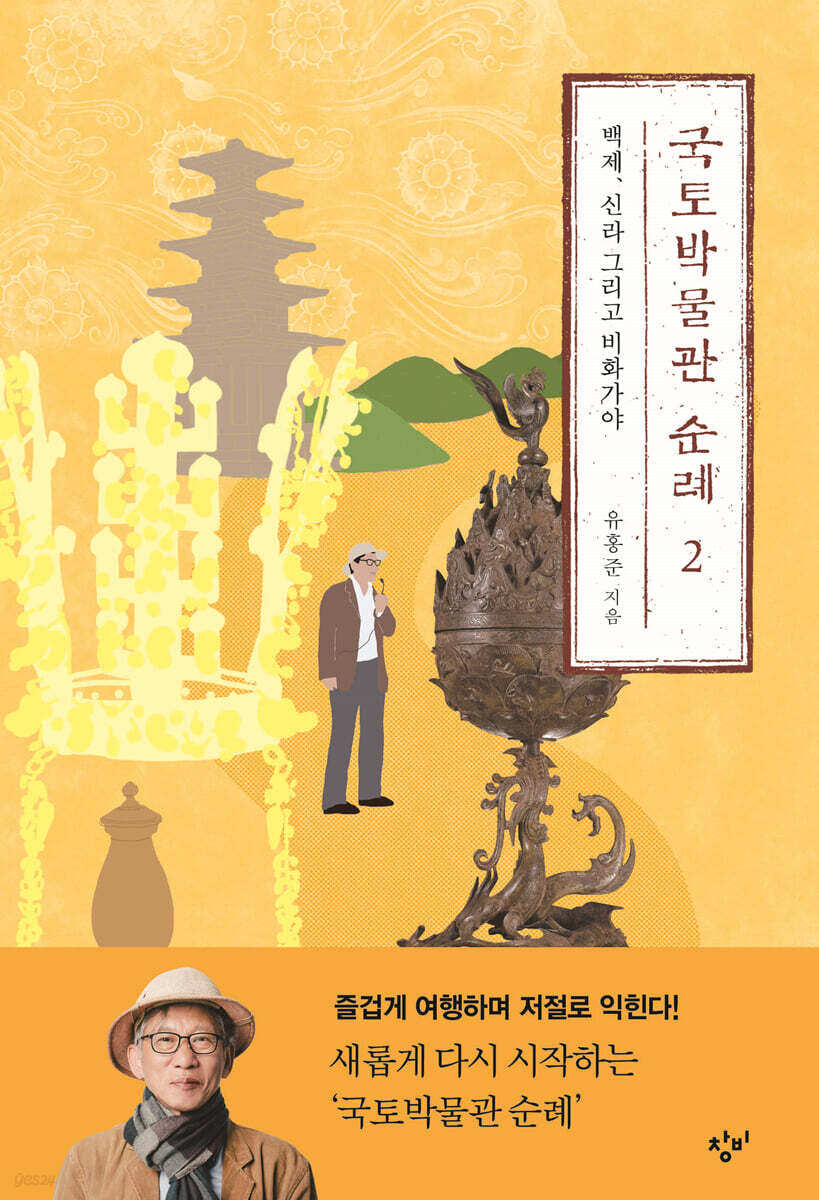
Pilgrimage to the National Museum of Korea 2
 |
Description
Book Introduction
- A word from MD
- [Yoo Hong-jun's new series] "History comes to us!" Yoo Hong-jun's new series.
We look at history in chronological order and introduce regions and cultural heritage representing each era.
The author's detailed explanation of the essence of our history is truly remarkable, and the journey of understanding the value of history leads to a process of experiencing the value of our lives.
- Ahn Hyeon-jae, History PD
Yoo Hong-jun's New Departure, "A Pilgrimage to the National Museum of Korea"
A historical journey to discover representative relics from each era.
Our era's 'cultural evangelist' Yoo Hong-jun has broken ground for a new series.
This is the "National Museum Pilgrimage" series, which examines our history in chronological order and encounters regions and cultural heritage sites representing each era.
Thirty years after the publication of "My Cultural Heritage Tour," which began with the slogan "The entire country is a museum," this is a new and evolved tour that seeks out the essence of our history, which could not be fully captured in the tour, in the National Museum of Korea.
Starting with volumes 1 and 2, which cover prehistoric and ancient history, it will continue to modern and contemporary times.
"Pilgrimage to the National Museum" is filled with insights and charm that can only be felt in the writings of Yoo Hong-jun, who has been touring and introducing the sites of our history for decades, encompassing history, culture, relics, and sites.
Additionally, it provides a detailed introduction to the field trip sites and provides in-depth explanations of the relevant eras, making it a valuable historical textbook for both adult and youth readers.
This book will be an excellent guide for readers who want to restart their studies of Korean history, those who want to embark on a historical tour with family or friends, or those who are involved in schools or clubs preparing field trips.
Let's listen to the new historical story told by the National Museum of Korea.
A historical journey to discover representative relics from each era.
Our era's 'cultural evangelist' Yoo Hong-jun has broken ground for a new series.
This is the "National Museum Pilgrimage" series, which examines our history in chronological order and encounters regions and cultural heritage sites representing each era.
Thirty years after the publication of "My Cultural Heritage Tour," which began with the slogan "The entire country is a museum," this is a new and evolved tour that seeks out the essence of our history, which could not be fully captured in the tour, in the National Museum of Korea.
Starting with volumes 1 and 2, which cover prehistoric and ancient history, it will continue to modern and contemporary times.
"Pilgrimage to the National Museum" is filled with insights and charm that can only be felt in the writings of Yoo Hong-jun, who has been touring and introducing the sites of our history for decades, encompassing history, culture, relics, and sites.
Additionally, it provides a detailed introduction to the field trip sites and provides in-depth explanations of the relevant eras, making it a valuable historical textbook for both adult and youth readers.
This book will be an excellent guide for readers who want to restart their studies of Korean history, those who want to embark on a historical tour with family or friends, or those who are involved in schools or clubs preparing field trips.
Let's listen to the new historical story told by the National Museum of Korea.
- You can preview some of the book's contents.
Preview
index
Introducing the book: On a field trip to Baekje, Silla, and Bihwa Gaya
Baekje 1 Neungsan-ri Baekje Royal Tombs and Royal Tomb
The Flower of Baekje Culture, the Baekje Gilt-Bronze Incense Burner
Baekje 2 Baekma River and Yuwangsan Mountain
"Sanyuhwa" echoes along the Baekma River
Silla 1 gold crown tomb
King Isaji's sword and golden crown
Silla 2 Nodong-dong and Noseo-dong Tumuli Group (Geumnyeongchong and Seobongchong Tomb)
Excavation of the Silla Gold Crown, the Land of Gold
Silla 3 Daereungwon Tomb (Cheonmachong Tomb and Hwangnamdaechong Tomb)
A golden crown on earth, a heavenly horse in heaven
Bigahwagayaya Changnyeong
The Unfinished Kingdom: Gaya's Legacy
Baekje 1 Neungsan-ri Baekje Royal Tombs and Royal Tomb
The Flower of Baekje Culture, the Baekje Gilt-Bronze Incense Burner
Baekje 2 Baekma River and Yuwangsan Mountain
"Sanyuhwa" echoes along the Baekma River
Silla 1 gold crown tomb
King Isaji's sword and golden crown
Silla 2 Nodong-dong and Noseo-dong Tumuli Group (Geumnyeongchong and Seobongchong Tomb)
Excavation of the Silla Gold Crown, the Land of Gold
Silla 3 Daereungwon Tomb (Cheonmachong Tomb and Hwangnamdaechong Tomb)
A golden crown on earth, a heavenly horse in heaven
Bigahwagayaya Changnyeong
The Unfinished Kingdom: Gaya's Legacy
Detailed image

Into the book
When I ask, “Who do you think came from the farthest?” thinking about the sincerity from far away, they confidently raise their hands and say, “Daejeon, Jeonju,” but when I say, “Ulsan, Mokpo,” they lower their hands as if embarrassed.
But one time, he shouted out loud, “Jeju Island!” and everyone was so surprised that they even clapped.
But, as they say, “Life is full of twists and turns,” and when I answered, “It’s Chicago,” I laughed and welcomed it.
--- p.13
The Baekje Gilt-Bronze Incense Burner is the flower of Baekje culture.
It is evidence that shows how much Baekje culture developed.
With the discovery of this incense burner, we can encounter the essence of Baekje's beauty, which possesses the aesthetics of 'frugality but not shabbiness, splendor but not extravagance'.
It was truly a great discovery.
--- p.45~46
The exhibition, which utilized cutting-edge equipment and technology such as video art, light art, kinetic art, and digital art, created a sense of mystery and excitement no less than that of Jeju's 'Bunker of Light' or 'Arte Museum.'
Along with the significance of the Silla tombs, the fact that our exhibition display standards have reached such a high level has also given rise to a great sense of cultural pride.
When I was the head of the Cultural Heritage Administration 15 years ago, I was so moved by the exhibition that I couldn't even dream of seeing it, and I cried in an 'un-adult-like' way.
I blushed and quickly turned around, afraid that others would see me.
--- p.151
The people who really enjoy this tumulus park are foreign tourists.
In their eyes, the tomb park located in the city center appears as an ‘unrealistic space.’
It is even more amazing to know that the tomb is 1,500 years old.
Moreover, at night, the night view unfolds fantastically.
The night view, reminiscent of light art, unfolds against the backdrop of the beautiful ridges of the ancient tombs, and it must have seemed unrealistic to them.
But one time, he shouted out loud, “Jeju Island!” and everyone was so surprised that they even clapped.
But, as they say, “Life is full of twists and turns,” and when I answered, “It’s Chicago,” I laughed and welcomed it.
--- p.13
The Baekje Gilt-Bronze Incense Burner is the flower of Baekje culture.
It is evidence that shows how much Baekje culture developed.
With the discovery of this incense burner, we can encounter the essence of Baekje's beauty, which possesses the aesthetics of 'frugality but not shabbiness, splendor but not extravagance'.
It was truly a great discovery.
--- p.45~46
The exhibition, which utilized cutting-edge equipment and technology such as video art, light art, kinetic art, and digital art, created a sense of mystery and excitement no less than that of Jeju's 'Bunker of Light' or 'Arte Museum.'
Along with the significance of the Silla tombs, the fact that our exhibition display standards have reached such a high level has also given rise to a great sense of cultural pride.
When I was the head of the Cultural Heritage Administration 15 years ago, I was so moved by the exhibition that I couldn't even dream of seeing it, and I cried in an 'un-adult-like' way.
I blushed and quickly turned around, afraid that others would see me.
--- p.151
The people who really enjoy this tumulus park are foreign tourists.
In their eyes, the tomb park located in the city center appears as an ‘unrealistic space.’
It is even more amazing to know that the tomb is 1,500 years old.
Moreover, at night, the night view unfolds fantastically.
The night view, reminiscent of light art, unfolds against the backdrop of the beautiful ridges of the ancient tombs, and it must have seemed unrealistic to them.
--- p.197~198
Publisher's Review
The elegance of the Buyeo Royal Tombs and the artistry of the gilt-bronze incense burner
The golden age of Baekje culture was in Buyeo.
Volume 2, "Baekje, Silla, and Bihwa Gaya," follows the history of Goguryeo in Volume 1 and covers the history of Baekje and Silla before unification, as well as the story of Bihwa Gaya, which was part of Gaya. The representative site of Baekje's research is Buyeo, its last capital.
It follows the actual program, 'Buyeo Field Trip with Yoo Hong-jun', and depicts the golden age and final scenes of Baekje culture.
The recently renovated Buyeo Royal Tombs are also designated as a UNESCO World Heritage Site, demonstrating the prosperity of Baekje culture.
The kings of Baekje who made this place their capital led Baekje to become a much stronger ancient nation, but they were unable to withstand the attacks of the Silla-Tang allied forces and fell.
However, the author argues that Baekje during this period should not be remembered as a nation that simply weakened militarily and then disappeared, but as a proud cultural powerhouse.
The Baekje Gilt-bronze Incense Burner, a rare masterpiece, proves this.
The Baekma River in Buyeo was also the route by which King Uija, the last king of Baekje, was exiled to the Tang Dynasty.
The 'Buyeo Exploration with Yoo Hong-jun' team follows this route and retrace the history of Baekje and Buyeo after Baekje, including Nakhwaam, Daejaegak, Busan Seowon, and Yuwangsan.
The legend of Mt. Yuwang, where the people mourned as they bid farewell to King Uija, remained in folklore, with the Mt. Yuwang memorial ceremony and the Banbogi game, and the history of the disappeared nation of Baekje left behind in the book “Sanyuhwaga.”
This image of the author and the traveler reminiscing about the past together feels right.
Experience the splendid history of Silla's gold crowns.
Finding the story hidden in the old tomb
The start of the Gaya tour is Changnyeong Bighwagaya
The most important relic in the history of Silla before unification, or 'Old Silla', is undoubtedly the ancient tomb complex in Gyeongju.
This group of ancient tombs in the Daereungwon area is a relic from the Silla Maripgan period (356-500), and is where splendid burial objects, including gold crowns, were excavated.
The relics that come to mind when we think of Silla were unearthed here.
In this “Pilgrimage to the National Museum,” you will encounter these key relics that were not covered in previous travelogues.
The century-long history of excavations of Gyeongju tombs, centered around the discovery of gold crowns, and the dazzling artifacts that captivate us, captivate us. The history of excavations of Silla tombs begins around the time of the Japanese colonial period.
Imperial Japan was very interested in ancient history, especially in finding evidence to support the theory that Japan ruled the southern part of the Korean Peninsula in ancient times.
The excavation of the Silla tombs in Gyeongju was also carried out in that context.
As interest in Silla tombs spread beyond Gyeongju, in September 1921, a gold crown was accidentally excavated from the Geumgwanchong Tomb in the Noseo-dong Tomb Complex in the city, making Silla's gold culture known.
However, at the time, the excavation was carried out incorrectly by non-experts, and later there were many twists and turns, such as the theft of artifacts.
However, the excavation of the Geumgwanchong Tomb was undoubtedly a valuable discovery that later led to the establishment of the Gyeongju Museum.
As a result of the professional excavation that followed the discovery of gold crowns in Geumgwanchong, gold crowns were unearthed again in the Bonghwang-ro area, including at Geumnyeongchong and Seobongchong.
In addition to the gold crown, there were also great achievements such as the discovery of various relics that allowed us to understand Silla's gold culture, and the more systematic understanding of the structure of Silla's stone mound tombs.
Even after liberation, the movement to excavate Silla tombs with our own hands continued.
In particular, a plan was made and promoted to excavate the large tombs in present-day Daereungwon, which are presumed to be royal tombs, centered around the National Museum.
The government's support for developing Gyeongju into a tourist city also contributed.
The tombs excavated in this way are Cheonmachong and Hwangnamdaechong.
In both of these tombs, gold crowns were excavated, and numerous other burial artifacts were found, including a celestial horse-shaped horse-shaped horse and a gilt-bronze crown.
This laid the foundation for studying the characteristics and origins of Silla gold crowns.
Recently, the Geumgwanchong, Geumnyeongchong, and Seobongchong tombs have been rediscovered, leading to new discoveries and research.
The history of Gaya begins with Bihwa Gaya, which was not included in the so-called 'Six Gayas'.
Along with the excavation results of Gaya tombs, we introduce the rich cultural heritage of the Changnyeong region where Bihwa Gaya was located.
Artifacts excavated from ancient tombs are introduced with photographs, proving that Gaya's culture, once considered culturally and politically subordinate to Silla, was unique and of a high standard.
There are many other cultural heritages in Changnyeong, including Upo Swamp, Bibong-ri shell mound, King Jinheung's monument to King Cheokgyeong, Suljeong-ri three-story stone pagoda, and Gwanryongsa Temple.
The main history of Gaya, including Daegaya and Geumgwan Gaya, will be described in detail in the next volume.
The doors of the National Museum of Korea open.
History comes to me!
Yoo Hong-jun's historical pilgrimage: The more you know, the more you see
Author Yoo Hong-jun said that the reason he conceived of “Pilgrimage to the National Museum of Korea” was “to write a travelogue that naturally studies history while having fun traveling.”
The 30 years of "My Cultural Heritage Tour" have not been without such tours, but the result of thinking about a more systematic and accessible method is this "Pilgrimage to National Museums."
Thirty years ago, when author Yoo Hong-jun declared, "Our entire country is a museum," many readers happily agreed with this statement, but they also thought it was partly an expression of national pride.
However, the author says that it took 30 years to prove, without any embellishment or distortion, his belief that our country is truly a museum.
Now, to clearly inform all citizens of the value of the National Museum, Professor Yoo Hong-jun begins the grand journey of "Pilgrimage to the National Museum."
Because the journey of learning the value of our history is the process of feeling the value of our lives.
The golden age of Baekje culture was in Buyeo.
Volume 2, "Baekje, Silla, and Bihwa Gaya," follows the history of Goguryeo in Volume 1 and covers the history of Baekje and Silla before unification, as well as the story of Bihwa Gaya, which was part of Gaya. The representative site of Baekje's research is Buyeo, its last capital.
It follows the actual program, 'Buyeo Field Trip with Yoo Hong-jun', and depicts the golden age and final scenes of Baekje culture.
The recently renovated Buyeo Royal Tombs are also designated as a UNESCO World Heritage Site, demonstrating the prosperity of Baekje culture.
The kings of Baekje who made this place their capital led Baekje to become a much stronger ancient nation, but they were unable to withstand the attacks of the Silla-Tang allied forces and fell.
However, the author argues that Baekje during this period should not be remembered as a nation that simply weakened militarily and then disappeared, but as a proud cultural powerhouse.
The Baekje Gilt-bronze Incense Burner, a rare masterpiece, proves this.
The Baekma River in Buyeo was also the route by which King Uija, the last king of Baekje, was exiled to the Tang Dynasty.
The 'Buyeo Exploration with Yoo Hong-jun' team follows this route and retrace the history of Baekje and Buyeo after Baekje, including Nakhwaam, Daejaegak, Busan Seowon, and Yuwangsan.
The legend of Mt. Yuwang, where the people mourned as they bid farewell to King Uija, remained in folklore, with the Mt. Yuwang memorial ceremony and the Banbogi game, and the history of the disappeared nation of Baekje left behind in the book “Sanyuhwaga.”
This image of the author and the traveler reminiscing about the past together feels right.
Experience the splendid history of Silla's gold crowns.
Finding the story hidden in the old tomb
The start of the Gaya tour is Changnyeong Bighwagaya
The most important relic in the history of Silla before unification, or 'Old Silla', is undoubtedly the ancient tomb complex in Gyeongju.
This group of ancient tombs in the Daereungwon area is a relic from the Silla Maripgan period (356-500), and is where splendid burial objects, including gold crowns, were excavated.
The relics that come to mind when we think of Silla were unearthed here.
In this “Pilgrimage to the National Museum,” you will encounter these key relics that were not covered in previous travelogues.
The century-long history of excavations of Gyeongju tombs, centered around the discovery of gold crowns, and the dazzling artifacts that captivate us, captivate us. The history of excavations of Silla tombs begins around the time of the Japanese colonial period.
Imperial Japan was very interested in ancient history, especially in finding evidence to support the theory that Japan ruled the southern part of the Korean Peninsula in ancient times.
The excavation of the Silla tombs in Gyeongju was also carried out in that context.
As interest in Silla tombs spread beyond Gyeongju, in September 1921, a gold crown was accidentally excavated from the Geumgwanchong Tomb in the Noseo-dong Tomb Complex in the city, making Silla's gold culture known.
However, at the time, the excavation was carried out incorrectly by non-experts, and later there were many twists and turns, such as the theft of artifacts.
However, the excavation of the Geumgwanchong Tomb was undoubtedly a valuable discovery that later led to the establishment of the Gyeongju Museum.
As a result of the professional excavation that followed the discovery of gold crowns in Geumgwanchong, gold crowns were unearthed again in the Bonghwang-ro area, including at Geumnyeongchong and Seobongchong.
In addition to the gold crown, there were also great achievements such as the discovery of various relics that allowed us to understand Silla's gold culture, and the more systematic understanding of the structure of Silla's stone mound tombs.
Even after liberation, the movement to excavate Silla tombs with our own hands continued.
In particular, a plan was made and promoted to excavate the large tombs in present-day Daereungwon, which are presumed to be royal tombs, centered around the National Museum.
The government's support for developing Gyeongju into a tourist city also contributed.
The tombs excavated in this way are Cheonmachong and Hwangnamdaechong.
In both of these tombs, gold crowns were excavated, and numerous other burial artifacts were found, including a celestial horse-shaped horse-shaped horse and a gilt-bronze crown.
This laid the foundation for studying the characteristics and origins of Silla gold crowns.
Recently, the Geumgwanchong, Geumnyeongchong, and Seobongchong tombs have been rediscovered, leading to new discoveries and research.
The history of Gaya begins with Bihwa Gaya, which was not included in the so-called 'Six Gayas'.
Along with the excavation results of Gaya tombs, we introduce the rich cultural heritage of the Changnyeong region where Bihwa Gaya was located.
Artifacts excavated from ancient tombs are introduced with photographs, proving that Gaya's culture, once considered culturally and politically subordinate to Silla, was unique and of a high standard.
There are many other cultural heritages in Changnyeong, including Upo Swamp, Bibong-ri shell mound, King Jinheung's monument to King Cheokgyeong, Suljeong-ri three-story stone pagoda, and Gwanryongsa Temple.
The main history of Gaya, including Daegaya and Geumgwan Gaya, will be described in detail in the next volume.
The doors of the National Museum of Korea open.
History comes to me!
Yoo Hong-jun's historical pilgrimage: The more you know, the more you see
Author Yoo Hong-jun said that the reason he conceived of “Pilgrimage to the National Museum of Korea” was “to write a travelogue that naturally studies history while having fun traveling.”
The 30 years of "My Cultural Heritage Tour" have not been without such tours, but the result of thinking about a more systematic and accessible method is this "Pilgrimage to National Museums."
Thirty years ago, when author Yoo Hong-jun declared, "Our entire country is a museum," many readers happily agreed with this statement, but they also thought it was partly an expression of national pride.
However, the author says that it took 30 years to prove, without any embellishment or distortion, his belief that our country is truly a museum.
Now, to clearly inform all citizens of the value of the National Museum, Professor Yoo Hong-jun begins the grand journey of "Pilgrimage to the National Museum."
Because the journey of learning the value of our history is the process of feeling the value of our lives.
GOODS SPECIFICS
- Date of issue: November 20, 2023
- Page count, weight, size: 316 pages | 482g | 142*208*19mm
- ISBN13: 9788936480080
- ISBN10: 8936480081
You may also like
카테고리
korean


korean

![GQ KOREA Mark (Monthly): December [2025]](http://librairie.coreenne.fr/cdn/shop/files/8ef265dbbfbf186523ed75ba7319009d.jpg?v=1765340328&width=3840)


