

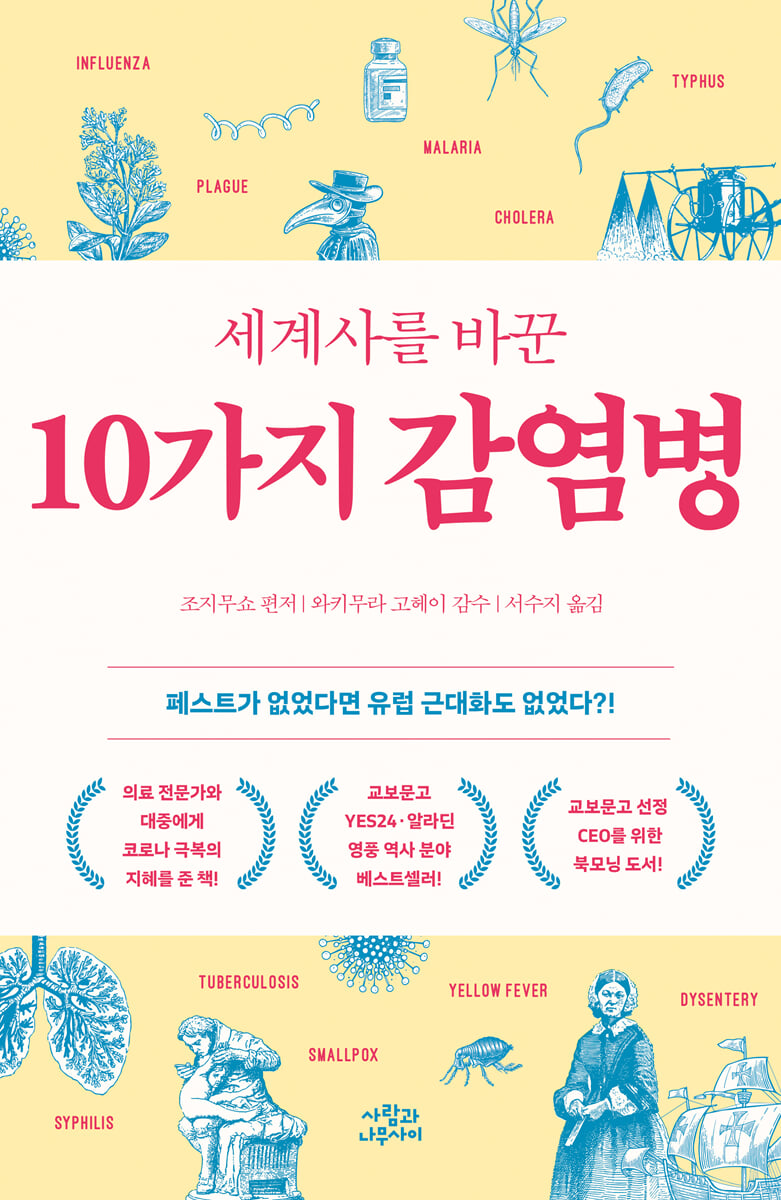
10 Infectious Diseases That Changed World History
 |
Description
Book Introduction
If it weren't for the 14th century plague pandemic
There was no European modernization, no European world domination?!
The plague pandemic served as a catalyst for European modernization, to the point that the saying, “European modernization began with the plague,” is often repeated.
Indeed, if it had not been for the plague pandemic, the "modernization" that has been a key driving force behind Europe's global dominance, immense wealth, and power over the past several hundred years would likely not have occurred.
The 14th-century plague pandemic, which plunged Europe and the world into a state of crisis, paradoxically served as an incubator for European modernization.
More specifically, if the plague pandemic that swept through Europe in the 14th century had not occurred, the knowledge revolution brought about by Gutenberg's invention of metal type would likely not have occurred.
Also, the Reformation of Martin Luther, which brought about a tremendous tectonic shift in the religious history of Europe and the world, the Renaissance, which gave birth to genius artists such as Leonardo da Vinci, Michelangelo, and Raphael and brought about a flourishing of culture and art, and the Industrial Revolution, which brought enormous economic wealth to European countries such as England, may not have happened.
How did the plague, an infectious disease that plunged humanity into despair, suffering, and fear, become the incubator of European modernization and the driving force behind Europe's global dominance? In short, it paradoxically brought about fundamental changes and innovations that upended European society, even as it claimed the lives of countless people—between a quarter and a third of the entire population.
This is because the wages of the common people responsible for production, such as farmers, artisans, and merchants, rose and their status improved, a full-scale 'rebellion of the Euls' unfolded, and great innovations were made in all fields, including politics, military, science and technology, and culture and arts, that would overwhelm other continents for the next several hundred years.
The COVID-19 pandemic currently sweeping the globe is expected to revolutionize the world, much like the 14th-century plague pandemic that served as an incubator for European modernization and the cholera epidemic that led to environmental and sanitary reforms in 19th-century European cities.
And indeed, dynamic change and innovation are taking place in many countries and areas today.
If you want to sharply understand how the desperate crisis of an infectious disease pandemic is accelerating global change and innovation at an astonishing pace, opening up a new world, and how the COVID-19 pandemic will lead the world in the future and dramatically change it, and if you want to respond wisely, study history. Readers who open and read “10 Infectious Diseases That Changed World History” will gain remarkable insight and wisdom into how plague, influenza, malaria, smallpox, and yellow fever, which took countless lives and brought suffering and despair to humanity, worked exquisitely at each of history’s great turning points and important inflection points to change the course of world history.
There was no European modernization, no European world domination?!
The plague pandemic served as a catalyst for European modernization, to the point that the saying, “European modernization began with the plague,” is often repeated.
Indeed, if it had not been for the plague pandemic, the "modernization" that has been a key driving force behind Europe's global dominance, immense wealth, and power over the past several hundred years would likely not have occurred.
The 14th-century plague pandemic, which plunged Europe and the world into a state of crisis, paradoxically served as an incubator for European modernization.
More specifically, if the plague pandemic that swept through Europe in the 14th century had not occurred, the knowledge revolution brought about by Gutenberg's invention of metal type would likely not have occurred.
Also, the Reformation of Martin Luther, which brought about a tremendous tectonic shift in the religious history of Europe and the world, the Renaissance, which gave birth to genius artists such as Leonardo da Vinci, Michelangelo, and Raphael and brought about a flourishing of culture and art, and the Industrial Revolution, which brought enormous economic wealth to European countries such as England, may not have happened.
How did the plague, an infectious disease that plunged humanity into despair, suffering, and fear, become the incubator of European modernization and the driving force behind Europe's global dominance? In short, it paradoxically brought about fundamental changes and innovations that upended European society, even as it claimed the lives of countless people—between a quarter and a third of the entire population.
This is because the wages of the common people responsible for production, such as farmers, artisans, and merchants, rose and their status improved, a full-scale 'rebellion of the Euls' unfolded, and great innovations were made in all fields, including politics, military, science and technology, and culture and arts, that would overwhelm other continents for the next several hundred years.
The COVID-19 pandemic currently sweeping the globe is expected to revolutionize the world, much like the 14th-century plague pandemic that served as an incubator for European modernization and the cholera epidemic that led to environmental and sanitary reforms in 19th-century European cities.
And indeed, dynamic change and innovation are taking place in many countries and areas today.
If you want to sharply understand how the desperate crisis of an infectious disease pandemic is accelerating global change and innovation at an astonishing pace, opening up a new world, and how the COVID-19 pandemic will lead the world in the future and dramatically change it, and if you want to respond wisely, study history. Readers who open and read “10 Infectious Diseases That Changed World History” will gain remarkable insight and wisdom into how plague, influenza, malaria, smallpox, and yellow fever, which took countless lives and brought suffering and despair to humanity, worked exquisitely at each of history’s great turning points and important inflection points to change the course of world history.
- You can preview some of the book's contents.
Preview
index
Introduction_ If there had been no plague pandemic in the 14th century, there would have been no intellectual revolution due to Gutenberg's invention of metal type, no religious reformation, no Renaissance,
There was no industrial revolution?!
01 The Incubator of European Modernization, Pest
ㆍ Gutenberg was the biggest beneficiary of the 14th century plague?
ㆍIf humans had not started farming, there would have been no plague?
Was the "boil" in the Old Testament's "1 Samuel" really the plague?
The 6th-century plague pandemic killed 33-40% of the world's 200 million people and halted population growth for the next 200 years.
ㆍ Black rats, brought to Europe in the luggage of soldiers returning from the Crusades, became the fuse for the plague outbreak.
The "globalization" sparked by the Mongol Empire became a decisive trigger for the 14th-century plague pandemic.
Why medieval European cities provided the optimal conditions for the outbreak and spread of the plague.
ㆍ Why did the persecution of Jews become so severe throughout Europe during the plague era?
Why the plague pandemic became a crucial stepping stone for Europe's transition from the Middle Ages to the modern era.
The plague pandemic transformed peasants, who were practically slaves, into free agricultural workers and gave birth to a new class of independent farmers who owned farmland.
The agricultural revolution in 18th-century Europe that laid the foundation for the development of capitalism
ㆍ After the plague pandemic, public health officials gained more power than the church?
ㆍ Did the plague trigger the emergence of genius artists such as Leonardo da Vinci, Michelangelo, and Raphael and accelerate the Renaissance?
ㆍ The medieval witch trials were a major cause of the plague pandemic, causing a sharp decline in the cat population and creating an infestation of rats?
ㆍ Why have plague pandemics rarely occurred in Europe since the mid-18th century?
ㆍ Why do people perceive the plague as a 'synonym for infectious disease'?
02 Influenza, which prevented the prolongation of World War I and brought peace
ㆍ The 'unprecedented epidemic' recorded by Hippocrates was influenza?
ㆍ Who was the first person to discover that the cause of influenza was a ‘virus’?
ㆍ The Spanish flu, a terrifying disease that infected 600 to 900 million of the world's 1.8 billion people and killed 40 to 50 million of them.
ㆍ The reason why the disease was named 'Spain' instead of 'USA', 'France', and 'China', which are suspected to be the first countries to experience influenza, is because there was no media control?
Allied barracks in France that became an incubator and base camp for influenza
ㆍ Did the Spanish flu actually stop the war and bring peace?
The mandatory mask-wearing ordinance instantly halved cigarette and tobacco sales.
Some doctors and fanatic anti-mask activists form the "Anti-Mask Alliance."
ㆍ Why were there so many more Spanish flu cases in Asia and Africa, and especially in India, than in Europe or the United States?
ㆍIf US President Wilson had not contracted the Spanish flu, World War II might not have occurred?
ㆍ The real reason why the Spanish flu, which killed over 50 million people, surprisingly had little impact on the global economy?
| Infectious diseases you should keep an eye on 1 |
The threat of AIDS, a disease that destroys the immune system and became prevalent in the 1980s
03 Cholera, which led to reforms in the urban environment and hygiene of 19th-century European cities
ㆍ The Ganges River, considered the source of life and a sacred river for Indians, is actually a collection of germs teeming with all sorts of pathogens.
ㆍ The person who coined the term ‘cholera’ was the ancient Greek physician Hippocrates?
ㆍ The secret to the cholera bacteria, which had tormented humans so mercilessly, conquering the world at such an astonishing rate was, ironically, thanks to the active help of humans?
ㆍ The cholera bacteria that even the German philosopher Hegel, Champollion who deciphered the Rosetta Stone, and Clausewitz, author of the immortal work On War, could not avoid
Why O'Shaughnessy's 'intravenous saline injection method' was not accepted by the mainstream medical community of the time, despite its clear effectiveness.
John Snow, known as the 'father of epidemiology' for discovering the cause of cholera on Broad Street
Robert Koch, a German scholar who discovered the identity of the cholera bacillus through thorough research and experiments throughout India.
ㆍ Why was the UK the only country to strongly oppose 'strengthened maritime quarantine measures' at the International Sanitary Conference?
The surprising reason why so many infections and deaths occurred in Japan's capital, Edo, during the second cholera pandemic.
Why did the Meiji government stake its life on cholera control?
The incredible power of cholera that changed the boundaries of each region.
Why the world cannot let its guard down against cholera even in the 21st century
Malaria, which changed the course of World War IV twice
ㆍ Is the history of imperialist expansion a history of struggles against infectious diseases like malaria?
Malaria parasites that destroy human red blood cells and prevent them from transporting oxygen
ㆍ Did the ancient Egyptian pharaoh Tutankhamun and the great Macedonian monarch Alexander the Great also die from malaria?
ㆍ The reason why representative Italian cities such as Rome and Naples were built on hills was to avoid malaria?
Quinine, a cinchona bark drug that saved the lives of King Charles II of England and King Louis XIV of France
Malaria plagued the British Empire more persistently than its most powerful rival, France.
ㆍ Fierce battle between the US and Japanese armies over quinine during the Pacific War
ㆍ Why did the United States, which had switched from quinine to chloroquine, switch to quinine again?
| 2 infectious diseases you should keep an eye on |
Measles still infects over 400,000 people annually! It's still a disease that shouldn't be underestimated.
05 The Difference That Changed the Map of the Hundred Years' War
ㆍ A highly contagious bacterial dysentery that can be caused by a very small number of bacteria, 10 to 100
ㆍ 3,600 years ago, the ancient Egyptians already knew the nature of dysentery and had a cure?
"The Crusaders succumbed not to the Muslim army, but to germs like dysentery."
Dysentery, a disease that greatly influenced the map of the Hundred Years' War
ㆍ Infectious diseases, dysentery and typhus, dealt another fatal blow to the Spanish Armada, which was defeated by the English Navy at the Battle of Calais.
ㆍ 'Hunger', an infectious disease that turned Ireland into hell along with the great famine caused by potato blight
ㆍ It is said that the tea culture that was fully introduced to England in the mid-19th century significantly reduced the incidence of dysentery?
ㆍ Was it because of the dysentery that spread within Prussia that the French Revolutionary Army won the Battle of Valmy against the vastly superior Prussian army?
ㆍTrenches of European armies during World War I, which became a production base for infectious diseases such as influenza, dysentery, typhus, and cholera.
ㆍWhy did the issue of expanding sewage treatment facilities in large cities during the Meiji era emerge as an urgent and critical issue?
ㆍ A European-originated dysentery that swept the world, causing numerous infections and deaths
The dark aura of imperialism and aggression lingering in the Big Hit product, the anti-diarrheal drug "Jeongro-hwan."
ㆍ The secret to the rapid decline in dysentery patients in Japan since 1965 was large-scale sewer maintenance?
06 Tuberculosis, the "White Plague" Spread by the Industrial Revolution
Why tuberculosis came to be associated with the image of a "terrible yet romantic disease"
Early symptoms of tuberculosis similar to cold symptoms
ㆍ In the Romance of the Three Kingdoms, Cao Cao's cause of death was tuberculosis?
The 'White Plague' Spread by the Industrial Revolution
Byron, the British poet who openly said, “I want to die of tuberculosis.”
ㆍ 19th-century European Romanticism that influenced changes in perceptions of tuberculosis
AIDS, along with malaria, has become one of the "three major infectious diseases."
07 Smallpox, the spearhead of Spain's conquest of the American continents
ㆍ Sweeping across the American continents with white men's guns and swords, hunting down indigenous people
Smallpox, a disease transmitted to humans through mutation of an infectious disease in livestock
ㆍ It was not Sparta or Thebes, but smallpox that brought down Pericles, the hero of ancient Athens?
The threat of smallpox, which even the great writer Natsume Soseki could not avoid
Smallpox, the infectious disease that struck down the Aztec and Inca Empires in South America
The Hidden Reason Why Native Americans in North and South America Were Helpless Against Smallpox
Spain waged war against all of Europe with silver plundered from Central and South America.
ㆍ In 1700, the Qing Dynasty's GDP was 22% of the world's GDP...
What about Britain and France then?
Jeffrey Amherst, a leader in 'viral bioweapons'
Britain's greed for colonies also turned Oceania and the Pacific islands into a "smallpox hell."
Edward Jenner, a British physician who developed the 'smallpox method' to prevent smallpox infection by inoculating with cowpox
Smallpox, the first infectious disease in human history to be virtually completely eradicated through effective international cooperation
| 3 infectious diseases you should keep an eye on |
The terrifying symptoms and mortality rate of rabies, transmitted by various animals such as dogs and raccoons.
08 Yellow fever persistently hindered the Panama Canal project, but eventually brought it to light.
Hideyo Noguchi, a figure who left a distinct mark on the history of yellow fever research
The 'yellow flag' has become a symbol of the infected area.
ㆍ In 1793, yellow fever devastated Philadelphia, the capital of the United States, and paralyzed government functions.
ㆍ In 19th century America, why did having a yellow fever infection actually become a condition for preferential treatment in employment, housing, and marriage?
The conflict between the United States and Spain over interests in Cuba
Walter Reed, the US Army surgeon who discovered that mosquitoes were the vector of yellow fever.
ㆍ If we hadn't won the war against mosquitoes, the Panama Canal project wouldn't have been successful?!
Rockefeller contributed greatly not only to the steel industry but also to the prevention and eradication of tropical infectious diseases such as malaria and yellow fever.
Why yellow fever still rages in some regions, including the African continent
09 Typhus, which led Napoleon's Russian expedition to defeat and downfall
Mary Mallon, the typhus super-spreader who shook New York in the early 19th century
William Jenner, a British physician who discovered that typhoid and typhus were completely different diseases.
ㆍ In 430 BC, the first infectious disease recorded in history, the 'Athenian Plague' that broke out in ancient Greece, was typhus?
"Whether this will win, or socialism, that is the question."
Typhoid fever completely changed Paris's water and sewage system.
Why the global typhus epidemic disappeared after World War II
10 Syphilis: The 'Fake Panacea' That Made the Fuggers One of Europe's Richest
ㆍ Japan during the Edo period, when syphilis was deeply ingrained in everyday life.
A disease that causes various terrifying symptoms and eventually leads to death
Is the "American origin theory" of syphilis correct? Or is the "ancient origin theory" correct?
The Fugger family amassed enormous wealth by selling a fake anti-syphilis drug to all of Europe.
ㆍ The strange Muromachi period in Japan, where contracting syphilis was considered a badge of honor, as if it were a "man who had played around a bit."
ㆍ Even having 'scars' from syphilis was a condition for being handsome or beautiful?
The Japanese government, unable to withstand the pressure from foreigners, had no choice but to begin quarantine.
ㆍ Salvarsan, a true savior from the terrible fear of syphilis, a syphilis treatment drug
11 How Humanity Survived, Transformed, and Prospered in the Face of Infectious Diseases
ㆍ Humanity fighting against infectious diseases that are constantly evolving and expanding their influence.
ㆍWhat is the difference between bacteria and viruses?
ㆍ Various ways in which infectious diseases spread and expand their influence
Human food production and economic activities that gave wings to infectious diseases
ㆍ Until the first half of the 19th century, why did the British set fires outdoors or fire cannons into the air when infectious diseases broke out?
ㆍ Bacteriology, which began with silkworm research in the 19th century
Semmelweis and Nightingale, two figures who contributed to human health by proving the importance of disinfection.
British bacteriologist Alexander Fleming developed penicillin, marking a turning point in the history of infectious disease treatment.
Why we need to revisit Lee Van Valen's "Red Queen Hypothesis" in the history of humanity's war against infectious diseases.
There was no industrial revolution?!
01 The Incubator of European Modernization, Pest
ㆍ Gutenberg was the biggest beneficiary of the 14th century plague?
ㆍIf humans had not started farming, there would have been no plague?
Was the "boil" in the Old Testament's "1 Samuel" really the plague?
The 6th-century plague pandemic killed 33-40% of the world's 200 million people and halted population growth for the next 200 years.
ㆍ Black rats, brought to Europe in the luggage of soldiers returning from the Crusades, became the fuse for the plague outbreak.
The "globalization" sparked by the Mongol Empire became a decisive trigger for the 14th-century plague pandemic.
Why medieval European cities provided the optimal conditions for the outbreak and spread of the plague.
ㆍ Why did the persecution of Jews become so severe throughout Europe during the plague era?
Why the plague pandemic became a crucial stepping stone for Europe's transition from the Middle Ages to the modern era.
The plague pandemic transformed peasants, who were practically slaves, into free agricultural workers and gave birth to a new class of independent farmers who owned farmland.
The agricultural revolution in 18th-century Europe that laid the foundation for the development of capitalism
ㆍ After the plague pandemic, public health officials gained more power than the church?
ㆍ Did the plague trigger the emergence of genius artists such as Leonardo da Vinci, Michelangelo, and Raphael and accelerate the Renaissance?
ㆍ The medieval witch trials were a major cause of the plague pandemic, causing a sharp decline in the cat population and creating an infestation of rats?
ㆍ Why have plague pandemics rarely occurred in Europe since the mid-18th century?
ㆍ Why do people perceive the plague as a 'synonym for infectious disease'?
02 Influenza, which prevented the prolongation of World War I and brought peace
ㆍ The 'unprecedented epidemic' recorded by Hippocrates was influenza?
ㆍ Who was the first person to discover that the cause of influenza was a ‘virus’?
ㆍ The Spanish flu, a terrifying disease that infected 600 to 900 million of the world's 1.8 billion people and killed 40 to 50 million of them.
ㆍ The reason why the disease was named 'Spain' instead of 'USA', 'France', and 'China', which are suspected to be the first countries to experience influenza, is because there was no media control?
Allied barracks in France that became an incubator and base camp for influenza
ㆍ Did the Spanish flu actually stop the war and bring peace?
The mandatory mask-wearing ordinance instantly halved cigarette and tobacco sales.
Some doctors and fanatic anti-mask activists form the "Anti-Mask Alliance."
ㆍ Why were there so many more Spanish flu cases in Asia and Africa, and especially in India, than in Europe or the United States?
ㆍIf US President Wilson had not contracted the Spanish flu, World War II might not have occurred?
ㆍ The real reason why the Spanish flu, which killed over 50 million people, surprisingly had little impact on the global economy?
| Infectious diseases you should keep an eye on 1 |
The threat of AIDS, a disease that destroys the immune system and became prevalent in the 1980s
03 Cholera, which led to reforms in the urban environment and hygiene of 19th-century European cities
ㆍ The Ganges River, considered the source of life and a sacred river for Indians, is actually a collection of germs teeming with all sorts of pathogens.
ㆍ The person who coined the term ‘cholera’ was the ancient Greek physician Hippocrates?
ㆍ The secret to the cholera bacteria, which had tormented humans so mercilessly, conquering the world at such an astonishing rate was, ironically, thanks to the active help of humans?
ㆍ The cholera bacteria that even the German philosopher Hegel, Champollion who deciphered the Rosetta Stone, and Clausewitz, author of the immortal work On War, could not avoid
Why O'Shaughnessy's 'intravenous saline injection method' was not accepted by the mainstream medical community of the time, despite its clear effectiveness.
John Snow, known as the 'father of epidemiology' for discovering the cause of cholera on Broad Street
Robert Koch, a German scholar who discovered the identity of the cholera bacillus through thorough research and experiments throughout India.
ㆍ Why was the UK the only country to strongly oppose 'strengthened maritime quarantine measures' at the International Sanitary Conference?
The surprising reason why so many infections and deaths occurred in Japan's capital, Edo, during the second cholera pandemic.
Why did the Meiji government stake its life on cholera control?
The incredible power of cholera that changed the boundaries of each region.
Why the world cannot let its guard down against cholera even in the 21st century
Malaria, which changed the course of World War IV twice
ㆍ Is the history of imperialist expansion a history of struggles against infectious diseases like malaria?
Malaria parasites that destroy human red blood cells and prevent them from transporting oxygen
ㆍ Did the ancient Egyptian pharaoh Tutankhamun and the great Macedonian monarch Alexander the Great also die from malaria?
ㆍ The reason why representative Italian cities such as Rome and Naples were built on hills was to avoid malaria?
Quinine, a cinchona bark drug that saved the lives of King Charles II of England and King Louis XIV of France
Malaria plagued the British Empire more persistently than its most powerful rival, France.
ㆍ Fierce battle between the US and Japanese armies over quinine during the Pacific War
ㆍ Why did the United States, which had switched from quinine to chloroquine, switch to quinine again?
| 2 infectious diseases you should keep an eye on |
Measles still infects over 400,000 people annually! It's still a disease that shouldn't be underestimated.
05 The Difference That Changed the Map of the Hundred Years' War
ㆍ A highly contagious bacterial dysentery that can be caused by a very small number of bacteria, 10 to 100
ㆍ 3,600 years ago, the ancient Egyptians already knew the nature of dysentery and had a cure?
"The Crusaders succumbed not to the Muslim army, but to germs like dysentery."
Dysentery, a disease that greatly influenced the map of the Hundred Years' War
ㆍ Infectious diseases, dysentery and typhus, dealt another fatal blow to the Spanish Armada, which was defeated by the English Navy at the Battle of Calais.
ㆍ 'Hunger', an infectious disease that turned Ireland into hell along with the great famine caused by potato blight
ㆍ It is said that the tea culture that was fully introduced to England in the mid-19th century significantly reduced the incidence of dysentery?
ㆍ Was it because of the dysentery that spread within Prussia that the French Revolutionary Army won the Battle of Valmy against the vastly superior Prussian army?
ㆍTrenches of European armies during World War I, which became a production base for infectious diseases such as influenza, dysentery, typhus, and cholera.
ㆍWhy did the issue of expanding sewage treatment facilities in large cities during the Meiji era emerge as an urgent and critical issue?
ㆍ A European-originated dysentery that swept the world, causing numerous infections and deaths
The dark aura of imperialism and aggression lingering in the Big Hit product, the anti-diarrheal drug "Jeongro-hwan."
ㆍ The secret to the rapid decline in dysentery patients in Japan since 1965 was large-scale sewer maintenance?
06 Tuberculosis, the "White Plague" Spread by the Industrial Revolution
Why tuberculosis came to be associated with the image of a "terrible yet romantic disease"
Early symptoms of tuberculosis similar to cold symptoms
ㆍ In the Romance of the Three Kingdoms, Cao Cao's cause of death was tuberculosis?
The 'White Plague' Spread by the Industrial Revolution
Byron, the British poet who openly said, “I want to die of tuberculosis.”
ㆍ 19th-century European Romanticism that influenced changes in perceptions of tuberculosis
AIDS, along with malaria, has become one of the "three major infectious diseases."
07 Smallpox, the spearhead of Spain's conquest of the American continents
ㆍ Sweeping across the American continents with white men's guns and swords, hunting down indigenous people
Smallpox, a disease transmitted to humans through mutation of an infectious disease in livestock
ㆍ It was not Sparta or Thebes, but smallpox that brought down Pericles, the hero of ancient Athens?
The threat of smallpox, which even the great writer Natsume Soseki could not avoid
Smallpox, the infectious disease that struck down the Aztec and Inca Empires in South America
The Hidden Reason Why Native Americans in North and South America Were Helpless Against Smallpox
Spain waged war against all of Europe with silver plundered from Central and South America.
ㆍ In 1700, the Qing Dynasty's GDP was 22% of the world's GDP...
What about Britain and France then?
Jeffrey Amherst, a leader in 'viral bioweapons'
Britain's greed for colonies also turned Oceania and the Pacific islands into a "smallpox hell."
Edward Jenner, a British physician who developed the 'smallpox method' to prevent smallpox infection by inoculating with cowpox
Smallpox, the first infectious disease in human history to be virtually completely eradicated through effective international cooperation
| 3 infectious diseases you should keep an eye on |
The terrifying symptoms and mortality rate of rabies, transmitted by various animals such as dogs and raccoons.
08 Yellow fever persistently hindered the Panama Canal project, but eventually brought it to light.
Hideyo Noguchi, a figure who left a distinct mark on the history of yellow fever research
The 'yellow flag' has become a symbol of the infected area.
ㆍ In 1793, yellow fever devastated Philadelphia, the capital of the United States, and paralyzed government functions.
ㆍ In 19th century America, why did having a yellow fever infection actually become a condition for preferential treatment in employment, housing, and marriage?
The conflict between the United States and Spain over interests in Cuba
Walter Reed, the US Army surgeon who discovered that mosquitoes were the vector of yellow fever.
ㆍ If we hadn't won the war against mosquitoes, the Panama Canal project wouldn't have been successful?!
Rockefeller contributed greatly not only to the steel industry but also to the prevention and eradication of tropical infectious diseases such as malaria and yellow fever.
Why yellow fever still rages in some regions, including the African continent
09 Typhus, which led Napoleon's Russian expedition to defeat and downfall
Mary Mallon, the typhus super-spreader who shook New York in the early 19th century
William Jenner, a British physician who discovered that typhoid and typhus were completely different diseases.
ㆍ In 430 BC, the first infectious disease recorded in history, the 'Athenian Plague' that broke out in ancient Greece, was typhus?
"Whether this will win, or socialism, that is the question."
Typhoid fever completely changed Paris's water and sewage system.
Why the global typhus epidemic disappeared after World War II
10 Syphilis: The 'Fake Panacea' That Made the Fuggers One of Europe's Richest
ㆍ Japan during the Edo period, when syphilis was deeply ingrained in everyday life.
A disease that causes various terrifying symptoms and eventually leads to death
Is the "American origin theory" of syphilis correct? Or is the "ancient origin theory" correct?
The Fugger family amassed enormous wealth by selling a fake anti-syphilis drug to all of Europe.
ㆍ The strange Muromachi period in Japan, where contracting syphilis was considered a badge of honor, as if it were a "man who had played around a bit."
ㆍ Even having 'scars' from syphilis was a condition for being handsome or beautiful?
The Japanese government, unable to withstand the pressure from foreigners, had no choice but to begin quarantine.
ㆍ Salvarsan, a true savior from the terrible fear of syphilis, a syphilis treatment drug
11 How Humanity Survived, Transformed, and Prospered in the Face of Infectious Diseases
ㆍ Humanity fighting against infectious diseases that are constantly evolving and expanding their influence.
ㆍWhat is the difference between bacteria and viruses?
ㆍ Various ways in which infectious diseases spread and expand their influence
Human food production and economic activities that gave wings to infectious diseases
ㆍ Until the first half of the 19th century, why did the British set fires outdoors or fire cannons into the air when infectious diseases broke out?
ㆍ Bacteriology, which began with silkworm research in the 19th century
Semmelweis and Nightingale, two figures who contributed to human health by proving the importance of disinfection.
British bacteriologist Alexander Fleming developed penicillin, marking a turning point in the history of infectious disease treatment.
Why we need to revisit Lee Van Valen's "Red Queen Hypothesis" in the history of humanity's war against infectious diseases.
Detailed image

Into the book
There is a saying that “Europe’s modernization began with the plague.”
The field where this statement was most clearly revealed was ‘publishing.’
This is because, as a result of the plague, publishing culture did not simply expand, but literally ‘exploded.’
How did the plague lead to the development of publishing culture? The unprecedented disaster dramatically increased public interest in and desire for science and technology, particularly medical knowledge, directly related to life and safety. This, in turn, fueled a growing thirst for media capable of effectively and efficiently disseminating diverse knowledge.
Humans have acquired knowledge through books, a paper medium.
The mass production of books began in earnest when the German Johannes Gutenberg began publishing the Bible using movable type printing.
This happened around 1455.
How were books made before Gutenberg's mass-produced printing press with metal type? Most books were either hand-copied, one by one, or produced using woodblock printing.
It was not easy to transcribe and publish a book.
A tremendous amount of time and labor was required, so much so that it took at least tens of days to transcribe a single book, and a large number of specialized personnel had to work day and night.
Another important factor that greatly promoted the development of publishing and culture and art in the 14th and 15th centuries, the late Middle Ages, was the plague.
The Renaissance is a literary and artistic revival movement that took place in several cities in Italy.
At that time, literature and art developed rapidly thanks to the spirit of the Renaissance, and along those lines, publishing also achieved remarkable growth.
--- p.25-26 From “Gutenberg was the biggest beneficiary of the 14th century plague?”
Unlike Asia, which went against the times, Europe saw a significant leap forward from the Middle Ages to the modern era, triggered by the plague.
The changes that occurred in Europe after the plague outbreak can be broadly summarized into three points.
First, the 'Eul Rebellion' occurred, which improved the status of artisans, merchants, and farmers.
Second, the authority of the Catholic Church was undermined, and the spark of the Reformation was ignited.
Third, a new method of recruiting talent that is not bound by social status or family background has emerged.
Let's look at the first change first.
At that time, human hands were needed to handle all sorts of miscellaneous and trivial tasks, such as transporting cargo, preparing documents and copying various materials needed by churches and government offices, contact and communication, preparing meals, and cleaning.
However, people of the upper class could not even live properly, let alone manage their households, without hiring servants.
In this situation, as the population rapidly decreased in a short period of time due to the plague pandemic, there was a shortage of workers in various workplaces, such as servants of nobles and clergy, shop assistants, and artisans.
Then, the servants and workers of the upper class were able to choose their own employers.
Before the plague, the nobles and merchants who had exercised their power through strict tyranny had to accept the various demands of workers, such as improving their treatment and raising their wages, in order to retain them.
--- p.50-51 From the text, “Why the Plague Pandemic Became an Important Stepping Stone for Europe to Transition from the Middle Ages to Modern Times”
Trench warfare was in full swing on the Western Front.
A trench is a defensive structure made by digging a hole and hiding people and weapons inside the hole.
The cramped, humid, and filthy conditions of the trenches provided the perfect environment for diseases like dysentery, typhus, cholera, and the Spanish flu to thrive as if they were their own home.
The Spanish flu swept through the front lines, indiscriminately affecting both enemy and friendly forces, leaving soldiers so weak they could no longer hold their weapons, and leaving both sides unable to fight.
In Germany, where the Spanish flu rapidly spread due to soldiers returning from the front, it caused food shortages and economic chaos.
Then, within Germany, anti-war sentiment and cynicism that made people nervous about war began to spread like an epidemic.
In October 1918, German sailors at the Kiel naval port refused to obey orders to sortie, and workers joined in, leading to large-scale riots.
Emperor Wilhelm II (reigned 1888-1918), whose life was in danger as the flames of revolution raged in Germany following the so-called 'Kiel Mutiny', hastily fled to the Netherlands.
This led to the collapse of the empire and the establishment of the Weimar Republic in November of the same year.
And on November 11, the Weimar Republic signed an armistice with the Allied Powers, ending World War I.
They say there are no ifs in history, but if the Spanish flu had not spread, World War I would have been prolonged and resulted in far more casualties.
In conclusion, it can be said that the Spanish flu pandemic stopped wars, brought peace, and significantly changed the course of world history.
--- p.91-92 From the text “Did the Spanish Flu Stop the War and Bring Peace?”
As the flames of revolution spread like wildfire, the heated domestic situation in France became even more chaotic and turbulent due to the intervention of foreign powers.
The Prussian army, which had received regular military training, displayed its comparatively superior military power against the French Revolutionary Army composed of conscripted citizens and advanced without hesitation toward Paris, the capital of France.
And soon after, the Prussian army fought a fierce battle with the revolutionary army at Valmy, northeast of Paris.
This happened in September 1792.
How did the French Revolutionary Wars end? Most people at the time predicted a Prussian victory, but the actual victory unexpectedly went to the French Revolutionary Army.
How did this result come about? There were many reasons for this outcome, but the most crucial factor was the spread of dysentery within Prussian territory, where the fighting took place in unsanitary conditions.
In any case, the Battle of Balmy will forever be remembered in history as the first battle in which an army composed of ordinary citizens defeated the well-trained regular army of a powerful dynasty.
Although there were about 200 casualties in the Battle of Valmy, only about 20,000 soldiers returned to Prussia alive out of the 42,000 who had initially invaded France.
--- p.195-196 From the text, “Was it because of the dysentery that spread within Prussia that the French Revolutionary Army won the Battle of Valmy against the far superior Prussian army?”
As Gogus feared, yellow fever cases were reported every day around the Panama Canal construction site.
In 1905, the newly appointed technical director, John Frank Stevens, understood Gorges's policy and cooperated fully.
Gogus thoroughly eradicated the mosquitoes, finding and burning all the bushes that could be mosquito habitats, spreading oil in puddles to prevent the growth of mosquitoes, and collecting and disposing of mosquito eggs, determined to even dry up the mosquito seeds.
These measures significantly reduced the number of infections among workers, allowing construction work to proceed smoothly.
And finally the Panama Canal was completed.
Until then, ships heading from New York on the west coast of the United States to San Francisco on the east coast had to cross the equator and pass through the Drake Passage between South America and Antarctica. However, the opening of the Panama Canal changed the route, shortening the total distance by 8,400 kilometers compared to the existing route and significantly reducing both the number of days required for navigation and the cost.
Human victory over tropical infectious diseases led to the development of trade networks through sea routes linking the Atlantic and Pacific Oceans.
With the opening of the Panama Canal, humanity gained confidence and realized that eradicating mosquitoes could prevent yellow fever.
After the successful opening of the Panama Canal, American businesspeople and medical professionals operating in Central and South America took various preventative measures, such as spraying pesticides, installing screens on buildings, and draining water from pools where mosquito larvae (dwarf beetles) were likely to breed.
The field where this statement was most clearly revealed was ‘publishing.’
This is because, as a result of the plague, publishing culture did not simply expand, but literally ‘exploded.’
How did the plague lead to the development of publishing culture? The unprecedented disaster dramatically increased public interest in and desire for science and technology, particularly medical knowledge, directly related to life and safety. This, in turn, fueled a growing thirst for media capable of effectively and efficiently disseminating diverse knowledge.
Humans have acquired knowledge through books, a paper medium.
The mass production of books began in earnest when the German Johannes Gutenberg began publishing the Bible using movable type printing.
This happened around 1455.
How were books made before Gutenberg's mass-produced printing press with metal type? Most books were either hand-copied, one by one, or produced using woodblock printing.
It was not easy to transcribe and publish a book.
A tremendous amount of time and labor was required, so much so that it took at least tens of days to transcribe a single book, and a large number of specialized personnel had to work day and night.
Another important factor that greatly promoted the development of publishing and culture and art in the 14th and 15th centuries, the late Middle Ages, was the plague.
The Renaissance is a literary and artistic revival movement that took place in several cities in Italy.
At that time, literature and art developed rapidly thanks to the spirit of the Renaissance, and along those lines, publishing also achieved remarkable growth.
--- p.25-26 From “Gutenberg was the biggest beneficiary of the 14th century plague?”
Unlike Asia, which went against the times, Europe saw a significant leap forward from the Middle Ages to the modern era, triggered by the plague.
The changes that occurred in Europe after the plague outbreak can be broadly summarized into three points.
First, the 'Eul Rebellion' occurred, which improved the status of artisans, merchants, and farmers.
Second, the authority of the Catholic Church was undermined, and the spark of the Reformation was ignited.
Third, a new method of recruiting talent that is not bound by social status or family background has emerged.
Let's look at the first change first.
At that time, human hands were needed to handle all sorts of miscellaneous and trivial tasks, such as transporting cargo, preparing documents and copying various materials needed by churches and government offices, contact and communication, preparing meals, and cleaning.
However, people of the upper class could not even live properly, let alone manage their households, without hiring servants.
In this situation, as the population rapidly decreased in a short period of time due to the plague pandemic, there was a shortage of workers in various workplaces, such as servants of nobles and clergy, shop assistants, and artisans.
Then, the servants and workers of the upper class were able to choose their own employers.
Before the plague, the nobles and merchants who had exercised their power through strict tyranny had to accept the various demands of workers, such as improving their treatment and raising their wages, in order to retain them.
--- p.50-51 From the text, “Why the Plague Pandemic Became an Important Stepping Stone for Europe to Transition from the Middle Ages to Modern Times”
Trench warfare was in full swing on the Western Front.
A trench is a defensive structure made by digging a hole and hiding people and weapons inside the hole.
The cramped, humid, and filthy conditions of the trenches provided the perfect environment for diseases like dysentery, typhus, cholera, and the Spanish flu to thrive as if they were their own home.
The Spanish flu swept through the front lines, indiscriminately affecting both enemy and friendly forces, leaving soldiers so weak they could no longer hold their weapons, and leaving both sides unable to fight.
In Germany, where the Spanish flu rapidly spread due to soldiers returning from the front, it caused food shortages and economic chaos.
Then, within Germany, anti-war sentiment and cynicism that made people nervous about war began to spread like an epidemic.
In October 1918, German sailors at the Kiel naval port refused to obey orders to sortie, and workers joined in, leading to large-scale riots.
Emperor Wilhelm II (reigned 1888-1918), whose life was in danger as the flames of revolution raged in Germany following the so-called 'Kiel Mutiny', hastily fled to the Netherlands.
This led to the collapse of the empire and the establishment of the Weimar Republic in November of the same year.
And on November 11, the Weimar Republic signed an armistice with the Allied Powers, ending World War I.
They say there are no ifs in history, but if the Spanish flu had not spread, World War I would have been prolonged and resulted in far more casualties.
In conclusion, it can be said that the Spanish flu pandemic stopped wars, brought peace, and significantly changed the course of world history.
--- p.91-92 From the text “Did the Spanish Flu Stop the War and Bring Peace?”
As the flames of revolution spread like wildfire, the heated domestic situation in France became even more chaotic and turbulent due to the intervention of foreign powers.
The Prussian army, which had received regular military training, displayed its comparatively superior military power against the French Revolutionary Army composed of conscripted citizens and advanced without hesitation toward Paris, the capital of France.
And soon after, the Prussian army fought a fierce battle with the revolutionary army at Valmy, northeast of Paris.
This happened in September 1792.
How did the French Revolutionary Wars end? Most people at the time predicted a Prussian victory, but the actual victory unexpectedly went to the French Revolutionary Army.
How did this result come about? There were many reasons for this outcome, but the most crucial factor was the spread of dysentery within Prussian territory, where the fighting took place in unsanitary conditions.
In any case, the Battle of Balmy will forever be remembered in history as the first battle in which an army composed of ordinary citizens defeated the well-trained regular army of a powerful dynasty.
Although there were about 200 casualties in the Battle of Valmy, only about 20,000 soldiers returned to Prussia alive out of the 42,000 who had initially invaded France.
--- p.195-196 From the text, “Was it because of the dysentery that spread within Prussia that the French Revolutionary Army won the Battle of Valmy against the far superior Prussian army?”
As Gogus feared, yellow fever cases were reported every day around the Panama Canal construction site.
In 1905, the newly appointed technical director, John Frank Stevens, understood Gorges's policy and cooperated fully.
Gogus thoroughly eradicated the mosquitoes, finding and burning all the bushes that could be mosquito habitats, spreading oil in puddles to prevent the growth of mosquitoes, and collecting and disposing of mosquito eggs, determined to even dry up the mosquito seeds.
These measures significantly reduced the number of infections among workers, allowing construction work to proceed smoothly.
And finally the Panama Canal was completed.
Until then, ships heading from New York on the west coast of the United States to San Francisco on the east coast had to cross the equator and pass through the Drake Passage between South America and Antarctica. However, the opening of the Panama Canal changed the route, shortening the total distance by 8,400 kilometers compared to the existing route and significantly reducing both the number of days required for navigation and the cost.
Human victory over tropical infectious diseases led to the development of trade networks through sea routes linking the Atlantic and Pacific Oceans.
With the opening of the Panama Canal, humanity gained confidence and realized that eradicating mosquitoes could prevent yellow fever.
After the successful opening of the Panama Canal, American businesspeople and medical professionals operating in Central and South America took various preventative measures, such as spraying pesticides, installing screens on buildings, and draining water from pools where mosquito larvae (dwarf beetles) were likely to breed.
--- p.282-285 From the text “If we had not won the war against mosquitoes, the Panama Canal construction would not have been successful?!”
Publisher's Review
Accelerate the modernization of Europe and exquisitely capture every important historical turning point.
10 Stories of Infectious Diseases That Changed World History
The 'Changed World History' series has been recognized for its content and value, consistently selling well and establishing itself as a bestseller and steady seller in major online and offline bookstores, including Kyobo Bookstore's history category bestseller for 65 consecutive weeks (『10 Medicines That Changed World History』), Kyobo Bookstore's '100 History Books that Shined in 2019' #1 (『13 Plants That Changed World History』), 2021 Education Office Student Education and Culture Center Recommended Book (『37 Stories of Fish That Changed World History』), Happy Morning Reading Recommended Books (『10 Medicines That Changed World History』, 『13 Plants That Changed World History』, 『37 Stories of Fish That Changed World History』), and School Library Journal Recommended Books (『13 Plants That Changed World History』, 『37 Stories of Fish That Changed World History』).
The newly published 『10 Infectious Diseases That Changed World History』 is the fifth book in the "Changed World History" series and a renewed edition of the book that was published in August 2021 and has been a long-term bestseller and steady seller in online and offline bookstores such as Kyobo Bookstore, YES24, Aladdin, and Youngpoong Bookstore, and has become a representative item for books on the topic of "infectious diseases" since the COVID-19 pandemic.
"10 Infectious Diseases That Changed World History" is full of ironic yet thought-provoking historical stories, such as the 10 infectious diseases that took countless lives for hundreds of thousands of years, brought suffering and despair to humanity, and pushed it to the brink of death at every moment. Paradoxically, they triggered the modernization of Europe (the plague), hastened the end of World War II and brought peace (the influenza known as the "Spanish flu"), and led to fundamental reforms in the urban environment and sanitation of 19th-century Europe (cholera).
Even just looking at the table of contents of the book reveals the concept and characteristics, which are as follows.
1.
Incubator of European Modernization, Pest 2.
Influenza 3, which brought peace by preventing the prolongation of World War I.
Cholera, which led to reforms in urban environments and hygiene in 19th-century Europe.
Malaria, which changed the course of world wars twice.
The 6th Dilemma that Changed the Map of the Hundred Years' War.
Tuberculosis, the 'white plague' spread by the Industrial Revolution 7.
Smallpox, the spearhead of Spain's conquest of North and South America 8.
Yellow fever, which persistently hindered the opening of the Panama Canal but eventually brought it to light.
Typhus 10, which led Napoleon's Russian expedition to defeat and downfall.
The syphilis that made the Fuggers the richest people in Europe with a "fake panacea"
11.
How Humanity Survived, Transformed, and Prospered in the Face of Infectious Diseases
The COVID-19 pandemic currently sweeping the globe is expected to revolutionize the world, much like the 14th-century plague pandemic that incubated European modernization and the cholera epidemic that led to environmental and sanitary reforms in 19th-century European cities.
And indeed, dynamic change and innovation are taking place in many countries and areas today.
If you want to sharply understand how the desperate crisis of an infectious disease pandemic is accelerating global change and innovation at an astonishing pace, opening up a new world, and how the COVID-19 pandemic will lead the world in the future and dramatically change it, and if you want to respond wisely, study history. Readers who open and read “10 Infectious Diseases That Changed World History” will gain remarkable insight and wisdom into how plague, influenza, malaria, smallpox, and yellow fever, which took countless lives and brought suffering and despair to humanity, worked exquisitely at each of history’s great turning points and important inflection points to change the course of world history.
If it weren't for the 14th century plague pandemic
There was no European modernization, no European world domination?!
The plague pandemic became a trigger for European modernization, to the point that the saying, “European modernization began with the plague,” is often repeated.
Indeed, if it had not been for the plague pandemic, the "modernization" that has been a key driving force behind Europe's global dominance, immense wealth, and power over the past several hundred years would likely not have occurred.
The 14th-century plague pandemic, which plunged Europe and the world into a state of crisis, paradoxically served as an incubator for European modernization.
More specifically, if the plague pandemic that swept through Europe in the 14th century had not occurred, the knowledge revolution brought about by Gutenberg's invention of metal type would likely not have occurred.
Also, the Reformation of Martin Luther, which brought about a tremendous tectonic shift in the religious history of Europe and the world, the Renaissance, which gave birth to genius artists such as Leonardo da Vinci, Michelangelo, and Raphael and brought about a flourishing of culture and art, and the Industrial Revolution, which brought enormous economic wealth to European countries such as England, may not have happened.
How did the plague, an infectious disease that plunged humanity into despair, suffering, and fear, become the incubator of European modernization and the driving force behind Europe's global dominance? In short, it paradoxically brought about fundamental changes and innovations that upended European society, even as it claimed the lives of countless people—between a quarter and a third of the entire population.
This is because the wages of the common people responsible for production, such as farmers, artisans, and merchants, rose and their status improved, a full-scale 'rebellion of the Euls' unfolded, and great innovations were made in all fields, including politics, military, science and technology, and culture and arts, that would overwhelm other continents for the next several hundred years.
1.
Gutenberg was the biggest beneficiary of the 14th-century plague pandemic?!
How did the 14th-century plague pandemic spark the intellectual revolution brought about by Gutenberg's invention of movable type?
The author of this book considers Gutenberg to be the greatest beneficiary of the 14th-century plague pandemic, believing that the plague had a decisive impact on the flourishing of the publishing culture and intellectual revolution of the time, which was brought about by his invention of metal movable type.
This is because, in the face of the unprecedented disaster of the plague pandemic, the public's interest in and desire for science and technology, especially medical knowledge, which are directly related to life and safety, has increased dramatically, and the thirst for media that can effectively and efficiently disseminate diverse knowledge has grown.
What medium is best suited to meet the public's explosive demand for knowledge in diverse fields, including scientific and medical knowledge directly related to life and safety? Books, of course.
But until then, most books were published by hand-copying each original book by scribes or by printing using woodblocks.
It was not easy to transcribe and publish a book.
It was a task that required an enormous amount of time and labor, and it took at least several dozen days to copy one volume.
Naturally, a large number of specialized personnel had to work day and night.
The plague pandemic that swept through 14th-century Europe exploded the public's thirst for knowledge, but it also instantly took away the vast number of people who could satisfy that thirst.
When you're desperate, you'll find a way out.
This was a problem that would be solved once mass production of books became possible.
The person who most keenly perceived the flow of these changes and took advantage of the opportunities was Johannes Gutenberg.
He began mass-producing Bibles by implementing the printing press using metal type, which led to explosive growth in publishing culture, a knowledge revolution, and the full-scale modernization of Europe.
2.
How the 14th-Century Plague Sparked Martin Luther's Reformation
How did the 14th-century plague pandemic spark the Reformation, a fundamental shift that rewrote the history of religion in Europe and around the world?
In the Middle Ages, when medicine was not developed and people were faced with various disasters, including infectious diseases, there was nothing they could do other than pray to God to protect them.
In the short term, the plague pandemic stimulated religious fervor, causing both nobles and commoners to flock to churches.
However, even though they prayed fervently to God with both hands together, the plague did not subside, and people became disappointed with God who did not answer their prayers, and gradually lost faith in the Catholic Church.
Among the people, the doctrine that the terrible plague was a punishment from God for an immoral world spread, and a movement began to return to the original ascetic spirit of Christianity in an independent form from the old and corrupt church.
In line with this trend, groups of ascetics who self-flagellated and went on pilgrimage to atone for their sins appeared throughout the Italian peninsula.
It happened around the late 13th century.
This religious order, which emerged after the plague pandemic and emphasized asceticism, actively expanded its influence through missionary work in various regions of several European countries, including France, the Netherlands, and Poland.
This spontaneous, faith-based movement was linked to peasant revolts across Europe and served as a catalyst for the Reformation.
Martin Luther's Reformation was a revolutionary movement that arose when this atmosphere was ripe and was triggered by the sale of indulgences by Pope Leo X, and it formed another major stream of modernization.
3.
It triggered the emergence of genius artists such as Leonardo da Vinci and Michelangelo.
The 14th-century plague pandemic that accelerated the Renaissance
How did the 14th-century plague pandemic spark the Renaissance, a great cultural movement that gave birth to countless genius artists like Leonardo da Vinci, Michelangelo, and Raphael?
At that time, the plague brought a wave of change to the class system, and a new talent emerged that was completely different from the existing clergy class.
And they have contributed greatly to cultural innovation.
The plague pandemic also reduced the social influence of the educated clergy class in Europe, who had learned Latin.
In England, French had been used alongside Latin in higher education since the 11th century, but when many French teachers lost their lives to the plague, education and publishing in the native language (English) for the common people began in earnest.
During the plague pandemic, the king, the priests, the peasants, the artisans, the merchants, and the common people were all equally helpless in the face of disease and death.
The hand of death swept through people like a swarm of locusts, without hesitation, regardless of social status or rank.
After the plague, the idea that “kings, nobles, and peasants are all equal before death” spread like wildfire across Europe.
In that extension, people realized that people of noble status, such as kings or nobles, as well as people of low or poor status, such as farmers or merchants, were all born with the same fate of having to die one day.
In this era, the Latin phrase “Memento mori” (remember that you must die) which perfectly reflected this perception became widespread.
The image of death led to a desire for 'rebirth' and an affirmation of a humane life.
Boccaccio's novel, The Decameron, written around that time, portrayed a new type of human being who indulged in lust and deceived and deceived people with shallow tricks, breaking away from the existing Christian morality.
“It’s a situation where no one can learn without doing something.”
This is a phrase that describes the atmosphere in Europe after the plague pandemic subsided, and is a record left by a chronicler from Siena, a city in northern Italy, who recorded the plague pandemic in detail in the 14th century.
People believed that if they were in a situation where they might die tomorrow, it would be better to try something boldly rather than just sit back and do nothing.
These emotions had a great influence on the paintings, sculptures, and literature of the Renaissance period, which began to flourish in earnest after the 15th century with the emergence of genius artists such as Leonardo da Vinci, Michelangelo, and Raphael.
4.
How did the 14th-century plague pandemic affect European countries, including England?
Was it the fuse that sparked the Industrial Revolution, which brought enormous economic wealth?
How did the 14th-century plague pandemic spark the Industrial Revolution, which brought enormous economic wealth to Britain and other European nations?
Let's examine the specific paths through which labor costs and the status of farmers, artisans, and merchants responsible for production at the time rose.
At that time, human hands were needed to handle all sorts of miscellaneous and trivial tasks, such as transporting cargo, preparing documents and copying various materials needed by churches and government offices, contact and communication, preparing meals, and cleaning.
People of the upper class could not even live a decent life, let alone manage their households, without hiring servants.
In this situation, as the population rapidly decreased in a short period of time due to the plague pandemic, there was a severe shortage of workers in various workplaces, such as servants of nobles and clergy, shopkeepers, and artisans.
Then, the servants and workers of the upper class were able to choose their own employers.
Before the plague, the nobles and merchants who had been ruling with absolute authority had to meet the various demands of workers, such as improving their treatment and raising their wages, in order to retain them.
At that time, the wages of workers had already risen significantly, and many were receiving wages two to three times higher than before the plague.
Before the plague, low-class workers earned wages that were barely enough to survive, but after the plague swept through Europe, they were able to earn three or four times more.
There has also been a significant increase in the number of female workers entering the workforce to fill the gap left by the rapidly decreasing number of male workers.
The increase in the number of wage workers promoted the development of a monetary economy.
In particular, in England, the wool textile industry grew rapidly around the 15th century as factory-based handicrafts, which gathered artisans in one place and had them work, became popular.
In Europe, where the population had been greatly reduced by the plague and had difficulty recovering for a long time, wages for workers continued to rise steadily even after the 16th century.
Thanks to this, the lives of city dwellers, including lower-class artisans and merchants, became more affluent day by day.
As people's circumstances improved, they began to eat meat more often, increasing their appetite.
There was also more room to spend money on culture, entertainment, and recreation, such as theater.
Entering the 18th century, the market economy expanded as the number of urban residents consuming large quantities of luxury goods such as black tea and sugar imported from Asia and Central and South America increased.
This rapidly growing and expanding market desperately demanded a wider variety of new products.
Accordingly, manufacturers had to achieve a dramatic increase in supply to meet the rapidly increasing market needs, and this led to the Industrial Revolution of the 18th century.
10 Stories of Infectious Diseases That Changed World History
The 'Changed World History' series has been recognized for its content and value, consistently selling well and establishing itself as a bestseller and steady seller in major online and offline bookstores, including Kyobo Bookstore's history category bestseller for 65 consecutive weeks (『10 Medicines That Changed World History』), Kyobo Bookstore's '100 History Books that Shined in 2019' #1 (『13 Plants That Changed World History』), 2021 Education Office Student Education and Culture Center Recommended Book (『37 Stories of Fish That Changed World History』), Happy Morning Reading Recommended Books (『10 Medicines That Changed World History』, 『13 Plants That Changed World History』, 『37 Stories of Fish That Changed World History』), and School Library Journal Recommended Books (『13 Plants That Changed World History』, 『37 Stories of Fish That Changed World History』).
The newly published 『10 Infectious Diseases That Changed World History』 is the fifth book in the "Changed World History" series and a renewed edition of the book that was published in August 2021 and has been a long-term bestseller and steady seller in online and offline bookstores such as Kyobo Bookstore, YES24, Aladdin, and Youngpoong Bookstore, and has become a representative item for books on the topic of "infectious diseases" since the COVID-19 pandemic.
"10 Infectious Diseases That Changed World History" is full of ironic yet thought-provoking historical stories, such as the 10 infectious diseases that took countless lives for hundreds of thousands of years, brought suffering and despair to humanity, and pushed it to the brink of death at every moment. Paradoxically, they triggered the modernization of Europe (the plague), hastened the end of World War II and brought peace (the influenza known as the "Spanish flu"), and led to fundamental reforms in the urban environment and sanitation of 19th-century Europe (cholera).
Even just looking at the table of contents of the book reveals the concept and characteristics, which are as follows.
1.
Incubator of European Modernization, Pest 2.
Influenza 3, which brought peace by preventing the prolongation of World War I.
Cholera, which led to reforms in urban environments and hygiene in 19th-century Europe.
Malaria, which changed the course of world wars twice.
The 6th Dilemma that Changed the Map of the Hundred Years' War.
Tuberculosis, the 'white plague' spread by the Industrial Revolution 7.
Smallpox, the spearhead of Spain's conquest of North and South America 8.
Yellow fever, which persistently hindered the opening of the Panama Canal but eventually brought it to light.
Typhus 10, which led Napoleon's Russian expedition to defeat and downfall.
The syphilis that made the Fuggers the richest people in Europe with a "fake panacea"
11.
How Humanity Survived, Transformed, and Prospered in the Face of Infectious Diseases
The COVID-19 pandemic currently sweeping the globe is expected to revolutionize the world, much like the 14th-century plague pandemic that incubated European modernization and the cholera epidemic that led to environmental and sanitary reforms in 19th-century European cities.
And indeed, dynamic change and innovation are taking place in many countries and areas today.
If you want to sharply understand how the desperate crisis of an infectious disease pandemic is accelerating global change and innovation at an astonishing pace, opening up a new world, and how the COVID-19 pandemic will lead the world in the future and dramatically change it, and if you want to respond wisely, study history. Readers who open and read “10 Infectious Diseases That Changed World History” will gain remarkable insight and wisdom into how plague, influenza, malaria, smallpox, and yellow fever, which took countless lives and brought suffering and despair to humanity, worked exquisitely at each of history’s great turning points and important inflection points to change the course of world history.
If it weren't for the 14th century plague pandemic
There was no European modernization, no European world domination?!
The plague pandemic became a trigger for European modernization, to the point that the saying, “European modernization began with the plague,” is often repeated.
Indeed, if it had not been for the plague pandemic, the "modernization" that has been a key driving force behind Europe's global dominance, immense wealth, and power over the past several hundred years would likely not have occurred.
The 14th-century plague pandemic, which plunged Europe and the world into a state of crisis, paradoxically served as an incubator for European modernization.
More specifically, if the plague pandemic that swept through Europe in the 14th century had not occurred, the knowledge revolution brought about by Gutenberg's invention of metal type would likely not have occurred.
Also, the Reformation of Martin Luther, which brought about a tremendous tectonic shift in the religious history of Europe and the world, the Renaissance, which gave birth to genius artists such as Leonardo da Vinci, Michelangelo, and Raphael and brought about a flourishing of culture and art, and the Industrial Revolution, which brought enormous economic wealth to European countries such as England, may not have happened.
How did the plague, an infectious disease that plunged humanity into despair, suffering, and fear, become the incubator of European modernization and the driving force behind Europe's global dominance? In short, it paradoxically brought about fundamental changes and innovations that upended European society, even as it claimed the lives of countless people—between a quarter and a third of the entire population.
This is because the wages of the common people responsible for production, such as farmers, artisans, and merchants, rose and their status improved, a full-scale 'rebellion of the Euls' unfolded, and great innovations were made in all fields, including politics, military, science and technology, and culture and arts, that would overwhelm other continents for the next several hundred years.
1.
Gutenberg was the biggest beneficiary of the 14th-century plague pandemic?!
How did the 14th-century plague pandemic spark the intellectual revolution brought about by Gutenberg's invention of movable type?
The author of this book considers Gutenberg to be the greatest beneficiary of the 14th-century plague pandemic, believing that the plague had a decisive impact on the flourishing of the publishing culture and intellectual revolution of the time, which was brought about by his invention of metal movable type.
This is because, in the face of the unprecedented disaster of the plague pandemic, the public's interest in and desire for science and technology, especially medical knowledge, which are directly related to life and safety, has increased dramatically, and the thirst for media that can effectively and efficiently disseminate diverse knowledge has grown.
What medium is best suited to meet the public's explosive demand for knowledge in diverse fields, including scientific and medical knowledge directly related to life and safety? Books, of course.
But until then, most books were published by hand-copying each original book by scribes or by printing using woodblocks.
It was not easy to transcribe and publish a book.
It was a task that required an enormous amount of time and labor, and it took at least several dozen days to copy one volume.
Naturally, a large number of specialized personnel had to work day and night.
The plague pandemic that swept through 14th-century Europe exploded the public's thirst for knowledge, but it also instantly took away the vast number of people who could satisfy that thirst.
When you're desperate, you'll find a way out.
This was a problem that would be solved once mass production of books became possible.
The person who most keenly perceived the flow of these changes and took advantage of the opportunities was Johannes Gutenberg.
He began mass-producing Bibles by implementing the printing press using metal type, which led to explosive growth in publishing culture, a knowledge revolution, and the full-scale modernization of Europe.
2.
How the 14th-Century Plague Sparked Martin Luther's Reformation
How did the 14th-century plague pandemic spark the Reformation, a fundamental shift that rewrote the history of religion in Europe and around the world?
In the Middle Ages, when medicine was not developed and people were faced with various disasters, including infectious diseases, there was nothing they could do other than pray to God to protect them.
In the short term, the plague pandemic stimulated religious fervor, causing both nobles and commoners to flock to churches.
However, even though they prayed fervently to God with both hands together, the plague did not subside, and people became disappointed with God who did not answer their prayers, and gradually lost faith in the Catholic Church.
Among the people, the doctrine that the terrible plague was a punishment from God for an immoral world spread, and a movement began to return to the original ascetic spirit of Christianity in an independent form from the old and corrupt church.
In line with this trend, groups of ascetics who self-flagellated and went on pilgrimage to atone for their sins appeared throughout the Italian peninsula.
It happened around the late 13th century.
This religious order, which emerged after the plague pandemic and emphasized asceticism, actively expanded its influence through missionary work in various regions of several European countries, including France, the Netherlands, and Poland.
This spontaneous, faith-based movement was linked to peasant revolts across Europe and served as a catalyst for the Reformation.
Martin Luther's Reformation was a revolutionary movement that arose when this atmosphere was ripe and was triggered by the sale of indulgences by Pope Leo X, and it formed another major stream of modernization.
3.
It triggered the emergence of genius artists such as Leonardo da Vinci and Michelangelo.
The 14th-century plague pandemic that accelerated the Renaissance
How did the 14th-century plague pandemic spark the Renaissance, a great cultural movement that gave birth to countless genius artists like Leonardo da Vinci, Michelangelo, and Raphael?
At that time, the plague brought a wave of change to the class system, and a new talent emerged that was completely different from the existing clergy class.
And they have contributed greatly to cultural innovation.
The plague pandemic also reduced the social influence of the educated clergy class in Europe, who had learned Latin.
In England, French had been used alongside Latin in higher education since the 11th century, but when many French teachers lost their lives to the plague, education and publishing in the native language (English) for the common people began in earnest.
During the plague pandemic, the king, the priests, the peasants, the artisans, the merchants, and the common people were all equally helpless in the face of disease and death.
The hand of death swept through people like a swarm of locusts, without hesitation, regardless of social status or rank.
After the plague, the idea that “kings, nobles, and peasants are all equal before death” spread like wildfire across Europe.
In that extension, people realized that people of noble status, such as kings or nobles, as well as people of low or poor status, such as farmers or merchants, were all born with the same fate of having to die one day.
In this era, the Latin phrase “Memento mori” (remember that you must die) which perfectly reflected this perception became widespread.
The image of death led to a desire for 'rebirth' and an affirmation of a humane life.
Boccaccio's novel, The Decameron, written around that time, portrayed a new type of human being who indulged in lust and deceived and deceived people with shallow tricks, breaking away from the existing Christian morality.
“It’s a situation where no one can learn without doing something.”
This is a phrase that describes the atmosphere in Europe after the plague pandemic subsided, and is a record left by a chronicler from Siena, a city in northern Italy, who recorded the plague pandemic in detail in the 14th century.
People believed that if they were in a situation where they might die tomorrow, it would be better to try something boldly rather than just sit back and do nothing.
These emotions had a great influence on the paintings, sculptures, and literature of the Renaissance period, which began to flourish in earnest after the 15th century with the emergence of genius artists such as Leonardo da Vinci, Michelangelo, and Raphael.
4.
How did the 14th-century plague pandemic affect European countries, including England?
Was it the fuse that sparked the Industrial Revolution, which brought enormous economic wealth?
How did the 14th-century plague pandemic spark the Industrial Revolution, which brought enormous economic wealth to Britain and other European nations?
Let's examine the specific paths through which labor costs and the status of farmers, artisans, and merchants responsible for production at the time rose.
At that time, human hands were needed to handle all sorts of miscellaneous and trivial tasks, such as transporting cargo, preparing documents and copying various materials needed by churches and government offices, contact and communication, preparing meals, and cleaning.
People of the upper class could not even live a decent life, let alone manage their households, without hiring servants.
In this situation, as the population rapidly decreased in a short period of time due to the plague pandemic, there was a severe shortage of workers in various workplaces, such as servants of nobles and clergy, shopkeepers, and artisans.
Then, the servants and workers of the upper class were able to choose their own employers.
Before the plague, the nobles and merchants who had been ruling with absolute authority had to meet the various demands of workers, such as improving their treatment and raising their wages, in order to retain them.
At that time, the wages of workers had already risen significantly, and many were receiving wages two to three times higher than before the plague.
Before the plague, low-class workers earned wages that were barely enough to survive, but after the plague swept through Europe, they were able to earn three or four times more.
There has also been a significant increase in the number of female workers entering the workforce to fill the gap left by the rapidly decreasing number of male workers.
The increase in the number of wage workers promoted the development of a monetary economy.
In particular, in England, the wool textile industry grew rapidly around the 15th century as factory-based handicrafts, which gathered artisans in one place and had them work, became popular.
In Europe, where the population had been greatly reduced by the plague and had difficulty recovering for a long time, wages for workers continued to rise steadily even after the 16th century.
Thanks to this, the lives of city dwellers, including lower-class artisans and merchants, became more affluent day by day.
As people's circumstances improved, they began to eat meat more often, increasing their appetite.
There was also more room to spend money on culture, entertainment, and recreation, such as theater.
Entering the 18th century, the market economy expanded as the number of urban residents consuming large quantities of luxury goods such as black tea and sugar imported from Asia and Central and South America increased.
This rapidly growing and expanding market desperately demanded a wider variety of new products.
Accordingly, manufacturers had to achieve a dramatic increase in supply to meet the rapidly increasing market needs, and this led to the Industrial Revolution of the 18th century.
GOODS SPECIFICS
- Date of issue: September 25, 2025
- Page count, weight, size: 360 pages | 602g | 140*215*28mm
- ISBN13: 9791194096252
- ISBN10: 1194096255
You may also like
카테고리
korean


korean

![GQ KOREA Mark (Monthly): December [2025]](http://librairie.coreenne.fr/cdn/shop/files/8ef265dbbfbf186523ed75ba7319009d.jpg?v=1765340328&width=3840)


