

World History Written Through Culture
 |
Description
Book Introduction
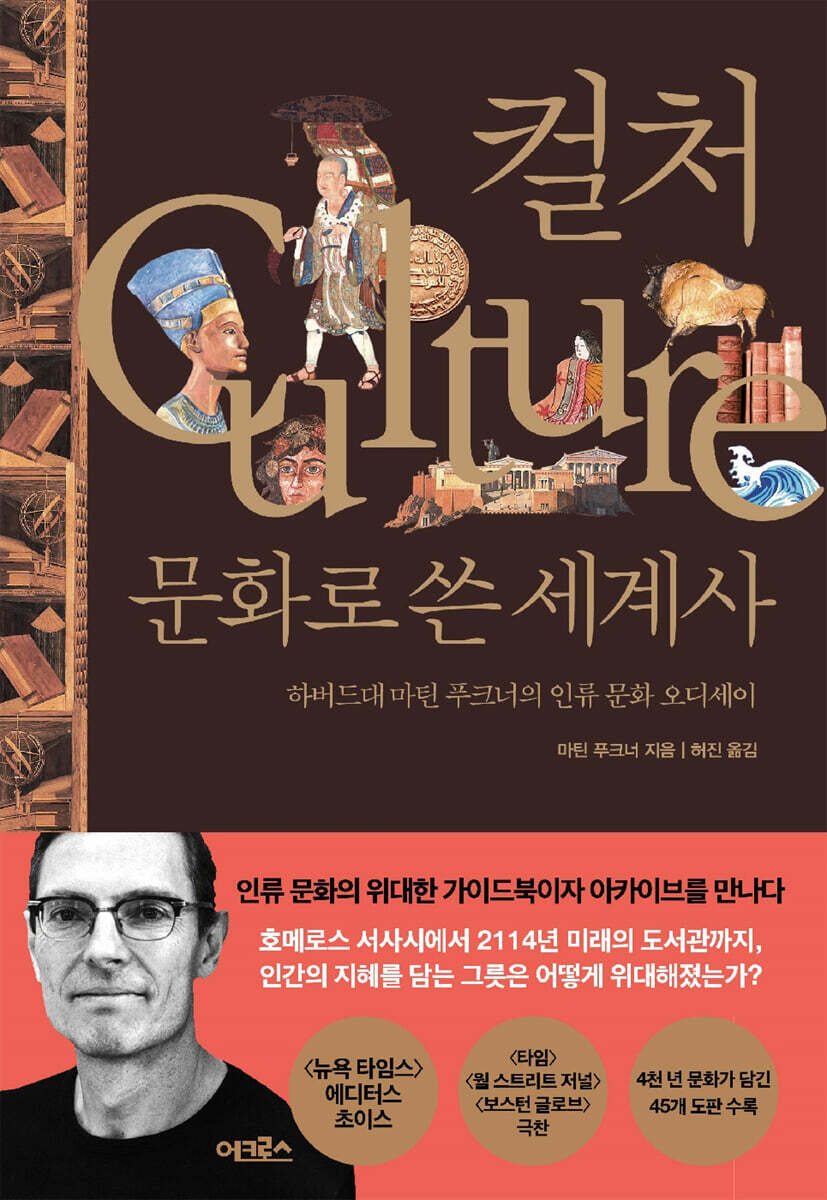
- New York Times Editor's Choice - Praise from Time, The Wall Street Journal, and The Boston Globe - A masterpiece by Humboldt Prize winner Martin Puchner - Includes 45 plates containing 4,000 years of culture Baghdad, the source of learning, The first pilgrim monk, Homer, the father of all heroes A compilation of 4,000 years of culture that changed world history. A scholar who captivated the world with “The World Made by Words” and “The Norton Anthology of World Literature.” 15 Scenes of Human Culture, compiled by Harvard Professor Martin Puchner We readily use the expression “unique culture of a nation,” and sometimes even emphasize the superiority of our own culture. But has there ever been such a thing as a pure culture in human history? The Roman Empire enjoyed the culture of the Greeks it conquered. The Tang Dynasty adopted Buddhism, an Indian religion, and Baghdad compiled pre-Islamic knowledge. The driving force behind the creation of a powerful civilization was never 'purity'. Martin Puchner, a professor of English at Harvard University and author of the international bestseller "Writing the World" and editor of "The Norton Collection of World Literature," compiles 15 stories of human culture spanning 4,000 years. These unique stories, spanning time and continents, reveal how humans borrowed from other cultures, blended with existing ones, and created defining moments in world history. Beginning with the Chauvet Cave in BC, where the first artist left his work, and continuing to the library of the future in 2114, where world-renowned authors Han Kang and Margaret Atwood will collaborate, let's follow the cultural odyssey of humanity that spans tens of centuries and imagine the future that culture will open up for us. |
- You can preview some of the book's contents.
Preview
index
Introduction: How Does Culture Work?
Introduction: Around 35,000 BC in the Chauvet Cave
1.
Queen Nefertiti of Egypt and the Faceless God
2.
Plato, Burning Tragedy and Inventing History
3.
King Ashoka Sends a Message to the Future
4.
South Asian goddess of Pompeii
5.
Buddhist pilgrims seeking ancient traces
6.
The Pillow Book and the Perils of Cultural Diplomacy
7.
Baghdad Becomes a Storehouse of Wisdom
8.
The Ethiopian Queen Welcomes the Ark of the Covenant's Reavers
9.
A Christian mystic and three European revivals
10.
The Aztec capital, destroyed with praise
11.
Portuguese sailors meet the gods of Olympus.
12.
The Enlightenment of Saint-Domingue and the Paris Salons
13.
A new science gives birth to historical fiction.
14.
Invasion and Love for Japanese Art
15.
Nigerian Independence and Shakespeare
Epilogue: Will libraries still exist in 2114?
Acknowledgements
main
Search
Introduction: Around 35,000 BC in the Chauvet Cave
1.
Queen Nefertiti of Egypt and the Faceless God
2.
Plato, Burning Tragedy and Inventing History
3.
King Ashoka Sends a Message to the Future
4.
South Asian goddess of Pompeii
5.
Buddhist pilgrims seeking ancient traces
6.
The Pillow Book and the Perils of Cultural Diplomacy
7.
Baghdad Becomes a Storehouse of Wisdom
8.
The Ethiopian Queen Welcomes the Ark of the Covenant's Reavers
9.
A Christian mystic and three European revivals
10.
The Aztec capital, destroyed with praise
11.
Portuguese sailors meet the gods of Olympus.
12.
The Enlightenment of Saint-Domingue and the Paris Salons
13.
A new science gives birth to historical fiction.
14.
Invasion and Love for Japanese Art
15.
Nigerian Independence and Shakespeare
Epilogue: Will libraries still exist in 2114?
Acknowledgements
main
Search
Detailed image

Into the book
If the erasure of Nefertiti and Akhenaten was due to their experiment in monotheism, then it is precisely for this reason that they are now remembered.
Because we live in a monotheistic world, we consider this brief period in Egyptian history to be of great importance.
If the world had continued to live in polytheism, the Aton experiment would have been nothing more than a curiosity or a footnote in history.
People view the past based on their own values and experiences.
--- p.55, 「1.
From "Queen Nefertiti of Egypt and the Faceless God"
With its intricate frescoes, atrium buildings, and theater, Pompeii is a great place to admire the results of Roman cultural graft.
An inscription by Virgil carved on a large building next to the Forum of Pompeii explains the mythical origin of Rome as Aeneas of Troy.
From frescoes to theaters, the whole of Pompeii is evidence of this cultural experiment.
--- p.122, 「4.
From "South Asian Goddess of Pompeii"
Chinese Buddhists were drawn to India, but few dared to make the dangerous and forbidden journey to the West.
The scene went on behalf of all of them.
More importantly, he returned with news that the experience of visiting the Holy Land was overrated.
Thanks to the scriptures, objects, observations, and experiences that Xuanzang brought back, Chinese Buddhism was able to flourish without feeling inferior to Buddhism in India, the homeland of the Buddha.
The scene was a pilgrim who gave Chinese Buddhists the assurance that it was okay to stay at home.
--- p.143, 「5.
From “Buddhist Pilgrims in Search of Ancient Traces”
Fortunately, we can see the storehouse of wisdom through the remaining traces.
The impact was immense, turning not only Baghdad but the entire Arab Empire into a center of learning, a place where new forms of knowledge preservation and production developed.
Perhaps the storehouse of wisdom was not a single building, but the very idea of collecting, translating, and synthesizing knowledge—not a single place, but an attitude toward the products of past and other cultures.
--- p.190~191, 「7.
From "Baghdad, a Storehouse of Wisdom"
Culture thrives through possibility and experimentation when diverse forms of expression and meaning production are readily accessible.
As cultural contact increases choices, cultural production and development are stimulated.
Conversely, those who value purity tend to block alternatives, limit possibilities, and police experiments with cultural fusion.
They impoverish themselves by ignoring the past that does not meet their narrow standards and by condoning or encouraging its destruction.
Because we live in a monotheistic world, we consider this brief period in Egyptian history to be of great importance.
If the world had continued to live in polytheism, the Aton experiment would have been nothing more than a curiosity or a footnote in history.
People view the past based on their own values and experiences.
--- p.55, 「1.
From "Queen Nefertiti of Egypt and the Faceless God"
With its intricate frescoes, atrium buildings, and theater, Pompeii is a great place to admire the results of Roman cultural graft.
An inscription by Virgil carved on a large building next to the Forum of Pompeii explains the mythical origin of Rome as Aeneas of Troy.
From frescoes to theaters, the whole of Pompeii is evidence of this cultural experiment.
--- p.122, 「4.
From "South Asian Goddess of Pompeii"
Chinese Buddhists were drawn to India, but few dared to make the dangerous and forbidden journey to the West.
The scene went on behalf of all of them.
More importantly, he returned with news that the experience of visiting the Holy Land was overrated.
Thanks to the scriptures, objects, observations, and experiences that Xuanzang brought back, Chinese Buddhism was able to flourish without feeling inferior to Buddhism in India, the homeland of the Buddha.
The scene was a pilgrim who gave Chinese Buddhists the assurance that it was okay to stay at home.
--- p.143, 「5.
From “Buddhist Pilgrims in Search of Ancient Traces”
Fortunately, we can see the storehouse of wisdom through the remaining traces.
The impact was immense, turning not only Baghdad but the entire Arab Empire into a center of learning, a place where new forms of knowledge preservation and production developed.
Perhaps the storehouse of wisdom was not a single building, but the very idea of collecting, translating, and synthesizing knowledge—not a single place, but an attitude toward the products of past and other cultures.
--- p.190~191, 「7.
From "Baghdad, a Storehouse of Wisdom"
Culture thrives through possibility and experimentation when diverse forms of expression and meaning production are readily accessible.
As cultural contact increases choices, cultural production and development are stimulated.
Conversely, those who value purity tend to block alternatives, limit possibilities, and police experiments with cultural fusion.
They impoverish themselves by ignoring the past that does not meet their narrow standards and by condoning or encouraging its destruction.
--- p.424, from “Epilogue: Will Libraries Exist in 2114?”
Publisher's Review
How did the Iliad become the origin of Rome?
The Roman Empire, which recreated Greek epics and became the subject of history
“The Greek influence on Rome extended to other fields, especially education.
After Rome's military victories, many Greek educators were brought to Rome as slaves to teach children.
“The Pompeian literati were educated primarily in Greece, so they could write in Greek and quote from Greek authors.” (p. 112)
Humanity has always needed tools to express meaning.
Culture is a tool for expressing the meaning of our existence, and humanity in each era has looked back to the distant past to find the best tool.
Rome also used Greek literature from 700 years ago to show off its achievements in building a vast empire.
Rome conquered Greece, but Greek culture, far from disappearing, exerted even more widespread influence in Rome.
Everywhere in Rome you could find paintings depicting Greek plays, and speaking Greek and knowing the names of Greek authors was a mark of intellectualism.
As Roman identity and Greek culture became inextricably linked, new concerns arose for the Romans.
Greece is now an important part of our identity.
So how do we connect our origins with Greece? Surprisingly, Virgil decided to write a new epic poem explaining the origins of Rome.
Aeneas, a character from Homer's epic poem "Iliad," was chosen as the founder of Rome.
Virgil explained how Rome was born in his epic poem, the Aeneid, featuring Aeneas.
A question arises here.
Aeneas is a figure who fled after the defeat of Troy, so why did Virgil establish the defeated man as the founder of Rome?
Virgil's choice of the loser of the Trojan War was not a sign of weakness.
It was an expression of the confidence that the Romans were always telling their own story, using the Greeks as their own agents.
The aim was to acknowledge the influence of Greek culture on Rome while also demonstrating that the Roman Empire was great in its own right.
What is the relationship between King Solomon and the civil rights movement?
From Judaism to Black Panther,
A chain reaction of culture that is constantly being reinterpreted
“Ethiopia claims to be a direct descendant of the Jewish monarchy, claiming to have stolen the Ark of the Covenant, and links Ethiopia with the Jewish monarchy.
What supported this was a story of dynastic succession that was much more solid than the translation of texts or the importation of artifacts.
“Kebra Nagast is not the only one pursuing this kind of cultural grafting or transfer.” (p. 200)
Literature, religion, and art have their originators, but they do not remain in the original intention of the originator forever.
As time passes, culture transcends the intentions of its creators and becomes richer in meaning.
The 14th-century Ethiopian epic, Kebra Nagast, is a prime example of such historical change.
According to the story told in the Kebra Nagast, the Ethiopian dynasty is a direct descendant of the Jewish dynasty that succeeded King Solomon.
Unlike the story in the Hebrew Bible, in the Kebra Nagast, King Solomon embraces the Queen of Ethiopia when she visits him, and she becomes pregnant with the king's child.
Menelik, the child of King Solomon and the Queen of Ethiopia, later visits Jerusalem, but misses his hometown and steals the Ark of the Covenant made by Moses and runs away to Ethiopia.
Thanks to two factors - the lineage of King Solomon and the Ark of the Covenant mentioned in the Hebrew Bible - Ethiopia gained the authority of the Jewish monarchy.
Puchner says this cultural mix is by no means unusual.
Today's Bible, which defines the Hebrew Bible as the Old Testament and the Christian canon as the New Testament, is also an example of the combination of two heterogeneous cultures.
Later commentators want to have their own original meaning along with historical authority.
To achieve both authenticity and originality, one must respect past texts while simultaneously denying them.
『Kebra Nagast』 introduced King Solomon to make Ethiopia a glorious nation, but it also made King Solomon a sinner who lusted after the queen.
『Kevra Nagast』 also created an unexpected future after several centuries.
Marcus Garvey, a Jamaican-born man who founded the International Black Progressive Association in the early 20th century, looked to Ethiopia as a historical model for black Christianity.
The then Ethiopian king, Riz Tafari Makonnen, legitimized his rule with Kebra Nagast, and black Jamaicans, including Marcus Garvey, were fascinated by Kebra Nagast.
『Kebra Nagast』, which relied on the authority of the Jewish monarchy, became a text that refuted the history of white people and symbolized a new history of black people, and influenced the black civil rights movement, including the Black Panthers.
From the Hebrew Bible to Kebra Nagast and Black Panther, this chain of history demonstrates the power of constant cultural reinterpretation.
It was a reinterpretation that the original author of the text would have called a misunderstanding, but thanks to it, humanity was able to make great progress in the issues of human rights and equality.
In reality, the title of original author has not had much power in human history.
Sometimes misunderstandings and reinterpretations can have a greater impact.
The idea of natural rights developed in Europe was only for white people and men, but it triggered a slave revolution in the French colony of Saint-Domingue and gave birth to the independent nation of Haiti.
The Japanese polychrome woodblock print “The Great Wave off Kanagawa” was a work that introduced Western techniques and was a painting style that was foreign to Japanese art at the time, but regardless of its context, it became a representative image of Japan.
Culture shatters the myths of originality and uniqueness, and questions what drives history forward.
A sharp insight into a turning point in history
The future of humanity lies in openness and change.
“Chinese Buddhists were drawn to India, but few dared to undertake the dangerous and forbidden journey to the West.
The scene went on behalf of all of them.
More importantly, he returned with news that the experience of visiting the Holy Land was overrated.
“Thanks to the scriptures, objects, observations, and experiences that Xuanzang brought back, Chinese Buddhism was able to flourish without feeling inferior to Buddhism in India, the homeland of the Buddha.” (p. 143)
A Chinese monk traveled to India for 16 years to obtain Buddhist scriptures.
His journey, a long time away from home, surprisingly ends with the lesson that Buddha need not be confined to India.
Because it is possible to attain enlightenment through Chinese Buddhism rather than Indian Buddhism.
The original culture is not superior to the culture it evolved from, and any culture evolves to become the best form of transmitting knowledge and wisdom.
An era of nationalism that emphasizes the superiority of one's own culture and rejects foreign cultures.
"Culture" provocatively questions whether the future can truly be guaranteed in a closed world.
The civilization we enjoy was born from countless challenges and adventures that sought to break out of the familiar world.
If culture had not moved and transformed, we would not exist today.
The monotheistic revolution that took place in the polytheistic nation of Egypt, the India of Emperor Ashoka, full of future-oriented phrases, and the Chinese opera that had a destructive influence on Western art—Culture tells the story of cultural achievements that moved the entire globe through disconnection and restoration, power struggles, and reckless journeys.
And it shows that the characteristics of culture, which are constantly changing and merging, are the driving force that transmits human wisdom to the future.
An archive of monumental moments in humanity's history and a guidebook for the future of humanity as a creative species has now arrived.
The Roman Empire, which recreated Greek epics and became the subject of history
“The Greek influence on Rome extended to other fields, especially education.
After Rome's military victories, many Greek educators were brought to Rome as slaves to teach children.
“The Pompeian literati were educated primarily in Greece, so they could write in Greek and quote from Greek authors.” (p. 112)
Humanity has always needed tools to express meaning.
Culture is a tool for expressing the meaning of our existence, and humanity in each era has looked back to the distant past to find the best tool.
Rome also used Greek literature from 700 years ago to show off its achievements in building a vast empire.
Rome conquered Greece, but Greek culture, far from disappearing, exerted even more widespread influence in Rome.
Everywhere in Rome you could find paintings depicting Greek plays, and speaking Greek and knowing the names of Greek authors was a mark of intellectualism.
As Roman identity and Greek culture became inextricably linked, new concerns arose for the Romans.
Greece is now an important part of our identity.
So how do we connect our origins with Greece? Surprisingly, Virgil decided to write a new epic poem explaining the origins of Rome.
Aeneas, a character from Homer's epic poem "Iliad," was chosen as the founder of Rome.
Virgil explained how Rome was born in his epic poem, the Aeneid, featuring Aeneas.
A question arises here.
Aeneas is a figure who fled after the defeat of Troy, so why did Virgil establish the defeated man as the founder of Rome?
Virgil's choice of the loser of the Trojan War was not a sign of weakness.
It was an expression of the confidence that the Romans were always telling their own story, using the Greeks as their own agents.
The aim was to acknowledge the influence of Greek culture on Rome while also demonstrating that the Roman Empire was great in its own right.
What is the relationship between King Solomon and the civil rights movement?
From Judaism to Black Panther,
A chain reaction of culture that is constantly being reinterpreted
“Ethiopia claims to be a direct descendant of the Jewish monarchy, claiming to have stolen the Ark of the Covenant, and links Ethiopia with the Jewish monarchy.
What supported this was a story of dynastic succession that was much more solid than the translation of texts or the importation of artifacts.
“Kebra Nagast is not the only one pursuing this kind of cultural grafting or transfer.” (p. 200)
Literature, religion, and art have their originators, but they do not remain in the original intention of the originator forever.
As time passes, culture transcends the intentions of its creators and becomes richer in meaning.
The 14th-century Ethiopian epic, Kebra Nagast, is a prime example of such historical change.
According to the story told in the Kebra Nagast, the Ethiopian dynasty is a direct descendant of the Jewish dynasty that succeeded King Solomon.
Unlike the story in the Hebrew Bible, in the Kebra Nagast, King Solomon embraces the Queen of Ethiopia when she visits him, and she becomes pregnant with the king's child.
Menelik, the child of King Solomon and the Queen of Ethiopia, later visits Jerusalem, but misses his hometown and steals the Ark of the Covenant made by Moses and runs away to Ethiopia.
Thanks to two factors - the lineage of King Solomon and the Ark of the Covenant mentioned in the Hebrew Bible - Ethiopia gained the authority of the Jewish monarchy.
Puchner says this cultural mix is by no means unusual.
Today's Bible, which defines the Hebrew Bible as the Old Testament and the Christian canon as the New Testament, is also an example of the combination of two heterogeneous cultures.
Later commentators want to have their own original meaning along with historical authority.
To achieve both authenticity and originality, one must respect past texts while simultaneously denying them.
『Kebra Nagast』 introduced King Solomon to make Ethiopia a glorious nation, but it also made King Solomon a sinner who lusted after the queen.
『Kevra Nagast』 also created an unexpected future after several centuries.
Marcus Garvey, a Jamaican-born man who founded the International Black Progressive Association in the early 20th century, looked to Ethiopia as a historical model for black Christianity.
The then Ethiopian king, Riz Tafari Makonnen, legitimized his rule with Kebra Nagast, and black Jamaicans, including Marcus Garvey, were fascinated by Kebra Nagast.
『Kebra Nagast』, which relied on the authority of the Jewish monarchy, became a text that refuted the history of white people and symbolized a new history of black people, and influenced the black civil rights movement, including the Black Panthers.
From the Hebrew Bible to Kebra Nagast and Black Panther, this chain of history demonstrates the power of constant cultural reinterpretation.
It was a reinterpretation that the original author of the text would have called a misunderstanding, but thanks to it, humanity was able to make great progress in the issues of human rights and equality.
In reality, the title of original author has not had much power in human history.
Sometimes misunderstandings and reinterpretations can have a greater impact.
The idea of natural rights developed in Europe was only for white people and men, but it triggered a slave revolution in the French colony of Saint-Domingue and gave birth to the independent nation of Haiti.
The Japanese polychrome woodblock print “The Great Wave off Kanagawa” was a work that introduced Western techniques and was a painting style that was foreign to Japanese art at the time, but regardless of its context, it became a representative image of Japan.
Culture shatters the myths of originality and uniqueness, and questions what drives history forward.
A sharp insight into a turning point in history
The future of humanity lies in openness and change.
“Chinese Buddhists were drawn to India, but few dared to undertake the dangerous and forbidden journey to the West.
The scene went on behalf of all of them.
More importantly, he returned with news that the experience of visiting the Holy Land was overrated.
“Thanks to the scriptures, objects, observations, and experiences that Xuanzang brought back, Chinese Buddhism was able to flourish without feeling inferior to Buddhism in India, the homeland of the Buddha.” (p. 143)
A Chinese monk traveled to India for 16 years to obtain Buddhist scriptures.
His journey, a long time away from home, surprisingly ends with the lesson that Buddha need not be confined to India.
Because it is possible to attain enlightenment through Chinese Buddhism rather than Indian Buddhism.
The original culture is not superior to the culture it evolved from, and any culture evolves to become the best form of transmitting knowledge and wisdom.
An era of nationalism that emphasizes the superiority of one's own culture and rejects foreign cultures.
"Culture" provocatively questions whether the future can truly be guaranteed in a closed world.
The civilization we enjoy was born from countless challenges and adventures that sought to break out of the familiar world.
If culture had not moved and transformed, we would not exist today.
The monotheistic revolution that took place in the polytheistic nation of Egypt, the India of Emperor Ashoka, full of future-oriented phrases, and the Chinese opera that had a destructive influence on Western art—Culture tells the story of cultural achievements that moved the entire globe through disconnection and restoration, power struggles, and reckless journeys.
And it shows that the characteristics of culture, which are constantly changing and merging, are the driving force that transmits human wisdom to the future.
An archive of monumental moments in humanity's history and a guidebook for the future of humanity as a creative species has now arrived.
GOODS SPECIFICS
- Date of issue: February 13, 2024
- Page count, weight, size: 472 pages | 680g | 150*217*27mm
- ISBN13: 9791167741370
You may also like
카테고리
korean


korean

![GQ KOREA Mark (Monthly): December [2025]](http://librairie.coreenne.fr/cdn/shop/files/8ef265dbbfbf186523ed75ba7319009d.jpg?v=1765340328&width=3840)


