

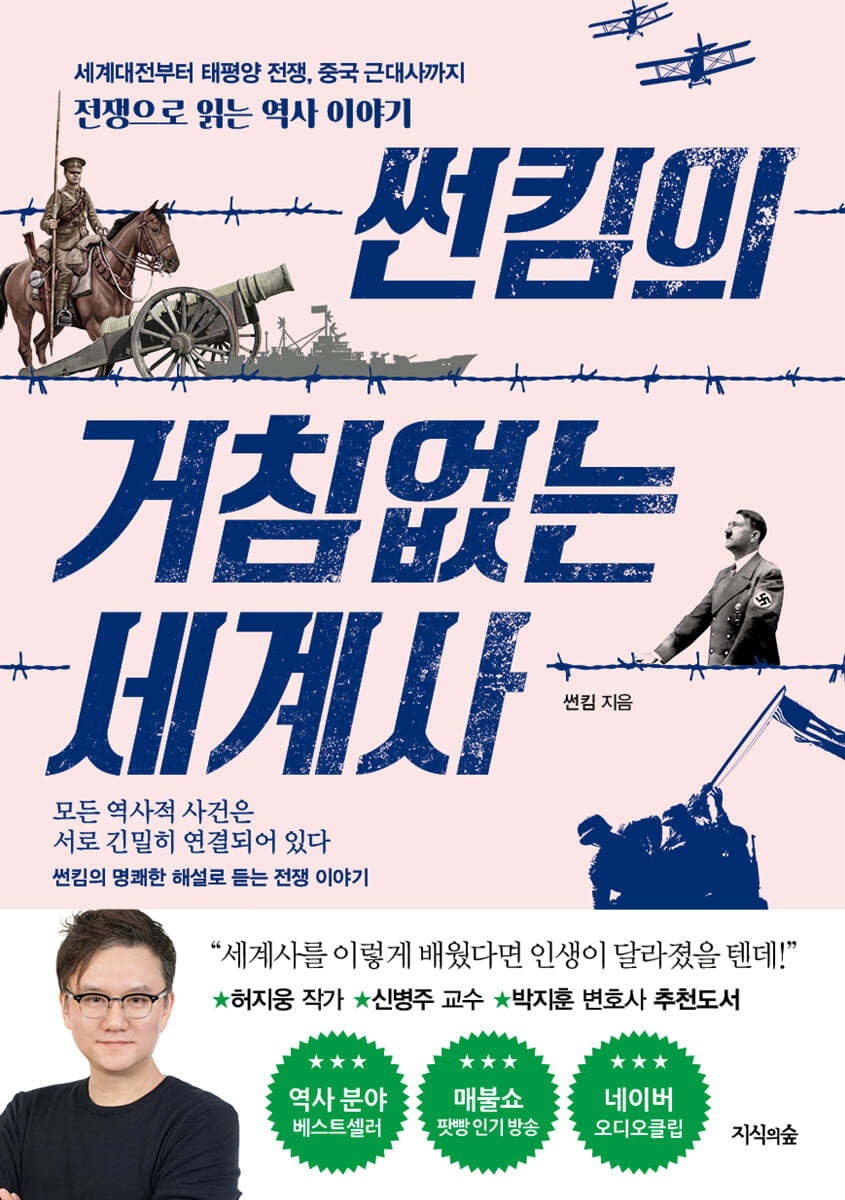
Sun Kim's Unstoppable World History
 |
Description
Book Introduction
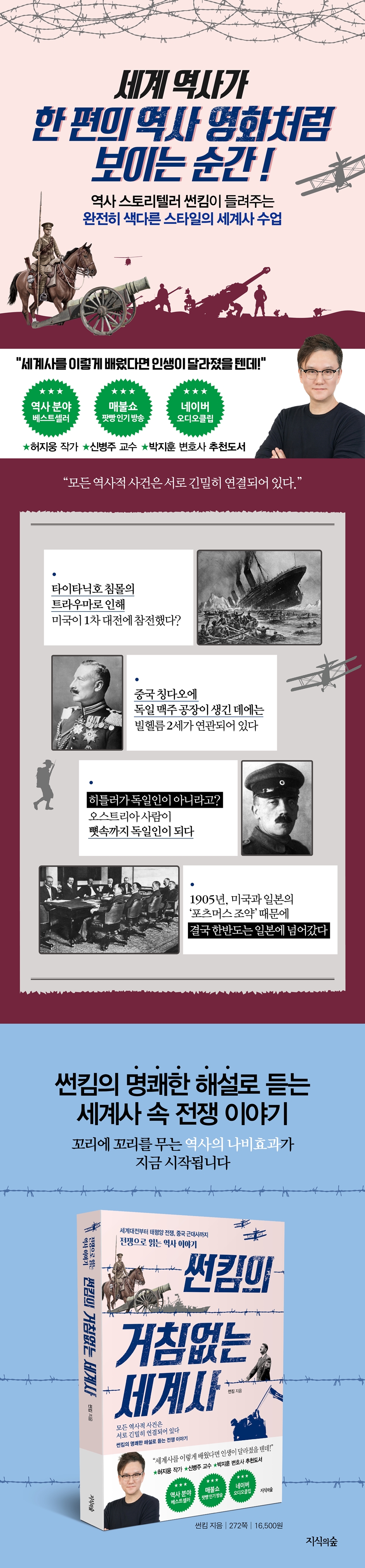
World history seems like a historical film! A story of war in world history that reads like a movie. If you've only encountered boring world history classes or world history classes that were too predictable, it's time to meet Sun Kim's world history. It contains world history lessons that allow you to understand and learn the major trends of world history with just one reading. This is also the first history book by Sun Kim, who is known as a 'historical storyteller' and 'historical comedian'. World War I, World War II, the Pacific War, and modern Chinese history are organized, and historical film commentary with Sun Kim's own commentary is added along with various photographic materials. Let's read through the author's friendly and bold story, which explains the history of war as if it were a movie plot. With this one book, we will be able to remember the history of war that we have only remembered in fragments without having to memorize it. As you read along, you will be able to immediately understand the flow of the story, as it not only highlights the major events of each war, but also conveys the era's social and cultural aspects, as well as anecdotes related to the characters. For those who want a more interesting world history story rather than a class full of rigid theories, this will be a world history class with a completely different style. |
- You can preview some of the book's contents.
Preview
index
Prologue | There are no coincidences in history as we know it.
Recommendation
Major battlefields of World War I and II
Major battle zones of the Pacific War
Major war zones in modern Chinese history
Chapter 1: World War I, Humanity's First Mass Murder
How much do we know about World War I?
Why did Germany become a monster nation?
Bismarck, the father of German unification, appears
Prussia defeats Austria
Prussia defeats France and declares a unified Germany
Bismarck, the master of diplomacy
Bismarck in full swing
Germany begins digging its own grave
Why a German beer factory opened in Qingdao, China
Britain, France, and Russia vs. Germany and Austria: The Prelude to World War I
The Balkan Peninsula, Europe's powder keg, finally explodes.
The Balkans: The Trigger of World War I?
Austria, with its German connections, miscalculated.
What was the 'Schlieffen Plan', the corner that Germany believed in?
Fatal flaw in the Schlieffen Plan
Britain enters World War I
The Hellgate of "Western Front" has finally opened.
Christmas comes even to the battlefield
Germany, beginning to crumble, survives on turnips
Russia suddenly disappeared from the battlefield, and the Bolshevik Revolution
Mexico almost got involved in World War I?
Germany's last desperate attempt
German Emperor, flee!
The Fall of Germany and Hitler
World History in Film | 1917
Chapter 2: The Meticulously Planned World War II
Hitler, an art student
Hitler enlists in the German army
Hitler despaired over Germany's defeat in World War I
Hitler entered German politics by accident
The birth of the Nazi Party and Hitler's attempted coup
Did America's economic collapse save Hitler?
German politics takes Hitler lightly
Hitler seizes power through the Plenipotentiary Act
German conservatives who were stabbed in the back by Hitler
Hitler declares German rearmament
Germany annexed Austria
Britain signs the worst peace treaty in history
Hitler joins hands with Stalin
World War II finally broke out
What is the Maginot Line?
The movie "Dunkirk" is based on a true story.
Hitler stabbed Stalin in the back
War within war, war within the Dokdo-German War
The Battle of Stalingrad, the worst massacre in history
German troops being annihilated at Stalingrad
Allied counterattack, Normandy landings!
Failed plot to assassinate Hitler
Germany's final counterattack
Hitler's suicide and the fall of Nazi Germany
Chapter 3: Japan and the United States Face Off in the Pacific War
The Japanese emperor was a puppet
Japan forced to open its ports by the United States
Let's remember Yoshida Shoin, the root of Japan's far right.
Why We Should Oppose Visits to Yasukuni Shrine
The rebellion of lower-ranking samurai and the Meiji Restoration
Japan exploiting Joseon's Donghak Peasant Revolution
Japan starts the Sino-Japanese War on Korean soil
After the Sino-Japanese War, Joseon fell into Japanese hands.
When looking at the assassination of Empress Myeongseong from a world historical perspective,
Japan, which destroyed Russia in the Russo-Japanese War
The Korean Peninsula falls to Japan due to a secret agreement between the United States and Japan.
Japan reels from the Great Kanto Earthquake
Imperial Japan invades Manchuria
Japan, slapped in Shanghai, takes revenge in Nanjing
The United States is starting to take care of Japan, which is just leaving.
Hardliner Hideki Tojo plans a surprise attack on Pearl Harbor.
Japan attacks Hawaii, Pearl Harbor burns
America's Revenge: Tokyo Air Raid
The Battle of Midway, the biggest battle of the Pacific War
Why the US Won the Battle of Midway
Victory and defeat are decided by the fateful five minutes
Japan's losing streak
Letters from Iwo Jima
Hell Begins: The Tokyo Air Raid
Battle of Okinawa and Kamikaze Attack Forces
The Korean Peninsula was torn in half by Japan's stubbornness
Japan becomes the first country to be hit by an atomic bomb
World History Through Film | Midway
Chapter 4: Modern Chinese History from the Opium Wars to the Chinese Civil War
The British Industrial Revolution, which began because of cotton
Let's fill the trade deficit with opium!
Joseon red ginseng and jajangmyeon are related to opium?
The Chinese emperor, who was addicted to opium, launched a crackdown on opium.
Hong Kong, a remote island filled with seagull droppings
British forces targeting the capital city of Beijing
The full-scale Opium War finally began
Jesus' brother? The Taiping Rebellion
The Manchu Qing Dynasty is a monster spoken of by God!
What? Another Opium War?
The burning capital Beijing
The Qing Dynasty, in crisis, attempted Westernization through the Self-Strengthening Movement.
The emergence of Sun Yat-sen, the founding father of the Republic of China
The Xinhai Revolution and the Birth of the Republic of China
Yuan Shikai hits Sun Yat-sen in the back of the head
Yuan Shikai, the traitor among traitors
Korea's March 1st Movement and China's May 4th Movement
The Return of Sun Yat-sen, His End, and the Emergence of Mao Zedong
A love spell that even death could not stop: the couple of Soo-moo-ong and Jin-cheol-gun
Chiang Kai-shek, who unified China, and the birth of Maotaiism
The incident of Chiang Kai-shek being kidnapped by his subordinates
Founding of the People's Republic of China, Chiang Kai-shek leaves for Taiwan
The Kuomintang in Taiwan
World History Through Film | Poem of Sadness
Epilogue | An Unstoppable Journey Through World History, Beginning in America
References
Recommendation
Major battlefields of World War I and II
Major battle zones of the Pacific War
Major war zones in modern Chinese history
Chapter 1: World War I, Humanity's First Mass Murder
How much do we know about World War I?
Why did Germany become a monster nation?
Bismarck, the father of German unification, appears
Prussia defeats Austria
Prussia defeats France and declares a unified Germany
Bismarck, the master of diplomacy
Bismarck in full swing
Germany begins digging its own grave
Why a German beer factory opened in Qingdao, China
Britain, France, and Russia vs. Germany and Austria: The Prelude to World War I
The Balkan Peninsula, Europe's powder keg, finally explodes.
The Balkans: The Trigger of World War I?
Austria, with its German connections, miscalculated.
What was the 'Schlieffen Plan', the corner that Germany believed in?
Fatal flaw in the Schlieffen Plan
Britain enters World War I
The Hellgate of "Western Front" has finally opened.
Christmas comes even to the battlefield
Germany, beginning to crumble, survives on turnips
Russia suddenly disappeared from the battlefield, and the Bolshevik Revolution
Mexico almost got involved in World War I?
Germany's last desperate attempt
German Emperor, flee!
The Fall of Germany and Hitler
World History in Film | 1917
Chapter 2: The Meticulously Planned World War II
Hitler, an art student
Hitler enlists in the German army
Hitler despaired over Germany's defeat in World War I
Hitler entered German politics by accident
The birth of the Nazi Party and Hitler's attempted coup
Did America's economic collapse save Hitler?
German politics takes Hitler lightly
Hitler seizes power through the Plenipotentiary Act
German conservatives who were stabbed in the back by Hitler
Hitler declares German rearmament
Germany annexed Austria
Britain signs the worst peace treaty in history
Hitler joins hands with Stalin
World War II finally broke out
What is the Maginot Line?
The movie "Dunkirk" is based on a true story.
Hitler stabbed Stalin in the back
War within war, war within the Dokdo-German War
The Battle of Stalingrad, the worst massacre in history
German troops being annihilated at Stalingrad
Allied counterattack, Normandy landings!
Failed plot to assassinate Hitler
Germany's final counterattack
Hitler's suicide and the fall of Nazi Germany
Chapter 3: Japan and the United States Face Off in the Pacific War
The Japanese emperor was a puppet
Japan forced to open its ports by the United States
Let's remember Yoshida Shoin, the root of Japan's far right.
Why We Should Oppose Visits to Yasukuni Shrine
The rebellion of lower-ranking samurai and the Meiji Restoration
Japan exploiting Joseon's Donghak Peasant Revolution
Japan starts the Sino-Japanese War on Korean soil
After the Sino-Japanese War, Joseon fell into Japanese hands.
When looking at the assassination of Empress Myeongseong from a world historical perspective,
Japan, which destroyed Russia in the Russo-Japanese War
The Korean Peninsula falls to Japan due to a secret agreement between the United States and Japan.
Japan reels from the Great Kanto Earthquake
Imperial Japan invades Manchuria
Japan, slapped in Shanghai, takes revenge in Nanjing
The United States is starting to take care of Japan, which is just leaving.
Hardliner Hideki Tojo plans a surprise attack on Pearl Harbor.
Japan attacks Hawaii, Pearl Harbor burns
America's Revenge: Tokyo Air Raid
The Battle of Midway, the biggest battle of the Pacific War
Why the US Won the Battle of Midway
Victory and defeat are decided by the fateful five minutes
Japan's losing streak
Letters from Iwo Jima
Hell Begins: The Tokyo Air Raid
Battle of Okinawa and Kamikaze Attack Forces
The Korean Peninsula was torn in half by Japan's stubbornness
Japan becomes the first country to be hit by an atomic bomb
World History Through Film | Midway
Chapter 4: Modern Chinese History from the Opium Wars to the Chinese Civil War
The British Industrial Revolution, which began because of cotton
Let's fill the trade deficit with opium!
Joseon red ginseng and jajangmyeon are related to opium?
The Chinese emperor, who was addicted to opium, launched a crackdown on opium.
Hong Kong, a remote island filled with seagull droppings
British forces targeting the capital city of Beijing
The full-scale Opium War finally began
Jesus' brother? The Taiping Rebellion
The Manchu Qing Dynasty is a monster spoken of by God!
What? Another Opium War?
The burning capital Beijing
The Qing Dynasty, in crisis, attempted Westernization through the Self-Strengthening Movement.
The emergence of Sun Yat-sen, the founding father of the Republic of China
The Xinhai Revolution and the Birth of the Republic of China
Yuan Shikai hits Sun Yat-sen in the back of the head
Yuan Shikai, the traitor among traitors
Korea's March 1st Movement and China's May 4th Movement
The Return of Sun Yat-sen, His End, and the Emergence of Mao Zedong
A love spell that even death could not stop: the couple of Soo-moo-ong and Jin-cheol-gun
Chiang Kai-shek, who unified China, and the birth of Maotaiism
The incident of Chiang Kai-shek being kidnapped by his subordinates
Founding of the People's Republic of China, Chiang Kai-shek leaves for Taiwan
The Kuomintang in Taiwan
World History Through Film | Poem of Sadness
Epilogue | An Unstoppable Journey Through World History, Beginning in America
References
Detailed image
Into the book
My curiosity turned to finding the connections between historical events that we had memorized in fragments.
The results were astonishing.
Not to mention the correlation between World War I and World War II, the sinking of the Titanic led to the United States' participation in World War I, which in turn influenced Korea's March 1st Movement, which in turn influenced China's May 4th Movement, leading to the founding of the Communist Party. We discovered the "butterfly effect of history."
The history of tail chasing tail began to come into view.
--- From the "Prologue"
King Wilhelm IV of Prussia, who was number two among the German Confederation member states, was not happy with being perpetually second.
Even if Germany were to later be unified as a single country, they wanted it to be led by Prussia, not Austria.
A person appears before Wilhelm IV.
It was Otto von Bismarck, the father of German unification who later led the 'Prussian-led German unification'.
Bismarck, a young Prussian politician, attracted attention with his radical statement, “German unification must be led by Prussia, and Austria’s tyranny must be crushed by force!”
Such 'radicalism' caught the eye of King Wilhelm IV.
In 1851, Wilhelm IV sent the 'radical extremist' Bismarck as Prussian ambassador to the German Federal Diet.
--- p.22~23, from “The Appearance of Bismarck, the Father of German Unification”
The more Hitler served in the military, the more satisfied he became.
I even came to love the military.
Even Hitler later wrote this in his autobiography:
“The Western Front battlefield felt like home.
“It was the most brilliant moment of my life.”
You might think that this is crazy, but if you think about Hitler's situation at the time, it seems like such a statement was possible.
He moved to Germany because he couldn't adapt in his home country of Austria, but the path of becoming an architecture student became more and more distant, and he was living a 'loser' life' with no other job, no money, and even homeless people, so to Hitler, the military was 'an organization that recognized the more you ran.'
---- p.87, from “Hitler enlists in the German army”
After capturing Iwo Jima and completing the bombing raid on Tokyo, the US military developed a plan to move closer to the mainland.
It was the occupation of Okinawa.
Okinawa is located below Kyushu, Japan.
If the US military occupied Okinawa, the occupation of Kyushu, Japan would be a piece of cake, and if Kyushu fell to the US military, the occupation of mainland Japan would become a fait accompli.
April 1, 1945.
The US military begins its operation to occupy Okinawa with a large force of 550,000 troops.
About 120,000 Japanese soldiers stationed in Okinawa fought against the American forces, prepared to die.
In particular, all Japanese soldiers are prepared to 'die to their death'.
It was an absurd statement that meant 'to break beautifully like jade', meaning to die beautifully while fighting for the Emperor.
--- p.208, from “The Battle of Okinawa and the Kamikaze Special Attack Force”
After the May Fourth Movement, Sun Yat-sen returned to China.
He was absorbed.
'I've been so naive until now.
The reason I was treated badly by the warlords was because I didn't have a clear faction.
In 1919, he founded the 'National Party' with the idea that 'a strong political force is needed for political activities'.
And a few years later, on July 23, 1921, 13 people gathered in a school dormitory in Shanghai and formed a political party.
The Chinese Communist Party was born with the idea that 'China's workers and farmers, who have been oppressed by the monarchy for thousands of years, should take the lead and change the world.'
The results were astonishing.
Not to mention the correlation between World War I and World War II, the sinking of the Titanic led to the United States' participation in World War I, which in turn influenced Korea's March 1st Movement, which in turn influenced China's May 4th Movement, leading to the founding of the Communist Party. We discovered the "butterfly effect of history."
The history of tail chasing tail began to come into view.
--- From the "Prologue"
King Wilhelm IV of Prussia, who was number two among the German Confederation member states, was not happy with being perpetually second.
Even if Germany were to later be unified as a single country, they wanted it to be led by Prussia, not Austria.
A person appears before Wilhelm IV.
It was Otto von Bismarck, the father of German unification who later led the 'Prussian-led German unification'.
Bismarck, a young Prussian politician, attracted attention with his radical statement, “German unification must be led by Prussia, and Austria’s tyranny must be crushed by force!”
Such 'radicalism' caught the eye of King Wilhelm IV.
In 1851, Wilhelm IV sent the 'radical extremist' Bismarck as Prussian ambassador to the German Federal Diet.
--- p.22~23, from “The Appearance of Bismarck, the Father of German Unification”
The more Hitler served in the military, the more satisfied he became.
I even came to love the military.
Even Hitler later wrote this in his autobiography:
“The Western Front battlefield felt like home.
“It was the most brilliant moment of my life.”
You might think that this is crazy, but if you think about Hitler's situation at the time, it seems like such a statement was possible.
He moved to Germany because he couldn't adapt in his home country of Austria, but the path of becoming an architecture student became more and more distant, and he was living a 'loser' life' with no other job, no money, and even homeless people, so to Hitler, the military was 'an organization that recognized the more you ran.'
---- p.87, from “Hitler enlists in the German army”
After capturing Iwo Jima and completing the bombing raid on Tokyo, the US military developed a plan to move closer to the mainland.
It was the occupation of Okinawa.
Okinawa is located below Kyushu, Japan.
If the US military occupied Okinawa, the occupation of Kyushu, Japan would be a piece of cake, and if Kyushu fell to the US military, the occupation of mainland Japan would become a fait accompli.
April 1, 1945.
The US military begins its operation to occupy Okinawa with a large force of 550,000 troops.
About 120,000 Japanese soldiers stationed in Okinawa fought against the American forces, prepared to die.
In particular, all Japanese soldiers are prepared to 'die to their death'.
It was an absurd statement that meant 'to break beautifully like jade', meaning to die beautifully while fighting for the Emperor.
--- p.208, from “The Battle of Okinawa and the Kamikaze Special Attack Force”
After the May Fourth Movement, Sun Yat-sen returned to China.
He was absorbed.
'I've been so naive until now.
The reason I was treated badly by the warlords was because I didn't have a clear faction.
In 1919, he founded the 'National Party' with the idea that 'a strong political force is needed for political activities'.
And a few years later, on July 23, 1921, 13 people gathered in a school dormitory in Shanghai and formed a political party.
The Chinese Communist Party was born with the idea that 'China's workers and farmers, who have been oppressed by the monarchy for thousands of years, should take the lead and change the world.'
--- p.256, from “The Return of Sun Yat-sen, His End, and the Emergence of Mao Zedong”
GOODS SPECIFICS
- Publication date: April 26, 2021
- Page count, weight, size: 272 pages | 454g | 150*210*16mm
- ISBN13: 9791166830518
- ISBN10: 1166830519
You may also like
카테고리
korean


korean

![GQ KOREA Mark (Monthly): December [2025]](http://librairie.coreenne.fr/cdn/shop/files/8ef265dbbfbf186523ed75ba7319009d.jpg?v=1765340328&width=3840)


