

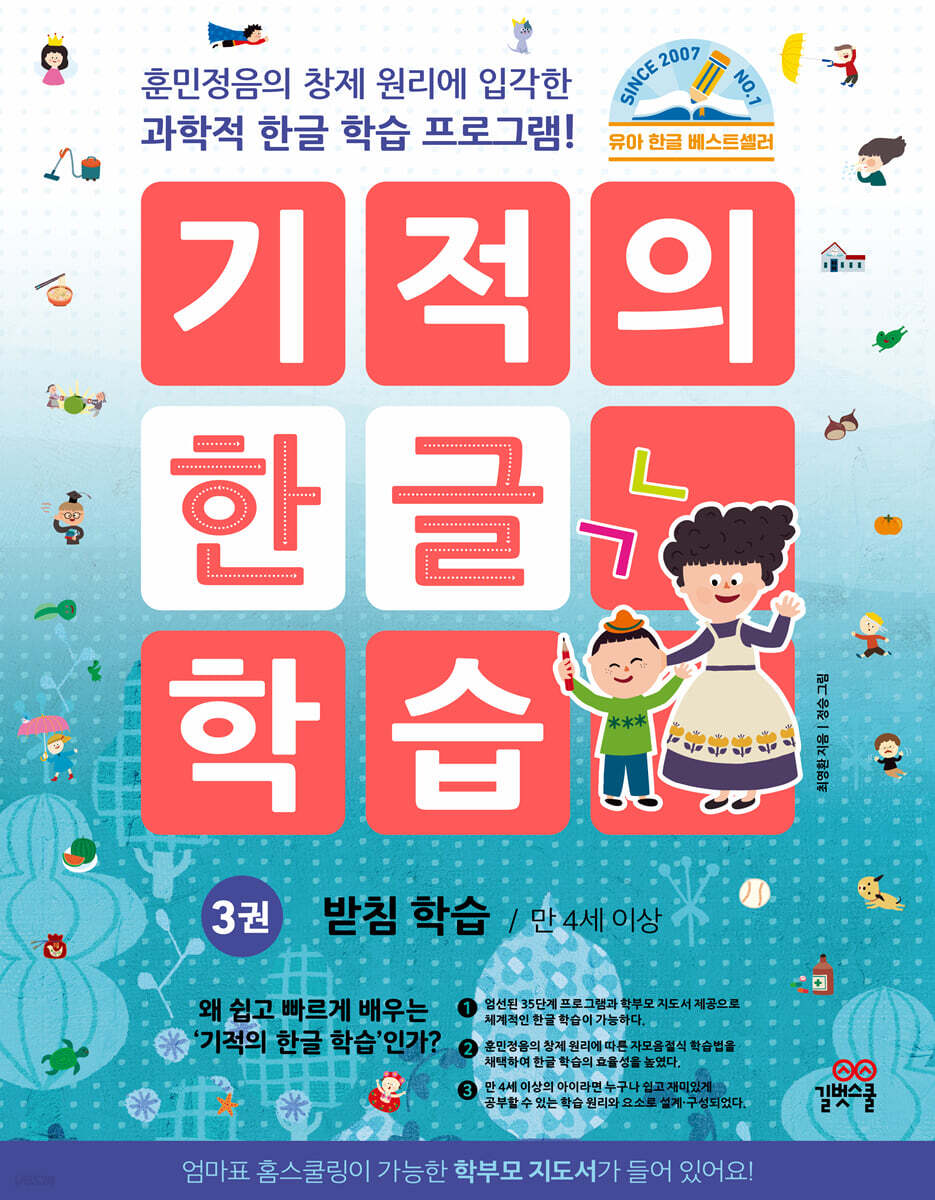
Miracle Korean Learning 3
 |
Description
Book Introduction
None of the Korean language learning textbooks currently on the market have professional authors.
However, Miracle Hangul Learning has a systematic Hangul learning program that was completed through the empirical experience and scientific experiments of Professor Choi Young-hwan, who has been researching Hangul education methods for a long time.
Based on the principles of Hangul, it is composed of a total of five volumes to help you learn Hangul easily and quickly.
Volume 1 covers learning basic consonants (ㄱ~ㅂ) based on vowels, Volume 2 covers learning basic consonants (ㅅ~ㅎ) based on vowels, Volume 3 covers learning 7 final consonants, Volume 4 covers learning complex vowels (11), and Volume 5 covers learning double consonants and the order in which to write Hangul beautifully.
Each volume consists of seven learning elements and review and summary learning.
However, Miracle Hangul Learning has a systematic Hangul learning program that was completed through the empirical experience and scientific experiments of Professor Choi Young-hwan, who has been researching Hangul education methods for a long time.
Based on the principles of Hangul, it is composed of a total of five volumes to help you learn Hangul easily and quickly.
Volume 1 covers learning basic consonants (ㄱ~ㅂ) based on vowels, Volume 2 covers learning basic consonants (ㅅ~ㅎ) based on vowels, Volume 3 covers learning 7 final consonants, Volume 4 covers learning complex vowels (11), and Volume 5 covers learning double consonants and the order in which to write Hangul beautifully.
Each volume consists of seven learning elements and review and summary learning.
- You can preview some of the book's contents.
Preview
index
15-step basic consonant 'ㅇ'
16-step basic consonant 'ㅁ'
17th level basic consonant 'ㄹ'
18th level basic consonant 'ㄴ'
19th level basic consonant 'ㄱ'
20-step basic consonant 'ㅂ'
21-step basic consonant 'ㅅ'
16-step basic consonant 'ㅁ'
17th level basic consonant 'ㄹ'
18th level basic consonant 'ㄴ'
19th level basic consonant 'ㄱ'
20-step basic consonant 'ㅂ'
21-step basic consonant 'ㅅ'
Detailed image
.jpg)
Publisher's Review
Since its publication in 2007, it has been the undisputed No. 1 in the field of Korean language for children.
1 Bestseller
Based on the principles of creation of Hunminjeongeum
Scientific Korean Learning Program, Miracle Korean Learning
Now it's our child's turn to meet!
Ⅰ Korean, it doesn't matter how you learn it?
Hangul is a writing system created by King Sejong based on scientific principles, and can be considered a type of linguistics discipline.
Every citizen of the Republic of Korea learns Hangul at some point in their lives.
However, most children learn Hangul using Western-style character learning methods, not King Sejong's Hangul, or through unscientific and unproven learning methods.
Whether you learn it this way or that way, learning Hangul in the manner of "no matter where you go, you'll get to Seoul" not only contradicts the principles of Hangul's creation, but also hinders the effectiveness of learning.
The purpose of learning Hangul is to enable communication by enabling us to read and write the characters.
If children can learn Korean quickly and easily at an appropriate age, learning Korean will no longer be a concern for parents.
The current Korean language learning system extends the learning period from 2 to 6 years old, and combines learning through play and learning through crude vocabulary, failing to fully utilize the greatest advantage of Korean language, which is that it can be learned and mastered quickly.
How long does it take to learn Hangul? Six months? A year? The Annals of the Joseon Dynasty (Sejong Sillok), which records the creation of Hunminjeongeum and its results, states, "A wise person can interpret it before dawn, and a fool can learn it in ten days."
It is said that during the Joseon Dynasty, Hangul was learned at an incomparably faster pace than it is now.
But why does it take so long to teach Korean to children today? Is it because they are young? Or is the teaching method flawed? "Miracle Korean Learning" provides a definitive answer to this question.
Ⅱ A New Understanding of Korean Language Learning
1.
The best time to learn Korean is during the period of perfecting the spoken language.
There is much debate about when to teach Hangul.
Some say that it is the right time for children to show interest in Hangul, or that it is advised to start around 24 months.
They also say that the earlier you start, the better.
But none of this is based on an understanding of language.
We learn letters to read and write.
Children with fully developed spoken language can read letters and understand their meaning, but children with less developed spoken language will read letters but will only make sounds like a parrot and will not understand the meaning.
Therefore, the optimal age for learning Korean should be around the age of 5, when a child's spoken language is fully developed.
However, in modern society, children's language development is very rapid, so this can be lowered a bit.
In fact, the author's research suggests that it can be lowered to as early as 48 months (though lowering it further would probably increase learning time somewhat).
Most parents try to teach their children Korean early, fearing that if they learn it late, they might fall behind other children.
If you follow the old Korean learning methods, these concerns are natural.
If it takes more than a year to teach Korean after 48 months, it becomes a serious problem.
However, if you use the right method to learn Korean, you don't have to worry about that.
If your spoken language is not properly developed, you will not be able to get ahead even if you learn Hangul early, and if your spoken language is properly developed, you will not fall behind even if you learn it late.
2.
Hangul, which cannot be learned through text
In our country, there are people who claim that the Tongmunja Learning Method is a method of teaching Hangul to children.
Research in brain physiology suggests that children with poor analytical skills need to understand letters as a whole, like pictures.
So we teach topic-centered.
For example, on the topic of picnics, you can present 'zoo, kimbap, balloons, cotton candy, and amusement rides' and have them learn the letters along with the pictures.
However, children who learn this way may know 'kimbap' but not 'kim', and they do not know that 'kim' and 'som' have the same final consonant.
Because they are recognized as different letters.
That is why we can say that it is not Korean language education.
Emotional education through words is possible, but Korean language education is not possible.
The Hieroglyphics Method is a method of teaching hieroglyphs.
Pictographs like Chinese characters must be learned with pictures.
And the earlier you learn, the higher your level of learning will be.
The number of characters learned is the number of words, and this determines the child's ability to use Chinese characters.
However, Hangul is not a hieroglyph.
The Tongja learning method is a method created by people who have no knowledge of the principles of Hangul.
The method of learning the entire alphabet is a strange method that did not exist even during the time of King Sejong, and has not existed since then.
In Hangul, you can pronounce the letters by looking at them, and of course you can understand the meaning of the sounds you make, so there is no reason to learn them as a whole.
Even if you teach Hangul for several months or years using the whole-character learning method, you will not be able to achieve satisfactory results.
It is difficult to remember letters that you have learned, and you do not even know letters that you have not learned.
So, they say that if you use the whole character learning method, you should learn using the consonant and vowel method when you reach a certain age.
If you have to learn it again, there is no reason to learn it in advance in the hard way.
Hangul is not a language that can be memorized and written.
3.
Not the consonants 'Ganadara' but the vowels 'ayaeoyeo'
When learning Korean, you must start with the vowels.
Syllables are made up of four combinations (examples are in parentheses):
'Vowel (A)', 'Consonant + Vowel (B)', 'Vowel + Consonant (Yang)', 'Consonant + Vowel + Consonant (Empty)'.
All four have vowels.
A syllable is formed by a vowel alone, or by a vowel combined with a consonant.
There are no syllables without vowels.
Here's why the vowels are '母音'.
Yet, most textbooks start with consonants.
This does not reflect the combination principle of Hangul.
If you learn the vowels first, you can learn Hangul very easily.
After learning the ten letters 'ayaeoyoyoyouyueuii', you learn the consonants, and each time a consonant is added, you learn ten syllables.
Learning efficiency is greatly increased.
And after learning 190 syllables, each time you learn a final consonant, you now get 190 more syllables.
So, if you learn 7 final consonants, you will naturally learn 1330 syllables.
4.
An Integrated Approach to Learning Korean
Methods for learning Korean are broadly divided into pronunciation-centered approaches (letter-centered, syllable-centered) and meaning-centered approaches (word-centered, sentence-centered).
Most Korean language learning materials are structured around one or two methods.
Alphabet or syllable methods can maximize efficiency through analysis and synthesis, but there is a risk of losing interest. Word or sentence methods may be interesting, but they are hardly effective for learning Korean.
Therefore, the best form of Korean language education method is to focus on consonant-vowel formation and use word-sentence formation as a supplementary means.
Ⅲ Why 『Miracle Korean Learning』, which allows you to learn easily and quickly?
The differences between 『Miracle Korean Learning』 and other textbooks can be summarized in the following four points.
1.
With a carefully selected 35-step learning program and content, we've designed it so you can efficiently learn the essential content for each learning element, from easy to difficult.
2.
Rather than the existing learning method of the entire alphabet, we adopted the consonant-vowel learning method, which is the principle of the creation of Hunminjeongeum, to enable learning Hangul to be completed more easily and quickly.
3.
We studied and analyzed the language acquisition process of 4-year-old children to create learning elements that make learning easier and more enjoyable for children. We also designed a system that allows children to study on their own by repeating a certain learning process.
4.
For the first time in Korean language textbooks for infants, we have provided a detailed 『Parents' Guide』, enabling mothers to complete homeschooling more easily and systematically.
My child's Korean study,
Don't leave it to just anyone or just any book.
"Miracle Korean Learning," with excellent content from professional authors and verified and approved by 3 million readers, is all you need!
1 Bestseller
Based on the principles of creation of Hunminjeongeum
Scientific Korean Learning Program, Miracle Korean Learning
Now it's our child's turn to meet!
Ⅰ Korean, it doesn't matter how you learn it?
Hangul is a writing system created by King Sejong based on scientific principles, and can be considered a type of linguistics discipline.
Every citizen of the Republic of Korea learns Hangul at some point in their lives.
However, most children learn Hangul using Western-style character learning methods, not King Sejong's Hangul, or through unscientific and unproven learning methods.
Whether you learn it this way or that way, learning Hangul in the manner of "no matter where you go, you'll get to Seoul" not only contradicts the principles of Hangul's creation, but also hinders the effectiveness of learning.
The purpose of learning Hangul is to enable communication by enabling us to read and write the characters.
If children can learn Korean quickly and easily at an appropriate age, learning Korean will no longer be a concern for parents.
The current Korean language learning system extends the learning period from 2 to 6 years old, and combines learning through play and learning through crude vocabulary, failing to fully utilize the greatest advantage of Korean language, which is that it can be learned and mastered quickly.
How long does it take to learn Hangul? Six months? A year? The Annals of the Joseon Dynasty (Sejong Sillok), which records the creation of Hunminjeongeum and its results, states, "A wise person can interpret it before dawn, and a fool can learn it in ten days."
It is said that during the Joseon Dynasty, Hangul was learned at an incomparably faster pace than it is now.
But why does it take so long to teach Korean to children today? Is it because they are young? Or is the teaching method flawed? "Miracle Korean Learning" provides a definitive answer to this question.
Ⅱ A New Understanding of Korean Language Learning
1.
The best time to learn Korean is during the period of perfecting the spoken language.
There is much debate about when to teach Hangul.
Some say that it is the right time for children to show interest in Hangul, or that it is advised to start around 24 months.
They also say that the earlier you start, the better.
But none of this is based on an understanding of language.
We learn letters to read and write.
Children with fully developed spoken language can read letters and understand their meaning, but children with less developed spoken language will read letters but will only make sounds like a parrot and will not understand the meaning.
Therefore, the optimal age for learning Korean should be around the age of 5, when a child's spoken language is fully developed.
However, in modern society, children's language development is very rapid, so this can be lowered a bit.
In fact, the author's research suggests that it can be lowered to as early as 48 months (though lowering it further would probably increase learning time somewhat).
Most parents try to teach their children Korean early, fearing that if they learn it late, they might fall behind other children.
If you follow the old Korean learning methods, these concerns are natural.
If it takes more than a year to teach Korean after 48 months, it becomes a serious problem.
However, if you use the right method to learn Korean, you don't have to worry about that.
If your spoken language is not properly developed, you will not be able to get ahead even if you learn Hangul early, and if your spoken language is properly developed, you will not fall behind even if you learn it late.
2.
Hangul, which cannot be learned through text
In our country, there are people who claim that the Tongmunja Learning Method is a method of teaching Hangul to children.
Research in brain physiology suggests that children with poor analytical skills need to understand letters as a whole, like pictures.
So we teach topic-centered.
For example, on the topic of picnics, you can present 'zoo, kimbap, balloons, cotton candy, and amusement rides' and have them learn the letters along with the pictures.
However, children who learn this way may know 'kimbap' but not 'kim', and they do not know that 'kim' and 'som' have the same final consonant.
Because they are recognized as different letters.
That is why we can say that it is not Korean language education.
Emotional education through words is possible, but Korean language education is not possible.
The Hieroglyphics Method is a method of teaching hieroglyphs.
Pictographs like Chinese characters must be learned with pictures.
And the earlier you learn, the higher your level of learning will be.
The number of characters learned is the number of words, and this determines the child's ability to use Chinese characters.
However, Hangul is not a hieroglyph.
The Tongja learning method is a method created by people who have no knowledge of the principles of Hangul.
The method of learning the entire alphabet is a strange method that did not exist even during the time of King Sejong, and has not existed since then.
In Hangul, you can pronounce the letters by looking at them, and of course you can understand the meaning of the sounds you make, so there is no reason to learn them as a whole.
Even if you teach Hangul for several months or years using the whole-character learning method, you will not be able to achieve satisfactory results.
It is difficult to remember letters that you have learned, and you do not even know letters that you have not learned.
So, they say that if you use the whole character learning method, you should learn using the consonant and vowel method when you reach a certain age.
If you have to learn it again, there is no reason to learn it in advance in the hard way.
Hangul is not a language that can be memorized and written.
3.
Not the consonants 'Ganadara' but the vowels 'ayaeoyeo'
When learning Korean, you must start with the vowels.
Syllables are made up of four combinations (examples are in parentheses):
'Vowel (A)', 'Consonant + Vowel (B)', 'Vowel + Consonant (Yang)', 'Consonant + Vowel + Consonant (Empty)'.
All four have vowels.
A syllable is formed by a vowel alone, or by a vowel combined with a consonant.
There are no syllables without vowels.
Here's why the vowels are '母音'.
Yet, most textbooks start with consonants.
This does not reflect the combination principle of Hangul.
If you learn the vowels first, you can learn Hangul very easily.
After learning the ten letters 'ayaeoyoyoyouyueuii', you learn the consonants, and each time a consonant is added, you learn ten syllables.
Learning efficiency is greatly increased.
And after learning 190 syllables, each time you learn a final consonant, you now get 190 more syllables.
So, if you learn 7 final consonants, you will naturally learn 1330 syllables.
4.
An Integrated Approach to Learning Korean
Methods for learning Korean are broadly divided into pronunciation-centered approaches (letter-centered, syllable-centered) and meaning-centered approaches (word-centered, sentence-centered).
Most Korean language learning materials are structured around one or two methods.
Alphabet or syllable methods can maximize efficiency through analysis and synthesis, but there is a risk of losing interest. Word or sentence methods may be interesting, but they are hardly effective for learning Korean.
Therefore, the best form of Korean language education method is to focus on consonant-vowel formation and use word-sentence formation as a supplementary means.
Ⅲ Why 『Miracle Korean Learning』, which allows you to learn easily and quickly?
The differences between 『Miracle Korean Learning』 and other textbooks can be summarized in the following four points.
1.
With a carefully selected 35-step learning program and content, we've designed it so you can efficiently learn the essential content for each learning element, from easy to difficult.
2.
Rather than the existing learning method of the entire alphabet, we adopted the consonant-vowel learning method, which is the principle of the creation of Hunminjeongeum, to enable learning Hangul to be completed more easily and quickly.
3.
We studied and analyzed the language acquisition process of 4-year-old children to create learning elements that make learning easier and more enjoyable for children. We also designed a system that allows children to study on their own by repeating a certain learning process.
4.
For the first time in Korean language textbooks for infants, we have provided a detailed 『Parents' Guide』, enabling mothers to complete homeschooling more easily and systematically.
My child's Korean study,
Don't leave it to just anyone or just any book.
"Miracle Korean Learning," with excellent content from professional authors and verified and approved by 3 million readers, is all you need!
GOODS SPECIFICS
- Date of issue: February 1, 2024
- Page count, weight, size: 76 pages | 230*295*15mm
- ISBN13: 9791164066445
- ISBN10: 1164066447
- KC Certification: Certification Type: Conformity Confirmation
You may also like
카테고리
korean


korean

![GQ KOREA Mark (Monthly): December [2025]](http://librairie.coreenne.fr/cdn/shop/files/8ef265dbbfbf186523ed75ba7319009d.jpg?v=1765340328&width=3840)


