

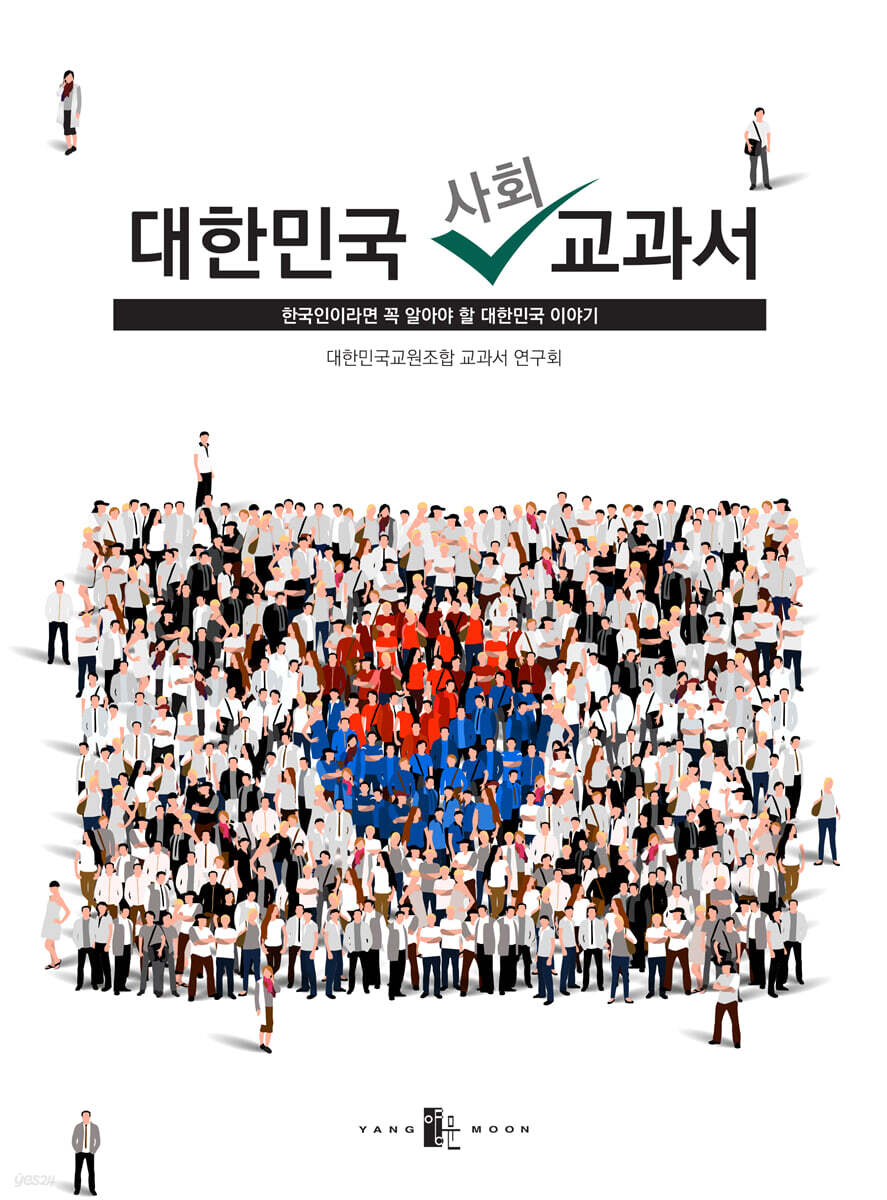
Korean social studies textbook
 |
Description
Book Introduction
The Korean Teachers' Association Textbook Research Group, the authors of this book, sincerely hope that readers will gain a deeper understanding of the recent, modern, and contemporary history that shaped Korea's present, and that based on that understanding, they will discover important lessons for solving present and future problems. This is why the concepts have been reorganized from the ground up.
The authors hope that parents who have been dissatisfied with the left-leaning bias in school education and teachers who have suffered in irrational educational settings will read this book.
And I hope this book will be a welcome shower to all those who have longed for a bolder view of history that confidently pioneers a bright and splendid future, breaking away from the gloomy view of history that only looks back and criticizes the country after it has been built well.
The authors hope that parents who have been dissatisfied with the left-leaning bias in school education and teachers who have suffered in irrational educational settings will read this book.
And I hope this book will be a welcome shower to all those who have longed for a bolder view of history that confidently pioneers a bright and splendid future, breaking away from the gloomy view of history that only looks back and criticizes the country after it has been built well.
- You can preview some of the book's contents.
Preview
index
Recommendation | Who Are We?
Recommendation | On the Publication of “The Social Studies Textbook of the Republic of Korea”
Recommendation | We need education that instills pride and hope in the younger generation.
Ⅰ.
ingress
Why I'm publishing this book
Ⅱ.
Setting the concept straight
1.
Individual and Society
(1) Free individuals
(2) Wise social life
2.
Economic life and market economy
(1) Economic life
(2) Market economy
(3) Market economy and government
3.
Liberal democracy and politics in South Korea
(1) Free and equal citizens
(2) Realization of democratic politics
(3) The birth and establishment of the international community
(4) International cooperation and globalization
Ⅲ.
Society before the Republic of Korea
1.
Late Joseon Dynasty society
2.
Japanese colonial era society
3.
Society in the three years after liberation
Ⅳ.
The path that the Republic of Korea has taken
1.
The great cause of nation-building achieved through trials
(1) Crisis immediately after the founding of the nation
(2) Korean War
(3) Learning about democracy
(4) From ashes to self-reliant economy
2.
A revolution of wealth, industrialization, and modernization
(1) The April 19th Democratic Revolution and the frustration of the Democratic Party government
(2) The May 16 Military Coup: The Path to Modernization
(3) Transition to an export-led development strategy
(4) Heavy chemical industrialization and national development
3.
Expansion of individual freedom (1980s-1990s)
(1) The shift in political power and the dawn of a democratic era
(2) A path to a high-level market economy
(3) Development of civil society and improvement of quality of life
4.
South Korea in the World (from the 1990s to the present)
(1) Peaceful regime change and polarized politics
(2) From a country that received aid to a country that gave aid
(3) Entering a new era and our tasks
V.
The path that South Korea should take
1.
Science, technology, and social change
(1) Scientific social life
(2) Development of science, technology, and civilization
(3) Changes in science, technology, and social life
(4) Our tasks for a better future society
2.
South Korea moving toward unification
(1) Why unification is necessary
(2) The Reality of North Korea 456
(3) Lessons from unification cases in other countries
(4) One step toward unification
3.
The future of the international community and South Korea
(1) Future international politics of the Republic of Korea
supplement
1.
Let us build a new nation on a foundation of eternal rock (National Foundation Address by the first President Syngman Rhee (August 15, 1948))
2.
A story about the president
3.
Comparison of the Constitutions of South Korea and North Korea
- annotation
- Social Studies Textbooks of the Republic of Korea_Participating Authors and Key Careers
- Reference books and materials
Recommendation | On the Publication of “The Social Studies Textbook of the Republic of Korea”
Recommendation | We need education that instills pride and hope in the younger generation.
Ⅰ.
ingress
Why I'm publishing this book
Ⅱ.
Setting the concept straight
1.
Individual and Society
(1) Free individuals
(2) Wise social life
2.
Economic life and market economy
(1) Economic life
(2) Market economy
(3) Market economy and government
3.
Liberal democracy and politics in South Korea
(1) Free and equal citizens
(2) Realization of democratic politics
(3) The birth and establishment of the international community
(4) International cooperation and globalization
Ⅲ.
Society before the Republic of Korea
1.
Late Joseon Dynasty society
2.
Japanese colonial era society
3.
Society in the three years after liberation
Ⅳ.
The path that the Republic of Korea has taken
1.
The great cause of nation-building achieved through trials
(1) Crisis immediately after the founding of the nation
(2) Korean War
(3) Learning about democracy
(4) From ashes to self-reliant economy
2.
A revolution of wealth, industrialization, and modernization
(1) The April 19th Democratic Revolution and the frustration of the Democratic Party government
(2) The May 16 Military Coup: The Path to Modernization
(3) Transition to an export-led development strategy
(4) Heavy chemical industrialization and national development
3.
Expansion of individual freedom (1980s-1990s)
(1) The shift in political power and the dawn of a democratic era
(2) A path to a high-level market economy
(3) Development of civil society and improvement of quality of life
4.
South Korea in the World (from the 1990s to the present)
(1) Peaceful regime change and polarized politics
(2) From a country that received aid to a country that gave aid
(3) Entering a new era and our tasks
V.
The path that South Korea should take
1.
Science, technology, and social change
(1) Scientific social life
(2) Development of science, technology, and civilization
(3) Changes in science, technology, and social life
(4) Our tasks for a better future society
2.
South Korea moving toward unification
(1) Why unification is necessary
(2) The Reality of North Korea 456
(3) Lessons from unification cases in other countries
(4) One step toward unification
3.
The future of the international community and South Korea
(1) Future international politics of the Republic of Korea
supplement
1.
Let us build a new nation on a foundation of eternal rock (National Foundation Address by the first President Syngman Rhee (August 15, 1948))
2.
A story about the president
3.
Comparison of the Constitutions of South Korea and North Korea
- annotation
- Social Studies Textbooks of the Republic of Korea_Participating Authors and Key Careers
- Reference books and materials
Into the book
The political slogans that emerged in political society after democratization were mainly populism that stimulated the collective emotions of the public.
For example, the political slogan of economic democratization simplified economic issues and reduced them to a good versus evil framework.
By elevating economic equality as good and condemning economic inequality as evil, they encouraged the collectivist desires of the masses.
If we reduce economic issues to a simple good-versus-evil framework, the problem will not be solved and will only become more complicated.
When we perceive any problem as a simplistic construct, we tend to ignore the realities of life and seek irrational and unrealistic solutions.
--- p.39
As direct transactions expand, two invisible problems arise.
First, the jobs of people working in mid-level distribution or mid-level manufacturing companies will completely disappear.
While farmworker wages may rise through direct trade, other jobs outside the farm fence will be completely and cruelly eliminated.
Second, while jobs offered to workers on fair trade farms will likely offer higher wages, they will also increase barriers to entry, ultimately reducing the number of jobs available.
Additionally, if you don't buy coffee from farms that are perceived as exploiting their labor in the name of producing good coffee, most of the workers on those farms will lose their jobs.
When they lose even the low-paying jobs they have had, they are forced into miserable lives such as drug trafficking, begging, and prostitution.
This is the inconvenient truth about 'good' trade.
--- p.86
If we look at the key points of the Constitution, we can clearly see what kind of country it was trying to build our country into.
The Constitution was a declaration of a democratic republic that adopted liberal democracy and a market economy.
Basic freedoms and property rights were guaranteed to all citizens, and the realization of social justice and the balanced development of the national economy became the state's mission.
The direction itself was revolutionary and different from that of the Joseon Dynasty, which was a monarchy.
Despite numerous domestic and international challenges, our country has maintained the core elements of liberal democracy and a market economy, enabling it to develop vigorously and become the advanced nation it is today.
--- p.101
The liberal democratic political ideology that values individual freedom and human rights as the highest values and the communist socialist political ideology that dreams of a utopian world where everyone works together and shares equally according to the labor theory of value were like oil and water.
It was a world view that could not possibly be mixed or held hands.
Soviet troops and communists in the North Korean region established the North Korean People's Committee in February 1946.
In March, a land reform was implemented, in which land was confiscated and distributed free of charge (North Korea's free distribution of land only granted farming rights without ownership rights), and in August of the same year, industry, transportation, postal services, and banks were nationalized.
A communist state was being built at a super-special rate.
Those who opposed communism risked their lives and came down to South Korea.
They did their best to inform the people of South Korea about the reality of communism.
--- p.182
The fact that many people were released without charge or found not guilty by the Special Committee on Anti-National Activities should not be simply concluded as a result of justice not being served.
Rather, it can be seen as a surprising achievement of the new republic of the Republic of Korea.
We tried to convict everything based on modern legal procedures and the rule of law, and there were many rulings that a person could not be convicted if there was circumstantial evidence but not enough evidence.
Despite the possibility of escalating to mad violence based on a hasty historical liquidation, efforts were made to maintain the form and procedures of a modern state governed by the rule of law.
This was an aspect that showed the maturity of the founding generation.
--- p.200
On the night of June 27, U.S. Ambassador Muccio visited Syngman Rhee.
Ambassador Muccio explained America's policy of active intervention, saying, "God has not abandoned Korea," and "The war is now not your war, but our war."
Empowered by these words, Syngman Rhee decided to broadcast to reassure the people and boost the morale of the military.
After consulting with the Director of Public Relations, I called Seoul Central Broadcasting Station and decided to broadcast at 10 PM on June 27th.
The content is, “The enemy is finally approaching Seoul with tanks, fighter planes, and battleships, and our military has virtually no means to fight back,” and “The UN and the United States have decided to help us fight.
The gist of it was, “Now, they have begun to help us by bringing in weapons and military supplies by air and sea, so please rest assured that if you persevere even though it may be difficult, you will be able to defeat the enemy.”
It was a message to not lose hope in the face of overwhelming despair.
Nowhere in that speech was there any irresponsible distortion of facts or deception of the public with lies, such as, “Citizens, please be at ease,” or “Seoul citizens, be at ease and defend Seoul.”
--- p.219
The early forms of authoritarianism in Korea were very different from those of other emerging countries.
There have not been many cases in which universal suffrage has been maintained in authoritarian regimes.
For example, only seven newly established countries have held general elections more than three times since their founding: Korea, India, Singapore, Malaysia, Taiwan, Ceylon, and the Philippines.
South Korea's authoritarian system was relatively good among newly developing countries.
The authoritarian regime in the early days of the nation's founding strengthened its legitimacy by expanding universal suffrage.
This is a rare example seen in other countries.
Korean politics in the 1950s needs to be fairly reevaluated from a comparative historical perspective, moving beyond the dichotomous perspective of democracy versus dictatorship.
--- p.248
Syngman Rhee's independent diplomacy appeared as a policy of strong confrontation with Japan.
At that time, the United States was pursuing an East Asian policy centered on Japan.
The United States hoped that South Korea would cooperate with Japan to pursue economic development and strengthen regional security.
To Syngman Rhee, it meant that we would once again become dependent on Japan.
Because Japan's post-war recovery and reconstruction meant sacrificing Korea, a victim of colonial rule and war.
He unilaterally drew a peace line and declared maritime sovereignty.
With this, it was made clear that Dokdo was Korean territory, and any Japanese fishing boat that entered the peace line was seized without a second thought.
Japanese ships that crossed the peace line without permission became Korean assets.
South Korea's left-wing intellectuals have criticized Syngman Rhee as a traitor to the nation for embracing some pro-Japanese collaborators in the construction of the Republic of Korea system.
However, the fact that they pursued a tough diplomatic approach toward Japan despite opposition from the United States and officially declared Dokdo as Korean territory shows how false their claims are.
--- p.264
The 1950s left behind more than just material assets.
The maturation and development of human capital during this period led to the miraculous development of the Republic of Korea.
At that time, something that could be called an 'educational revolution' occurred in national education.
The Syngman Rhee government invested one-fifth of the government budget into education, meaning that in a situation where half of the government budget had to be spent on defense, most of the national budget was spent on national education.
Considering that one-fifth of the government budget was spent on the Gyeongbu Expressway during the Park Chung-hee administration, the situation was much worse than during the Park Chung-hee administration, and it can be said that there was excessive emphasis on education despite the fact that there were many areas where the government's money could be spent in the early days of the nation's founding.
Despite difficult economic conditions, the government provided abundant educational opportunities for young people, and the people also devoted themselves to their children's education with remarkable passion.
Most people who could not read were able to read and think at a higher level.
Both the country and the people believed that only education could open the future.
--- p.285
The majority of the people were gripped by a deep sense of crisis, unable to predict even an inch ahead.
A poll conducted a few months after Chang Myon took power showed that public sentiment had turned against him, with only 3.7% of respondents supporting him.
The U.S. government began to take a pessimistic view of the leader's situation.
In a report sent to his home country, Ambassador McConaughey predicted that "from a political leadership perspective, Chang Myon is not the right person for the job, and the Korean government will have to rely on a group or organization of young and promising leaders rather than an individual."
The only force that could overcome the crisis was the military.
On the morning of May 16, 1961, the military staged a coup.
The Democratic Party's Jang Myon government ended up disintegrating without any power.
--- p.306
Park Chung-hee's modernization revolution, which began with the May 16 military coup, was based on Syngman Rhee's great cause of nation-building.
The April 19 Revolution aimed for democracy, while the May 16 Revolution practiced authoritarianism, so they appear to be at odds with each other.
However, the April 19 Revolution and the May 16 Revolution grew together in the political system established by Syngman Rhee's founding forces.
Together, they transformed the political landscape of the Republic of Korea and worked together to modernize their country.
The April 19 generation actively participated in the economic development led by the May 16th forces.
That's how the free market economic system grew.
--- p.332
By concluding the Korea-Japan Agreement around 1965 and dispatching troops to Vietnam, the Park Chung-hee government created a political and economic environment suited to its export-led development strategy.
South Korea has not only strengthened political and military ties with key allies, but also secured the market conditions necessary for economic development.
Korea imported raw materials and intermediate goods from Japan, processed them into finished products domestically, and exported them to the United States.
Entry into international markets was the most important driving force behind Korea's high economic growth until 1972.
The political and economic relationship between Korea, the United States, and Japan, established across the Pacific Ocean, was similar to the Pacific Triangle Alliance.
--- p.341
The Saemaul Movement reorganized traditional villages, which were suffering from the caste system, into entities with shared property and joint projects, and thus into corporations.
All villages have changed their character to a general meeting of residents according to village rules.
The General Assembly elected leaders, planned and promoted joint projects, reviewed budgets and accounts related to the projects, and accumulated surplus funds as a joint fund.
They also jointly owned village halls and workshops.
To build shared facilities, residents had to give up their farmland little by little.
For a village business to succeed, its residents had to be diligent, self-helpful, and cooperative with the New Village spirit, and they had to completely wash away decadent practices such as superstition, gambling, and drinking.
President Park Chung-hee expanded the Saemaul Movement from rural areas to fishing villages, cities, and factories.
The Saemaul Movement was not just a movement to increase income and improve the environment in rural areas.
It was a spiritual reform movement based on the revolutionary pledge to 'eradicate the country's corruption and evils and rectify the decadent national morality and national spirit.'
The Saemaul Movement itself was a modernization revolution that put into practice the spirit of May 16.
--- p.368
During this period, our country achieved modern development in all fields and can be said to have effectively become a modern nation in the 1990s.
The characteristics of a modern state include individual freedom and choice based on free will, the existence of a people with responsibility and sovereignty over their free choices, the development of liberal democratic politics and scientific and technological advancements, economic development and improvement of cultural life through industrialization, a social culture in which rational individuals live in harmony, trust in individual reason and reason, and optimism about the future.
In the 20 years since President Park Chung-hee's death, the various regimes that took power during these turbulent times can boast of having successfully addressed the challenges of the times in all areas of society.
It seems that all of these people, without exception, played their own roles in transforming our country into a modern nation.
In particular, the Chun Doo-hwan government, which achieved high economic growth despite severe political, economic, and social crises, appears to have overcome its inherent limitations and fully fulfilled its epochal mission.
-
--- p.395
However, China's attitude throughout President Moon Jae-in's visit was disappointing.
Although it was a state visit, only two of the ten meals were official banquets, and the rest were so-called "meals alone," eaten by the visiting delegation.
And an unprecedented incident occurred where the reporters who went together were kicked by a Chinese security guard.
Despite suffering unbearable humiliation, President Moon Jae-in delivered a rousing speech at Peking University, saying, “I hope that the Chinese dream will not be just China’s dream, but a dream shared by all of Asia and, ultimately, all of humanity.”
He then said, “Korea is a small country, but we will join you in achieving that dream,” which was more than just a compliment; it was close to mean flattery.
Former President Jiang Zemin treated President Kim Dae-jung as “big brother,” but President Moon Jae-in treated him no differently than a Joseon envoy who crawled on the ground.
--- p.410
Entering the 21st century, South Korea's international status has further improved.
During the Lee Myung-bak administration, it became the chair country of the G20 summit held in Seoul.
We also hosted a Nuclear Security Summit to jointly address the threat of nuclear proliferation.
It also hosted the secretariat of the Green Climate Fund (GCF), which aims to solve environmental problems in developing countries.
A country that was devastated by the Korean War miraculously achieved economic development and hosted the 1988 Seoul Olympics.
It was a great achievement that made the world aware of the advanced Republic of Korea.
The Korea-Japan World Cup was also held.
Following this, the Daegu World Athletics Championships and the Pyeongchang Winter Olympics were held.
Our country became the fifth country in the world to achieve the Grand Slam of hosting international sports competitions, following Italy, Germany, Japan, and France.
--- p.421
In the process of preparing for unification, we must build a relationship with North Korea that upholds principles.
If we give unconditionally or waver without principles, we will not be able to make good use of the opportunity for unification even when it comes.
All citizens must maintain a firm belief in liberal democracy and not be swayed by propaganda from North Korea or leftist forces.
The new Cold War of the US-China hegemony competition will unfold in a much more complex manner than the old Cold War of the US-Soviet hegemony competition.
A generous and mature national consciousness is most important.
--- p.474
How did South Korea, from the poorest of the poor, achieve the "Miracle on the Han River"? After the Korean War ended, the country established a national financial plan with aid from the United States.
In a time when most of the necessities were aid goods, the main export items were primary industrial products such as rice, seaweed, raw silk, and pig hair.
The high growth of the Korean economy began in the 1960s.
The Park Chung-hee regime revised the three-year economic development plan prepared by the Syngman Rhee regime and, after the May 16 Revolution, made anti-communism and economic development its top priorities.
In the early days of the regime, a five-year economic development plan was promoted with a focus on light industry.
In addition, we established an export strategy and entered the global market, focusing on export trade.
In the early 1970s, the 'Saemaul Movement' was launched, awakening the diligence and sincerity that had been dormant within the people.
The slogan, “Fight while working, work while fighting, fight while working,” illustrates this well.
In the late 1960s, the construction of the Gyeongbu Expressway and the construction of the Pohang Iron and Steel Company began, and industrial infrastructure began to be established.
Entering the 1970s, a five-year economic development plan centered on heavy industry was established and ambitiously implemented.
The size of the Korean economy grew steadily in 1974 as it earned oil dollars through its entry into the Middle East construction market.
For example, the political slogan of economic democratization simplified economic issues and reduced them to a good versus evil framework.
By elevating economic equality as good and condemning economic inequality as evil, they encouraged the collectivist desires of the masses.
If we reduce economic issues to a simple good-versus-evil framework, the problem will not be solved and will only become more complicated.
When we perceive any problem as a simplistic construct, we tend to ignore the realities of life and seek irrational and unrealistic solutions.
--- p.39
As direct transactions expand, two invisible problems arise.
First, the jobs of people working in mid-level distribution or mid-level manufacturing companies will completely disappear.
While farmworker wages may rise through direct trade, other jobs outside the farm fence will be completely and cruelly eliminated.
Second, while jobs offered to workers on fair trade farms will likely offer higher wages, they will also increase barriers to entry, ultimately reducing the number of jobs available.
Additionally, if you don't buy coffee from farms that are perceived as exploiting their labor in the name of producing good coffee, most of the workers on those farms will lose their jobs.
When they lose even the low-paying jobs they have had, they are forced into miserable lives such as drug trafficking, begging, and prostitution.
This is the inconvenient truth about 'good' trade.
--- p.86
If we look at the key points of the Constitution, we can clearly see what kind of country it was trying to build our country into.
The Constitution was a declaration of a democratic republic that adopted liberal democracy and a market economy.
Basic freedoms and property rights were guaranteed to all citizens, and the realization of social justice and the balanced development of the national economy became the state's mission.
The direction itself was revolutionary and different from that of the Joseon Dynasty, which was a monarchy.
Despite numerous domestic and international challenges, our country has maintained the core elements of liberal democracy and a market economy, enabling it to develop vigorously and become the advanced nation it is today.
--- p.101
The liberal democratic political ideology that values individual freedom and human rights as the highest values and the communist socialist political ideology that dreams of a utopian world where everyone works together and shares equally according to the labor theory of value were like oil and water.
It was a world view that could not possibly be mixed or held hands.
Soviet troops and communists in the North Korean region established the North Korean People's Committee in February 1946.
In March, a land reform was implemented, in which land was confiscated and distributed free of charge (North Korea's free distribution of land only granted farming rights without ownership rights), and in August of the same year, industry, transportation, postal services, and banks were nationalized.
A communist state was being built at a super-special rate.
Those who opposed communism risked their lives and came down to South Korea.
They did their best to inform the people of South Korea about the reality of communism.
--- p.182
The fact that many people were released without charge or found not guilty by the Special Committee on Anti-National Activities should not be simply concluded as a result of justice not being served.
Rather, it can be seen as a surprising achievement of the new republic of the Republic of Korea.
We tried to convict everything based on modern legal procedures and the rule of law, and there were many rulings that a person could not be convicted if there was circumstantial evidence but not enough evidence.
Despite the possibility of escalating to mad violence based on a hasty historical liquidation, efforts were made to maintain the form and procedures of a modern state governed by the rule of law.
This was an aspect that showed the maturity of the founding generation.
--- p.200
On the night of June 27, U.S. Ambassador Muccio visited Syngman Rhee.
Ambassador Muccio explained America's policy of active intervention, saying, "God has not abandoned Korea," and "The war is now not your war, but our war."
Empowered by these words, Syngman Rhee decided to broadcast to reassure the people and boost the morale of the military.
After consulting with the Director of Public Relations, I called Seoul Central Broadcasting Station and decided to broadcast at 10 PM on June 27th.
The content is, “The enemy is finally approaching Seoul with tanks, fighter planes, and battleships, and our military has virtually no means to fight back,” and “The UN and the United States have decided to help us fight.
The gist of it was, “Now, they have begun to help us by bringing in weapons and military supplies by air and sea, so please rest assured that if you persevere even though it may be difficult, you will be able to defeat the enemy.”
It was a message to not lose hope in the face of overwhelming despair.
Nowhere in that speech was there any irresponsible distortion of facts or deception of the public with lies, such as, “Citizens, please be at ease,” or “Seoul citizens, be at ease and defend Seoul.”
--- p.219
The early forms of authoritarianism in Korea were very different from those of other emerging countries.
There have not been many cases in which universal suffrage has been maintained in authoritarian regimes.
For example, only seven newly established countries have held general elections more than three times since their founding: Korea, India, Singapore, Malaysia, Taiwan, Ceylon, and the Philippines.
South Korea's authoritarian system was relatively good among newly developing countries.
The authoritarian regime in the early days of the nation's founding strengthened its legitimacy by expanding universal suffrage.
This is a rare example seen in other countries.
Korean politics in the 1950s needs to be fairly reevaluated from a comparative historical perspective, moving beyond the dichotomous perspective of democracy versus dictatorship.
--- p.248
Syngman Rhee's independent diplomacy appeared as a policy of strong confrontation with Japan.
At that time, the United States was pursuing an East Asian policy centered on Japan.
The United States hoped that South Korea would cooperate with Japan to pursue economic development and strengthen regional security.
To Syngman Rhee, it meant that we would once again become dependent on Japan.
Because Japan's post-war recovery and reconstruction meant sacrificing Korea, a victim of colonial rule and war.
He unilaterally drew a peace line and declared maritime sovereignty.
With this, it was made clear that Dokdo was Korean territory, and any Japanese fishing boat that entered the peace line was seized without a second thought.
Japanese ships that crossed the peace line without permission became Korean assets.
South Korea's left-wing intellectuals have criticized Syngman Rhee as a traitor to the nation for embracing some pro-Japanese collaborators in the construction of the Republic of Korea system.
However, the fact that they pursued a tough diplomatic approach toward Japan despite opposition from the United States and officially declared Dokdo as Korean territory shows how false their claims are.
--- p.264
The 1950s left behind more than just material assets.
The maturation and development of human capital during this period led to the miraculous development of the Republic of Korea.
At that time, something that could be called an 'educational revolution' occurred in national education.
The Syngman Rhee government invested one-fifth of the government budget into education, meaning that in a situation where half of the government budget had to be spent on defense, most of the national budget was spent on national education.
Considering that one-fifth of the government budget was spent on the Gyeongbu Expressway during the Park Chung-hee administration, the situation was much worse than during the Park Chung-hee administration, and it can be said that there was excessive emphasis on education despite the fact that there were many areas where the government's money could be spent in the early days of the nation's founding.
Despite difficult economic conditions, the government provided abundant educational opportunities for young people, and the people also devoted themselves to their children's education with remarkable passion.
Most people who could not read were able to read and think at a higher level.
Both the country and the people believed that only education could open the future.
--- p.285
The majority of the people were gripped by a deep sense of crisis, unable to predict even an inch ahead.
A poll conducted a few months after Chang Myon took power showed that public sentiment had turned against him, with only 3.7% of respondents supporting him.
The U.S. government began to take a pessimistic view of the leader's situation.
In a report sent to his home country, Ambassador McConaughey predicted that "from a political leadership perspective, Chang Myon is not the right person for the job, and the Korean government will have to rely on a group or organization of young and promising leaders rather than an individual."
The only force that could overcome the crisis was the military.
On the morning of May 16, 1961, the military staged a coup.
The Democratic Party's Jang Myon government ended up disintegrating without any power.
--- p.306
Park Chung-hee's modernization revolution, which began with the May 16 military coup, was based on Syngman Rhee's great cause of nation-building.
The April 19 Revolution aimed for democracy, while the May 16 Revolution practiced authoritarianism, so they appear to be at odds with each other.
However, the April 19 Revolution and the May 16 Revolution grew together in the political system established by Syngman Rhee's founding forces.
Together, they transformed the political landscape of the Republic of Korea and worked together to modernize their country.
The April 19 generation actively participated in the economic development led by the May 16th forces.
That's how the free market economic system grew.
--- p.332
By concluding the Korea-Japan Agreement around 1965 and dispatching troops to Vietnam, the Park Chung-hee government created a political and economic environment suited to its export-led development strategy.
South Korea has not only strengthened political and military ties with key allies, but also secured the market conditions necessary for economic development.
Korea imported raw materials and intermediate goods from Japan, processed them into finished products domestically, and exported them to the United States.
Entry into international markets was the most important driving force behind Korea's high economic growth until 1972.
The political and economic relationship between Korea, the United States, and Japan, established across the Pacific Ocean, was similar to the Pacific Triangle Alliance.
--- p.341
The Saemaul Movement reorganized traditional villages, which were suffering from the caste system, into entities with shared property and joint projects, and thus into corporations.
All villages have changed their character to a general meeting of residents according to village rules.
The General Assembly elected leaders, planned and promoted joint projects, reviewed budgets and accounts related to the projects, and accumulated surplus funds as a joint fund.
They also jointly owned village halls and workshops.
To build shared facilities, residents had to give up their farmland little by little.
For a village business to succeed, its residents had to be diligent, self-helpful, and cooperative with the New Village spirit, and they had to completely wash away decadent practices such as superstition, gambling, and drinking.
President Park Chung-hee expanded the Saemaul Movement from rural areas to fishing villages, cities, and factories.
The Saemaul Movement was not just a movement to increase income and improve the environment in rural areas.
It was a spiritual reform movement based on the revolutionary pledge to 'eradicate the country's corruption and evils and rectify the decadent national morality and national spirit.'
The Saemaul Movement itself was a modernization revolution that put into practice the spirit of May 16.
--- p.368
During this period, our country achieved modern development in all fields and can be said to have effectively become a modern nation in the 1990s.
The characteristics of a modern state include individual freedom and choice based on free will, the existence of a people with responsibility and sovereignty over their free choices, the development of liberal democratic politics and scientific and technological advancements, economic development and improvement of cultural life through industrialization, a social culture in which rational individuals live in harmony, trust in individual reason and reason, and optimism about the future.
In the 20 years since President Park Chung-hee's death, the various regimes that took power during these turbulent times can boast of having successfully addressed the challenges of the times in all areas of society.
It seems that all of these people, without exception, played their own roles in transforming our country into a modern nation.
In particular, the Chun Doo-hwan government, which achieved high economic growth despite severe political, economic, and social crises, appears to have overcome its inherent limitations and fully fulfilled its epochal mission.
-
--- p.395
However, China's attitude throughout President Moon Jae-in's visit was disappointing.
Although it was a state visit, only two of the ten meals were official banquets, and the rest were so-called "meals alone," eaten by the visiting delegation.
And an unprecedented incident occurred where the reporters who went together were kicked by a Chinese security guard.
Despite suffering unbearable humiliation, President Moon Jae-in delivered a rousing speech at Peking University, saying, “I hope that the Chinese dream will not be just China’s dream, but a dream shared by all of Asia and, ultimately, all of humanity.”
He then said, “Korea is a small country, but we will join you in achieving that dream,” which was more than just a compliment; it was close to mean flattery.
Former President Jiang Zemin treated President Kim Dae-jung as “big brother,” but President Moon Jae-in treated him no differently than a Joseon envoy who crawled on the ground.
--- p.410
Entering the 21st century, South Korea's international status has further improved.
During the Lee Myung-bak administration, it became the chair country of the G20 summit held in Seoul.
We also hosted a Nuclear Security Summit to jointly address the threat of nuclear proliferation.
It also hosted the secretariat of the Green Climate Fund (GCF), which aims to solve environmental problems in developing countries.
A country that was devastated by the Korean War miraculously achieved economic development and hosted the 1988 Seoul Olympics.
It was a great achievement that made the world aware of the advanced Republic of Korea.
The Korea-Japan World Cup was also held.
Following this, the Daegu World Athletics Championships and the Pyeongchang Winter Olympics were held.
Our country became the fifth country in the world to achieve the Grand Slam of hosting international sports competitions, following Italy, Germany, Japan, and France.
--- p.421
In the process of preparing for unification, we must build a relationship with North Korea that upholds principles.
If we give unconditionally or waver without principles, we will not be able to make good use of the opportunity for unification even when it comes.
All citizens must maintain a firm belief in liberal democracy and not be swayed by propaganda from North Korea or leftist forces.
The new Cold War of the US-China hegemony competition will unfold in a much more complex manner than the old Cold War of the US-Soviet hegemony competition.
A generous and mature national consciousness is most important.
--- p.474
How did South Korea, from the poorest of the poor, achieve the "Miracle on the Han River"? After the Korean War ended, the country established a national financial plan with aid from the United States.
In a time when most of the necessities were aid goods, the main export items were primary industrial products such as rice, seaweed, raw silk, and pig hair.
The high growth of the Korean economy began in the 1960s.
The Park Chung-hee regime revised the three-year economic development plan prepared by the Syngman Rhee regime and, after the May 16 Revolution, made anti-communism and economic development its top priorities.
In the early days of the regime, a five-year economic development plan was promoted with a focus on light industry.
In addition, we established an export strategy and entered the global market, focusing on export trade.
In the early 1970s, the 'Saemaul Movement' was launched, awakening the diligence and sincerity that had been dormant within the people.
The slogan, “Fight while working, work while fighting, fight while working,” illustrates this well.
In the late 1960s, the construction of the Gyeongbu Expressway and the construction of the Pohang Iron and Steel Company began, and industrial infrastructure began to be established.
Entering the 1970s, a five-year economic development plan centered on heavy industry was established and ambitiously implemented.
The size of the Korean economy grew steadily in 1974 as it earned oil dollars through its entry into the Middle East construction market.
--- p.504
Publisher's Review
[Republic of Korea Social Studies Textbook], created with the goal of providing a proper understanding of modern and contemporary Korean history.
Written to accurately understand the significance of important events related to the birth and development of the Republic of Korea
It is designed to encourage students to think deeply about past events rather than simply memorizing them.
This book will be a welcome shower to all those who have longed for a bold historical perspective that will break free from the gloomy view of history and confidently pioneer a bright and splendid future.
Our country achieved the Miracle on the Han River from the ruins of war and became one of the world's most advanced countries.
Our young people are leading youth culture on the global stage, Samsung's mobile phones are competing for the top two spots in the world, and Hyundai Motor Company has risen to third place.
Nevertheless, they are either deceived by the inflammatory rhetoric that "South Korea should never have been born" or are lumping all former presidents together and looking down on them for being dictators.
The reason why this kind of incorrect historical awareness is so widespread is because teachers from the Korean Teachers and Education Workers Union (KTU) have been leading anti-Republic of Korea education in elementary, middle, and high schools.
The Korean Teachers and Education Workers Union taught that "denying the legitimacy of the Republic of Korea and unreasonably opposing national policy" was democratization in the educational field, and encouraged students to take part in candlelight protests.
While condemning all past right-wing regimes as dictatorships, they supported the left-wing forces in power and openly defended them once they took power.
They also played a leading role in deleting 'liberal democracy' and inserting 'democracy' in the curriculum review.
If this happens, no matter which textbook they use, all students across the country will not know what liberal democracy is.
Until now, schools have provided textbooks that hide the successful history of South Korea and defend the totalitarian dictatorship of North Korea.
This book was written with the realization that we have reached a critical juncture where we must rebuke their uneducational mistakes and instill a correct view of history in our future generations.
We must no longer allow our modern history to be taught in a distorted manner in our educational settings and to only promote the leftist regime that recently came to power.
Modern history must clearly teach that it has been a struggle for freedom, and that democracy without freedom is nothing but totalitarianism.
This book, [Republic of Korea Social Studies Textbook], written with this goal in mind, richly covers the achievements of past presidents, including President Syngman Rhee, the founder of the nation, and President Park Chung-hee, the founder of a wealthy nation, as well as the achievements of prominent entrepreneurs, including Lee Byung-chul and Chung Ju-yung.
The authors also wrote this book with the conviction that, if our country is to become a well-ordered political nation, a country conducive to business, and a nation filled with creativity and consideration, our younger generation must gain much inspiration and wisdom from great leaders.
The Korean Teachers' Association Textbook Research Group, the authors of this book, sincerely hope that readers will gain a deeper understanding of the recent, modern, and contemporary history that shaped Korea's present, and that based on that understanding, they will discover important lessons for solving present and future problems. This is why the concepts have been reorganized from the ground up.
The authors hope that parents who have been dissatisfied with the left-leaning bias in school education and teachers who have suffered in irrational educational settings will read this book.
And I hope this book will be a welcome shower to all those who have longed for a bolder view of history that confidently pioneers a bright and splendid future, breaking away from the gloomy view of history that only looks back and criticizes the country after it has been built well.
Written to accurately understand the significance of important events related to the birth and development of the Republic of Korea
It is designed to encourage students to think deeply about past events rather than simply memorizing them.
This book will be a welcome shower to all those who have longed for a bold historical perspective that will break free from the gloomy view of history and confidently pioneer a bright and splendid future.
Our country achieved the Miracle on the Han River from the ruins of war and became one of the world's most advanced countries.
Our young people are leading youth culture on the global stage, Samsung's mobile phones are competing for the top two spots in the world, and Hyundai Motor Company has risen to third place.
Nevertheless, they are either deceived by the inflammatory rhetoric that "South Korea should never have been born" or are lumping all former presidents together and looking down on them for being dictators.
The reason why this kind of incorrect historical awareness is so widespread is because teachers from the Korean Teachers and Education Workers Union (KTU) have been leading anti-Republic of Korea education in elementary, middle, and high schools.
The Korean Teachers and Education Workers Union taught that "denying the legitimacy of the Republic of Korea and unreasonably opposing national policy" was democratization in the educational field, and encouraged students to take part in candlelight protests.
While condemning all past right-wing regimes as dictatorships, they supported the left-wing forces in power and openly defended them once they took power.
They also played a leading role in deleting 'liberal democracy' and inserting 'democracy' in the curriculum review.
If this happens, no matter which textbook they use, all students across the country will not know what liberal democracy is.
Until now, schools have provided textbooks that hide the successful history of South Korea and defend the totalitarian dictatorship of North Korea.
This book was written with the realization that we have reached a critical juncture where we must rebuke their uneducational mistakes and instill a correct view of history in our future generations.
We must no longer allow our modern history to be taught in a distorted manner in our educational settings and to only promote the leftist regime that recently came to power.
Modern history must clearly teach that it has been a struggle for freedom, and that democracy without freedom is nothing but totalitarianism.
This book, [Republic of Korea Social Studies Textbook], written with this goal in mind, richly covers the achievements of past presidents, including President Syngman Rhee, the founder of the nation, and President Park Chung-hee, the founder of a wealthy nation, as well as the achievements of prominent entrepreneurs, including Lee Byung-chul and Chung Ju-yung.
The authors also wrote this book with the conviction that, if our country is to become a well-ordered political nation, a country conducive to business, and a nation filled with creativity and consideration, our younger generation must gain much inspiration and wisdom from great leaders.
The Korean Teachers' Association Textbook Research Group, the authors of this book, sincerely hope that readers will gain a deeper understanding of the recent, modern, and contemporary history that shaped Korea's present, and that based on that understanding, they will discover important lessons for solving present and future problems. This is why the concepts have been reorganized from the ground up.
The authors hope that parents who have been dissatisfied with the left-leaning bias in school education and teachers who have suffered in irrational educational settings will read this book.
And I hope this book will be a welcome shower to all those who have longed for a bolder view of history that confidently pioneers a bright and splendid future, breaking away from the gloomy view of history that only looks back and criticizes the country after it has been built well.
GOODS SPECIFICS
- Date of issue: September 20, 2024
- Page count, weight, size: 584 pages | 170*230*35mm
- ISBN13: 9791198670236
- ISBN10: 1198670231
You may also like
카테고리
korean


korean

![GQ KOREA Mark (Monthly): December [2025]](http://librairie.coreenne.fr/cdn/shop/files/8ef265dbbfbf186523ed75ba7319009d.jpg?v=1765340328&width=3840)


