

A house in Seoul
 |
Description
Book Introduction
- A word from MD
-
Making a place for me to liveA struggle for a space of 'true residence' where you can eat, sleep, rest, and return at any time.
Editor Park Chan-yong's seven years of renovating his old apartment went beyond the simple process of repairs; perhaps it was a time of building up layers of 'residence' one by one.
November 11, 2025. Art PD Ahn Hyun-jae
- The 10th Gwangju Design Biennale 'Park Chan-yong's House' Exhibition
- A house that Kim Na-young of No Filter TV personally recruited after seeing a magazine and sending a DM saying, “It’s so pretty, I want to go to this house.”
7 years of minor, complicated home repairs
The story of renovating a house in Seoul and living there
The '15-pyeong maze' is connected to another maze.
It took 7 years from signing the contract for the house to living there.
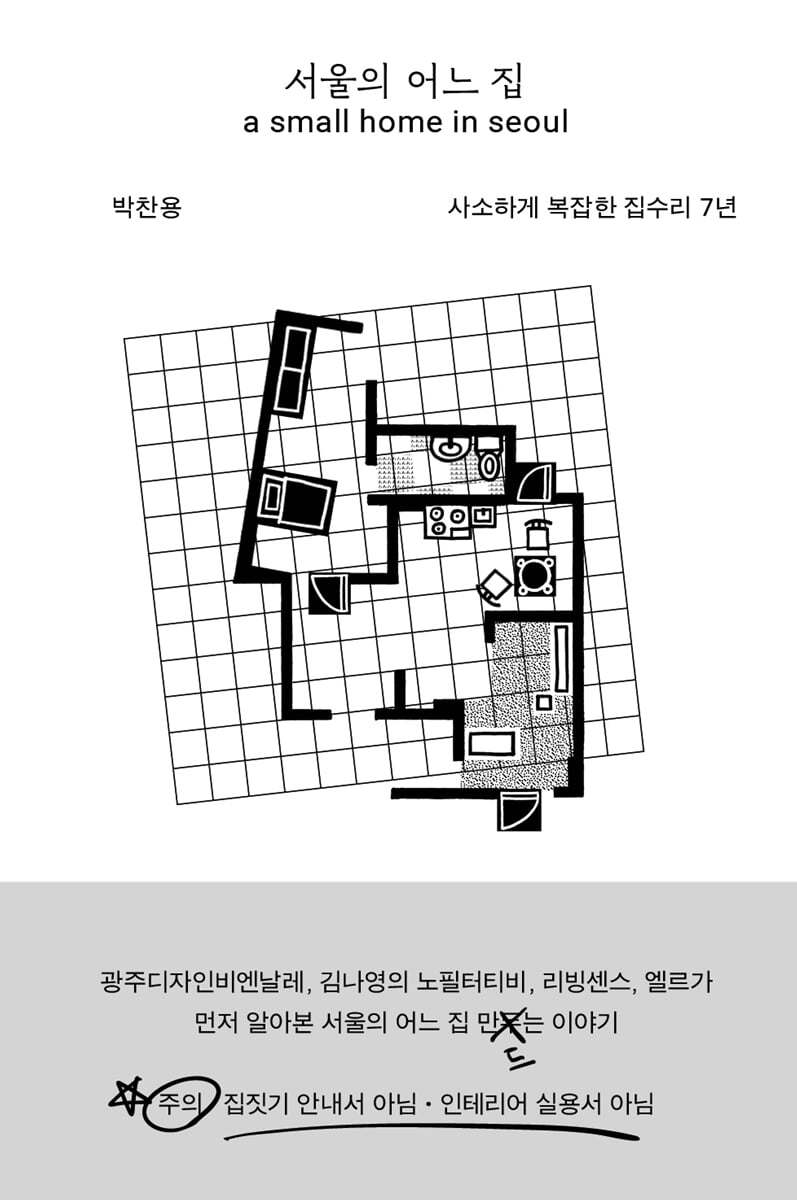
The story of magazine editor Park Chan-yong, who buys an old apartment in a neighborhood in Seoul, renovates it, and lives there.
Or, reference material on what you can and cannot do to create a living space that suits you.
A 300-page nonfiction book on home repairs
+ A conversation with architect Lee Hee-jun (adjunct professor at Kookmin University)
+ 12 appendices, including an interview with a demolition foreman and a guide to warehouses, tiles, and ceramics
+ Includes a chronology of 'A House in Seoul'
It took 7 years from signing the contract for the house to living there.
“It was an undeniable waste, and I can only say that I am satisfied with that waste.
Because now I know that I can only realize it by wasting money.” (Elle, April 2024, Park Chan-yong column) At the time of writing this article for the magazine, ‘a house in Seoul’ was habitable after six years of renovations, and I could shower with warm water.
What does "residence" even mean? In 21st-century Seoul, few would truly call living without any real furniture a "living" experience.
At that time, he would have been sitting on a used chair he had bought during a business trip to Switzerland, his laptop resting on his lap (or was it a delivery box?), and planning his furniture setup in between finishing his manuscript.
A place would become a home if it had a bed, a closet, and most importantly, a bookshelf (so I could stop unpacking things from boxes).
Why on earth? Why, for what purpose, has this house renovation remained unfinished after six years? According to "A 15-Pyeong Maze," the prologue to "A House in Seoul"...
The author purchased a unit in an old apartment building that was nearly 50 years old seven years ago.
It was the oldest apartment complex in Seodaemun-gu, Seoul, and was located on the top floor of a building without an elevator.
It was not renovated to meet today's housing standards, and so it was cheap.
He poured all the resources he had at the time into that house.
At the time, everyone around him tried to dissuade him from making this decision.
He didn't care.
Because there was a reason.
The main materials and props used to renovate this house came from several countries.
The switches, lights and sink are Swiss.
The toilet is Japanese, the second sink is German, the floor is Italian, and the tiles are Italian, Japanese, and Turkish.
He searched for those materials for a long time.
He was not well off and still is.
So most of the items he collected were bad inventory.
The sink, tiles, and toilet are over 30 years old.
Marudo is over 10 years old.
After collecting them all, he managed to fix up an old house in Seoul.
He started out thinking he knew a little about home repairs, but once he finished, he realized he didn't even know what he didn't know.
Meanwhile, the house has been built for over 50 years, and the world has gone through COVID-19 and entered the second era of AI and Trump.
When I was renovating this house, the reactions of the people around me were similar.
Why is that?
Why do you do that?
Now he can answer in a wide variety of ways, depending on who is asking and with what intention.
In a word, he wanted to know.
If you make it longer, it's like this.
What does it take for an individual with limited resources and talents to achieve the goal of living a decent life in Seoul?
How much can he spend, who can he meet, what can he create, what does his 00,000 won home repair budget consist of, how much can he save within it, where can he splurge, what can he implement, and how can he get what he wants, and before that, what is the 'reasonable life' he wants?
This book is a longer answer.
- A house that Kim Na-young of No Filter TV personally recruited after seeing a magazine and sending a DM saying, “It’s so pretty, I want to go to this house.”
7 years of minor, complicated home repairs
The story of renovating a house in Seoul and living there
The '15-pyeong maze' is connected to another maze.
It took 7 years from signing the contract for the house to living there.
The story of magazine editor Park Chan-yong, who buys an old apartment in a neighborhood in Seoul, renovates it, and lives there.
Or, reference material on what you can and cannot do to create a living space that suits you.
A 300-page nonfiction book on home repairs
+ A conversation with architect Lee Hee-jun (adjunct professor at Kookmin University)
+ 12 appendices, including an interview with a demolition foreman and a guide to warehouses, tiles, and ceramics
+ Includes a chronology of 'A House in Seoul'
It took 7 years from signing the contract for the house to living there.
“It was an undeniable waste, and I can only say that I am satisfied with that waste.
Because now I know that I can only realize it by wasting money.” (Elle, April 2024, Park Chan-yong column) At the time of writing this article for the magazine, ‘a house in Seoul’ was habitable after six years of renovations, and I could shower with warm water.
What does "residence" even mean? In 21st-century Seoul, few would truly call living without any real furniture a "living" experience.
At that time, he would have been sitting on a used chair he had bought during a business trip to Switzerland, his laptop resting on his lap (or was it a delivery box?), and planning his furniture setup in between finishing his manuscript.
A place would become a home if it had a bed, a closet, and most importantly, a bookshelf (so I could stop unpacking things from boxes).
Why on earth? Why, for what purpose, has this house renovation remained unfinished after six years? According to "A 15-Pyeong Maze," the prologue to "A House in Seoul"...
The author purchased a unit in an old apartment building that was nearly 50 years old seven years ago.
It was the oldest apartment complex in Seodaemun-gu, Seoul, and was located on the top floor of a building without an elevator.
It was not renovated to meet today's housing standards, and so it was cheap.
He poured all the resources he had at the time into that house.
At the time, everyone around him tried to dissuade him from making this decision.
He didn't care.
Because there was a reason.
The main materials and props used to renovate this house came from several countries.
The switches, lights and sink are Swiss.
The toilet is Japanese, the second sink is German, the floor is Italian, and the tiles are Italian, Japanese, and Turkish.
He searched for those materials for a long time.
He was not well off and still is.
So most of the items he collected were bad inventory.
The sink, tiles, and toilet are over 30 years old.
Marudo is over 10 years old.
After collecting them all, he managed to fix up an old house in Seoul.
He started out thinking he knew a little about home repairs, but once he finished, he realized he didn't even know what he didn't know.
Meanwhile, the house has been built for over 50 years, and the world has gone through COVID-19 and entered the second era of AI and Trump.
When I was renovating this house, the reactions of the people around me were similar.
Why is that?
Why do you do that?
Now he can answer in a wide variety of ways, depending on who is asking and with what intention.
In a word, he wanted to know.
If you make it longer, it's like this.
What does it take for an individual with limited resources and talents to achieve the goal of living a decent life in Seoul?
How much can he spend, who can he meet, what can he create, what does his 00,000 won home repair budget consist of, how much can he save within it, where can he splurge, what can he implement, and how can he get what he wants, and before that, what is the 'reasonable life' he wants?
This book is a longer answer.
- You can preview some of the book's contents.
Preview
index
Prologue - A 15-pyeong maze
Part 1.
thought
1.
Frozen Laundry 2.
3. From dawn to contract.
Cases of life (viewed through the variable called home) 4.
Principle of Principles (for Repair)
Part 2.
execution
5.
6. Rat droppings that fell on the former class president.
Bones of the House 7.
Bloodline of the House 8.
Kitchen Dreams and Electric Miyamoto Musashi 9.
10 Ways COVID-19 Affected My Windows
Intermission of home repairs
Intermission
11.
Hansel and Gretel at Hakdong Station 12.
Encounter with Maru 13.
Giorgio Armani 14 of the 00s in the tile world.
Toilet in a cloudy memory
Part 3.
Move in
15.
16 Home Repair Experts Who Look Like Cat Buses.
Beauty and Instinct 17.
Because it can't always be good.
18 Missing tiles 19.
Ironworks Time 20 The day I moved in
Park Chan-yong's House Exhibition
Part 4.
life
21.
Shower Curtain Blues 22.
Furniture Samgochoryo 23.
24th day of moving furniture.
IKEA ratio 2025 25.
Refrigerator, washing machine, air conditioner 26.
Moving bare-chested
Conversation - with young architect Lee Hee-jun
Epilogue - Connecting Labyrinths
Acknowledgments and Notes
Chronology
[supplement]
First (Set) House Chronicles
villas in Seoul
Interview with former class president
Some books I read while doing home repairs
About windows
The floor of dreams and the floor of reality
Dropped tiles
Bathroom ware variables
Repairs you do yourself vs. leaving to a designer
Sounds inside the house
Personal furniture commissioning process and results experience
A book about architecture loosely connected to this house
Part 1.
thought
1.
Frozen Laundry 2.
3. From dawn to contract.
Cases of life (viewed through the variable called home) 4.
Principle of Principles (for Repair)
Part 2.
execution
5.
6. Rat droppings that fell on the former class president.
Bones of the House 7.
Bloodline of the House 8.
Kitchen Dreams and Electric Miyamoto Musashi 9.
10 Ways COVID-19 Affected My Windows
Intermission of home repairs
Intermission
11.
Hansel and Gretel at Hakdong Station 12.
Encounter with Maru 13.
Giorgio Armani 14 of the 00s in the tile world.
Toilet in a cloudy memory
Part 3.
Move in
15.
16 Home Repair Experts Who Look Like Cat Buses.
Beauty and Instinct 17.
Because it can't always be good.
18 Missing tiles 19.
Ironworks Time 20 The day I moved in
Park Chan-yong's House Exhibition
Part 4.
life
21.
Shower Curtain Blues 22.
Furniture Samgochoryo 23.
24th day of moving furniture.
IKEA ratio 2025 25.
Refrigerator, washing machine, air conditioner 26.
Moving bare-chested
Conversation - with young architect Lee Hee-jun
Epilogue - Connecting Labyrinths
Acknowledgments and Notes
Chronology
[supplement]
First (Set) House Chronicles
villas in Seoul
Interview with former class president
Some books I read while doing home repairs
About windows
The floor of dreams and the floor of reality
Dropped tiles
Bathroom ware variables
Repairs you do yourself vs. leaving to a designer
Sounds inside the house
Personal furniture commissioning process and results experience
A book about architecture loosely connected to this house
Into the book
The storyline of this book is like a series of quests and solutions for a home improvement game set in 2020s Korea.
What to consider at a demolition site, how to install windows, how to find a home improvement expert, what to prepare, what to accept, and what to give up if you want to add unique details to your home.
I went through this process very slowly, spending my own time and resources.
Personally, there were times when it was painful, but other people's pain is what makes me happy.
I hope that my difficult and foolish story will bring joy to you, my readers.
--- From "Prologue - A 15-Pyeong Maze"
I had no desire to live in a large officetel or apartment, which is like a fortress in modern society.
I know that the facility is good.
However, as convenient and safe as the facility was, I felt that it was hiding some part of the real world from me.
--- 「2.
From "From Dawn to Contract"
When I was a magazine editor in the late 2010s, the world I saw was like a hotel lounge on the brink of a recession.
Outside the hotel, the crowds were thinning and the lights were dimming, but inside, everyone still had businesslike smiles and it felt like everyone was sharing free champagne that had fallen from the sky.
Everyone was shivering into the increasingly cramped lounge, but they couldn't give up the champagne, and I felt like I was part of that crowd.
I know it's a distorted view, but at that time, I wanted to break away from that flow.
--- 「2.
From "From Dawn to Contract"
In the editorial world where I work, or in the broader cultural industry, there are many people who say they are deeply interested in so-called urban culture.
Since they are interested in culture, they have their own preferences and directions, and while they say that diversity is important, their thoughts strangely converge in similar directions.
This should be like this and that should be like that, I like old places and history is precious.
--- 「3.
From “The Cases of Life”
If it was completed in 1971, it is a house built in the same year as Banpo Public Housing.
Just like 'Howl's Moving Castle', this house was old on the outside but sturdy on the inside.
I wanted to live in a place like this.
In an old and sturdy place.
--- 「3.
From “The Cases of Life”
I think there are countless people like former class presidents across the country who are saved in someone's phone book as 'Class President XX'.
Because there is nothing that these class leaders cannot do when it comes to home repairs.
Everyone needs a class president like that.
--- 「5.
From "Rat droppings that fell on the former class president"
Something is starting now.
I don't just know nothing, I don't even know what I don't know.
But it was too late to turn back.
The ceiling was breached and rat droppings fell out.
--- 「5.
From "Rat droppings that fell on the former class president"
I've always wondered what the so-called "good thing" is, and the more I thought about it, the more I came to the conclusion that good things don't always have to be expensive.
After going through the hassle, I was able to obtain good quality items within my means.
--- 「13.
From "Giorgio Armani of the 00s in the tile world"
There is a saying in our industry that 'deadlines are deadlines.'
It's a bit embarrassing to say this passively, but when you actually do something, this is often true.
The more I finish various deadlines, the more I feel like it's more like, "Oh, the deadline is over," rather than, "I finished the deadline."
--- 「15.
From "Home Repair Experts Who Look Like Cat Buses"
“Architecture is the desire to build something beautiful rather than just build it from the beginning.” This is how Kim Tae-su described Sakara’s architecture.
Hearing those words, I was reminded of my old scene.
--- 「16.
From “Beauty and Instinct”
Of course, wood grain or taka marks are not evil.
Not all sites need to be like that.
However, when I found a Taka mark in a place that was quite stylish, I started to laugh a little.
It's like they're showing off by leaving taka marks all over the place...?
I have a prejudice against Korean hipsters that doesn't go away even after time passes and I meet them in person.
--- 「17.
From "It can't always be good"
There were no tiles.
Their explanation was this:
While cleaning out the warehouse, all of the bad inventory was disposed of.
Among them are the tiles I bought.
The sky seemed to be tiled and the tiles were falling apart.
--- 「18.
From "The Lost Tiles"
At the end of that process, the day came when I threw away the old, worn-out key and locked the door with the new lock I bought.
As you climb the old stairs and reach the front of the house, there is a nondescript door on the old floor, only the lock hole is new.
Turning the key there opens a completely new space, but one that doesn't look all that new.
It felt like a small, simple dream had come true.
--- 「19.
From "The Time of Ironworks"
I lived a life where all my luggage fit into a compact car.
Among the post office delivery boxes, there were some that I had picked up from the studio apartment where I lived, so I used a box with the name of Jeong Eun-ji, whom I had never met, on it for several years.
It was a few years where I lived indifferently to some part of my life.
--- 「20.
From "The Day I Moved In"
I thought this couldn't be happening.
I realized the obvious too late.
Cracks were appearing in every aspect of life.
It was a real rift, not just a symbolic one.
I couldn't take out the clothes that were in the delivery box and wear them forever.
Even after moving in, I couldn't move out, so I had to keep paying rent and couldn't use the storage space.
To solve this, furniture was needed.
There wasn't a single piece of furniture.
--- 「22.
From "Furniture Samgochoryo"
When I asked someone to move a book, I've heard things like, "Oh, this is a complete rock." more than once.
The book is quite heavy, but to me it is a valuable cargo.
I didn't want to see someone getting annoyed while moving my books.
The surest way to avoid that annoyance was to carry my books with my body.
--- 「26.
From "Naked Moving"
The process of unpacking dozens of books one by one was the process of me settling down at home.
The books had been tied together with rope in the warehouse for several years, so they were all covered in sticky dust.
I decided the fate of the books by wiping the dust off each one.
A book to keep.
A book to throw away.
Arm book.
A book to give to someone.
I continued to fill the bookshelf with those boring tidy things.
--- 「26.
From "Naked Moving"
That process was the most symbolic ending to my move.
The reasons and process for the things I did, from purchasing this house to renovating it, are so numerous that they could easily fill a book.
In the meantime, I fundamentally wanted a place where books could be safe, a place where I could stay safe with books.
And that's how I ended up here.
What to consider at a demolition site, how to install windows, how to find a home improvement expert, what to prepare, what to accept, and what to give up if you want to add unique details to your home.
I went through this process very slowly, spending my own time and resources.
Personally, there were times when it was painful, but other people's pain is what makes me happy.
I hope that my difficult and foolish story will bring joy to you, my readers.
--- From "Prologue - A 15-Pyeong Maze"
I had no desire to live in a large officetel or apartment, which is like a fortress in modern society.
I know that the facility is good.
However, as convenient and safe as the facility was, I felt that it was hiding some part of the real world from me.
--- 「2.
From "From Dawn to Contract"
When I was a magazine editor in the late 2010s, the world I saw was like a hotel lounge on the brink of a recession.
Outside the hotel, the crowds were thinning and the lights were dimming, but inside, everyone still had businesslike smiles and it felt like everyone was sharing free champagne that had fallen from the sky.
Everyone was shivering into the increasingly cramped lounge, but they couldn't give up the champagne, and I felt like I was part of that crowd.
I know it's a distorted view, but at that time, I wanted to break away from that flow.
--- 「2.
From "From Dawn to Contract"
In the editorial world where I work, or in the broader cultural industry, there are many people who say they are deeply interested in so-called urban culture.
Since they are interested in culture, they have their own preferences and directions, and while they say that diversity is important, their thoughts strangely converge in similar directions.
This should be like this and that should be like that, I like old places and history is precious.
--- 「3.
From “The Cases of Life”
If it was completed in 1971, it is a house built in the same year as Banpo Public Housing.
Just like 'Howl's Moving Castle', this house was old on the outside but sturdy on the inside.
I wanted to live in a place like this.
In an old and sturdy place.
--- 「3.
From “The Cases of Life”
I think there are countless people like former class presidents across the country who are saved in someone's phone book as 'Class President XX'.
Because there is nothing that these class leaders cannot do when it comes to home repairs.
Everyone needs a class president like that.
--- 「5.
From "Rat droppings that fell on the former class president"
Something is starting now.
I don't just know nothing, I don't even know what I don't know.
But it was too late to turn back.
The ceiling was breached and rat droppings fell out.
--- 「5.
From "Rat droppings that fell on the former class president"
I've always wondered what the so-called "good thing" is, and the more I thought about it, the more I came to the conclusion that good things don't always have to be expensive.
After going through the hassle, I was able to obtain good quality items within my means.
--- 「13.
From "Giorgio Armani of the 00s in the tile world"
There is a saying in our industry that 'deadlines are deadlines.'
It's a bit embarrassing to say this passively, but when you actually do something, this is often true.
The more I finish various deadlines, the more I feel like it's more like, "Oh, the deadline is over," rather than, "I finished the deadline."
--- 「15.
From "Home Repair Experts Who Look Like Cat Buses"
“Architecture is the desire to build something beautiful rather than just build it from the beginning.” This is how Kim Tae-su described Sakara’s architecture.
Hearing those words, I was reminded of my old scene.
--- 「16.
From “Beauty and Instinct”
Of course, wood grain or taka marks are not evil.
Not all sites need to be like that.
However, when I found a Taka mark in a place that was quite stylish, I started to laugh a little.
It's like they're showing off by leaving taka marks all over the place...?
I have a prejudice against Korean hipsters that doesn't go away even after time passes and I meet them in person.
--- 「17.
From "It can't always be good"
There were no tiles.
Their explanation was this:
While cleaning out the warehouse, all of the bad inventory was disposed of.
Among them are the tiles I bought.
The sky seemed to be tiled and the tiles were falling apart.
--- 「18.
From "The Lost Tiles"
At the end of that process, the day came when I threw away the old, worn-out key and locked the door with the new lock I bought.
As you climb the old stairs and reach the front of the house, there is a nondescript door on the old floor, only the lock hole is new.
Turning the key there opens a completely new space, but one that doesn't look all that new.
It felt like a small, simple dream had come true.
--- 「19.
From "The Time of Ironworks"
I lived a life where all my luggage fit into a compact car.
Among the post office delivery boxes, there were some that I had picked up from the studio apartment where I lived, so I used a box with the name of Jeong Eun-ji, whom I had never met, on it for several years.
It was a few years where I lived indifferently to some part of my life.
--- 「20.
From "The Day I Moved In"
I thought this couldn't be happening.
I realized the obvious too late.
Cracks were appearing in every aspect of life.
It was a real rift, not just a symbolic one.
I couldn't take out the clothes that were in the delivery box and wear them forever.
Even after moving in, I couldn't move out, so I had to keep paying rent and couldn't use the storage space.
To solve this, furniture was needed.
There wasn't a single piece of furniture.
--- 「22.
From "Furniture Samgochoryo"
When I asked someone to move a book, I've heard things like, "Oh, this is a complete rock." more than once.
The book is quite heavy, but to me it is a valuable cargo.
I didn't want to see someone getting annoyed while moving my books.
The surest way to avoid that annoyance was to carry my books with my body.
--- 「26.
From "Naked Moving"
The process of unpacking dozens of books one by one was the process of me settling down at home.
The books had been tied together with rope in the warehouse for several years, so they were all covered in sticky dust.
I decided the fate of the books by wiping the dust off each one.
A book to keep.
A book to throw away.
Arm book.
A book to give to someone.
I continued to fill the bookshelf with those boring tidy things.
--- 「26.
From "Naked Moving"
That process was the most symbolic ending to my move.
The reasons and process for the things I did, from purchasing this house to renovating it, are so numerous that they could easily fill a book.
In the meantime, I fundamentally wanted a place where books could be safe, a place where I could stay safe with books.
And that's how I ended up here.
--- 「26.
From "Naked Moving"
From "Naked Moving"
Publisher's Review
The story of magazine editor Park Chan-yong, who bought an old apartment in a neighborhood in Seoul and renovated it to live in.
It takes about a month to renovate the interior of a 15-pyeong apartment these days (Korea, 2025).
(See the construction notice posted on the elevator bulletin board.) In the 2010s, it was about 1 to 2 weeks.
Both construction costs and times have increased due to COVID-19.
Even though magazine editor Park Chan-yong had a hard time doing house repairs in between finishing the magazine, it's hard to believe that it took seven years.
But he's the kind of person who spent about two months worrying about irons when he first became independent, and he still is… .
There are many things in the world that cannot be known no matter how hard you try, but fortunately, he learned a few things at the end of this process.
The special nature of renovating an old house.
Things that happen when you transplant things that exist in some developed countries but not yet in Seoul.
Field experts in construction sites and the interior design market.
High-quality malicious inventory hidden online and offline.
The practices of home repair, their pros and cons, and the people who try to do something cool in between.
He compiled what he learned along the way.
As the title suggests, “A House in Seoul” is a story about renovating a small, old house in Seoul.
Every family has its own circumstances and course of events.
There can be context, reason, opinion and basis for a single house.
This house has that too.
I tried to reveal the layers of meaning accumulated within the object or place called a small house.
References on 21st Century Home Repair
So, I hope this book will be helpful to many readers as a reference on what you can and cannot do to have a living space that suits you.
This house was quite well known even before the book was published.
It was exhibited under the name ‘Park Chan-yong’s House’ at the 2023 Gwangju Design Biennale.
It was featured in an article in the January 2025 issue of Elle.
Broadcaster Kim Na-young, who saw the article, sent a direct message to Park Chan-yong and his house, introducing them on YouTube's 'No Filter TV'.
The June issue of the interior design magazine Living Sense featured it as a cover story.
Because this house is pretty.
(But it's not the first place in the pretty house audition.) Because good materials were used.
(It was cheap because it was old.) Because it was unique.
Of course, every house has its own story, and this house's story begins like this.
(I hope the author’s long-term thoughts and hard work shine through in his writing…)
“The episodes in this book begin in winter and end in summer.
What I experienced during a very cold winter became the starting point of this whole story.
“The object at the starting point is laundry frozen like a fish on the floor.”
It takes about a month to renovate the interior of a 15-pyeong apartment these days (Korea, 2025).
(See the construction notice posted on the elevator bulletin board.) In the 2010s, it was about 1 to 2 weeks.
Both construction costs and times have increased due to COVID-19.
Even though magazine editor Park Chan-yong had a hard time doing house repairs in between finishing the magazine, it's hard to believe that it took seven years.
But he's the kind of person who spent about two months worrying about irons when he first became independent, and he still is… .
There are many things in the world that cannot be known no matter how hard you try, but fortunately, he learned a few things at the end of this process.
The special nature of renovating an old house.
Things that happen when you transplant things that exist in some developed countries but not yet in Seoul.
Field experts in construction sites and the interior design market.
High-quality malicious inventory hidden online and offline.
The practices of home repair, their pros and cons, and the people who try to do something cool in between.
He compiled what he learned along the way.
As the title suggests, “A House in Seoul” is a story about renovating a small, old house in Seoul.
Every family has its own circumstances and course of events.
There can be context, reason, opinion and basis for a single house.
This house has that too.
I tried to reveal the layers of meaning accumulated within the object or place called a small house.
References on 21st Century Home Repair
So, I hope this book will be helpful to many readers as a reference on what you can and cannot do to have a living space that suits you.
This house was quite well known even before the book was published.
It was exhibited under the name ‘Park Chan-yong’s House’ at the 2023 Gwangju Design Biennale.
It was featured in an article in the January 2025 issue of Elle.
Broadcaster Kim Na-young, who saw the article, sent a direct message to Park Chan-yong and his house, introducing them on YouTube's 'No Filter TV'.
The June issue of the interior design magazine Living Sense featured it as a cover story.
Because this house is pretty.
(But it's not the first place in the pretty house audition.) Because good materials were used.
(It was cheap because it was old.) Because it was unique.
Of course, every house has its own story, and this house's story begins like this.
(I hope the author’s long-term thoughts and hard work shine through in his writing…)
“The episodes in this book begin in winter and end in summer.
What I experienced during a very cold winter became the starting point of this whole story.
“The object at the starting point is laundry frozen like a fish on the floor.”
GOODS SPECIFICS
- Date of issue: October 20, 2025
- Page count, weight, size: 372 pages | 392g | 125*188*23mm
- ISBN13: 9791190314466
- ISBN10: 1190314460
You may also like
카테고리
korean


korean

![GQ KOREA Mark (Monthly): December [2025]](http://librairie.coreenne.fr/cdn/shop/files/8ef265dbbfbf186523ed75ba7319009d.jpg?v=1765340328&width=3840)


