

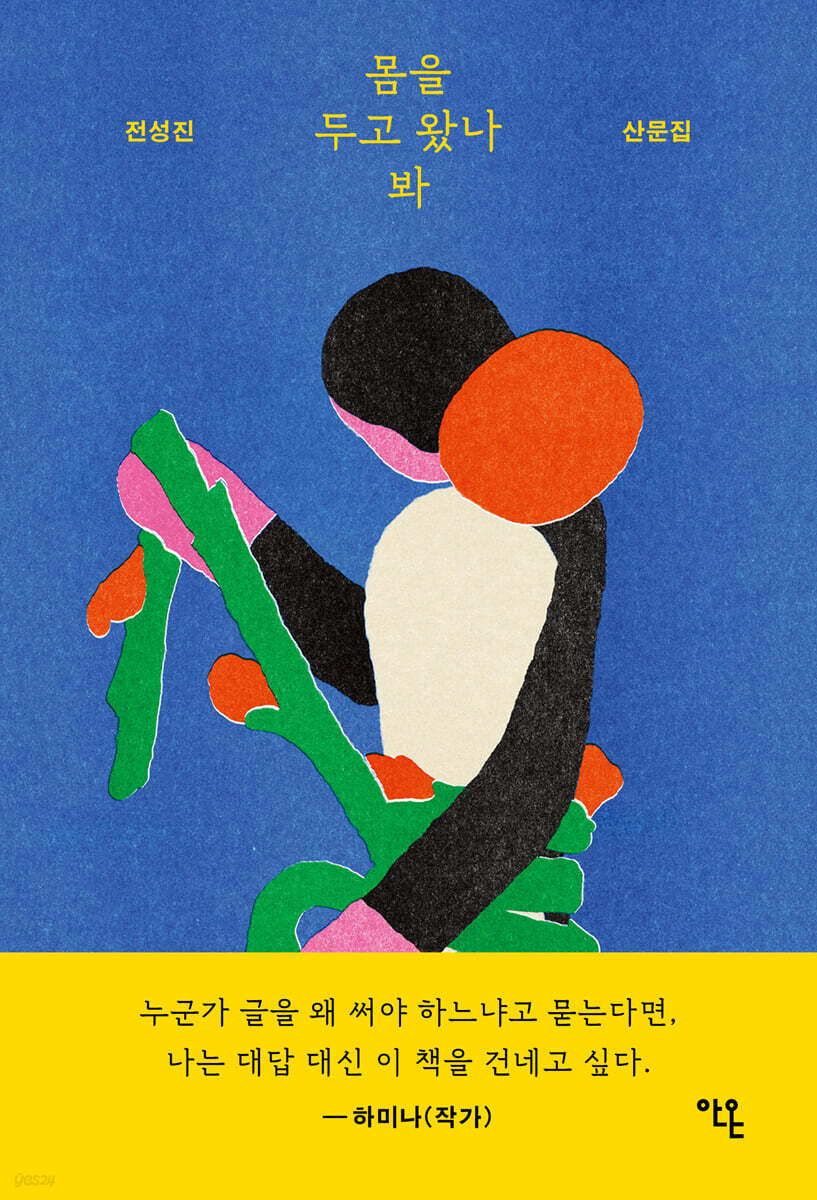
I guess I left my body behind
 |
Description
Book Introduction
To the body that was left behind in various places in life
To me, who just endured it with my body there
The story of recovery that is finally being told
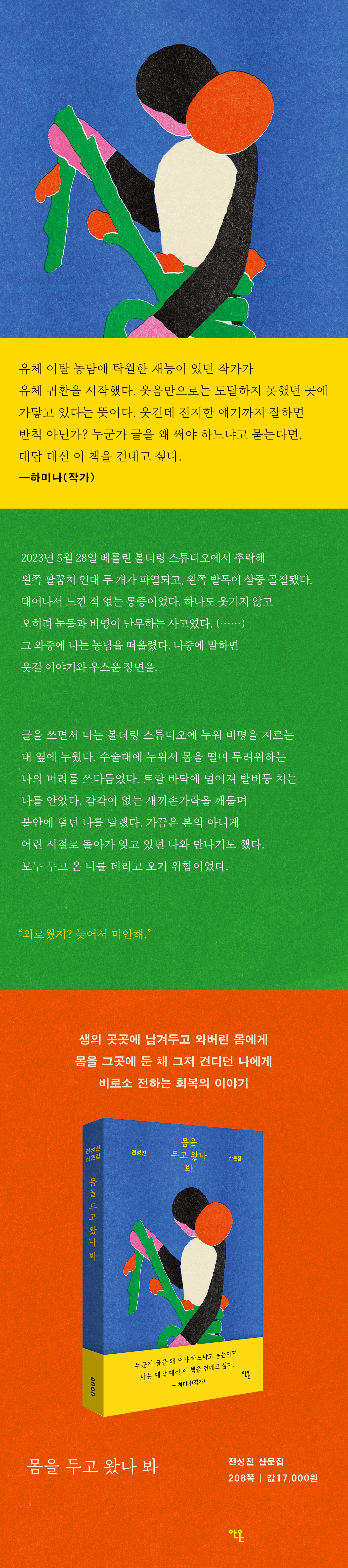
“This article started from something that came to me out of nowhere.
It's the back of the joke, and a personal experience.
It is a hardened stone inside.
It is also a belated realization that I am only now realizing something that I should have felt but left behind.” - Page 9
The second collection of essays by author Jeon Seong-jin, who displayed his unique charm with “There’s No Yukgaejang in Berlin,” “I Think I Left My Body Behind,” has been published by Anon Books.
In “There’s No Yukgaejang in Berlin,” the author continues to coexist with strangers in a distant foreign country with a healthy “spirit.”
It seemed that a clear mind and persistent focus would make anything in the world possible.
Then one day, the writer suffers an unexpected accident.
The 'body' that was left here and there, relying on only one spirit, suddenly broke down.
The writer finally speaks to a body with a torn ligament in its arm and a broken bone in its ankle.
As I look back on the past experiences of astral projection without realizing it, I realize my own body.
The author finally realized that this process, which could be a lifelong rehabilitation, was the only prescription for recovery and complete cure.
To all those who have been hurt, whether physically or mentally, "I Think I Left My Body Behind" will convey the courage of true recovery, mixed with laughter and tears.
To me, who just endured it with my body there
The story of recovery that is finally being told
“This article started from something that came to me out of nowhere.
It's the back of the joke, and a personal experience.
It is a hardened stone inside.
It is also a belated realization that I am only now realizing something that I should have felt but left behind.” - Page 9
The second collection of essays by author Jeon Seong-jin, who displayed his unique charm with “There’s No Yukgaejang in Berlin,” “I Think I Left My Body Behind,” has been published by Anon Books.
In “There’s No Yukgaejang in Berlin,” the author continues to coexist with strangers in a distant foreign country with a healthy “spirit.”
It seemed that a clear mind and persistent focus would make anything in the world possible.
Then one day, the writer suffers an unexpected accident.
The 'body' that was left here and there, relying on only one spirit, suddenly broke down.
The writer finally speaks to a body with a torn ligament in its arm and a broken bone in its ankle.
As I look back on the past experiences of astral projection without realizing it, I realize my own body.
The author finally realized that this process, which could be a lifelong rehabilitation, was the only prescription for recovery and complete cure.
To all those who have been hurt, whether physically or mentally, "I Think I Left My Body Behind" will convey the courage of true recovery, mixed with laughter and tears.
- You can preview some of the book's contents.
Preview
index
Prologue ─ 7
Memory ─ 13
Astral projection ─ 25
Body ─ 43
Recovery ─ 65
Up ─ 99
Relationships ─ 121
Rehabilitation ─ 143
Aftereffects ─ 177
Completely cured - 197
Memory ─ 13
Astral projection ─ 25
Body ─ 43
Recovery ─ 65
Up ─ 99
Relationships ─ 121
Rehabilitation ─ 143
Aftereffects ─ 177
Completely cured - 197
Detailed image
Into the book
When you fall, time stretches like a rubber band.
In the gap in time, I somehow remembered the old saying that even in a tiger's den, you just have to keep your wits about you.
Just as I was thinking about bending my back and falling to avoid hitting my head, I heard a popping sound from my left elbow.
There was a tearing sound along with a feeling of breaking in my left foot.
A pain I had never felt before choked my breathing.
--- p.23
The regret, shame, and guilt I had put off came rushing back to me in a harsh voice.
He used it this way and that as he pleased, and in the end, half of his body was destroyed.
I can't even be grateful, but I have no shame.
Are you satisfied now? I made your body into something that can never go back to how it was before the accident.
It's a shame.
There is no one to blame and no one to hide.
There's no use racking your brain now.
--- p.41
Now that I've decided to face you, I'll practice not leaving you behind anymore.
Even if it's painful, I'll try to make you feel it too.
Let's immerse ourselves in the moment and feel it together.
I won't throw pain at you and run away just because it's hard.
I will be on your side more than anyone else.
Were you lonely? Sorry I'm late.
--- p.63
The only time I ever really noticed my elbows was when I was in middle and high school, when I would rub my darkened elbows with a towel.
This was the first time in my life that I had looked into something so closely.
Even though I moved my elbows all day and increased the angle of extension by about 5 degrees, they would stiffen again while I was sleeping and by the morning they had decreased by 7 degrees.
Going to the sauna or taking a hot shower will relax your ligaments and make them much more stretched out than before you showered.
Instead, if it's cold, it hardens.
There really was a ligament inside the elbow.
--- p.157
The process of becoming accustomed to the aftereffects is similar to the way we come to terms with the past.
It was a journey of accepting the irreversibility, no longer clinging, accepting the present without regret, and focusing on what is to come, ultimately becoming free.
Strange sensations and memories of violence are ultimately traces left behind in the place where they passed.
I don't want to be pushed around by the inertia of problems I've already digested that no longer affect me.
I would gladly save the strength I would use for inertia for the countless sufferings to come.
This is a grand declaration to live the rest of your life incredibly well.
--- pp.195-196
As I write, I'm lying in a bouldering studio with someone screaming next to me.
He stroked my head as I lay on the operating table, trembling and afraid.
He picked me up as I fell on the tram floor and struggled.
He comforted me, who was trembling with anxiety, by biting my numb little finger.
Sometimes, I would inadvertently go back to my childhood and meet a side of myself I had forgotten.
It was to bring me back, whom I had left behind.
In the gap in time, I somehow remembered the old saying that even in a tiger's den, you just have to keep your wits about you.
Just as I was thinking about bending my back and falling to avoid hitting my head, I heard a popping sound from my left elbow.
There was a tearing sound along with a feeling of breaking in my left foot.
A pain I had never felt before choked my breathing.
--- p.23
The regret, shame, and guilt I had put off came rushing back to me in a harsh voice.
He used it this way and that as he pleased, and in the end, half of his body was destroyed.
I can't even be grateful, but I have no shame.
Are you satisfied now? I made your body into something that can never go back to how it was before the accident.
It's a shame.
There is no one to blame and no one to hide.
There's no use racking your brain now.
--- p.41
Now that I've decided to face you, I'll practice not leaving you behind anymore.
Even if it's painful, I'll try to make you feel it too.
Let's immerse ourselves in the moment and feel it together.
I won't throw pain at you and run away just because it's hard.
I will be on your side more than anyone else.
Were you lonely? Sorry I'm late.
--- p.63
The only time I ever really noticed my elbows was when I was in middle and high school, when I would rub my darkened elbows with a towel.
This was the first time in my life that I had looked into something so closely.
Even though I moved my elbows all day and increased the angle of extension by about 5 degrees, they would stiffen again while I was sleeping and by the morning they had decreased by 7 degrees.
Going to the sauna or taking a hot shower will relax your ligaments and make them much more stretched out than before you showered.
Instead, if it's cold, it hardens.
There really was a ligament inside the elbow.
--- p.157
The process of becoming accustomed to the aftereffects is similar to the way we come to terms with the past.
It was a journey of accepting the irreversibility, no longer clinging, accepting the present without regret, and focusing on what is to come, ultimately becoming free.
Strange sensations and memories of violence are ultimately traces left behind in the place where they passed.
I don't want to be pushed around by the inertia of problems I've already digested that no longer affect me.
I would gladly save the strength I would use for inertia for the countless sufferings to come.
This is a grand declaration to live the rest of your life incredibly well.
--- pp.195-196
As I write, I'm lying in a bouldering studio with someone screaming next to me.
He stroked my head as I lay on the operating table, trembling and afraid.
He picked me up as I fell on the tram floor and struggled.
He comforted me, who was trembling with anxiety, by biting my numb little finger.
Sometimes, I would inadvertently go back to my childhood and meet a side of myself I had forgotten.
It was to bring me back, whom I had left behind.
--- p.203
Publisher's Review
Oh my gosh, look at my mind
Someone might have said this morning:
“I think he’s lost his mind”, “He’s completely out of his mind”.
There is a saying that even if you are caught in a tiger's den, you will survive as long as you keep your wits about you.
In both sports and academics, mental strength was emphasized over ability.
Author Jeon Seong-jin was the same.
The author says that the reason death is feared is because the mind disappears.
I also thought that it would be okay if my body died but my spirit remained.
This belief could not be intact after an accident that actually shattered the body.
While I was climbing an indoor rock wall, trying to pull myself together and tackle the last hold, my body fell before I even realized it.
I tore my elbow ligaments and broke my ankle.
Even at the moment of the accident, the writer tried to come to his senses, but what struck him was a pain he had never felt before.
The writer's recovery period was a time of talking to his body.
The more the writer talks to the body, the more he realizes that he has left the body in various places in life.
Can the body abandoned there be brought back here? Can body and mind coexist? "I Think I Left My Body Behind" carefully addresses these questions, questions likely lingering in the minds of everyone who has been hurt or wounded by something.
There, there must have been a body
The beginning of "I Think I Left My Body Behind" was the podcast "Homeless Soul."
The episode where writer Jeon Seong-jin appeared and told jokes that occurred after the accident ranked second in the 'Most Shared Episodes in South Korea' that year.
The author's ability to transform pain into laughter was relatable and loved by many.
The author's unique humor shines through in his previous work, "There's No Yukgaejang in Berlin."
He waited for the readers, packing bundles of laughter throughout the book.
The readers and writers I met there laughed together, and after the laughter, I experienced a tingling sensation in my nose.
In this book, author Jeon Seong-jin goes one step, or rather, several steps further.
We bravely enter into a story that cannot be reached with laughter alone.
This book is the back side of the jokes the author has made, and the hard rock that remains inside.
The experience described in the book was clearly a major accident for the author, a long treatment, and a slow recovery.
It was something that could not be expressed in words, but if I could not write it down, complete recovery would be impossible.
《I Think I Left My Body Behind》 serves as a solid example of writing for all those who need a period of recovery.
Someone might have said this morning:
“I think he’s lost his mind”, “He’s completely out of his mind”.
There is a saying that even if you are caught in a tiger's den, you will survive as long as you keep your wits about you.
In both sports and academics, mental strength was emphasized over ability.
Author Jeon Seong-jin was the same.
The author says that the reason death is feared is because the mind disappears.
I also thought that it would be okay if my body died but my spirit remained.
This belief could not be intact after an accident that actually shattered the body.
While I was climbing an indoor rock wall, trying to pull myself together and tackle the last hold, my body fell before I even realized it.
I tore my elbow ligaments and broke my ankle.
Even at the moment of the accident, the writer tried to come to his senses, but what struck him was a pain he had never felt before.
The writer's recovery period was a time of talking to his body.
The more the writer talks to the body, the more he realizes that he has left the body in various places in life.
Can the body abandoned there be brought back here? Can body and mind coexist? "I Think I Left My Body Behind" carefully addresses these questions, questions likely lingering in the minds of everyone who has been hurt or wounded by something.
There, there must have been a body
The beginning of "I Think I Left My Body Behind" was the podcast "Homeless Soul."
The episode where writer Jeon Seong-jin appeared and told jokes that occurred after the accident ranked second in the 'Most Shared Episodes in South Korea' that year.
The author's ability to transform pain into laughter was relatable and loved by many.
The author's unique humor shines through in his previous work, "There's No Yukgaejang in Berlin."
He waited for the readers, packing bundles of laughter throughout the book.
The readers and writers I met there laughed together, and after the laughter, I experienced a tingling sensation in my nose.
In this book, author Jeon Seong-jin goes one step, or rather, several steps further.
We bravely enter into a story that cannot be reached with laughter alone.
This book is the back side of the jokes the author has made, and the hard rock that remains inside.
The experience described in the book was clearly a major accident for the author, a long treatment, and a slow recovery.
It was something that could not be expressed in words, but if I could not write it down, complete recovery would be impossible.
《I Think I Left My Body Behind》 serves as a solid example of writing for all those who need a period of recovery.
GOODS SPECIFICS
- Date of issue: October 29, 2025
- Page count, weight, size: 208 pages | 284g | 128*188*17mm
- ISBN13: 9791192638744
- ISBN10: 1192638743
You may also like
카테고리
korean


korean

![GQ KOREA Mark (Monthly): December [2025]](http://librairie.coreenne.fr/cdn/shop/files/8ef265dbbfbf186523ed75ba7319009d.jpg?v=1765340328&width=3840)


