

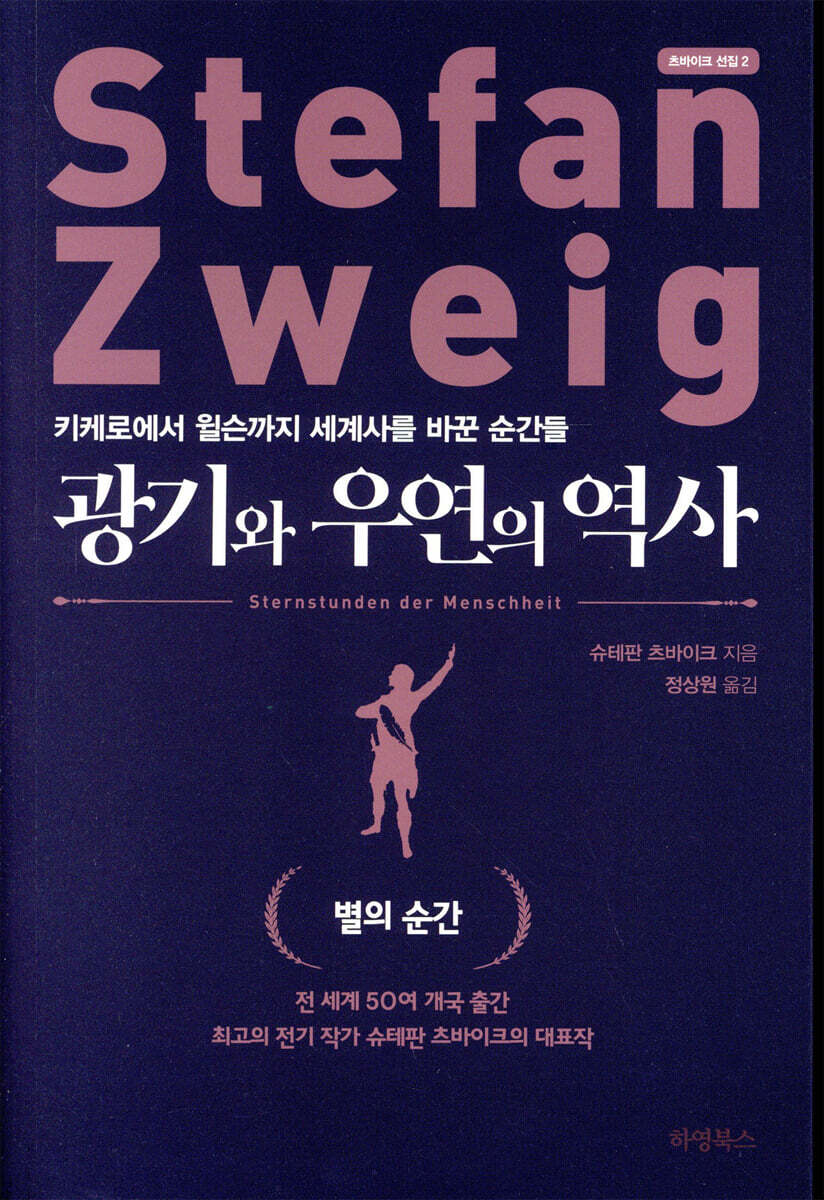
A History of Madness and Chance
 |
Description
Book Introduction
Published in over 50 countries worldwide
The masterpiece of the greatest biographer, Stefan Zweig
Consisting of 14 historical episodes, 『A History of Madness and Chance』 is the most widely loved steady seller among all of Stefan Zweig's works.
It has been translated into over 50 languages worldwide and has sold millions of copies in German-speaking countries alone.
Even now, nearly 100 years after its first publication in 1927, it remains a must-read for young people and is used as a textbook in many European countries.
Pick up the book, choose any of the 14 chapters, and read a few lines, and you'll immediately understand why it's so beloved.
Readers will experience a magical world where historical figures, previously perceived as fossils, come to life.
You will feel their tears and sweat, hear their sighs, screams, and cheers, and your palms will sweat.
In short, this is a work in which the true value of the best storyteller, Zweig, shines brightly.
The masterpiece of the greatest biographer, Stefan Zweig
Consisting of 14 historical episodes, 『A History of Madness and Chance』 is the most widely loved steady seller among all of Stefan Zweig's works.
It has been translated into over 50 languages worldwide and has sold millions of copies in German-speaking countries alone.
Even now, nearly 100 years after its first publication in 1927, it remains a must-read for young people and is used as a textbook in many European countries.
Pick up the book, choose any of the 14 chapters, and read a few lines, and you'll immediately understand why it's so beloved.
Readers will experience a magical world where historical figures, previously perceived as fossils, come to life.
You will feel their tears and sweat, hear their sighs, screams, and cheers, and your palms will sweat.
In short, this is a work in which the true value of the best storyteller, Zweig, shines brightly.
- You can preview some of the book's contents.
Preview
index
Introduction
1.
The Death of Cicero and the End of the Roman Republic
2.
The end of the Eastern Roman Empire
3.
Running towards immortality
4.
George Frideric Handel's Resurrection
5.
The Tragedy of a Mayfly Genius
6.
The Battle of Waterloo, which shaped world history
7.
Goethe's Last Love
8.
The Curse of El Dorado, the Land of Gold
9.
An artist who experienced death
10.
submarine cable connecting the United States and Europe
11.
Tolstoy's Last Days - Late October 1910
12.
The race to conquer Antarctica
13.
Sealed Train
14.
Wilson's frustration
The publication process of "A History of Madness and Chance"
Translator's Note
Search
1.
The Death of Cicero and the End of the Roman Republic
2.
The end of the Eastern Roman Empire
3.
Running towards immortality
4.
George Frideric Handel's Resurrection
5.
The Tragedy of a Mayfly Genius
6.
The Battle of Waterloo, which shaped world history
7.
Goethe's Last Love
8.
The Curse of El Dorado, the Land of Gold
9.
An artist who experienced death
10.
submarine cable connecting the United States and Europe
11.
Tolstoy's Last Days - Late October 1910
12.
The race to conquer Antarctica
13.
Sealed Train
14.
Wilson's frustration
The publication process of "A History of Madness and Chance"
Translator's Note
Search
Detailed image

Into the book
Just as artistic geniuses transcend time, so too do star-studded moments in history shape decades and even centuries of history.
--- p.5
For a thinking man, there is nothing happier than to distance himself from public life, that is, from political life.
--- p.11
This is the same in a person's life or in history.
A mistake made in a moment cannot be undone even after a thousand years.
--- p.75
It's the sea.
An unknown sea, a new sea that we have only dreamed of but never seen, a legendary sea that Columbus and his successors have been searching for for many years, the sea that embraces America, India, and China.
Balboa looks and looks and looks again.
I am proud and ecstatic to know that I am the first European to see this endless blue sea.
--- p.96
Like all true artists, he did not boast about his work.
But I loved one piece in particular.
It was none other than the "Messiah."
He loved the Messiah with gratitude because the Messiah saved him from the cliff, because the Messiah gave him peace of mind.
Every year he performed this work in London, donating all the proceeds each time.
Of these, he always donated 500 pounds to the hospital.
It was money sent by the healed to the sick, and by the freed to those still in bondage.
--- p.136
Now, humanity lives, sees, hears, and communicates simultaneously from one end of the Earth to the other.
Thanks to human creativity, we are able to exist everywhere at the same time, like God.
If humanity, having conquered time and space, could unite as one forever, there would be nothing more to wish for.
Unfortunately, humanity continues to be consumed by the madness of trying to destroy this grand unity, and it is a pity that it is using the very power it has over nature to destroy itself.
--- p.250
In the grand scheme of things, life is elevated only through heroic death, and only through downfall can the infinite will to rise arise.
To be inspired by accidental success and easy achievement is nothing but a lust for fame.
Nothing lifts our spirits more than to see a man fall in an unwinnable struggle against a mighty destiny.
This is the greatest tragedy of any age.
Poets create such tragedies several times, but life creates them countless times.
--- p.5
For a thinking man, there is nothing happier than to distance himself from public life, that is, from political life.
--- p.11
This is the same in a person's life or in history.
A mistake made in a moment cannot be undone even after a thousand years.
--- p.75
It's the sea.
An unknown sea, a new sea that we have only dreamed of but never seen, a legendary sea that Columbus and his successors have been searching for for many years, the sea that embraces America, India, and China.
Balboa looks and looks and looks again.
I am proud and ecstatic to know that I am the first European to see this endless blue sea.
--- p.96
Like all true artists, he did not boast about his work.
But I loved one piece in particular.
It was none other than the "Messiah."
He loved the Messiah with gratitude because the Messiah saved him from the cliff, because the Messiah gave him peace of mind.
Every year he performed this work in London, donating all the proceeds each time.
Of these, he always donated 500 pounds to the hospital.
It was money sent by the healed to the sick, and by the freed to those still in bondage.
--- p.136
Now, humanity lives, sees, hears, and communicates simultaneously from one end of the Earth to the other.
Thanks to human creativity, we are able to exist everywhere at the same time, like God.
If humanity, having conquered time and space, could unite as one forever, there would be nothing more to wish for.
Unfortunately, humanity continues to be consumed by the madness of trying to destroy this grand unity, and it is a pity that it is using the very power it has over nature to destroy itself.
--- p.250
In the grand scheme of things, life is elevated only through heroic death, and only through downfall can the infinite will to rise arise.
To be inspired by accidental success and easy achievement is nothing but a lust for fame.
Nothing lifts our spirits more than to see a man fall in an unwinnable struggle against a mighty destiny.
This is the greatest tragedy of any age.
Poets create such tragedies several times, but life creates them countless times.
--- p.324
Publisher's Review
The masterpiece of the greatest biographer, Stefan Zweig
Consisting of 14 historical episodes, 『A History of Madness and Chance』 is the most widely loved steady seller among all of Stefan Zweig's works.
It has been translated into over 50 languages worldwide and has sold millions of copies in German-speaking countries alone.
Even now, nearly 100 years after its first publication in 1927, it remains a must-read for young people and is used as a textbook in many European countries.
Pick up the book, choose any of the 14 chapters, and read a few lines, and you'll immediately understand why it's so beloved.
Readers will experience a magical world where historical figures, previously perceived as fossils, come to life.
You will feel their tears and sweat, hear their sighs, screams, and cheers, and your palms will sweat.
In short, this is a work in which the true value of the best storyteller, Zweig, shines brightly.
Bestseller, Latest Complete Translation
The Stefan Zweig Center and the Department of German Literature at the University of Salzburg are undertaking an ambitious project to publish a complete edition of Zweig's works, based on a thorough philological examination, in accordance with the author's final intentions.
The first result of this project was 『A History of Madness and Chance』, published in 2017.
This translation mainly refers to this complete edition, and, where necessary, to the Reclam and Fischer editions published by authoritative German publishers to enhance the quality of the translation.
Star Moment
This book presents a panoramic view of the figures who have shaped Western history, from Cicero to Mehmet II, Balboa, Handel, Rouget de Lisle, Wellington, Napoleon, Goethe, Sutter, Dostoevsky, Field, Tolstoy, Scott, Lenin, and Wilson, as well as the fateful moments and star moments they created.
Zweig once said, “I am always drawn to the fate of the defeated, and when I write biographies, I am always drawn to those who have done right in a moral sense, not to those who have succeeded in the real world.”
This book also focuses on morally superior losers rather than successful figures.
Zweig pursued the dream of “world peace through ethical awakening and reconciliation.”
Although they lacked courage, were indecisive, and experienced defeat, the lives of these “star-like” figures who dedicated themselves to realizing their dreams bring us empathy, inspiration, and awakening.
Stefan Zweig's masterpiece, a trustworthy and readable work
Zweig, a leading European intellectual, left behind a brilliant biography that deeply explores the human mind through deep insight into history and in-depth study of characters.
His writing skills, which are still loved by countless readers around the world even after so many years, are also evident in this book.
Zweig demonstrates psychological insight by focusing on the characters' inner struggles and conflicts, as well as the zeitgeist of the time that serves as their background.
Therefore, readers will “willingly follow Zweig’s story to the end, which he lovingly holds while observing so closely,” expanding their knowledge and broadening their interest in history.
Consisting of 14 historical episodes, 『A History of Madness and Chance』 is the most widely loved steady seller among all of Stefan Zweig's works.
It has been translated into over 50 languages worldwide and has sold millions of copies in German-speaking countries alone.
Even now, nearly 100 years after its first publication in 1927, it remains a must-read for young people and is used as a textbook in many European countries.
Pick up the book, choose any of the 14 chapters, and read a few lines, and you'll immediately understand why it's so beloved.
Readers will experience a magical world where historical figures, previously perceived as fossils, come to life.
You will feel their tears and sweat, hear their sighs, screams, and cheers, and your palms will sweat.
In short, this is a work in which the true value of the best storyteller, Zweig, shines brightly.
Bestseller, Latest Complete Translation
The Stefan Zweig Center and the Department of German Literature at the University of Salzburg are undertaking an ambitious project to publish a complete edition of Zweig's works, based on a thorough philological examination, in accordance with the author's final intentions.
The first result of this project was 『A History of Madness and Chance』, published in 2017.
This translation mainly refers to this complete edition, and, where necessary, to the Reclam and Fischer editions published by authoritative German publishers to enhance the quality of the translation.
Star Moment
This book presents a panoramic view of the figures who have shaped Western history, from Cicero to Mehmet II, Balboa, Handel, Rouget de Lisle, Wellington, Napoleon, Goethe, Sutter, Dostoevsky, Field, Tolstoy, Scott, Lenin, and Wilson, as well as the fateful moments and star moments they created.
Zweig once said, “I am always drawn to the fate of the defeated, and when I write biographies, I am always drawn to those who have done right in a moral sense, not to those who have succeeded in the real world.”
This book also focuses on morally superior losers rather than successful figures.
Zweig pursued the dream of “world peace through ethical awakening and reconciliation.”
Although they lacked courage, were indecisive, and experienced defeat, the lives of these “star-like” figures who dedicated themselves to realizing their dreams bring us empathy, inspiration, and awakening.
Stefan Zweig's masterpiece, a trustworthy and readable work
Zweig, a leading European intellectual, left behind a brilliant biography that deeply explores the human mind through deep insight into history and in-depth study of characters.
His writing skills, which are still loved by countless readers around the world even after so many years, are also evident in this book.
Zweig demonstrates psychological insight by focusing on the characters' inner struggles and conflicts, as well as the zeitgeist of the time that serves as their background.
Therefore, readers will “willingly follow Zweig’s story to the end, which he lovingly holds while observing so closely,” expanding their knowledge and broadening their interest in history.
GOODS SPECIFICS
- Date of issue: May 27, 2024
- Page count, weight, size: 388 pages | 145*215*30mm
- ISBN13: 9791198650832
- ISBN10: 1198650834
You may also like
카테고리
korean


korean

![GQ KOREA Mark (Monthly): December [2025]](http://librairie.coreenne.fr/cdn/shop/files/8ef265dbbfbf186523ed75ba7319009d.jpg?v=1765340328&width=3840)


