

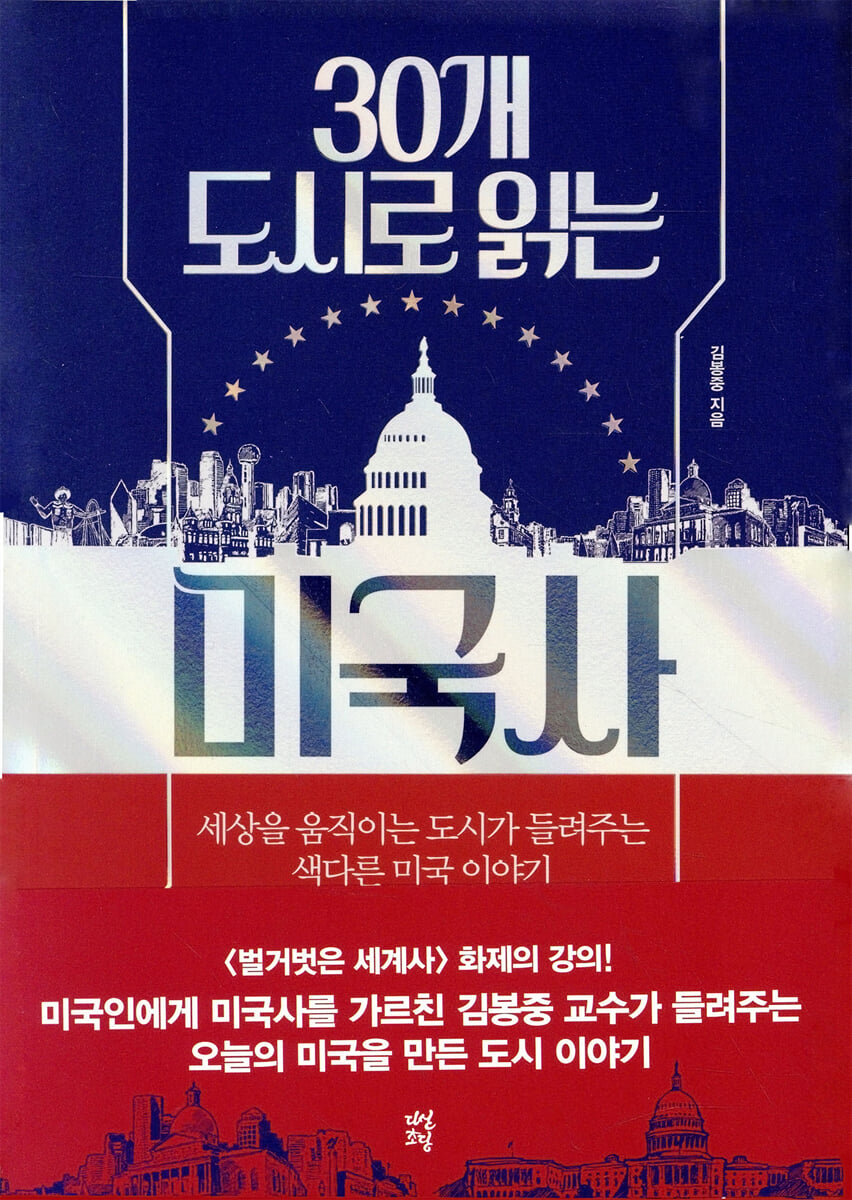
American History in 30 Cities
 |
Description
Book Introduction
“The hot topic of lecture ‘Naked World History’!
Professor Bong-Jung Kim, who taught American history to Americans, tells us
“Stories of the Cities That Made America What It Is Today”
The history of the United States is only about 250 years old.
Because of this, there is a prejudice that American history is not rich or interesting.
But as you follow the history of the 30 cities featured in this book, you will see the larger flow and subtle textures of American history that were previously invisible.
You can gain rich intellectual satisfaction from fascinating stories while understanding the historical flow of events, such as which cities were the main stages and played a major role during the American Revolution, why the Civil War occurred and what context existed before and after it, and what adventures and tragedies marked American history during the western expansion.
From Las Vegas, a city of pleasure that emerged from the wasteland of the Spanish Route, to Santa Fe, a city of the past that makes you feel like you've entered a fantasy world, a unique American story we never knew about unfolds vividly.
Professor Bong-Jung Kim, who taught American history to Americans, tells us
“Stories of the Cities That Made America What It Is Today”
The history of the United States is only about 250 years old.
Because of this, there is a prejudice that American history is not rich or interesting.
But as you follow the history of the 30 cities featured in this book, you will see the larger flow and subtle textures of American history that were previously invisible.
You can gain rich intellectual satisfaction from fascinating stories while understanding the historical flow of events, such as which cities were the main stages and played a major role during the American Revolution, why the Civil War occurred and what context existed before and after it, and what adventures and tragedies marked American history during the western expansion.
From Las Vegas, a city of pleasure that emerged from the wasteland of the Spanish Route, to Santa Fe, a city of the past that makes you feel like you've entered a fantasy world, a unique American story we never knew about unfolds vividly.
- You can preview some of the book's contents.
Preview
index
Introduction - The Best Way to Look into the Vast and Complex History of the United States
Part 1.
Northeast
01 Boston - The most American city, full of history and culture
02 Providence - A City of Rebellion and Freedom, Tolerance and Art
03 Philadelphia - The City of Brotherhood, Where Ideals and Reality Intersect
04 New York - The Light and Shadow of the American Dream, a City in the World
05 Washington - the capital of the United States and the capital of the world
06 Baltimore - The birthplace of the American national anthem, where two extreme images intersect.
Part 2.
Southeast
07 Williamsburg - A city that vividly preserves the image of colonial Virginia.
08 Charleston - The political, economic, and cultural center of the South
09 Atlanta - A Colony Dreaming of Utopia, the New Center of the South
10 Miami - A city that has created magic in a short period of time
11 Louisville - A Legend of the Western Frontier Becomes a KFC Mecca
Part 3.
Midwest
12 Chicago - The Heart of New America, the 'Windy City'
13 Milwaukee - A rebel's paradise, the most American city
14 Detroit - From Automobile Mecca to Bankrupt City
15 St. Louis - The Golden Noda, the starting point of American expansion
16 Kansas City - From a small French town to a mafia city
Part 4.
South-central
17 Houston - From Texas Wasteland to Global City
18 New Orleans - A city steeped in Creole pride and tradition
19 Denver - The most American pioneer city in the southern Rocky Mountains
20 Santa Fe - A city of the past that makes you feel like you've entered a fantasy world.
21 Phoenix - The Success Story of Wasteland to 'Valley of the Sun'
Part 5.
Far West
22 Seattle - From a city of success stories to a city of 'sleepless' problems
23 San Francisco - From Gold Rush City to Hippie and Freedom Mecca
24 Los Angeles - From the tiny 'City of Angels' to America's second largest city
25 San Diego - A beautiful and safe resort city where Horton's faith became reality.
26 Las Vegas - The world's greatest pleasure city, set on the Spanish Way of the Wasteland.
Part 6.
Other regions
27 Rapid City - A city imbued with the pain of Indians born of western expansion.
28 Salt Lake City - From a Mormon holy site to the most American city
29 Anchorage - The heart of Alaska, which has transformed from a "frozen wasteland" to America's "last frontier."
30 Honolulu - From Sugarcane Farm to Top Tourist Attraction
Part 1.
Northeast
01 Boston - The most American city, full of history and culture
02 Providence - A City of Rebellion and Freedom, Tolerance and Art
03 Philadelphia - The City of Brotherhood, Where Ideals and Reality Intersect
04 New York - The Light and Shadow of the American Dream, a City in the World
05 Washington - the capital of the United States and the capital of the world
06 Baltimore - The birthplace of the American national anthem, where two extreme images intersect.
Part 2.
Southeast
07 Williamsburg - A city that vividly preserves the image of colonial Virginia.
08 Charleston - The political, economic, and cultural center of the South
09 Atlanta - A Colony Dreaming of Utopia, the New Center of the South
10 Miami - A city that has created magic in a short period of time
11 Louisville - A Legend of the Western Frontier Becomes a KFC Mecca
Part 3.
Midwest
12 Chicago - The Heart of New America, the 'Windy City'
13 Milwaukee - A rebel's paradise, the most American city
14 Detroit - From Automobile Mecca to Bankrupt City
15 St. Louis - The Golden Noda, the starting point of American expansion
16 Kansas City - From a small French town to a mafia city
Part 4.
South-central
17 Houston - From Texas Wasteland to Global City
18 New Orleans - A city steeped in Creole pride and tradition
19 Denver - The most American pioneer city in the southern Rocky Mountains
20 Santa Fe - A city of the past that makes you feel like you've entered a fantasy world.
21 Phoenix - The Success Story of Wasteland to 'Valley of the Sun'
Part 5.
Far West
22 Seattle - From a city of success stories to a city of 'sleepless' problems
23 San Francisco - From Gold Rush City to Hippie and Freedom Mecca
24 Los Angeles - From the tiny 'City of Angels' to America's second largest city
25 San Diego - A beautiful and safe resort city where Horton's faith became reality.
26 Las Vegas - The world's greatest pleasure city, set on the Spanish Way of the Wasteland.
Part 6.
Other regions
27 Rapid City - A city imbued with the pain of Indians born of western expansion.
28 Salt Lake City - From a Mormon holy site to the most American city
29 Anchorage - The heart of Alaska, which has transformed from a "frozen wasteland" to America's "last frontier."
30 Honolulu - From Sugarcane Farm to Top Tourist Attraction
Detailed image

Into the book
Beyond tobacco farming, John Rolfe left a very special mark on Virginia history.
In 1614, Rolfe married Pocahontas, the daughter of the Powhatan Indian chief.
It was the very year that tobacco cultivation was first successfully cultivated.
Before her marriage, Pocahontas became a Christian, was baptized, and changed her name to Rebecca.
Two years later, Rolf and Rebecca visited London.
This became news across Britain.
Rebecca's every move became a subject of interest to the British people.
Sadly, Pocahontas died of an unknown illness a year later and was buried in St. George's Cathedral.
John Rolfe and Pocahontas had a son named Thomas Rolfe.
Thomas had many descendants who continued the lineage of Rolfe-Pocahontas, a legend in Virginia and American history.
One of them was Thomas Jefferson Randolph, a Virginia politician, planter, and president of the University of Virginia.
He is the eldest grandson of the third President, Thomas Jefferson, and his mother was President Jefferson's eldest daughter.
Edith Bolling Gault Wilson, the first wife of the 28th President Woodrow Wilson, is a ninth-generation descendant of Pocahontas.
Richard Avery Byrd, who discovered Antarctica in the late 1920s, is also a descendant of Rolf-Pocahontas, and his younger brother, Harry Flood Byrd, served in the U.S. Senate from the 1930s to the 1960s and even emerged as a Democratic presidential candidate.
Although Senator Byrd was a Democrat, he was known as a black segregationist and led a strong racist force within Congress.
It's ironic, considering that his ancestor was Rolfe-Pocahontas, the first interracial marriage.
---From "07 Williamsburg - A city that vividly preserves the image of colonial Virginia"
In 1919, the 18th Amendment to the U.S. Constitution made it legal for the federal government to prohibit the production and sale of alcoholic beverages.
But Prohibition ushered in the gangster era.
Until the repeal of Prohibition in 1933, the power struggles between gangs in major cities over the bootlegging of alcohol became a major social problem.
The center of it all was Chicago.
Because Chicago was the center of the most notorious crime syndicate at the time, Al Capone.
Capone began to take control of the bootlegging business, as well as gambling and prostitution, by eliminating rival gangs one by one in Chicago.
He developed close relationships with the mayor and, with the support of the Sicilian Italian police network in particular, grew into a powerful force that no one could touch.
When the Great Depression broke out, he even set up a free food pantry in downtown Chicago, providing bread and coffee to hungry citizens.
Chicagoans even praised him as the "Robin Hood of the Great Depression."
Capone's face, nicknamed "Scarface" for the scars carved into it, was both an object of fear and a star attraction for Chicagoans.
However, the continued gunfights and murders between gangsters made Chicago citizens anxious.
Then, in 1929, the so-called "St. Valentine's Day Massacre" occurred, when a gang believed to be sent by Al Capone shot and killed seven members of the rival North Side gang, then led by Bugs Moran.
Although the mastermind behind this incident was never revealed, the people of Chicago had no doubt that Al Capone was behind it.
---From "11 Chicago - The Heart of the New America, the 'Windy City'"
After World War II, San Francisco began to emerge as the most liberal city in the United States.
The Beat Movement, or Beat Generation, was an American social and artistic movement centered around bohemian artistic communities in San Francisco's North Beach, along with Venice West in Los Angeles and Greenwich Village in New York City.
In the 1960s, hippies flocked to Haight-Ashbury, creating a unique streetscape filled with vintage clothing stores, record stores, bookstores, seedy bars, and eclectic restaurants.
San Francisco's hippie culture reached its peak with the "Summer of Love" in 1967.
More than 100,000 young people gathered on Haight-Ashbury Street across the country.
If San Francisco was teeming with immigrants from across the United States and abroad during the Gold Rush over a century ago, now young people are flocking to Haight-Ashbury to call for peace and enjoy freedom.
They wore hippie attire and led a massive counterculture movement that advocated anti-Vietnam War demonstrations and free love.
Among them was legendary singer Jimi Hendrix.
Even now, the house he lived in is a landmark on the street and welcomes tourists.
In 1964, Life magazine called San Francisco the "gay capital of America," and indeed, San Francisco still has the highest per capita gay population in the United States.
In 1614, Rolfe married Pocahontas, the daughter of the Powhatan Indian chief.
It was the very year that tobacco cultivation was first successfully cultivated.
Before her marriage, Pocahontas became a Christian, was baptized, and changed her name to Rebecca.
Two years later, Rolf and Rebecca visited London.
This became news across Britain.
Rebecca's every move became a subject of interest to the British people.
Sadly, Pocahontas died of an unknown illness a year later and was buried in St. George's Cathedral.
John Rolfe and Pocahontas had a son named Thomas Rolfe.
Thomas had many descendants who continued the lineage of Rolfe-Pocahontas, a legend in Virginia and American history.
One of them was Thomas Jefferson Randolph, a Virginia politician, planter, and president of the University of Virginia.
He is the eldest grandson of the third President, Thomas Jefferson, and his mother was President Jefferson's eldest daughter.
Edith Bolling Gault Wilson, the first wife of the 28th President Woodrow Wilson, is a ninth-generation descendant of Pocahontas.
Richard Avery Byrd, who discovered Antarctica in the late 1920s, is also a descendant of Rolf-Pocahontas, and his younger brother, Harry Flood Byrd, served in the U.S. Senate from the 1930s to the 1960s and even emerged as a Democratic presidential candidate.
Although Senator Byrd was a Democrat, he was known as a black segregationist and led a strong racist force within Congress.
It's ironic, considering that his ancestor was Rolfe-Pocahontas, the first interracial marriage.
---From "07 Williamsburg - A city that vividly preserves the image of colonial Virginia"
In 1919, the 18th Amendment to the U.S. Constitution made it legal for the federal government to prohibit the production and sale of alcoholic beverages.
But Prohibition ushered in the gangster era.
Until the repeal of Prohibition in 1933, the power struggles between gangs in major cities over the bootlegging of alcohol became a major social problem.
The center of it all was Chicago.
Because Chicago was the center of the most notorious crime syndicate at the time, Al Capone.
Capone began to take control of the bootlegging business, as well as gambling and prostitution, by eliminating rival gangs one by one in Chicago.
He developed close relationships with the mayor and, with the support of the Sicilian Italian police network in particular, grew into a powerful force that no one could touch.
When the Great Depression broke out, he even set up a free food pantry in downtown Chicago, providing bread and coffee to hungry citizens.
Chicagoans even praised him as the "Robin Hood of the Great Depression."
Capone's face, nicknamed "Scarface" for the scars carved into it, was both an object of fear and a star attraction for Chicagoans.
However, the continued gunfights and murders between gangsters made Chicago citizens anxious.
Then, in 1929, the so-called "St. Valentine's Day Massacre" occurred, when a gang believed to be sent by Al Capone shot and killed seven members of the rival North Side gang, then led by Bugs Moran.
Although the mastermind behind this incident was never revealed, the people of Chicago had no doubt that Al Capone was behind it.
---From "11 Chicago - The Heart of the New America, the 'Windy City'"
After World War II, San Francisco began to emerge as the most liberal city in the United States.
The Beat Movement, or Beat Generation, was an American social and artistic movement centered around bohemian artistic communities in San Francisco's North Beach, along with Venice West in Los Angeles and Greenwich Village in New York City.
In the 1960s, hippies flocked to Haight-Ashbury, creating a unique streetscape filled with vintage clothing stores, record stores, bookstores, seedy bars, and eclectic restaurants.
San Francisco's hippie culture reached its peak with the "Summer of Love" in 1967.
More than 100,000 young people gathered on Haight-Ashbury Street across the country.
If San Francisco was teeming with immigrants from across the United States and abroad during the Gold Rush over a century ago, now young people are flocking to Haight-Ashbury to call for peace and enjoy freedom.
They wore hippie attire and led a massive counterculture movement that advocated anti-Vietnam War demonstrations and free love.
Among them was legendary singer Jimi Hendrix.
Even now, the house he lived in is a landmark on the street and welcomes tourists.
In 1964, Life magazine called San Francisco the "gay capital of America," and indeed, San Francisco still has the highest per capita gay population in the United States.
---From "24 Los Angeles - From a Tiny 'City of Angels' to America's Second Largest City"
Publisher's Review
The best way to look into the vast history of the United States
Even though its influence has diminished in the 21st century, the United States still exerts a significant influence on Korea.
Despite the fact that the United States is such a close country, our knowledge of American history is limited to a few topics, such as the American Revolutionary War, the Civil War, and the Vietnam War.
When it comes to historical figures, only a few come to mind, such as George Washington, Lincoln, and Kennedy.
The author of this book, Professor Bong-Jung Kim of the Department of History at Chonnam National University, taught American history directly to Americans at San Diego City University.
What is the best way to delve into the vast, diverse, and complex history of the United States? This book began with this question in mind.
This book is the first American history to be read through the lens of cities.
This is an attempt to select 30 cities, organize their history and culture, and complete the mosaic of the state and surrounding areas, and the United States at large.
The goal is to illuminate the diverse spectrum of American history and culture across 30 cities, while also revealing the American values and image that permeate this diversity.
The author presents content that combines both knowledge and entertainment through the history of the rise and fall of 30 cities.
Over 300 rich illustrations and vivid sentences will make you feel like you are traveling around the United States.
From the heart of the Industrial Revolution to the streets of zombies, Philadelphia
In the music video for "Streets of Philadelphia," released in 1993, famous rock musician Bruce Springsteen walks the streets of Philadelphia.
However, the scenes on the screen are filled with a gloomy atmosphere rather than a glamorous one.
Springsteen's clothes are also tattered and worn as he passes by black people rummaging through trash cans.
This song is the OST of the movie [Philadelphia], which was released in the same year.
This film tells the story of a gay man with AIDS who continues to work as a lawyer even as he is dying.
Why did the filmmakers choose Philadelphia?
Independence Hall and the Liberty Bell are symbols of Philadelphia.
Since colonial times, Philadelphia has been a symbol of freedom and equality, and a place where these ideals were pursued.
Philadelphia means 'city of brotherly love' in Greek.
The protagonist, who is gay and has AIDS, fights against the prejudice and inequality directed at him, which is very Philadelphia-like.
Throughout the 19th century, Philadelphia played a central role in American industrialization.
The 1876 World's Fair was held in Philadelphia to celebrate the centennial of American independence.
It was a monumental event, the first World's Fair held in the United States.
This was a moment that shook the world to the ground the status of the United States, which was rapidly emerging as a global capitalist power.
People were fascinated by new inventions like the typewriter, sewing machine, and telephone, and admired the hand and torch statues that would become part of the Statue of Liberty.
Above all, I was overwhelmed by the enormous steam engines that powered the numerous buildings and exhibits of the fair.
However, Philadelphia, which had been developing continuously, hit a wall due to the Great Depression in 1929.
Even after the darkness of the Great Depression lifted, Philadelphia's economy did not recover.
The city center was devastated and the white middle class fled the city.
Instead, black people from the South began to settle in the city center.
The center of this great migration of blacks was Philadelphia.
As American industrialization was concentrated in Philadelphia, its devastation was rapid and widespread.
Kensington Street in particular has become a 'zombie street' full of drug addicts.
The streets are filled with drug-addicted homeless people, who move in strange ways, like zombies in a movie.
It's hard to believe that this is the United States, at the pinnacle of global capitalism.
Las Vegas, the world's largest entertainment city in the wasteland
1931 was a historic year that served as a catalyst for the development of Las Vegas.
Nevada legalized gambling and shortened the residency requirement for divorce to six weeks.
Moreover, construction of the Hoover Dam began that year.
As construction workers increased, Las Vegas' population quickly grew from about 5,000 to 25,000.
Las Vegas businessmen and mafia bigwigs began luring workers into their casinos and showgirl theaters.
Las Vegas began to gain a reputation as a men's entertainment district, not only among Hoover Dam workers but also among Westerners.
After World War II, Las Vegas was filled with lavishly decorated hotels.
In 1957, the first topless show, 'Minsky's Police', was performed.
The Mafia played a major role in the growth of Las Vegas after the war.
The Flamingo Hotel, built in 1946 by Jewish mafia bigwig 'Bugsy' Siegel, is a representative example, and is the only hotel built before 1950 that is still in operation.
Las Vegas took a turning point in 1966 when eccentric billionaire Howard Hughes stayed at the Desert Inn over the Thanksgiving holiday.
The Desert Inn opened in 1950 and was the largest hotel in Las Vegas at the time, at nine stories.
But Hughes didn't come out of his room for a whole month.
Then the owner threatened to evict him, and Hughes bought the hotel.
And he stayed there.
He did not leave his hotel room for four years after that.
Meanwhile, he purchased nearby hotels and casinos through his managers.
That group of managers were all Mormons.
They were called Hughes' 'Mormon Mafia'.
Hughes himself was not a Mormon, but he hired them because they did not drink, smoke, or gamble.
In 2000, real estate developer Steve Wynn purchased the Desert Inn.
This time too the Mormon Mafia intervened.
In 2004, Wynn tore down the historic hotel and built a new hotel-casino in its place.
That is the current Win-Angkor Hotel.
Las Vegas has become America's top vacation destination.
It attracts more tourists than the nearby Grand Canyon or Yellowstone National Park.
The bitter pain of the Indians left behind in the Black Hills, Rapid City
In 1874, gold was discovered in the Black Hills of South Dakota.
Rapid City, located at the foot of the hill, began to swarm with ambitious people from all over the country.
The Black Hills were a long-time home to the Lakota tribe, a Sioux tribe.
The U.S. government also designated the land as the Pine Ridge Indian Reservation in 1868, promising to protect it from white encroachment.
But when gold was discovered, countless white people came and went freely through the Pine Ridge Reservation, trampling on the land and the Indians.
The legendary Battle of the Little Bighorn took place on June 25–26, 1876, between Sioux warriors led by "Crazy Horse" and U.S. Union forces led by Lieutenant Colonel George Armstrong Custer.
It was a great victory for 'Crazy Horse', contrary to expectations.
Of Custer's 600-man army, a whopping 268 were killed.
It is remembered as the greatest victory for Indians in American history.
But it was also, in fact, the last battle of the Indians.
When the buffalo, which had been the lifeline of the Indians, disappeared due to westward expansion, including the construction of the transcontinental railroad, the Indians could no longer endure.
The tribes surrendered one by one, and eventually even the 'Mad Horse' surrendered.
On December 9, 1890, the U.S. Cavalry attempted to disarm the Sioux living on the Pine Ridge Indian Reservation.
The deaf young warrior, 'Black Wolf', struggled to keep his gun from being taken away, and in the process, a bullet was fired.
The cavalry mistook the Indians for an attack and began firing their machine guns.
About 300 Indians were killed.
The cavalry dug a large hole, stuffed the bodies of the dead Indians into it, and left the wounded behind.
This is the Wounded Knee Massacre, remembered as the most tragic Indian massacre in American history.
Twenty American soldiers involved in the massacre received the Medal of Honor.
In 2001, the National Congress of American Indians criticized the medal and asked the federal government to withdraw it.
And the massacre site was designated as a national historic site.
In 1990, to mark the centennial of the massacre, both houses of Congress formally expressed their "deepest apology" for the massacre.
Lively sentences and abundant illustrations provide a pleasant travel experience.
"American History in 30 Cities" is the third book in the "History in 30 Cities" series, following "World History in 30 Cities" and "Japanese History in 30 Cities," and is the first book published in Korea.
Afterwards, 『Reading Korean History through 30 Cities』 and 『Reading Chinese History through 30 Cities』 are awaiting publication.
It's hard to find history books in the best-selling sections of bookstores these days.
Many humanities books, too, are written in the humanities, but their actual content is closer to essays.
The History Through 30 Cities series is an attempt to introduce humanities and historical knowledge to the general public by incorporating the keywords of cities and travel into history.
With vivid sentences and abundant illustrations, we aim to provide readers with the pleasure of traveling.
I recommend readers to read it.
Even though its influence has diminished in the 21st century, the United States still exerts a significant influence on Korea.
Despite the fact that the United States is such a close country, our knowledge of American history is limited to a few topics, such as the American Revolutionary War, the Civil War, and the Vietnam War.
When it comes to historical figures, only a few come to mind, such as George Washington, Lincoln, and Kennedy.
The author of this book, Professor Bong-Jung Kim of the Department of History at Chonnam National University, taught American history directly to Americans at San Diego City University.
What is the best way to delve into the vast, diverse, and complex history of the United States? This book began with this question in mind.
This book is the first American history to be read through the lens of cities.
This is an attempt to select 30 cities, organize their history and culture, and complete the mosaic of the state and surrounding areas, and the United States at large.
The goal is to illuminate the diverse spectrum of American history and culture across 30 cities, while also revealing the American values and image that permeate this diversity.
The author presents content that combines both knowledge and entertainment through the history of the rise and fall of 30 cities.
Over 300 rich illustrations and vivid sentences will make you feel like you are traveling around the United States.
From the heart of the Industrial Revolution to the streets of zombies, Philadelphia
In the music video for "Streets of Philadelphia," released in 1993, famous rock musician Bruce Springsteen walks the streets of Philadelphia.
However, the scenes on the screen are filled with a gloomy atmosphere rather than a glamorous one.
Springsteen's clothes are also tattered and worn as he passes by black people rummaging through trash cans.
This song is the OST of the movie [Philadelphia], which was released in the same year.
This film tells the story of a gay man with AIDS who continues to work as a lawyer even as he is dying.
Why did the filmmakers choose Philadelphia?
Independence Hall and the Liberty Bell are symbols of Philadelphia.
Since colonial times, Philadelphia has been a symbol of freedom and equality, and a place where these ideals were pursued.
Philadelphia means 'city of brotherly love' in Greek.
The protagonist, who is gay and has AIDS, fights against the prejudice and inequality directed at him, which is very Philadelphia-like.
Throughout the 19th century, Philadelphia played a central role in American industrialization.
The 1876 World's Fair was held in Philadelphia to celebrate the centennial of American independence.
It was a monumental event, the first World's Fair held in the United States.
This was a moment that shook the world to the ground the status of the United States, which was rapidly emerging as a global capitalist power.
People were fascinated by new inventions like the typewriter, sewing machine, and telephone, and admired the hand and torch statues that would become part of the Statue of Liberty.
Above all, I was overwhelmed by the enormous steam engines that powered the numerous buildings and exhibits of the fair.
However, Philadelphia, which had been developing continuously, hit a wall due to the Great Depression in 1929.
Even after the darkness of the Great Depression lifted, Philadelphia's economy did not recover.
The city center was devastated and the white middle class fled the city.
Instead, black people from the South began to settle in the city center.
The center of this great migration of blacks was Philadelphia.
As American industrialization was concentrated in Philadelphia, its devastation was rapid and widespread.
Kensington Street in particular has become a 'zombie street' full of drug addicts.
The streets are filled with drug-addicted homeless people, who move in strange ways, like zombies in a movie.
It's hard to believe that this is the United States, at the pinnacle of global capitalism.
Las Vegas, the world's largest entertainment city in the wasteland
1931 was a historic year that served as a catalyst for the development of Las Vegas.
Nevada legalized gambling and shortened the residency requirement for divorce to six weeks.
Moreover, construction of the Hoover Dam began that year.
As construction workers increased, Las Vegas' population quickly grew from about 5,000 to 25,000.
Las Vegas businessmen and mafia bigwigs began luring workers into their casinos and showgirl theaters.
Las Vegas began to gain a reputation as a men's entertainment district, not only among Hoover Dam workers but also among Westerners.
After World War II, Las Vegas was filled with lavishly decorated hotels.
In 1957, the first topless show, 'Minsky's Police', was performed.
The Mafia played a major role in the growth of Las Vegas after the war.
The Flamingo Hotel, built in 1946 by Jewish mafia bigwig 'Bugsy' Siegel, is a representative example, and is the only hotel built before 1950 that is still in operation.
Las Vegas took a turning point in 1966 when eccentric billionaire Howard Hughes stayed at the Desert Inn over the Thanksgiving holiday.
The Desert Inn opened in 1950 and was the largest hotel in Las Vegas at the time, at nine stories.
But Hughes didn't come out of his room for a whole month.
Then the owner threatened to evict him, and Hughes bought the hotel.
And he stayed there.
He did not leave his hotel room for four years after that.
Meanwhile, he purchased nearby hotels and casinos through his managers.
That group of managers were all Mormons.
They were called Hughes' 'Mormon Mafia'.
Hughes himself was not a Mormon, but he hired them because they did not drink, smoke, or gamble.
In 2000, real estate developer Steve Wynn purchased the Desert Inn.
This time too the Mormon Mafia intervened.
In 2004, Wynn tore down the historic hotel and built a new hotel-casino in its place.
That is the current Win-Angkor Hotel.
Las Vegas has become America's top vacation destination.
It attracts more tourists than the nearby Grand Canyon or Yellowstone National Park.
The bitter pain of the Indians left behind in the Black Hills, Rapid City
In 1874, gold was discovered in the Black Hills of South Dakota.
Rapid City, located at the foot of the hill, began to swarm with ambitious people from all over the country.
The Black Hills were a long-time home to the Lakota tribe, a Sioux tribe.
The U.S. government also designated the land as the Pine Ridge Indian Reservation in 1868, promising to protect it from white encroachment.
But when gold was discovered, countless white people came and went freely through the Pine Ridge Reservation, trampling on the land and the Indians.
The legendary Battle of the Little Bighorn took place on June 25–26, 1876, between Sioux warriors led by "Crazy Horse" and U.S. Union forces led by Lieutenant Colonel George Armstrong Custer.
It was a great victory for 'Crazy Horse', contrary to expectations.
Of Custer's 600-man army, a whopping 268 were killed.
It is remembered as the greatest victory for Indians in American history.
But it was also, in fact, the last battle of the Indians.
When the buffalo, which had been the lifeline of the Indians, disappeared due to westward expansion, including the construction of the transcontinental railroad, the Indians could no longer endure.
The tribes surrendered one by one, and eventually even the 'Mad Horse' surrendered.
On December 9, 1890, the U.S. Cavalry attempted to disarm the Sioux living on the Pine Ridge Indian Reservation.
The deaf young warrior, 'Black Wolf', struggled to keep his gun from being taken away, and in the process, a bullet was fired.
The cavalry mistook the Indians for an attack and began firing their machine guns.
About 300 Indians were killed.
The cavalry dug a large hole, stuffed the bodies of the dead Indians into it, and left the wounded behind.
This is the Wounded Knee Massacre, remembered as the most tragic Indian massacre in American history.
Twenty American soldiers involved in the massacre received the Medal of Honor.
In 2001, the National Congress of American Indians criticized the medal and asked the federal government to withdraw it.
And the massacre site was designated as a national historic site.
In 1990, to mark the centennial of the massacre, both houses of Congress formally expressed their "deepest apology" for the massacre.
Lively sentences and abundant illustrations provide a pleasant travel experience.
"American History in 30 Cities" is the third book in the "History in 30 Cities" series, following "World History in 30 Cities" and "Japanese History in 30 Cities," and is the first book published in Korea.
Afterwards, 『Reading Korean History through 30 Cities』 and 『Reading Chinese History through 30 Cities』 are awaiting publication.
It's hard to find history books in the best-selling sections of bookstores these days.
Many humanities books, too, are written in the humanities, but their actual content is closer to essays.
The History Through 30 Cities series is an attempt to introduce humanities and historical knowledge to the general public by incorporating the keywords of cities and travel into history.
With vivid sentences and abundant illustrations, we aim to provide readers with the pleasure of traveling.
I recommend readers to read it.
GOODS SPECIFICS
- Publication date: October 11, 2022
- Page count, weight, size: 376 pages | 608g | 149*211*23mm
- ISBN13: 9791130693873
- ISBN10: 1130693872
You may also like
카테고리
korean


korean

![GQ KOREA Mark (Monthly): December [2025]](http://librairie.coreenne.fr/cdn/shop/files/8ef265dbbfbf186523ed75ba7319009d.jpg?v=1765340328&width=3840)


