

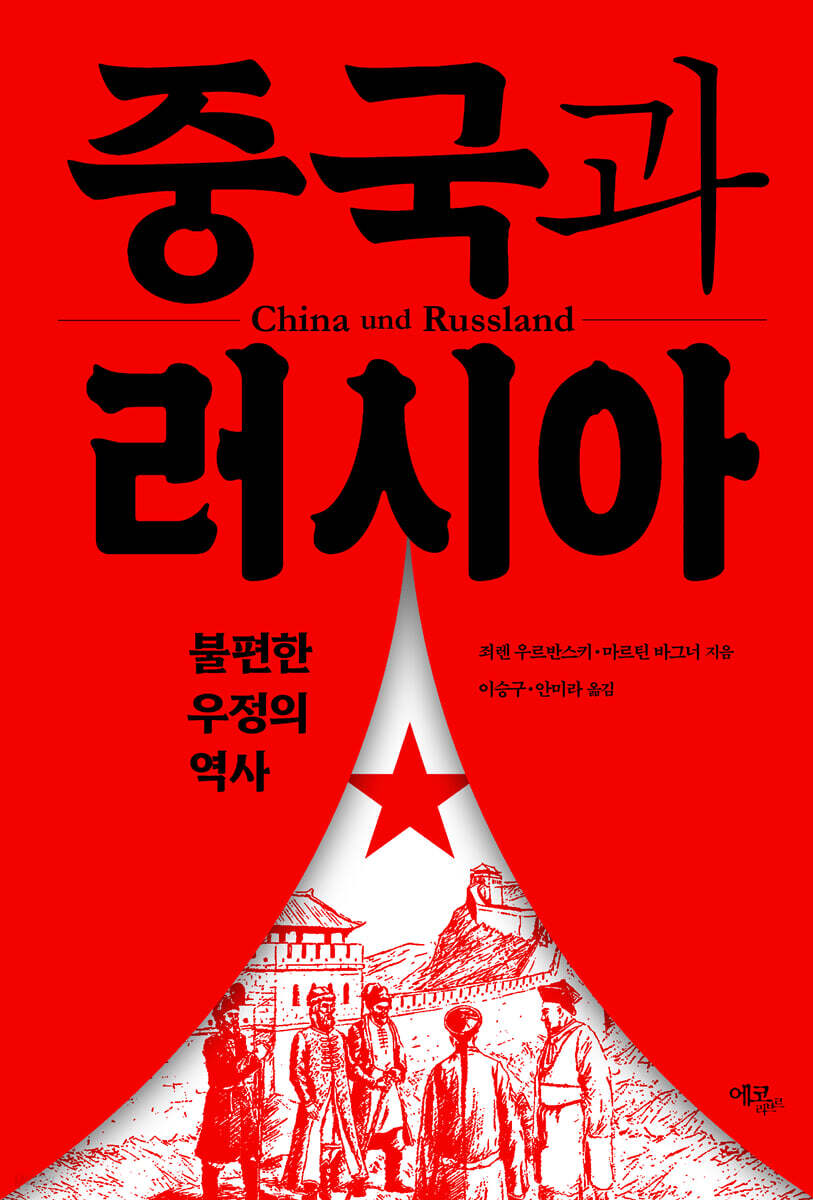
China and Russia
 |
Description
Book Introduction
The history of unbalanced friendship, explored through 12 central events!
A unique and fascinating introduction to the history of Sino-Russian relations.
"China and Russia" is a short story that explains a long relationship.
This history spans over 400 years, from the first visit of a Siberian explorer to Beijing in 1618 to the geopolitical engagement between Xi Jinping and Putin in the wake of Russia's invasion of Ukraine in 2022.
This paper examines the relationship between the two countries and their peoples from three perspectives. It begins by interpreting historical moments that brought about change in the relationship and that remain controversial even afterward.
Among these turning points, some are now largely forgotten or deliberately ignored.
Second, we analyze the foreign policies of both countries from the perspective of each country's domestic politics.
The communist revolution in Russia or the capitalist reform and opening up of China have been the subject of heated debate in neighboring countries, sometimes as if they were seeing a glimpse into their own future.
Ultimately, Sino-Russian relations have not only been influenced by the international power structure, but changes in it have also always brought about a reorganization of the world order.
It is therefore a history of inter-state encounters, transnational intertwining of economic and social relations, and competition between international systems.
A unique and fascinating introduction to the history of Sino-Russian relations.
"China and Russia" is a short story that explains a long relationship.
This history spans over 400 years, from the first visit of a Siberian explorer to Beijing in 1618 to the geopolitical engagement between Xi Jinping and Putin in the wake of Russia's invasion of Ukraine in 2022.
This paper examines the relationship between the two countries and their peoples from three perspectives. It begins by interpreting historical moments that brought about change in the relationship and that remain controversial even afterward.
Among these turning points, some are now largely forgotten or deliberately ignored.
Second, we analyze the foreign policies of both countries from the perspective of each country's domestic politics.
The communist revolution in Russia or the capitalist reform and opening up of China have been the subject of heated debate in neighboring countries, sometimes as if they were seeing a glimpse into their own future.
Ultimately, Sino-Russian relations have not only been influenced by the international power structure, but changes in it have also always brought about a reorganization of the world order.
It is therefore a history of inter-state encounters, transnational intertwining of economic and social relations, and competition between international systems.
index
introduction
01 Beijing 1618: Encountering the Unknown
02 Nerchinsk 1689: Establishing the Border
03 Aihun 1858: The Empire's Map Changes
04 Harbin 1898: Experiencing Imperialism
05 Shanghai 1921: Ignite the Revolution
06 Moscow 1950: Pledge of Friendship
07 Beijing 1956: Facing De-Stalinization
08 Damansky 1969: Testing the Borders
09 Tashkent 1982: Attempting to Approach
10 Beijing 1989: Losing Control
11 Shanghai 2001: Shaking the World Order
12 Kiiu 2022: Interpreting War
Epilogue
Acknowledgements
main
Sources and References
Chronology
Photo source
01 Beijing 1618: Encountering the Unknown
02 Nerchinsk 1689: Establishing the Border
03 Aihun 1858: The Empire's Map Changes
04 Harbin 1898: Experiencing Imperialism
05 Shanghai 1921: Ignite the Revolution
06 Moscow 1950: Pledge of Friendship
07 Beijing 1956: Facing De-Stalinization
08 Damansky 1969: Testing the Borders
09 Tashkent 1982: Attempting to Approach
10 Beijing 1989: Losing Control
11 Shanghai 2001: Shaking the World Order
12 Kiiu 2022: Interpreting War
Epilogue
Acknowledgements
main
Sources and References
Chronology
Photo source
Publisher's Review
Following Chinese President Xi Jinping's attendance at Russia's Victory Day celebrations in May 2025, the world's attention was drawn to Russian President Vladimir Putin's attendance at China's Victory Day celebrations in September alongside North Korean National Defense Commission Chairman Kim Jong Un.
The close relationship between the two countries is prominent.
Russia's invasion of Ukraine in 2022, geopolitical factors, and the turbulent global economic order following President Trump's re-election may also have played a role.
There is much speculation about the relationship between China and Russia.
While the alliance between the two authoritarian regimes is concerning, the geopolitical interests of Beijing and Moscow sometimes conflict.
Although the two countries flaunt their friendly relations by using words like “unlimited friendship,” “strong friendship,” and “good friends,” it is unclear whether the two countries regard each other as equals.
This book is a short story that explains a long relationship.
This history spans over 400 years, from the first visit of a Siberian explorer to Beijing in 1618 to the geopolitical engagement between Xi Jinping and Putin in the wake of Russia's invasion of Ukraine in 2022.
This paper examines the relationship between the two countries and their peoples from three perspectives. It begins by interpreting historical moments that brought about change in the relationship and that remain controversial even afterward.
Among these turning points, some are now largely forgotten or deliberately ignored.
Second, we analyze the foreign policies of both countries from the perspective of each country's domestic politics.
The communist revolution in Russia or the capitalist reform and opening up of China have been the subject of heated debate in neighboring countries, sometimes as if they were seeing a glimpse into their own future.
Ultimately, Sino-Russian relations have not only been influenced by the international power structure, but changes in it have also always brought about a reorganization of the world order.
It is therefore a history of inter-state encounters, transnational intertwining of economic and social relations, and competition between international systems.
As an introduction to the history of relations between China and Russia, the authors address the historical complexity of this relationship of global significance head-on, while maintaining a perspective on contemporary realities.
It examines various aspects of Sino-Russian relations through twelve central events, ranging from high-level politics in the heartland to everyday encounters in the border region.
By focusing on defining moments rather than recounting them chronologically, the narrative reveals recurring challenges and timeless contradictions.
This approach illustrates the dynamic nature of the relationship between the two countries.
Beginning with the story of a Russian Enlightenment delegation that took more than two years to reach Beijing but was refused even an audience, and of a letter from the Chinese emperor that Moscow could not decipher (Chapter 1), the book also tells the story of Jesuit missionaries who wrote border treaties in Latin on the uninhabited steppe (Chapter 2), and the fevered dreams of St. Petersburg armchairists of a "Russian" California that to this day remains a swamp in the shadow of China (Chapter 3).
We follow the footsteps of a young Chinese journalist who sets out for the 'Red Mecca' only to witness a 'land of starvation' in Soviet Russia (Chapter 5), and we also see a supporting role of a Chinese opera diva who unhesitatingly sings Soviet military songs in Mariupol, which was mercilessly destroyed by the Russians (Chapter 12).
Explaining relationships through metaphors
Historians use metaphors to explain the relationship between China and Russia.
However, the relationship between the two countries, which has both shared interests and competes with each other, is complex and two-sided, making it difficult to simplify and express it with a single symbolic image.
Although it is expressed in terms of family ties, the image of a socialist brother state, with the Soviet Union as the older brother, is no longer used because it brings up old wounds.
Beijing has long refused to allow the expression "China is Russia's son."
The two countries are portrayed as lovers who love each other.
These expressions have one thing in common.
China and Russia may seem inseparable, but they are very different.
asymmetrical relationship
Sino-Russian relations have been influenced by foreign powers competing with China, Russia, or both.
In the 19th century, Britain and France played that role, and in the 20th and 21st centuries, Japan and the United States played that role.
The upheavals experienced by the two countries have transformed the foundations of their relationship. Historically, there are three logics of exchange that have formed distinct frameworks in Sino-Russian relations.
From the early modern period until the 19th century, the two countries maintained a largely distant relationship until territorial expansion brought them face-to-face.
In the 20th century, communist ideologues in Moscow and Beijing created a kind of unified fiction, in the shadow of which the Soviet Union gained the upper hand in asymmetrical power relations.
Today, China and Russia are united in their anti-Western stance, but Moscow has now been relegated to the position of junior partner.
In addition to these historical specificities, there are also recurring phenomena that have shaped bilateral relations across time boundaries.
As empires based on continental land states, China and Russia have always had a tense relationship between their centers and peripheries from the 17th century to the present.
Dominion over the empire's periphery was realized only late and proved to be unstable even in the 20th century.
Geographical and cultural distances remain, and economic dependence remains essentially the same, with only the division of roles changing.
Relations between the two countries have been fundamentally characterized by repeated alternations of domination and cooperation.
It was rare for the relationship to be equal and symmetrical.
adjacent distant neighbors
The uniqueness of Sino-Russian relations stems from their neighboring geopolitical locations on the Eurasian continent.
Today, Russia's territory spans 11 time zones from the Baltic Sea to the Pacific Ocean.
China has five climate zones, from the subarctic region of the Amur River basin to the tropical region of Hainan Island.
The border between the two countries is approximately 4,000 kilometers long.
Until the early 20th century, when Mongolia was part of the Chinese Empire and the Central Asian countries were part of the Russian Empire, the border between the two countries was the world's longest land border at about 12,000 kilometers.
Despite being so close together, the societies of the two countries still maintain a certain distance from each other to this day.
The border area shared by the two countries is a sparsely populated periphery of both countries.
There were no bridges on the Amur River until 2022, and even now there are only two.
This lack of connectivity, independent of the political closeness between Beijing and Moscow, symbolizes the real distance between the two countries.
Chinese and Russian societies have been strangers to each other for hundreds of years.
The political centers of the two empires are not only far apart from each other, but also far from their borders.
Until the 20th century, people living along the border between the two countries considered themselves neither Russian nor Chinese.
The dominant ethnic groups of the two countries remain culturally, linguistically, and religiously heterogeneous to this day.
There is a contradiction between the rhetoric emphasizing alliance and cultural heterogeneity and historical conflict, which is only barely masked by increasingly exaggerated rhetoric of friendship.
This book explores the true nature of this duality.
Three periods that distinguish Sino-Russian relations
The 400 years of Sino-Russian contact have timeless characteristics, but can be divided into three periods according to the unique logic of the relationship.
The imperialist period from the 17th to the 19th century, the socialist world empire period in the 20th century, and the current authoritarian regime period.
The imperialist relationship between China and Russia revolved around territorial expansion.
From the first direct contact in the 17th century until the construction of the railway in the late 19th century, the geographical distance between the two empires was a major obstacle.
Modernization of transportation infrastructure led to large-scale migration of major ethnic groups from both empires and settlement in the border areas.
In new urban centers like Harbin and Blagoveshchensk, everyday contacts became more frequent, and the two empires' desire to extend their spheres of influence to increasingly tightly controlled borders grew.
Thus, through the control of space, the logic of imperialism transformed the indifference that arose from a distance into confrontation in conflict zones.
Both empires ruled by emperors became communist empires in the 20th century.
However, even before the founding of the People's Republic of China in 1949, Chinese Communist Party officials had gone their own way and, after Stalin's death, asserted their leadership in the socialist world.
The economic interdependence of the two empires reached a new peak under Moscow's leadership in the mid-20th century, while uncontrolled, informal border crossings declined.
Therefore, the socialist era was characterized by ideological unity and asymmetrical power relations that favored the Soviet Union.
As ideological divisions became apparent, no major war broke out, but fragile alliances were broken.
The two countries became closer again after China's opening up in 1978 and the collapse of the Soviet Union in 1991, which led to different systems.
Today, although the two countries differ ideologically, pragmatic political and economic interests bind Beijing and Moscow together.
As an authoritarian regime, they are perfecting their repressive techniques domestically and rejecting the US-led international order externally.
Russia is clearly economically inferior to China, and today's bilateral relationship is structured around 'Russian resources versus Chinese advanced technology.'
China and Russia, which have formed an authoritarian bloc, are increasingly openly challenging the United States, the European Union (EU), and other democratic countries around the world.
Their collaborative geopolitical actions expose the fragility of the rules-based world order they seek to undermine.
Moreover, Russia's invasion of Ukraine clearly demonstrates that Moscow will not hesitate to use military force again for neo-imperialist purposes.
China is closely watching the unfolding war in the heart of Europe.
Only time will tell what this means for Taiwan.
The past provides no answers when it comes to interpreting the present or predicting the future.
The twelve chapters of this book focus on specific events, revealing the openness of concrete situations and the dynamism and discontinuity inherent in seemingly continuous processes of development.
This book does not seek to be an encyclopedic, all-encompassing book.
Focusing on the relationship between two similar, intertwined, competing, and cooperating nations—an imperialist power and a socialist superpower, a violent and authoritarian regime—it tells the multifaceted history of their multifaceted interactions, never able to escape the key events that shaped them.
Relations between the two countries are not free from the shadows of the past, and their history clearly demonstrates that neither side has fully realized its shared ambitions, and this remains the case even today.
Moreover, as multi-ethnic empires and neighbors with different cultures, China and Russia have always maintained a unique relationship, and will continue to do so in the future.
For the past 400 years, rhetoric promoting good friendships has sometimes been an indicator of conflict, conflict of interest, and disagreement between nations, while ceremonial declarations of friendship have served to mask these rivalries and conflicts.
Moreover, the two countries cannot avoid each other and need each other.
Then and now, relations between the two countries have become closer when one side has been insulted, defeated, or ignored by a third party.
For example, when China suffered a crushing defeat at the hands of Japan in 1895, Russia offered itself as a savior.
Today, the roles have changed.
Xi Jinping rolls out the red carpet for Putin, who is internationally marginalized.
The purpose-driven alliance between China and Russia, both past and present, stems from common power interests and a common enemy.
The current close relationship between North Korea, China, and Russia casts a deep shadow over the Korean Peninsula.
It is impossible to know what each country's true intentions are.
But an alliance with a purpose breaks down as soon as one of the two loses its utility.
Conversely, alliance partners become more cohesive when they believe that they will benefit from their shared success in the future.
It is unclear how long this alliance will last, but to secure our place within it, we must closely observe the international situation, employ deep insight, and adopt a nuanced approach.
Therefore, today is more important to us politically and economically than ever before, and this book will serve as an important reference for understanding the relationship between our two countries and the global situation.
The close relationship between the two countries is prominent.
Russia's invasion of Ukraine in 2022, geopolitical factors, and the turbulent global economic order following President Trump's re-election may also have played a role.
There is much speculation about the relationship between China and Russia.
While the alliance between the two authoritarian regimes is concerning, the geopolitical interests of Beijing and Moscow sometimes conflict.
Although the two countries flaunt their friendly relations by using words like “unlimited friendship,” “strong friendship,” and “good friends,” it is unclear whether the two countries regard each other as equals.
This book is a short story that explains a long relationship.
This history spans over 400 years, from the first visit of a Siberian explorer to Beijing in 1618 to the geopolitical engagement between Xi Jinping and Putin in the wake of Russia's invasion of Ukraine in 2022.
This paper examines the relationship between the two countries and their peoples from three perspectives. It begins by interpreting historical moments that brought about change in the relationship and that remain controversial even afterward.
Among these turning points, some are now largely forgotten or deliberately ignored.
Second, we analyze the foreign policies of both countries from the perspective of each country's domestic politics.
The communist revolution in Russia or the capitalist reform and opening up of China have been the subject of heated debate in neighboring countries, sometimes as if they were seeing a glimpse into their own future.
Ultimately, Sino-Russian relations have not only been influenced by the international power structure, but changes in it have also always brought about a reorganization of the world order.
It is therefore a history of inter-state encounters, transnational intertwining of economic and social relations, and competition between international systems.
As an introduction to the history of relations between China and Russia, the authors address the historical complexity of this relationship of global significance head-on, while maintaining a perspective on contemporary realities.
It examines various aspects of Sino-Russian relations through twelve central events, ranging from high-level politics in the heartland to everyday encounters in the border region.
By focusing on defining moments rather than recounting them chronologically, the narrative reveals recurring challenges and timeless contradictions.
This approach illustrates the dynamic nature of the relationship between the two countries.
Beginning with the story of a Russian Enlightenment delegation that took more than two years to reach Beijing but was refused even an audience, and of a letter from the Chinese emperor that Moscow could not decipher (Chapter 1), the book also tells the story of Jesuit missionaries who wrote border treaties in Latin on the uninhabited steppe (Chapter 2), and the fevered dreams of St. Petersburg armchairists of a "Russian" California that to this day remains a swamp in the shadow of China (Chapter 3).
We follow the footsteps of a young Chinese journalist who sets out for the 'Red Mecca' only to witness a 'land of starvation' in Soviet Russia (Chapter 5), and we also see a supporting role of a Chinese opera diva who unhesitatingly sings Soviet military songs in Mariupol, which was mercilessly destroyed by the Russians (Chapter 12).
Explaining relationships through metaphors
Historians use metaphors to explain the relationship between China and Russia.
However, the relationship between the two countries, which has both shared interests and competes with each other, is complex and two-sided, making it difficult to simplify and express it with a single symbolic image.
Although it is expressed in terms of family ties, the image of a socialist brother state, with the Soviet Union as the older brother, is no longer used because it brings up old wounds.
Beijing has long refused to allow the expression "China is Russia's son."
The two countries are portrayed as lovers who love each other.
These expressions have one thing in common.
China and Russia may seem inseparable, but they are very different.
asymmetrical relationship
Sino-Russian relations have been influenced by foreign powers competing with China, Russia, or both.
In the 19th century, Britain and France played that role, and in the 20th and 21st centuries, Japan and the United States played that role.
The upheavals experienced by the two countries have transformed the foundations of their relationship. Historically, there are three logics of exchange that have formed distinct frameworks in Sino-Russian relations.
From the early modern period until the 19th century, the two countries maintained a largely distant relationship until territorial expansion brought them face-to-face.
In the 20th century, communist ideologues in Moscow and Beijing created a kind of unified fiction, in the shadow of which the Soviet Union gained the upper hand in asymmetrical power relations.
Today, China and Russia are united in their anti-Western stance, but Moscow has now been relegated to the position of junior partner.
In addition to these historical specificities, there are also recurring phenomena that have shaped bilateral relations across time boundaries.
As empires based on continental land states, China and Russia have always had a tense relationship between their centers and peripheries from the 17th century to the present.
Dominion over the empire's periphery was realized only late and proved to be unstable even in the 20th century.
Geographical and cultural distances remain, and economic dependence remains essentially the same, with only the division of roles changing.
Relations between the two countries have been fundamentally characterized by repeated alternations of domination and cooperation.
It was rare for the relationship to be equal and symmetrical.
adjacent distant neighbors
The uniqueness of Sino-Russian relations stems from their neighboring geopolitical locations on the Eurasian continent.
Today, Russia's territory spans 11 time zones from the Baltic Sea to the Pacific Ocean.
China has five climate zones, from the subarctic region of the Amur River basin to the tropical region of Hainan Island.
The border between the two countries is approximately 4,000 kilometers long.
Until the early 20th century, when Mongolia was part of the Chinese Empire and the Central Asian countries were part of the Russian Empire, the border between the two countries was the world's longest land border at about 12,000 kilometers.
Despite being so close together, the societies of the two countries still maintain a certain distance from each other to this day.
The border area shared by the two countries is a sparsely populated periphery of both countries.
There were no bridges on the Amur River until 2022, and even now there are only two.
This lack of connectivity, independent of the political closeness between Beijing and Moscow, symbolizes the real distance between the two countries.
Chinese and Russian societies have been strangers to each other for hundreds of years.
The political centers of the two empires are not only far apart from each other, but also far from their borders.
Until the 20th century, people living along the border between the two countries considered themselves neither Russian nor Chinese.
The dominant ethnic groups of the two countries remain culturally, linguistically, and religiously heterogeneous to this day.
There is a contradiction between the rhetoric emphasizing alliance and cultural heterogeneity and historical conflict, which is only barely masked by increasingly exaggerated rhetoric of friendship.
This book explores the true nature of this duality.
Three periods that distinguish Sino-Russian relations
The 400 years of Sino-Russian contact have timeless characteristics, but can be divided into three periods according to the unique logic of the relationship.
The imperialist period from the 17th to the 19th century, the socialist world empire period in the 20th century, and the current authoritarian regime period.
The imperialist relationship between China and Russia revolved around territorial expansion.
From the first direct contact in the 17th century until the construction of the railway in the late 19th century, the geographical distance between the two empires was a major obstacle.
Modernization of transportation infrastructure led to large-scale migration of major ethnic groups from both empires and settlement in the border areas.
In new urban centers like Harbin and Blagoveshchensk, everyday contacts became more frequent, and the two empires' desire to extend their spheres of influence to increasingly tightly controlled borders grew.
Thus, through the control of space, the logic of imperialism transformed the indifference that arose from a distance into confrontation in conflict zones.
Both empires ruled by emperors became communist empires in the 20th century.
However, even before the founding of the People's Republic of China in 1949, Chinese Communist Party officials had gone their own way and, after Stalin's death, asserted their leadership in the socialist world.
The economic interdependence of the two empires reached a new peak under Moscow's leadership in the mid-20th century, while uncontrolled, informal border crossings declined.
Therefore, the socialist era was characterized by ideological unity and asymmetrical power relations that favored the Soviet Union.
As ideological divisions became apparent, no major war broke out, but fragile alliances were broken.
The two countries became closer again after China's opening up in 1978 and the collapse of the Soviet Union in 1991, which led to different systems.
Today, although the two countries differ ideologically, pragmatic political and economic interests bind Beijing and Moscow together.
As an authoritarian regime, they are perfecting their repressive techniques domestically and rejecting the US-led international order externally.
Russia is clearly economically inferior to China, and today's bilateral relationship is structured around 'Russian resources versus Chinese advanced technology.'
China and Russia, which have formed an authoritarian bloc, are increasingly openly challenging the United States, the European Union (EU), and other democratic countries around the world.
Their collaborative geopolitical actions expose the fragility of the rules-based world order they seek to undermine.
Moreover, Russia's invasion of Ukraine clearly demonstrates that Moscow will not hesitate to use military force again for neo-imperialist purposes.
China is closely watching the unfolding war in the heart of Europe.
Only time will tell what this means for Taiwan.
The past provides no answers when it comes to interpreting the present or predicting the future.
The twelve chapters of this book focus on specific events, revealing the openness of concrete situations and the dynamism and discontinuity inherent in seemingly continuous processes of development.
This book does not seek to be an encyclopedic, all-encompassing book.
Focusing on the relationship between two similar, intertwined, competing, and cooperating nations—an imperialist power and a socialist superpower, a violent and authoritarian regime—it tells the multifaceted history of their multifaceted interactions, never able to escape the key events that shaped them.
Relations between the two countries are not free from the shadows of the past, and their history clearly demonstrates that neither side has fully realized its shared ambitions, and this remains the case even today.
Moreover, as multi-ethnic empires and neighbors with different cultures, China and Russia have always maintained a unique relationship, and will continue to do so in the future.
For the past 400 years, rhetoric promoting good friendships has sometimes been an indicator of conflict, conflict of interest, and disagreement between nations, while ceremonial declarations of friendship have served to mask these rivalries and conflicts.
Moreover, the two countries cannot avoid each other and need each other.
Then and now, relations between the two countries have become closer when one side has been insulted, defeated, or ignored by a third party.
For example, when China suffered a crushing defeat at the hands of Japan in 1895, Russia offered itself as a savior.
Today, the roles have changed.
Xi Jinping rolls out the red carpet for Putin, who is internationally marginalized.
The purpose-driven alliance between China and Russia, both past and present, stems from common power interests and a common enemy.
The current close relationship between North Korea, China, and Russia casts a deep shadow over the Korean Peninsula.
It is impossible to know what each country's true intentions are.
But an alliance with a purpose breaks down as soon as one of the two loses its utility.
Conversely, alliance partners become more cohesive when they believe that they will benefit from their shared success in the future.
It is unclear how long this alliance will last, but to secure our place within it, we must closely observe the international situation, employ deep insight, and adopt a nuanced approach.
Therefore, today is more important to us politically and economically than ever before, and this book will serve as an important reference for understanding the relationship between our two countries and the global situation.
GOODS SPECIFICS
- Date of issue: October 20, 2025
- Page count, weight, size: 368 pages | 148*217*30mm
- ISBN13: 9788962633245
- ISBN10: 8962633248
You may also like
카테고리
korean


korean

![GQ KOREA Mark (Monthly): December [2025]](http://librairie.coreenne.fr/cdn/shop/files/8ef265dbbfbf186523ed75ba7319009d.jpg?v=1765340328&width=3840)


