

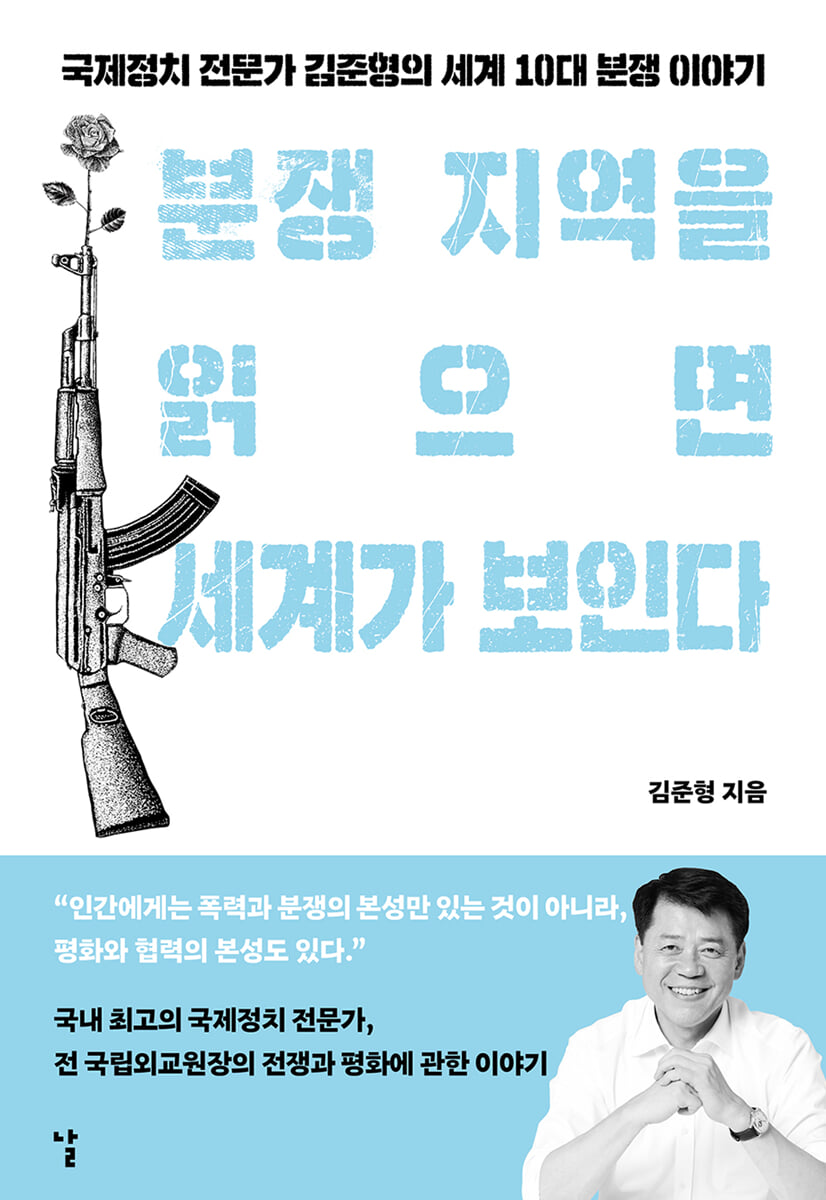
Reading conflict zones reveals the world
 |
Description
Book Introduction
It is politicians who cause wars and conflicts.
Why should the people have to take responsibility for the aftermath?
The country's top international politics expert tells us
Stories of conflict and peace
There have only been a few hundred years in human history without war.
That's how much humanity has been fighting constantly.
What is the reason?
There are many reasons, such as limited resources, different races, and different hegemonies.
The problem is that politicians are the ones who start wars and conflicts, but the damage is borne solely by the people and the nation.
This is why we must abandon the very idea of trying to solve any problem through war or conflict.
Why should the people have to take responsibility for the aftermath?
The country's top international politics expert tells us
Stories of conflict and peace
There have only been a few hundred years in human history without war.
That's how much humanity has been fighting constantly.
What is the reason?
There are many reasons, such as limited resources, different races, and different hegemonies.
The problem is that politicians are the ones who start wars and conflicts, but the damage is borne solely by the people and the nation.
This is why we must abandon the very idea of trying to solve any problem through war or conflict.
- You can preview some of the book's contents.
Preview
index
In publishing a book
Chapter 1.
Why did Russia invade Ukraine?: The Russo-Ukrainian War
Memory of the Ukrainian Genocide
Pro-Russian vs. pro-European
Why Russia is anxious
America did not prevent the war
Towards the end of the war
Chapter 2.
Will Peace Come to Palestine?: The Israel-Palestine Conflict
Britain straddling both sides
The UN raised its hand against Israel
The prelude to the Middle East war
The expanded land of Israel
Oslo Accords recognized by both countries
border issues
The never-ending war
Netanyahu's supporters are far-right
Chapter 3.
Why America Has Become Indifferent to Afghanistan: The US-Afghan War
A strategic location coveted by everyone
bear trap
Both the Soviet Union and the United States withdrew
Why America Has Become Indifferent to the Middle East
Read more blogback
Chapter 4.
Why Taiwan Doesn't Have a Flag: The China-Taiwan Conflict
Conflict between the Communist Party and the Kuomintang
The United States caught between the two
China's new ideology is nationalism
America's vacillations
Read more Taiwan's political parties
Chapter 5.
Why did Chinese and Indian troops engage in a physical altercation?: The China-India conflict.
Britain draws its own borders
The reason why we fell out
Why are you saying you want to build a road on my land?
No need to rush
India overtaking China
Chapter 6.
Why We're Fighting Our Neighbors: The India-Pakistan Kashmir Conflict
Britain suppressed Islam
Divided Kashmir
Pakistan claims 'two Indias'
China joins hands with Pakistan
An unstable nuclear arms race
Read more about the movie Hotel Mumbai?
Chapter 7.
Why the Kurds Couldn't Establish a State: The Turki-Kurdish Conflict
The largest single nation without a state
Powers that exploited independence as bait
countries coveting resources
Too many tribes to form a nation
Chapter 8.
Is the war over in Syria?: The Syrian Civil War
Children who returned as corpses
From civil war to religious war
Turkey and Israel's participation in the war
Iran and Russia supporting government forces
Why the US and Western Europe pulled out
I hate neither Assad nor HTS.
Read more Arab Spring
Chapter 9.
Why the Military Remains in Power: Myanmar's Civil War
Civil war since independence
Why didn't you remove the numbers?
A civilian government that failed to exert its power
A lonely struggle
Read more about the Rohingya genocide
Chapter 10.
Why a Nobel Peace Prize Winner Became a Massacre: The Ethiopian Civil War
The only country that defeated the West
The real power lies with the Prime Minister and his party.
Reasons for excluding TPLF
A murderer who is a Nobel Peace Prize winner
Reviews
Chapter 1.
Why did Russia invade Ukraine?: The Russo-Ukrainian War
Memory of the Ukrainian Genocide
Pro-Russian vs. pro-European
Why Russia is anxious
America did not prevent the war
Towards the end of the war
Chapter 2.
Will Peace Come to Palestine?: The Israel-Palestine Conflict
Britain straddling both sides
The UN raised its hand against Israel
The prelude to the Middle East war
The expanded land of Israel
Oslo Accords recognized by both countries
border issues
The never-ending war
Netanyahu's supporters are far-right
Chapter 3.
Why America Has Become Indifferent to Afghanistan: The US-Afghan War
A strategic location coveted by everyone
bear trap
Both the Soviet Union and the United States withdrew
Why America Has Become Indifferent to the Middle East
Read more blogback
Chapter 4.
Why Taiwan Doesn't Have a Flag: The China-Taiwan Conflict
Conflict between the Communist Party and the Kuomintang
The United States caught between the two
China's new ideology is nationalism
America's vacillations
Read more Taiwan's political parties
Chapter 5.
Why did Chinese and Indian troops engage in a physical altercation?: The China-India conflict.
Britain draws its own borders
The reason why we fell out
Why are you saying you want to build a road on my land?
No need to rush
India overtaking China
Chapter 6.
Why We're Fighting Our Neighbors: The India-Pakistan Kashmir Conflict
Britain suppressed Islam
Divided Kashmir
Pakistan claims 'two Indias'
China joins hands with Pakistan
An unstable nuclear arms race
Read more about the movie Hotel Mumbai?
Chapter 7.
Why the Kurds Couldn't Establish a State: The Turki-Kurdish Conflict
The largest single nation without a state
Powers that exploited independence as bait
countries coveting resources
Too many tribes to form a nation
Chapter 8.
Is the war over in Syria?: The Syrian Civil War
Children who returned as corpses
From civil war to religious war
Turkey and Israel's participation in the war
Iran and Russia supporting government forces
Why the US and Western Europe pulled out
I hate neither Assad nor HTS.
Read more Arab Spring
Chapter 9.
Why the Military Remains in Power: Myanmar's Civil War
Civil war since independence
Why didn't you remove the numbers?
A civilian government that failed to exert its power
A lonely struggle
Read more about the Rohingya genocide
Chapter 10.
Why a Nobel Peace Prize Winner Became a Massacre: The Ethiopian Civil War
The only country that defeated the West
The real power lies with the Prime Minister and his party.
Reasons for excluding TPLF
A murderer who is a Nobel Peace Prize winner
Reviews
Detailed image

Into the book
Since time immemorial, mankind has often tried to solve problems through war.
But after reading this book, you will realize that no war ends cleanly.
The idea is that we should not even think about trying to solve anything through war.
And the biggest reason why we should not use war is that in most cases, it is not the rich or the powerful who suffer the most, but the socially and economically disadvantaged.
--- p.9
Eastern Ukraine is friendly with Russia, and western Ukraine is friendly with Europe.
This is where almost all the problems arise.
The public has often been divided based on the president's inclinations, and even in the run-up to the 2004 presidential election, the public was divided based on the presidential candidates' inclinations.
This division led to great social conflict, the most representative of which was the so-called 'Orange Revolution'.
--- p.21
Russia demands from the United States:
They demand that Ukraine be banned from joining NATO and that the troops and nuclear weapons deployed to the new NATO member be withdrawn.
It also called for compliance with the Minsk agreements signed in 2014.
However, the United States rejected Russia's demands outright, and Ukrainian President Zelensky did not withdraw his intention to join NATO, which ultimately led to war.
--- p.25
If there is a ceasefire, Ukraine will likely remain a conflict zone.
The biggest problem remains that Russia, which invaded another country, is being given a free pass without being punished.
The best-case scenario would be for mature Russian citizens to remove Putin from power, but that will take time.
A war can only end when one side wins unilaterally, or when both sides come to the conclusion that it is better to compromise than to fight.
--- p.30
After World War I, the international community sided with the Jews.
It was decided to establish a Jewish state in Palestine.
Why? As I mentioned earlier, Jews played a significant role in helping Western Europe, including Britain, win World War I.
--- p.37
With the collapse of the Soviet Union in 1991, the Cold War system also collapsed.
The United States becomes the sole superpower.
U.S. President Clinton takes an active role in resolving the Israeli-Palestinian conflict.
The result was the Oslo Accords of 1993.
The core idea is that Israel and Palestine should become independent sovereign states and coexist as a “nation-to-nation” system.
--- p.43
The prospects for a resolution to the Israeli-Palestinian conflict are bleak.
This is because Netanyahu, who has the strongest extreme right-wing tendency in Israeli history, is in power for a long time and Trump is president again.
As of March 2025, Trump has shocked the world by not only openly siding with Israel, but also by declaring that the United States intends to dominate the Gaza Strip.
--- p.52
Sephardi refers to a Jewish group that mainly lived in the Iberian Peninsula region, including Spain and Portugal.
They formed the lower class in Israel.
So, the basis of my life overlapped with my residence in Palestine.
Those with weak socioeconomic foundations oppose the progressive forces' policy of returning occupied territories.
And it is driving Israel's rightward shift.
The far-right became stronger after the collapse of the Soviet Union in 1991, with an influx of up to 700,000 Russian Jews.
The result is Netanyahu's long-term rule.
--- p.54
The Soviet Union invaded Afghanistan in December 1979, fearing that the regime would collapse.
There was another reason.
In 1979, the Islamic Revolution took place in Iran.
As a result, the dynasty (Pahlavi Dynasty) collapsed and an Islamic republic was established with an Islamic religious leader holding supreme power.
The Soviet Union is nervous.
They were also afraid that an Islamic revolution would occur in the Islamic republics in the southern regions of the Soviet Union, such as Tajikistan, Uzbekistan, and Turkmenistan.
The Soviet Union waged war in Afghanistan, adjacent to these republics, to prevent the revolution from spreading.
--- p.59
One of the reasons the United States was interested in the Middle East was because of oil, and the 'shale gas revolution' solved the energy problem.
There is no need to pay attention to the Middle East anymore.
Shale gas is natural gas contained in shale, a rock layer formed by horizontal sedimentation of mud.
The transition from an energy era dependent on oil to a new energy era called shale gas is called the 'shale gas revolution.'
With the discovery and exploitation of large quantities of shale gas in the United States, the country has transformed from an energy importer to an energy exporter.
--- p.66
China and Taiwan are deeply hostile to each other.
China views Taiwan as a puppet government (a government that claims to be independent but is actually controlled by external forces) established by Chiang Kai-shek, who lost the war, while Taiwan views China as a communist force that staged a coup.
Each side claims that it is the only legitimate ruling power and regards the other as a target for unification by force.
--- p.76
In the international community, Taiwan is not an independent country.
So you have to be careful when notating it.
It should be written as 'Chinese Taipei'.
Taiwan is also called Taiwan, but Taiwan is just the Chinese pronunciation of Taiwan.
Just like how Beijing is called Peking.
Therefore, when referring to Taiwan, it should be referred to as a liaison office, which is lower than an embassy, such as ‘Representative Office of the Republic of Korea in Taipei’ or ‘Representative Office of the Republic of Korea in Taipei’.
Because Taiwan is not a country, it is not a diplomatic target.
--- p.79
The Democratic Party's support base is made up of people who are alienated from the Kuomintang.
Those who support the Democratic Progressive Party believe that the recovery of mainland China is an unrealistic slogan.
The Democratic Progressive Party is furious, saying that the Kuomintang is only maintaining the status quo under the pretext of recovering mainland China and is only engaging in corruption.
In fact, the KMT hoped that China and Taiwan would settle into a relationship similar to that of China and Hong Kong or China and Macau.
--- p.86
Immediately after the founding of the People's Republic of China, relations between China and India were quite good.
India recognized China as a country before the United States or Western Europe.
However, after allowing the Tibetan government in exile to exist, relations between the two rapidly deteriorated.
And starting in the fall of 1959, armed conflicts began along the border.
--- p.95
India stays close to the United States when it comes to border disputes with China, but that doesn't mean it takes an anti-China stance.
We also oppose the United States' attempts to impose economic sanctions on Russia.
Because Russia has provided India with weapons and cheap oil, and has helped it more than the United States since independence.
Yet, when he met Putin, he displayed a strong presence to the point of giving him a sharp advice to stop the war.
According to a 2022 survey by a US consulting firm, India views the US as a threat as much as China.
--- p.108
Britain's so-called 'divide and rule' is notorious.
During their rule over India, the British intentionally highlighted the differences between Islam and Hinduism, fostering animosity between the two religions, and these sentiments continued to dominate the people even after independence.
It seems likely that this sentiment is the biggest cause of the conflict between India and Pakistan.
There is a country that followed the British division and rule.
It's the Japanese colonial period.
When Japan ruled our country, it tried to divide the people by inciting regionalism.
--- p.113
With China and Russia also intervening in the Kashmir conflict, the region's conflict has become increasingly difficult to resolve.
China provides weapons and military technology to Pakistan, and Russia provides weapons and military technology to India.
Particular attention should be paid to China's intervention.
--- p.125
Not only Turkey, but most countries are against the Kurds establishing a state.
One reason is that the areas where Kurds live are rich in resources.
Western European countries such as Britain and France, as well as neighboring Arab countries, are competing with each other to seize those resources.
Another example is the British decision to not give the Kurds land they had promised to give them because of their genetic resources.
--- p.145
Of course, ISIS also played a role in the US and Western Europe's withdrawal from the Syrian civil war.
Because helping anti-government forces would end up supporting ISIS.
Since both the anti-government forces and IS are fighting against the government forces, supporting the anti-government forces will also benefit IS.
What does ISIS mean to the United States and Western Europe? It's a force that has committed countless terrorist attacks and must be annihilated.
Ultimately, the United States and Western Europe became increasingly passive in their support of the anti-government forces.
--- p.158
But Syrians, whether those who remained in Syria or those who returned to Syria after wandering as refugees, dislike the Assad regime, but they also dislike HTS.
After the Assad family fled to Russia, Assad's remnants attacked the HTS-led coalition transitional government. HTS immediately retaliated.
Syrians who witnessed this process were shocked.
Even though they were remnants, they were also citizens.
--- p.159
During the 8888 Uprising, the government indiscriminately massacred even non-resisting civilians.
Thousands die.
How horrible it is for soldiers to point guns at their own people.
As a result of the resistance, Ne Win steps down, but the military again stage a coup and seize power.
The military becomes more vicious.
Aung San Suu Kyi was also placed under house arrest, unable to leave her home.
The figures were not released until 2010, over 20 years later.
--- p.170
The civil war in Myanmar resembles the Syrian civil war.
This is because the democratization movement turned into an armed struggle, citizens were divided by religion and ethnicity, and the interests of neighboring countries and world powers were intertwined.
Moreover, the impotent response of international organizations, including the UN, and the passive attitude of the United States toward matters that do not directly benefit the country are the same.
--- p.181
In December 2019, Aung San Suu Kyi will appear before the International Court of Justice as a witness to the 2017 Rohingya genocide.
By denying the massacre here, you are effectively supporting the military.
The international community was deeply disappointed, and protests continued across Europe demanding the revocation of the Nobel Peace Prize.
--- p.184
Ethiopia was the only African country at the time to win against a Western power.
European countries that had been proud of Africa as their front yard were shocked.
As a result, Ethiopia became one of two countries in Africa recognized as a legitimate state by Western imperialist powers.
The remaining country is Liberia.
--- p.192
The Abiy government's actions during the civil war have lost the trust of the international community.
Although they deny that they have committed human rights violations and war crimes against humanity, many countries are already distancing themselves from them.
Prime Minister Abiy has been particularly dissatisfied with the United States.
They protested, saying that the so-called "terrorists" TPLF and themselves, who were elected through a formal election, should not be judged by the same standards.
They also claim that this civil war is strictly a domestic issue and that the United States and Western countries have no right to interfere.
But after reading this book, you will realize that no war ends cleanly.
The idea is that we should not even think about trying to solve anything through war.
And the biggest reason why we should not use war is that in most cases, it is not the rich or the powerful who suffer the most, but the socially and economically disadvantaged.
--- p.9
Eastern Ukraine is friendly with Russia, and western Ukraine is friendly with Europe.
This is where almost all the problems arise.
The public has often been divided based on the president's inclinations, and even in the run-up to the 2004 presidential election, the public was divided based on the presidential candidates' inclinations.
This division led to great social conflict, the most representative of which was the so-called 'Orange Revolution'.
--- p.21
Russia demands from the United States:
They demand that Ukraine be banned from joining NATO and that the troops and nuclear weapons deployed to the new NATO member be withdrawn.
It also called for compliance with the Minsk agreements signed in 2014.
However, the United States rejected Russia's demands outright, and Ukrainian President Zelensky did not withdraw his intention to join NATO, which ultimately led to war.
--- p.25
If there is a ceasefire, Ukraine will likely remain a conflict zone.
The biggest problem remains that Russia, which invaded another country, is being given a free pass without being punished.
The best-case scenario would be for mature Russian citizens to remove Putin from power, but that will take time.
A war can only end when one side wins unilaterally, or when both sides come to the conclusion that it is better to compromise than to fight.
--- p.30
After World War I, the international community sided with the Jews.
It was decided to establish a Jewish state in Palestine.
Why? As I mentioned earlier, Jews played a significant role in helping Western Europe, including Britain, win World War I.
--- p.37
With the collapse of the Soviet Union in 1991, the Cold War system also collapsed.
The United States becomes the sole superpower.
U.S. President Clinton takes an active role in resolving the Israeli-Palestinian conflict.
The result was the Oslo Accords of 1993.
The core idea is that Israel and Palestine should become independent sovereign states and coexist as a “nation-to-nation” system.
--- p.43
The prospects for a resolution to the Israeli-Palestinian conflict are bleak.
This is because Netanyahu, who has the strongest extreme right-wing tendency in Israeli history, is in power for a long time and Trump is president again.
As of March 2025, Trump has shocked the world by not only openly siding with Israel, but also by declaring that the United States intends to dominate the Gaza Strip.
--- p.52
Sephardi refers to a Jewish group that mainly lived in the Iberian Peninsula region, including Spain and Portugal.
They formed the lower class in Israel.
So, the basis of my life overlapped with my residence in Palestine.
Those with weak socioeconomic foundations oppose the progressive forces' policy of returning occupied territories.
And it is driving Israel's rightward shift.
The far-right became stronger after the collapse of the Soviet Union in 1991, with an influx of up to 700,000 Russian Jews.
The result is Netanyahu's long-term rule.
--- p.54
The Soviet Union invaded Afghanistan in December 1979, fearing that the regime would collapse.
There was another reason.
In 1979, the Islamic Revolution took place in Iran.
As a result, the dynasty (Pahlavi Dynasty) collapsed and an Islamic republic was established with an Islamic religious leader holding supreme power.
The Soviet Union is nervous.
They were also afraid that an Islamic revolution would occur in the Islamic republics in the southern regions of the Soviet Union, such as Tajikistan, Uzbekistan, and Turkmenistan.
The Soviet Union waged war in Afghanistan, adjacent to these republics, to prevent the revolution from spreading.
--- p.59
One of the reasons the United States was interested in the Middle East was because of oil, and the 'shale gas revolution' solved the energy problem.
There is no need to pay attention to the Middle East anymore.
Shale gas is natural gas contained in shale, a rock layer formed by horizontal sedimentation of mud.
The transition from an energy era dependent on oil to a new energy era called shale gas is called the 'shale gas revolution.'
With the discovery and exploitation of large quantities of shale gas in the United States, the country has transformed from an energy importer to an energy exporter.
--- p.66
China and Taiwan are deeply hostile to each other.
China views Taiwan as a puppet government (a government that claims to be independent but is actually controlled by external forces) established by Chiang Kai-shek, who lost the war, while Taiwan views China as a communist force that staged a coup.
Each side claims that it is the only legitimate ruling power and regards the other as a target for unification by force.
--- p.76
In the international community, Taiwan is not an independent country.
So you have to be careful when notating it.
It should be written as 'Chinese Taipei'.
Taiwan is also called Taiwan, but Taiwan is just the Chinese pronunciation of Taiwan.
Just like how Beijing is called Peking.
Therefore, when referring to Taiwan, it should be referred to as a liaison office, which is lower than an embassy, such as ‘Representative Office of the Republic of Korea in Taipei’ or ‘Representative Office of the Republic of Korea in Taipei’.
Because Taiwan is not a country, it is not a diplomatic target.
--- p.79
The Democratic Party's support base is made up of people who are alienated from the Kuomintang.
Those who support the Democratic Progressive Party believe that the recovery of mainland China is an unrealistic slogan.
The Democratic Progressive Party is furious, saying that the Kuomintang is only maintaining the status quo under the pretext of recovering mainland China and is only engaging in corruption.
In fact, the KMT hoped that China and Taiwan would settle into a relationship similar to that of China and Hong Kong or China and Macau.
--- p.86
Immediately after the founding of the People's Republic of China, relations between China and India were quite good.
India recognized China as a country before the United States or Western Europe.
However, after allowing the Tibetan government in exile to exist, relations between the two rapidly deteriorated.
And starting in the fall of 1959, armed conflicts began along the border.
--- p.95
India stays close to the United States when it comes to border disputes with China, but that doesn't mean it takes an anti-China stance.
We also oppose the United States' attempts to impose economic sanctions on Russia.
Because Russia has provided India with weapons and cheap oil, and has helped it more than the United States since independence.
Yet, when he met Putin, he displayed a strong presence to the point of giving him a sharp advice to stop the war.
According to a 2022 survey by a US consulting firm, India views the US as a threat as much as China.
--- p.108
Britain's so-called 'divide and rule' is notorious.
During their rule over India, the British intentionally highlighted the differences between Islam and Hinduism, fostering animosity between the two religions, and these sentiments continued to dominate the people even after independence.
It seems likely that this sentiment is the biggest cause of the conflict between India and Pakistan.
There is a country that followed the British division and rule.
It's the Japanese colonial period.
When Japan ruled our country, it tried to divide the people by inciting regionalism.
--- p.113
With China and Russia also intervening in the Kashmir conflict, the region's conflict has become increasingly difficult to resolve.
China provides weapons and military technology to Pakistan, and Russia provides weapons and military technology to India.
Particular attention should be paid to China's intervention.
--- p.125
Not only Turkey, but most countries are against the Kurds establishing a state.
One reason is that the areas where Kurds live are rich in resources.
Western European countries such as Britain and France, as well as neighboring Arab countries, are competing with each other to seize those resources.
Another example is the British decision to not give the Kurds land they had promised to give them because of their genetic resources.
--- p.145
Of course, ISIS also played a role in the US and Western Europe's withdrawal from the Syrian civil war.
Because helping anti-government forces would end up supporting ISIS.
Since both the anti-government forces and IS are fighting against the government forces, supporting the anti-government forces will also benefit IS.
What does ISIS mean to the United States and Western Europe? It's a force that has committed countless terrorist attacks and must be annihilated.
Ultimately, the United States and Western Europe became increasingly passive in their support of the anti-government forces.
--- p.158
But Syrians, whether those who remained in Syria or those who returned to Syria after wandering as refugees, dislike the Assad regime, but they also dislike HTS.
After the Assad family fled to Russia, Assad's remnants attacked the HTS-led coalition transitional government. HTS immediately retaliated.
Syrians who witnessed this process were shocked.
Even though they were remnants, they were also citizens.
--- p.159
During the 8888 Uprising, the government indiscriminately massacred even non-resisting civilians.
Thousands die.
How horrible it is for soldiers to point guns at their own people.
As a result of the resistance, Ne Win steps down, but the military again stage a coup and seize power.
The military becomes more vicious.
Aung San Suu Kyi was also placed under house arrest, unable to leave her home.
The figures were not released until 2010, over 20 years later.
--- p.170
The civil war in Myanmar resembles the Syrian civil war.
This is because the democratization movement turned into an armed struggle, citizens were divided by religion and ethnicity, and the interests of neighboring countries and world powers were intertwined.
Moreover, the impotent response of international organizations, including the UN, and the passive attitude of the United States toward matters that do not directly benefit the country are the same.
--- p.181
In December 2019, Aung San Suu Kyi will appear before the International Court of Justice as a witness to the 2017 Rohingya genocide.
By denying the massacre here, you are effectively supporting the military.
The international community was deeply disappointed, and protests continued across Europe demanding the revocation of the Nobel Peace Prize.
--- p.184
Ethiopia was the only African country at the time to win against a Western power.
European countries that had been proud of Africa as their front yard were shocked.
As a result, Ethiopia became one of two countries in Africa recognized as a legitimate state by Western imperialist powers.
The remaining country is Liberia.
--- p.192
The Abiy government's actions during the civil war have lost the trust of the international community.
Although they deny that they have committed human rights violations and war crimes against humanity, many countries are already distancing themselves from them.
Prime Minister Abiy has been particularly dissatisfied with the United States.
They protested, saying that the so-called "terrorists" TPLF and themselves, who were elected through a formal election, should not be judged by the same standards.
They also claim that this civil war is strictly a domestic issue and that the United States and Western countries have no right to interfere.
--- p.202
Publisher's Review
To realize the value of 'peace'
There is no need for war!
"Reading Conflict Zones Reveals the World" carefully selects ten recent conflicts and examines their context, how they unfolded, and what they left behind.
The ten conflicts are the Russia-Ukraine War, which is nearing its end, the Israel-Palestine conflict, the US-Afghanistan War, the China-Taiwan conflict, the China-India conflict, the India-Pakistan Kashmir conflict, the Turkmen-Kurdish conflict, the Syrian Civil War, the Myanmar Civil War, and the Ethiopian Civil War.
Why did the author focus on these disputes?
Because they have three things in common.
It is the most typical form of conflict, and it is difficult to resolve because it is not a simple cause but rather a complex intertwining of multiple reasons, and peace can only be achieved through diplomacy.
What is the author ultimately trying to say through these disputes?
It is peace.
You only realize the value of oxygen when you don't have it, and you only realize the value of democracy when you are in an undemocratic situation.
Unfortunately, the greatest lesson that war brings is also the preciousness of peace.
So, what should we do to keep the peace?
The author emphasizes 'diplomacy'.
Many people do not believe that good diplomacy can prevent war.
Still, the only place we can rely on is diplomacy.
Diplomacy allows a nation to pursue its own interests without the need for tragic wars, and above all, it allows it to find the most desirable way to live peacefully with other nations.
-[From the book publication]
Another word for diplomacy is 'dialogue'.
If dialogue fails, war or conflict will occur.
After that, it is not easy to return to a peaceful daily life.
This is because the international community often operates on the logic of power.
In the face of the logic of power, international organizations like the UN are powerless to exert as much force as the wind.
We can't always rely on peacemakers like former US President Jimmy Carter.
Therefore, the best way to prevent conflict or war is to resolve it through diplomacy.
Korea's top international politics expert
Kim Jun-hyung's commentary
Author Kim Jun-hyung is a leading expert on international politics in Korea.
I have been focusing on the fields of diplomacy and security for over 40 years, since my 20s.
He served as a professor in the Department of International Area Studies at Handong University and as the president of the Korea National Diplomatic Academy. He is currently a member of the National Assembly for the Cho Kuk Innovation Party.
I am currently working in the Foreign Affairs and Unification Committee, making use of my major.
The internal energy accumulated over a long period of time stands out when analyzing each conflict.
The author believes that Ukraine is likely to remain a conflict zone.
The analysis is that if Russia occupies Ukraine, it will once again border Western Europe, so it will rather leave it as a conflict zone and use it as a buffer zone.
It is also predicted that the civil war in Myanmar will be difficult to end.
Aung San Suu Kyi has called on the UN to take responsibility for protecting her, but it is clear that China, one of the permanent members of the Security Council, will exercise its veto.
The background to the judgment is as follows.
China has had close relations with the Myanmar military since the Ne Win era.
Myanmar is economically dependent on China, and its oil and gas go to China.
Myanmar is also a key partner in China's Belt and Road Initiative.
China is seeking to create a "China-Myanmar Economic Corridor" linking southern Yunnan province with Myanmar's Rakhine State, serving as a gateway to the Indian Ocean.
-Page 179
Another word for diplomacy is
'conversation'
The Korean Peninsula also experienced war.
As a result, the country has remained divided for over 70 years, from 1953 to March 2025.
It is not a state of peace, but a state of armistice where the war temporarily stops.
Yet we delude ourselves into thinking we live in a state of 'peace'.
The author emphasizes that we must not let our guard down until true peace is restored.
So, what should we do to maintain peace?
The author repeatedly emphasizes diplomacy.
As I said before, another word for diplomacy is 'dialogue'.
Former U.S. Secretary of Defense Robert McNamara once recalled that the Vietnam War would not have happened if “top leaders, even if they were enemies, had continued to talk to each other.”
This is why we must not give up on ‘dialogue’ with North Korea.
Fortunately, there has never been a breakdown in dialogue from the Park Chung-hee military regime to the Moon Jae-in administration.
It was only cut off during the Yoon Seok-yeol administration.
What will the next government do?
This book provides a simple and concise explanation of the world's ten biggest conflicts still ongoing.
At the same time, it sharply points out the root cause of why each conflict occurred.
This will be a useful guide for readers who want to understand the core of each conflict, as well as teachers and caregivers who want to inform their children about each conflict.
There is no need for war!
"Reading Conflict Zones Reveals the World" carefully selects ten recent conflicts and examines their context, how they unfolded, and what they left behind.
The ten conflicts are the Russia-Ukraine War, which is nearing its end, the Israel-Palestine conflict, the US-Afghanistan War, the China-Taiwan conflict, the China-India conflict, the India-Pakistan Kashmir conflict, the Turkmen-Kurdish conflict, the Syrian Civil War, the Myanmar Civil War, and the Ethiopian Civil War.
Why did the author focus on these disputes?
Because they have three things in common.
It is the most typical form of conflict, and it is difficult to resolve because it is not a simple cause but rather a complex intertwining of multiple reasons, and peace can only be achieved through diplomacy.
What is the author ultimately trying to say through these disputes?
It is peace.
You only realize the value of oxygen when you don't have it, and you only realize the value of democracy when you are in an undemocratic situation.
Unfortunately, the greatest lesson that war brings is also the preciousness of peace.
So, what should we do to keep the peace?
The author emphasizes 'diplomacy'.
Many people do not believe that good diplomacy can prevent war.
Still, the only place we can rely on is diplomacy.
Diplomacy allows a nation to pursue its own interests without the need for tragic wars, and above all, it allows it to find the most desirable way to live peacefully with other nations.
-[From the book publication]
Another word for diplomacy is 'dialogue'.
If dialogue fails, war or conflict will occur.
After that, it is not easy to return to a peaceful daily life.
This is because the international community often operates on the logic of power.
In the face of the logic of power, international organizations like the UN are powerless to exert as much force as the wind.
We can't always rely on peacemakers like former US President Jimmy Carter.
Therefore, the best way to prevent conflict or war is to resolve it through diplomacy.
Korea's top international politics expert
Kim Jun-hyung's commentary
Author Kim Jun-hyung is a leading expert on international politics in Korea.
I have been focusing on the fields of diplomacy and security for over 40 years, since my 20s.
He served as a professor in the Department of International Area Studies at Handong University and as the president of the Korea National Diplomatic Academy. He is currently a member of the National Assembly for the Cho Kuk Innovation Party.
I am currently working in the Foreign Affairs and Unification Committee, making use of my major.
The internal energy accumulated over a long period of time stands out when analyzing each conflict.
The author believes that Ukraine is likely to remain a conflict zone.
The analysis is that if Russia occupies Ukraine, it will once again border Western Europe, so it will rather leave it as a conflict zone and use it as a buffer zone.
It is also predicted that the civil war in Myanmar will be difficult to end.
Aung San Suu Kyi has called on the UN to take responsibility for protecting her, but it is clear that China, one of the permanent members of the Security Council, will exercise its veto.
The background to the judgment is as follows.
China has had close relations with the Myanmar military since the Ne Win era.
Myanmar is economically dependent on China, and its oil and gas go to China.
Myanmar is also a key partner in China's Belt and Road Initiative.
China is seeking to create a "China-Myanmar Economic Corridor" linking southern Yunnan province with Myanmar's Rakhine State, serving as a gateway to the Indian Ocean.
-Page 179
Another word for diplomacy is
'conversation'
The Korean Peninsula also experienced war.
As a result, the country has remained divided for over 70 years, from 1953 to March 2025.
It is not a state of peace, but a state of armistice where the war temporarily stops.
Yet we delude ourselves into thinking we live in a state of 'peace'.
The author emphasizes that we must not let our guard down until true peace is restored.
So, what should we do to maintain peace?
The author repeatedly emphasizes diplomacy.
As I said before, another word for diplomacy is 'dialogue'.
Former U.S. Secretary of Defense Robert McNamara once recalled that the Vietnam War would not have happened if “top leaders, even if they were enemies, had continued to talk to each other.”
This is why we must not give up on ‘dialogue’ with North Korea.
Fortunately, there has never been a breakdown in dialogue from the Park Chung-hee military regime to the Moon Jae-in administration.
It was only cut off during the Yoon Seok-yeol administration.
What will the next government do?
This book provides a simple and concise explanation of the world's ten biggest conflicts still ongoing.
At the same time, it sharply points out the root cause of why each conflict occurred.
This will be a useful guide for readers who want to understand the core of each conflict, as well as teachers and caregivers who want to inform their children about each conflict.
GOODS SPECIFICS
- Date of issue: May 5, 2025
- Page count, weight, size: 216 pages | 386g | 148*215*19mm
- ISBN13: 9791168103528
- ISBN10: 1168103525
You may also like
카테고리
korean


korean

![GQ KOREA Mark (Monthly): December [2025]](http://librairie.coreenne.fr/cdn/shop/files/8ef265dbbfbf186523ed75ba7319009d.jpg?v=1765340328&width=3840)


