

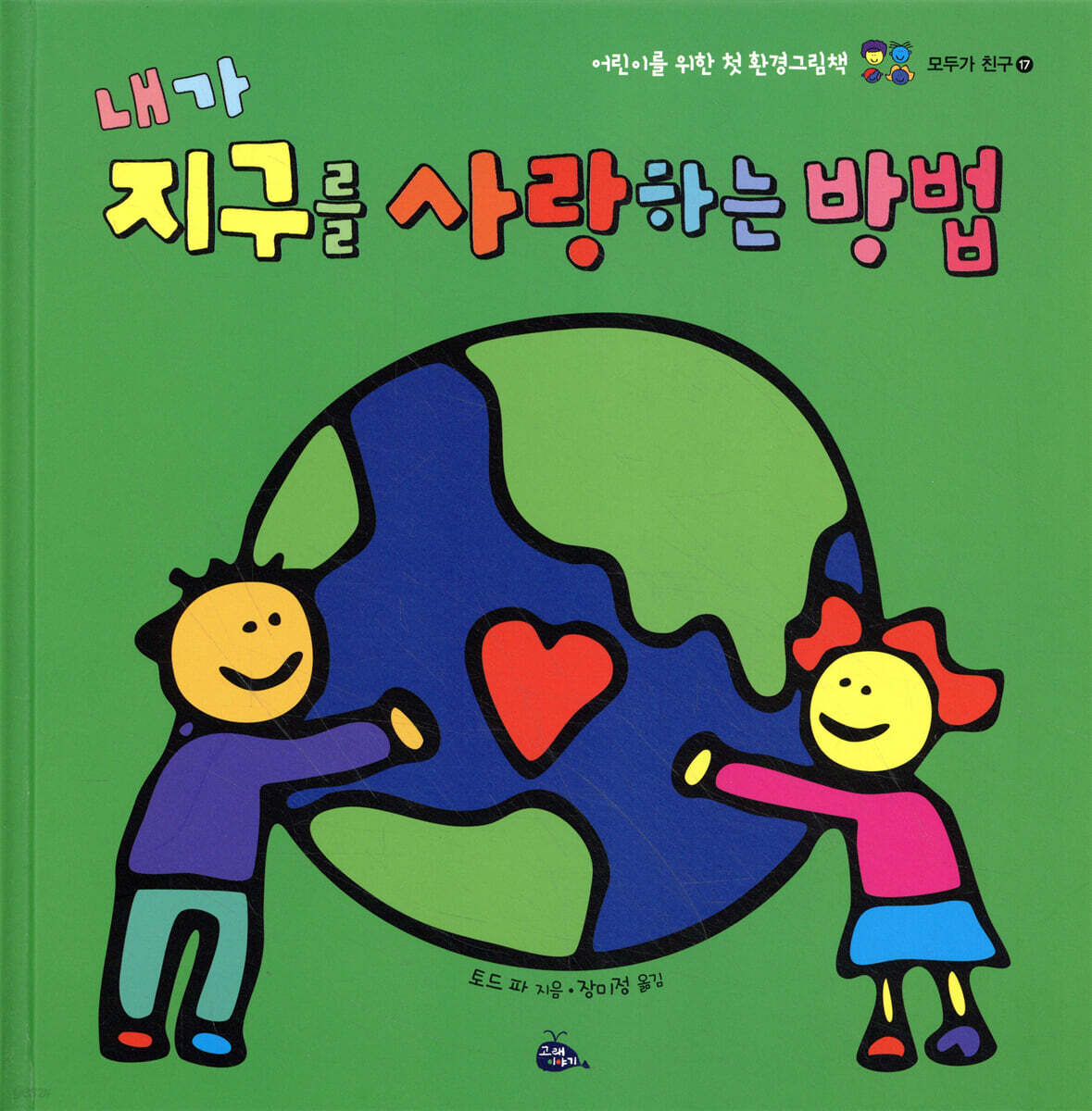
How I Love the Earth
 |
Description
Book Introduction
What children need first is not knowledge, but ‘ecological sensitivity’!
An environmental book written with the warm hearts of children who love nature.
Rather than listing a few fragmentary ways to protect the environment, it fosters children's ecological sensitivity by emotionally teaching them what the environment and life mean to us.
He poetically expressed that what our children need now is not environmental knowledge that everyone knows, but love for the Earth's environment and life.
An environmental book written with the warm hearts of children who love nature.
Rather than listing a few fragmentary ways to protect the environment, it fosters children's ecological sensitivity by emotionally teaching them what the environment and life mean to us.
He poetically expressed that what our children need now is not environmental knowledge that everyone knows, but love for the Earth's environment and life.
- You can preview some of the book's contents.
Preview
Detailed image

Into the book
I always turn off the faucet when I brush my teeth.
Don't save water even when you take a bath.
Why?
Because I love fish.
I wish the sea was always blue and clean.
--- p.8~11
I take the bus.
Sometimes I ride a bike.
Why?
Because I love stars.
The air must be clear to see the stars twinkling.
Don't save water even when you take a bath.
Why?
Because I love fish.
I wish the sea was always blue and clean.
--- p.8~11
I take the bus.
Sometimes I ride a bike.
Why?
Because I love stars.
The air must be clear to see the stars twinkling.
--- p.12~15
Publisher's Review
A confession of love for the Earth from the hearts of children, “Earth, I love you!”
The reason we put so much effort and care into something is very simple.
Because I love you.
This book clearly explains why we must cherish and care for the Earth: 'Because it holds so many things I love.'
This book will give children a chance to reflect on what the Earth's environment means to them and why we must protect it.
When children begin to understand the answer to the question, "Why should we do that?" and begin to accept it in their hearts, their actions will naturally change one by one.
It is clear that we will have the will and hope for even greater change.
"The Earth holds the things I love." "That's why I must cherish and love it even more."
The thought that ‘the Earth holds the things I love’ and the feeling that ‘that’s why I should cherish and love it even more.’
Shouldn't this be the most fundamental foundation for recognizing environmental issues and seeking alternatives? In that sense, this book will serve as a foundation for children to establish their own thoughts and actions regarding the environment.
Additionally, the book creates a cheerful and lively atmosphere with rhythmic sentences and vividly colored pictures, making it a book that children can read without feeling any resistance.
When you first want to tell a child about the 'environment', you should be considerate so that they can approach you emotionally and without feeling burdened.
An environment that has become everyone's homework
A high level of concern for the environment has now become a natural thing for us.
Because it has become a problem that humanity can no longer avoid or ignore.
Many people are working hard to protect the Earth's environment and ensure that all life can coexist.
And I started talking to my children about the 'environment' in detail.
From the moment it became an important issue for everyone, it seemed like it might have become a 'homework' for children.
It tells us why the Earth is suffering, and it also tells us all the methods we need to protect and save the environment, and tells us that we must put them into practice.
Of course, it is important to make environmental protection a habit from a young age.
So, it is necessary to provide environmental education to young children.
However, since it is an important issue, we should not approach it with a blind sense of duty or obligation, saying, “You must do it this way!”
For young children, it is most important to understand with their hearts and to foster interest.
Because children hear countless times about what they need to do to protect the environment, but they may not know what it has to do with them.
Sometimes, even though you know it, you feel like it's too far away from you right now.
What children need first is not knowledge, but ‘ecological sensitivity’!
‘Environment’ is already a very important educational topic in our society.
Because it is a problem that everyone must be interested in and find a solution to.
Early childhood is a time when the foundation for intellectual, emotional, and social development is formed, so if appropriate environmental education is provided at this time, the educational effect is very significant.
Therefore, environmental education should be conducted from early childhood.
The purpose of environmental education is to awaken children's latent ecological sensitivity and instill in them the wisdom and courage to live together with humans and nature.
Many parents take their children on experiential trips to the mountains and fields to instill these values in them.
Schools also teach about the dangers and consequences of environmental destruction.
The most important things in accepting information that helps us feel and understand with our bodies are ‘emotion’ and ‘motivation.’
What is most important is the attitude of looking at nature with warm eyes and finding things you can do for it.
This book will help young children develop a sensitivity to nature and guide them to use their imagination to discover what they should do.
The world changes when we move beyond "me" and "you" to become "us."
"I try to cherish and care for the Earth.
Why?
Because I know that the little things I do can make a huge difference to the Earth."
The first child to appear declares:
Next, the children introduce things they should do one by one for the Earth.
Of course, everyone has their own motivation to do that.
And it shows what impact these small actions can have on the Earth and nature, and what changes they can bring about.
It doesn't just stop at what 'I' do, but it lets us know how much of a change it can bring when it comes together.
So, let the children feel proud and valued for what they do.
Even for young children who still have difficulty properly understanding 'relationships', it helps them to keep in mind that when 'I' and 'you' come together to become 'we', it can have a big impact, that I and the Earth are like friends who help each other, and that 'my actions' can ultimately make 'us all happy'.
This is like planting a small seed that can blossom into the 'heart' and 'strength' that are most important for children to live.
The reason we put so much effort and care into something is very simple.
Because I love you.
This book clearly explains why we must cherish and care for the Earth: 'Because it holds so many things I love.'
This book will give children a chance to reflect on what the Earth's environment means to them and why we must protect it.
When children begin to understand the answer to the question, "Why should we do that?" and begin to accept it in their hearts, their actions will naturally change one by one.
It is clear that we will have the will and hope for even greater change.
"The Earth holds the things I love." "That's why I must cherish and love it even more."
The thought that ‘the Earth holds the things I love’ and the feeling that ‘that’s why I should cherish and love it even more.’
Shouldn't this be the most fundamental foundation for recognizing environmental issues and seeking alternatives? In that sense, this book will serve as a foundation for children to establish their own thoughts and actions regarding the environment.
Additionally, the book creates a cheerful and lively atmosphere with rhythmic sentences and vividly colored pictures, making it a book that children can read without feeling any resistance.
When you first want to tell a child about the 'environment', you should be considerate so that they can approach you emotionally and without feeling burdened.
An environment that has become everyone's homework
A high level of concern for the environment has now become a natural thing for us.
Because it has become a problem that humanity can no longer avoid or ignore.
Many people are working hard to protect the Earth's environment and ensure that all life can coexist.
And I started talking to my children about the 'environment' in detail.
From the moment it became an important issue for everyone, it seemed like it might have become a 'homework' for children.
It tells us why the Earth is suffering, and it also tells us all the methods we need to protect and save the environment, and tells us that we must put them into practice.
Of course, it is important to make environmental protection a habit from a young age.
So, it is necessary to provide environmental education to young children.
However, since it is an important issue, we should not approach it with a blind sense of duty or obligation, saying, “You must do it this way!”
For young children, it is most important to understand with their hearts and to foster interest.
Because children hear countless times about what they need to do to protect the environment, but they may not know what it has to do with them.
Sometimes, even though you know it, you feel like it's too far away from you right now.
What children need first is not knowledge, but ‘ecological sensitivity’!
‘Environment’ is already a very important educational topic in our society.
Because it is a problem that everyone must be interested in and find a solution to.
Early childhood is a time when the foundation for intellectual, emotional, and social development is formed, so if appropriate environmental education is provided at this time, the educational effect is very significant.
Therefore, environmental education should be conducted from early childhood.
The purpose of environmental education is to awaken children's latent ecological sensitivity and instill in them the wisdom and courage to live together with humans and nature.
Many parents take their children on experiential trips to the mountains and fields to instill these values in them.
Schools also teach about the dangers and consequences of environmental destruction.
The most important things in accepting information that helps us feel and understand with our bodies are ‘emotion’ and ‘motivation.’
What is most important is the attitude of looking at nature with warm eyes and finding things you can do for it.
This book will help young children develop a sensitivity to nature and guide them to use their imagination to discover what they should do.
The world changes when we move beyond "me" and "you" to become "us."
"I try to cherish and care for the Earth.
Why?
Because I know that the little things I do can make a huge difference to the Earth."
The first child to appear declares:
Next, the children introduce things they should do one by one for the Earth.
Of course, everyone has their own motivation to do that.
And it shows what impact these small actions can have on the Earth and nature, and what changes they can bring about.
It doesn't just stop at what 'I' do, but it lets us know how much of a change it can bring when it comes together.
So, let the children feel proud and valued for what they do.
Even for young children who still have difficulty properly understanding 'relationships', it helps them to keep in mind that when 'I' and 'you' come together to become 'we', it can have a big impact, that I and the Earth are like friends who help each other, and that 'my actions' can ultimately make 'us all happy'.
This is like planting a small seed that can blossom into the 'heart' and 'strength' that are most important for children to live.
GOODS SPECIFICS
- Publication date: December 10, 2022
- Format: Hardcover book binding method guide
- Page count, weight, size: 36 pages | 348g | 231*233*9mm
- ISBN13: 9788991941991
- ISBN10: 8991941990
- KC Certification: Certification Type: Conformity Confirmation
You may also like
카테고리
korean


korean

![GQ KOREA Mark (Monthly): December [2025]](http://librairie.coreenne.fr/cdn/shop/files/8ef265dbbfbf186523ed75ba7319009d.jpg?v=1765340328&width=3840)


