

My Life's Journey
 |
Description
Book Introduction
- A word from MD
-
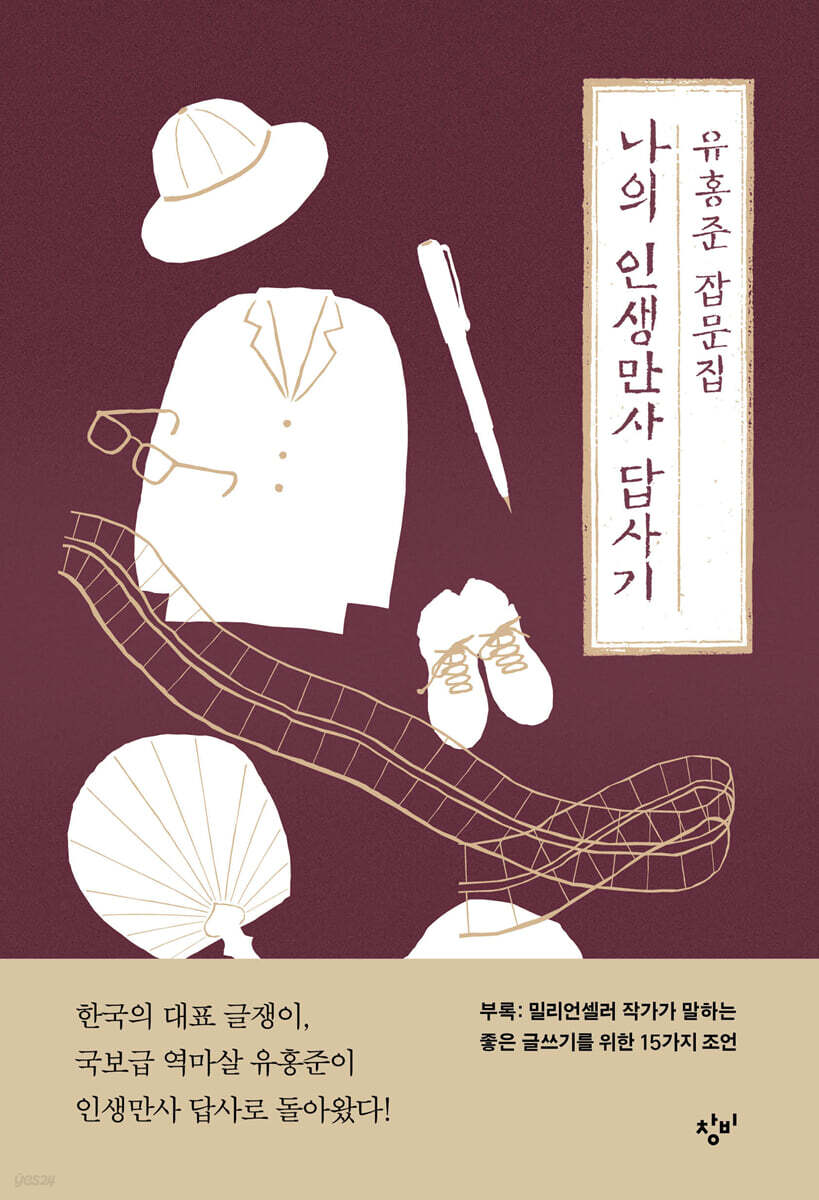
Writer Yoo Hong-jun speaks of lifeA collection of essays by Hongjun Yoo, author of ‘My Cultural Heritage Tour’.
As a representative Korean writer, he shares his writing secrets and the story of his life, in which he lived without losing his wit and intelligence in the complex world.
It's time to immerse yourself in this beautiful "Miscellaneous Essay," filled with writings on art, the times, and humanity, written by intellectuals who have lived through this era.
November 8, 2024. Essay PD Lee Ju-eun
"His sentences move people, and stories bloom wherever he walks."
Korea's representative writer, a national treasure of reverse horse slaughter
Yoo Hong-jun has returned to the world of life!
Hongjun Yoo, author of “My Cultural Heritage Tour,” has returned to readers with a collection of essays after 30 years.
Although he is widely known to the public as a cultural heritage evangelist and the head of the Cultural Heritage Administration, he is also a representative author of South Korea, having written a legend of selling 5 million copies.
This book reveals in detail the writing secrets of Yoo Hong-jun, who has remained a best-selling author for decades, and the history of his "sentence lessons." It also selects and compiles the best of Yoo Hong-jun's prose published in various media, including newspapers, allowing readers to feel the agony and lyricism of an intellectual who breathes with the times.
These writings, which the author himself calls "miscellaneous writings," are not long in length, but their sharp message shines through, and Yoo Hong-jun's humane charm and uniquely articulate writing style add luster to the writing.
In "Farewell Party," where he publicly declared his decision to quit smoking and caused a stir, his sense of humor and humanistic spirit shine even in the complexities of the world. In his eulogy for his close friends of 50 years, Hong Se-hwa and Kim Min-ki, he showed his deep understanding of humanity and friendship that transcended time. In his recollection of his wedding teacher, Lee Young-hee, he impressively displayed the exchanges between intellectuals who cherished relationships even in the midst of the twists and turns of modern history.
After reading this book, I hope you will gain wisdom in life through Yoo Hong-jun's attitude of discovering not only the secrets of writing but also joy and beauty in life, and living a richer life than anyone else.
Korea's representative writer, a national treasure of reverse horse slaughter
Yoo Hong-jun has returned to the world of life!
Hongjun Yoo, author of “My Cultural Heritage Tour,” has returned to readers with a collection of essays after 30 years.
Although he is widely known to the public as a cultural heritage evangelist and the head of the Cultural Heritage Administration, he is also a representative author of South Korea, having written a legend of selling 5 million copies.
This book reveals in detail the writing secrets of Yoo Hong-jun, who has remained a best-selling author for decades, and the history of his "sentence lessons." It also selects and compiles the best of Yoo Hong-jun's prose published in various media, including newspapers, allowing readers to feel the agony and lyricism of an intellectual who breathes with the times.
These writings, which the author himself calls "miscellaneous writings," are not long in length, but their sharp message shines through, and Yoo Hong-jun's humane charm and uniquely articulate writing style add luster to the writing.
In "Farewell Party," where he publicly declared his decision to quit smoking and caused a stir, his sense of humor and humanistic spirit shine even in the complexities of the world. In his eulogy for his close friends of 50 years, Hong Se-hwa and Kim Min-ki, he showed his deep understanding of humanity and friendship that transcended time. In his recollection of his wedding teacher, Lee Young-hee, he impressively displayed the exchanges between intellectuals who cherished relationships even in the midst of the twists and turns of modern history.
After reading this book, I hope you will gain wisdom in life through Yoo Hong-jun's attitude of discovering not only the secrets of writing but also joy and beauty in life, and living a richer life than anyone else.
- You can preview some of the book's contents.
Preview
index
My Miscellaneous Writings and Writings in Publishing a Book
Chapter 1: Life and Everything
Farewell Party: Smoking the Last Cigarette
Weed public service monument
inflorescence
Baduk FTA
honest audience
The former owner of Tongmungwan, Mr. Lee Gyeom-ro
My mother's resume
Chapter 2: The Window of Culture
Touch Me Museum for the Visually Impaired
Walk on the left, drive on the right
The White Porcelain Moon Jar, an Eternal Icon of Korean Beauty
The aesthetics of the pavilion as an 'image of Korea'
The Annals of the Joseon Dynasty: A Long History of Suffering and Preservation
Are there any national treasures or treasures that will be designated in 100 years?
Areas of jurisdiction of the Cultural Heritage Administration
Malilpachohoe, defeating the first calligraphy at the end of each month
My experiential art education story
Chapter 3: Remnants of the Field Trip
Baekdu Mountain Tour: "That's Nothing But Desire"
Introduction to the China Field Trip: Everyone is Responsible
Beijing Glass: "Where can I buy glasses like that?"
Japan Trip Review: "Azuki Beans from Head to Tail"
Chapter 4 With the Artist
Nam June Paik: I wanted to be his mourner.
Shin Hak-cheol: [Rice Planting] The Trial and Me
Oh Yoon: A Legend of Folk Art That Gone Like the Wind
Kim Ji-ha: Flowers, Dharma, and the Aesthetics of "White Shadow"
Kim Ga-jin: Dongnong's "Baekunseo-gyeong"
Chapter 5: Teacher and Friend
Lee Young-hee: My wedding teacher
Baek Gi-wan: The Story of Jangsan Gotmae and The Story of Bareseonbal
Shin Young-bok: A bright soul born from 20 years at Mumun-gwan
Lee Ae-ju: A dancer, a one-of-a-kind human cultural asset
Park Hyung-seon: A Pillar of the Gwangju Democratization Movement
Hong Se-hwa: An upright intellectual, or a simple free spirit
Kim Min-ki: Before "Back": Kim Min-ki's front view
Appendix: My Writing
15 Tips for Good Writing
My Sentence Class
My Cultural Heritage Tour Resume
Document 1: A letter to my parents from prison
Data 2: Answer sheet for exam during third year of college
Data 3 Writing Guided by Brother Kim Ji-ha in Prison
Chapter 1: Life and Everything
Farewell Party: Smoking the Last Cigarette
Weed public service monument
inflorescence
Baduk FTA
honest audience
The former owner of Tongmungwan, Mr. Lee Gyeom-ro
My mother's resume
Chapter 2: The Window of Culture
Touch Me Museum for the Visually Impaired
Walk on the left, drive on the right
The White Porcelain Moon Jar, an Eternal Icon of Korean Beauty
The aesthetics of the pavilion as an 'image of Korea'
The Annals of the Joseon Dynasty: A Long History of Suffering and Preservation
Are there any national treasures or treasures that will be designated in 100 years?
Areas of jurisdiction of the Cultural Heritage Administration
Malilpachohoe, defeating the first calligraphy at the end of each month
My experiential art education story
Chapter 3: Remnants of the Field Trip
Baekdu Mountain Tour: "That's Nothing But Desire"
Introduction to the China Field Trip: Everyone is Responsible
Beijing Glass: "Where can I buy glasses like that?"
Japan Trip Review: "Azuki Beans from Head to Tail"
Chapter 4 With the Artist
Nam June Paik: I wanted to be his mourner.
Shin Hak-cheol: [Rice Planting] The Trial and Me
Oh Yoon: A Legend of Folk Art That Gone Like the Wind
Kim Ji-ha: Flowers, Dharma, and the Aesthetics of "White Shadow"
Kim Ga-jin: Dongnong's "Baekunseo-gyeong"
Chapter 5: Teacher and Friend
Lee Young-hee: My wedding teacher
Baek Gi-wan: The Story of Jangsan Gotmae and The Story of Bareseonbal
Shin Young-bok: A bright soul born from 20 years at Mumun-gwan
Lee Ae-ju: A dancer, a one-of-a-kind human cultural asset
Park Hyung-seon: A Pillar of the Gwangju Democratization Movement
Hong Se-hwa: An upright intellectual, or a simple free spirit
Kim Min-ki: Before "Back": Kim Min-ki's front view
Appendix: My Writing
15 Tips for Good Writing
My Sentence Class
My Cultural Heritage Tour Resume
Document 1: A letter to my parents from prison
Data 2: Answer sheet for exam during third year of college
Data 3 Writing Guided by Brother Kim Ji-ha in Prison
Detailed image

Publisher's Review
“I am, to put it bluntly, a writer,
And the writer's field is the manuscript paper."
Yoo Hong-jun's resume is so impressive that it would take a long time just to list the titles he has held, including professor of art history, museum director, head of the Cultural Heritage Administration, and chairman of the Academy of Korean Studies.
However, the most important identity that Yoo Hong-jun thinks of himself is that of a ‘writer.’
Officially, since being selected for the 1981 New Year's Literary Contest, he has been tirelessly making social statements as an art critic and cultural heritage expert through various publications such as newspapers, magazines, and catalogs for 44 years.
"My Life's Journey" is a book filled with the stories of Yoo Hong-jun's past, in which he spoke about art, the times, and humanity, sometimes with sharp analysis and sometimes with boundless affection.
This book has the subtitle ‘Yoo Hong-jun’s Miscellaneous Essays’.
Some readers may be surprised by the connotations of disparagement and contempt implied by the word "miscellaneous writings," which is neither prose nor essay.
Yoo Hong-jun confesses that his writing has a strong 'miscellaneous' character that deviates from the typical prose format, and that this is due to the influence he received from Lu Xun's miscellaneous writings in his youth.
Lu Xun said that his writings were miscellaneous, but his writings were not just miscellaneous writings; they ranged from everyday life to discourse on ideas.
Yoo Hong-jun, emulating Lu Xun, who was the 'symbol of intellectuals' for his generation, did not abandon his sense of responsibility as an intellectual and his duty as a writer, who believes that 'the writer's field is the manuscript paper', even in the short articles permitted by newspapers.
As an art historian, he not only opened our eyes to the beauty of Korean aesthetics in our daily lives, but also provided insight into viewing art in its close connection to social reality.
However, Yoo Hong-jun's writing does not fall into the traps that professional writing can fall into.
His gaze is neither contemplative nor indifferent.
Yoo Hong-jun is not a scholar who has steadfastly settled in an ivory tower of knowledge, but rather a person who observes the world with curiosity and affection in the bustling streets and dives into it.
So, this writer's writings are imbued with the unhesitating curiosity of a child, the vitality and enthusiasm of youth, the composure of middle age, and the insight of old age.
Through 『My Life's Journey』, a collection of carefully selected essays written by Yoo Hong-jun over the past 30 years, readers will be able to feel that he is a rich thinker who understands the dialectics of life and art with his whole body.
“Simple yet literary,
“An autobiographical yet contemporary piece”
『My Life's Journey』 is composed of five chapters.
Chapter 1, 'All Things in Life', contains writings that allow us to confirm his thoughts on life.
The writings that celebrate the beauty and longing for cigarettes ("Farewell Party: Smoking the Last Cigarette"), weeds ("Weed Monument"), and spring flowers ("Inflorescence") are nothing less than "poems for small things," as BTS sang.
By approaching each material closely, we can read the era and society contained within it, and sentences that suddenly recall memories amplify the nostalgia for life.
In works such as “The Former Owner of Tongmungwan, Mr. Lee Gyeom-ro” and “Our Mother’s Resume,” we can feel a special affection for the characters. Yu Hong-jun’s gaze, which does not lose sight of the historical dimension of the narrative that the characters contain, but also does not lose sight of the specificity of the life that the individual embodies, brings us to the vivid present of a person.
Chapter 2, "Window of Culture," explores the aesthetics of moon jars and pavilions, which are essential when discussing the beauty of Korean culture, and demonstrates through various episodes how life becomes enriched when art enters our lives.
Chapter 3, 'Travelogue', is a special travelogue written by Yoo Hong-jun, a traveler known as a 'national treasure-level horseman', and covers North Korea, China, Japan, and other places.
The culture and history flowing through the travel destination, the tension and dynamism created by the relationships with the people met there, and even the humor added as a finishing touch, truly show the essence of travel literature.
Chapter 4, ‘With Artists,’ covers the lives and artistic worlds of Nam June Paik, Shin Hak-cheol, Oh Yoon, Kim Ji-ha, and Kim Ga-jin.
In a short piece, the artist's world of work and life, the artist's relationship with the reality of his time, and even his personal interactions with Yoo Hong-jun himself are all exquisitely blended.
These writings particularly reveal the author's fierce sense of professional mission as an art critic.
In his personal departure for New York after sensing the lack of state courtesy at Nam June Paik's funeral, in his unwavering attendance at the trial of Shin Hak-cheol's [Rice Planting] painting, and in his refusal to deny the aesthetic consciousness opened up by Kim Ji-ha's art no matter how much the world criticized and turned its back on him, we can read his struggles as a contemporary art critic to consider what to testify and what to commemorate.
Chapter 5, 'Teacher and Friend', is a collection of reminiscences about Lee Young-hee, Baek Gi-wan, Shin Young-bok, Lee Ae-ju, Park Hyeong-seon, Hong Se-hwa, and Kim Min-ki, and contains the essence of their lives.
Yoo Hong-jun confesses, "The thing I find most difficult to write as a writer is a eulogy."
This is because a eulogy is something that a newspaper reporter reports today and asks to be written by the morning of the day after tomorrow.
These writings generously commemorate the achievements of those who have left unforgettable marks on Korean society, while also poignantly expressing the human side revealed through personal interactions with the author.
Reading it once will make you realize how special and precious these people were to Korean society, and reading it again will make you feel the generosity of Yoo Hong-jun, who wholeheartedly interacted with them.
The writing secrets of a best-selling author revealed!
This book contains "15 Tips for Good Writing" from Yoo Hong-jun, who has been a best-selling author for decades.
Although it is advertised as an appendix, it will undoubtedly be a 'bonbon' to the book for readers interested in writing.
Advice on writing can easily become a series of vague principles, but the advice he imparts is more specific and clear than any other writing book.
In particular, the author's argument is further strengthened by providing examples of sentences that are considered to be the best in 『My Cultural Heritage Tour』, that is, sentences that have been verified by readers.
Another article in the appendix, “My Sentence Class,” is about Yoo Hong-jun’s reading experiences that led him to become the writer he is today.
His journey of developing his own writing style, based on the intellectual influences he received from his contemporaries and colleagues, is vividly recorded.
Yoo Hong-jun is often referred to as one of the 'Three Greatest Guras of Joseon' and is also evaluated as an exquisite combination of 'a scholar and a ttanttara'.
This remark, which may seem like a joke, proves that Yoo Hong-jun was thoroughly conscious of the public's reaction and the sensibilities of the time when he published the specialized knowledge he had acquired in a book.
The secret to the success of the "Dapsagi" series as a bestseller for decades is that he constantly contemplates his writing, immediately senses the public's reaction through newspaper columns, and updates his writing style and sensibility according to the changing times.
All of these processes and results are contained in "My Life's Journey," so readers will be able to gain a beautiful way to live their daily lives through Yoo Hong-jun's intense and rich attitude toward life.
And the writer's field is the manuscript paper."
Yoo Hong-jun's resume is so impressive that it would take a long time just to list the titles he has held, including professor of art history, museum director, head of the Cultural Heritage Administration, and chairman of the Academy of Korean Studies.
However, the most important identity that Yoo Hong-jun thinks of himself is that of a ‘writer.’
Officially, since being selected for the 1981 New Year's Literary Contest, he has been tirelessly making social statements as an art critic and cultural heritage expert through various publications such as newspapers, magazines, and catalogs for 44 years.
"My Life's Journey" is a book filled with the stories of Yoo Hong-jun's past, in which he spoke about art, the times, and humanity, sometimes with sharp analysis and sometimes with boundless affection.
This book has the subtitle ‘Yoo Hong-jun’s Miscellaneous Essays’.
Some readers may be surprised by the connotations of disparagement and contempt implied by the word "miscellaneous writings," which is neither prose nor essay.
Yoo Hong-jun confesses that his writing has a strong 'miscellaneous' character that deviates from the typical prose format, and that this is due to the influence he received from Lu Xun's miscellaneous writings in his youth.
Lu Xun said that his writings were miscellaneous, but his writings were not just miscellaneous writings; they ranged from everyday life to discourse on ideas.
Yoo Hong-jun, emulating Lu Xun, who was the 'symbol of intellectuals' for his generation, did not abandon his sense of responsibility as an intellectual and his duty as a writer, who believes that 'the writer's field is the manuscript paper', even in the short articles permitted by newspapers.
As an art historian, he not only opened our eyes to the beauty of Korean aesthetics in our daily lives, but also provided insight into viewing art in its close connection to social reality.
However, Yoo Hong-jun's writing does not fall into the traps that professional writing can fall into.
His gaze is neither contemplative nor indifferent.
Yoo Hong-jun is not a scholar who has steadfastly settled in an ivory tower of knowledge, but rather a person who observes the world with curiosity and affection in the bustling streets and dives into it.
So, this writer's writings are imbued with the unhesitating curiosity of a child, the vitality and enthusiasm of youth, the composure of middle age, and the insight of old age.
Through 『My Life's Journey』, a collection of carefully selected essays written by Yoo Hong-jun over the past 30 years, readers will be able to feel that he is a rich thinker who understands the dialectics of life and art with his whole body.
“Simple yet literary,
“An autobiographical yet contemporary piece”
『My Life's Journey』 is composed of five chapters.
Chapter 1, 'All Things in Life', contains writings that allow us to confirm his thoughts on life.
The writings that celebrate the beauty and longing for cigarettes ("Farewell Party: Smoking the Last Cigarette"), weeds ("Weed Monument"), and spring flowers ("Inflorescence") are nothing less than "poems for small things," as BTS sang.
By approaching each material closely, we can read the era and society contained within it, and sentences that suddenly recall memories amplify the nostalgia for life.
In works such as “The Former Owner of Tongmungwan, Mr. Lee Gyeom-ro” and “Our Mother’s Resume,” we can feel a special affection for the characters. Yu Hong-jun’s gaze, which does not lose sight of the historical dimension of the narrative that the characters contain, but also does not lose sight of the specificity of the life that the individual embodies, brings us to the vivid present of a person.
Chapter 2, "Window of Culture," explores the aesthetics of moon jars and pavilions, which are essential when discussing the beauty of Korean culture, and demonstrates through various episodes how life becomes enriched when art enters our lives.
Chapter 3, 'Travelogue', is a special travelogue written by Yoo Hong-jun, a traveler known as a 'national treasure-level horseman', and covers North Korea, China, Japan, and other places.
The culture and history flowing through the travel destination, the tension and dynamism created by the relationships with the people met there, and even the humor added as a finishing touch, truly show the essence of travel literature.
Chapter 4, ‘With Artists,’ covers the lives and artistic worlds of Nam June Paik, Shin Hak-cheol, Oh Yoon, Kim Ji-ha, and Kim Ga-jin.
In a short piece, the artist's world of work and life, the artist's relationship with the reality of his time, and even his personal interactions with Yoo Hong-jun himself are all exquisitely blended.
These writings particularly reveal the author's fierce sense of professional mission as an art critic.
In his personal departure for New York after sensing the lack of state courtesy at Nam June Paik's funeral, in his unwavering attendance at the trial of Shin Hak-cheol's [Rice Planting] painting, and in his refusal to deny the aesthetic consciousness opened up by Kim Ji-ha's art no matter how much the world criticized and turned its back on him, we can read his struggles as a contemporary art critic to consider what to testify and what to commemorate.
Chapter 5, 'Teacher and Friend', is a collection of reminiscences about Lee Young-hee, Baek Gi-wan, Shin Young-bok, Lee Ae-ju, Park Hyeong-seon, Hong Se-hwa, and Kim Min-ki, and contains the essence of their lives.
Yoo Hong-jun confesses, "The thing I find most difficult to write as a writer is a eulogy."
This is because a eulogy is something that a newspaper reporter reports today and asks to be written by the morning of the day after tomorrow.
These writings generously commemorate the achievements of those who have left unforgettable marks on Korean society, while also poignantly expressing the human side revealed through personal interactions with the author.
Reading it once will make you realize how special and precious these people were to Korean society, and reading it again will make you feel the generosity of Yoo Hong-jun, who wholeheartedly interacted with them.
The writing secrets of a best-selling author revealed!
This book contains "15 Tips for Good Writing" from Yoo Hong-jun, who has been a best-selling author for decades.
Although it is advertised as an appendix, it will undoubtedly be a 'bonbon' to the book for readers interested in writing.
Advice on writing can easily become a series of vague principles, but the advice he imparts is more specific and clear than any other writing book.
In particular, the author's argument is further strengthened by providing examples of sentences that are considered to be the best in 『My Cultural Heritage Tour』, that is, sentences that have been verified by readers.
Another article in the appendix, “My Sentence Class,” is about Yoo Hong-jun’s reading experiences that led him to become the writer he is today.
His journey of developing his own writing style, based on the intellectual influences he received from his contemporaries and colleagues, is vividly recorded.
Yoo Hong-jun is often referred to as one of the 'Three Greatest Guras of Joseon' and is also evaluated as an exquisite combination of 'a scholar and a ttanttara'.
This remark, which may seem like a joke, proves that Yoo Hong-jun was thoroughly conscious of the public's reaction and the sensibilities of the time when he published the specialized knowledge he had acquired in a book.
The secret to the success of the "Dapsagi" series as a bestseller for decades is that he constantly contemplates his writing, immediately senses the public's reaction through newspaper columns, and updates his writing style and sensibility according to the changing times.
All of these processes and results are contained in "My Life's Journey," so readers will be able to gain a beautiful way to live their daily lives through Yoo Hong-jun's intense and rich attitude toward life.
GOODS SPECIFICS
- Date of issue: November 1, 2024
- Page count, weight, size: 364 pages | 562g | 142*208*21mm
- ISBN13: 9788936480608
- ISBN10: 893648060X
You may also like
카테고리
korean


korean

![GQ KOREA Mark (Monthly): December [2025]](http://librairie.coreenne.fr/cdn/shop/files/8ef265dbbfbf186523ed75ba7319009d.jpg?v=1765340328&width=3840)


