

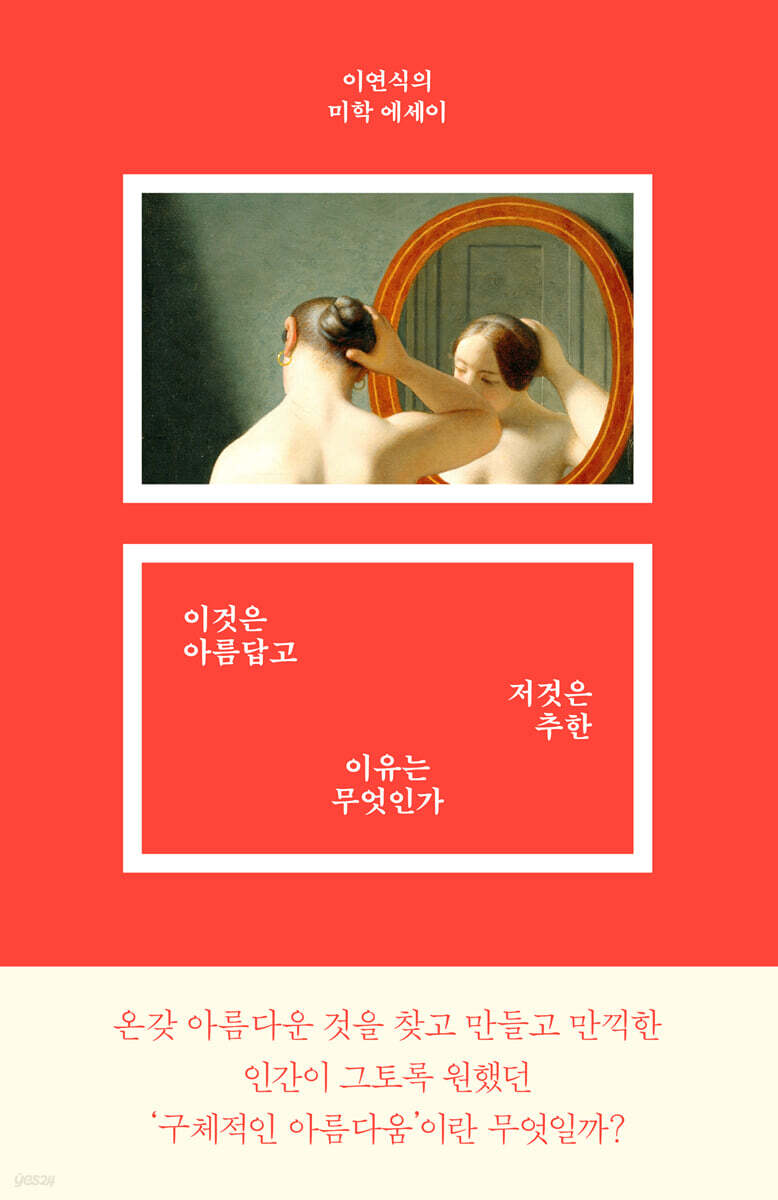
Why is this beautiful and that ugly?
 |
Description
Book Introduction
- A word from MD
-
All problems come down to beauty.An aesthetic essay by art historian Lee Yeon-sik, who questions and explores.
We constantly ask ourselves what ‘beauty’ means to humans.
A book that will help you think about your own standards of beauty.
October 24, 2025. Art PD Ahn Hyun-jae
Why are you beautiful to me!
What is the standard that distinguishes beauty from ugliness?
Art historian Lee Yeon-sik's aesthetic essays
The recently released film "Face" is a story about a woman with an ugly face.
Ultimately, the film speaks to social prejudice, but it also raises the question of what determines what is ugly or beautiful.
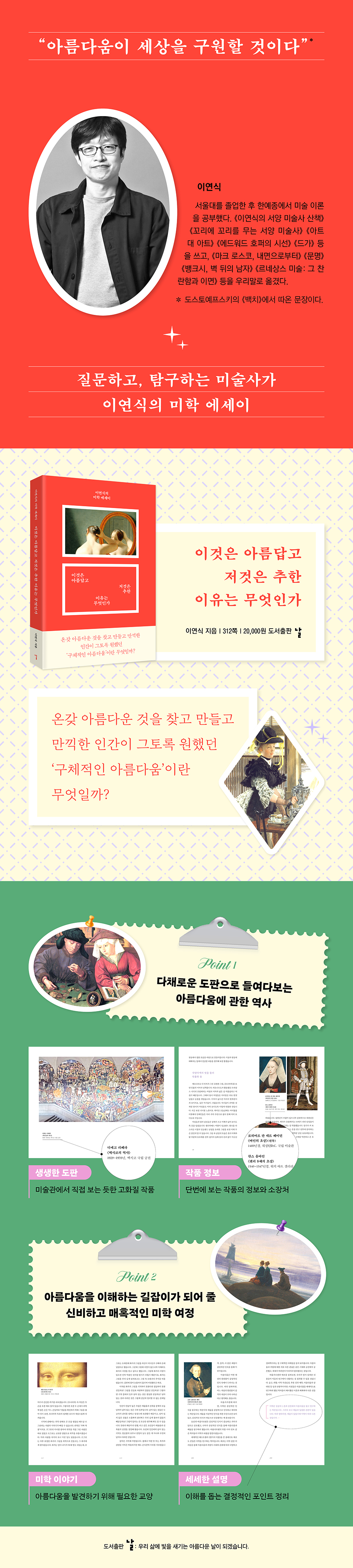
"Why Is This Beautiful and That Ugly?" is an introductory book to aesthetics that delves into what humanity has considered beautiful or ugly, what factors have influenced those judgments, and how beauty becomes art and establishes itself as a work of art.
By exploring beauty through questions that can be asked in everyday life with art historian Lee Yeon-sik, who is dedicated to delving into the depths of art, you will come to understand what beauty is, how art reveals beauty, and even discover the beauty hidden in your own daily life.
What is the standard that distinguishes beauty from ugliness?
Art historian Lee Yeon-sik's aesthetic essays
The recently released film "Face" is a story about a woman with an ugly face.
Ultimately, the film speaks to social prejudice, but it also raises the question of what determines what is ugly or beautiful.
"Why Is This Beautiful and That Ugly?" is an introductory book to aesthetics that delves into what humanity has considered beautiful or ugly, what factors have influenced those judgments, and how beauty becomes art and establishes itself as a work of art.
By exploring beauty through questions that can be asked in everyday life with art historian Lee Yeon-sik, who is dedicated to delving into the depths of art, you will come to understand what beauty is, how art reveals beauty, and even discover the beauty hidden in your own daily life.
- You can preview some of the book's contents.
Preview
index
In the Book - Following the Specific Beauty
Part 1: What is Beauty?
A splendid and captivating face in fantasy
Where should the line be drawn to establish a standard?
Beauty that doesn't fit with instinct
A body that changes depending on the style you pursue
How does the era view the body?
The fight for the right to see
Art expressed through unwavering faith
Feel the thrill of the overwhelming scenery
Even if the work disappears, I dream of eternity
The memories I look back on are only beautiful memories
Part 2: Measuring the Knot of Beauty
In search of the origins of bad charm
No matter how ugly it is, there is a beautiful side to it.
If you don't like it but don't know why you keep getting drawn to it
How do other people's tastes infiltrate me?
Power changes the standards of beauty.
The beauty that becomes clearer the further away you get
The magic that makes ordinary moments beautiful
Beauty is in the eye of the beholder.
I want to give a name to my imperfect taste
What is aesthetics?
Part 3: When beauty deepens
It becomes art
Conditions for things called art
In whose story is the truth?
In search of the purpose of pure art
Rules that exist to be broken
When all art is called a work of art
Asking about invisible values
Cupid, connecting art and audience
I don't know why this painting is so expensive.
What it means to do well
Beauty created with my own hands
Part 1: What is Beauty?
A splendid and captivating face in fantasy
Where should the line be drawn to establish a standard?
Beauty that doesn't fit with instinct
A body that changes depending on the style you pursue
How does the era view the body?
The fight for the right to see
Art expressed through unwavering faith
Feel the thrill of the overwhelming scenery
Even if the work disappears, I dream of eternity
The memories I look back on are only beautiful memories
Part 2: Measuring the Knot of Beauty
In search of the origins of bad charm
No matter how ugly it is, there is a beautiful side to it.
If you don't like it but don't know why you keep getting drawn to it
How do other people's tastes infiltrate me?
Power changes the standards of beauty.
The beauty that becomes clearer the further away you get
The magic that makes ordinary moments beautiful
Beauty is in the eye of the beholder.
I want to give a name to my imperfect taste
What is aesthetics?
Part 3: When beauty deepens
It becomes art
Conditions for things called art
In whose story is the truth?
In search of the purpose of pure art
Rules that exist to be broken
When all art is called a work of art
Asking about invisible values
Cupid, connecting art and audience
I don't know why this painting is so expensive.
What it means to do well
Beauty created with my own hands
Detailed image
Into the book
The paintings called Wang Zhaojun, Yang Guifei, and Xi Shi are not actual portraits of them, but rather 'portraits of beauties.'
The portrait of a beautifier is the ideal of beauty.
It is both typical and fantastic.
--- p.22
Without individual beauty, there can be no absolute standards.
So, can we say that the standards of beauty that cannot help but depend on individual things are 'absolute'?
--- p.29
The story that the ideal beauty was drawn by gathering various beauties means, in other words, that the standard of beauty was derived from a specific beauty.
Meanwhile, the story of Pygmalion shows that ideal beauty breeds obsession.
--- p.34
There has been a constant debate over whether beauty is a biological instinct or a cultural product.
Biologically, the standards of beauty are simple.
However, it is desirable that the standard of beauty be diverse.
It's just like it's good for various values to coexist socially.
--- p.42
The reason why the nude bodies depicted in medieval European art feel more naked than naked is because artists gave the nude body a negative meaning.
--- p.62
Seeing is a right, and the fight to expand or control that right has been relentless.
The body was the space where such battles took place.
The body was the starting point of beauty, and beauty was a struggle from the very beginning.
--- p.77
In religion, beauty is expressed in two ways.
Sometimes, the god is depicted in a beautiful form, and sometimes the space where the god is worshipped is decorated beautifully.
--- p.85
What classicism learned from ancient culture and art was rigorous and balanced beauty.
In contrast, Romanticism sought to break away from norms and institutions and freely reveal the inner self of human beings.
--- p.95
We must examine not only our attraction to ugly things, but also our attraction to demonic beings.
The image of the devil as portrayed by humans has gradually changed over time.
The devil has transformed into an attractive figure.
It also gives off a strangely flexible and alluring feeling.
--- p.125
There is no right or wrong when it comes to aesthetic judgment.
But in many stories, we see people sharing or imposing their aesthetic judgments on others.
--- p.148
Taste ultimately becomes a question of power.
Because people or groups in power can force their tastes on other people or groups.
--- p.157
Wabi-sabi is the beauty felt when looking at things like old, worn-out buildings or crudely made dishes.
Something that is not flashy and fleeting.
It is not a beauty that is clearly revealed and overwhelming, but rather a beauty that is naturally formed and permeates.
--- p.168
Aesthetics is the study of beauty in everyday feelings and emotions.
As such, it is closely related to art.
In other words, aesthetics followed because there was art.
--- p.209
Answers and questions are matters of process, and art is about process.
To understand art, you must understand the process.
You must be able to savor, observe, and experience the process.
--- p.230
Art is play.
Art is a means of conveying ideology, an object to focus on, a model of beauty, the activity of pursuing beauty itself, and a means of conveying noble or vulgar values.
--- p.241
Criticism is based on theory, but on the other hand, criticism is the development of taste, the application of taste, and the expression of taste.
The very concept of taste is logically inconsistent.
Simply put, there is no reason to like or dislike it.
Criticism is the process of explaining the reasons for one's likes and dislikes and helping readers or viewers understand a work of art.
--- p.277
Art is made up of creation and enjoyment.
Enjoyment is the final stage of creation.
Creations are evaluated, consumed, and ultimately follow the audience.
The work is completed by the audience, and creation is completed by enjoyment.
Ultimately, the basis of creation is discernment and taste.
The portrait of a beautifier is the ideal of beauty.
It is both typical and fantastic.
--- p.22
Without individual beauty, there can be no absolute standards.
So, can we say that the standards of beauty that cannot help but depend on individual things are 'absolute'?
--- p.29
The story that the ideal beauty was drawn by gathering various beauties means, in other words, that the standard of beauty was derived from a specific beauty.
Meanwhile, the story of Pygmalion shows that ideal beauty breeds obsession.
--- p.34
There has been a constant debate over whether beauty is a biological instinct or a cultural product.
Biologically, the standards of beauty are simple.
However, it is desirable that the standard of beauty be diverse.
It's just like it's good for various values to coexist socially.
--- p.42
The reason why the nude bodies depicted in medieval European art feel more naked than naked is because artists gave the nude body a negative meaning.
--- p.62
Seeing is a right, and the fight to expand or control that right has been relentless.
The body was the space where such battles took place.
The body was the starting point of beauty, and beauty was a struggle from the very beginning.
--- p.77
In religion, beauty is expressed in two ways.
Sometimes, the god is depicted in a beautiful form, and sometimes the space where the god is worshipped is decorated beautifully.
--- p.85
What classicism learned from ancient culture and art was rigorous and balanced beauty.
In contrast, Romanticism sought to break away from norms and institutions and freely reveal the inner self of human beings.
--- p.95
We must examine not only our attraction to ugly things, but also our attraction to demonic beings.
The image of the devil as portrayed by humans has gradually changed over time.
The devil has transformed into an attractive figure.
It also gives off a strangely flexible and alluring feeling.
--- p.125
There is no right or wrong when it comes to aesthetic judgment.
But in many stories, we see people sharing or imposing their aesthetic judgments on others.
--- p.148
Taste ultimately becomes a question of power.
Because people or groups in power can force their tastes on other people or groups.
--- p.157
Wabi-sabi is the beauty felt when looking at things like old, worn-out buildings or crudely made dishes.
Something that is not flashy and fleeting.
It is not a beauty that is clearly revealed and overwhelming, but rather a beauty that is naturally formed and permeates.
--- p.168
Aesthetics is the study of beauty in everyday feelings and emotions.
As such, it is closely related to art.
In other words, aesthetics followed because there was art.
--- p.209
Answers and questions are matters of process, and art is about process.
To understand art, you must understand the process.
You must be able to savor, observe, and experience the process.
--- p.230
Art is play.
Art is a means of conveying ideology, an object to focus on, a model of beauty, the activity of pursuing beauty itself, and a means of conveying noble or vulgar values.
--- p.241
Criticism is based on theory, but on the other hand, criticism is the development of taste, the application of taste, and the expression of taste.
The very concept of taste is logically inconsistent.
Simply put, there is no reason to like or dislike it.
Criticism is the process of explaining the reasons for one's likes and dislikes and helping readers or viewers understand a work of art.
--- p.277
Art is made up of creation and enjoyment.
Enjoyment is the final stage of creation.
Creations are evaluated, consumed, and ultimately follow the audience.
The work is completed by the audience, and creation is completed by enjoyment.
Ultimately, the basis of creation is discernment and taste.
--- p.310
Publisher's Review
Why do humans love beauty?
Have you been taken away by my heart?
The author, who majored in Western painting and studied art theory, begins this book with everyday questions about beauty, ranging from philosophy and art, the body and religion, to emotions and memory, rather than delving into complex aesthetic theories. This helps readers find clues to explain and ask their own questions about the unfamiliar field of aesthetics.
Part 1 begins with the fundamental question, “What is beauty?”
Focusing on themes such as face and body, religion and the sublime, memory and time, the author traces the traces of beauty that can be found in everyday life.
It lowers the threshold of art so that readers can explore beauty for themselves, using small questions about beauty as a guide.
Part 2 explores beauty in more detail and how it connects with the questions humanity has asked over the years.
We will examine the relationship between beauty and ugliness, which are essential topics in aesthetics, such as the devil, aging, pleasure and displeasure, and what influences those judgments.
Part 3 examines the issues of art, works, and creation, which can be considered concrete practices of aesthetics.
We explore the conditions of art, its truth, purpose, and rules, and examine how beauty becomes a work of art and how art reflects beauty.
Through this, we ultimately explore the direction of aesthetics surrounding beauty.
Finding beauty in everyday life,
That's aesthetics!
Although we often use the words 'beautiful' and 'art', it is not easy to clearly define them.
This is because each person has different tastes and therefore different standards of beauty.
However, the moment we go beyond the level of the senses and try to find some principle in experience and phenomena, beauty is finally expanded into universal recognition.
That is the role of aesthetics.
Aesthetics is not limited to the simple pleasure that beauty and art provide, but also plays a role in guiding humans to the truth.
The author defines aesthetics as the beauty found in everyday feelings and emotions.
It is an insight that many beautiful things are hidden in everyday life that we easily overlook.
Readers who find it difficult to describe the beauty they see, feel, and judge every day, or who love art but don't know how to experience it, will be able to establish their own standards for beauty through this book.
Have you been taken away by my heart?
The author, who majored in Western painting and studied art theory, begins this book with everyday questions about beauty, ranging from philosophy and art, the body and religion, to emotions and memory, rather than delving into complex aesthetic theories. This helps readers find clues to explain and ask their own questions about the unfamiliar field of aesthetics.
Part 1 begins with the fundamental question, “What is beauty?”
Focusing on themes such as face and body, religion and the sublime, memory and time, the author traces the traces of beauty that can be found in everyday life.
It lowers the threshold of art so that readers can explore beauty for themselves, using small questions about beauty as a guide.
Part 2 explores beauty in more detail and how it connects with the questions humanity has asked over the years.
We will examine the relationship between beauty and ugliness, which are essential topics in aesthetics, such as the devil, aging, pleasure and displeasure, and what influences those judgments.
Part 3 examines the issues of art, works, and creation, which can be considered concrete practices of aesthetics.
We explore the conditions of art, its truth, purpose, and rules, and examine how beauty becomes a work of art and how art reflects beauty.
Through this, we ultimately explore the direction of aesthetics surrounding beauty.
Finding beauty in everyday life,
That's aesthetics!
Although we often use the words 'beautiful' and 'art', it is not easy to clearly define them.
This is because each person has different tastes and therefore different standards of beauty.
However, the moment we go beyond the level of the senses and try to find some principle in experience and phenomena, beauty is finally expanded into universal recognition.
That is the role of aesthetics.
Aesthetics is not limited to the simple pleasure that beauty and art provide, but also plays a role in guiding humans to the truth.
The author defines aesthetics as the beauty found in everyday feelings and emotions.
It is an insight that many beautiful things are hidden in everyday life that we easily overlook.
Readers who find it difficult to describe the beauty they see, feel, and judge every day, or who love art but don't know how to experience it, will be able to establish their own standards for beauty through this book.
GOODS SPECIFICS
- Date of issue: November 5, 2025
- Page count, weight, size: 312 pages | 456g | 133*205*20mm
- ISBN13: 9791168103931
- ISBN10: 1168103932
You may also like
카테고리
korean


korean

![GQ KOREA Mark (Monthly): December [2025]](http://librairie.coreenne.fr/cdn/shop/files/8ef265dbbfbf186523ed75ba7319009d.jpg?v=1765340328&width=3840)


