

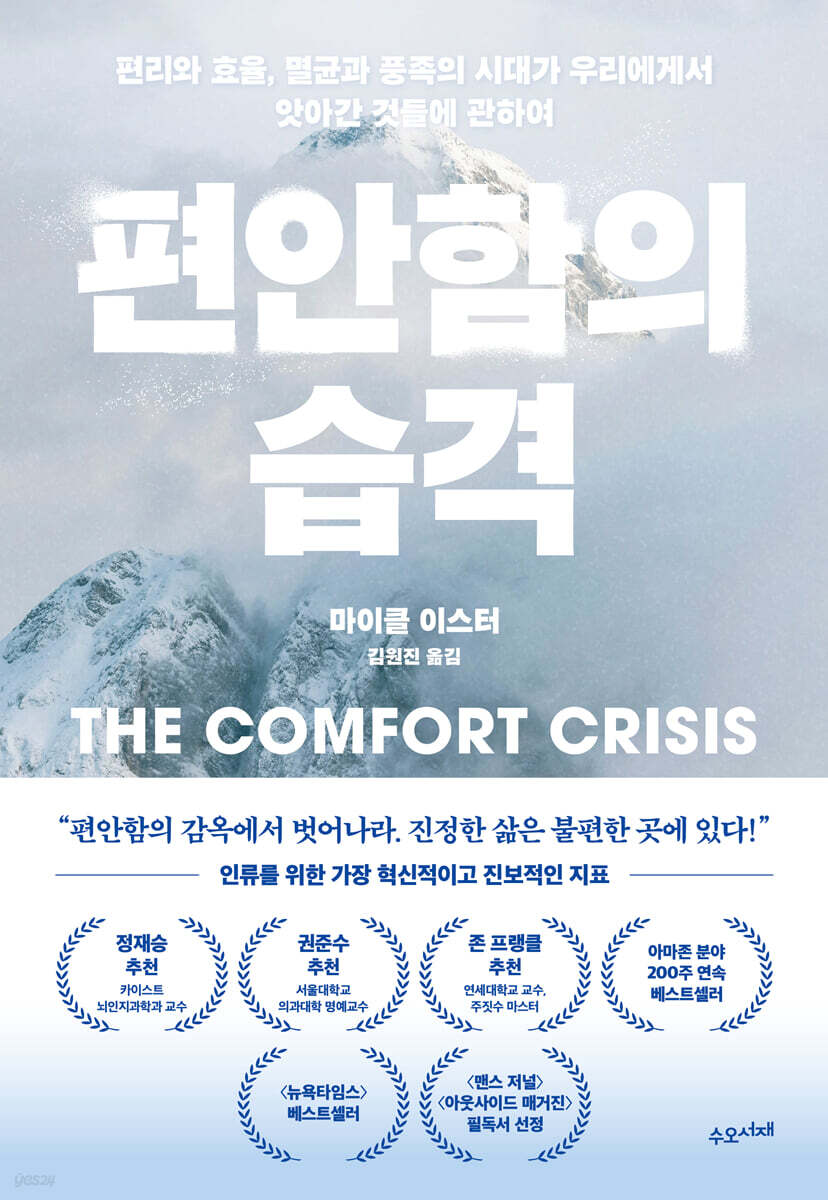
Attack of Comfort
 |
Description
Book Introduction
- A word from MD
- Now, mankind lives comfortably and safely.
Yet, there is not much evidence that they are happy.
Suffering from depression, anxiety and lethargy.
This book explores remote areas and talks with experts from various fields to suggest solutions to inconveniences.
Why is it said that a good life is one that struggles so hard that you don't die? - Son Min-gyu, Humanities PD
★ Highly recommended by Jaeseung Jeong (KAIST Professor), Junsu Kwon (Seoul National University Professor Emeritus), and John Frankl (Yonsei University Professor)!
★ Amazon's bestseller for 200 consecutive weeks, published in 13 countries worldwide!
“What have you lost in exchange for your comfort?”
Today we live in a more comfortable environment than ever before.
All rooms are perfectly climate-controlled, there is plenty of food around so you never feel hungry, life expectancy has increased thanks to modern medicine, and there are no challenges that threaten your survival.
But does comfort really bring health and happiness? Michael Easter, a behavior change expert and health journalist, has explored the Arctic, Alaska, Bhutan, war zones, and the Bolivian jungle, interviewing thousands of experts—from leading scholars and professional athletes to religious and environmental leaders—to explore the health, happiness, and meaningful lives of modern people.
In his quest for scientific strategies that could offer practical help in optimizing life, he found the answer in a sense humanity has lost: discomfort.
The author even embarks on a 33-day caribou hunt in the Alaskan wilderness to experience extreme discomfort firsthand.
In addition to the exciting and experimental Alaskan reporting, it presents groundbreaking research findings from diverse fields such as neuroscience, psychoanalysis, evolutionary psychology, exercise physiology, and anthropology, persuasively presenting the reasons why discomfort is necessary in our lives.
This book boldly challenges the dominant modern narrative that comfort leads to happiness and fulfillment.
It explores the evolutionary utility of discomfort, a sense lost by humanity, and delves into how comfort is connected to the problems facing modern people, such as addiction, depression, anxiety, suicide, obesity, loneliness syndrome, burnout, and loss of meaning in life.
★ Amazon's bestseller for 200 consecutive weeks, published in 13 countries worldwide!
“What have you lost in exchange for your comfort?”
Today we live in a more comfortable environment than ever before.
All rooms are perfectly climate-controlled, there is plenty of food around so you never feel hungry, life expectancy has increased thanks to modern medicine, and there are no challenges that threaten your survival.
But does comfort really bring health and happiness? Michael Easter, a behavior change expert and health journalist, has explored the Arctic, Alaska, Bhutan, war zones, and the Bolivian jungle, interviewing thousands of experts—from leading scholars and professional athletes to religious and environmental leaders—to explore the health, happiness, and meaningful lives of modern people.
In his quest for scientific strategies that could offer practical help in optimizing life, he found the answer in a sense humanity has lost: discomfort.
The author even embarks on a 33-day caribou hunt in the Alaskan wilderness to experience extreme discomfort firsthand.
In addition to the exciting and experimental Alaskan reporting, it presents groundbreaking research findings from diverse fields such as neuroscience, psychoanalysis, evolutionary psychology, exercise physiology, and anthropology, persuasively presenting the reasons why discomfort is necessary in our lives.
This book boldly challenges the dominant modern narrative that comfort leads to happiness and fulfillment.
It explores the evolutionary utility of discomfort, a sense lost by humanity, and delves into how comfort is connected to the problems facing modern people, such as addiction, depression, anxiety, suicide, obesity, loneliness syndrome, burnout, and loss of meaning in life.
- You can preview some of the book's contents.
Preview
index
Part 1.
It must be very difficult, but you must not die.
Day 33 | Departure for Alaskan Caribou Hunting
35, 55, or 75 | Breaking out of your comfort zone
0.004 percent | Instinctive and evolutionary laziness
800 Faces | Humanity Encroached on Comfort
18 meters | Returning to nature
50/50 | Suffering enough to not die makes a person stronger.
50, 70, or 90 | Prepare to come back alive
150 people | A fascinating study on the misery of city dwellers
163 kilometers | The correlation between being alone and health
110 kilometers per hour | First day in the Arctic
Part 2.
Enjoy the boredom
11 hours and 6 minutes | Time stolen by digital devices
20 minutes, 5 hours, 3 days | Nature is a natural tranquilizer.
Twelve Places | The Stress-Reducing Effects of Silence
Part 3.
Feel hungry
-4,000 calories | Rediscovering hunger
12-16 hours | Hunger makes us healthy.
Part 4.
Think about death every day
Three Healthy Legs | Reindeer Hunting
December 31, 23:59:33 | Bhutan's Death-Reflective Culture
20 minutes 11 seconds | Facing Death
Part 5.
Carry the luggage
45 kilograms | The weakest human in history
23 kilograms | Awaken your carrying instinct
80 percent | imprisoned humans
Epilogue
81.2 years | Severe discomfort extends lifespan
Acknowledgements
It must be very difficult, but you must not die.
Day 33 | Departure for Alaskan Caribou Hunting
35, 55, or 75 | Breaking out of your comfort zone
0.004 percent | Instinctive and evolutionary laziness
800 Faces | Humanity Encroached on Comfort
18 meters | Returning to nature
50/50 | Suffering enough to not die makes a person stronger.
50, 70, or 90 | Prepare to come back alive
150 people | A fascinating study on the misery of city dwellers
163 kilometers | The correlation between being alone and health
110 kilometers per hour | First day in the Arctic
Part 2.
Enjoy the boredom
11 hours and 6 minutes | Time stolen by digital devices
20 minutes, 5 hours, 3 days | Nature is a natural tranquilizer.
Twelve Places | The Stress-Reducing Effects of Silence
Part 3.
Feel hungry
-4,000 calories | Rediscovering hunger
12-16 hours | Hunger makes us healthy.
Part 4.
Think about death every day
Three Healthy Legs | Reindeer Hunting
December 31, 23:59:33 | Bhutan's Death-Reflective Culture
20 minutes 11 seconds | Facing Death
Part 5.
Carry the luggage
45 kilograms | The weakest human in history
23 kilograms | Awaken your carrying instinct
80 percent | imprisoned humans
Epilogue
81.2 years | Severe discomfort extends lifespan
Acknowledgements
Detailed image
.jpg)
Into the book
It is said that modern people today live longer and better lives, earn more money, and are less likely to be murdered or starve than in all previous eras.
Even the poorest person in America is richer than all previous generations! Look! Don't these numbers, data, and graphs actually tell you that the world has become a better place? The world has certainly become a better place! But there's a catch.
Because our ancestors faced countless inconveniences every day, there were also inconveniences they didn't necessarily have to face.
That is, the most pressing problems facing modern civilization today, problems that are making the lives of countless people less healthy, more unhappy, and more destitute.
Thanks to modern medicine, people are living longer than ever before, but a closer look at the data reveals that a significant portion of their lives are dependent on drugs and machines.
Life expectancy has increased, but healthy life expectancy has decreased.
--- From "0.004 Percent: Instinctive and Evolutionary Laziness"
Of course, comfort and convenience are good things.
However, we have not always progressed in terms of 'a happy and healthy life', which is the most important indicator for humans.
Our past, when we lived in an environment of increasing comfort and abundance, produced results that no one intended.
Humanity now has extremely limited opportunities for profound and profound experiences.
The experiences we were meant to have are no longer relevant to our lives.
This has undoubtedly changed humanity, and not always in the best way.
--- From "0.004 Percent: Instinctive and Evolutionary Laziness"
We headed along the ridge to the campsite.
Smoke from the west was blocking out the sun, creating a reddish-brown shade.
A feeling of 'I'm alive' comes over me.
It was a feeling far more intense than the first few days of sobriety when I realized that a whole new life lay before me.
My mind was more calm and my body was more useful.
I found myself in sync with the wild rhythm, several times higher than the frequency of the hectic modern life.
--- From "18 Meters: Returning to Nature"
“You should know in advance that this will be much harsher and more dangerous than the Nevada expedition.”
"All right.
But how much more harsh and dangerous can it be?”
“20 times.”
“Oh, then that’s fine.
I was afraid that it would be 50 times.”
"uh….
It could be 50 times.
It could be 70 times… .
Or 90 times.”
90x? Oh my goodness.
Yes, I am an Eagle Scout, a top Boy Scout with over twenty-one merit badges.
But surviving the brutal cold, the angry wild animals, the unforgiving terrain, building emergency stoves, constructing makeshift shelters, making tourniquets, and tying the right knots for any situation—all of these things had been forgotten since I discovered Evan Williams discount bourbon in college.
Tying a knot? I can barely tie my shoelaces.
At the level of a six-year-old child.
--- From "50, 70, or 90: Preparing to Come Back Alive"
“It’s a bit of a tight landing spot.
“Hold on tight.” A gust of wind pushes the aircraft backwards.
I found myself laughing without realizing it.
I'm flying hundreds of meters in this damn plane, at over 100 miles per hour, about to crash into the most dangerous place on Earth, and millions of years of human evolution whisper to me that I should avoid danger, yet I'm going beyond it and enjoying hell.
It was definitely stressful.
But the types were different.
It was a liberating stress.
--- From "163 Kilometers: The Correlation Between Being Alone and Health"
The 11 hours and 6 minutes of attention we give to digital media aren't free.
All this time is spent in a state of concentration.
Let's compare this state of concentration to lifting a heavy object and resting in a non-concentrated mode.
When we are distracted by our phones, TVs, computers, etc., our brains expend a huge amount of energy, just like when we repeat an exercise over and over again.
Eventually, overusing your attention will tire you out.
Modern life is taxing our brains.
--- From "11 Hours and 6 Minutes: Time Stolen by Digital Devices"
Today, bright and talented developers gather in the Behavioral Design Lab to research how to encourage people to stay in their apps longer.
So that you can see more ads.
Plus, they're freaking good at what they do.
For example, notifications on Twitter or likes on Instagram are designed to appear within seconds of a user opening the app.
This is not just a coincidence.
That short wait is like waiting for the wheel on a slot machine to spin.
It leverages the biological mechanisms that keep people coming back to apps.
The geniuses of Silicon Valley know exactly what tricks will attract us through big data, and idiots like me are helpless against their strategies.
--- From "11 Hours and 6 Minutes: Time Stolen by Digital Devices"
Ultra-processed foods are like cheap anti-anxiety medications that can be purchased over the counter anywhere.
As with tranquilizers, once the effects wear off, the stress remains.
So you have to take another pill or eat more junk food.
Side effects? Weight gain, heart disease, heart attack, cancer, high blood pressure, increased LDL cholesterol, type 2 diabetes, chronic fatigue, depression, osteoarthritis, pain, shortened lifespan, etc.
--- From "-4,000 Calories: Rediscovering Hunger"
The problem isn't potatoes, it's how we handle them.
The problem with all foods from nature, not just potatoes, is 'us'.
We instinctively tend to transform natural foods into dopamine-blasting foods.
For example, cut potatoes into small sticks or chips and fry them in hot oil.
Fifty percent of the potatoes produced in the United States are used in French fries, potato chips, and other processed potato products.
Alternatively, boil the potatoes, mash them, and mix in the butter and cream.
They are then baked and topped with butter, sour cream, and, in the American South, cheese and a rich meat sauce.
This dramatically increases the energy density of the food.
“In other words, it’s not a potato anymore.
“It just became a binge.”
--- From "-4,000 Calories: Rediscovering Hunger"
When we get tired or bored while working out at the gym, we sit down and rest.
Or drink cold beverages or purified water.
Or change the song on your smartphone.
After completing the set time, distance, sets and repetitions, you go into the sauna and sit down.
I'm not saying we should go back to the days when we had to struggle to find food to eat today.
Our comfortable world is great.
But as a result of our tendency toward comfort, our bodies are rarely challenged, and in return, we are losing health and strength.
--- From "45 Kilograms: The Weakest Man in History"
“We sterilize and disinfect everything.
Yet, we get sick, break, and fall more often.
“The immune system is losing its ability to discern what is actually harmful and what is not.”
If this trend continues, the human immune system will become “messy.”
When your immune system gets messed up, strange things happen.
For example, there is an over-protective response to foods that should be safe, such as peanuts.
Food allergies are disproportionately distributed among citizens of the most hygienic countries.
Ten percent of children under two years old have some degree of peanut allergy, and hospitalizations have doubled over the past decade.
Even the poorest person in America is richer than all previous generations! Look! Don't these numbers, data, and graphs actually tell you that the world has become a better place? The world has certainly become a better place! But there's a catch.
Because our ancestors faced countless inconveniences every day, there were also inconveniences they didn't necessarily have to face.
That is, the most pressing problems facing modern civilization today, problems that are making the lives of countless people less healthy, more unhappy, and more destitute.
Thanks to modern medicine, people are living longer than ever before, but a closer look at the data reveals that a significant portion of their lives are dependent on drugs and machines.
Life expectancy has increased, but healthy life expectancy has decreased.
--- From "0.004 Percent: Instinctive and Evolutionary Laziness"
Of course, comfort and convenience are good things.
However, we have not always progressed in terms of 'a happy and healthy life', which is the most important indicator for humans.
Our past, when we lived in an environment of increasing comfort and abundance, produced results that no one intended.
Humanity now has extremely limited opportunities for profound and profound experiences.
The experiences we were meant to have are no longer relevant to our lives.
This has undoubtedly changed humanity, and not always in the best way.
--- From "0.004 Percent: Instinctive and Evolutionary Laziness"
We headed along the ridge to the campsite.
Smoke from the west was blocking out the sun, creating a reddish-brown shade.
A feeling of 'I'm alive' comes over me.
It was a feeling far more intense than the first few days of sobriety when I realized that a whole new life lay before me.
My mind was more calm and my body was more useful.
I found myself in sync with the wild rhythm, several times higher than the frequency of the hectic modern life.
--- From "18 Meters: Returning to Nature"
“You should know in advance that this will be much harsher and more dangerous than the Nevada expedition.”
"All right.
But how much more harsh and dangerous can it be?”
“20 times.”
“Oh, then that’s fine.
I was afraid that it would be 50 times.”
"uh….
It could be 50 times.
It could be 70 times… .
Or 90 times.”
90x? Oh my goodness.
Yes, I am an Eagle Scout, a top Boy Scout with over twenty-one merit badges.
But surviving the brutal cold, the angry wild animals, the unforgiving terrain, building emergency stoves, constructing makeshift shelters, making tourniquets, and tying the right knots for any situation—all of these things had been forgotten since I discovered Evan Williams discount bourbon in college.
Tying a knot? I can barely tie my shoelaces.
At the level of a six-year-old child.
--- From "50, 70, or 90: Preparing to Come Back Alive"
“It’s a bit of a tight landing spot.
“Hold on tight.” A gust of wind pushes the aircraft backwards.
I found myself laughing without realizing it.
I'm flying hundreds of meters in this damn plane, at over 100 miles per hour, about to crash into the most dangerous place on Earth, and millions of years of human evolution whisper to me that I should avoid danger, yet I'm going beyond it and enjoying hell.
It was definitely stressful.
But the types were different.
It was a liberating stress.
--- From "163 Kilometers: The Correlation Between Being Alone and Health"
The 11 hours and 6 minutes of attention we give to digital media aren't free.
All this time is spent in a state of concentration.
Let's compare this state of concentration to lifting a heavy object and resting in a non-concentrated mode.
When we are distracted by our phones, TVs, computers, etc., our brains expend a huge amount of energy, just like when we repeat an exercise over and over again.
Eventually, overusing your attention will tire you out.
Modern life is taxing our brains.
--- From "11 Hours and 6 Minutes: Time Stolen by Digital Devices"
Today, bright and talented developers gather in the Behavioral Design Lab to research how to encourage people to stay in their apps longer.
So that you can see more ads.
Plus, they're freaking good at what they do.
For example, notifications on Twitter or likes on Instagram are designed to appear within seconds of a user opening the app.
This is not just a coincidence.
That short wait is like waiting for the wheel on a slot machine to spin.
It leverages the biological mechanisms that keep people coming back to apps.
The geniuses of Silicon Valley know exactly what tricks will attract us through big data, and idiots like me are helpless against their strategies.
--- From "11 Hours and 6 Minutes: Time Stolen by Digital Devices"
Ultra-processed foods are like cheap anti-anxiety medications that can be purchased over the counter anywhere.
As with tranquilizers, once the effects wear off, the stress remains.
So you have to take another pill or eat more junk food.
Side effects? Weight gain, heart disease, heart attack, cancer, high blood pressure, increased LDL cholesterol, type 2 diabetes, chronic fatigue, depression, osteoarthritis, pain, shortened lifespan, etc.
--- From "-4,000 Calories: Rediscovering Hunger"
The problem isn't potatoes, it's how we handle them.
The problem with all foods from nature, not just potatoes, is 'us'.
We instinctively tend to transform natural foods into dopamine-blasting foods.
For example, cut potatoes into small sticks or chips and fry them in hot oil.
Fifty percent of the potatoes produced in the United States are used in French fries, potato chips, and other processed potato products.
Alternatively, boil the potatoes, mash them, and mix in the butter and cream.
They are then baked and topped with butter, sour cream, and, in the American South, cheese and a rich meat sauce.
This dramatically increases the energy density of the food.
“In other words, it’s not a potato anymore.
“It just became a binge.”
--- From "-4,000 Calories: Rediscovering Hunger"
When we get tired or bored while working out at the gym, we sit down and rest.
Or drink cold beverages or purified water.
Or change the song on your smartphone.
After completing the set time, distance, sets and repetitions, you go into the sauna and sit down.
I'm not saying we should go back to the days when we had to struggle to find food to eat today.
Our comfortable world is great.
But as a result of our tendency toward comfort, our bodies are rarely challenged, and in return, we are losing health and strength.
--- From "45 Kilograms: The Weakest Man in History"
“We sterilize and disinfect everything.
Yet, we get sick, break, and fall more often.
“The immune system is losing its ability to discern what is actually harmful and what is not.”
If this trend continues, the human immune system will become “messy.”
When your immune system gets messed up, strange things happen.
For example, there is an over-protective response to foods that should be safe, such as peanuts.
Food allergies are disproportionately distributed among citizens of the most hygienic countries.
Ten percent of children under two years old have some degree of peanut allergy, and hospitalizations have doubled over the past decade.
--- From "81.2: Severe Discomfort Extends Life"
Publisher's Review
“What have you lost in exchange for your comfort?”
Uncover the true nature of the comfort that surrounds humanity!
★ Highly recommended by Jaeseung Jeong (KAIST Professor), Junsu Kwon (Seoul National University Professor Emeritus), and John Frankl (Yonsei University Professor)!
★ A New York Times bestseller, selected as a must-read by Men's Journal and Outside Magazine
★ Amazon's bestseller for 200 consecutive weeks, published in 13 countries worldwide!
Today we live in a more comfortable environment than ever before.
All rooms are perfectly climate-controlled, there is plenty of food around so you never feel hungry, life expectancy has increased thanks to modern medicine, and there are no challenges that threaten your survival.
But does comfort really bring health and happiness? Michael Easter, a behavior change expert and health journalist, has explored the Arctic, Alaska, Bhutan, war zones, and the Bolivian jungle, interviewing thousands of experts, including leading scholars, professional athletes, and religious and environmental leaders, to explore the health, happiness, and meaningful lives of modern people.
In his quest for scientific strategies that could offer practical help in optimizing life, he found the answer in a sense humanity has lost: discomfort.
This book boldly challenges the dominant modern narrative that comfort leads to happiness and fulfillment.
It explores the evolutionary utility of discomfort, a sense lost by humanity, and delves into how comfort is connected to the problems facing modern people, such as addiction, depression, anxiety, suicide, obesity, loneliness syndrome, burnout, and loss of meaning in life.
The evolutionary mechanisms of our brain
How Comfort Eats Away Life
There are stairs and escalators here.
What would you use?
Experiments show that only 2 percent of people use the stairs.
There was a time when stairs boasted amazing efficiency.
But why still climb stairs when escalators have emerged? Humans have evolved to pursue comfort.
Because it is advantageous for survival.
Relative comparison is also an evolutionary mechanism of the brain.
By making relative comparisons rather than remembering every situation, you save your brain energy and instantly judge the right decision and safer solution.
Let's apply it to comfort.
When new comforts emerge, people can no longer accept the old ones.
In other words, the goalpost of comfort is pushed back, and today's comfort becomes tomorrow's discomfort.
David Leverley, a professor of psychology at Harvard University, warns that all of this is happening unconsciously.
Comfort seeps in like a thief, encroaching upon our lives without end.
Smartphones, cars, computers, junk food, TVs, drugs, air conditioners, and other things that are synonymous with a comfortable and convenient life seem to eliminate boredom, pain, stress, and discomfort, but in reality, they sink us deeper into the swamp of comfort.
Who would have guessed that the comfort of life could become a problem? Comfort now threatens not only health, but also the vitality and meaning of life.
“How did we get into history?
“Would I have become the human being with the most miserable health?”
Humanity's Lost Movement and Stolen Time
We hardly move anymore.
Only about 20 percent of Americans follow government-recommended exercise guidelines.
Twenty-seven percent of adults do not engage in any physical activity that could be considered exercise.
As a result, a whopping 70 percent of adults are overweight.
In Korea, according to the Korean Society for the Study of Obesity, the prevalence of obesity in men is 46.2% and in women is 27.3%, and the figures are rapidly increasing every year.
Today, people spend an average of 11 hours and 6 minutes a day on digital devices.
With the advent of smartphones, boredom was condemned to complete death.
In a society overflowing with all kinds of stimulation, smartphone addiction and stress levels are closely related and increasing.
When humanity is robbed of the time it can leisurely wander, it's not just creativity and mental health that are being lost.
We even miss the 'beauty of life', which is revealed only when we perceive stillness.
If we don't consciously embrace discomfort—if we don't actively push away the comfort that increasingly infiltrates our lives—we will become increasingly weak, difficult, and sick.
“Reviving the Value of Old Inconveniences”
It is a record of change that finally broke free from addiction.
A journey to restore a humane life
“The journey this book proposes is at the ‘extreme end’ of the ‘prescriptions’ that researchers in various fields recommend we incorporate into our lives.
It is a return to the wild, and partly a reconfiguration of mindset.
And the benefits are immeasurable and all-round.” _ From the text
Michael Easter was a health journalist who became an alcoholic.
Embark on an epic journey to break free from self-destructive and contradictory life patterns and understand the evolutionary necessity of "uncomfortable challenges." Meet a top NBA exercise physiologist and learn the secrets of training for physically demanding tasks. Meet a Bhutanese religious leader and discover the transience of life, gaining insights into death and happiness.
In the lab of a young neuroscientist, we explore how nature expands human creativity and heals overload and anxiety.
We delve into the importance of connecting with nature by getting out of the city and spending substantial time in nature, the health problems that come with a lack of physical activity, research showing that hunger isn't simply a state of deprivation but rather a survival mechanism that allows the body to function more healthily and powerfully, the benefits of exercise and what types of exercise are best for you, and the challenges of modern life, where digital connectivity has increased but meaningful connections have diminished.
Not only that, the author embarks on a 33-day caribou hunt in the Alaskan wilderness, putting himself in extreme discomfort.
In a place where no human has ever set foot, the last remaining wild land on Earth, he personally experiences the bone-chilling cold, hardship, hunger, filth, silence, and boredom of a 'return to the wild', and based on this, he vividly conveys to the reader the utility of discomfort.
Along with exciting and unusual hunting stories, the book unfolds at a brisk pace, presenting a wealth of data and research accumulated over many years by experts from around the world.
The author confesses that in the process of exploring “what makes humans live longer,” he was paradoxically learning “how to live more easily,” and calls “The Assault of Comfort” a record of change.
“Facing discomfort, choosing discomfort, and sometimes even deliberately trying to be a little more uncomfortable.
“That is the wisdom we absolutely need to live without losing our natural human energy and vitality amidst the onslaught of all kinds of comfort.” _From a recommendation by John Frankl
Throughout this journey, Easter asks fundamental questions about health and happiness, encouraging us to embrace some discomfort and challenges in our daily lives to rediscover the essence of human existence.
Rather than complete comfort, moderate stress and challenge actually make us stronger, happier, and healthier.
This book reminds us that true fulfillment in life lies beyond the confines of comfort, challenging our dulled thoughts and inspiring us to discover the wildness hidden within.
If you feel the fleeting nature of life demands a change, are startled by your own escape to your smartphone whenever boredom strikes, or are weary of our technology-saturated modern society, and thus seek to challenge yourself and find a deeper purpose, this book will open a new perspective on life and offer a surprising transformation.
Uncover the true nature of the comfort that surrounds humanity!
★ Highly recommended by Jaeseung Jeong (KAIST Professor), Junsu Kwon (Seoul National University Professor Emeritus), and John Frankl (Yonsei University Professor)!
★ A New York Times bestseller, selected as a must-read by Men's Journal and Outside Magazine
★ Amazon's bestseller for 200 consecutive weeks, published in 13 countries worldwide!
Today we live in a more comfortable environment than ever before.
All rooms are perfectly climate-controlled, there is plenty of food around so you never feel hungry, life expectancy has increased thanks to modern medicine, and there are no challenges that threaten your survival.
But does comfort really bring health and happiness? Michael Easter, a behavior change expert and health journalist, has explored the Arctic, Alaska, Bhutan, war zones, and the Bolivian jungle, interviewing thousands of experts, including leading scholars, professional athletes, and religious and environmental leaders, to explore the health, happiness, and meaningful lives of modern people.
In his quest for scientific strategies that could offer practical help in optimizing life, he found the answer in a sense humanity has lost: discomfort.
This book boldly challenges the dominant modern narrative that comfort leads to happiness and fulfillment.
It explores the evolutionary utility of discomfort, a sense lost by humanity, and delves into how comfort is connected to the problems facing modern people, such as addiction, depression, anxiety, suicide, obesity, loneliness syndrome, burnout, and loss of meaning in life.
The evolutionary mechanisms of our brain
How Comfort Eats Away Life
There are stairs and escalators here.
What would you use?
Experiments show that only 2 percent of people use the stairs.
There was a time when stairs boasted amazing efficiency.
But why still climb stairs when escalators have emerged? Humans have evolved to pursue comfort.
Because it is advantageous for survival.
Relative comparison is also an evolutionary mechanism of the brain.
By making relative comparisons rather than remembering every situation, you save your brain energy and instantly judge the right decision and safer solution.
Let's apply it to comfort.
When new comforts emerge, people can no longer accept the old ones.
In other words, the goalpost of comfort is pushed back, and today's comfort becomes tomorrow's discomfort.
David Leverley, a professor of psychology at Harvard University, warns that all of this is happening unconsciously.
Comfort seeps in like a thief, encroaching upon our lives without end.
Smartphones, cars, computers, junk food, TVs, drugs, air conditioners, and other things that are synonymous with a comfortable and convenient life seem to eliminate boredom, pain, stress, and discomfort, but in reality, they sink us deeper into the swamp of comfort.
Who would have guessed that the comfort of life could become a problem? Comfort now threatens not only health, but also the vitality and meaning of life.
“How did we get into history?
“Would I have become the human being with the most miserable health?”
Humanity's Lost Movement and Stolen Time
We hardly move anymore.
Only about 20 percent of Americans follow government-recommended exercise guidelines.
Twenty-seven percent of adults do not engage in any physical activity that could be considered exercise.
As a result, a whopping 70 percent of adults are overweight.
In Korea, according to the Korean Society for the Study of Obesity, the prevalence of obesity in men is 46.2% and in women is 27.3%, and the figures are rapidly increasing every year.
Today, people spend an average of 11 hours and 6 minutes a day on digital devices.
With the advent of smartphones, boredom was condemned to complete death.
In a society overflowing with all kinds of stimulation, smartphone addiction and stress levels are closely related and increasing.
When humanity is robbed of the time it can leisurely wander, it's not just creativity and mental health that are being lost.
We even miss the 'beauty of life', which is revealed only when we perceive stillness.
If we don't consciously embrace discomfort—if we don't actively push away the comfort that increasingly infiltrates our lives—we will become increasingly weak, difficult, and sick.
“Reviving the Value of Old Inconveniences”
It is a record of change that finally broke free from addiction.
A journey to restore a humane life
“The journey this book proposes is at the ‘extreme end’ of the ‘prescriptions’ that researchers in various fields recommend we incorporate into our lives.
It is a return to the wild, and partly a reconfiguration of mindset.
And the benefits are immeasurable and all-round.” _ From the text
Michael Easter was a health journalist who became an alcoholic.
Embark on an epic journey to break free from self-destructive and contradictory life patterns and understand the evolutionary necessity of "uncomfortable challenges." Meet a top NBA exercise physiologist and learn the secrets of training for physically demanding tasks. Meet a Bhutanese religious leader and discover the transience of life, gaining insights into death and happiness.
In the lab of a young neuroscientist, we explore how nature expands human creativity and heals overload and anxiety.
We delve into the importance of connecting with nature by getting out of the city and spending substantial time in nature, the health problems that come with a lack of physical activity, research showing that hunger isn't simply a state of deprivation but rather a survival mechanism that allows the body to function more healthily and powerfully, the benefits of exercise and what types of exercise are best for you, and the challenges of modern life, where digital connectivity has increased but meaningful connections have diminished.
Not only that, the author embarks on a 33-day caribou hunt in the Alaskan wilderness, putting himself in extreme discomfort.
In a place where no human has ever set foot, the last remaining wild land on Earth, he personally experiences the bone-chilling cold, hardship, hunger, filth, silence, and boredom of a 'return to the wild', and based on this, he vividly conveys to the reader the utility of discomfort.
Along with exciting and unusual hunting stories, the book unfolds at a brisk pace, presenting a wealth of data and research accumulated over many years by experts from around the world.
The author confesses that in the process of exploring “what makes humans live longer,” he was paradoxically learning “how to live more easily,” and calls “The Assault of Comfort” a record of change.
“Facing discomfort, choosing discomfort, and sometimes even deliberately trying to be a little more uncomfortable.
“That is the wisdom we absolutely need to live without losing our natural human energy and vitality amidst the onslaught of all kinds of comfort.” _From a recommendation by John Frankl
Throughout this journey, Easter asks fundamental questions about health and happiness, encouraging us to embrace some discomfort and challenges in our daily lives to rediscover the essence of human existence.
Rather than complete comfort, moderate stress and challenge actually make us stronger, happier, and healthier.
This book reminds us that true fulfillment in life lies beyond the confines of comfort, challenging our dulled thoughts and inspiring us to discover the wildness hidden within.
If you feel the fleeting nature of life demands a change, are startled by your own escape to your smartphone whenever boredom strikes, or are weary of our technology-saturated modern society, and thus seek to challenge yourself and find a deeper purpose, this book will open a new perspective on life and offer a surprising transformation.
GOODS SPECIFICS
- Date of issue: June 24, 2025
- Page count, weight, size: 444 pages | 606g | 145*210*30mm
- ISBN13: 9791193238691
- ISBN10: 1193238692
You may also like
카테고리
korean


korean

![GQ KOREA Mark (Monthly): December [2025]](http://librairie.coreenne.fr/cdn/shop/files/8ef265dbbfbf186523ed75ba7319009d.jpg?v=1765340328&width=3840)


