

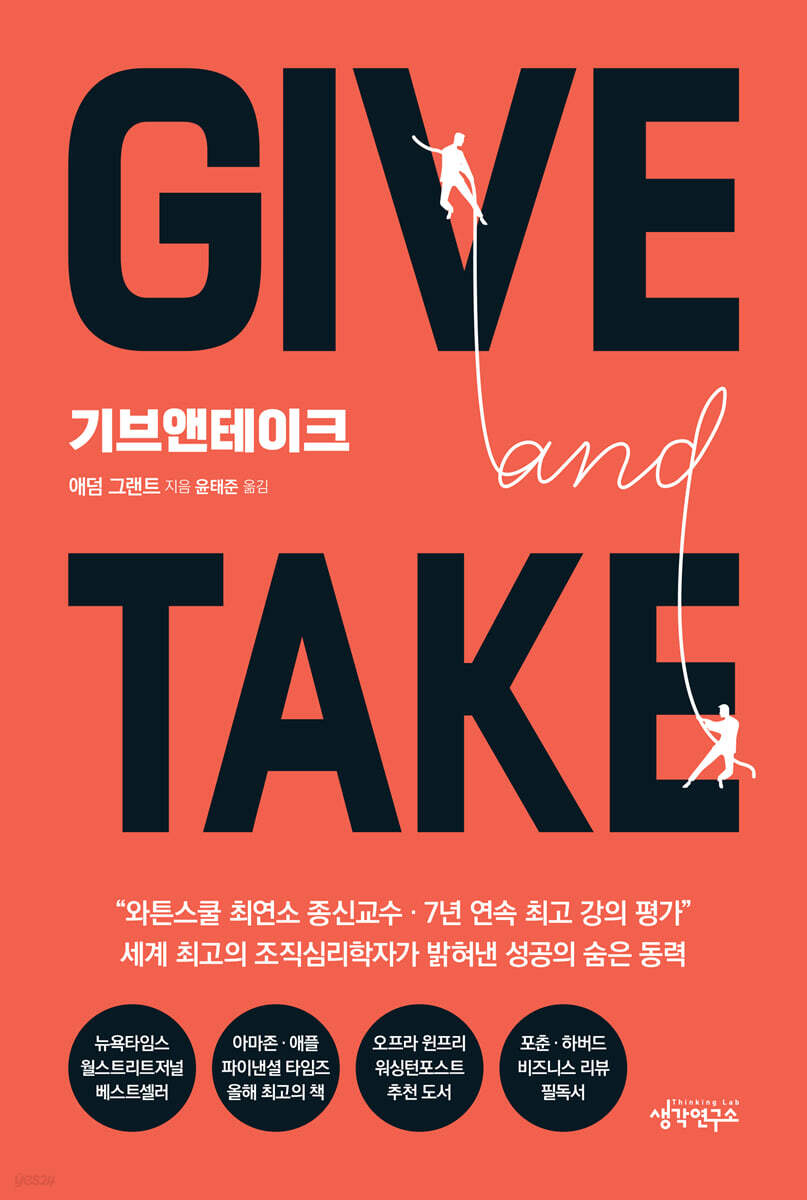
Give and Take
 |
Description
Book Introduction
A person who compromises, is considerate, generous, sacrificing, and gives unconditionally.
How did you get to the top of the ladder of success?
Who has built the world's best network, according to [Pocheon], and what is their secret? How did a stuttering rookie lawyer outperform a seasoned veteran lawyer in court? What secrets lie behind the appointment system of the greatest president in American history? How did a man who lives by the motto of generosity become one of the world's richest men?
Conventional wisdom suggests that people who achieve exceptional success have three things in common.
It's all about natural talent, hard work, and crucial timing.
Adam Grant, an organizational psychologist who was appointed the youngest tenured professor at Wharton School, one of the world's top three business schools, defines the fourth critical but often overlooked element of success as 'interaction with others' in this book.
And he puts forward a revolutionary hypothesis: people who put others before their own interests (givers) are more likely to succeed than people who seek to gain more than they give (takers) or who give as much as they receive (matchers).
This book overturns the fundamental premise of the "winner takes all" success that has dominated our society: the strong and the vicious take all.
It also breaks the unwritten rule that good people are only exploited and have a hard time succeeding, and systematically proves through a surprisingly large number of cases, three-dimensional analysis, and flawless logic that those who "help others even when they are busy, are willing to share knowledge and information, and sacrifice their own interests for others"—in other words, givers—occupy the very top of the ladder of success.
How did you get to the top of the ladder of success?
Who has built the world's best network, according to [Pocheon], and what is their secret? How did a stuttering rookie lawyer outperform a seasoned veteran lawyer in court? What secrets lie behind the appointment system of the greatest president in American history? How did a man who lives by the motto of generosity become one of the world's richest men?
Conventional wisdom suggests that people who achieve exceptional success have three things in common.
It's all about natural talent, hard work, and crucial timing.
Adam Grant, an organizational psychologist who was appointed the youngest tenured professor at Wharton School, one of the world's top three business schools, defines the fourth critical but often overlooked element of success as 'interaction with others' in this book.
And he puts forward a revolutionary hypothesis: people who put others before their own interests (givers) are more likely to succeed than people who seek to gain more than they give (takers) or who give as much as they receive (matchers).
This book overturns the fundamental premise of the "winner takes all" success that has dominated our society: the strong and the vicious take all.
It also breaks the unwritten rule that good people are only exploited and have a hard time succeeding, and systematically proves through a surprisingly large number of cases, three-dimensional analysis, and flawless logic that those who "help others even when they are busy, are willing to share knowledge and information, and sacrifice their own interests for others"—in other words, givers—occupy the very top of the ladder of success.
- You can preview some of the book's contents.
Preview
index
Give and Take
Chapter 1: Investment Recovery - Success that Defies Conventional Thinking
Are good people destined to end up at the bottom?
The Hidden Power of Success Behind Talent, Hard Work, and Luck
A person who climbs to the top of the ladder of success
Contagion of Victory
What makes their success special
The fact that pathologically yielding people work in politics
A person who is almost perfect but lacks one thing
Sacrifice, the boomerang of success
Winning Choice
The noble instinct that exists within us
A world that benefits not only me but everyone
Those who give succeed
Chapter 2: The Peacock and the Panda: The Secret of People Who Give Enough and Still Be Productive
A great conman disguised as a benevolent person
What is networking?
Masks don't last long.
The Crucial Clue That Distinguishes Givers from Takers
Who has the world's best network?
The secret to his ability to build the best network
The dangers of the principle of giving back as much as you receive
Dominoes of chance luck
Happy conspiracy, pleasant fantasy
The power of a distant relationship
The 5-Minute Kindness Rule
unconditional tolerance
Chapter 3: Sharing Success - The Amazing Value of Not Taking Victory for Yourself
People who create geniuses
The Correlation Between Creativity and Collaboration
How Great Achievements Are Born
A star made
How Givers Work Differently
What you gain by giving in
When others shine, I shine too.
The sin of monopolizing victory
responsibility bias
An atmosphere where it's okay to fail
gap in perception
The ability to see the world through other people's eyes
Chapter 4: Talent Created - Who Unleashes Potential and How?
How did they become masters?
The art of recognizing potential
Every human being is born a diamond.
How to properly cut a rough diamond
What's more important than talent
A huge investment in humble talent
The Folly of Preserving Pride and Saving Face
How to Respond to Negative Feedback
A pure desire to find a pearl in the dirt
What Michael Jordan Doesn't Have
Chapter 5: Humble Victory - The Secret Weapon of Those Who Succeed in Persuading Without Persuading
Survival Guide for a Stuttering Lawyer
The power of communication that defies convention
The value of an attitude that reveals weaknesses
How did he become the best salesman?
How to persuade without persuading
5 Speaking Techniques for Effective Hesitation
What does a leader say?
The Secret to Huge Benefits Without Negotiation
4 Benefits of Asking for Advice
Chapter 6: The Selfish Altruist - The Difference Between Those Who Burn Out and Those Who Keep Burning
The Difference Between a Successful Giver and an Unsuccessful Giver
Can excessive dedication and sacrifice become toxic?
What's more important than how much you give
Why You Can Stay Energized Even While Working More
Lighting a fire and watering the garden
The Magic Number: The 100-Hour Rule
The perfect antidote to burnout
I gave up money and it came to me.
The joy of helping
Chapter 7: Escaping the Foolish Trap: How to Be Generous Without Being a Pushover
3 Traps That Plague Givers
The Kind Devil and the Grumpy Angel
The shell of action
Empathize with thoughts, not feelings.
A generous retaliatory strategy
Role change
How to Win in Negotiations While Living for the Benefit of Others
Giving selfishly
Chapter 8: The Chain of Reciprocity: What Makes Humans Give
The power of the group
Can humans be purely altruistic?
The power of a sense of solidarity that turns equators into comrades
Differentiation, being the same and different at the same time
A role model that I can emulate
The Ring of Reciprocity
How to signal that you are a good person
Anyway, kindness is human nature.
Chapter 9: A Different Dimension of Success - Those who yield, are considerate, and give rise to the best.
Conditions for wise action
A smart negotiator wins even when he loses.
In the age of the giver monopoly, the giver takes it all.
Chapter 1: Investment Recovery - Success that Defies Conventional Thinking
Are good people destined to end up at the bottom?
The Hidden Power of Success Behind Talent, Hard Work, and Luck
A person who climbs to the top of the ladder of success
Contagion of Victory
What makes their success special
The fact that pathologically yielding people work in politics
A person who is almost perfect but lacks one thing
Sacrifice, the boomerang of success
Winning Choice
The noble instinct that exists within us
A world that benefits not only me but everyone
Those who give succeed
Chapter 2: The Peacock and the Panda: The Secret of People Who Give Enough and Still Be Productive
A great conman disguised as a benevolent person
What is networking?
Masks don't last long.
The Crucial Clue That Distinguishes Givers from Takers
Who has the world's best network?
The secret to his ability to build the best network
The dangers of the principle of giving back as much as you receive
Dominoes of chance luck
Happy conspiracy, pleasant fantasy
The power of a distant relationship
The 5-Minute Kindness Rule
unconditional tolerance
Chapter 3: Sharing Success - The Amazing Value of Not Taking Victory for Yourself
People who create geniuses
The Correlation Between Creativity and Collaboration
How Great Achievements Are Born
A star made
How Givers Work Differently
What you gain by giving in
When others shine, I shine too.
The sin of monopolizing victory
responsibility bias
An atmosphere where it's okay to fail
gap in perception
The ability to see the world through other people's eyes
Chapter 4: Talent Created - Who Unleashes Potential and How?
How did they become masters?
The art of recognizing potential
Every human being is born a diamond.
How to properly cut a rough diamond
What's more important than talent
A huge investment in humble talent
The Folly of Preserving Pride and Saving Face
How to Respond to Negative Feedback
A pure desire to find a pearl in the dirt
What Michael Jordan Doesn't Have
Chapter 5: Humble Victory - The Secret Weapon of Those Who Succeed in Persuading Without Persuading
Survival Guide for a Stuttering Lawyer
The power of communication that defies convention
The value of an attitude that reveals weaknesses
How did he become the best salesman?
How to persuade without persuading
5 Speaking Techniques for Effective Hesitation
What does a leader say?
The Secret to Huge Benefits Without Negotiation
4 Benefits of Asking for Advice
Chapter 6: The Selfish Altruist - The Difference Between Those Who Burn Out and Those Who Keep Burning
The Difference Between a Successful Giver and an Unsuccessful Giver
Can excessive dedication and sacrifice become toxic?
What's more important than how much you give
Why You Can Stay Energized Even While Working More
Lighting a fire and watering the garden
The Magic Number: The 100-Hour Rule
The perfect antidote to burnout
I gave up money and it came to me.
The joy of helping
Chapter 7: Escaping the Foolish Trap: How to Be Generous Without Being a Pushover
3 Traps That Plague Givers
The Kind Devil and the Grumpy Angel
The shell of action
Empathize with thoughts, not feelings.
A generous retaliatory strategy
Role change
How to Win in Negotiations While Living for the Benefit of Others
Giving selfishly
Chapter 8: The Chain of Reciprocity: What Makes Humans Give
The power of the group
Can humans be purely altruistic?
The power of a sense of solidarity that turns equators into comrades
Differentiation, being the same and different at the same time
A role model that I can emulate
The Ring of Reciprocity
How to signal that you are a good person
Anyway, kindness is human nature.
Chapter 9: A Different Dimension of Success - Those who yield, are considerate, and give rise to the best.
Conditions for wise action
A smart negotiator wins even when he loses.
In the age of the giver monopoly, the giver takes it all.
Into the book
Give and Take
Over the past three decades, groundbreaking research has revealed that individuals have different preferences for what they call "reciprocity"—that is, they differ dramatically in how much they expect to give and how much they expect to receive.
To better understand this preference, consider the two extremes of the reciprocity principle commonly found in the workplace.
Here, we will call them 'giver' and 'taker' respectively.
The most striking characteristic of a taker is that he or she wants to receive more than he or she gives.
They distort relationships to suit their own tastes and prioritize their own interests over the needs of others.
They also see the world as a fiercely competitive arena where "if you don't catch them first, you will be caught" and believe that to succeed, you have to be better than others.
For this reason, they try to prove their abilities by working hard and getting a lot of reward for it.
In fact, the average taker is not cruel or vicious.
I'm just being cautious and defensive.
They think like this.
'If I don't take care of mine, who will?'
In the business world, givers are a relatively rare breed.
They like to put the weight of the relationship on the other person's side and give more than they receive.
A giver helps others when the benefit to others is greater than the effort or cost to him.
They help others without expecting anything in return, even without sparing any effort or expense.
If there's someone in your office who's willing to dedicate their time, effort, knowledge, skills, ideas, and relationships to helping someone, that person is a giver.
This type of behavior is quite common outside of the workplace.
Research by Yale University psychologist Margaret Clark shows that in intimate relationships, almost everyone acts like a giver.
For example, in our marriage or relationships with friends, we serve others without thinking about profit or loss as much as possible.
In the workplace, on the other hand, relationships are more complex.
Few people are strictly givers or takers professionally, and most choose the third behavioral type.
That type is the 'matcher', who strives to balance losses and gains.
Matchers who adhere to the principle of fairness protect their own interests by advocating the principle of mutual assistance when helping others.
If you believe in the principle of giving back as much as you receive and think that human relationships are about giving and receiving favors, then you are a matchmaker.
Giving, receiving, and achieving balance are three fundamental behaviors necessary for social life.
But the distinction is not clear.
Even if you follow one behavioral pattern, it can change into a different pattern if your job responsibilities or relationships change at work.
It wouldn't be surprising if you acted like a taker when negotiating your salary, a giver when advising subordinates, and a matcher when sharing your expertise with colleagues.
However, there is evidence that people tend to adopt one dominant behavioral style when interacting with others in the workplace.
That behavioral pattern plays a vital role in success, along with ability, motivation, and opportunity.
In fact, the patterns of success based on behavior are surprisingly clear.
If you were asked who would fall to the bottom of the ladder of success, what would you say? Givers, takers, or matchers? --- pp. 20-22
In the traditional principle of reciprocity, we act like matchmakers, giving and receiving in return.
It means that I only help those who have helped me, and I only reach out to those from whom I expect something in return.
But today, the kind of reciprocity shown by givers like Rifkin holds even greater power.
Rifkin doesn't exchange value, he just adds value.
For example, he acts according to a simple rule called 'five minutes of kindness'.
“I think it’s about investing just five minutes for someone else.”
Rifkin doesn't believe that those who have been helped will ever give something back.
While takers network to connect with important and influential people, and matchers network to gain favors, Rifkin meets people to find opportunities to give more.
--- p.101
As Malcolm Gladwell points out in Outliers, research led by psychologist Anders Ericsson has shown that it takes 10,000 hours of diligent practice to acquire expert skills in a field.
So what motivated them to practice for so long? The scene often features a giver.
Pianists and their parents consistently focused on one theme when talking about their first piano teacher.
The teachers taught us with care, kindness, and patience.
The star pianist always looked forward to piano lessons thanks to the fun and engaging way the teacher taught him music.
Bloom's research team explains this as follows:
“The children had a very positive experience in their first lesson.
“They met a warm, loving, and supportive adult outside of the home.”
The teachers who first sparked the world-renowned pianist's interest in music were the Givers.
They strived to find ways to make teaching piano enjoyable, which played a major role in helping pianists develop outstanding skills through intense practice from a young age.
'Exploring possibilities and experiencing a wide variety of music' takes precedence over other factors like 'right and wrong, good and bad'.
World-class tennis players have also shown the same pattern.
Bloom's research team interviewed eighteen American tennis players who had ever been ranked in the world's top 10.
As a result, they found that the first coach was 'not very good as a coach, but he dealt well with the children' and 'motivated the players to get interested in tennis and practice hard'.
Givers who take on the role of leaders and mentors are not tempted to look for talent first.
The Giver focuses on motivating and empowering people to develop their talents.
According to Bloom's research team, the first coaches of tennis players ranked in the top 10 generally paid "special attention to them."
The reason is not that the players have any special physical abilities, but because we know that if we motivate them, they will work hard.
--- pp.176~177
He felt more energized when he volunteered at an educational institution for nearly two weeks a year, or more than 100 hours.
In the world of giving, 100 hours is like a magic number.
A survey of more than 2,000 adults in their mid-60s in Australia found that those who volunteered between 100 and 800 hours a year were happier and more satisfied with their lives than those who volunteered less than 100 hours or more than 800 hours.
A 1998 study in the United States also found that adults who volunteered for at least 100 hours were more likely to be alive in 2000.
There was no greater benefit to volunteering more than 100 hours.
This is the '100-hour rule' of volunteering.
That is, 100 hours is the range in which the act of giving gives the most energy and consumes the least energy.
Over the past three decades, groundbreaking research has revealed that individuals have different preferences for what they call "reciprocity"—that is, they differ dramatically in how much they expect to give and how much they expect to receive.
To better understand this preference, consider the two extremes of the reciprocity principle commonly found in the workplace.
Here, we will call them 'giver' and 'taker' respectively.
The most striking characteristic of a taker is that he or she wants to receive more than he or she gives.
They distort relationships to suit their own tastes and prioritize their own interests over the needs of others.
They also see the world as a fiercely competitive arena where "if you don't catch them first, you will be caught" and believe that to succeed, you have to be better than others.
For this reason, they try to prove their abilities by working hard and getting a lot of reward for it.
In fact, the average taker is not cruel or vicious.
I'm just being cautious and defensive.
They think like this.
'If I don't take care of mine, who will?'
In the business world, givers are a relatively rare breed.
They like to put the weight of the relationship on the other person's side and give more than they receive.
A giver helps others when the benefit to others is greater than the effort or cost to him.
They help others without expecting anything in return, even without sparing any effort or expense.
If there's someone in your office who's willing to dedicate their time, effort, knowledge, skills, ideas, and relationships to helping someone, that person is a giver.
This type of behavior is quite common outside of the workplace.
Research by Yale University psychologist Margaret Clark shows that in intimate relationships, almost everyone acts like a giver.
For example, in our marriage or relationships with friends, we serve others without thinking about profit or loss as much as possible.
In the workplace, on the other hand, relationships are more complex.
Few people are strictly givers or takers professionally, and most choose the third behavioral type.
That type is the 'matcher', who strives to balance losses and gains.
Matchers who adhere to the principle of fairness protect their own interests by advocating the principle of mutual assistance when helping others.
If you believe in the principle of giving back as much as you receive and think that human relationships are about giving and receiving favors, then you are a matchmaker.
Giving, receiving, and achieving balance are three fundamental behaviors necessary for social life.
But the distinction is not clear.
Even if you follow one behavioral pattern, it can change into a different pattern if your job responsibilities or relationships change at work.
It wouldn't be surprising if you acted like a taker when negotiating your salary, a giver when advising subordinates, and a matcher when sharing your expertise with colleagues.
However, there is evidence that people tend to adopt one dominant behavioral style when interacting with others in the workplace.
That behavioral pattern plays a vital role in success, along with ability, motivation, and opportunity.
In fact, the patterns of success based on behavior are surprisingly clear.
If you were asked who would fall to the bottom of the ladder of success, what would you say? Givers, takers, or matchers? --- pp. 20-22
In the traditional principle of reciprocity, we act like matchmakers, giving and receiving in return.
It means that I only help those who have helped me, and I only reach out to those from whom I expect something in return.
But today, the kind of reciprocity shown by givers like Rifkin holds even greater power.
Rifkin doesn't exchange value, he just adds value.
For example, he acts according to a simple rule called 'five minutes of kindness'.
“I think it’s about investing just five minutes for someone else.”
Rifkin doesn't believe that those who have been helped will ever give something back.
While takers network to connect with important and influential people, and matchers network to gain favors, Rifkin meets people to find opportunities to give more.
--- p.101
As Malcolm Gladwell points out in Outliers, research led by psychologist Anders Ericsson has shown that it takes 10,000 hours of diligent practice to acquire expert skills in a field.
So what motivated them to practice for so long? The scene often features a giver.
Pianists and their parents consistently focused on one theme when talking about their first piano teacher.
The teachers taught us with care, kindness, and patience.
The star pianist always looked forward to piano lessons thanks to the fun and engaging way the teacher taught him music.
Bloom's research team explains this as follows:
“The children had a very positive experience in their first lesson.
“They met a warm, loving, and supportive adult outside of the home.”
The teachers who first sparked the world-renowned pianist's interest in music were the Givers.
They strived to find ways to make teaching piano enjoyable, which played a major role in helping pianists develop outstanding skills through intense practice from a young age.
'Exploring possibilities and experiencing a wide variety of music' takes precedence over other factors like 'right and wrong, good and bad'.
World-class tennis players have also shown the same pattern.
Bloom's research team interviewed eighteen American tennis players who had ever been ranked in the world's top 10.
As a result, they found that the first coach was 'not very good as a coach, but he dealt well with the children' and 'motivated the players to get interested in tennis and practice hard'.
Givers who take on the role of leaders and mentors are not tempted to look for talent first.
The Giver focuses on motivating and empowering people to develop their talents.
According to Bloom's research team, the first coaches of tennis players ranked in the top 10 generally paid "special attention to them."
The reason is not that the players have any special physical abilities, but because we know that if we motivate them, they will work hard.
--- pp.176~177
He felt more energized when he volunteered at an educational institution for nearly two weeks a year, or more than 100 hours.
In the world of giving, 100 hours is like a magic number.
A survey of more than 2,000 adults in their mid-60s in Australia found that those who volunteered between 100 and 800 hours a year were happier and more satisfied with their lives than those who volunteered less than 100 hours or more than 800 hours.
A 1998 study in the United States also found that adults who volunteered for at least 100 hours were more likely to be alive in 2000.
There was no greater benefit to volunteering more than 100 hours.
This is the '100-hour rule' of volunteering.
That is, 100 hours is the range in which the act of giving gives the most energy and consumes the least energy.
--- From the text
Publisher's Review
Give and Take
A New York Times bestseller! A Wall Street Journal bestseller! An Amazon and Barnes & Noble bestseller!
A book that completely overturns conventional wisdom about success.
Social science research has proven that "giving" people, who help others, take the lead in sharing knowledge, and offer generous advice even in the midst of busy schedules, can live fully productive lives and even achieve success.
[New York Times] Among the cover stories
Winner takes all is wrong!
How do kind and altruistic people climb to the top of the ladder of success?
The power of "winning concessions" revealed by Wharton School's youngest tenured professor and world-renowned organizational psychologist!
Robert Green, who is called the resurrected Machiavelli, argued in The 48 Laws of Power that “he who seeks to be good alone must surely be destroyed.”
To succeed in life and in the business world, you must learn the art of war, the way of a fighter who risks his life fighting in the Colosseum. You can never become the 'number one' by being good.
His logic has resonated with countless managers and leaders, and his book has been hailed as a modern-day version of The Prince.
The "iron law of success" has long dominated our consciousness: to gain power in life, especially at work, to win the competition, and ultimately to climb to the top of the ladder of success, we must put our own interests before those of others, be stronger than others, and never show weakness.
The rule of 'winner takes all', where the strong and victorious take everything, has become a virtue, and 'giving one and getting ten in return' has been considered a good thing.
In short, I believed that in order to succeed, you had to be better than others.
So what about the opposite? What if we put others before ourselves, sacrifice our own responsibilities to help others, and boldly share valuable information, even trade secrets? What about those who dedicate their time and effort to helping others without expecting anything in return, those who place the weight of the relationship on the other person's side? Wouldn't those so-called "good, altruistic people" simply be exploited by the bad and selfish, far from achieving success?
《Give and Take》 (original title: Give and Take, published by Saenggak Research Institute) provides an answer to this question that defies common sense.
The old business adage that "the tough get ahead" is wrong, and it's those who "compromise, are considerate, generous, sacrificial, and give unconditionally" who reach the top of the success ladder.
The author, a professor of organizational psychology at Wharton School who has been researching the 'correlation between the principle of reciprocity and success' for over 10 years, combines numerous cutting-edge psychological experiments conducted around the world, management theories, and unique cases never encountered before to turn the absurd hypothesis that 'those who give succeed' into 'truth.'
The most helpful and most productive psychologist in America,
Academically demonstrating how compromise and consideration lead to success.
Filled with insightful insights, flawless logic, and the hidden success stories of those who gave, compromised, and shared their victories, this book persuasively challenges the conventional wisdom of success and immediately hit the New York Times, Amazon.com, and Wall Street Journal bestseller lists.
Even before its publication, the book and an interview with the author were featured on the cover of the New York Times, creating a lot of buzz.
Adam Grant, the author of the book, is a brilliant genius who was appointed the youngest tenured professor at the Wharton School, one of the world's top three business schools, at the young age of 31.
Recently, it also received the Best Lecture Evaluation Award for three consecutive years.
In particular, in just seven years, he published more papers in top-tier journals such as the American Psychological Association, the Society for Management, and the Society for Industrial-Organizational Psychology than his senior professors who received lifetime achievement awards, and his passionate research activities were recognized by winning the Young Scholar Award and the Outstanding Academic Award, respectively.
His influence extends beyond academia into the business world, where he lectures and consults for organizations such as Google, Goldman Sachs, Facebook, Microsoft, the United Nations, the World Economic Forum, and the U.S. Army, Navy, and Air Force.
The New York Times described him as “the most productive psychologist in America” due to his “greed” for work.
He is the main character of the book, who actually practices the core message of Give and Take.
The book contains his experiences of 'habitually' helping others and giving back to others, which resulted in good results.
A New York Times article confirms that he responds to countless students' emails, responds to their consultations without showing any signs of discomfort, and yet continues to pursue new research.
His motto is to help others, and the phrase he says most often throughout the day is, "How can I help you?"
The following is an excerpt from the [New York Times] article.
Grant's life motto is helpfulness.
He is a teacher and colleague who always recommends others when an award opportunity comes his way, takes the time to offer thoughtful critiques, and writes lengthy letters of recommendation for his students.
He writes nearly 100 letters of recommendation a year.
It even helps people you've never met before.
Recently, a student at Warwick Business School in the UK emailed him expressing his admiration and asking how he managed to publish so many papers, and in such prestigious journals.
As Grant read this email, he didn't think he had to answer each and every question.
…Furthermore, when Grant returned home, he checked over 200 emails one by one, replying with, “You can call if you want to discuss this,” and attaching a presentation on productivity he had given at the Academy of Management annual conference a few years earlier.
For Professor Grant, 'helping others' is not the enemy of productivity, a waste of time that reduces work efficiency.
Rather, it is a motivating factor that stimulates increased productivity and creativity.
He always helped someone.
And yet, it was always productive.
He was always curious about how these two factors (helping behavior and productivity) interact.
Perhaps the reason he was able to achieve so much in his field at such a young age was because of his life's motto: his relentless pursuit of unraveling the mystery of the interplay between helping and productivity.
The book contains the results of his painstaking research over the years.
A revolutionary report that overturns the long-held myth of success,
A passionate cheering song for kind-hearted souls who follow their inherently noble instincts.
Along with 'winner takes all', there is a long-standing superstition about success.
Success requires natural talent, hard work, and crucial timing.
People have recognized these three as the key elements needed to achieve success.
The book says there is a fourth, often overlooked, but crucial element to success.
It is ‘interaction with others’.
At work, we often encounter three types of people.
A person who prioritizes his own interests over giving to others (a taker).
A person who gives only as much as he receives and receives only as much as he gives (matcher).
Lastly, a giver is someone who thinks of others' interests before their own and gives unconditionally.
The book acknowledges that, in common sense, 'givers' fall to the bottom of the ladder of success.
This is because they are treated as easygoing people and are exploited by others, or they give in without feedback and end up exhausted and falling behind.
But at the same time, it also comes to the rather shocking conclusion that climbing to the very top of the ladder of success is also a 'giver'.
Through the stories of living givers who have risen to the top in their fields, as well as the stories of takers who have suffered miserable failures by focusing only on themselves, the film sheds new light on the potential for success of the 'giver', a concept that has been underestimated.
The 'giver instinct' is risky, but it's the most powerful force in the long run.
First, it reveals how a man who filled his cabinet with people more famous, better educated, and more capable than himself, even at the risk of obscuring his authority, became America's greatest president, and how a pathologically conceding man survived in politics.
Through the case of David Honig, who achieved an 89% investment success rate (versus the industry average of 50%) by breaking two of the most sacred principles in the venture capital world, we demonstrate the power of the "giving instinct" that doesn't monopolize victory. (Chapter 1)
How Small Kindnesses Lead to Financial Achievement and Success
We reveal how people with altruistic behaviors, or givers, rise to the top and reveal their unique networking methods.
We explore how Kenneth Lay, once hailed as a "good, compassionate man" by President George W. Bush, became the mastermind behind the Enron scandal, and what clues could have revealed his selfish instincts four years before America's largest bankruptcy.
We also analyze the differences between the way takers like Kenneth Lay networked and the way [Fortune] ranked the world's best networkers.
We'll also explore how small acts of kindness can lead to success and the "Five Minutes of Kindness" principle for forming new relationships and maintaining existing ones (Chapter 2).
The question is whether success ends with the individual or spreads to the organization.
Through the stories of Frank Lloyd Wright, recognized as the greatest architect in American history, and John Mayer, considered the most successful figure in American show business history, it also shows the difference between how some people stop at personal success, while others go beyond the individual and lead their organizations to success.
We also explore which types of people contribute the most to the overall organization and how creative givers spread success (Chapter 3).
The Counterattack on Talent: How Great Teachers Teach
Through the case of an accounting professor who produced students who swept the top three spots on the Certified Public Accountant exam, we also uncover the surprising nature of his skills in judging and nurturing others' talents to achieve the best results.
We also explore the characteristics of the leaders and mentors behind world-renowned pianists, basketball players, and tennis players.
Moreover, it boldly overturns the correlation between talent and success by proposing a new proposition: "A great teacher does not discover talented people, but believes that talent exists in everyone." (Chapter 4)
Why a Humble Salesman, a Stutterer Lawyer, and a Professor Younger Than His Students Succeeded
Learn how a stuttering rookie lawyer beat a seasoned veteran lawyer in court and why the conventional wisdom that you need to speak with conviction and assertiveness to gain influence is wrong.
It also proves that communication that reveals weakness and lessens power is more persuasive than communication that uses force to establish authority.
In particular, through the case of the eyewear retailer Lenscrafters, we uncover the secrets of many successful salespeople who are givers and their outstanding performance (Chapter 5).
The difference between someone who gets tired and falls and someone who continues to burn with passion.
The case of the Overbrook High School teacher sheds light on why some altruists remain vibrant while others burn out easily, and why they never tire of giving more.
We also explore how a failing university fundraising call center saw its fundraising numbers soar by 144 percent and the amount raised by over 400 percent, and why feedback is more important than how much you give.
Through this, we reveal the secret to maintaining passion without burning out while doing more work, as well as the magic time when you feel the greatest happiness and vitality in giving (Chapter 6).
How to tell the difference between a kind devil and a sullen angel
It explores why some givers thrive without being taken advantage of by others, while others fall prey to easy prey, and how dangerous it is to be selfless, unconditionally trust others, excessively empathetic, and overly timid.
It also helps us realize that people who appear cooperative, polite, kind, and gentle are sometimes strong takers, and that people who are aggressive, competitive, critical, and sarcastic are sometimes true givers (Chapter 7).
Altruistic acts spread like a waterfall.
Robert Cialdini's experiment on electricity usage demonstrates how exposure to "norms" can reduce selfish behavior. The case studies of Craigslist, a website for selling used goods, and FreeSite demonstrate how sharing a shared identity and providing role models to emulate can spread generosity within a group. (Chapter 8)
A New York Times bestseller! A Wall Street Journal bestseller! An Amazon and Barnes & Noble bestseller!
A book that completely overturns conventional wisdom about success.
Social science research has proven that "giving" people, who help others, take the lead in sharing knowledge, and offer generous advice even in the midst of busy schedules, can live fully productive lives and even achieve success.
[New York Times] Among the cover stories
Winner takes all is wrong!
How do kind and altruistic people climb to the top of the ladder of success?
The power of "winning concessions" revealed by Wharton School's youngest tenured professor and world-renowned organizational psychologist!
Robert Green, who is called the resurrected Machiavelli, argued in The 48 Laws of Power that “he who seeks to be good alone must surely be destroyed.”
To succeed in life and in the business world, you must learn the art of war, the way of a fighter who risks his life fighting in the Colosseum. You can never become the 'number one' by being good.
His logic has resonated with countless managers and leaders, and his book has been hailed as a modern-day version of The Prince.
The "iron law of success" has long dominated our consciousness: to gain power in life, especially at work, to win the competition, and ultimately to climb to the top of the ladder of success, we must put our own interests before those of others, be stronger than others, and never show weakness.
The rule of 'winner takes all', where the strong and victorious take everything, has become a virtue, and 'giving one and getting ten in return' has been considered a good thing.
In short, I believed that in order to succeed, you had to be better than others.
So what about the opposite? What if we put others before ourselves, sacrifice our own responsibilities to help others, and boldly share valuable information, even trade secrets? What about those who dedicate their time and effort to helping others without expecting anything in return, those who place the weight of the relationship on the other person's side? Wouldn't those so-called "good, altruistic people" simply be exploited by the bad and selfish, far from achieving success?
《Give and Take》 (original title: Give and Take, published by Saenggak Research Institute) provides an answer to this question that defies common sense.
The old business adage that "the tough get ahead" is wrong, and it's those who "compromise, are considerate, generous, sacrificial, and give unconditionally" who reach the top of the success ladder.
The author, a professor of organizational psychology at Wharton School who has been researching the 'correlation between the principle of reciprocity and success' for over 10 years, combines numerous cutting-edge psychological experiments conducted around the world, management theories, and unique cases never encountered before to turn the absurd hypothesis that 'those who give succeed' into 'truth.'
The most helpful and most productive psychologist in America,
Academically demonstrating how compromise and consideration lead to success.
Filled with insightful insights, flawless logic, and the hidden success stories of those who gave, compromised, and shared their victories, this book persuasively challenges the conventional wisdom of success and immediately hit the New York Times, Amazon.com, and Wall Street Journal bestseller lists.
Even before its publication, the book and an interview with the author were featured on the cover of the New York Times, creating a lot of buzz.
Adam Grant, the author of the book, is a brilliant genius who was appointed the youngest tenured professor at the Wharton School, one of the world's top three business schools, at the young age of 31.
Recently, it also received the Best Lecture Evaluation Award for three consecutive years.
In particular, in just seven years, he published more papers in top-tier journals such as the American Psychological Association, the Society for Management, and the Society for Industrial-Organizational Psychology than his senior professors who received lifetime achievement awards, and his passionate research activities were recognized by winning the Young Scholar Award and the Outstanding Academic Award, respectively.
His influence extends beyond academia into the business world, where he lectures and consults for organizations such as Google, Goldman Sachs, Facebook, Microsoft, the United Nations, the World Economic Forum, and the U.S. Army, Navy, and Air Force.
The New York Times described him as “the most productive psychologist in America” due to his “greed” for work.
He is the main character of the book, who actually practices the core message of Give and Take.
The book contains his experiences of 'habitually' helping others and giving back to others, which resulted in good results.
A New York Times article confirms that he responds to countless students' emails, responds to their consultations without showing any signs of discomfort, and yet continues to pursue new research.
His motto is to help others, and the phrase he says most often throughout the day is, "How can I help you?"
The following is an excerpt from the [New York Times] article.
Grant's life motto is helpfulness.
He is a teacher and colleague who always recommends others when an award opportunity comes his way, takes the time to offer thoughtful critiques, and writes lengthy letters of recommendation for his students.
He writes nearly 100 letters of recommendation a year.
It even helps people you've never met before.
Recently, a student at Warwick Business School in the UK emailed him expressing his admiration and asking how he managed to publish so many papers, and in such prestigious journals.
As Grant read this email, he didn't think he had to answer each and every question.
…Furthermore, when Grant returned home, he checked over 200 emails one by one, replying with, “You can call if you want to discuss this,” and attaching a presentation on productivity he had given at the Academy of Management annual conference a few years earlier.
For Professor Grant, 'helping others' is not the enemy of productivity, a waste of time that reduces work efficiency.
Rather, it is a motivating factor that stimulates increased productivity and creativity.
He always helped someone.
And yet, it was always productive.
He was always curious about how these two factors (helping behavior and productivity) interact.
Perhaps the reason he was able to achieve so much in his field at such a young age was because of his life's motto: his relentless pursuit of unraveling the mystery of the interplay between helping and productivity.
The book contains the results of his painstaking research over the years.
A revolutionary report that overturns the long-held myth of success,
A passionate cheering song for kind-hearted souls who follow their inherently noble instincts.
Along with 'winner takes all', there is a long-standing superstition about success.
Success requires natural talent, hard work, and crucial timing.
People have recognized these three as the key elements needed to achieve success.
The book says there is a fourth, often overlooked, but crucial element to success.
It is ‘interaction with others’.
At work, we often encounter three types of people.
A person who prioritizes his own interests over giving to others (a taker).
A person who gives only as much as he receives and receives only as much as he gives (matcher).
Lastly, a giver is someone who thinks of others' interests before their own and gives unconditionally.
The book acknowledges that, in common sense, 'givers' fall to the bottom of the ladder of success.
This is because they are treated as easygoing people and are exploited by others, or they give in without feedback and end up exhausted and falling behind.
But at the same time, it also comes to the rather shocking conclusion that climbing to the very top of the ladder of success is also a 'giver'.
Through the stories of living givers who have risen to the top in their fields, as well as the stories of takers who have suffered miserable failures by focusing only on themselves, the film sheds new light on the potential for success of the 'giver', a concept that has been underestimated.
The 'giver instinct' is risky, but it's the most powerful force in the long run.
First, it reveals how a man who filled his cabinet with people more famous, better educated, and more capable than himself, even at the risk of obscuring his authority, became America's greatest president, and how a pathologically conceding man survived in politics.
Through the case of David Honig, who achieved an 89% investment success rate (versus the industry average of 50%) by breaking two of the most sacred principles in the venture capital world, we demonstrate the power of the "giving instinct" that doesn't monopolize victory. (Chapter 1)
How Small Kindnesses Lead to Financial Achievement and Success
We reveal how people with altruistic behaviors, or givers, rise to the top and reveal their unique networking methods.
We explore how Kenneth Lay, once hailed as a "good, compassionate man" by President George W. Bush, became the mastermind behind the Enron scandal, and what clues could have revealed his selfish instincts four years before America's largest bankruptcy.
We also analyze the differences between the way takers like Kenneth Lay networked and the way [Fortune] ranked the world's best networkers.
We'll also explore how small acts of kindness can lead to success and the "Five Minutes of Kindness" principle for forming new relationships and maintaining existing ones (Chapter 2).
The question is whether success ends with the individual or spreads to the organization.
Through the stories of Frank Lloyd Wright, recognized as the greatest architect in American history, and John Mayer, considered the most successful figure in American show business history, it also shows the difference between how some people stop at personal success, while others go beyond the individual and lead their organizations to success.
We also explore which types of people contribute the most to the overall organization and how creative givers spread success (Chapter 3).
The Counterattack on Talent: How Great Teachers Teach
Through the case of an accounting professor who produced students who swept the top three spots on the Certified Public Accountant exam, we also uncover the surprising nature of his skills in judging and nurturing others' talents to achieve the best results.
We also explore the characteristics of the leaders and mentors behind world-renowned pianists, basketball players, and tennis players.
Moreover, it boldly overturns the correlation between talent and success by proposing a new proposition: "A great teacher does not discover talented people, but believes that talent exists in everyone." (Chapter 4)
Why a Humble Salesman, a Stutterer Lawyer, and a Professor Younger Than His Students Succeeded
Learn how a stuttering rookie lawyer beat a seasoned veteran lawyer in court and why the conventional wisdom that you need to speak with conviction and assertiveness to gain influence is wrong.
It also proves that communication that reveals weakness and lessens power is more persuasive than communication that uses force to establish authority.
In particular, through the case of the eyewear retailer Lenscrafters, we uncover the secrets of many successful salespeople who are givers and their outstanding performance (Chapter 5).
The difference between someone who gets tired and falls and someone who continues to burn with passion.
The case of the Overbrook High School teacher sheds light on why some altruists remain vibrant while others burn out easily, and why they never tire of giving more.
We also explore how a failing university fundraising call center saw its fundraising numbers soar by 144 percent and the amount raised by over 400 percent, and why feedback is more important than how much you give.
Through this, we reveal the secret to maintaining passion without burning out while doing more work, as well as the magic time when you feel the greatest happiness and vitality in giving (Chapter 6).
How to tell the difference between a kind devil and a sullen angel
It explores why some givers thrive without being taken advantage of by others, while others fall prey to easy prey, and how dangerous it is to be selfless, unconditionally trust others, excessively empathetic, and overly timid.
It also helps us realize that people who appear cooperative, polite, kind, and gentle are sometimes strong takers, and that people who are aggressive, competitive, critical, and sarcastic are sometimes true givers (Chapter 7).
Altruistic acts spread like a waterfall.
Robert Cialdini's experiment on electricity usage demonstrates how exposure to "norms" can reduce selfish behavior. The case studies of Craigslist, a website for selling used goods, and FreeSite demonstrate how sharing a shared identity and providing role models to emulate can spread generosity within a group. (Chapter 8)
GOODS SPECIFICS
- Date of issue: June 7, 2013
- Page count, weight, size: 464 pages | 670g | 153*224*30mm
- ISBN13: 9788962605815
- ISBN10: 8962605813
You may also like
카테고리
korean


korean

![ELLE 엘르 스페셜 에디션 A형 : 12월 [2025]](http://librairie.coreenne.fr/cdn/shop/files/b8e27a3de6c9538896439686c6b0e8fb.jpg?v=1766436872&width=3840)


