

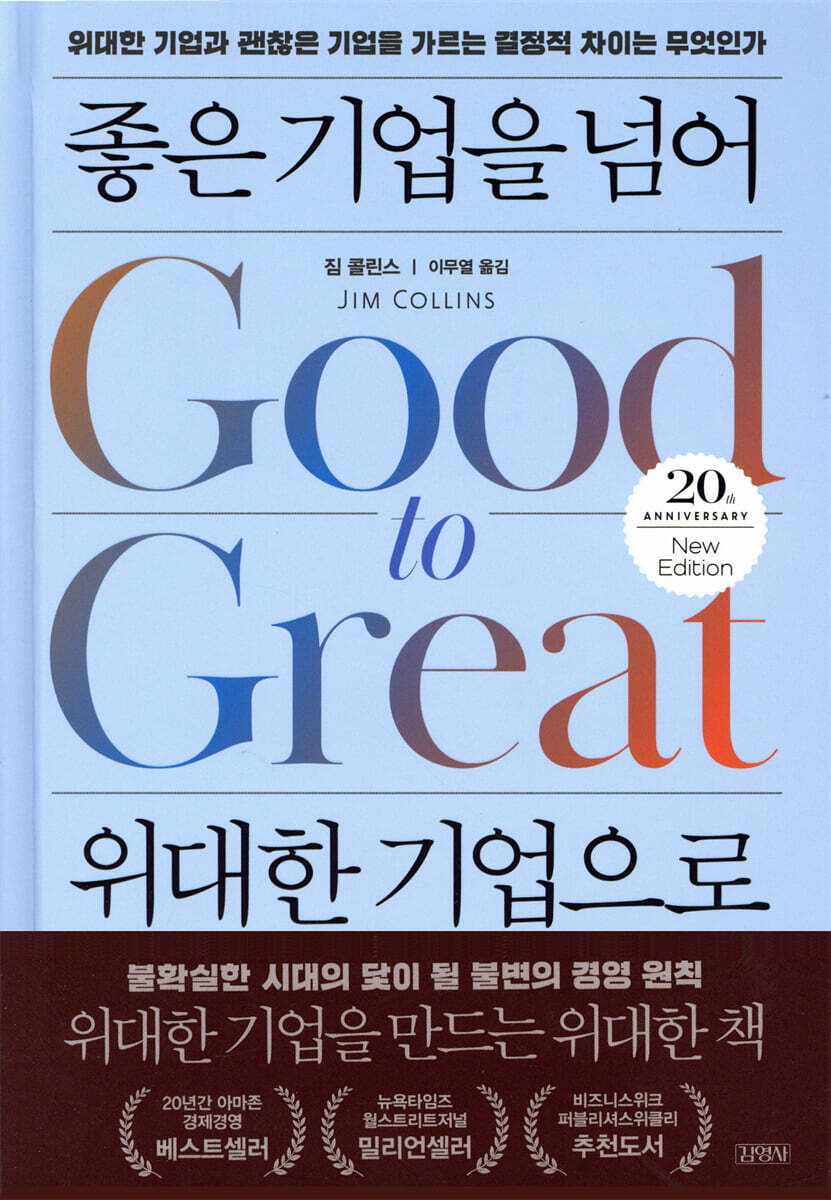
From Good to Great (20th Anniversary New Edition)
 |
Description
Book Introduction
What is the critical difference between a great company and a good one?
Jim Collins' masterpiece, a bestseller on Amazon's business and management for 20 years.
A new edition commemorating the 20th anniversary of publication
"From Good to Great" reveals the management principles of great companies that break stereotypes and preconceptions.
Through five years of extensive research, it has become a must-read for CEOs around the world and a "management bible."
The new edition, with its new cover, is published alongside Jim Collins's new book, Turning the Flywheel: How to Create Momentum from Good to Great.
You can experience a new perspective on the immortal management classic that remains unchanged even after 20 years.
Jim Collins' masterpiece, a bestseller on Amazon's business and management for 20 years.
A new edition commemorating the 20th anniversary of publication
"From Good to Great" reveals the management principles of great companies that break stereotypes and preconceptions.
Through five years of extensive research, it has become a must-read for CEOs around the world and a "management bible."
The new edition, with its new cover, is published alongside Jim Collins's new book, Turning the Flywheel: How to Create Momentum from Good to Great.
You can experience a new perspective on the immortal management classic that remains unchanged even after 20 years.
- You can preview some of the book's contents.
Preview
index
introduction
1 The good is the enemy of the great
Level 2 Leadership Level 5
3 people first… what to do next
4 Face the harsh facts, but don't lose faith.
5 Hedgehog Concepts (simple concepts extracted from three categories)
6 Culture of Discipline
7 Technology Accelerator Pedal
8 Flywheel and the Noose of Doom
9 From Leaping to Greatness to Defending the High Ground
Epilogue: Frequently Asked Questions
supplement
Acknowledgements
References
Search
1 The good is the enemy of the great
Level 2 Leadership Level 5
3 people first… what to do next
4 Face the harsh facts, but don't lose faith.
5 Hedgehog Concepts (simple concepts extracted from three categories)
6 Culture of Discipline
7 Technology Accelerator Pedal
8 Flywheel and the Noose of Doom
9 From Leaping to Greatness to Defending the High Ground
Epilogue: Frequently Asked Questions
supplement
Acknowledgements
References
Search
Detailed image

Into the book
Compared to the grandiose leaders with big personalities who make headlines and become celebrities, the leaders who take good companies from good to great seem like they came from Mars.
These leaders, reserved, quiet, cautious, and even shy, displayed a paradoxical blend of personal humility and professional will.
They were closer to Lincoln or Socrates than to General Patton or Caesar.
--- p.28
Every company has a culture, and some companies have discipline, but very few companies have a culture of discipline.
Disciplined people have no need for hierarchy.
If you think disciplinedly, you don't need bureaucracy.
Disciplined behavior eliminates the need for excessive control.
--- p.29
"is it so.
I really don't know where we should take this bus.
But I know this much.
“If we can get the right people on the bus, put the right people in the right seats, and get the wrong people off the bus, we’ll figure out how to take this bus somewhere great.”
--- p.77~78
Churchill was concerned that his exceptionally charismatic personality would distort bad news and convey it to him in a positive light.
So, early in the war, he created a completely independent department outside the formal chain of command called the 'Statistical Office'.
Its primary function was to continually update Churchill with the harshest realities, without any exaggeration.
(…) he wrote:
“I… didn’t need any dreams of being applauded.
“The truth is better than the dream.”
--- p.130
Are you a hedgehog or a fox? In his famous essay, "The Hedgehog and the Fox," Isaiah Berlin, drawing on an ancient Greek fable, divides the world into hedgehogs and foxes.
“The fox knows many things, but the hedgehog knows one big thing.”
(…) Hedgehogs are not stupid fools.
They had a keen insight that allowed them to cut through the complexity and discern underlying patterns.
A hedgehog sees the essential and ignores the rest.
--- p.159~161
People who have taken good companies to greatness have used "to-do" lists as much as "to-do" lists.
They were superbly disciplined and cleared out all sorts of irrelevant nonsense.
--- p.234
In fact, the real question isn't "Why should you be great?" but "What makes you want to be great?"
If you find yourself asking, "Why should we bother trying to make it great? Isn't this already successful enough?", you're probably doing the wrong thing.
These leaders, reserved, quiet, cautious, and even shy, displayed a paradoxical blend of personal humility and professional will.
They were closer to Lincoln or Socrates than to General Patton or Caesar.
--- p.28
Every company has a culture, and some companies have discipline, but very few companies have a culture of discipline.
Disciplined people have no need for hierarchy.
If you think disciplinedly, you don't need bureaucracy.
Disciplined behavior eliminates the need for excessive control.
--- p.29
"is it so.
I really don't know where we should take this bus.
But I know this much.
“If we can get the right people on the bus, put the right people in the right seats, and get the wrong people off the bus, we’ll figure out how to take this bus somewhere great.”
--- p.77~78
Churchill was concerned that his exceptionally charismatic personality would distort bad news and convey it to him in a positive light.
So, early in the war, he created a completely independent department outside the formal chain of command called the 'Statistical Office'.
Its primary function was to continually update Churchill with the harshest realities, without any exaggeration.
(…) he wrote:
“I… didn’t need any dreams of being applauded.
“The truth is better than the dream.”
--- p.130
Are you a hedgehog or a fox? In his famous essay, "The Hedgehog and the Fox," Isaiah Berlin, drawing on an ancient Greek fable, divides the world into hedgehogs and foxes.
“The fox knows many things, but the hedgehog knows one big thing.”
(…) Hedgehogs are not stupid fools.
They had a keen insight that allowed them to cut through the complexity and discern underlying patterns.
A hedgehog sees the essential and ignores the rest.
--- p.159~161
People who have taken good companies to greatness have used "to-do" lists as much as "to-do" lists.
They were superbly disciplined and cleared out all sorts of irrelevant nonsense.
--- p.234
In fact, the real question isn't "Why should you be great?" but "What makes you want to be great?"
If you find yourself asking, "Why should we bother trying to make it great? Isn't this already successful enough?", you're probably doing the wrong thing.
--- p.338
Publisher's Review
What is the critical difference between a great company and a good one?
Good to Great by Jim Collins, a world-renowned management guru
A new edition commemorating the 20th anniversary of publication
The management bible that elevated Jim Collins to the ranks of the world's most influential economists, Good to Great, celebrates its 20th anniversary and returns to readers in a new form.
"From Good to Great," a bestseller on Amazon's business and management page for 20 years, reveals the management principles of great companies that break stereotypes and preconceptions.
This new edition, published alongside Jim Collins's new book, Turning the Flywheel: How to Create Momentum from Good to Great, will offer existing readers a chance to revisit management principles that have endured for 20 years, while offering newcomers a chance to experience an immortal management classic anew.
Through 2,000 pages of interviews, 6,000 papers, and 380 million bytes of data,
Picked up from the ground without any preconceptions or assumptions
The Truth About Great Companies
There are many good companies, but not many great companies.
What is the secret to the success of great companies? Before Jim Collins, there was a lot of speculation on this question.
Collins and his team conducted a thorough five-year investigation to dissect facts people didn't know or had misunderstood.
“Great companies always have star CEOs who represent the company,” “Great companies succeed by expanding into various fields,” “Everything is built on a clear vision,” “They compete with the latest innovative technology”—these were nothing more than myths.
Collins' research findings, which are still fresh today, have become management principles that all companies seeking to become great companies should adhere to.
ㆍLevel 5 Leaders: Among the CEOs who led great companies, there were more who did not step forward.
ㆍGetting the right people on the bus: Great companies first gather the right people and then develop a strategy.
ㆍFacing the harsh reality: Companies that ignore reality and rely on unfounded optimism fail to become great companies.
ㆍHedgehog Concept: The consistency of a hedgehog that foolishly focuses on one thing creates a great company.
Disciplined behavior of disciplined people: Tight rules don't help businesses.
Great companies set firm standards and cultivate a culture of freedom and responsibility.
ㆍTechnology Accelerator: Great companies aren't obsessed with innovative technologies.
No matter how amazing the technology was, he first checked whether it fit his 'hedgehog concept'.
Unchanging management principles that will serve as an anchor in uncertain times.
A must-read for CEOs who dream of building great companies.
“Many of the findings from our five-year ‘Good to Great’ study are truly surprising and directly contradict the traditional teachings of business management we have held dear.
But there is one big conclusion that stands above all else.
“If we seriously apply the conceptual framework uncovered through this research, any organization can sufficiently grow in size and performance, and even become a great organization.”
The list of great companies may change, but the principles of great companies do not.
From Good to Great to Turning the Flywheel, Jim Collins imparts one important lesson:
Even ordinary people, not superhumans, can transform their organizations into great ones, regardless of size or industry, by simply following clear principles.
That's why countless CEOs have considered "Good to Great" a must-read, ever since Peter Drucker praised it as "a brilliant book based on meticulous research."
In these uncertain times, which companies will seize the future? The management principles in this book will serve as a solid anchor to steady struggling businesses and a magnifying glass to help identify the great companies of the future.
Good to Great by Jim Collins, a world-renowned management guru
A new edition commemorating the 20th anniversary of publication
The management bible that elevated Jim Collins to the ranks of the world's most influential economists, Good to Great, celebrates its 20th anniversary and returns to readers in a new form.
"From Good to Great," a bestseller on Amazon's business and management page for 20 years, reveals the management principles of great companies that break stereotypes and preconceptions.
This new edition, published alongside Jim Collins's new book, Turning the Flywheel: How to Create Momentum from Good to Great, will offer existing readers a chance to revisit management principles that have endured for 20 years, while offering newcomers a chance to experience an immortal management classic anew.
Through 2,000 pages of interviews, 6,000 papers, and 380 million bytes of data,
Picked up from the ground without any preconceptions or assumptions
The Truth About Great Companies
There are many good companies, but not many great companies.
What is the secret to the success of great companies? Before Jim Collins, there was a lot of speculation on this question.
Collins and his team conducted a thorough five-year investigation to dissect facts people didn't know or had misunderstood.
“Great companies always have star CEOs who represent the company,” “Great companies succeed by expanding into various fields,” “Everything is built on a clear vision,” “They compete with the latest innovative technology”—these were nothing more than myths.
Collins' research findings, which are still fresh today, have become management principles that all companies seeking to become great companies should adhere to.
ㆍLevel 5 Leaders: Among the CEOs who led great companies, there were more who did not step forward.
ㆍGetting the right people on the bus: Great companies first gather the right people and then develop a strategy.
ㆍFacing the harsh reality: Companies that ignore reality and rely on unfounded optimism fail to become great companies.
ㆍHedgehog Concept: The consistency of a hedgehog that foolishly focuses on one thing creates a great company.
Disciplined behavior of disciplined people: Tight rules don't help businesses.
Great companies set firm standards and cultivate a culture of freedom and responsibility.
ㆍTechnology Accelerator: Great companies aren't obsessed with innovative technologies.
No matter how amazing the technology was, he first checked whether it fit his 'hedgehog concept'.
Unchanging management principles that will serve as an anchor in uncertain times.
A must-read for CEOs who dream of building great companies.
“Many of the findings from our five-year ‘Good to Great’ study are truly surprising and directly contradict the traditional teachings of business management we have held dear.
But there is one big conclusion that stands above all else.
“If we seriously apply the conceptual framework uncovered through this research, any organization can sufficiently grow in size and performance, and even become a great organization.”
The list of great companies may change, but the principles of great companies do not.
From Good to Great to Turning the Flywheel, Jim Collins imparts one important lesson:
Even ordinary people, not superhumans, can transform their organizations into great ones, regardless of size or industry, by simply following clear principles.
That's why countless CEOs have considered "Good to Great" a must-read, ever since Peter Drucker praised it as "a brilliant book based on meticulous research."
In these uncertain times, which companies will seize the future? The management principles in this book will serve as a solid anchor to steady struggling businesses and a magnifying glass to help identify the great companies of the future.
GOODS SPECIFICS
- Publication date: March 22, 2021
- Format: Hardcover book binding method guide
- Page count, weight, size: 456 pages | 842g | 158*226*26mm
- ISBN13: 9788934989790
- ISBN10: 8934989793
You may also like
카테고리
korean


korean

![ELLE 엘르 스페셜 에디션 A형 : 12월 [2025]](http://librairie.coreenne.fr/cdn/shop/files/b8e27a3de6c9538896439686c6b0e8fb.jpg?v=1766436872&width=3840)


