

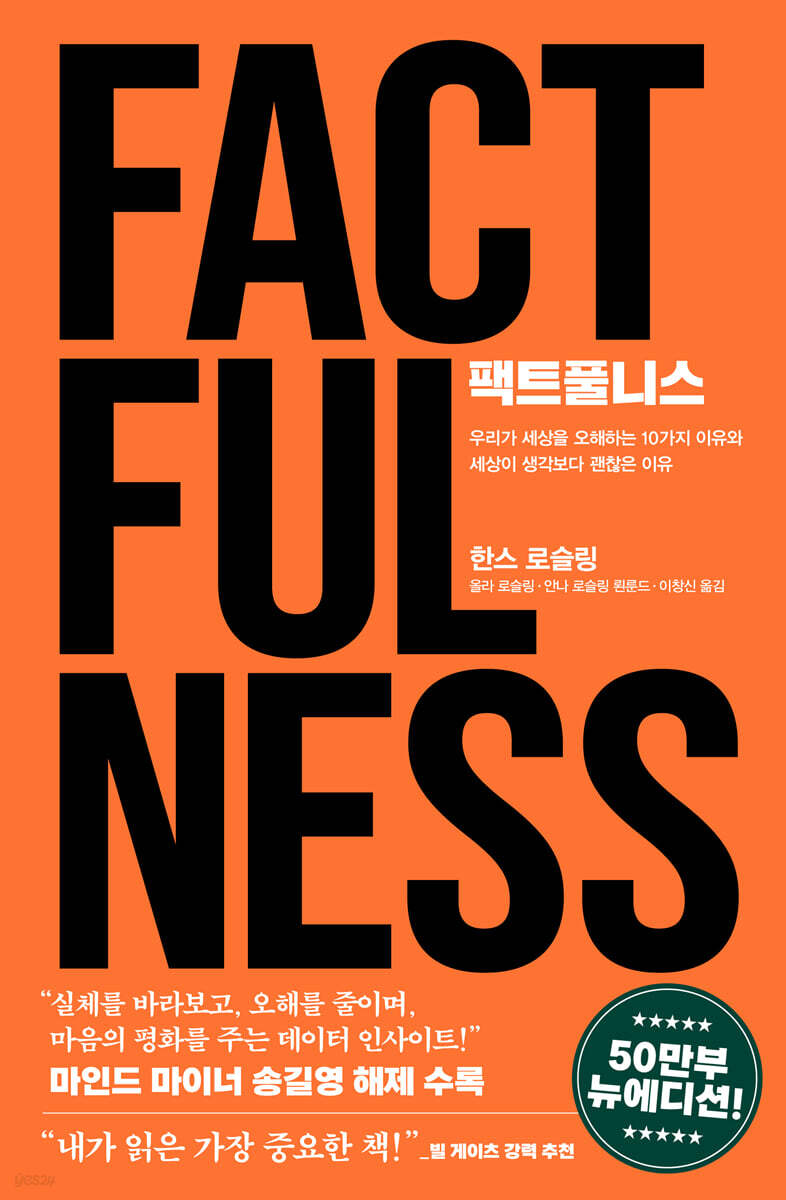
Factfulness
 |
Description
Book Introduction
The global bestseller that captivated the intellectual world! A new edition commemorating the 500,000th copy sale!
“Data insights that reveal reality, reduce misunderstandings, and provide peace of mind!”
_Mind Minor Song Gil-young's release included
★ Book of the Year by Chosun, Donga, and Hankyoreh! #1 Bestseller in Bookstores Across the Country
★ A hotly-talked-about book that Bill Gates gifted to every college graduate in the United States.
★ Over 5 million copies sold worldwide! Published in 50 countries, including the US, UK, Germany, and Japan!
★ Observer's Best Book of the Century! A New York Times and Amazon Bestseller
In a post-truth era where confirmation bias is rampant worldwide, this world-renowned masterpiece reminds us of the importance of facts overcoming vague fears and prejudices! In 13 questions designed to help us understand the world, humans average 16% accuracy, while chimpanzees achieve 33%.
Why can't we beat chimpanzees? The smarter and wiser we are, the less we truly understand the world! This book reveals ten irrational human instincts that lead us to interpret "feelings" as "facts," and offers astonishing insights that, contrary to our misconceptions, the world is constantly progressing.
A must-read to change the way you see the world and prepare for future crises and opportunities.
“Data insights that reveal reality, reduce misunderstandings, and provide peace of mind!”
_Mind Minor Song Gil-young's release included
★ Book of the Year by Chosun, Donga, and Hankyoreh! #1 Bestseller in Bookstores Across the Country
★ A hotly-talked-about book that Bill Gates gifted to every college graduate in the United States.
★ Over 5 million copies sold worldwide! Published in 50 countries, including the US, UK, Germany, and Japan!
★ Observer's Best Book of the Century! A New York Times and Amazon Bestseller
In a post-truth era where confirmation bias is rampant worldwide, this world-renowned masterpiece reminds us of the importance of facts overcoming vague fears and prejudices! In 13 questions designed to help us understand the world, humans average 16% accuracy, while chimpanzees achieve 33%.
Why can't we beat chimpanzees? The smarter and wiser we are, the less we truly understand the world! This book reveals ten irrational human instincts that lead us to interpret "feelings" as "facts," and offers astonishing insights that, contrary to our misconceptions, the world is constantly progressing.
A must-read to change the way you see the world and prepare for future crises and opportunities.
- You can preview some of the book's contents.
Preview
index
clear
Author's Note
preface
Chapter 1: The Gap Instinct
This is how it started
The huge misconception that 'the world is divided in two'
The first giant misunderstanding tracker
What's wrong with the pictures people have in their heads?
Catch the beast
Help! Many of them are gone.
So what should we call "them"? A four-step nomenclature.
Gap instinct
How to suppress the gap instinct?
Factual accuracy
Chapter 2: The Negative Instinct
Get out of the sewer
The huge misconception that 'the world is getting worse'
Statistics as Healing
Negative instinct
How to suppress the negative instinct?
I want to thank society
Factual accuracy
Chapter 3: The Straight Line Instinct
The creepiest graph I've ever seen
The huge misconception that the world population is 'only' growing and growing
straight line instinct
Population curve shape
Wait, 'they' still have a lot of children
Why would the population decline if there are many survivors?
How to suppress your straight-line instinct? Not all lines are straight.
Which part of a curve do you see?
Factual accuracy
Chapter 4: The Fear Instinct
Blood pooling on the floor
Attention filter
fear instinct
Natural Disasters: In These Times
40 million invisible planes
War and conflict
pollution
terrorism
Fear vs. Risk: Being Fearful of What's Actually Dangerous
Factual accuracy
Chapter 5 Size Instinct
Death invisible to my eyes
Size instinct
How to suppress the size instinct?
80/20 rule
Divide the numbers
Compare and share
Factual accuracy
Chapter 6: The Generalization Instinct
Dinner is ready
generalization instinct
The harsh reality
How to suppress the instinct to generalize?
Factual accuracy
Chapter 7: The Instinct of Fate
Passing through the eye of a needle
fate instinct
How do rocks move?
How to suppress the instinct of fate?
I have no vision
Factual accuracy
Chapter 8: The Single-Point Instinct
Who can you trust?
Single-perspective instinct
Professionals: Experts and Activists
ideology
Factual accuracy
Chapter 9: The Blame Instinct
You want to beat up grandma?
instinct to blame
blame game
A more likely suspect
Who is to blame?
Factual accuracy
Chapter 10: The Urgency Instinct
Roadblocks and mental barriers
Urgency instinct
Learn to suppress your sense of urgency.
Special price today!
Five global risks we should 'really' worry about
Factual accuracy
Chapter 11: Practicing Factual Fidelity
How did truthfulness save my life?
Practicing factual fidelity
Final request
Rules of thumb based on facts
Conclusion
Acknowledgements
Appendix_ How many points does my country have?
References
source
Author's Note
preface
Chapter 1: The Gap Instinct
This is how it started
The huge misconception that 'the world is divided in two'
The first giant misunderstanding tracker
What's wrong with the pictures people have in their heads?
Catch the beast
Help! Many of them are gone.
So what should we call "them"? A four-step nomenclature.
Gap instinct
How to suppress the gap instinct?
Factual accuracy
Chapter 2: The Negative Instinct
Get out of the sewer
The huge misconception that 'the world is getting worse'
Statistics as Healing
Negative instinct
How to suppress the negative instinct?
I want to thank society
Factual accuracy
Chapter 3: The Straight Line Instinct
The creepiest graph I've ever seen
The huge misconception that the world population is 'only' growing and growing
straight line instinct
Population curve shape
Wait, 'they' still have a lot of children
Why would the population decline if there are many survivors?
How to suppress your straight-line instinct? Not all lines are straight.
Which part of a curve do you see?
Factual accuracy
Chapter 4: The Fear Instinct
Blood pooling on the floor
Attention filter
fear instinct
Natural Disasters: In These Times
40 million invisible planes
War and conflict
pollution
terrorism
Fear vs. Risk: Being Fearful of What's Actually Dangerous
Factual accuracy
Chapter 5 Size Instinct
Death invisible to my eyes
Size instinct
How to suppress the size instinct?
80/20 rule
Divide the numbers
Compare and share
Factual accuracy
Chapter 6: The Generalization Instinct
Dinner is ready
generalization instinct
The harsh reality
How to suppress the instinct to generalize?
Factual accuracy
Chapter 7: The Instinct of Fate
Passing through the eye of a needle
fate instinct
How do rocks move?
How to suppress the instinct of fate?
I have no vision
Factual accuracy
Chapter 8: The Single-Point Instinct
Who can you trust?
Single-perspective instinct
Professionals: Experts and Activists
ideology
Factual accuracy
Chapter 9: The Blame Instinct
You want to beat up grandma?
instinct to blame
blame game
A more likely suspect
Who is to blame?
Factual accuracy
Chapter 10: The Urgency Instinct
Roadblocks and mental barriers
Urgency instinct
Learn to suppress your sense of urgency.
Special price today!
Five global risks we should 'really' worry about
Factual accuracy
Chapter 11: Practicing Factual Fidelity
How did truthfulness save my life?
Practicing factual fidelity
Final request
Rules of thumb based on facts
Conclusion
Acknowledgements
Appendix_ How many points does my country have?
References
source
Detailed image

Into the book
We surveyed approximately 12,000 people in 14 countries in 2017.
As a result, out of the twelve questions excluding the last 13, the average number of correct answers was two.
There was not a single person who got perfect scores, and a whopping 15% got zero marks.
Do you think it would be any better if you were educated or interested in the subject? I certainly thought so at first, but it turns out that wasn't the case.
I have experimented with people from all walks of life around the world.
There were medical students, teachers, university lecturers, prominent scientists, investment bankers, multinational executives, journalists, activists, and even high-ranking political decision-makers.
They are all highly educated and interested in the world.
But the 'absolute majority' of these also gave incorrect answers.
Some of them scored lower than the general public, and the results were particularly dismal among Nobel laureates and medical researchers.
In short, it wasn't a question of having or not having knowledge.
Everyone was seriously misunderstanding the world.
This misunderstanding was not only serious but also 'systematic'.
--- p.30~31
The data in this book is heart-healing data that readers have never seen before.
It could also be said to be data that provides mental peace.
Because the world is not as dramatic as it seems.
'Factual integrity' can and should become a daily routine, like a healthy diet or regular exercise.
Just practice it.
Then, we can replace the overly dramatic worldview with a worldview based on facts.
And you can understand the world correctly without memorizing it.
You can also make better decisions, be aware of real risks and possibilities, and not get stressed by misinformation.
In the future, I will teach you how to distinguish overly dramatic stories and provide thinking tools to curb your dramatic instincts.
If readers can use this to dispel misconceptions and develop a fact-based worldview, they will be able to beat the chimpanzee every time.
--- p.41
The media doesn't waste time on stories that won't pass our attention filter.
Let's look at just two article titles that didn't get the editor's approval because they didn't seem like they would pass the attention filter.
“Malaria continues to decline.” “The Met Office’s prediction of mild weather in London today proved correct.” On the other hand, let’s list topics that easily pass our filters.
Earthquakes, wars, refugees, diseases, fires, floods, shark attacks, terrorism.
Such rare events are more newsworthy than everyday occurrences.
And the rare stories we see consistently in the media paint a big picture in our minds.
So, if you're not very careful, you can easily believe that rare events are common, that that's how the world works.
--- p.159
Two aspects of the size instinct, along with the negativity instinct, lead us to systematically underestimate the progress of the world.
When asked about the percentage of the world's population that meets their basic needs, most people consistently give the answer of around 20%.
But the correct answer is closer to 80%, or even 90%.
The percentage of children receiving vaccinations is 88%, and the percentage of children receiving electricity is 85%.
The percentage of girls who graduated from elementary school is 90%.
But because charities and the media constantly show sensational numbers alongside images of suffering individuals, people perceive the world through a distorted lens, systematically underestimating all other proportions and developments.
--- p.193
I sometimes cringe when people systematically blame China and India for climate change based on their "total" emissions by country.
That's like claiming that obesity is more serious in China than in the United States because the combined weight of China's entire population is greater than that of the United States.
The argument that total emissions per country are an issue is absurd, given that populations vary greatly across countries.
By this logic, Norway, with a population of 5 million, could emit as much carbon dioxide per capita as it wanted without any problems.
In such cases, dividing a large figure, such as total national emissions, by the country's population is necessary to obtain meaningful and comparable figures. When measuring HIV, gross domestic product (GDP), mobile phone sales, internet users, or carbon dioxide emissions, calculating per capita figures is always more meaningful.
--- p.209
The fate instinct is the idea that innate traits determine the fate of people, nations, religions, and cultures.
So, we believe that something is in its current state because it cannot be avoided or escaped, and that it has always existed in that state and will never change in the future.
(…) The most common example of the fatalistic instinct manifesting itself is the idea, as the gentleman who attended the Edinburgh lecture said, that Africa is always helpless and will never catch up with Europe.
Another is the idea that Islamic society is fundamentally different from Christian society.
The idea that this or that religion, this continent, that culture, that country has traditional, immutable 'values' that will never change (or should not change) is all the same in essence, although it may differ only in appearance.
At first glance, this analysis seems plausible, but a closer look reveals that our instincts often deceive us.
It may sound noble, but it feels like it's just disguised as truth.
--- p.249~250
I do not deny that there are pressing global dangers that we must address.
I am not an optimist who sees the world in rosy colors.
Taking your eyes off the problem doesn't give you peace of mind.
My five biggest concerns are a global pandemic, a financial crisis, World War III, climate change, and extreme poverty.
Why are these issues so concerning? Because they're so likely to happen.
The first three happened in the past, and the last two are happening now.
And all five will directly or indirectly cause countless people to suffer and halt human progress for years or even decades.
If we don't stop this problem, nothing else will work.
These five are huge killers, so if possible, we must all work together and solve the problem step by step.
As a result, out of the twelve questions excluding the last 13, the average number of correct answers was two.
There was not a single person who got perfect scores, and a whopping 15% got zero marks.
Do you think it would be any better if you were educated or interested in the subject? I certainly thought so at first, but it turns out that wasn't the case.
I have experimented with people from all walks of life around the world.
There were medical students, teachers, university lecturers, prominent scientists, investment bankers, multinational executives, journalists, activists, and even high-ranking political decision-makers.
They are all highly educated and interested in the world.
But the 'absolute majority' of these also gave incorrect answers.
Some of them scored lower than the general public, and the results were particularly dismal among Nobel laureates and medical researchers.
In short, it wasn't a question of having or not having knowledge.
Everyone was seriously misunderstanding the world.
This misunderstanding was not only serious but also 'systematic'.
--- p.30~31
The data in this book is heart-healing data that readers have never seen before.
It could also be said to be data that provides mental peace.
Because the world is not as dramatic as it seems.
'Factual integrity' can and should become a daily routine, like a healthy diet or regular exercise.
Just practice it.
Then, we can replace the overly dramatic worldview with a worldview based on facts.
And you can understand the world correctly without memorizing it.
You can also make better decisions, be aware of real risks and possibilities, and not get stressed by misinformation.
In the future, I will teach you how to distinguish overly dramatic stories and provide thinking tools to curb your dramatic instincts.
If readers can use this to dispel misconceptions and develop a fact-based worldview, they will be able to beat the chimpanzee every time.
--- p.41
The media doesn't waste time on stories that won't pass our attention filter.
Let's look at just two article titles that didn't get the editor's approval because they didn't seem like they would pass the attention filter.
“Malaria continues to decline.” “The Met Office’s prediction of mild weather in London today proved correct.” On the other hand, let’s list topics that easily pass our filters.
Earthquakes, wars, refugees, diseases, fires, floods, shark attacks, terrorism.
Such rare events are more newsworthy than everyday occurrences.
And the rare stories we see consistently in the media paint a big picture in our minds.
So, if you're not very careful, you can easily believe that rare events are common, that that's how the world works.
--- p.159
Two aspects of the size instinct, along with the negativity instinct, lead us to systematically underestimate the progress of the world.
When asked about the percentage of the world's population that meets their basic needs, most people consistently give the answer of around 20%.
But the correct answer is closer to 80%, or even 90%.
The percentage of children receiving vaccinations is 88%, and the percentage of children receiving electricity is 85%.
The percentage of girls who graduated from elementary school is 90%.
But because charities and the media constantly show sensational numbers alongside images of suffering individuals, people perceive the world through a distorted lens, systematically underestimating all other proportions and developments.
--- p.193
I sometimes cringe when people systematically blame China and India for climate change based on their "total" emissions by country.
That's like claiming that obesity is more serious in China than in the United States because the combined weight of China's entire population is greater than that of the United States.
The argument that total emissions per country are an issue is absurd, given that populations vary greatly across countries.
By this logic, Norway, with a population of 5 million, could emit as much carbon dioxide per capita as it wanted without any problems.
In such cases, dividing a large figure, such as total national emissions, by the country's population is necessary to obtain meaningful and comparable figures. When measuring HIV, gross domestic product (GDP), mobile phone sales, internet users, or carbon dioxide emissions, calculating per capita figures is always more meaningful.
--- p.209
The fate instinct is the idea that innate traits determine the fate of people, nations, religions, and cultures.
So, we believe that something is in its current state because it cannot be avoided or escaped, and that it has always existed in that state and will never change in the future.
(…) The most common example of the fatalistic instinct manifesting itself is the idea, as the gentleman who attended the Edinburgh lecture said, that Africa is always helpless and will never catch up with Europe.
Another is the idea that Islamic society is fundamentally different from Christian society.
The idea that this or that religion, this continent, that culture, that country has traditional, immutable 'values' that will never change (or should not change) is all the same in essence, although it may differ only in appearance.
At first glance, this analysis seems plausible, but a closer look reveals that our instincts often deceive us.
It may sound noble, but it feels like it's just disguised as truth.
--- p.249~250
I do not deny that there are pressing global dangers that we must address.
I am not an optimist who sees the world in rosy colors.
Taking your eyes off the problem doesn't give you peace of mind.
My five biggest concerns are a global pandemic, a financial crisis, World War III, climate change, and extreme poverty.
Why are these issues so concerning? Because they're so likely to happen.
The first three happened in the past, and the last two are happening now.
And all five will directly or indirectly cause countless people to suffer and halt human progress for years or even decades.
If we don't stop this problem, nothing else will work.
These five are huge killers, so if possible, we must all work together and solve the problem step by step.
--- p.348
Publisher's Review
Humanity can progress when we overcome prejudice and uncover the truth.
Pay attention to the 'facts' that overcome vague fears!
“The most important book I’ve ever read!” _Bill Gates
Articles about Bill Gates and a book were published simultaneously in Korean and international media.
Since 2010, Bill Gates has been recommending books for college students every May or June, but this time, he went beyond just recommending books and personally purchased and gifted books to graduates from every university and graduate school in the United States.
The reason for the recommendation was that it was “the most important book I have ever read and a useful guide to clearly understanding the world.”
The book is Factfulness by world-renowned scholar Hans Rosling.
'Factfulness' means 'factual fidelity' and refers to the attitude and perspective of looking at and understanding the world based on facts.
The book captivated the world's intellectual community and became a hot topic as soon as it was published.
Former President Barack Obama recommended it as one of his five must-read books.
Steven Pinker, a professor of psychology at Harvard University, praised the book, saying that it rationally explains how our cognitive processes can lead us astray through abundant data, and that just reading it will completely change our worldview.
Additionally, the Observer selected it as the best book of the century, and it was a bestseller in major media outlets such as the New York Times, the Wall Street Journal, the Guardian, and the Sunday Times, selling over one million copies in just six months after its publication.
In the post-truth era, where confirmation bias is on the rise worldwide, Factfulness is a masterpiece that reminds us of the importance of facts overcoming vague fears and prejudices.
It offers insights that bridge the gap between the world we think we know and the real world, and break down preconceptions, in areas such as poverty, education, environment, energy, and population.
Contrary to our prejudices, the world is progressing day by day, proving this point in detail with clear data and statistics faithful to the facts.
The reason Bill Gates gave this book to young people entering society is probably to instill a positive perspective that "the world is getting better," while also advising them to reflect on whether their beliefs are in line with the truth.
If you're interested in living righteously rather than remaining stuck in a well, if you're willing to change your worldview, if you're ready to think critically instead of reacting instinctively, then this book is a must-read.
It will also serve as an important milestone in the direction that Korean society will move forward.
“Why do humans understand the world less clearly than chimpanzees?”
Introducing "Factfulness," a powerful tool to combat the world's ignorance and prejudice.
Author Hans Rosling has a unique academic background as a physician, public health expert, and statistician.
This has become the basis for an objective statistical look at the situation faced by people all over the world.
He discovers one important fact in his research.
It's just that people don't know much about the world.
More seriously, there was a systematic misunderstanding of the reality of the world.
Dr. Rosling created the '13 Problems to Understand the World' to test people's knowledge of the world and had them solve them.
As a result, the average correct answer rate was only 16%.
This is much lower than the 33% rate when chimpanzees randomly select the correct answer.
What's even more surprising is that the smarter and wiser a person is, the less he or she knows the truth. (p. 31)
Why is that? It's because of the ten irrational human instincts (the gap instinct, the denial instinct, the straight-line instinct, the fear instinct, the size instinct, the generalization instinct, the fate instinct, the single-perspective instinct, the blame instinct, and the urgency instinct) that perceive "feelings" as "facts."
When people think, guess, and learn about the world, they constantly and intuitively refer to their own worldview, and if an irrational instinct causes an error in that worldview, they are bound to give structurally incorrect answers.
Hans Rosling identified the confusion between facts and claims as a source of social conflict and stress.
The world is not as dramatic as it seems.
Mastering 'factfulness' allows us to replace an overly dramatic worldview with one based on facts.
You can make better decisions, be aware of real risks and possibilities, and not be stressed by misinformation.
Furthermore, you can clear up misunderstandings, become more positive, and embrace new hope.
And finally, we will be able to beat the chimpanzee.
(Dr. Hans Rosling, who dedicated his life to changing humanity's misconceptions, passed away from pancreatic cancer on February 7, 2017, shortly after finishing writing this book.
Factfulness became the culmination of his lifelong research and his last work.)
Based on strong facts, without exaggerating the incident or distorting the perspective.
A revolutionary work that contains an accurate way to see the world!
This book covers a wide range of topics, from the proportion of people living in extreme poverty to the number of years of education for women, life expectancy, global population trends, deaths from natural disasters, childhood vaccination rates, and changes in average temperatures, to understand the true picture of the world.
We present the latest statistical data and introduce the correct viewpoint on it.
Furthermore, it goes beyond emphasizing the importance of accurate information about the world, and systematically reveals the realities we all face, such as the public's tendency to be swayed by the media and the negative psychology that exacerbates crises, as well as solutions to these realities.
Most of the world's population lives in middle-income countries.
Humans have an instinct to pursue dichotomous thinking.
For example, it is a method of dividing the countries of the world into only two groups, such as developed vs. developing countries, Western vs. other, low-income vs. high-income, Northern vs. Southern, etc.
When asked, “What percentage of the world’s population lives in low-income countries?” the majority answered that more than 50%.
But the correct answer is 9%.
Only 9% of the world's population lives in low-income countries.
The majority of the world's population lives in middle-income countries, neither low-income nor high-income.
Middle-income countries are a category that does not exist in the world-dividing mindset, but in reality, they do exist.
75% of humanity lives there.
In this book, Dr. Rosling presents a four-stage classification of countries.
If you earn about $2 a day, you are at level 1, $2 to $8 is level 2, $8 to $32 is level 3, and $32 or more is level 4.
Reality is not as polar opposite as we think.
Where people think there is a gap, in fact, there is a majority of the population.
To suppress the gap instinct, you have to look at the majority.
The news mostly reports dramatic and negative news.
Humans generally pay attention to dramatic situations.
As a result, we pay more attention to and react more sensitively to events that occur infrequently, such as war, natural disasters, corruption, pandemics, mass layoffs, and terrorism, than to everyday events.
In 2015, the world watched the situation in Nepal for about ten days as 9,000 people died.
Meanwhile, during the same period, 9,000 children around the world died from diarrhea caused by drinking contaminated water.
But the camera doesn't show these children unconscious in the arms of their crying parents.
In the first few months of 2009, thousands of people died from the new flu.
The media covered the news extensively for weeks, stoking fear.
However, during the same period, 63,066 people died from tuberculosis.
We are much more likely to die from tuberculosis than from the new flu, but we don't really know this.
We must be aware that the news tends to focus on the negative and dramatic aspects.
Bad news is much more likely to reach us.
So it's easy to have an overly negative impression of the world around you.
You should know that the news always reports only dramatic events.
When an incident occurs, comparing and dividing the facts becomes clear.
People tend to distort proportions and inflate them beyond reality.
Big numbers always look big, and it's easy to misjudge when there's only one number.
This leads us to systematically underestimate the progress of the world.
In 2016, there were 141 million newborns and 4.2 million deaths.
It is so tragic that 4.2 million children die every year.
The mortality rate is 3%, meaning that 3 out of 100 children die before their first birthday.
But let's take a closer look at the statistics. In 1950, there were 97 million newborns and 14.4 million deaths.
At this time, the child mortality rate was 15%.
This means that 15 out of 100 newborns die before their first birthday.
The infant mortality rate dropped from 15% to 3%! The 4.2 million figure alone seems enormous, but when you compare the percentages, the recent figures suddenly appear surprisingly low.
We must realize that when we have any number, big or small, it may seem impressive, but it is only one.
And remember that when you compare that number with another related number or divide it by another number, you may get the opposite impression.
To curb your size instinct, consider proportions.
The world is slowly but surely getting better.
Hans Rosling asked 30 countries, “Do you think the world is getting better, worse, or the same?” and every country answered, “It’s getting worse.”
In particular, Korea had the third highest number of negative responses, following Türkiye, Belgium, and Mexico.
More than 80% of our country's population is pessimistic about the future of the world.
“Things are getting worse” is the phrase we hear most often.
Terrorism and civil war are on the rise, and overfishing and ocean pollution are also worrisome.
Ice will melt and sea levels will continue to rise.
So, is the world really only going to get worse? Statistically, however, looking at the world as a whole, ozone-depleting substances have decreased by a factor of 100 since the 1970s, and disaster death rates have decreased by a factor of 10.
The global illiteracy rate is only 10%, and about 90% of female students have completed primary school.
90% of people have access to safe water and 90% of children are vaccinated, 85% have access to electricity and 65% have mobile phones.
We must recognize that many things, including people, nations, religions, and cultures, can always appear the same because they change slowly.
Remember that even small, slow changes can add up to big changes.
The center of gravity of the global market is shifting to Asia.
The United Nations projects that by the end of the 21st century, the populations of the Americas and Europe will remain virtually unchanged, while Africa will grow by 3 billion and Asia by 1 billion.
It is said that by 2100, more than 80% of the world's population will live in Africa and Asia.
Today, 11% of the world's population, living in wealthy countries around the North Atlantic, account for 60% of the fourth-tier consumer market.
But if incomes continue to rise steadily around the world, as they are now, that proportion will fall to 50% by 2027.
And by 2040, 60% of Stage 4 consumers will live outside the West.
Yes, that's right.
This means that the West's dominance of the world economy will soon end.
We must recognize that a significant portion of the world's population lives in Asia.
In terms of economic influence, Westerners are becoming 20%, not 80%.
The center of gravity of the global market is shifting from the Atlantic to the Indian Ocean.
If we miss Asia and Africa, we will easily miss out on the people and large markets that will dominate trade in the future.
To change the way we view the world and prepare for future crises and opportunities, we must confirm clear facts, not just our own knowledge and perspective.
Spend just three minutes with Hans Rosling and your world view will change completely.
_〈Nature〉
Bestsellers on statistics are as rare as unicorns.
Reaching number one is as rare as a unicorn on the moon.
Hans Rosling's downside is that he is a lunar-based creature.
It's attractive.
_<times>
Pay attention to the 'facts' that overcome vague fears!
“The most important book I’ve ever read!” _Bill Gates
Articles about Bill Gates and a book were published simultaneously in Korean and international media.
Since 2010, Bill Gates has been recommending books for college students every May or June, but this time, he went beyond just recommending books and personally purchased and gifted books to graduates from every university and graduate school in the United States.
The reason for the recommendation was that it was “the most important book I have ever read and a useful guide to clearly understanding the world.”
The book is Factfulness by world-renowned scholar Hans Rosling.
'Factfulness' means 'factual fidelity' and refers to the attitude and perspective of looking at and understanding the world based on facts.
The book captivated the world's intellectual community and became a hot topic as soon as it was published.
Former President Barack Obama recommended it as one of his five must-read books.
Steven Pinker, a professor of psychology at Harvard University, praised the book, saying that it rationally explains how our cognitive processes can lead us astray through abundant data, and that just reading it will completely change our worldview.
Additionally, the Observer selected it as the best book of the century, and it was a bestseller in major media outlets such as the New York Times, the Wall Street Journal, the Guardian, and the Sunday Times, selling over one million copies in just six months after its publication.
In the post-truth era, where confirmation bias is on the rise worldwide, Factfulness is a masterpiece that reminds us of the importance of facts overcoming vague fears and prejudices.
It offers insights that bridge the gap between the world we think we know and the real world, and break down preconceptions, in areas such as poverty, education, environment, energy, and population.
Contrary to our prejudices, the world is progressing day by day, proving this point in detail with clear data and statistics faithful to the facts.
The reason Bill Gates gave this book to young people entering society is probably to instill a positive perspective that "the world is getting better," while also advising them to reflect on whether their beliefs are in line with the truth.
If you're interested in living righteously rather than remaining stuck in a well, if you're willing to change your worldview, if you're ready to think critically instead of reacting instinctively, then this book is a must-read.
It will also serve as an important milestone in the direction that Korean society will move forward.
“Why do humans understand the world less clearly than chimpanzees?”
Introducing "Factfulness," a powerful tool to combat the world's ignorance and prejudice.
Author Hans Rosling has a unique academic background as a physician, public health expert, and statistician.
This has become the basis for an objective statistical look at the situation faced by people all over the world.
He discovers one important fact in his research.
It's just that people don't know much about the world.
More seriously, there was a systematic misunderstanding of the reality of the world.
Dr. Rosling created the '13 Problems to Understand the World' to test people's knowledge of the world and had them solve them.
As a result, the average correct answer rate was only 16%.
This is much lower than the 33% rate when chimpanzees randomly select the correct answer.
What's even more surprising is that the smarter and wiser a person is, the less he or she knows the truth. (p. 31)
Why is that? It's because of the ten irrational human instincts (the gap instinct, the denial instinct, the straight-line instinct, the fear instinct, the size instinct, the generalization instinct, the fate instinct, the single-perspective instinct, the blame instinct, and the urgency instinct) that perceive "feelings" as "facts."
When people think, guess, and learn about the world, they constantly and intuitively refer to their own worldview, and if an irrational instinct causes an error in that worldview, they are bound to give structurally incorrect answers.
Hans Rosling identified the confusion between facts and claims as a source of social conflict and stress.
The world is not as dramatic as it seems.
Mastering 'factfulness' allows us to replace an overly dramatic worldview with one based on facts.
You can make better decisions, be aware of real risks and possibilities, and not be stressed by misinformation.
Furthermore, you can clear up misunderstandings, become more positive, and embrace new hope.
And finally, we will be able to beat the chimpanzee.
(Dr. Hans Rosling, who dedicated his life to changing humanity's misconceptions, passed away from pancreatic cancer on February 7, 2017, shortly after finishing writing this book.
Factfulness became the culmination of his lifelong research and his last work.)
Based on strong facts, without exaggerating the incident or distorting the perspective.
A revolutionary work that contains an accurate way to see the world!
This book covers a wide range of topics, from the proportion of people living in extreme poverty to the number of years of education for women, life expectancy, global population trends, deaths from natural disasters, childhood vaccination rates, and changes in average temperatures, to understand the true picture of the world.
We present the latest statistical data and introduce the correct viewpoint on it.
Furthermore, it goes beyond emphasizing the importance of accurate information about the world, and systematically reveals the realities we all face, such as the public's tendency to be swayed by the media and the negative psychology that exacerbates crises, as well as solutions to these realities.
Most of the world's population lives in middle-income countries.
Humans have an instinct to pursue dichotomous thinking.
For example, it is a method of dividing the countries of the world into only two groups, such as developed vs. developing countries, Western vs. other, low-income vs. high-income, Northern vs. Southern, etc.
When asked, “What percentage of the world’s population lives in low-income countries?” the majority answered that more than 50%.
But the correct answer is 9%.
Only 9% of the world's population lives in low-income countries.
The majority of the world's population lives in middle-income countries, neither low-income nor high-income.
Middle-income countries are a category that does not exist in the world-dividing mindset, but in reality, they do exist.
75% of humanity lives there.
In this book, Dr. Rosling presents a four-stage classification of countries.
If you earn about $2 a day, you are at level 1, $2 to $8 is level 2, $8 to $32 is level 3, and $32 or more is level 4.
Reality is not as polar opposite as we think.
Where people think there is a gap, in fact, there is a majority of the population.
To suppress the gap instinct, you have to look at the majority.
The news mostly reports dramatic and negative news.
Humans generally pay attention to dramatic situations.
As a result, we pay more attention to and react more sensitively to events that occur infrequently, such as war, natural disasters, corruption, pandemics, mass layoffs, and terrorism, than to everyday events.
In 2015, the world watched the situation in Nepal for about ten days as 9,000 people died.
Meanwhile, during the same period, 9,000 children around the world died from diarrhea caused by drinking contaminated water.
But the camera doesn't show these children unconscious in the arms of their crying parents.
In the first few months of 2009, thousands of people died from the new flu.
The media covered the news extensively for weeks, stoking fear.
However, during the same period, 63,066 people died from tuberculosis.
We are much more likely to die from tuberculosis than from the new flu, but we don't really know this.
We must be aware that the news tends to focus on the negative and dramatic aspects.
Bad news is much more likely to reach us.
So it's easy to have an overly negative impression of the world around you.
You should know that the news always reports only dramatic events.
When an incident occurs, comparing and dividing the facts becomes clear.
People tend to distort proportions and inflate them beyond reality.
Big numbers always look big, and it's easy to misjudge when there's only one number.
This leads us to systematically underestimate the progress of the world.
In 2016, there were 141 million newborns and 4.2 million deaths.
It is so tragic that 4.2 million children die every year.
The mortality rate is 3%, meaning that 3 out of 100 children die before their first birthday.
But let's take a closer look at the statistics. In 1950, there were 97 million newborns and 14.4 million deaths.
At this time, the child mortality rate was 15%.
This means that 15 out of 100 newborns die before their first birthday.
The infant mortality rate dropped from 15% to 3%! The 4.2 million figure alone seems enormous, but when you compare the percentages, the recent figures suddenly appear surprisingly low.
We must realize that when we have any number, big or small, it may seem impressive, but it is only one.
And remember that when you compare that number with another related number or divide it by another number, you may get the opposite impression.
To curb your size instinct, consider proportions.
The world is slowly but surely getting better.
Hans Rosling asked 30 countries, “Do you think the world is getting better, worse, or the same?” and every country answered, “It’s getting worse.”
In particular, Korea had the third highest number of negative responses, following Türkiye, Belgium, and Mexico.
More than 80% of our country's population is pessimistic about the future of the world.
“Things are getting worse” is the phrase we hear most often.
Terrorism and civil war are on the rise, and overfishing and ocean pollution are also worrisome.
Ice will melt and sea levels will continue to rise.
So, is the world really only going to get worse? Statistically, however, looking at the world as a whole, ozone-depleting substances have decreased by a factor of 100 since the 1970s, and disaster death rates have decreased by a factor of 10.
The global illiteracy rate is only 10%, and about 90% of female students have completed primary school.
90% of people have access to safe water and 90% of children are vaccinated, 85% have access to electricity and 65% have mobile phones.
We must recognize that many things, including people, nations, religions, and cultures, can always appear the same because they change slowly.
Remember that even small, slow changes can add up to big changes.
The center of gravity of the global market is shifting to Asia.
The United Nations projects that by the end of the 21st century, the populations of the Americas and Europe will remain virtually unchanged, while Africa will grow by 3 billion and Asia by 1 billion.
It is said that by 2100, more than 80% of the world's population will live in Africa and Asia.
Today, 11% of the world's population, living in wealthy countries around the North Atlantic, account for 60% of the fourth-tier consumer market.
But if incomes continue to rise steadily around the world, as they are now, that proportion will fall to 50% by 2027.
And by 2040, 60% of Stage 4 consumers will live outside the West.
Yes, that's right.
This means that the West's dominance of the world economy will soon end.
We must recognize that a significant portion of the world's population lives in Asia.
In terms of economic influence, Westerners are becoming 20%, not 80%.
The center of gravity of the global market is shifting from the Atlantic to the Indian Ocean.
If we miss Asia and Africa, we will easily miss out on the people and large markets that will dominate trade in the future.
To change the way we view the world and prepare for future crises and opportunities, we must confirm clear facts, not just our own knowledge and perspective.
Spend just three minutes with Hans Rosling and your world view will change completely.
_〈Nature〉
Bestsellers on statistics are as rare as unicorns.
Reaching number one is as rare as a unicorn on the moon.
Hans Rosling's downside is that he is a lunar-based creature.
It's attractive.
_<times>
GOODS SPECIFICS
- Date of issue: September 1, 2024
- Format: Hardcover book binding method guide
- Page count, weight, size: 484 pages | 686g | 135*209*30mm
- ISBN13: 9788934933878
- ISBN10: 8934933879
You may also like
카테고리
korean


korean

![GQ KOREA Mark (Monthly): December [2025]](http://librairie.coreenne.fr/cdn/shop/files/8ef265dbbfbf186523ed75ba7319009d.jpg?v=1765340328&width=3840)


