

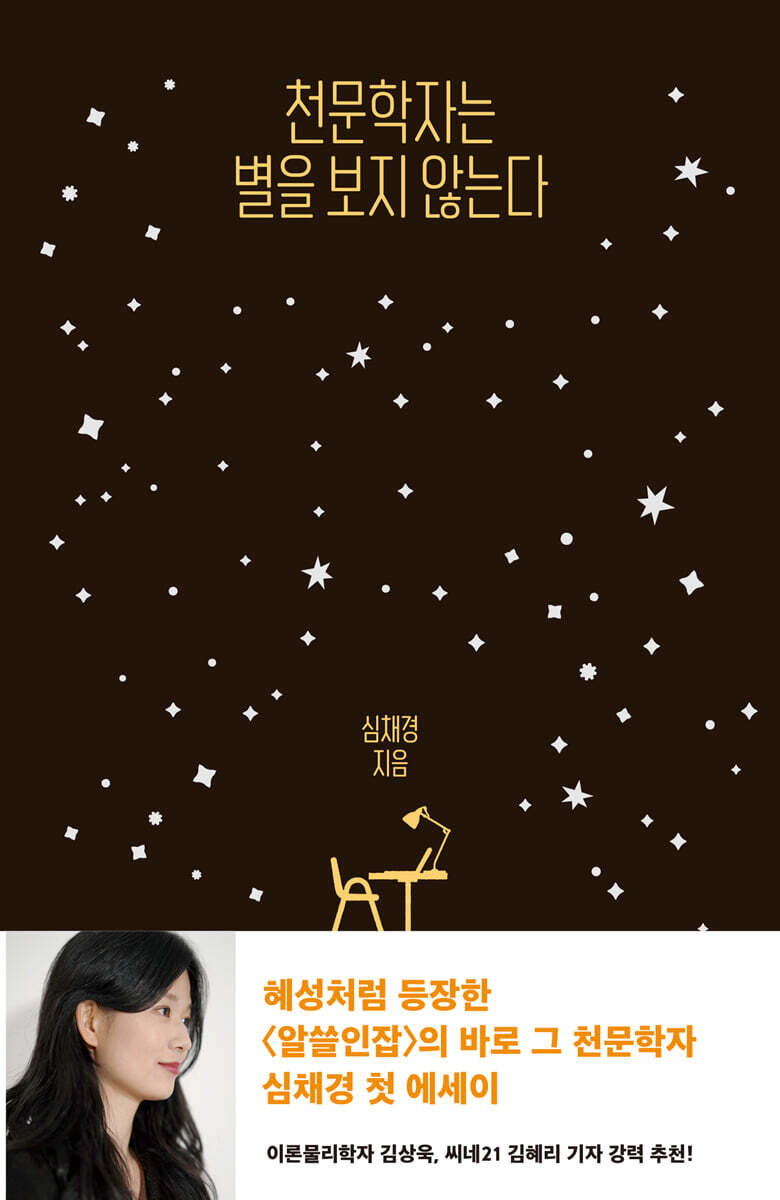
Astronomers don't look at stars.
 |
Description
Book Introduction
Astronomer in 'Pale Blue Dot' How to love the universe while living everyday life The first essay by Sim Chae-kyung, a scientist recognized by Nature as a leader in future lunar science. Highly recommended by theoretical physicist Kim Sang-wook and Cine21 reporter Kim Hye-ri! Everyday life, the world, and the distant yet close universe seen through the eyes of an astronomer We use the term 'astronomical' when we talk about something that is beyond the realm of prediction. When we talk about something beautiful, we say, "It shines like a star," and when we desperately want something, we consult our constellations and pray for the "energy of the universe" to be with us. But what does astronomy, the moon, the stars, and the universe mean to an astronomer? The "action" of scientists in Hollywood movies is thrilling, and the space exploration journals of NASA and Elon Musk are incredibly glamorous, but isn't such news actually making astronomy seem like a story from another world? The world of astronomy shown by astronomer Sim Chae-kyung in “Astronomers Don’t Look at the Stars” is far from such a spectacle. Astronomers, who wonder about the secrets of light, darkness, and the universe, must solve the thorny real-world problems of each day, just like everyone else. We are simply trying to solve the mystery 'scientifically'. The story of an astronomer who lives within the universal yet everyday truth that 'the earth turns and time passes' is all the more novel and beautiful for that reason. I liked those kinds of people. People who happily immerse themselves in things that others may wonder what on earth they are. People who are passionate about things that don't harm others or create political infighting, that don't bring great fame or fortune, and that don't have the influence to change the way people live like television or cell phones. Harmless people who endlessly broadcast radio waves to places where it would take hundreds of years for the signal to reach, and ponder deeply whether they are alone in the universe. I admire people like that. And they long for the sky, nature, and the universe together. (_From "Prologue") |
- You can preview some of the book's contents.
Preview
index
Prologue People who happily immerse themselves in things that make you wonder what they are.
Part 1.
University part-time planetary scientist
Cassini, which flew through time
You are a doctor
Our own universe
『Sillok』 Variations
Poetic license is not permitted.
Re) To the professor
Part 2.
I'm a science-oriented person
Enjoy
A cheeky space walk
100% shooting star
Best astronaut
Amplitude of emotions
The Earth is not a star
A perfect day for observation
Would you like to have an interview?
pale blue dot
Let's go see the sunset
Part 3.
A very short astronomy lesson
Rendezvous with Space
Ten Thousand Ways to Love the Universe
Where in the sky
Traveler receiving moisture
well-known astronomer
Little-known astronomer
Part 4.
We are all solar system people
Hello, Gorilong
Fly Me to the Moon
See you on Mars
Pluto has disappeared
Time passes by seasons
Travel music
We, the people of the solar system
Epilogue
Part 1.
University part-time planetary scientist
Cassini, which flew through time
You are a doctor
Our own universe
『Sillok』 Variations
Poetic license is not permitted.
Re) To the professor
Part 2.
I'm a science-oriented person
Enjoy
A cheeky space walk
100% shooting star
Best astronaut
Amplitude of emotions
The Earth is not a star
A perfect day for observation
Would you like to have an interview?
pale blue dot
Let's go see the sunset
Part 3.
A very short astronomy lesson
Rendezvous with Space
Ten Thousand Ways to Love the Universe
Where in the sky
Traveler receiving moisture
well-known astronomer
Little-known astronomer
Part 4.
We are all solar system people
Hello, Gorilong
Fly Me to the Moon
See you on Mars
Pluto has disappeared
Time passes by seasons
Travel music
We, the people of the solar system
Epilogue
Into the book
Harmless people who endlessly broadcast radio waves to places where it would take hundreds of years for the signal to reach, and ponder deeply whether they are alone in the universe.
I admire people like that.
And they long for the sky, nature, and the universe together.
--- p.13
Looking back, the reason I couldn't quit in the middle was because I didn't have the courage to leave.
But it also took great courage to remain and endure.
Those who left did not choose not to stay, but rather chose not to stay, and those who stayed did not choose not to leave, but rather chose not to leave.
Now I know.
Whichever path you choose, just walk that path silently.
The experience of winning and losing against the waves will make me a seasoned sailor.
--- p.31
I praise both me who bravely left and me who bravely stayed in the parallel universes that branched off into many paths.
So, I practice taking another step like that.
May the force be with me.
--- p.32
All I have to do today is do my best as a researcher to ensure that the 'research license' I worked so hard to obtain doesn't end up as a useless piece of paper.
All I can do is silently walk through life, evaluating and being evaluated, just like everyone else.
Tomorrow too, and the day after.
--- p.36
The 'Basic Astronomy' lecture I attended began with the wonderful words, "Astronomy is timeless, fundamental knowledge that will remain unchanged into the future."
I wrote it on a post-it note and stuck it at the front of my notebook.
--- p.45
We don't always know.
Nature always has exceptions.
The only truth is that what you see right now may not be everything.
--- p.95
Some people were reluctant to accept Yi So-yeon as Korea's first astronaut.
It was disconcerting that the astronaut who was selected amidst the nation's attention was suddenly replaced, and there was also an added layer of concern that a female astronaut would step forward.
For some, it was a beautiful sight to see a female astronaut standing next to a male astronaut and then clapping and cheering at the moment of the historic launch.
The incident of Go San being replaced by Lee So-yeon spread as a shock that a woman was taking a man's place.
--- p.100
I secretly admire a certain female professor.
Although I didn't have many opportunities to meet and talk with him in person because our fields were different, I once ran into a graduate student from that department and asked, "What do you think of that professor?"
In a male-dominated society, female scientists are always objects of curiosity, admiration, and envy.
I was curious about what kind of personality you have, what your research style is, how you lecture, and what you mainly research these days.
But the answer I got back was, “Well,
“There are times when the child doesn’t come to school because he or she is sick.”
In my view, he is a wonderful professor who actively conducts research even nearing retirement age and is always proud of his graduate students, but that's all I get.
--- p.107~108
Voyager will continue to move forward until its lifespan ends.
The fuel brought from Earth has run out.
The sun's gravity is gradually becoming lighter, and even its light is becoming too faint.
But it doesn't stop.
We advance silently into the cold, dark, and vast universe.
That's how we create our own universe.
That's how you become an adult.
--- p.156
The ecstatic twilight is hard to find anywhere in the solar system.
Praise me for being born on Earth.
--- p.158
If we build a house on the moon, we will have a window facing Earth.
Your windows will soon become living picture frames.
I admire people like that.
And they long for the sky, nature, and the universe together.
--- p.13
Looking back, the reason I couldn't quit in the middle was because I didn't have the courage to leave.
But it also took great courage to remain and endure.
Those who left did not choose not to stay, but rather chose not to stay, and those who stayed did not choose not to leave, but rather chose not to leave.
Now I know.
Whichever path you choose, just walk that path silently.
The experience of winning and losing against the waves will make me a seasoned sailor.
--- p.31
I praise both me who bravely left and me who bravely stayed in the parallel universes that branched off into many paths.
So, I practice taking another step like that.
May the force be with me.
--- p.32
All I have to do today is do my best as a researcher to ensure that the 'research license' I worked so hard to obtain doesn't end up as a useless piece of paper.
All I can do is silently walk through life, evaluating and being evaluated, just like everyone else.
Tomorrow too, and the day after.
--- p.36
The 'Basic Astronomy' lecture I attended began with the wonderful words, "Astronomy is timeless, fundamental knowledge that will remain unchanged into the future."
I wrote it on a post-it note and stuck it at the front of my notebook.
--- p.45
We don't always know.
Nature always has exceptions.
The only truth is that what you see right now may not be everything.
--- p.95
Some people were reluctant to accept Yi So-yeon as Korea's first astronaut.
It was disconcerting that the astronaut who was selected amidst the nation's attention was suddenly replaced, and there was also an added layer of concern that a female astronaut would step forward.
For some, it was a beautiful sight to see a female astronaut standing next to a male astronaut and then clapping and cheering at the moment of the historic launch.
The incident of Go San being replaced by Lee So-yeon spread as a shock that a woman was taking a man's place.
--- p.100
I secretly admire a certain female professor.
Although I didn't have many opportunities to meet and talk with him in person because our fields were different, I once ran into a graduate student from that department and asked, "What do you think of that professor?"
In a male-dominated society, female scientists are always objects of curiosity, admiration, and envy.
I was curious about what kind of personality you have, what your research style is, how you lecture, and what you mainly research these days.
But the answer I got back was, “Well,
“There are times when the child doesn’t come to school because he or she is sick.”
In my view, he is a wonderful professor who actively conducts research even nearing retirement age and is always proud of his graduate students, but that's all I get.
--- p.107~108
Voyager will continue to move forward until its lifespan ends.
The fuel brought from Earth has run out.
The sun's gravity is gradually becoming lighter, and even its light is becoming too faint.
But it doesn't stop.
We advance silently into the cold, dark, and vast universe.
That's how we create our own universe.
That's how you become an adult.
--- p.156
The ecstatic twilight is hard to find anywhere in the solar system.
Praise me for being born on Earth.
--- p.158
If we build a house on the moon, we will have a window facing Earth.
Your windows will soon become living picture frames.
--- p.230
Publisher's Review
What do scientists around us, not just in science fiction movies, live for?
In 2019, the 50th anniversary of lunar exploration, Nature named Chae-kyung Shim as one of the five world-renowned astronomers who will lead future lunar science.
Currently, Sim Chae-kyung is also participating in Korea's first lunar exploration project at the Korea Astronomy and Space Science Institute.
However, the life of a researcher that the author shows in the book is very different from that of the main character in the movie Gravity.
It is rare to go to an observatory and look through a telescope to observe a planet directly.
Because planetary observation data can usually be transferred to a laboratory computer, modern astronomers primarily work with the data in the laboratory.
We also use observation data from NASA, which has a monopoly period of about a year.
Another reason why the stories of astronomers in movies and the stories in this book are quite different is because they depict the daily lives of scientists in South Korea, especially female scientists.
The author, a mother of two and a part-time planetary scientist, describes the life of a scientist as one that fiercely battles prejudice every day.
"The Best Astronaut," an article about Korea's first astronaut, Yi So-yeon, provides a subtle yet sharp look at the prejudice and discrimination faced by female scientists in Korea.
The incident of Go San being replaced by Lee So-yeon spread as a shock that a woman was taking a man's place.
It was easily overlooked that Lee So-yeon, with a degree in mechanical engineering and a PhD in bioengineering, was ideally suited to conducting experiments on the space station.
Although many people missed it, the nominal purpose of the Astronaut Project was scientific experiments on the space station.
Our country's first person to conduct a space experiment happened to be a scientist in academia, and this good fortune was not noticed at all.
_Page 100 of the text
Science is so dazzlingly beautiful that it's meticulously suspicious.
_The refreshing feeling of the astronomer's precise and thoughtful sentences
The sun, moon, and stars in the sky have long been objects of fear and awe, as well as intense curiosity, because they are connected to natural phenomena that are difficult to explain.
To observe the climate for agriculture, to find accurate navigation routes, to sing of love and soothe loneliness, and to divine the future, mankind has looked up to the sky.
But even as a new, high-tech space race unfolds between the superpowers, with lunar real estate investment seemingly on the horizon, space still harbors complex mysteries.
Astronomical images provided by NASA are more 'unrealistic' and mysterious than scientific phenomena.
Perhaps that is why astronomy is given a romantic perspective.
However, astronomy is a science that has drastically changed the world view and life of mankind, to the point that the expression 'Copernican shift' is used.
It is no exaggeration to say that the questions and discoveries of astronomers have changed the world.
And deep reflection on such discoveries, experiments, and errors often leads to fundamental questions about our humanity.
This may also be the reason why I am willing to be fascinated by astronomy, which seems difficult.
Shim Chae-kyung's essays are filled with scientifically beautiful and unique thoughts that only an astronomer could think of and write.
While I remain still, the Earth spins quickly, whoosh, whoosh.
15 degrees per hour, that's a speed that never stops.
I remember the night when I opened my eyes wide because I felt the stars moving.
The night flows, and the seasons will also flow.
I, too, will live and move like this every moment, flowing endlessly along with life.
Even while I pause, the night passes and the seasons pass.
After the unbearable waves of life have swept over me, I want to lie flat under the water, soothe my body that has endured so much, sit on an equatorial beach, have a cup of coffee, and stare blankly at the sea.
When the heat of the day has completely faded, the dolphins of the summer night will speak to me.
Even if we stay still, we are moving forward very quickly.
Even if it stops for a moment, it's all okay.
_Page 253
What happens when you look at Earth from the perspective of the solar system
At first glance, astronomy may seem unrelated to our daily lives, but it has transformed the world and deeply influenced our everyday way of thinking.
But more than anything, astronomy has greatly broadened our perspective on humans and the world.
From the time when we thought the Earth we stand on was the center of the universe to the present day when Mars exploration is being realized, mankind has never stopped its curiosity and exploration of space.
In the process, our perspective has expanded from ‘me’ to humanity and all living things on Earth.
The competition among Earthlings surrounding the universe is fierce, but the reason we are awed and amazed every time astronomers make a new discovery is probably because it makes us secretly feel that the daily struggles that take place in that tiny "pale blue dot" may actually be nothing special.
Another important role of astronomy is to foster humility before the seemingly insurmountable mysteries of life and the birth of the universe.
Like astronauts who have left Earth, we too are travelers aboard the most wonderful spaceship called Earth.
Maybe that's why our lives are so brilliant.
Because everything you encounter on your travels looks beautiful.
Because I can hum even when I don't have anything in my hands._Page 259
In 2019, the 50th anniversary of lunar exploration, Nature named Chae-kyung Shim as one of the five world-renowned astronomers who will lead future lunar science.
Currently, Sim Chae-kyung is also participating in Korea's first lunar exploration project at the Korea Astronomy and Space Science Institute.
However, the life of a researcher that the author shows in the book is very different from that of the main character in the movie Gravity.
It is rare to go to an observatory and look through a telescope to observe a planet directly.
Because planetary observation data can usually be transferred to a laboratory computer, modern astronomers primarily work with the data in the laboratory.
We also use observation data from NASA, which has a monopoly period of about a year.
Another reason why the stories of astronomers in movies and the stories in this book are quite different is because they depict the daily lives of scientists in South Korea, especially female scientists.
The author, a mother of two and a part-time planetary scientist, describes the life of a scientist as one that fiercely battles prejudice every day.
"The Best Astronaut," an article about Korea's first astronaut, Yi So-yeon, provides a subtle yet sharp look at the prejudice and discrimination faced by female scientists in Korea.
The incident of Go San being replaced by Lee So-yeon spread as a shock that a woman was taking a man's place.
It was easily overlooked that Lee So-yeon, with a degree in mechanical engineering and a PhD in bioengineering, was ideally suited to conducting experiments on the space station.
Although many people missed it, the nominal purpose of the Astronaut Project was scientific experiments on the space station.
Our country's first person to conduct a space experiment happened to be a scientist in academia, and this good fortune was not noticed at all.
_Page 100 of the text
Science is so dazzlingly beautiful that it's meticulously suspicious.
_The refreshing feeling of the astronomer's precise and thoughtful sentences
The sun, moon, and stars in the sky have long been objects of fear and awe, as well as intense curiosity, because they are connected to natural phenomena that are difficult to explain.
To observe the climate for agriculture, to find accurate navigation routes, to sing of love and soothe loneliness, and to divine the future, mankind has looked up to the sky.
But even as a new, high-tech space race unfolds between the superpowers, with lunar real estate investment seemingly on the horizon, space still harbors complex mysteries.
Astronomical images provided by NASA are more 'unrealistic' and mysterious than scientific phenomena.
Perhaps that is why astronomy is given a romantic perspective.
However, astronomy is a science that has drastically changed the world view and life of mankind, to the point that the expression 'Copernican shift' is used.
It is no exaggeration to say that the questions and discoveries of astronomers have changed the world.
And deep reflection on such discoveries, experiments, and errors often leads to fundamental questions about our humanity.
This may also be the reason why I am willing to be fascinated by astronomy, which seems difficult.
Shim Chae-kyung's essays are filled with scientifically beautiful and unique thoughts that only an astronomer could think of and write.
While I remain still, the Earth spins quickly, whoosh, whoosh.
15 degrees per hour, that's a speed that never stops.
I remember the night when I opened my eyes wide because I felt the stars moving.
The night flows, and the seasons will also flow.
I, too, will live and move like this every moment, flowing endlessly along with life.
Even while I pause, the night passes and the seasons pass.
After the unbearable waves of life have swept over me, I want to lie flat under the water, soothe my body that has endured so much, sit on an equatorial beach, have a cup of coffee, and stare blankly at the sea.
When the heat of the day has completely faded, the dolphins of the summer night will speak to me.
Even if we stay still, we are moving forward very quickly.
Even if it stops for a moment, it's all okay.
_Page 253
What happens when you look at Earth from the perspective of the solar system
At first glance, astronomy may seem unrelated to our daily lives, but it has transformed the world and deeply influenced our everyday way of thinking.
But more than anything, astronomy has greatly broadened our perspective on humans and the world.
From the time when we thought the Earth we stand on was the center of the universe to the present day when Mars exploration is being realized, mankind has never stopped its curiosity and exploration of space.
In the process, our perspective has expanded from ‘me’ to humanity and all living things on Earth.
The competition among Earthlings surrounding the universe is fierce, but the reason we are awed and amazed every time astronomers make a new discovery is probably because it makes us secretly feel that the daily struggles that take place in that tiny "pale blue dot" may actually be nothing special.
Another important role of astronomy is to foster humility before the seemingly insurmountable mysteries of life and the birth of the universe.
Like astronauts who have left Earth, we too are travelers aboard the most wonderful spaceship called Earth.
Maybe that's why our lives are so brilliant.
Because everything you encounter on your travels looks beautiful.
Because I can hum even when I don't have anything in my hands._Page 259
GOODS SPECIFICS
- Publication date: February 22, 2021
- Page count, weight, size: 272 pages | 338g | 130*200*18mm
- ISBN13: 9788954677257
- ISBN10: 8954677258
You may also like
카테고리
korean


korean

![ELLE 엘르 스페셜 에디션 A형 : 12월 [2025]](http://librairie.coreenne.fr/cdn/shop/files/b8e27a3de6c9538896439686c6b0e8fb.jpg?v=1766436872&width=3840)


