

The Psychology of Wasted Effort
 |
Description
Book Introduction
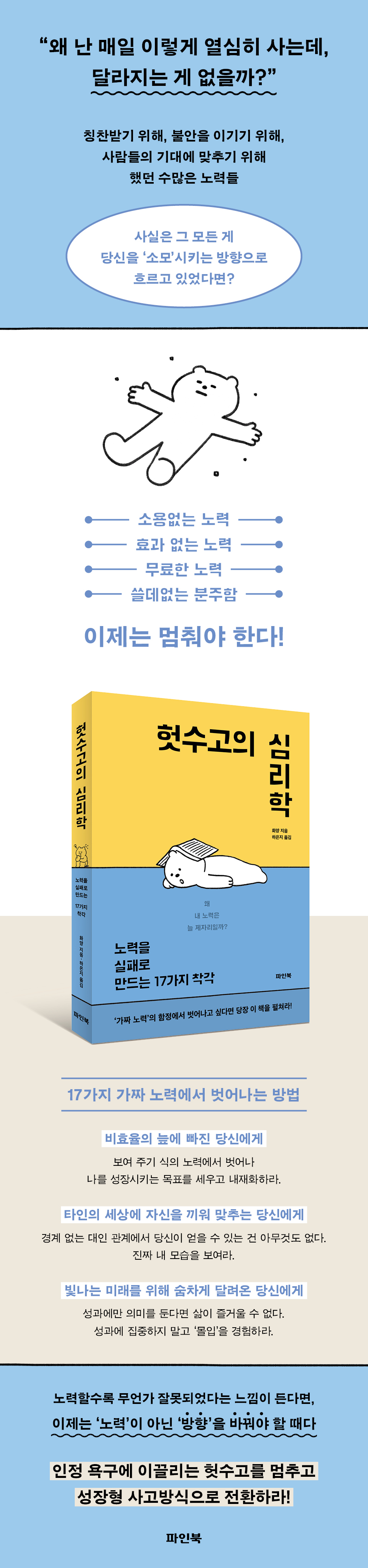
“Why do my efforts always remain stagnant?”
If the direction is wrong, no matter how hard you try, it's useless.
“If you want to escape the trap of wasted effort,
“Open this book now!”
- Best Reviews of Dangdangwang, China's Largest Online Bookstore
"Even though I work hard, why does my life always remain stagnant?" If this question lingers in your mind, this book is just for you.
The problem isn't laziness, it's direction.
No matter how much time you pour into it, if you are on the wrong road, the cart will only run north instead of south.
If you sit at your desk from dawn, work overtime more often than anyone else, and push yourself too hard, but still don't see results, it's not because you lack ability or will, but because your efforts are going in the wrong direction.
Based on thousands of hours of counseling experience, psychologist Hwayang summarizes the reasons why people repeat failures in one word.
That is 'fake effort'.
This is the case when you study hard but end up feeling inferior because you are only interested in comparing yourself to others, or when you are endlessly obsessed with useless certificates due to a desire for recognition rather than achievement, or when you are driven by anxiety and set new goals without thinking and quickly give up.
The insight that the actions we commonly believe to be "I'm working hard" are actually "traps that slowly wear down the ego" is shocking.
This book presents 17 psychological strategies to avoid that trap.
For example, the moment you realize that the reason you've always been tired of trying to please others isn't an unavoidable personality problem, but rather a treatable psychological misconception, your relationship anxiety will finally find a way to resolve itself.
When we realize that our empty lives, where we lose sight of the present while chasing only results, are actually the result of the mindset of "performance-oriented", we learn for the first time how to find meaning in the process.
The message the author emphasizes is simple.
Our frustration is not a lack of ability, but a problem of mindset.
And the answer lies in letting go of the obsession with proving yourself and shifting to a "growth mindset" that doesn't fear failure.
This book, which received a high rating of 4.5 points on China's leading knowledge platform, has already changed the lives of countless readers.
They say that the moment they encountered the author's insight, they realized why they had always been struggling in place, and released the pause button on their lives.
Now you are the main character.
There is no need to regret the time you wasted.
If you just refocus, your efforts will no longer be in vain.
And this book is the starting point.
If the direction is wrong, no matter how hard you try, it's useless.
“If you want to escape the trap of wasted effort,
“Open this book now!”
- Best Reviews of Dangdangwang, China's Largest Online Bookstore
"Even though I work hard, why does my life always remain stagnant?" If this question lingers in your mind, this book is just for you.
The problem isn't laziness, it's direction.
No matter how much time you pour into it, if you are on the wrong road, the cart will only run north instead of south.
If you sit at your desk from dawn, work overtime more often than anyone else, and push yourself too hard, but still don't see results, it's not because you lack ability or will, but because your efforts are going in the wrong direction.
Based on thousands of hours of counseling experience, psychologist Hwayang summarizes the reasons why people repeat failures in one word.
That is 'fake effort'.
This is the case when you study hard but end up feeling inferior because you are only interested in comparing yourself to others, or when you are endlessly obsessed with useless certificates due to a desire for recognition rather than achievement, or when you are driven by anxiety and set new goals without thinking and quickly give up.
The insight that the actions we commonly believe to be "I'm working hard" are actually "traps that slowly wear down the ego" is shocking.
This book presents 17 psychological strategies to avoid that trap.
For example, the moment you realize that the reason you've always been tired of trying to please others isn't an unavoidable personality problem, but rather a treatable psychological misconception, your relationship anxiety will finally find a way to resolve itself.
When we realize that our empty lives, where we lose sight of the present while chasing only results, are actually the result of the mindset of "performance-oriented", we learn for the first time how to find meaning in the process.
The message the author emphasizes is simple.
Our frustration is not a lack of ability, but a problem of mindset.
And the answer lies in letting go of the obsession with proving yourself and shifting to a "growth mindset" that doesn't fear failure.
This book, which received a high rating of 4.5 points on China's leading knowledge platform, has already changed the lives of countless readers.
They say that the moment they encountered the author's insight, they realized why they had always been struggling in place, and released the pause button on their lives.
Now you are the main character.
There is no need to regret the time you wasted.
If you just refocus, your efforts will no longer be in vain.
And this book is the starting point.
- You can preview some of the book's contents.
Preview
index
PART 1.
Why We Are Always Betrayed by Our Efforts
01.
To you who are stuck in the swamp of inefficiency
: Why I work harder than anyone else, but get worse results than anyone else
- Phenomenon Analysis: You work harder than anyone else, so why are you always stuck in the same place?
Let's try this: 'Internalize' and 'Specify' your goals.
- Organize
02.
Fake efforts that consume me
: The more you obsess over willpower, the more you become caught up in a whirlpool of disorder.
- Analysis of the phenomenon: Willpower is not something you create, but something you release naturally.
Let's try this: One step back to take 100 steps forward.
- Organize
03.
Fake efforts to prove myself
: The more you try to prove your superiority, the more self-destructive you become.
- Analysis of the phenomenon: The end of those who try to show off their superiority
- Let's try this: look at your present self from the perspective of the future.
- Organize
04.
Fake effort that burns white impulsively
: The goal is more 'harsh' than anyone else, and the giving up is 'faster' than anyone else.
- Phenomenon Analysis: Don't Expect a One-Time Miracle
- Let's look at it this way: More important than planning is learning how to manage your time.
- Organize
05.
Where is your cart going?
: You can't stop, the more you try, the more futile it becomes.
- Analysis of the phenomenon: The wheel rolling with worry and anxiety
Let's try this: Address your 'basic needs' first, then confront the wounds deep within.
- Organize
06.
Fake efforts that never change your life
: We know so much, but why is reality stagnant?
- Phenomenon Analysis: Theory is 'Dr. Chuck Chuck', but practice is 'Dr. Jackass'
- Let's do this: 4 new ideas and 5 elements
- Organize
PART 2.
To you who keeps getting betrayed in relationships
07.
Fake love given in my own way
: How could you not know how much I sacrificed for you?
- Phenomenon Analysis: What do you think ‘good love’ is?
- Let's try this: Focus on who the other person is and what they want, not on yourself.
- Organize
08.
A fake conversation that continues without any emotion
: “It’s all for you.” The hidden meaning behind those words
- Phenomenon Analysis: What it takes to have a real conversation
Let's do this: 5 Steps to Creating a Conversation Filled with Love and Humility
- Organize
09.
Fake communication disguised as 'interest'
: On the subtle difference between genuine and fake interest
- Phenomenon Analysis: The more interest you have, the more thoroughly the other person builds a wall around their heart.
- Let's try this: Put a 'muzzle' on your mouth and listen to what the other person has to say.
- Organize
10.
A false sacrifice that fits me into someone else's world
: The more I try to please people, the more miserable I become.
- Analysis of the phenomenon: You have nothing to gain from boundary-less interpersonal relationships.
- Let's look at it this way: What does true consideration and respect for others look like?
- Organize
11.
To you who think too much and have a hard time living
: Why you don't have to be overly conscious of other people's gaze
- Analysis of the phenomenon: People are not as interested in me as I think.
- Let's try this: Stop making hasty assumptions about others and be honest with yourself.
- Organize
12.
To you who is accustomed to always receiving love
: Among so many people, why is there no one who ‘loves me’?
- Phenomenon Analysis: The feeling of being loved is different from love.
- Let's do this: Stop being the person who just waits for love to come.
- Organize
PART 3.
Your deep misunderstanding about cognition
13.
True knowledge is not something you fill up, but something you empty out.
: Your deep misunderstanding of the truth
- Analysis of the phenomenon: For you who builds a strong wall inside yourself and tries to find the truth outside.
- Let's try this: Allowing ourselves to be influenced by the outside world.
- Organize
14.
People who keep trying to impose 'order' on the world
: To you who looks at everyone else but me with pitiful eyes
- Analysis of the phenomenon: Can we put life in order with rational logic that is confined to a framework?
- Let's do this: Two ways to increase your cognitive level
- Organize
15.
To you who is trying hard to become someone else
: Why does my inferiority complex get worse when I try to become a better person?
- Analysis of the phenomenon: To you who are making fake efforts to become someone else
- Let's do this: examine who I am and what my temperament is.
- Organize
16.
To you who strive for performance-based efforts
: What's left for you who ran breathlessly toward a bright future?
- Phenomenon Analysis: Life can never be enjoyable for you who only value performance.
Let's do this: Three ways to break free from excessive performance-based pay.
- Organize
17.
To you who dreams of a fairytale-like happy ending
: If we solve this problem, another problem will come up, and where will it end?
- Analysis of the phenomenon: Did the prince and princess live happily or unhappily after that?
Let's try this: Change your mindset.
- Organize
Why We Are Always Betrayed by Our Efforts
01.
To you who are stuck in the swamp of inefficiency
: Why I work harder than anyone else, but get worse results than anyone else
- Phenomenon Analysis: You work harder than anyone else, so why are you always stuck in the same place?
Let's try this: 'Internalize' and 'Specify' your goals.
- Organize
02.
Fake efforts that consume me
: The more you obsess over willpower, the more you become caught up in a whirlpool of disorder.
- Analysis of the phenomenon: Willpower is not something you create, but something you release naturally.
Let's try this: One step back to take 100 steps forward.
- Organize
03.
Fake efforts to prove myself
: The more you try to prove your superiority, the more self-destructive you become.
- Analysis of the phenomenon: The end of those who try to show off their superiority
- Let's try this: look at your present self from the perspective of the future.
- Organize
04.
Fake effort that burns white impulsively
: The goal is more 'harsh' than anyone else, and the giving up is 'faster' than anyone else.
- Phenomenon Analysis: Don't Expect a One-Time Miracle
- Let's look at it this way: More important than planning is learning how to manage your time.
- Organize
05.
Where is your cart going?
: You can't stop, the more you try, the more futile it becomes.
- Analysis of the phenomenon: The wheel rolling with worry and anxiety
Let's try this: Address your 'basic needs' first, then confront the wounds deep within.
- Organize
06.
Fake efforts that never change your life
: We know so much, but why is reality stagnant?
- Phenomenon Analysis: Theory is 'Dr. Chuck Chuck', but practice is 'Dr. Jackass'
- Let's do this: 4 new ideas and 5 elements
- Organize
PART 2.
To you who keeps getting betrayed in relationships
07.
Fake love given in my own way
: How could you not know how much I sacrificed for you?
- Phenomenon Analysis: What do you think ‘good love’ is?
- Let's try this: Focus on who the other person is and what they want, not on yourself.
- Organize
08.
A fake conversation that continues without any emotion
: “It’s all for you.” The hidden meaning behind those words
- Phenomenon Analysis: What it takes to have a real conversation
Let's do this: 5 Steps to Creating a Conversation Filled with Love and Humility
- Organize
09.
Fake communication disguised as 'interest'
: On the subtle difference between genuine and fake interest
- Phenomenon Analysis: The more interest you have, the more thoroughly the other person builds a wall around their heart.
- Let's try this: Put a 'muzzle' on your mouth and listen to what the other person has to say.
- Organize
10.
A false sacrifice that fits me into someone else's world
: The more I try to please people, the more miserable I become.
- Analysis of the phenomenon: You have nothing to gain from boundary-less interpersonal relationships.
- Let's look at it this way: What does true consideration and respect for others look like?
- Organize
11.
To you who think too much and have a hard time living
: Why you don't have to be overly conscious of other people's gaze
- Analysis of the phenomenon: People are not as interested in me as I think.
- Let's try this: Stop making hasty assumptions about others and be honest with yourself.
- Organize
12.
To you who is accustomed to always receiving love
: Among so many people, why is there no one who ‘loves me’?
- Phenomenon Analysis: The feeling of being loved is different from love.
- Let's do this: Stop being the person who just waits for love to come.
- Organize
PART 3.
Your deep misunderstanding about cognition
13.
True knowledge is not something you fill up, but something you empty out.
: Your deep misunderstanding of the truth
- Analysis of the phenomenon: For you who builds a strong wall inside yourself and tries to find the truth outside.
- Let's try this: Allowing ourselves to be influenced by the outside world.
- Organize
14.
People who keep trying to impose 'order' on the world
: To you who looks at everyone else but me with pitiful eyes
- Analysis of the phenomenon: Can we put life in order with rational logic that is confined to a framework?
- Let's do this: Two ways to increase your cognitive level
- Organize
15.
To you who is trying hard to become someone else
: Why does my inferiority complex get worse when I try to become a better person?
- Analysis of the phenomenon: To you who are making fake efforts to become someone else
- Let's do this: examine who I am and what my temperament is.
- Organize
16.
To you who strive for performance-based efforts
: What's left for you who ran breathlessly toward a bright future?
- Phenomenon Analysis: Life can never be enjoyable for you who only value performance.
Let's do this: Three ways to break free from excessive performance-based pay.
- Organize
17.
To you who dreams of a fairytale-like happy ending
: If we solve this problem, another problem will come up, and where will it end?
- Analysis of the phenomenon: Did the prince and princess live happily or unhappily after that?
Let's try this: Change your mindset.
- Organize
Detailed image
Into the book
** As numerous psychological studies have shown, people who act based on their inner motivations are much more effective than those who don't.
In other words, the thought, “I like myself for trying,” is much more effective than the thought, “I absolutely have to try.”
The sense of accomplishment you feel after making a 'conscious effort' that comes from within is sweet.
Even though you may not see the results right now, you know better than anyone else that you have improved one step further than yesterday.
This is how you create intrinsic motivation.
** The reason you try so hard is because you can't stand the feeling of defeat that you're inferior to others.
That sense of defeat is so painful that we end up blaming the past, our parents, and other people for the cause.
This kind of 'blaming others' leaves you feeling helpless, and to escape this helplessness, you start comparing yourself to others and making false efforts to somehow prove yourself.
In this vicious cycle, you blame and condemn yourself, slowly destroying yourself.
** More important than time management is managing the ‘emotions’ within the time.
There are 24 hours in a day.
No matter how talented a person is, he or she cannot manage 25 hours.
Likewise, if your mind is complicated and tired, it is useless even if you are given 25 hours.
But if you feel at ease, you can try at any time.
Then, you will be able to achieve your goals much more easily than you think.
**Change brings responsibility.
If you learn conversation and communication skills to improve your relationships, you may be afraid that all the problems that occurred in your past relationships will be your fault.
It's a desire to avoid responsibility.
Also, if you take action and make efforts to improve the relationship but nothing changes, you may worry about losing face.
So they think.
'It's because I'm not trying hard. If I just put my mind to it, everything will be fine!' You're hypnotizing yourself into avoiding responsibility without taking action.
** Projecting your own helplessness onto others is also not about showing interest, but rather self-satisfaction.
Advice and reprimands are narcissism disguised as 'concern', and excessive meddling that crosses the line is a desire for control.
But listening is different.
Because it is an act of putting aside all my personal desires and wholeheartedly listening to who the other person is and what they are thinking.
** You are accommodating people by sacrificing yourself, but they are not 'getting' much out of you, so there is a big difference in how you perceive it.
You sacrificed your time for someone, but to others it all seemed like you were just delivering a box.
Interpersonal relationships are built on mutual trust.
But the person doesn't know how much you cater to him or how much you sacrifice for him.
** Being anxious and worried about what other people think is no different from fighting the air.
If you are exhausted physically and mentally from thinking too much uselessly, it is best to stop right now.
It's like trying to fight the 'air' and win by punching the air.
It's not just that you're tired and worn out, it's also that your self-esteem is seriously damaged.
So, problems frequently arise in interpersonal relationships.
This is completely different from the love you want, the self-satisfaction you envision.
** You have to ask yourself this:
'What am I thinking?' 'How am I feeling?' Feeling is fun.
I also feel a sense of accomplishment.
I think I will continue to work hard in the future because I want to continue feeling this good feeling.
You need to be able to enjoy the joy of your own accomplishments and determine your future attitude for your own happiness.
Act according to your feelings and thoughts.
Not for anyone else.
That energy will give you a powerful confidence that no one can take away.
In other words, the thought, “I like myself for trying,” is much more effective than the thought, “I absolutely have to try.”
The sense of accomplishment you feel after making a 'conscious effort' that comes from within is sweet.
Even though you may not see the results right now, you know better than anyone else that you have improved one step further than yesterday.
This is how you create intrinsic motivation.
** The reason you try so hard is because you can't stand the feeling of defeat that you're inferior to others.
That sense of defeat is so painful that we end up blaming the past, our parents, and other people for the cause.
This kind of 'blaming others' leaves you feeling helpless, and to escape this helplessness, you start comparing yourself to others and making false efforts to somehow prove yourself.
In this vicious cycle, you blame and condemn yourself, slowly destroying yourself.
** More important than time management is managing the ‘emotions’ within the time.
There are 24 hours in a day.
No matter how talented a person is, he or she cannot manage 25 hours.
Likewise, if your mind is complicated and tired, it is useless even if you are given 25 hours.
But if you feel at ease, you can try at any time.
Then, you will be able to achieve your goals much more easily than you think.
**Change brings responsibility.
If you learn conversation and communication skills to improve your relationships, you may be afraid that all the problems that occurred in your past relationships will be your fault.
It's a desire to avoid responsibility.
Also, if you take action and make efforts to improve the relationship but nothing changes, you may worry about losing face.
So they think.
'It's because I'm not trying hard. If I just put my mind to it, everything will be fine!' You're hypnotizing yourself into avoiding responsibility without taking action.
** Projecting your own helplessness onto others is also not about showing interest, but rather self-satisfaction.
Advice and reprimands are narcissism disguised as 'concern', and excessive meddling that crosses the line is a desire for control.
But listening is different.
Because it is an act of putting aside all my personal desires and wholeheartedly listening to who the other person is and what they are thinking.
** You are accommodating people by sacrificing yourself, but they are not 'getting' much out of you, so there is a big difference in how you perceive it.
You sacrificed your time for someone, but to others it all seemed like you were just delivering a box.
Interpersonal relationships are built on mutual trust.
But the person doesn't know how much you cater to him or how much you sacrifice for him.
** Being anxious and worried about what other people think is no different from fighting the air.
If you are exhausted physically and mentally from thinking too much uselessly, it is best to stop right now.
It's like trying to fight the 'air' and win by punching the air.
It's not just that you're tired and worn out, it's also that your self-esteem is seriously damaged.
So, problems frequently arise in interpersonal relationships.
This is completely different from the love you want, the self-satisfaction you envision.
** You have to ask yourself this:
'What am I thinking?' 'How am I feeling?' Feeling is fun.
I also feel a sense of accomplishment.
I think I will continue to work hard in the future because I want to continue feeling this good feeling.
You need to be able to enjoy the joy of your own accomplishments and determine your future attitude for your own happiness.
Act according to your feelings and thoughts.
Not for anyone else.
That energy will give you a powerful confidence that no one can take away.
--- From the text
Publisher's Review
“On How to Avoid Wasting My Blood, Sweat, and Tears”
Even effort needs direction.
● If you are suffering from burnout due to lack of results despite your efforts
● If you are always tired in a relationship and are only forced to ‘make good efforts’
● If you suffer from growth obsession but your life does not change
Now is the time to start making real efforts.
Let's be honest.
You wake up to the sound of your alarm in the morning, grab your vocabulary book, and turn off the office lights late at night, telling yourself, "I worked hard today too."
Yet, if the results are consistently worse than those of the average colleague sitting next to you, could those intense days have been nothing more than a grand theatrical performance? What if your sweaty routine was actually a futile act staged on a stage of "fake effort"?
That doesn't mean this book is going to scold you.
'The author, a psychological expert with extensive experience in field counseling, instead of giving the obvious scolding that we are 'weak-willed,' highlights 17 psychological traps that we cannot escape from, one by one.
The trap is so subtle and so hard to detect that you've mistaken it for effort until now.
The reason you pushed yourself to get a master's degree or set unrealistic goals and pushed yourself too hard wasn't actually because you wanted to grow.
Behind it all, there was a dark shadow lurking: the 'need for recognition' that was not fulfilled in childhood.
So I only slept five hours a day and hoped for a miracle, but even a small failure left me helpless.
It wasn't that I was weak-willed.
From the beginning, your ship was sailing in the wrong direction with the power of its huge, inflated sails, full of the wind of 'anxiety'.
An even more heartbreaking twist emerges in human relationships.
What was hidden behind the words “It’s all for you” was not love, but a desire for control.
The moment we admit that the devotion we gave to our family and lovers was actually a coercion that ignored their feelings, our faces turn red.
And then there were the days when I was anxious and worried about what other people would think of me.
When I realized that the heavy gaze was nothing more than a psychological illusion, I felt a sense of emptiness that made me not know whether to laugh or cry.
The author says:
Our problem is not laziness, but the fixed mindset of 'I'm worse than him', that is, the endless competition to prove superiority.
The moment you put down that burden, your life begins a new phase.
Stop rushing towards the perfect happy ending and keep going 'until you can' with the mindset that it's okay to fail.
That is the beginning of a growth mindset.
This book, which has already turned on the life switch of countless readers, shows those who want to step down from the stage of fake effort how to finish the last rehearsal.
In particular, the real-life examples the author presents at the beginning of every table of contents create a sense of deja vu, as if I were watching a drama in my mind.
So, I can't help but nod my head even more vigorously at the insight and psychological prescription that follows.
Now the lights on the fake stage go out, and your real stage begins.
A stage to climb, not for the audience, but for yourself.
“I work hard, so why can’t I succeed?”
The Pitfalls of Fake Effort Revealed in 17 Case Studies
● A wasted effort created by anxiety and the need for recognition
● Self-destruction caused by comparison and perfectionism
● A life pattern that becomes empty when you only pursue results
"I work so hard, but why am I always stuck in the same place?" This desperate question isn't simply a matter of laziness; it's a powerful signal that you're trapped in the trap of "fake effort."
This book is a psychological report that points out that it is not because you lack effort, but because your direction is fundamentally wrong.
We give meaning to the act of waking up early in the morning and staying up all night, but that 'hard work' can be a futile gesture that doesn't produce results and only 'consumes' 'me'.
So what is the fundamental reason why our sweat turns into 'fake effort' that drives the cart in the opposite direction of our goal?
The first reason our efforts are in vain is due to poor motivation in the areas of work and study.
The reason why you always got up earlier than anyone else and sat at your desk during your school days, but your grades always lagged behind your friends, is because your efforts weren't for 'growth', but were just for 'showing off' to satisfy yourself with the comfort of 'trying hard'.
Furthermore, this kind of unstoppable, excessive effort only serves to satisfy lower-level needs, such as anxiety or the desire for recognition from others, and leads to a vicious cycle of setting unrealistic goals, such as marching for five hours a day, only to collapse after three days.
If our motivation for effort is rooted in anxiety, doesn't it make us wonder what kind of destruction this distorted energy will bring about in our relationships?
The second part of this book exposes how our 'fake effort' operates in interpersonal relationships.
The moment you package your feelings and needs as love for your family, that love may actually be a distorted desire to control the situation while ignoring their feelings.
This makes you realize that the reason you were constantly conscious of other people's gaze and suffered when you were tired of relationships, that is, the obsession with 'what others think of me', is just a typical psychological illusion.
If all of our efforts and relationships are tied up in psychological anxiety, we must ultimately examine 'your mindset', which is the root of all this suffering.
The final section, Insights into Cognitive Level Errors, opens up a whole new perspective for you.
Your frustration and helplessness stem from a fixed mindset of 'proving your superiority' that starts with the premise 'I'm inferior to him', and this keeps you stuck in place forever.
Moreover, they cling to the cognitive misconception that if they work hard, all their problems will disappear and they will be happy forever, which makes them despair whenever a new problem arises.
This book offers a concrete roadmap for letting go of all those distorted perceptions that have been eating away at you, and shifting to a growth mindset that says, "Failure is okay, keep trying until you succeed."
The author's 17 psychological strategies, developed from over 2,000 hours of field counseling, will help you break free from the shackles of "fake effort" and begin real growth.
Even effort needs direction.
● If you are suffering from burnout due to lack of results despite your efforts
● If you are always tired in a relationship and are only forced to ‘make good efforts’
● If you suffer from growth obsession but your life does not change
Now is the time to start making real efforts.
Let's be honest.
You wake up to the sound of your alarm in the morning, grab your vocabulary book, and turn off the office lights late at night, telling yourself, "I worked hard today too."
Yet, if the results are consistently worse than those of the average colleague sitting next to you, could those intense days have been nothing more than a grand theatrical performance? What if your sweaty routine was actually a futile act staged on a stage of "fake effort"?
That doesn't mean this book is going to scold you.
'The author, a psychological expert with extensive experience in field counseling, instead of giving the obvious scolding that we are 'weak-willed,' highlights 17 psychological traps that we cannot escape from, one by one.
The trap is so subtle and so hard to detect that you've mistaken it for effort until now.
The reason you pushed yourself to get a master's degree or set unrealistic goals and pushed yourself too hard wasn't actually because you wanted to grow.
Behind it all, there was a dark shadow lurking: the 'need for recognition' that was not fulfilled in childhood.
So I only slept five hours a day and hoped for a miracle, but even a small failure left me helpless.
It wasn't that I was weak-willed.
From the beginning, your ship was sailing in the wrong direction with the power of its huge, inflated sails, full of the wind of 'anxiety'.
An even more heartbreaking twist emerges in human relationships.
What was hidden behind the words “It’s all for you” was not love, but a desire for control.
The moment we admit that the devotion we gave to our family and lovers was actually a coercion that ignored their feelings, our faces turn red.
And then there were the days when I was anxious and worried about what other people would think of me.
When I realized that the heavy gaze was nothing more than a psychological illusion, I felt a sense of emptiness that made me not know whether to laugh or cry.
The author says:
Our problem is not laziness, but the fixed mindset of 'I'm worse than him', that is, the endless competition to prove superiority.
The moment you put down that burden, your life begins a new phase.
Stop rushing towards the perfect happy ending and keep going 'until you can' with the mindset that it's okay to fail.
That is the beginning of a growth mindset.
This book, which has already turned on the life switch of countless readers, shows those who want to step down from the stage of fake effort how to finish the last rehearsal.
In particular, the real-life examples the author presents at the beginning of every table of contents create a sense of deja vu, as if I were watching a drama in my mind.
So, I can't help but nod my head even more vigorously at the insight and psychological prescription that follows.
Now the lights on the fake stage go out, and your real stage begins.
A stage to climb, not for the audience, but for yourself.
“I work hard, so why can’t I succeed?”
The Pitfalls of Fake Effort Revealed in 17 Case Studies
● A wasted effort created by anxiety and the need for recognition
● Self-destruction caused by comparison and perfectionism
● A life pattern that becomes empty when you only pursue results
"I work so hard, but why am I always stuck in the same place?" This desperate question isn't simply a matter of laziness; it's a powerful signal that you're trapped in the trap of "fake effort."
This book is a psychological report that points out that it is not because you lack effort, but because your direction is fundamentally wrong.
We give meaning to the act of waking up early in the morning and staying up all night, but that 'hard work' can be a futile gesture that doesn't produce results and only 'consumes' 'me'.
So what is the fundamental reason why our sweat turns into 'fake effort' that drives the cart in the opposite direction of our goal?
The first reason our efforts are in vain is due to poor motivation in the areas of work and study.
The reason why you always got up earlier than anyone else and sat at your desk during your school days, but your grades always lagged behind your friends, is because your efforts weren't for 'growth', but were just for 'showing off' to satisfy yourself with the comfort of 'trying hard'.
Furthermore, this kind of unstoppable, excessive effort only serves to satisfy lower-level needs, such as anxiety or the desire for recognition from others, and leads to a vicious cycle of setting unrealistic goals, such as marching for five hours a day, only to collapse after three days.
If our motivation for effort is rooted in anxiety, doesn't it make us wonder what kind of destruction this distorted energy will bring about in our relationships?
The second part of this book exposes how our 'fake effort' operates in interpersonal relationships.
The moment you package your feelings and needs as love for your family, that love may actually be a distorted desire to control the situation while ignoring their feelings.
This makes you realize that the reason you were constantly conscious of other people's gaze and suffered when you were tired of relationships, that is, the obsession with 'what others think of me', is just a typical psychological illusion.
If all of our efforts and relationships are tied up in psychological anxiety, we must ultimately examine 'your mindset', which is the root of all this suffering.
The final section, Insights into Cognitive Level Errors, opens up a whole new perspective for you.
Your frustration and helplessness stem from a fixed mindset of 'proving your superiority' that starts with the premise 'I'm inferior to him', and this keeps you stuck in place forever.
Moreover, they cling to the cognitive misconception that if they work hard, all their problems will disappear and they will be happy forever, which makes them despair whenever a new problem arises.
This book offers a concrete roadmap for letting go of all those distorted perceptions that have been eating away at you, and shifting to a growth mindset that says, "Failure is okay, keep trying until you succeed."
The author's 17 psychological strategies, developed from over 2,000 hours of field counseling, will help you break free from the shackles of "fake effort" and begin real growth.
GOODS SPECIFICS
- Date of issue: November 10, 2025
- Page count, weight, size: 256 pages | 147*212*20mm
- ISBN13: 9791198632586
- ISBN10: 1198632585
You may also like
카테고리
korean


korean

![ELLE 엘르 스페셜 에디션 A형 : 12월 [2025]](http://librairie.coreenne.fr/cdn/shop/files/b8e27a3de6c9538896439686c6b0e8fb.jpg?v=1766436872&width=3840)


