

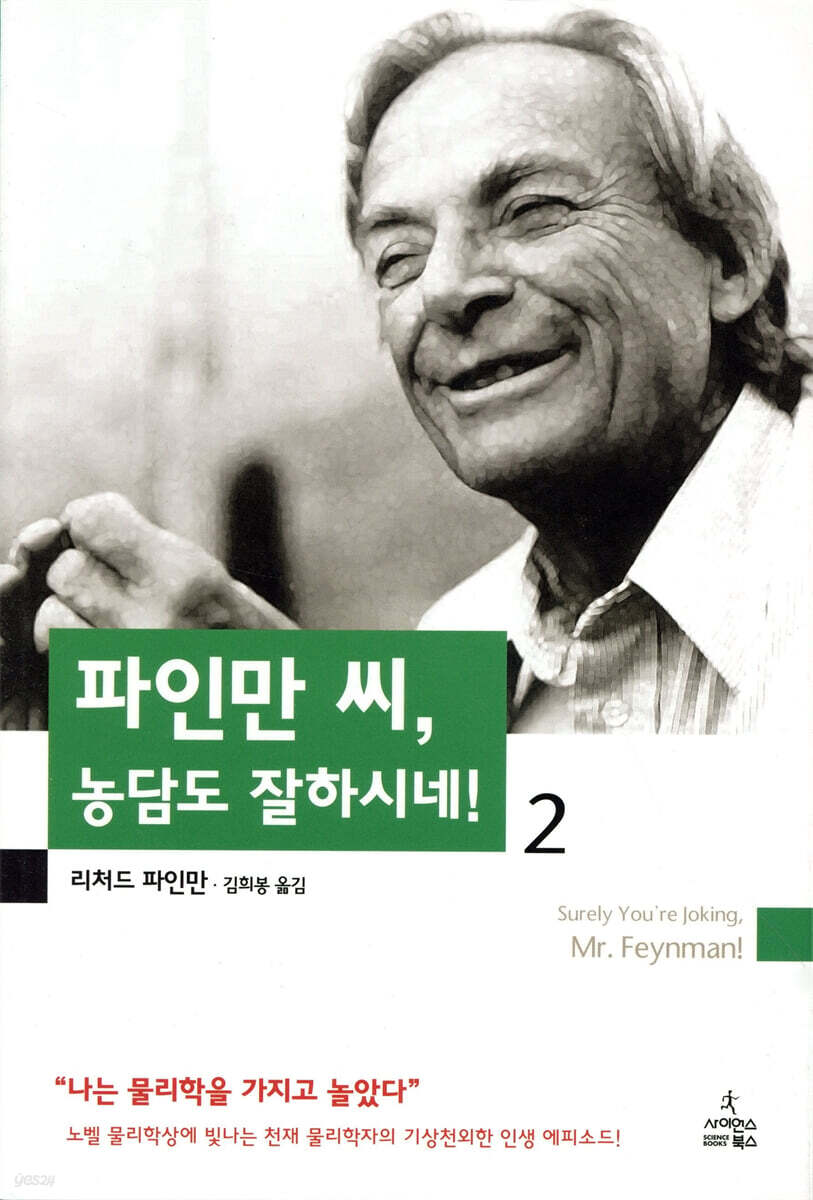
Mr. Feynman, you're good at making jokes. 2
 |
Description
Book Introduction
The unique and fascinating life story of Dr. Richard Feynman, who redefined quantum mechanics, won the Nobel Prize in Physics, and is considered one of the greatest physicists of the 20th century, along with Einstein.
His life story, which includes his diverse experiences as a physicist, safecracker, bongo player, and painter, is filled with his unique way of thinking that breaks stereotypes, his endless curiosity, and his boldness, conveying to readers the wit and emotion of life.
His life story, which includes his diverse experiences as a physicist, safecracker, bongo player, and painter, is filled with his unique way of thinking that breaks stereotypes, his endless curiosity, and his boldness, conveying to readers the wit and emotion of life.
- You can preview some of the book's contents.
Preview
index
1.
From Cornell University to Caltech
Noble Professor
Any questions?
Give me a dollar!
Just ask for it?
Lucky numbers
It's that American again!
A man who knows a thousand words
In Las Vegas
An offer that must be refused
2.
The joy of my life
Would you like to solve the Dirac equation?
7 percent answer
I'll sign only thirteen times.
It sounds like Greek
But is this art?
Is electricity fire?
Judge a book by its cover
Another mistake by Alfred Nobel
General education courses for physicists
Get caught in Paris
Hallucinations and out-of-body experiences
Cargo Cult Science
From Cornell University to Caltech
Noble Professor
Any questions?
Give me a dollar!
Just ask for it?
Lucky numbers
It's that American again!
A man who knows a thousand words
In Las Vegas
An offer that must be refused
2.
The joy of my life
Would you like to solve the Dirac equation?
7 percent answer
I'll sign only thirteen times.
It sounds like Greek
But is this art?
Is electricity fire?
Judge a book by its cover
Another mistake by Alfred Nobel
General education courses for physicists
Get caught in Paris
Hallucinations and out-of-body experiences
Cargo Cult Science
Into the book
In the Middle Ages, there were various myths, such as the belief that rhinoceros horn would increase strength.
Then a way to separate ideas was discovered.
This is to see if one thing works, and if not, discard it.
Of course, this method developed and became a science.
And this has developed greatly, and we now live in the age of science.
In this scientific age, it is difficult to understand how wizards could exist.
Their magic probably didn't actually work at all (or at most).
But even today, I meet people who talk about UFOs, astrology, various forms of mysticism, expanded consciousness, new forms of poetry, ESP, and so on.
And I came to the conclusion that these things are not science.
Then a way to separate ideas was discovered.
This is to see if one thing works, and if not, discard it.
Of course, this method developed and became a science.
And this has developed greatly, and we now live in the age of science.
In this scientific age, it is difficult to understand how wizards could exist.
Their magic probably didn't actually work at all (or at most).
But even today, I meet people who talk about UFOs, astrology, various forms of mysticism, expanded consciousness, new forms of poetry, ESP, and so on.
And I came to the conclusion that these things are not science.
--- p.260
People said that after receiving an award from the King of Sweden, he should not turn around but take a step back.
You have to go down a few steps, get a prize, and then go up a few more steps.
So I thought this.
And I practiced jumping backwards and climbing the stairs.
I wanted to show how ridiculous this custom is.
I felt so bad! Of course, this was stupid and foolish.
But I learned that taking a step back is no longer the rule.
When you step away from the king, you can turn around and walk in the direction you want to go like a normal person.
I was very pleased to learn that Swedes do not take royal events as seriously as people usually think.
When I went to Sweden, everyone was on our side.
For example, students are given special awards to Nobel Prize winners.
The winner who receives the little frog must make a frog croaking sound.
People said that after receiving an award from the King of Sweden, he should not turn around but take a step back.
You have to go down a few steps, get a prize, and then go up a few more steps.
So I thought this.
And I practiced jumping backwards and climbing the stairs.
I wanted to show how ridiculous this custom is.
I felt so bad! Of course, this was stupid and foolish.
But I learned that taking a step back is no longer the rule.
When you step away from the king, you can turn around and walk in the direction you want to go like a normal person.
I was very pleased to learn that Swedes do not take royal events as seriously as people usually think.
When I went to Sweden, everyone was on our side.
For example, students are given special awards to Nobel Prize winners.
The winner who receives the little frog must make a frog croaking sound.
You have to go down a few steps, get a prize, and then go up a few more steps.
So I thought this.
And I practiced jumping backwards and climbing the stairs.
I wanted to show how ridiculous this custom is.
I felt so bad! Of course, this was stupid and foolish.
But I learned that taking a step back is no longer the rule.
When you step away from the king, you can turn around and walk in the direction you want to go like a normal person.
I was very pleased to learn that Swedes do not take royal events as seriously as people usually think.
When I went to Sweden, everyone was on our side.
For example, students are given special awards to Nobel Prize winners.
The winner who receives the little frog must make a frog croaking sound.
People said that after receiving an award from the King of Sweden, he should not turn around but take a step back.
You have to go down a few steps, get a prize, and then go up a few more steps.
So I thought this.
And I practiced jumping backwards and climbing the stairs.
I wanted to show how ridiculous this custom is.
I felt so bad! Of course, this was stupid and foolish.
But I learned that taking a step back is no longer the rule.
When you step away from the king, you can turn around and walk in the direction you want to go like a normal person.
I was very pleased to learn that Swedes do not take royal events as seriously as people usually think.
When I went to Sweden, everyone was on our side.
For example, students are given special awards to Nobel Prize winners.
The winner who receives the little frog must make a frog croaking sound.
--- p.
218
218
This was a great idea.
I don't have to live up to what other people expect me to achieve.
I have no obligation to live up to their expectations.
This is not my failure, it is their fault.
This was a great idea.
I don't have to live up to what other people expect me to achieve.
I have no obligation to live up to their expectations.
This is not my failure, it is their fault.
I don't have to live up to what other people expect me to achieve.
I have no obligation to live up to their expectations.
This is not my failure, it is their fault.
This was a great idea.
I don't have to live up to what other people expect me to achieve.
I have no obligation to live up to their expectations.
This is not my failure, it is their fault.
--- p.20
~I showed them the basic physics textbook they use.
~I said.
'Is there any science here? No! This is just explaining one word with another.
There is no mention of nature here.
Have you ever seen students go home and do experiments? Students can't do experiments.'
This doesn't make any sense. ~No knowledge is conveyed here.
These are just words.~
All the books were like this.
They were explaining useless things in a confusing, vague, and partially inaccurate way.
How can you learn science from a book like this? I don't know.
This isn't science, so I showed them the basic physics textbook they use.
~I said.
'Is there any science here? No! This is just explaining one word with another.
There is no mention of nature here.
Have you ever seen students go home and do experiments? Students can't do experiments.'
This doesn't make any sense. ~No knowledge is conveyed here.
These are just words.~
All the books were like this.
They were explaining useless things in a confusing, vague, and partially inaccurate way.
How can you learn science from a book like this? I don't know.
Because this is not science
~I said.
'Is there any science here? No! This is just explaining one word with another.
There is no mention of nature here.
Have you ever seen students go home and do experiments? Students can't do experiments.'
This doesn't make any sense. ~No knowledge is conveyed here.
These are just words.~
All the books were like this.
They were explaining useless things in a confusing, vague, and partially inaccurate way.
How can you learn science from a book like this? I don't know.
This isn't science, so I showed them the basic physics textbook they use.
~I said.
'Is there any science here? No! This is just explaining one word with another.
There is no mention of nature here.
Have you ever seen students go home and do experiments? Students can't do experiments.'
This doesn't make any sense. ~No knowledge is conveyed here.
These are just words.~
All the books were like this.
They were explaining useless things in a confusing, vague, and partially inaccurate way.
How can you learn science from a book like this? I don't know.
Because this is not science
--- p.87, 205
This was a great idea.
I don't have to live up to what other people expect me to achieve.
I have no obligation to live up to their expectations.
This is not my failure, it is their fault.
This was a great idea.
I don't have to live up to what other people expect me to achieve.
I have no obligation to live up to their expectations.
This is not my failure, it is their fault.
I don't have to live up to what other people expect me to achieve.
I have no obligation to live up to their expectations.
This is not my failure, it is their fault.
This was a great idea.
I don't have to live up to what other people expect me to achieve.
I have no obligation to live up to their expectations.
This is not my failure, it is their fault.
--- p.20
~I showed them the basic physics textbook they use.
~I said.
'Is there any science here? No! This is just explaining one word with another.
There is no mention of nature here.
Have you ever seen students go home and do experiments? Students can't do experiments.'
This doesn't make any sense. ~No knowledge is conveyed here.
These are just words.~
All the books were like this.
They were explaining useless things in a confusing, vague, and partially inaccurate way.
How can you learn science from a book like this? I don't know.
This isn't science, so I showed them the basic physics textbook they use.
~I said.
'Is there any science here? No! This is just explaining one word with another.
There is no mention of nature here.
Have you ever seen students go home and do experiments? Students can't do experiments.'
This doesn't make any sense. ~No knowledge is conveyed here.
These are just words.~
All the books were like this.
They were explaining useless things in a confusing, vague, and partially inaccurate way.
How can you learn science from a book like this? I don't know.
Because this is not science
~I said.
'Is there any science here? No! This is just explaining one word with another.
There is no mention of nature here.
Have you ever seen students go home and do experiments? Students can't do experiments.'
This doesn't make any sense. ~No knowledge is conveyed here.
These are just words.~
All the books were like this.
They were explaining useless things in a confusing, vague, and partially inaccurate way.
How can you learn science from a book like this? I don't know.
This isn't science, so I showed them the basic physics textbook they use.
~I said.
'Is there any science here? No! This is just explaining one word with another.
There is no mention of nature here.
Have you ever seen students go home and do experiments? Students can't do experiments.'
This doesn't make any sense. ~No knowledge is conveyed here.
These are just words.~
All the books were like this.
They were explaining useless things in a confusing, vague, and partially inaccurate way.
How can you learn science from a book like this? I don't know.
Because this is not science
--- p.87, 205
Publisher's Review
This book is a compilation of stories that Feynman's friend Ralph Leighton heard when they played drums together. It has been a bestseller in the United States since its first publication, and has been read steadily for over ten years. It also became the catalyst for Feynman to become as famous as Einstein.
Feynman's Footsteps in Physics
Feynman is known in the physics community as an eccentric with a unique personality and diverse hobbies.
He had a great obsession with riddles, was full of mischief in everything he did, and had a burning hatred for pretense and hypocrisy.
This was a very advantageous condition for him to study physics, and it enabled him to think freely in ways that no one else had thought of.
By his early twenties, while attending graduate school at Princeton, he had already emerged as a first-class scientist, giving seminars in front of leading scientists of the time, including Einstein and Pauli.
And when early quantum mechanics had been producing only inaccurate solutions or approximations for nearly 20 years, he made the greatest contribution in formalizing it and achieving remarkable accuracy.
He devised a simple diagram, the famous "Feynman diagram," to easily visualize the complex mathematical expressions needed to describe the shape of systems of interacting particles. This series of studies greatly simplified some of the calculations used to observe and predict interactions, and for this, Feynman shared the Nobel Prize in Physics with Julian Schwinger of the United States and Shinichiro Tomonaga of Japan.
Feynman's Colorful Stories
This book contains honest and entertaining episodes hidden behind all of Feynman's fame and achievements.
It consists of two volumes, and is divided into five parts in chronological order, covering Feynman's adventures and thoughts throughout his life.
Volume 1 covers Feynman's childhood up to his participation in the development of the atomic bomb during World War II, while Volume 2 covers his time as a professor at the California Institute of Technology after attending Cornell University, including the events surrounding the Nobel Prize and stories from Brazil and Japan.
He completely shed the thick overcoat-like stereotypes worn by scientists and other intellectuals, and left behind many amusing and bizarre anecdotes from his interactions with people in laboratories, classrooms, and on the streets.
Feynman's Footsteps in Physics
Feynman is known in the physics community as an eccentric with a unique personality and diverse hobbies.
He had a great obsession with riddles, was full of mischief in everything he did, and had a burning hatred for pretense and hypocrisy.
This was a very advantageous condition for him to study physics, and it enabled him to think freely in ways that no one else had thought of.
By his early twenties, while attending graduate school at Princeton, he had already emerged as a first-class scientist, giving seminars in front of leading scientists of the time, including Einstein and Pauli.
And when early quantum mechanics had been producing only inaccurate solutions or approximations for nearly 20 years, he made the greatest contribution in formalizing it and achieving remarkable accuracy.
He devised a simple diagram, the famous "Feynman diagram," to easily visualize the complex mathematical expressions needed to describe the shape of systems of interacting particles. This series of studies greatly simplified some of the calculations used to observe and predict interactions, and for this, Feynman shared the Nobel Prize in Physics with Julian Schwinger of the United States and Shinichiro Tomonaga of Japan.
Feynman's Colorful Stories
This book contains honest and entertaining episodes hidden behind all of Feynman's fame and achievements.
It consists of two volumes, and is divided into five parts in chronological order, covering Feynman's adventures and thoughts throughout his life.
Volume 1 covers Feynman's childhood up to his participation in the development of the atomic bomb during World War II, while Volume 2 covers his time as a professor at the California Institute of Technology after attending Cornell University, including the events surrounding the Nobel Prize and stories from Brazil and Japan.
He completely shed the thick overcoat-like stereotypes worn by scientists and other intellectuals, and left behind many amusing and bizarre anecdotes from his interactions with people in laboratories, classrooms, and on the streets.
GOODS SPECIFICS
- Date of issue: May 19, 2000
- Page count, weight, size: 274 pages | 462g | 148*210*20mm
- ISBN13: 9788983710451
- ISBN10: 8983710454
You may also like
카테고리
korean


korean

![GQ KOREA Mark (Monthly): December [2025]](http://librairie.coreenne.fr/cdn/shop/files/8ef265dbbfbf186523ed75ba7319009d.jpg?v=1765340328&width=3840)


