

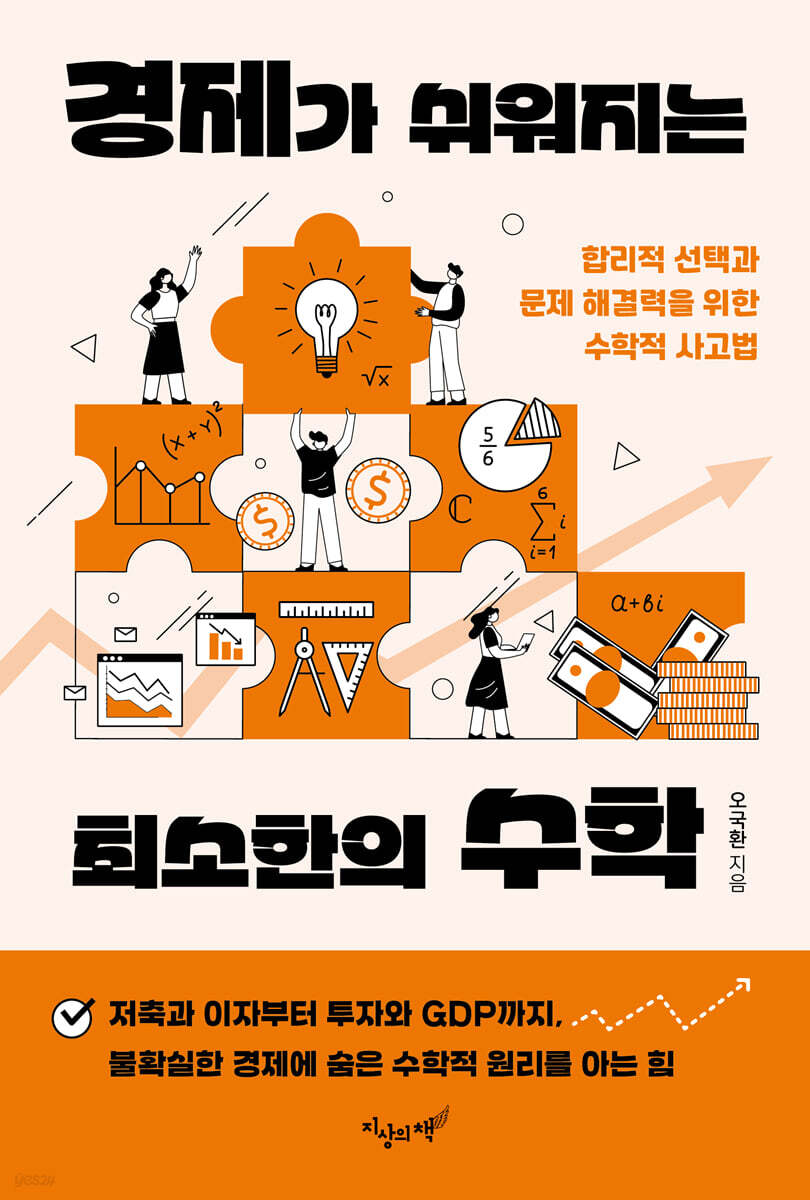
The minimal math that makes economics easier
 |
Description
Book Introduction
Unlocking the Secrets of Mathematics and Economics
The Math in Economics We Never Knew
What happens to the interest rate if I cancel my savings account midway?
Why are the taxes paid different depending on the tax base?
Can consumer satisfaction be expressed in numbers?
How much should production be increased if the store is successful?
Our lives are a series of choices.
Among them, making wise economic choices is essential to living a successful life.
From comparing savings and deposit interest rates to calculating year-end tax deductions and seeking investment information, the economy influences many aspects of our lives.
Moreover, as economic freedom emerges as a new life goal and the era of uncertainty continues with low growth, making rational choices has become increasingly important.
"Minimum Mathematics for Making Economics Easy" proposes a "mathematical way of thinking" as a method.
Author Oh Kook-hwan, a high school mathematics teacher, was in charge of the newly introduced "Economic Mathematics" course in the 2015 revised curriculum when he realized the value of mathematics as a language for explaining the complex human world.
While there wasn't much new material to teach in terms of mathematics, a variety of economic concepts emerged. I had to study them one by one, as if I were digging a well, to understand the context. In the process, I opened my eyes to the intersection between the fundamental question, "What is mathematics?" and the ever-changing realities of the economy.
Based on that experience, I decided to write this book and present it to the world, with the goal of providing an experience of 'understanding and expressing various complex economic phenomena through the lens of mathematics and in the language of mathematics to solve problems.'
This book gives us the courage to believe that 'economics' and 'mathematics' are not the exclusive domain of experts, but that we can experience the joy of knowledge and solve problems when economic and mathematical thinking meet in our daily lives.
Han Jin-soo, Professor of Social Studies Education, Gyeongin National University of Education, author of "Economics Essays for Youth"
This book, consisting of four chapters, presents a minimum mathematical thinking method that will serve as a guide for understanding the economy.
Through the framework of 'change and regularity (sequence),' 'relative size (ratio and proportion),' 'modeling (mathematical model),' and 'rational choice (optimization),' we examine everything from the problem of calculating the changing value of money to methods of maximizing the profits of market participants.
The author repeatedly emphasizes that mathematics is like a 'language', meaning that just as written language concretizes abstract ideas and enables high-level communication, mathematics, too, serves as a language that expresses the complex world and helps us think beyond intuition.
By exploring economic issues, sometimes broadly and sometimes deeply, through the language of mathematics, by the time you finish the book, you'll be able to discover the mathematical thinking hidden within even the most complex tasks—whether choosing a banking product, considering installment payments or lump sum payments, or even leaving a star rating review—and solve the problems on your own.
The Math in Economics We Never Knew
What happens to the interest rate if I cancel my savings account midway?
Why are the taxes paid different depending on the tax base?
Can consumer satisfaction be expressed in numbers?
How much should production be increased if the store is successful?
Our lives are a series of choices.
Among them, making wise economic choices is essential to living a successful life.
From comparing savings and deposit interest rates to calculating year-end tax deductions and seeking investment information, the economy influences many aspects of our lives.
Moreover, as economic freedom emerges as a new life goal and the era of uncertainty continues with low growth, making rational choices has become increasingly important.
"Minimum Mathematics for Making Economics Easy" proposes a "mathematical way of thinking" as a method.
Author Oh Kook-hwan, a high school mathematics teacher, was in charge of the newly introduced "Economic Mathematics" course in the 2015 revised curriculum when he realized the value of mathematics as a language for explaining the complex human world.
While there wasn't much new material to teach in terms of mathematics, a variety of economic concepts emerged. I had to study them one by one, as if I were digging a well, to understand the context. In the process, I opened my eyes to the intersection between the fundamental question, "What is mathematics?" and the ever-changing realities of the economy.
Based on that experience, I decided to write this book and present it to the world, with the goal of providing an experience of 'understanding and expressing various complex economic phenomena through the lens of mathematics and in the language of mathematics to solve problems.'
This book gives us the courage to believe that 'economics' and 'mathematics' are not the exclusive domain of experts, but that we can experience the joy of knowledge and solve problems when economic and mathematical thinking meet in our daily lives.
Han Jin-soo, Professor of Social Studies Education, Gyeongin National University of Education, author of "Economics Essays for Youth"
This book, consisting of four chapters, presents a minimum mathematical thinking method that will serve as a guide for understanding the economy.
Through the framework of 'change and regularity (sequence),' 'relative size (ratio and proportion),' 'modeling (mathematical model),' and 'rational choice (optimization),' we examine everything from the problem of calculating the changing value of money to methods of maximizing the profits of market participants.
The author repeatedly emphasizes that mathematics is like a 'language', meaning that just as written language concretizes abstract ideas and enables high-level communication, mathematics, too, serves as a language that expresses the complex world and helps us think beyond intuition.
By exploring economic issues, sometimes broadly and sometimes deeply, through the language of mathematics, by the time you finish the book, you'll be able to discover the mathematical thinking hidden within even the most complex tasks—whether choosing a banking product, considering installment payments or lump sum payments, or even leaving a star rating review—and solve the problems on your own.
- You can preview some of the book's contents.
Preview
index
Preface: The Power of Mathematical Thinking to Develop Economic Literacy in Everyday Life
1.
Discover the Principle of Money Growth: Change and Regularity
The Secret of Sequences that Understand the Ever-Fluctuating Flow of Money
Interest: Finding the Principle of Money Making Money
· Are there times when borrowing money is actually more cost-effective?
· The key to rational decision-making hidden in the numbers listed
* Economic Literacy: How Realizable Is the 'Rule of 72'?
Deposits and Savings: Split the Money or Roll It All at Once?
Knowledge is power? The more you know, the more money you make!
· How to find answers by expressing the same thing differently
* Economic Literacy: Finding Hidden Pictures in Deposits and Savings
Loans and Installments: How much do you want me to pay per month?
· Is there a smart way to get into debt?
· Avoid becoming house poor by knowing present value and discount rates.
Pension: The Difference Between 'Thin and Long' and 'Thick and Short'
· What if you were offered a year's allowance all at once?
· The calculation method for pensions received until death is different.
* Economic Literacy: In the Age of Investment, What Value Does a Job Have?
Everyone has the right to dream of economic freedom.
2.
The Economy in Numbers: Relative Size
The secret to showing complex fluctuations at a glance with ratios and percentages
Ratios and Indicators: Easily Understanding Huge Amounts of Change
· Why isn't the sum of the unemployment rate and employment rate 100%?
· Various economic indicators that provide statistical information on the economic situation
Economic Indicators: Reading the Economy Through Ups and Downs
· If the KOSPI index falls, is the country at risk?
· What is GDP and why is it important?
· What GDP and economic growth rates around the world tell us
* Economic Literacy: The Complex and Diverse World of Stock Markets
Exchange Rates: Why Buying and Selling Are Different
· How to properly read exchange rate tables
Taxes: If you can't avoid them, know them and use them wisely.
· Are there any words whose search volume increases during the year-end and New Year holidays?
· How much direct and indirect taxes are you paying?
* Economic Literacy: Revealing International Problems with Economic Indicators
Why Zoom In and Out to Explore the Economy
3.
Making Complex Economics Simple: Mathematical Modeling
A mathematical model that explains economic phenomena
Utility Function: Can Consumer Satisfaction Be Expressed Numerically?
· The math behind star ratings, the difference between order and score
· A combination of candy and jelly that gives the same satisfaction
· Multiple variables lead to more complex functions
Production and Cost: How much should a producer produce and at what cost?
· The optimal way to increase production and reduce costs
· Additional cost and average cost of making one more donut
Supply and Demand: The Invisible Hand That Determines Prices?
Why mask prices have skyrocketed due to COVID-19
· How are the equilibrium price and trading volume determined?
* Economic Literacy: Why did Marshall use reversed graph axes?
Elasticity: Half-price chicken and high-priced luxury goods are the same strategy?
· How can you not buy chicken and gasoline because they are expensive?
· If you want to revive the economy, you need to understand resilience.
* Economic Literacy: Is a Big Harvest Always Good? The Farmer's Paradox
Matrices: Let's deal with more variables
· The Hand That Moves the Economy Beyond Producers and Consumers · A New Language, Matrix
Going beyond intuition with the language of mathematics
4.
Getting the best results with limited resources: rational choice
Optimization problem that mathematically calculates cost-effectiveness
Profit Maximization: How to Find a Higher Maximum
· How does a company achieve its goals?
· How to increase your income more than the money you put in?
* Economic Literacy: Some businesses aren't solely about profit.
Utility Maximization: "If You're Going to Buy a Red Skirt" Explained Through Differentiation
· Finding the moment when consumers are happiest
· A mathematical approach to maximizing utility
* Economic Literacy: How to Protect Consumer Rights in the Marketplace
Linear Programming: You Can't Make Everything You Want
· The perfect combination for selling out bagels and croissants
· What if there are more additional conditions to consider?
Gradient descent: an iterative optimization algorithm
· How to climb or descend a mountain on a foggy day
· The reality and limitations of gradient descent
Until we achieve tangible benefits as a result of rational decision-making
Conclusion: Reflecting on the beauty and practicality of mathematics
Americas
1.
Discover the Principle of Money Growth: Change and Regularity
The Secret of Sequences that Understand the Ever-Fluctuating Flow of Money
Interest: Finding the Principle of Money Making Money
· Are there times when borrowing money is actually more cost-effective?
· The key to rational decision-making hidden in the numbers listed
* Economic Literacy: How Realizable Is the 'Rule of 72'?
Deposits and Savings: Split the Money or Roll It All at Once?
Knowledge is power? The more you know, the more money you make!
· How to find answers by expressing the same thing differently
* Economic Literacy: Finding Hidden Pictures in Deposits and Savings
Loans and Installments: How much do you want me to pay per month?
· Is there a smart way to get into debt?
· Avoid becoming house poor by knowing present value and discount rates.
Pension: The Difference Between 'Thin and Long' and 'Thick and Short'
· What if you were offered a year's allowance all at once?
· The calculation method for pensions received until death is different.
* Economic Literacy: In the Age of Investment, What Value Does a Job Have?
Everyone has the right to dream of economic freedom.
2.
The Economy in Numbers: Relative Size
The secret to showing complex fluctuations at a glance with ratios and percentages
Ratios and Indicators: Easily Understanding Huge Amounts of Change
· Why isn't the sum of the unemployment rate and employment rate 100%?
· Various economic indicators that provide statistical information on the economic situation
Economic Indicators: Reading the Economy Through Ups and Downs
· If the KOSPI index falls, is the country at risk?
· What is GDP and why is it important?
· What GDP and economic growth rates around the world tell us
* Economic Literacy: The Complex and Diverse World of Stock Markets
Exchange Rates: Why Buying and Selling Are Different
· How to properly read exchange rate tables
Taxes: If you can't avoid them, know them and use them wisely.
· Are there any words whose search volume increases during the year-end and New Year holidays?
· How much direct and indirect taxes are you paying?
* Economic Literacy: Revealing International Problems with Economic Indicators
Why Zoom In and Out to Explore the Economy
3.
Making Complex Economics Simple: Mathematical Modeling
A mathematical model that explains economic phenomena
Utility Function: Can Consumer Satisfaction Be Expressed Numerically?
· The math behind star ratings, the difference between order and score
· A combination of candy and jelly that gives the same satisfaction
· Multiple variables lead to more complex functions
Production and Cost: How much should a producer produce and at what cost?
· The optimal way to increase production and reduce costs
· Additional cost and average cost of making one more donut
Supply and Demand: The Invisible Hand That Determines Prices?
Why mask prices have skyrocketed due to COVID-19
· How are the equilibrium price and trading volume determined?
* Economic Literacy: Why did Marshall use reversed graph axes?
Elasticity: Half-price chicken and high-priced luxury goods are the same strategy?
· How can you not buy chicken and gasoline because they are expensive?
· If you want to revive the economy, you need to understand resilience.
* Economic Literacy: Is a Big Harvest Always Good? The Farmer's Paradox
Matrices: Let's deal with more variables
· The Hand That Moves the Economy Beyond Producers and Consumers · A New Language, Matrix
Going beyond intuition with the language of mathematics
4.
Getting the best results with limited resources: rational choice
Optimization problem that mathematically calculates cost-effectiveness
Profit Maximization: How to Find a Higher Maximum
· How does a company achieve its goals?
· How to increase your income more than the money you put in?
* Economic Literacy: Some businesses aren't solely about profit.
Utility Maximization: "If You're Going to Buy a Red Skirt" Explained Through Differentiation
· Finding the moment when consumers are happiest
· A mathematical approach to maximizing utility
* Economic Literacy: How to Protect Consumer Rights in the Marketplace
Linear Programming: You Can't Make Everything You Want
· The perfect combination for selling out bagels and croissants
· What if there are more additional conditions to consider?
Gradient descent: an iterative optimization algorithm
· How to climb or descend a mountain on a foggy day
· The reality and limitations of gradient descent
Until we achieve tangible benefits as a result of rational decision-making
Conclusion: Reflecting on the beauty and practicality of mathematics
Americas
Detailed image

Into the book
To make rational decisions that take into account the changing value of money, we need to go beyond the abstract understanding that "money is growing."
That means you need to be able to think specifically about how the value of money increases or decreases, how the value of money changes over time, and how the size of the principal affects interest.
The first thing to understand is ‘interest’.
This is because the interest rate, depending on the size of the principal or the period of borrowing, changes the value of money.
---「1.
- Interest: In search of the principle by which money makes money
This function represents the difference between the time it takes for your money to actually double and the time it would take for the rule of 72 to predict.
If we represent it as a graph, it is as follows.
As you can see from the graph, this function has the smallest error when it has a degree value.
This means that the Rule of 72 is most effective when you have a return of around 8%.
---「1.
- From "Economic Literacy: How Realizable Is the 'Rule of 72'?"
When calculating based on present value, the amount to be repaid is the same as the principal.
Since the calculation is based on the present, you can think of the loan as not having accrued interest yet.
Instead, if the monthly payment is in won, then the discount rate should be applied to each won.
Because the value of the won I will pay in a month will be less than the won I pay now.
Naturally, the further in the future you plan to pay, the smaller the discount rate will be applied.
Therefore, when calculating based on present value, you can calculate it by applying a discount rate to each monthly payment and adding them all up so that the current loan amount is the same.
---「1.
- Loans and Installments: How much do you want to pay per month?
The fundamental reason why these problems are difficult to solve is because they involve the concept of 'infinity'.
What I'm saying is that the problem contains parts that are difficult to solve intuitively.
To solve this, the solution to the infinite geometric series problem is to bring the problem to a point where it can be intuitively understood.
In other words, the original problem of finding the sum of infinitely many terms is changed to the problem of finding the sum up to the terms, and after making it into a form that is easy to imagine infinity (), we imagine what the value will be when this becomes infinitely large.
This is also the idea of solving a problem by reducing it to a smaller scale when it is difficult to think about the whole picture, and then using the result to solve the original problem.
---「1.
- Pension: The difference between 'thin and long' and 'thick and short'
GDP calculated this way has limitations in accurately representing a country's production capacity. Production and prices are variables in GDP calculations, so changes in commodity prices can affect GDP even if production remains unchanged.
So GDP is divided into nominal GDP and real GDP.
Nominal GDP is calculated by multiplying the production volume of the current year by the price of the current year, and real GDP is calculated by multiplying the production volume of the current year by the price of the base year.
By eliminating the impact of price fluctuations, we can accurately identify changes in production capacity.
---「2.
- Economic Index: Reading the Economy Through Ups and Downs in Numbers
Income tax should be applied at progressive rates.
If everyone is taxed the same amount of income tax, those with lower incomes will bear a relatively greater tax burden.
( ··· ) In our country, the tax base is divided into sections as shown in the table below, and tax rates are applied differentially according to the section.
There are two ways to apply progressive tax: simple progressive tax rate and excess progressive tax rate.
A simple progressive tax rate is a method of uniformly applying a high tax rate according to a high tax base, while an excess progressive tax rate is a method of dividing the tax base into sections and applying the tax rate for each section only to the excess amount and adding them together.
---「2.
- From "Taxes: If you can't avoid them, know them and use them"
In fact, we can roughly understand the meaning of articles that use complex economic indicators.
If you look at the vocabulary used in the text or the nuances of the text, you can see whether the economy is in crisis or boom.
The problem is that if you don't clearly understand the meaning of the terms, it's difficult to understand more information from the text or interpret it critically.
For example, if an article comes out saying that the exchange rate is rising and the economy is at risk, if you don't know how the exchange rate rises and falls in the first place, you won't be able to imagine how this economic risk will materialize and affect you.
---「2.
- From "Why we look at the economy by zooming in and out"
It is noteworthy that even when explaining the same phenomenon, different mathematical models or approaches arise when the assumptions change.
What marginal utility theory and indifference curves ultimately try to explain is the behavior of consumers when consuming goods or services.
To this end, marginal utility theory assumed that utility could be quantified, and indifference curves assumed that only the order of utility could be assigned.
Here, it might be worth considering that when approaching a theoretical mathematical model, we should keep in mind what assumptions are being made about the dog.
As in the previous example, mathematical models appear in different forms depending on what assumptions are made and how which variables are controlled.
---「3.
- Utility Function: Can Consumer Satisfaction Be Expressed Numerically?
Production does not increase proportionally as the amount of labor increases.
If you keep adding staff to your donut shop, your production will initially increase, but as time goes on, the shop will become more complex and less useful.
This is called the 'law of diminishing returns'.
On the one hand, as we continue to hire employees, various costs, including labor costs, increase rapidly.
Production volume is gradually decreasing while costs are increasing, so it is not a good situation for producers.
Ultimately, producers will strive to find a balance between production and costs that maximizes profits while maintaining an appropriate number of employees.
---「3.
- Production and Cost: How much should a producer produce and at what price?
When there is a good harvest, the supply curve shifts to the right, prices fall, and quantity traded increases.
However, in the case of agricultural products, the demand curve is inelastic, so the increase in transaction volume is not large compared to the large drop in price.
So, in the end, total revenue, which is calculated by multiplying price and production quantity, decreases.
On the other hand, when there is a famine, the supply curve shifts to the left, prices rise and quantity traded falls.
However, the trading volume does not drop significantly compared to the significant increase in price.
In this case, the total income will eventually increase compared to before.
Because of this principle, the farmer's paradox occurs, where total income decreases during good harvests and increases during bad harvests.
---「3.
- Economic Literacy: Is a Big Harvest Always Good? From "The Farmer's Paradox"
In general, when a consumer consumes multiple goods, utility is maximized when the marginal utility of each good per 1 won is the same.
This is called the law of equal marginal utility.
This rule is often explained using the situation of going to a buffet.
If you go to a buffet and keep eating only steak because the steak is good, you'll soon get sick of it.
Because the marginal utility of steak has declined.
If you insist on filling your stomach with only steak and leave the restaurant, you'll probably be left with some regrets. If you leave with the uneaten dessert lingering in your eyes, you won't be very satisfied with your meal.
So when you get hungry for steak, you need to find a new food with a higher marginal utility to increase your overall utility.
If you keep eating new foods like this, there will eventually come a point where no matter what you eat, it won't be beneficial.
Now, I don't have any regrets about what else I should eat.
Now that you're fully satisfied, you can leave the restaurant feeling good, right?
That means you need to be able to think specifically about how the value of money increases or decreases, how the value of money changes over time, and how the size of the principal affects interest.
The first thing to understand is ‘interest’.
This is because the interest rate, depending on the size of the principal or the period of borrowing, changes the value of money.
---「1.
- Interest: In search of the principle by which money makes money
This function represents the difference between the time it takes for your money to actually double and the time it would take for the rule of 72 to predict.
If we represent it as a graph, it is as follows.
As you can see from the graph, this function has the smallest error when it has a degree value.
This means that the Rule of 72 is most effective when you have a return of around 8%.
---「1.
- From "Economic Literacy: How Realizable Is the 'Rule of 72'?"
When calculating based on present value, the amount to be repaid is the same as the principal.
Since the calculation is based on the present, you can think of the loan as not having accrued interest yet.
Instead, if the monthly payment is in won, then the discount rate should be applied to each won.
Because the value of the won I will pay in a month will be less than the won I pay now.
Naturally, the further in the future you plan to pay, the smaller the discount rate will be applied.
Therefore, when calculating based on present value, you can calculate it by applying a discount rate to each monthly payment and adding them all up so that the current loan amount is the same.
---「1.
- Loans and Installments: How much do you want to pay per month?
The fundamental reason why these problems are difficult to solve is because they involve the concept of 'infinity'.
What I'm saying is that the problem contains parts that are difficult to solve intuitively.
To solve this, the solution to the infinite geometric series problem is to bring the problem to a point where it can be intuitively understood.
In other words, the original problem of finding the sum of infinitely many terms is changed to the problem of finding the sum up to the terms, and after making it into a form that is easy to imagine infinity (), we imagine what the value will be when this becomes infinitely large.
This is also the idea of solving a problem by reducing it to a smaller scale when it is difficult to think about the whole picture, and then using the result to solve the original problem.
---「1.
- Pension: The difference between 'thin and long' and 'thick and short'
GDP calculated this way has limitations in accurately representing a country's production capacity. Production and prices are variables in GDP calculations, so changes in commodity prices can affect GDP even if production remains unchanged.
So GDP is divided into nominal GDP and real GDP.
Nominal GDP is calculated by multiplying the production volume of the current year by the price of the current year, and real GDP is calculated by multiplying the production volume of the current year by the price of the base year.
By eliminating the impact of price fluctuations, we can accurately identify changes in production capacity.
---「2.
- Economic Index: Reading the Economy Through Ups and Downs in Numbers
Income tax should be applied at progressive rates.
If everyone is taxed the same amount of income tax, those with lower incomes will bear a relatively greater tax burden.
( ··· ) In our country, the tax base is divided into sections as shown in the table below, and tax rates are applied differentially according to the section.
There are two ways to apply progressive tax: simple progressive tax rate and excess progressive tax rate.
A simple progressive tax rate is a method of uniformly applying a high tax rate according to a high tax base, while an excess progressive tax rate is a method of dividing the tax base into sections and applying the tax rate for each section only to the excess amount and adding them together.
---「2.
- From "Taxes: If you can't avoid them, know them and use them"
In fact, we can roughly understand the meaning of articles that use complex economic indicators.
If you look at the vocabulary used in the text or the nuances of the text, you can see whether the economy is in crisis or boom.
The problem is that if you don't clearly understand the meaning of the terms, it's difficult to understand more information from the text or interpret it critically.
For example, if an article comes out saying that the exchange rate is rising and the economy is at risk, if you don't know how the exchange rate rises and falls in the first place, you won't be able to imagine how this economic risk will materialize and affect you.
---「2.
- From "Why we look at the economy by zooming in and out"
It is noteworthy that even when explaining the same phenomenon, different mathematical models or approaches arise when the assumptions change.
What marginal utility theory and indifference curves ultimately try to explain is the behavior of consumers when consuming goods or services.
To this end, marginal utility theory assumed that utility could be quantified, and indifference curves assumed that only the order of utility could be assigned.
Here, it might be worth considering that when approaching a theoretical mathematical model, we should keep in mind what assumptions are being made about the dog.
As in the previous example, mathematical models appear in different forms depending on what assumptions are made and how which variables are controlled.
---「3.
- Utility Function: Can Consumer Satisfaction Be Expressed Numerically?
Production does not increase proportionally as the amount of labor increases.
If you keep adding staff to your donut shop, your production will initially increase, but as time goes on, the shop will become more complex and less useful.
This is called the 'law of diminishing returns'.
On the one hand, as we continue to hire employees, various costs, including labor costs, increase rapidly.
Production volume is gradually decreasing while costs are increasing, so it is not a good situation for producers.
Ultimately, producers will strive to find a balance between production and costs that maximizes profits while maintaining an appropriate number of employees.
---「3.
- Production and Cost: How much should a producer produce and at what price?
When there is a good harvest, the supply curve shifts to the right, prices fall, and quantity traded increases.
However, in the case of agricultural products, the demand curve is inelastic, so the increase in transaction volume is not large compared to the large drop in price.
So, in the end, total revenue, which is calculated by multiplying price and production quantity, decreases.
On the other hand, when there is a famine, the supply curve shifts to the left, prices rise and quantity traded falls.
However, the trading volume does not drop significantly compared to the significant increase in price.
In this case, the total income will eventually increase compared to before.
Because of this principle, the farmer's paradox occurs, where total income decreases during good harvests and increases during bad harvests.
---「3.
- Economic Literacy: Is a Big Harvest Always Good? From "The Farmer's Paradox"
In general, when a consumer consumes multiple goods, utility is maximized when the marginal utility of each good per 1 won is the same.
This is called the law of equal marginal utility.
This rule is often explained using the situation of going to a buffet.
If you go to a buffet and keep eating only steak because the steak is good, you'll soon get sick of it.
Because the marginal utility of steak has declined.
If you insist on filling your stomach with only steak and leave the restaurant, you'll probably be left with some regrets. If you leave with the uneaten dessert lingering in your eyes, you won't be very satisfied with your meal.
So when you get hungry for steak, you need to find a new food with a higher marginal utility to increase your overall utility.
If you keep eating new foods like this, there will eventually come a point where no matter what you eat, it won't be beneficial.
Now, I don't have any regrets about what else I should eat.
Now that you're fully satisfied, you can leave the restaurant feeling good, right?
---「4.
- Utility Maximization: From “If You’re Going to Do It, Do It” Explained Through Differentiation
- Utility Maximization: From “If You’re Going to Do It, Do It” Explained Through Differentiation
Publisher's Review
From savings and interest to investment and GDP
The power of knowing the mathematical principles behind an uncertain economy
《Minimum Mathematics for Easy Economics》 begins Chapter 1 with the most relevant question posed by mathematics today: “What is the principle of money growth?”
The basis for making somewhat bold claims as a teacher, such as "there are times when borrowing money is more cost-effective" or "how to shine smartly," is, of course, mathematics.
It is a mathematical tool for understanding the value of money that changes over time, and deals with 'sequences and functions' that explain the concepts of 'change and regularity'.
Even if you're daunted by the mathematical principles behind core financial concepts, if you've ever wondered how much you should repay on a loan, or why the actual take-home pay for a deposit or savings account with the same interest rate is different, it's worth a look.
There's something fascinating about discovering how the mathematics we've been learning for so long connects to economics.
The value of money changes over time.
Because factors like interest rates and inflation intervene.
Therefore, to understand the changing value of money and make rational decisions, we need a mathematical tool to explain these changes.
The functions introduced earlier, especially sequences, help explain financial situations and make sound decisions.
_From the text
In fact, “Minimum Mathematics for Easy Economics” is not a soft math book that simply explains the complexities of economics in an easy way.
Not everyone needs to understand arithmetic and geometric sequences and calculate present and future values to make money and avoid becoming house poor.
However, in an era when most people dream of becoming FIRE tribe members, there have been few books that explain labor income and capital income by calculating the modern value based on salary and working hours, and that easily explain the correlation between functions and statistics in interpreting economic indicators such as the KOSPI index, consumer price index, GDP, and economic growth rate.
The "cost-effectiveness" we often talk about is ultimately a mathematical optimization problem, and furthermore, the story that mathematical linear programming and gradient descent, which are optimization algorithms through repetition, have led to the development of artificial intelligence today is a big picture that only "Minimum Mathematics for Easy Economics" can show.
That's why I hope this book will serve as another tool to help you analyze and navigate the uncertain economy using the language of concrete mathematics.
Are economics and management the exclusive domain of experts?
Let's develop 'economic literacy' from calculating cost-effectiveness to managing a store!
The author explains the perspective of interpreting the economy by comparing it to a camera, zooming in and out.
If zooming in is about taking a closer look at a phenomenon, zooming out is about understanding the overall flow. In fact, when we read economic articles, we tend to be intimidated by difficult economic indicators and either take the numbers at face value or try to grasp the article's intention through the overall nuance.
But if you want to get accurate information about reality, these two are inseparable.
Chapter 2, which explores the method of calculating various economic indicators using 'ratios and proportions', shows that it is better to explain using relative sizes to the whole (zoom out) rather than directly mentioning specific quantities (zoom in).
Let’s look at the article, “While France’s minimum wage rose by 7%, Korea’s rose by 42%.”
At first glance, the negative view on the minimum wage increase is evident.
But if we calculate it using ratios and proportions, we can see the other side of it.
Considering that the GDPs of the two countries are similar, while Korea's minimum wage rose from 6,470 won to 9,160 won, France's rose from 13,664 won to 14,672 won.
Mathematical thinking, encompassing zooming in and out, is revealed to be the key to economic literacy, the ability to critically read information.
These days, when learning a concept, it seems rare to think critically about why the concept was defined this way, why it had to be defined that way, or whether there are any other alternatives.
This is probably because it is a more advantageous environment to accept the given concept and solve many problems rather than overthinking this and that.
_From the text
The same goes for Chapter 3, which explains economic phenomena through ‘mathematical modeling.’
If we look at the function graph that models production and consumption, supply and demand, we can see the concept of 'elasticity', which numerically represents how much demand changes depending on price.
For example, chicken is a product with high 'price elasticity of demand', so lowering the price increases total revenue.
From the producer's perspective, this will provide a basis for actively utilizing the "half-price chicken" strategy of high volume and low profit margins, and furthermore, it will enable them to calculate appropriate prices and expected revenue based on flexibility.
On the other hand, what about rice? Because the demand curve for rice is inelastic, even if prices fall during a bumper harvest, the increase in transaction volume is minimal, lowering total revenue.
However, producers have very little room to respond to agricultural products affected by natural disasters.
So, in this 'farmer's paradox', the government often intervenes appropriately to solve the problem of oversupply.
Mathematical attempts to model complex phenomena involving various variables and to uncover cause and effect are having a significant impact on solving real-world problems from the perspectives of producers, consumers, and governments.
As the author says, "The more you know, the more money you make," the economy is full of hidden things that can only be seen when you can read the language of mathematics.
This is because, from a business's perspective, maximizing profits, and from a consumer's perspective, maximizing utility, making optimal choices by efficiently utilizing limited resources is ultimately no different from the path of mathematics, which requires logical reasoning and problem-solving skills to rationally judge a problem.
In today's world, where many people dream of financial freedom, we hope to experience the practical value of the school math they've spent so much time learning.
Kim Yu-jeong, math teacher at Seoul Science High School
For rational choice and problem-solving skills
What is mathematical thinking?
Mathematician Alfred Marshall introduced mathematics to the study of economics to answer the question, "Why does Britain have so many poor people, even though it is the richest country in the world?"
The famous supply and demand function is a theory that was born in the process of establishing a mathematical model to explain economic phenomena.
The fact that this function, known to determine the equilibrium price or quantity in a market, actually originated as an attempt to solve a society's economic problems, tells us a lot about the practicality of mathematics.
The author also hoped that students would overcome the limitations of the school curriculum, which only taught them to solve problems involving functions and graphs, and gain experience solving economic problems by analyzing economic phenomena and applying appropriate mathematical concepts to express them. However, due to various practical constraints, classes did not always proceed as intended.
But in the process, I had the valuable experience of discovering together what mathematical thinking is and how it applies to real-world problems.
This is why the author says, “I hope that readers will also feel the expansion of thought that I experienced while writing.”
What is a mathematical thinking method that develops problem-solving skills?
· Simplify complex phenomena
· Solve different phenomena in the same way
· Find hidden meaning by solving the same problem differently
· Brings issues beyond intuition into the realm of thought.
"Minimum Mathematics for Easy Economics" is a book that can be read by everyone, from readers who love math but are curious about where numbers and reality intersect, to those who are interested in economics but feel burdened by the mathematics.
As the author says, the beauty of mathematics is difficult to explain unless you experience it firsthand. I hope that many people will experience an expansion of their thinking and enjoy the joy of knowledge through this book.
The power of knowing the mathematical principles behind an uncertain economy
《Minimum Mathematics for Easy Economics》 begins Chapter 1 with the most relevant question posed by mathematics today: “What is the principle of money growth?”
The basis for making somewhat bold claims as a teacher, such as "there are times when borrowing money is more cost-effective" or "how to shine smartly," is, of course, mathematics.
It is a mathematical tool for understanding the value of money that changes over time, and deals with 'sequences and functions' that explain the concepts of 'change and regularity'.
Even if you're daunted by the mathematical principles behind core financial concepts, if you've ever wondered how much you should repay on a loan, or why the actual take-home pay for a deposit or savings account with the same interest rate is different, it's worth a look.
There's something fascinating about discovering how the mathematics we've been learning for so long connects to economics.
The value of money changes over time.
Because factors like interest rates and inflation intervene.
Therefore, to understand the changing value of money and make rational decisions, we need a mathematical tool to explain these changes.
The functions introduced earlier, especially sequences, help explain financial situations and make sound decisions.
_From the text
In fact, “Minimum Mathematics for Easy Economics” is not a soft math book that simply explains the complexities of economics in an easy way.
Not everyone needs to understand arithmetic and geometric sequences and calculate present and future values to make money and avoid becoming house poor.
However, in an era when most people dream of becoming FIRE tribe members, there have been few books that explain labor income and capital income by calculating the modern value based on salary and working hours, and that easily explain the correlation between functions and statistics in interpreting economic indicators such as the KOSPI index, consumer price index, GDP, and economic growth rate.
The "cost-effectiveness" we often talk about is ultimately a mathematical optimization problem, and furthermore, the story that mathematical linear programming and gradient descent, which are optimization algorithms through repetition, have led to the development of artificial intelligence today is a big picture that only "Minimum Mathematics for Easy Economics" can show.
That's why I hope this book will serve as another tool to help you analyze and navigate the uncertain economy using the language of concrete mathematics.
Are economics and management the exclusive domain of experts?
Let's develop 'economic literacy' from calculating cost-effectiveness to managing a store!
The author explains the perspective of interpreting the economy by comparing it to a camera, zooming in and out.
If zooming in is about taking a closer look at a phenomenon, zooming out is about understanding the overall flow. In fact, when we read economic articles, we tend to be intimidated by difficult economic indicators and either take the numbers at face value or try to grasp the article's intention through the overall nuance.
But if you want to get accurate information about reality, these two are inseparable.
Chapter 2, which explores the method of calculating various economic indicators using 'ratios and proportions', shows that it is better to explain using relative sizes to the whole (zoom out) rather than directly mentioning specific quantities (zoom in).
Let’s look at the article, “While France’s minimum wage rose by 7%, Korea’s rose by 42%.”
At first glance, the negative view on the minimum wage increase is evident.
But if we calculate it using ratios and proportions, we can see the other side of it.
Considering that the GDPs of the two countries are similar, while Korea's minimum wage rose from 6,470 won to 9,160 won, France's rose from 13,664 won to 14,672 won.
Mathematical thinking, encompassing zooming in and out, is revealed to be the key to economic literacy, the ability to critically read information.
These days, when learning a concept, it seems rare to think critically about why the concept was defined this way, why it had to be defined that way, or whether there are any other alternatives.
This is probably because it is a more advantageous environment to accept the given concept and solve many problems rather than overthinking this and that.
_From the text
The same goes for Chapter 3, which explains economic phenomena through ‘mathematical modeling.’
If we look at the function graph that models production and consumption, supply and demand, we can see the concept of 'elasticity', which numerically represents how much demand changes depending on price.
For example, chicken is a product with high 'price elasticity of demand', so lowering the price increases total revenue.
From the producer's perspective, this will provide a basis for actively utilizing the "half-price chicken" strategy of high volume and low profit margins, and furthermore, it will enable them to calculate appropriate prices and expected revenue based on flexibility.
On the other hand, what about rice? Because the demand curve for rice is inelastic, even if prices fall during a bumper harvest, the increase in transaction volume is minimal, lowering total revenue.
However, producers have very little room to respond to agricultural products affected by natural disasters.
So, in this 'farmer's paradox', the government often intervenes appropriately to solve the problem of oversupply.
Mathematical attempts to model complex phenomena involving various variables and to uncover cause and effect are having a significant impact on solving real-world problems from the perspectives of producers, consumers, and governments.
As the author says, "The more you know, the more money you make," the economy is full of hidden things that can only be seen when you can read the language of mathematics.
This is because, from a business's perspective, maximizing profits, and from a consumer's perspective, maximizing utility, making optimal choices by efficiently utilizing limited resources is ultimately no different from the path of mathematics, which requires logical reasoning and problem-solving skills to rationally judge a problem.
In today's world, where many people dream of financial freedom, we hope to experience the practical value of the school math they've spent so much time learning.
Kim Yu-jeong, math teacher at Seoul Science High School
For rational choice and problem-solving skills
What is mathematical thinking?
Mathematician Alfred Marshall introduced mathematics to the study of economics to answer the question, "Why does Britain have so many poor people, even though it is the richest country in the world?"
The famous supply and demand function is a theory that was born in the process of establishing a mathematical model to explain economic phenomena.
The fact that this function, known to determine the equilibrium price or quantity in a market, actually originated as an attempt to solve a society's economic problems, tells us a lot about the practicality of mathematics.
The author also hoped that students would overcome the limitations of the school curriculum, which only taught them to solve problems involving functions and graphs, and gain experience solving economic problems by analyzing economic phenomena and applying appropriate mathematical concepts to express them. However, due to various practical constraints, classes did not always proceed as intended.
But in the process, I had the valuable experience of discovering together what mathematical thinking is and how it applies to real-world problems.
This is why the author says, “I hope that readers will also feel the expansion of thought that I experienced while writing.”
What is a mathematical thinking method that develops problem-solving skills?
· Simplify complex phenomena
· Solve different phenomena in the same way
· Find hidden meaning by solving the same problem differently
· Brings issues beyond intuition into the realm of thought.
"Minimum Mathematics for Easy Economics" is a book that can be read by everyone, from readers who love math but are curious about where numbers and reality intersect, to those who are interested in economics but feel burdened by the mathematics.
As the author says, the beauty of mathematics is difficult to explain unless you experience it firsthand. I hope that many people will experience an expansion of their thinking and enjoy the joy of knowledge through this book.
GOODS SPECIFICS
- Date of issue: May 3, 2024
- Page count, weight, size: 308 pages | 472g | 152*225*20mm
- ISBN13: 9791193301029
- ISBN10: 1193301025
You may also like
카테고리
korean


korean

![ELLE 엘르 스페셜 에디션 A형 : 12월 [2025]](http://librairie.coreenne.fr/cdn/shop/files/b8e27a3de6c9538896439686c6b0e8fb.jpg?v=1766436872&width=3840)


