

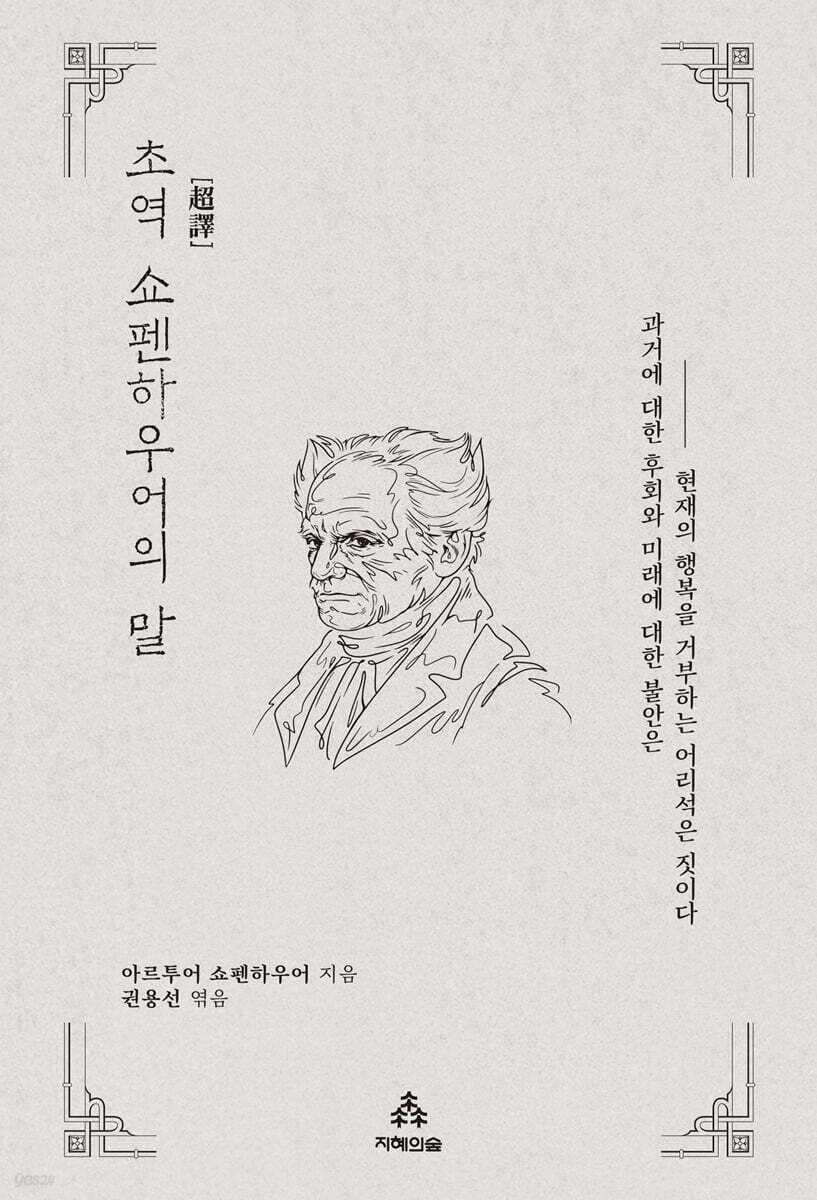
The words of Schopenhauer in his first translation
 |
Description
Book Introduction
Read Schopenhauer yourself.
There is no commentary or summary.
To confront his sentences directly is to bear the weight of a philosophy that does not turn away from suffering.
Short but decisive sentences, uncomfortable but honest insights.
Key sentences were selected from major works such as 『The World as Will and Representation』 and organized into seven themes.
Now, a book that allows you to read Schopenhauer most clearly.
There is no commentary or summary.
To confront his sentences directly is to bear the weight of a philosophy that does not turn away from suffering.
Short but decisive sentences, uncomfortable but honest insights.
Key sentences were selected from major works such as 『The World as Will and Representation』 and organized into seven themes.
Now, a book that allows you to read Schopenhauer most clearly.
- You can preview some of the book's contents.
Preview
index
ingress
Chapter 1 Pain and Pleasure
Don't waste the present
Don't buy pleasure with pain
A life without pain is a happy life.
If you're stuck in the past, there's no tomorrow.
Pain diminishes over time
Everything changes
Become an expert in misfortune
Giving up is betraying the whole world.
When you're having a hard time, go outside and get some light.
When life is shaken, stand before the great nature.
Don't ignore my little signals
There is no end to suffering
Humans are just parts of this world.
All humans are both protagonists of tragedy and clowns of comedy.
When life is empty, you fall into superstition.
Life is fortunate to be short.
The end of vanity is despair.
This world writes you off
Why You Can't Be Happy Forever
Fear luck
Lose it in advance
He who has no desires is free.
Chapter 2: Aging and Death
Life is a constant escaping of death.
What you see as a child lasts a lifetime.
Misfortune doesn't love you in particular.
Boredom is the privilege of youth.
How to waste your youth
The young man is crazy
Don't complain
There is no life that blooms by chance.
All humans are slaves to time.
Youth is passionate, middle age is ripe, and old age is peaceful.
It's comfortable if you don't expect anything.
There is no special happiness
Even if your body ages, your mind should not age.
Even when you get old, your temper remains the same.
Don't show off your age
Things you only get at the end of life
The Birth of Death
Birth and death are one
Life is borrowed, death is returned.
There is no eternal stage, no eternal mask.
Chapter 3: Me and Others
Don't waste your life on others
The moment you lower your eyes, you fall.
If you do it well, you will be bitten
Friendship with a dog is true friendship.
People wait for other people's misfortune
Don't fry
Misfortune exchanges friends for enemies.
The phrase "you have a good personality" is the worst insult.
Respond to rude questions with lies.
Information is a weakness
A soliloquy tells everything
Think of it as a comedy
Don't forget other people's shortcomings
Don't miss the moment the mask comes off
A person who doesn't know how to cry is dangerous.
People who mistreat animals are worth knowing.
If you ignore someone in need, look back.
Habits speak volumes
You can tell a person's personality by looking at their body shape.
Children have no obligations to their parents.
Humans can never be rewritten
Chapter 4: Habits and Success
Move now
A diary is a teacher
A person who doesn't know how to look in the mirror is ugly.
Be me, not someone else
If you exercise every day, you will die early.
The brain is not a muscle
If you cut down on sleep, your life will be cut down too.
Effort cannot overcome fate.
There are times when waiting is better
Life is war
Never let go of money once you have it.
Don't laugh at me for yesterday
What is a proper regret?
Touch the desire
Catch the daily warnings
Personality is innate
Humans live two lives
If you don't know yourself, life is in vain.
Don't follow me
Chapter 5 Selfishness and Morality
One person destroys the whole world
Selfishness has a price.
Possession is effort
Even exaggeration is a lie
Lying is worse than violence
Lies destroy society
self-defense
Lies are followed by lies
The law is cold
The illusion that law is morality
The law is far from utopia.
The law is the minimum standard
Punishment protects the future
Public opinion is cruel but accurate.
The vengeance of the righteous is the final conscience of humanity.
The face of a villain is different.
The road to becoming a villain is easy.
You can't change people through lectures or sermons.
Don't do good deeds expecting something
Don't differentiate between yourself and others.
If you have a legacy, don't forget society.
Consideration for others and true morality
A selfish person is anxious at every moment.
Love that cannot be sacrificed is just selfishness.
You don't have to learn true ethics to know them.
Manners are hypocritical, but necessary.
Jealousy makes society sick.
Egoists corrode morality.
The wicked are pure
Right and wrong cannot be measured with a ruler.
Traitors should not be forgiven
Even good deeds can sometimes be like a sword.
Don't confuse good deeds with shopping.
Things to Remember When Cynicism Beckons
Religion is weak
The Golden Spoon's Secret to Happiness
A person who appears when others are suffering
fake conscience
Chapter 6: Truth and Art
Truth prevails
Knowledge never disappears
Only humans can make jokes.
Why Plagiarism Is Evil
Philosophers and Truth
Be evaluated by your writing
Logic and reason aren't everything
Don't pretend to be the lord of all creation.
Nature cannot be defeated
Not a single day of my life is mine
Reason interferes with intuition.
Art is not a thought, it is a feeling.
If you don't know art, you don't deserve to be human.
Great works are always uncomfortable.
Genius is not self-absorbed.
Genius is never satisfied
Nature blows away all bonds
Literary works you must read
Ordinary people and geniuses have different perspectives.
How to deal with truth and error
Chapter 7: Argument and Speaking
The hotter it is, the colder it should be spoken.
Inflate your argument cleverly
Feel free to change it
Generalize
Don't show off my argument
Take out the lie
Don't prove it, assume it.
Let them answer for themselves
Buy anger
The more dizzying the question, the better.
Use your opposing temperaments
Interpret fragmentary cases as universal phenomena.
If you preempt a word, you preempt a frame.
Force a choice
Shout out loud that you won
Throw out words that you don't understand
If you get blocked, attack your opponent.
Change your words
If the odds are against you, turn the table over.
Tell an abstract story
Don't give me any room
Sophistry is followed by sophistry
Ask for proof
Pour oil on a burning house
Twist the argument
One counterexample is enough
Give back what you received
Hit the emotional nerve
Borrow the power of the audience
Buy time
Borrow authority
Admit my foolishness
Cover the shadow of disgust
Hold reality hostage
Never miss the silence of your opponent.
Stimulate your audience's interests
The more difficult the nonsense, the better.
If one piece of evidence falls apart, the whole thing falls apart.
A mad dog has no enemies.
Chapter 1 Pain and Pleasure
Don't waste the present
Don't buy pleasure with pain
A life without pain is a happy life.
If you're stuck in the past, there's no tomorrow.
Pain diminishes over time
Everything changes
Become an expert in misfortune
Giving up is betraying the whole world.
When you're having a hard time, go outside and get some light.
When life is shaken, stand before the great nature.
Don't ignore my little signals
There is no end to suffering
Humans are just parts of this world.
All humans are both protagonists of tragedy and clowns of comedy.
When life is empty, you fall into superstition.
Life is fortunate to be short.
The end of vanity is despair.
This world writes you off
Why You Can't Be Happy Forever
Fear luck
Lose it in advance
He who has no desires is free.
Chapter 2: Aging and Death
Life is a constant escaping of death.
What you see as a child lasts a lifetime.
Misfortune doesn't love you in particular.
Boredom is the privilege of youth.
How to waste your youth
The young man is crazy
Don't complain
There is no life that blooms by chance.
All humans are slaves to time.
Youth is passionate, middle age is ripe, and old age is peaceful.
It's comfortable if you don't expect anything.
There is no special happiness
Even if your body ages, your mind should not age.
Even when you get old, your temper remains the same.
Don't show off your age
Things you only get at the end of life
The Birth of Death
Birth and death are one
Life is borrowed, death is returned.
There is no eternal stage, no eternal mask.
Chapter 3: Me and Others
Don't waste your life on others
The moment you lower your eyes, you fall.
If you do it well, you will be bitten
Friendship with a dog is true friendship.
People wait for other people's misfortune
Don't fry
Misfortune exchanges friends for enemies.
The phrase "you have a good personality" is the worst insult.
Respond to rude questions with lies.
Information is a weakness
A soliloquy tells everything
Think of it as a comedy
Don't forget other people's shortcomings
Don't miss the moment the mask comes off
A person who doesn't know how to cry is dangerous.
People who mistreat animals are worth knowing.
If you ignore someone in need, look back.
Habits speak volumes
You can tell a person's personality by looking at their body shape.
Children have no obligations to their parents.
Humans can never be rewritten
Chapter 4: Habits and Success
Move now
A diary is a teacher
A person who doesn't know how to look in the mirror is ugly.
Be me, not someone else
If you exercise every day, you will die early.
The brain is not a muscle
If you cut down on sleep, your life will be cut down too.
Effort cannot overcome fate.
There are times when waiting is better
Life is war
Never let go of money once you have it.
Don't laugh at me for yesterday
What is a proper regret?
Touch the desire
Catch the daily warnings
Personality is innate
Humans live two lives
If you don't know yourself, life is in vain.
Don't follow me
Chapter 5 Selfishness and Morality
One person destroys the whole world
Selfishness has a price.
Possession is effort
Even exaggeration is a lie
Lying is worse than violence
Lies destroy society
self-defense
Lies are followed by lies
The law is cold
The illusion that law is morality
The law is far from utopia.
The law is the minimum standard
Punishment protects the future
Public opinion is cruel but accurate.
The vengeance of the righteous is the final conscience of humanity.
The face of a villain is different.
The road to becoming a villain is easy.
You can't change people through lectures or sermons.
Don't do good deeds expecting something
Don't differentiate between yourself and others.
If you have a legacy, don't forget society.
Consideration for others and true morality
A selfish person is anxious at every moment.
Love that cannot be sacrificed is just selfishness.
You don't have to learn true ethics to know them.
Manners are hypocritical, but necessary.
Jealousy makes society sick.
Egoists corrode morality.
The wicked are pure
Right and wrong cannot be measured with a ruler.
Traitors should not be forgiven
Even good deeds can sometimes be like a sword.
Don't confuse good deeds with shopping.
Things to Remember When Cynicism Beckons
Religion is weak
The Golden Spoon's Secret to Happiness
A person who appears when others are suffering
fake conscience
Chapter 6: Truth and Art
Truth prevails
Knowledge never disappears
Only humans can make jokes.
Why Plagiarism Is Evil
Philosophers and Truth
Be evaluated by your writing
Logic and reason aren't everything
Don't pretend to be the lord of all creation.
Nature cannot be defeated
Not a single day of my life is mine
Reason interferes with intuition.
Art is not a thought, it is a feeling.
If you don't know art, you don't deserve to be human.
Great works are always uncomfortable.
Genius is not self-absorbed.
Genius is never satisfied
Nature blows away all bonds
Literary works you must read
Ordinary people and geniuses have different perspectives.
How to deal with truth and error
Chapter 7: Argument and Speaking
The hotter it is, the colder it should be spoken.
Inflate your argument cleverly
Feel free to change it
Generalize
Don't show off my argument
Take out the lie
Don't prove it, assume it.
Let them answer for themselves
Buy anger
The more dizzying the question, the better.
Use your opposing temperaments
Interpret fragmentary cases as universal phenomena.
If you preempt a word, you preempt a frame.
Force a choice
Shout out loud that you won
Throw out words that you don't understand
If you get blocked, attack your opponent.
Change your words
If the odds are against you, turn the table over.
Tell an abstract story
Don't give me any room
Sophistry is followed by sophistry
Ask for proof
Pour oil on a burning house
Twist the argument
One counterexample is enough
Give back what you received
Hit the emotional nerve
Borrow the power of the audience
Buy time
Borrow authority
Admit my foolishness
Cover the shadow of disgust
Hold reality hostage
Never miss the silence of your opponent.
Stimulate your audience's interests
The more difficult the nonsense, the better.
If one piece of evidence falls apart, the whole thing falls apart.
A mad dog has no enemies.
Detailed image
.jpg)
Publisher's Review
If you don't read Schopenhauer yourself,
Don't say you know Schopenhauer
"The First Translation of Schopenhauer's Words" is a book that reinterprets the uncomfortably honest language of a philosopher in an age when so much advice and comfort is consumed and passed away.
Schopenhauer does not turn away from the suffering of life.
We don't even wrap reality in a vain hope.
His sentences, which confront the essence of human existence in its raw form, fully capture the character and attitude of a philosopher.
Short but sharp, cynical but deep.
Above all, his sentences refuse to be summarized or explained.
The weight and pain contained in Schopenhauer's sentences must be borne by the reader himself.
This book was designed to convey Schopenhauer as fully as possible to the reader.
A book that allows you to directly encounter Schopenhauer's thoughts and sentences, rather than someone else's interpretation or 'received words'.
Even readers who thought they knew Schopenhauer will be forced to start over again after reading this book.
Honest and sharp,
It's sharp but it's warm
We often pretend not to know.
They say things that won't get better will get better, and they say things that aren't okay are okay.
Even though they know it is a lie and pretense, they pretend to be deceived, and even though they know it is wrong, they pretend not to see it.
This kind of 'exteriority' cannot necessarily be said to be bad.
Because the truth always hurts most of the time.
Humans live by relying on sweet lies to avoid suffering.
Even emotional essays and self-help books that preach positivity ultimately stem from that kind of psychology.
But Schopenhauer is different.
He is called the 'philosopher of pain' and he does not lie or turn a blind eye to pain.
He doesn't offer a single line of comfort.
He asserts that humans cannot help but suffer as long as they live, and even goes so far as to say, “Life is fortunate because it is short.”
In this way, his sentences are firm, direct, and sometimes ruthless.
But because it is such a sentence, it is even more true.
His awareness of his own suffering, from which even he himself was not spared, is vividly conveyed beyond the sentences.
Ironically, we feel a deeper sense of comfort in front of it.
The editor of this book says:
“If you are willing to endure the discomfort that Schopenhauer’s honesty brings, I believe you will find true comfort and courage in it that will make life affirming.”
『The First Translation of Schopenhauer's Words』 is the only philosophy book recommended to readers who desire true thought and reflection.
This will be the first step toward overcoming the fatigue of the flood of emotional essays and self-help books and accepting life as it is.
Schopenhauer's scattered sentences, in one volume
『The First Translation of Schopenhauer's Words』 is a book that preserves Schopenhauer's painfully direct speaking style while focusing on the structure so that each sentence can be clearly understood.
To reduce the burden readers feel when reading philosophy books, sentences are organized by page unit to increase concentration and readability.
This book contains key sentences from his major works, including “The World as Will and Representation,” “The Record and the Possession,” “On the Will in Nature,” and “On the Foundations of Morality,” all selected and put into a single volume.
The summarized content was reorganized into seven themes: ‘Pain and Pleasure’, ‘Aging and Death’, ‘Me and Others’, ‘Habits and Success’, ‘Selfishness and Morality’, ‘Truth and Art’, and ‘Debate and Oratory’.
I have placed Schopenhauer's sentences only as much as necessary and in the most appropriate places.
Hearing the philosopher's voice directly.
Once you face the essence of what Schopenhauer is talking about, you will no longer need any previous comfort or advice.
Don't say you know Schopenhauer
"The First Translation of Schopenhauer's Words" is a book that reinterprets the uncomfortably honest language of a philosopher in an age when so much advice and comfort is consumed and passed away.
Schopenhauer does not turn away from the suffering of life.
We don't even wrap reality in a vain hope.
His sentences, which confront the essence of human existence in its raw form, fully capture the character and attitude of a philosopher.
Short but sharp, cynical but deep.
Above all, his sentences refuse to be summarized or explained.
The weight and pain contained in Schopenhauer's sentences must be borne by the reader himself.
This book was designed to convey Schopenhauer as fully as possible to the reader.
A book that allows you to directly encounter Schopenhauer's thoughts and sentences, rather than someone else's interpretation or 'received words'.
Even readers who thought they knew Schopenhauer will be forced to start over again after reading this book.
Honest and sharp,
It's sharp but it's warm
We often pretend not to know.
They say things that won't get better will get better, and they say things that aren't okay are okay.
Even though they know it is a lie and pretense, they pretend to be deceived, and even though they know it is wrong, they pretend not to see it.
This kind of 'exteriority' cannot necessarily be said to be bad.
Because the truth always hurts most of the time.
Humans live by relying on sweet lies to avoid suffering.
Even emotional essays and self-help books that preach positivity ultimately stem from that kind of psychology.
But Schopenhauer is different.
He is called the 'philosopher of pain' and he does not lie or turn a blind eye to pain.
He doesn't offer a single line of comfort.
He asserts that humans cannot help but suffer as long as they live, and even goes so far as to say, “Life is fortunate because it is short.”
In this way, his sentences are firm, direct, and sometimes ruthless.
But because it is such a sentence, it is even more true.
His awareness of his own suffering, from which even he himself was not spared, is vividly conveyed beyond the sentences.
Ironically, we feel a deeper sense of comfort in front of it.
The editor of this book says:
“If you are willing to endure the discomfort that Schopenhauer’s honesty brings, I believe you will find true comfort and courage in it that will make life affirming.”
『The First Translation of Schopenhauer's Words』 is the only philosophy book recommended to readers who desire true thought and reflection.
This will be the first step toward overcoming the fatigue of the flood of emotional essays and self-help books and accepting life as it is.
Schopenhauer's scattered sentences, in one volume
『The First Translation of Schopenhauer's Words』 is a book that preserves Schopenhauer's painfully direct speaking style while focusing on the structure so that each sentence can be clearly understood.
To reduce the burden readers feel when reading philosophy books, sentences are organized by page unit to increase concentration and readability.
This book contains key sentences from his major works, including “The World as Will and Representation,” “The Record and the Possession,” “On the Will in Nature,” and “On the Foundations of Morality,” all selected and put into a single volume.
The summarized content was reorganized into seven themes: ‘Pain and Pleasure’, ‘Aging and Death’, ‘Me and Others’, ‘Habits and Success’, ‘Selfishness and Morality’, ‘Truth and Art’, and ‘Debate and Oratory’.
I have placed Schopenhauer's sentences only as much as necessary and in the most appropriate places.
Hearing the philosopher's voice directly.
Once you face the essence of what Schopenhauer is talking about, you will no longer need any previous comfort or advice.
GOODS SPECIFICS
- Date of issue: July 22, 2025
- Page count, weight, size: 210 pages | 128*188*14mm
- ISBN13: 9791193282311
- ISBN10: 1193282314
You may also like
카테고리
korean


korean

![GQ KOREA Mark (Monthly): December [2025]](http://librairie.coreenne.fr/cdn/shop/files/8ef265dbbfbf186523ed75ba7319009d.jpg?v=1765340328&width=3840)


