

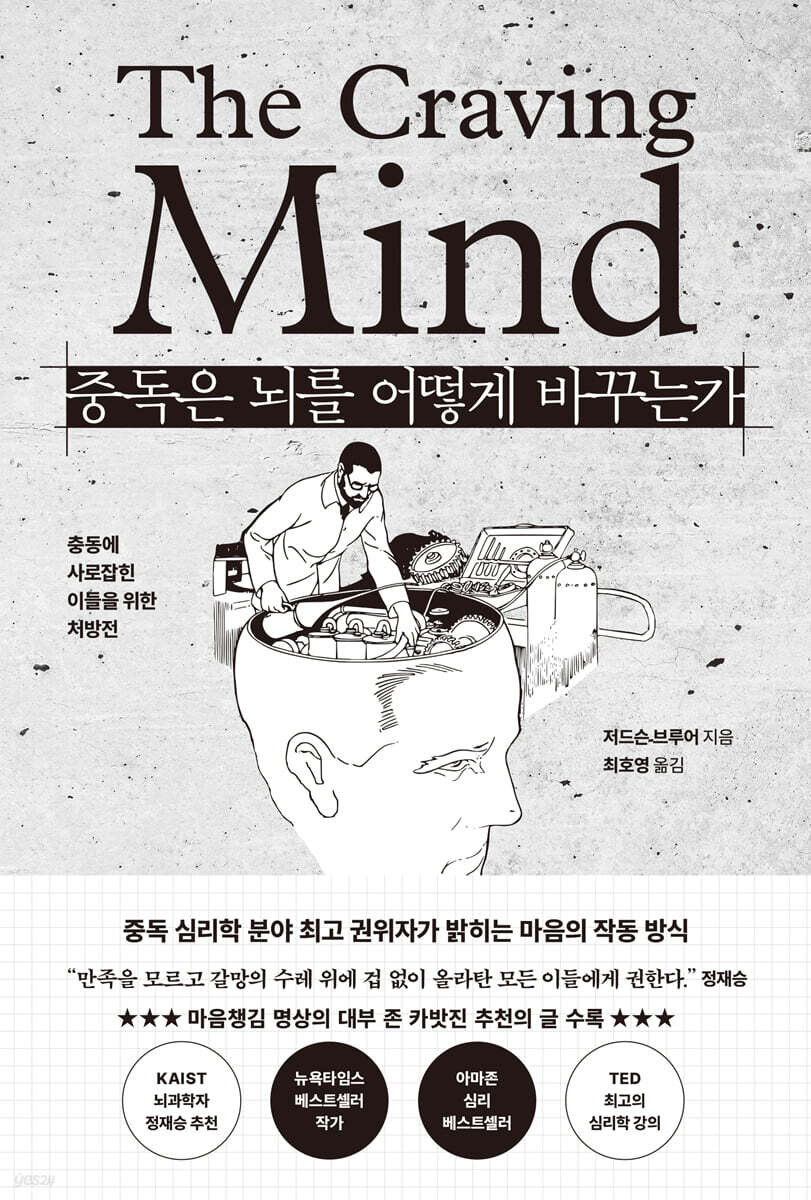
How Addiction Changes the Brain
 |
Description
Book Introduction
- A word from MD
-
Breaking free from alcohol, cigarette, and smartphone addictionDrinking, smoking, binge eating, and even smartphones.
We waste a significant amount of our precious lives engaging in undesirable, bad habits.
Addiction expert Judson Brewer offers simple tips for overcoming addiction.
Understanding how your brain works solves problems! The answers lie in neuroscience and mindfulness.
October 10, 2025. Min-gyu Son, Humanities PD
'The leading authority in addiction psychology'
Judson Brewer Reveals How the Mind Works
“To all who fearlessly climb onto the chariot of desire, never knowing satisfaction.”
Jaeseung Jeong (Professor, Department of Brain and Cognitive Sciences, KAIST)
Why do we become addicted to something, and why can't we break free from its shackles even when we know it's a bad habit? Judson Brewer, author of "How Addiction Changes the Brain," finds the answer in the brain, and the solution in mindfulness.
As a neuroscientist, the author scientifically explains the process by which cravings are formed and strengthened in the brain and become habits, and as an addiction psychologist, he presents a fundamental solution through mindfulness.
The range of addictions covered in this book ranges from addictive substances like alcohol and cigarettes, to smartphones and social media, which are indispensable to our lives, to more complex dimensions like self, thoughts, and love.
The brain strengthens the reward pathway through a process called 'trigger-action-reward', and as a result, learns cravings.
If it's possible to learn bad habits, it's equally possible to develop good ones, and as you read along, you'll encounter mindfulness.
If we could only look closely at the true nature of the reward we receive for giving in to temptation, it would be that the reality is not as sweet as it seems.
It's like not being able to resist temptation and eating a late-night snack and then regretting it the next day when you look swollen.
At this time, mindfulness training, including meditation, helps our brains, which have been attacked by dopamine, to return to their normal state.
This book, which argues that “desire is not something to be suppressed, but something to be understood,” will become a must-read for modern people who are under the onslaught of dopamine, informing them of “liberation from dopamine.”
Judson Brewer Reveals How the Mind Works
“To all who fearlessly climb onto the chariot of desire, never knowing satisfaction.”
Jaeseung Jeong (Professor, Department of Brain and Cognitive Sciences, KAIST)
Why do we become addicted to something, and why can't we break free from its shackles even when we know it's a bad habit? Judson Brewer, author of "How Addiction Changes the Brain," finds the answer in the brain, and the solution in mindfulness.
As a neuroscientist, the author scientifically explains the process by which cravings are formed and strengthened in the brain and become habits, and as an addiction psychologist, he presents a fundamental solution through mindfulness.
The range of addictions covered in this book ranges from addictive substances like alcohol and cigarettes, to smartphones and social media, which are indispensable to our lives, to more complex dimensions like self, thoughts, and love.
The brain strengthens the reward pathway through a process called 'trigger-action-reward', and as a result, learns cravings.
If it's possible to learn bad habits, it's equally possible to develop good ones, and as you read along, you'll encounter mindfulness.
If we could only look closely at the true nature of the reward we receive for giving in to temptation, it would be that the reality is not as sweet as it seems.
It's like not being able to resist temptation and eating a late-night snack and then regretting it the next day when you look swollen.
At this time, mindfulness training, including meditation, helps our brains, which have been attacked by dopamine, to return to their normal state.
This book, which argues that “desire is not something to be suppressed, but something to be understood,” will become a must-read for modern people who are under the onslaught of dopamine, informing them of “liberation from dopamine.”
- You can preview some of the book's contents.
Preview
index
Recommendation | A Longing Heart
introduction
preface
Part 1: Dopamine Attack
Chapter 1: The Face of Addiction
Chapter 2: People Addicted to Modern Technology: Social Media Addiction
Chapter 3: A Story About Myself: Ego Addiction
Chapter 4: A World of My Own Soul: Addicted to Fun
Chapter 5: My Head is Full of Thoughts: Thought Addiction
Chapter 6 My World is Full of Affection: Love Addiction
Part 2: Freedom from Dopamine
Chapter 7: Why Your Focus Was Stolen
Chapter 8: Learning Bad and Good Behaviors
Chapter 9 Immersion
Chapter 10: Resilience Training
Conclusion: The future is here.
Appendix Mindfulness Personality Types
main
Acknowledgements
Search
introduction
preface
Part 1: Dopamine Attack
Chapter 1: The Face of Addiction
Chapter 2: People Addicted to Modern Technology: Social Media Addiction
Chapter 3: A Story About Myself: Ego Addiction
Chapter 4: A World of My Own Soul: Addicted to Fun
Chapter 5: My Head is Full of Thoughts: Thought Addiction
Chapter 6 My World is Full of Affection: Love Addiction
Part 2: Freedom from Dopamine
Chapter 7: Why Your Focus Was Stolen
Chapter 8: Learning Bad and Good Behaviors
Chapter 9 Immersion
Chapter 10: Resilience Training
Conclusion: The future is here.
Appendix Mindfulness Personality Types
main
Acknowledgements
Search
Detailed image

Into the book
Mindfulness is seeing the world more clearly.
When we lose our way and keep going in circles because of subjective biases, mindfulness helps us become aware of these biases and see how they are leading us astray.
Only when we realize that we are going around in circles can we stop, let go of unnecessary baggage, and change direction.
Metaphorically speaking, mindfulness is like a map for navigating the terrain of life.
--- p.48
Paradoxically, mindfulness is also a process of paying attention to what is happening in our bodies and minds and becoming personally acquainted with it.
It's about moving forward willingly with our experience rather than trying to make unpleasant cravings go away as quickly as possible.
--- p.71
At some point in human history, we became conditioned to believe that the feeling we get when our brain delivers a dopamine reward is happiness.
Of course, defining happiness is a very difficult and subjective thing.
The scientific definition of happiness remains controversial and hotly debated.
Emotions don't seem to fit into the learning algorithm of survival of the fittest.
But one thing is certain: the expectation of reward does not automatically lead to happiness.
--- p.104
Like I did when I was lost in the illusion of thought, most of us mistake suffering for happiness in life.
How do we know this? The evidence is our inability to stop our suffering.
How many times a day do you find yourself stressed out, lashing out at someone, eating comfort food, or going on a shopping spree? Advertisements are everywhere, urging us to buy X and be happy, promising that consumption can lead to happiness.
The reason these incentives are so effective is that they leverage our innate reward-based learning process: behavior leads to rewards, which in turn shape and reinforce future behavior.
--- p.210
By learning mindfulness, we will discover a more mindful and thoughtful way to live, making more deliberate decisions about all kinds of behaviors instead of blindly pressing levers for a dopamine reward.
In this way, we will live a happier and healthier life, not one filled with superficial excitement.
When we lose our way and keep going in circles because of subjective biases, mindfulness helps us become aware of these biases and see how they are leading us astray.
Only when we realize that we are going around in circles can we stop, let go of unnecessary baggage, and change direction.
Metaphorically speaking, mindfulness is like a map for navigating the terrain of life.
--- p.48
Paradoxically, mindfulness is also a process of paying attention to what is happening in our bodies and minds and becoming personally acquainted with it.
It's about moving forward willingly with our experience rather than trying to make unpleasant cravings go away as quickly as possible.
--- p.71
At some point in human history, we became conditioned to believe that the feeling we get when our brain delivers a dopamine reward is happiness.
Of course, defining happiness is a very difficult and subjective thing.
The scientific definition of happiness remains controversial and hotly debated.
Emotions don't seem to fit into the learning algorithm of survival of the fittest.
But one thing is certain: the expectation of reward does not automatically lead to happiness.
--- p.104
Like I did when I was lost in the illusion of thought, most of us mistake suffering for happiness in life.
How do we know this? The evidence is our inability to stop our suffering.
How many times a day do you find yourself stressed out, lashing out at someone, eating comfort food, or going on a shopping spree? Advertisements are everywhere, urging us to buy X and be happy, promising that consumption can lead to happiness.
The reason these incentives are so effective is that they leverage our innate reward-based learning process: behavior leads to rewards, which in turn shape and reinforce future behavior.
--- p.210
By learning mindfulness, we will discover a more mindful and thoughtful way to live, making more deliberate decisions about all kinds of behaviors instead of blindly pressing levers for a dopamine reward.
In this way, we will live a happier and healthier life, not one filled with superficial excitement.
--- p.297
Publisher's Review
Those who cannot escape the shackles of addiction
A book that examines both the brain and the mind simultaneously
We've all had the experience of knowing we should put our smartphones down but still continuing, or deciding to go on a diet only to crumble in front of food.
Addiction is a universal phenomenon that permeates every aspect of modern life today.
Addiction psychologist Judson Brewer doesn't dismiss addiction as simply a "lack of willpower" or a "bad habit."
In the context of mislearning the dopamine reward circuitry, where the brain mistakes certain behaviors for rewards, resulting in repetitive cravings and behaviors regardless of one's will, addiction is not a moral failing of the individual, but rather a learned response pattern of the brain.
The author's extensive clinical experience and personal exploration, accumulated during his time at Yale, the University of Massachusetts, and Brown, led him to explore in earnest what happens in the brain when we properly care for our minds, and how these insights can be used to improve patients' lives.
After a personal experience sparked his interest in exploring the relationship between mind and body, he began researching the impact of stress on the immune system. One day, while struggling with stress, he found himself holding a book in his hands.
It was 『Full Catastrophe Living』 by Jon Kabat-Zinn, the godfather of mindfulness meditation.
After that, the author's life began to change 180 degrees.
I began meditating daily, and in the process, the connections between early Buddhist teachings and the discoveries of modern science began to dawn on me.
Particular attention has been focused on how this could be used to address addiction issues.
The research that began that way continued for over 20 years and established Judson Brewer as the 'leading authority in the field of addiction psychology.'
A brain that wants to stop but can't
The book begins by explaining the mechanisms of the brain that lead to addiction through Skinner's 'reward-based learning'.
'I did well on the test, so my mom praised me → I studied hard to receive praise → I felt good after receiving praise.' Every time we repeat this behavior, the brain pathways are strengthened and a cycle of habits is created.
As a result, the way we view the world becomes fixed, and this biased view, created based on the rewards and punishments of previous actions, is called 'subjective bias'.
Regardless of the type, most addictions go through this process, leading to a state where subjective bias becomes overly dominant.
The book covers a variety of addictions in detail over six chapters, and the chapter on love addiction is particularly interesting.
A research team led by biological anthropologist Helen Fisher conducted an fMRI experiment to see if the brains of people in love were the same areas activated by addictive drugs such as cocaine, and found that feelings of love increased activity in the areas of the brain that produce dopamine.
So what's the difference between being addicted to love and being in a mature relationship? The author shares his own story of how he began practicing loving-kindness meditation to overcome the difficult times following the end of a romantic relationship.
Brain activity graphs during meditation showed decreased activity in the posterior cingulate cortex, suggesting that love does not necessarily activate the brain region associated with egocentrism.
This means that through mindfulness, love can also progress in a fulfilling way.
How to Be Free from Cravings Through Mindfulness
People often rely on willpower to break bad habits, but willpower alone isn't enough to overcome them.
Based on neuroscientific and clinical evidence, the author suggests 'mindfulness' as a way to escape this vicious cycle.
Mindfulness is the practice of observing emotional signals such as anxiety, impulses, and cravings as they arise, without judging or suppressing them.
Numerous studies have shown that during this process, the prefrontal cortex of the brain is activated and the ability to regulate the impulsive reward circuit is strengthened.
To prove this again, the author conducted a clinical trial applying mindfulness to smoking cessation, and the results showed that the group that received mindfulness-based training had a smoking cessation success rate more than twice as high as the group that participated in a famous smoking cessation program.
This book explores the nature of desire and addiction based on brain science and clinical cases, and even presents specific practical methods that anyone can apply in their daily lives. The author's message is simple.
Addiction is a badly learned brain habit that can be easily changed through new learning.
As you read this book, which offers those suffering from addiction the opportunity to break free from self-blame and live a more assertive life, you'll find yourself on the right path, holding the map of mindfulness to navigate life's terrain.
A book that examines both the brain and the mind simultaneously
We've all had the experience of knowing we should put our smartphones down but still continuing, or deciding to go on a diet only to crumble in front of food.
Addiction is a universal phenomenon that permeates every aspect of modern life today.
Addiction psychologist Judson Brewer doesn't dismiss addiction as simply a "lack of willpower" or a "bad habit."
In the context of mislearning the dopamine reward circuitry, where the brain mistakes certain behaviors for rewards, resulting in repetitive cravings and behaviors regardless of one's will, addiction is not a moral failing of the individual, but rather a learned response pattern of the brain.
The author's extensive clinical experience and personal exploration, accumulated during his time at Yale, the University of Massachusetts, and Brown, led him to explore in earnest what happens in the brain when we properly care for our minds, and how these insights can be used to improve patients' lives.
After a personal experience sparked his interest in exploring the relationship between mind and body, he began researching the impact of stress on the immune system. One day, while struggling with stress, he found himself holding a book in his hands.
It was 『Full Catastrophe Living』 by Jon Kabat-Zinn, the godfather of mindfulness meditation.
After that, the author's life began to change 180 degrees.
I began meditating daily, and in the process, the connections between early Buddhist teachings and the discoveries of modern science began to dawn on me.
Particular attention has been focused on how this could be used to address addiction issues.
The research that began that way continued for over 20 years and established Judson Brewer as the 'leading authority in the field of addiction psychology.'
A brain that wants to stop but can't
The book begins by explaining the mechanisms of the brain that lead to addiction through Skinner's 'reward-based learning'.
'I did well on the test, so my mom praised me → I studied hard to receive praise → I felt good after receiving praise.' Every time we repeat this behavior, the brain pathways are strengthened and a cycle of habits is created.
As a result, the way we view the world becomes fixed, and this biased view, created based on the rewards and punishments of previous actions, is called 'subjective bias'.
Regardless of the type, most addictions go through this process, leading to a state where subjective bias becomes overly dominant.
The book covers a variety of addictions in detail over six chapters, and the chapter on love addiction is particularly interesting.
A research team led by biological anthropologist Helen Fisher conducted an fMRI experiment to see if the brains of people in love were the same areas activated by addictive drugs such as cocaine, and found that feelings of love increased activity in the areas of the brain that produce dopamine.
So what's the difference between being addicted to love and being in a mature relationship? The author shares his own story of how he began practicing loving-kindness meditation to overcome the difficult times following the end of a romantic relationship.
Brain activity graphs during meditation showed decreased activity in the posterior cingulate cortex, suggesting that love does not necessarily activate the brain region associated with egocentrism.
This means that through mindfulness, love can also progress in a fulfilling way.
How to Be Free from Cravings Through Mindfulness
People often rely on willpower to break bad habits, but willpower alone isn't enough to overcome them.
Based on neuroscientific and clinical evidence, the author suggests 'mindfulness' as a way to escape this vicious cycle.
Mindfulness is the practice of observing emotional signals such as anxiety, impulses, and cravings as they arise, without judging or suppressing them.
Numerous studies have shown that during this process, the prefrontal cortex of the brain is activated and the ability to regulate the impulsive reward circuit is strengthened.
To prove this again, the author conducted a clinical trial applying mindfulness to smoking cessation, and the results showed that the group that received mindfulness-based training had a smoking cessation success rate more than twice as high as the group that participated in a famous smoking cessation program.
This book explores the nature of desire and addiction based on brain science and clinical cases, and even presents specific practical methods that anyone can apply in their daily lives. The author's message is simple.
Addiction is a badly learned brain habit that can be easily changed through new learning.
As you read this book, which offers those suffering from addiction the opportunity to break free from self-blame and live a more assertive life, you'll find yourself on the right path, holding the map of mindfulness to navigate life's terrain.
GOODS SPECIFICS
- Date of issue: September 12, 2025
- Page count, weight, size: 328 pages | 442g | 142*210*21mm
- ISBN13: 9788925573373
- ISBN10: 8925573377
You may also like
카테고리
korean


korean

![ELLE 엘르 스페셜 에디션 A형 : 12월 [2025]](http://librairie.coreenne.fr/cdn/shop/files/b8e27a3de6c9538896439686c6b0e8fb.jpg?v=1766436872&width=3840)


