

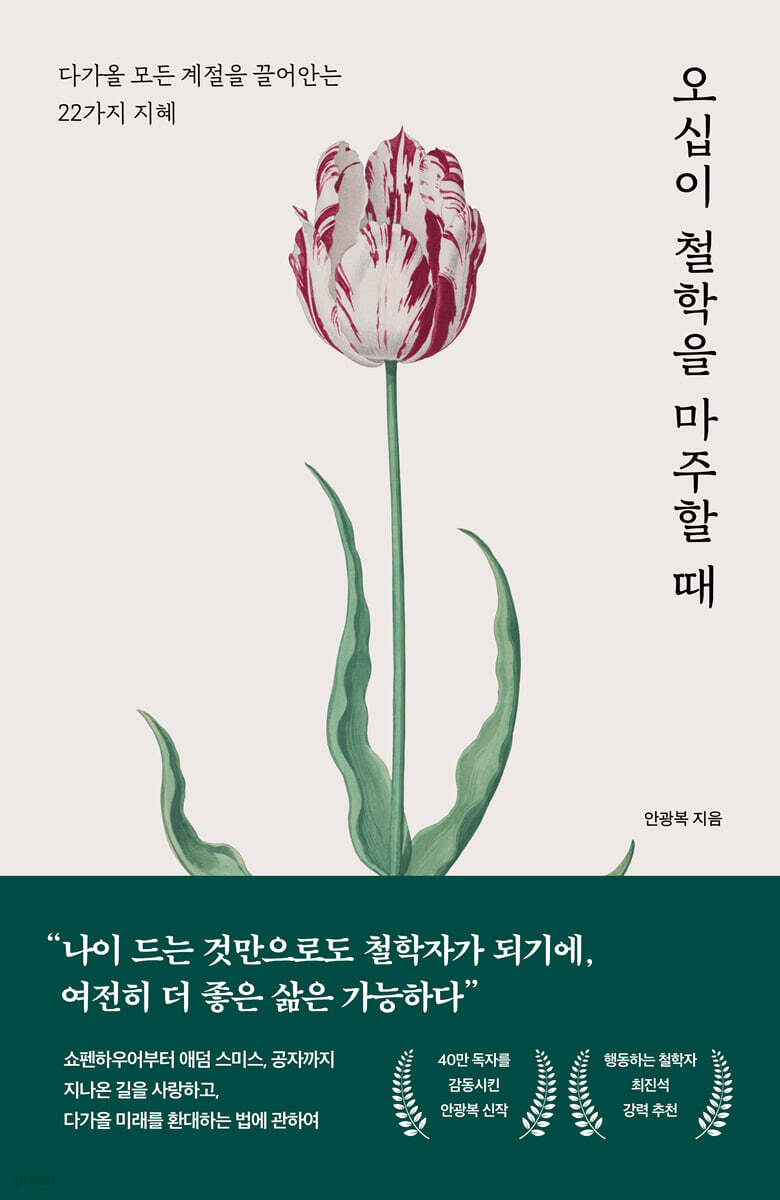
When fifty-two face philosophy
 |
Description
Book Introduction
★★★ Highly recommended by Philosopher Jinseok Choi! ★★★
“The age when the inner tree begins to bear fruit,
“I decided to create the pinnacle of my life in the most authentic way possible.”
To you who only ran without rest
A midlife philosophy class that presents a rich life narrative
Ahn Gwang-bok, a first-generation philosophy teacher in Korea and CEO of SERI, considered the best humanities teacher, has returned with his new book, "When Fifty-Two Face Philosophy."
This is a philosophical essay that offers wisdom to readers facing a midlife crisis.
This article, which had been a hot topic among readers in their forties and fifties even before its publication and was serialized in “Hankyoreh 21” and “Monthly Country Life,” has now been reborn as a book along with 26 beautiful paintings.
An Gwang-bok, who studies endlessly with the belief that he “writes to find the wisdom and knowledge I desperately need,” honestly addresses the concerns he experienced while overcoming the midlife crisis, including anxiety, emptiness, futility, and loneliness.
And in this process, the wisdom gained is carefully woven into each season of life.
Middle age, the midpoint of one's life, is often called the 'autumn of life.'
However, in this book, the author says that even in one's fifties, there is spring, summer, fall, and winter, and conveys 22 attitudes toward life that will love all the seasons to come.
“When you encounter philosophy, you can experience the ecstatic state of becoming your own North Star.” Philosopher Jinseok Choi, who is an active philosopher, strongly recommends that you encounter philosophy right now through this book.
For readers who regret having lived a life of inadequacy, and for middle-aged people who feel depressed at the thought that their prime is over, this book will give them the courage to love the path they have taken and welcome the future that lies ahead.
“The age when the inner tree begins to bear fruit,
“I decided to create the pinnacle of my life in the most authentic way possible.”
To you who only ran without rest
A midlife philosophy class that presents a rich life narrative
Ahn Gwang-bok, a first-generation philosophy teacher in Korea and CEO of SERI, considered the best humanities teacher, has returned with his new book, "When Fifty-Two Face Philosophy."
This is a philosophical essay that offers wisdom to readers facing a midlife crisis.
This article, which had been a hot topic among readers in their forties and fifties even before its publication and was serialized in “Hankyoreh 21” and “Monthly Country Life,” has now been reborn as a book along with 26 beautiful paintings.
An Gwang-bok, who studies endlessly with the belief that he “writes to find the wisdom and knowledge I desperately need,” honestly addresses the concerns he experienced while overcoming the midlife crisis, including anxiety, emptiness, futility, and loneliness.
And in this process, the wisdom gained is carefully woven into each season of life.
Middle age, the midpoint of one's life, is often called the 'autumn of life.'
However, in this book, the author says that even in one's fifties, there is spring, summer, fall, and winter, and conveys 22 attitudes toward life that will love all the seasons to come.
“When you encounter philosophy, you can experience the ecstatic state of becoming your own North Star.” Philosopher Jinseok Choi, who is an active philosopher, strongly recommends that you encounter philosophy right now through this book.
For readers who regret having lived a life of inadequacy, and for middle-aged people who feel depressed at the thought that their prime is over, this book will give them the courage to love the path they have taken and welcome the future that lies ahead.
- You can preview some of the book's contents.
Preview
index
Recommendation _Jinseok Choi (Principal of Saemal Saemomjit Elementary School)
Prologue _Just getting older makes you a philosopher
1.
Spring: The Courage to Let Go and Start Again
[Acceptance] Caring for the Shadows in Your Heart _Carl Jung
[Practice] Letting Go of Worries _『Heart Sutra』
[Freedom] A man you can kill but not defeat _Immanuel Kant
[Contemplation] It is not heavy unless you lift it _Arthur Schopenhauer
[Intellect] Where Does the Dignity of Fifty Come From? _Michel de Montaigne
2.
Summer: A Time to Satisfy Your Desires
[Power] There is no power that can overcome time _Epicurus
[Desire] To repeat the orgasmic experience _Abraham Maslow
[Lust] How to Overcome the Storm of Emotions _ Cicero
[Training] Freedom from Wealth and Fame _ Epictetus
[Premier] Let what will happen happen _Marcus Aurelius
3.
Autumn: Growth Called Maturity
[Quiet] A Life That Resembles Nature _ Alain de Botton
[Will] As long as there is a dream, life is still passionate _Pascal Brückner
[Sincerity] Even if you fail, try to be a good person. _Confucius
[Honesty] The Secret of People Who Are Respected Everywhere _Adam Smith
[Exclamation] Rediscovering the Wonder of Life _Dakker Keltner
[Happiness] The best is yet to come _Jonathan Rausch
4.
Winter: Wisdom Deepened by Reflection
[Conformity] Don't argue with fate _Seneca
[Exploration] Restoring Intellectual Curiosity _Bertrand Russell
[Frugality] How to Be Elegantly Poor _Epicurus
[Growth] Don't Regress to the Old Ones _ Aristotle
[Change] How Roots Are Made _Simone Weil
[Hope] What kind of old man do you want to be? _Hermann Hesse
Epilogue: A Better Life Is Still Possible
main
Image source
Prologue _Just getting older makes you a philosopher
1.
Spring: The Courage to Let Go and Start Again
[Acceptance] Caring for the Shadows in Your Heart _Carl Jung
[Practice] Letting Go of Worries _『Heart Sutra』
[Freedom] A man you can kill but not defeat _Immanuel Kant
[Contemplation] It is not heavy unless you lift it _Arthur Schopenhauer
[Intellect] Where Does the Dignity of Fifty Come From? _Michel de Montaigne
2.
Summer: A Time to Satisfy Your Desires
[Power] There is no power that can overcome time _Epicurus
[Desire] To repeat the orgasmic experience _Abraham Maslow
[Lust] How to Overcome the Storm of Emotions _ Cicero
[Training] Freedom from Wealth and Fame _ Epictetus
[Premier] Let what will happen happen _Marcus Aurelius
3.
Autumn: Growth Called Maturity
[Quiet] A Life That Resembles Nature _ Alain de Botton
[Will] As long as there is a dream, life is still passionate _Pascal Brückner
[Sincerity] Even if you fail, try to be a good person. _Confucius
[Honesty] The Secret of People Who Are Respected Everywhere _Adam Smith
[Exclamation] Rediscovering the Wonder of Life _Dakker Keltner
[Happiness] The best is yet to come _Jonathan Rausch
4.
Winter: Wisdom Deepened by Reflection
[Conformity] Don't argue with fate _Seneca
[Exploration] Restoring Intellectual Curiosity _Bertrand Russell
[Frugality] How to Be Elegantly Poor _Epicurus
[Growth] Don't Regress to the Old Ones _ Aristotle
[Change] How Roots Are Made _Simone Weil
[Hope] What kind of old man do you want to be? _Hermann Hesse
Epilogue: A Better Life Is Still Possible
main
Image source
Into the book
During adolescence, emotions run wild.
Middle-aged people going through menopause are no different.
It means that there are many cases where I cannot control my own heart.
But there is a difference between the two.
During puberty, we want to grow faster, become more beautiful, and become stronger.
So, they put on a 'show'.
Middle-aged people also act tough.
With your physical strength gradually declining, your mind not working properly, you are gradually being pushed out of the workplace, your belly fat increasing, and your hair falling out, your confidence in your appearance will also plummet.
Despite their circumstances, middle-aged people are still showing off.
Still pretending to be strong and powerful, showing off and giving advice.
Their ‘old farts’ contain a desperate plea: “I’m not dead yet!”
Unfortunately, the flow of time cannot be reversed.
If you have presbyopia, you need to adjust your mind to your eyesight.
--- From “[Acceptance] Caring for the Shadows in Your Heart _ Carl Jung”
The philosophy of Arthur Schopenhauer has been popular in recent years.
Several books about him stand out on the comprehensive bestseller lists.
My heart is complicated when I see this.
This is because the term ‘pessimistic philosopher’ is attached to Schopenhauer like a nickname.
How can we be drawn to dark music when we are depressed, and how can a society that is drawn to dark philosophy be bright and healthy?
The average age in South Korea is 45.5 years old as of 2025.
This means that the entire society is at a point where it could fall into a 'midlife crisis'.
The emotions that sweep through middle age—anxiety, helplessness, jealousy, envy, and inexplicable anger—appear like keywords that describe the state of South Korea.
What wisdom can Schopenhauer offer to the unstable middle-aged society of South Korea?
--- From “[Contemplation] It is not heavy if you don’t lift it _Arthur Schopenhauer”
It's frowned upon to see a fully grown adult whining like a child.
The image of a middle-aged man trying to look young by dressing up to look young and trying to attract the attention of a young lover is no different.
The youth that leaves like this will never come back.
The feelings of love in middle age are like fallen leaves.
It means that it is flashy for a moment, but in the end it is destined to fall and roll on the floor.
Of course, middle-aged sex is just as intense as that of any young person.
The attraction between middle-aged people in similar situations can be as pure and sincere as puppy love.
But it's more like an addictive sedative that makes you forget reality.
Even though the passion for life is rekindled during the moment of sharing love, once that scene ends, we are left with anxiety and emptiness.
How many times has a desperate late love flowed into obsession and suspicion, and collapsed into an 'ugly love with a burning aftertaste'?
The emptiness of one's fifties cannot be filled with physical love.
It's the same reason why a young person's anxiety doesn't go away when he receives his favorite toy from childhood.
An empty heart must be filled in a way that is appropriate to one's age.
--- From “How to Overcome the Storm of Emotions _ Cicero”
When an organization is doing well, its managers are looked up to.
However, performance does not come from skill alone.
Don't coincidences and circumstances sometimes create success?
When his luck runs out and his fate falls into the abyss, the world laughs at him and curses him.
On the other hand, what about a manager who perseveres and does his job even in the midst of ruin?
Regardless of the outcome, he is respected and his reputation rarely changes over time.
Aurelius says:
“If Hercules had stayed in his house, lived in luxury, and slept comfortably, he would not have been Hercules.” This means to face the fate of suffering boldly.
A young rival openly mocked the weak, old, and novice commander as an 'old philosopher'.
But Aurelius didn't care.
I was only concerned with doing what I had to do according to the role given to me.
Youth is swayed by temptations and gnashes at insults.
However, middle-aged people who have reached the realm of wisdom only listen to the will of heaven.
--- From “Let What Will Happen Happen _ Marcus Aurelius”
According to Brückner, today's middle-aged people are 'a generation that has recreated their prime youth.'
Since then, life expectancy has increased significantly.
Now fifty is neither young nor old.
If so, aren't these people destined to "recreate their old age" in line with the expanded life cycle? Looking at the population structure, those in their fifties are the largest demographic, making them a strong contender for the mainstream of society.
So what should we do now?
I need to look into my own condition first.
I am not the master of my body now.
When I push through the stiffness and pain without embracing it, my body definitely takes revenge on my daily routine.
So middle-aged people constantly ask themselves:
“Not everything is possible now.
“So what can I hope for? What more can I know?” This is a philosophical question that Kant once posed.
This is why Brückner says that we become philosophers of our own lives simply by growing old.
To plan our lives after fifty, we must find answers to these questions.
--- From “[Will] As long as there is a dream, life is still passionate _ Pascal Brückner”
Awe does not stop at the desire to become one with others.
According to Keltner, human society relies on 'traditional ecological knowledge'.
There is a saying, “There is no bad person who likes mountains.”
It seems that this is not just a collusion between mountaineers.
When we see the vast fields, majestic mountains, and vast seas, our hearts become infinitely generous.
Traditional ecological knowledge awakens the wisdom that humans are part of nature.
There is no society that neglects the sublimity and preciousness of nature.
Whenever people have the chance, they try to feel and experience nature.
This is also because it is a human instinct that is part of nature.
When we look at people and the world from the mother's embrace called the universe, our way of approaching life also changes.
You become more tolerant and open to things you don't know.
What if everyday life feels burdensome and meaningless, like the repetitive, monotonous blows of a heavy hammer? You subconsciously know what to do.
I just can't do it.
Middle-aged people going through menopause are no different.
It means that there are many cases where I cannot control my own heart.
But there is a difference between the two.
During puberty, we want to grow faster, become more beautiful, and become stronger.
So, they put on a 'show'.
Middle-aged people also act tough.
With your physical strength gradually declining, your mind not working properly, you are gradually being pushed out of the workplace, your belly fat increasing, and your hair falling out, your confidence in your appearance will also plummet.
Despite their circumstances, middle-aged people are still showing off.
Still pretending to be strong and powerful, showing off and giving advice.
Their ‘old farts’ contain a desperate plea: “I’m not dead yet!”
Unfortunately, the flow of time cannot be reversed.
If you have presbyopia, you need to adjust your mind to your eyesight.
--- From “[Acceptance] Caring for the Shadows in Your Heart _ Carl Jung”
The philosophy of Arthur Schopenhauer has been popular in recent years.
Several books about him stand out on the comprehensive bestseller lists.
My heart is complicated when I see this.
This is because the term ‘pessimistic philosopher’ is attached to Schopenhauer like a nickname.
How can we be drawn to dark music when we are depressed, and how can a society that is drawn to dark philosophy be bright and healthy?
The average age in South Korea is 45.5 years old as of 2025.
This means that the entire society is at a point where it could fall into a 'midlife crisis'.
The emotions that sweep through middle age—anxiety, helplessness, jealousy, envy, and inexplicable anger—appear like keywords that describe the state of South Korea.
What wisdom can Schopenhauer offer to the unstable middle-aged society of South Korea?
--- From “[Contemplation] It is not heavy if you don’t lift it _Arthur Schopenhauer”
It's frowned upon to see a fully grown adult whining like a child.
The image of a middle-aged man trying to look young by dressing up to look young and trying to attract the attention of a young lover is no different.
The youth that leaves like this will never come back.
The feelings of love in middle age are like fallen leaves.
It means that it is flashy for a moment, but in the end it is destined to fall and roll on the floor.
Of course, middle-aged sex is just as intense as that of any young person.
The attraction between middle-aged people in similar situations can be as pure and sincere as puppy love.
But it's more like an addictive sedative that makes you forget reality.
Even though the passion for life is rekindled during the moment of sharing love, once that scene ends, we are left with anxiety and emptiness.
How many times has a desperate late love flowed into obsession and suspicion, and collapsed into an 'ugly love with a burning aftertaste'?
The emptiness of one's fifties cannot be filled with physical love.
It's the same reason why a young person's anxiety doesn't go away when he receives his favorite toy from childhood.
An empty heart must be filled in a way that is appropriate to one's age.
--- From “How to Overcome the Storm of Emotions _ Cicero”
When an organization is doing well, its managers are looked up to.
However, performance does not come from skill alone.
Don't coincidences and circumstances sometimes create success?
When his luck runs out and his fate falls into the abyss, the world laughs at him and curses him.
On the other hand, what about a manager who perseveres and does his job even in the midst of ruin?
Regardless of the outcome, he is respected and his reputation rarely changes over time.
Aurelius says:
“If Hercules had stayed in his house, lived in luxury, and slept comfortably, he would not have been Hercules.” This means to face the fate of suffering boldly.
A young rival openly mocked the weak, old, and novice commander as an 'old philosopher'.
But Aurelius didn't care.
I was only concerned with doing what I had to do according to the role given to me.
Youth is swayed by temptations and gnashes at insults.
However, middle-aged people who have reached the realm of wisdom only listen to the will of heaven.
--- From “Let What Will Happen Happen _ Marcus Aurelius”
According to Brückner, today's middle-aged people are 'a generation that has recreated their prime youth.'
Since then, life expectancy has increased significantly.
Now fifty is neither young nor old.
If so, aren't these people destined to "recreate their old age" in line with the expanded life cycle? Looking at the population structure, those in their fifties are the largest demographic, making them a strong contender for the mainstream of society.
So what should we do now?
I need to look into my own condition first.
I am not the master of my body now.
When I push through the stiffness and pain without embracing it, my body definitely takes revenge on my daily routine.
So middle-aged people constantly ask themselves:
“Not everything is possible now.
“So what can I hope for? What more can I know?” This is a philosophical question that Kant once posed.
This is why Brückner says that we become philosophers of our own lives simply by growing old.
To plan our lives after fifty, we must find answers to these questions.
--- From “[Will] As long as there is a dream, life is still passionate _ Pascal Brückner”
Awe does not stop at the desire to become one with others.
According to Keltner, human society relies on 'traditional ecological knowledge'.
There is a saying, “There is no bad person who likes mountains.”
It seems that this is not just a collusion between mountaineers.
When we see the vast fields, majestic mountains, and vast seas, our hearts become infinitely generous.
Traditional ecological knowledge awakens the wisdom that humans are part of nature.
There is no society that neglects the sublimity and preciousness of nature.
Whenever people have the chance, they try to feel and experience nature.
This is also because it is a human instinct that is part of nature.
When we look at people and the world from the mother's embrace called the universe, our way of approaching life also changes.
You become more tolerant and open to things you don't know.
What if everyday life feels burdensome and meaningless, like the repetitive, monotonous blows of a heavy hammer? You subconsciously know what to do.
I just can't do it.
--- From “[Exclamation] Recovering the Wonder of Life _Dakker Keltner”
Publisher's Review
“Just getting older makes you a philosopher,
“A better life is still possible”
Twenty-two philosophy lessons to complete the narrative of a rich life in middle age.
Many people call middle age the 'autumn of life,' but within that there are spring, summer, autumn, and winter.
Being middle-aged doesn't mean you only have a cold winter ahead of you. It means you're still dreaming, sowing seeds, farming, harvesting, and moving forward while waiting for the next spring.
Of course, the seasons of your fifties are different from before.
If the season of youth in your twenties flows with excitement toward infinite possibilities, your fifties flow with quiet ripening toward inner maturity.
Ahn Gwang-bok, a first-generation philosophy teacher in Korea and CEO of SERI, considered one of the best humanities teachers, shares the wisdom of philosophy that will enrich the season of fifty in this new work.
This is intelligent advice for those who are burdened by their physical and mental health declining day by day, situations where they are constantly pushed out of important tasks, increasing belly fat and wrinkles, and emotions that jump around several times a day.
The author recalls the concerns he had as he crossed the threshold of his fifties and seeks answers one by one from the voices of 21 Eastern and Western philosophers, from Schopenhauer to Adam Smith and Confucius.
As one of Korea's first-generation philosophy teachers, Ahn Gwang-bok has taught students for nearly 30 years and, as CEO of SERI, has been responsible for nurturing the humanities knowledge of Korea's top leaders for over 10 years. In this book, he demonstrates the essence of "everyday philosophy."
Professor Jin-Seok Choi, who strongly recommended this book, sympathizes with the midlife crisis, saying, “If you live to be fifty, at some point you may start to feel anxious about whether you are just existing like a street tree or a telephone pole, or whether you will live like this until you die.”
He then advises us to overcome the crisis with philosophy.
"When you encounter philosophy, you can experience the ecstatic state of becoming your own North Star, and becoming your own flag, fluttering by your own wings." If you are a middle-aged person who has been running tirelessly and has neglected to take care of yourself, this book will be the beginning of creating the pinnacle of your life in the most authentic way.
“Whether my life is good or not depends on me.”
A time of self-care with beautiful masterpieces
An Gwang-bok delicately draws from Eastern and Western philosophy the 22 attitudes necessary to cultivate the fifty seasons.
These are ways to 'accept' the shadow of myself that I didn't know about, 'courageously' put down the desires of my youthful days, and 'train' myself not to be swayed by the world.
It guides readers on the path to maturity, accepting reality without being discouraged, and dreaming new dreams without being trapped by greed.
This wisdom resonates even more deeply because it comes from the author's own intimate concerns.
As a father and office worker who has endured the burden of earning a living, as a clinical philosopher who practices 'philosophizing in everyday life,' and as a person in his fifties, I bring out the anxiety, emptiness, futility, and loneliness that shake my heart several times a day.
The stories of philosophers in their fifties told by the author are also interesting.
Immanuel Kant finally became a professor at the age of forty-six after fourteen years of teaching without a steady salary.
Even though it was a job he had worked so hard to obtain, he had to submit to the king's authority as a 'national civil servant' while being an enlightened person who followed equality and reason.
It seems that the wind and reality are at odds.
Yet, Kant lives his own life freely.
It was thanks to the fact that I knew how to follow the organization's judgment during work hours, but outside of that, I knew how to express my thoughts as a 'free person'.
It is the wisdom to gain ‘freedom’ even in the midst of the hardships of earning a living.
The book is full of philosophical wisdom that allows us to live true to ourselves, rather than losing ourselves, even in moments when life approaches us with pain.
Moreover, it goes beyond simply providing insight, providing readers with the opportunity to contemplate deeply alongside beautiful masterpieces.
The 26 famous paintings included in the book are from the collections of the Metropolitan Museum of Art, the Cleveland Museum of Art, and the National Gallery of Art, among others, and leave a deep impression along with the emotion conveyed by the text.
If you've been so busy with family and work that you've been running ahead without looking back at your true self, try renewing the second half of your life through philosophy.
It is about enjoying the seasons that can only be experienced at fifty.
As you go through spring, a time of letting go and starting again, summer, a time of yearning, autumn, a time of maturity, and winter, a time of deep reflection, you will come face to face with yourself, complete and fulfilled as you are.
“A better life is still possible”
Twenty-two philosophy lessons to complete the narrative of a rich life in middle age.
Many people call middle age the 'autumn of life,' but within that there are spring, summer, autumn, and winter.
Being middle-aged doesn't mean you only have a cold winter ahead of you. It means you're still dreaming, sowing seeds, farming, harvesting, and moving forward while waiting for the next spring.
Of course, the seasons of your fifties are different from before.
If the season of youth in your twenties flows with excitement toward infinite possibilities, your fifties flow with quiet ripening toward inner maturity.
Ahn Gwang-bok, a first-generation philosophy teacher in Korea and CEO of SERI, considered one of the best humanities teachers, shares the wisdom of philosophy that will enrich the season of fifty in this new work.
This is intelligent advice for those who are burdened by their physical and mental health declining day by day, situations where they are constantly pushed out of important tasks, increasing belly fat and wrinkles, and emotions that jump around several times a day.
The author recalls the concerns he had as he crossed the threshold of his fifties and seeks answers one by one from the voices of 21 Eastern and Western philosophers, from Schopenhauer to Adam Smith and Confucius.
As one of Korea's first-generation philosophy teachers, Ahn Gwang-bok has taught students for nearly 30 years and, as CEO of SERI, has been responsible for nurturing the humanities knowledge of Korea's top leaders for over 10 years. In this book, he demonstrates the essence of "everyday philosophy."
Professor Jin-Seok Choi, who strongly recommended this book, sympathizes with the midlife crisis, saying, “If you live to be fifty, at some point you may start to feel anxious about whether you are just existing like a street tree or a telephone pole, or whether you will live like this until you die.”
He then advises us to overcome the crisis with philosophy.
"When you encounter philosophy, you can experience the ecstatic state of becoming your own North Star, and becoming your own flag, fluttering by your own wings." If you are a middle-aged person who has been running tirelessly and has neglected to take care of yourself, this book will be the beginning of creating the pinnacle of your life in the most authentic way.
“Whether my life is good or not depends on me.”
A time of self-care with beautiful masterpieces
An Gwang-bok delicately draws from Eastern and Western philosophy the 22 attitudes necessary to cultivate the fifty seasons.
These are ways to 'accept' the shadow of myself that I didn't know about, 'courageously' put down the desires of my youthful days, and 'train' myself not to be swayed by the world.
It guides readers on the path to maturity, accepting reality without being discouraged, and dreaming new dreams without being trapped by greed.
This wisdom resonates even more deeply because it comes from the author's own intimate concerns.
As a father and office worker who has endured the burden of earning a living, as a clinical philosopher who practices 'philosophizing in everyday life,' and as a person in his fifties, I bring out the anxiety, emptiness, futility, and loneliness that shake my heart several times a day.
The stories of philosophers in their fifties told by the author are also interesting.
Immanuel Kant finally became a professor at the age of forty-six after fourteen years of teaching without a steady salary.
Even though it was a job he had worked so hard to obtain, he had to submit to the king's authority as a 'national civil servant' while being an enlightened person who followed equality and reason.
It seems that the wind and reality are at odds.
Yet, Kant lives his own life freely.
It was thanks to the fact that I knew how to follow the organization's judgment during work hours, but outside of that, I knew how to express my thoughts as a 'free person'.
It is the wisdom to gain ‘freedom’ even in the midst of the hardships of earning a living.
The book is full of philosophical wisdom that allows us to live true to ourselves, rather than losing ourselves, even in moments when life approaches us with pain.
Moreover, it goes beyond simply providing insight, providing readers with the opportunity to contemplate deeply alongside beautiful masterpieces.
The 26 famous paintings included in the book are from the collections of the Metropolitan Museum of Art, the Cleveland Museum of Art, and the National Gallery of Art, among others, and leave a deep impression along with the emotion conveyed by the text.
If you've been so busy with family and work that you've been running ahead without looking back at your true self, try renewing the second half of your life through philosophy.
It is about enjoying the seasons that can only be experienced at fifty.
As you go through spring, a time of letting go and starting again, summer, a time of yearning, autumn, a time of maturity, and winter, a time of deep reflection, you will come face to face with yourself, complete and fulfilled as you are.
GOODS SPECIFICS
- Date of issue: September 3, 2025
- Page count, weight, size: 272 pages | 388g | 133*204*17mm
- ISBN13: 9791130669700
- ISBN10: 113066970X
You may also like
카테고리
korean


korean

![GQ KOREA Mark (Monthly): December [2025]](http://librairie.coreenne.fr/cdn/shop/files/8ef265dbbfbf186523ed75ba7319009d.jpg?v=1765340328&width=3840)


