

Carl Jung's Memory Dream Thought
 |
Description
Book Introduction
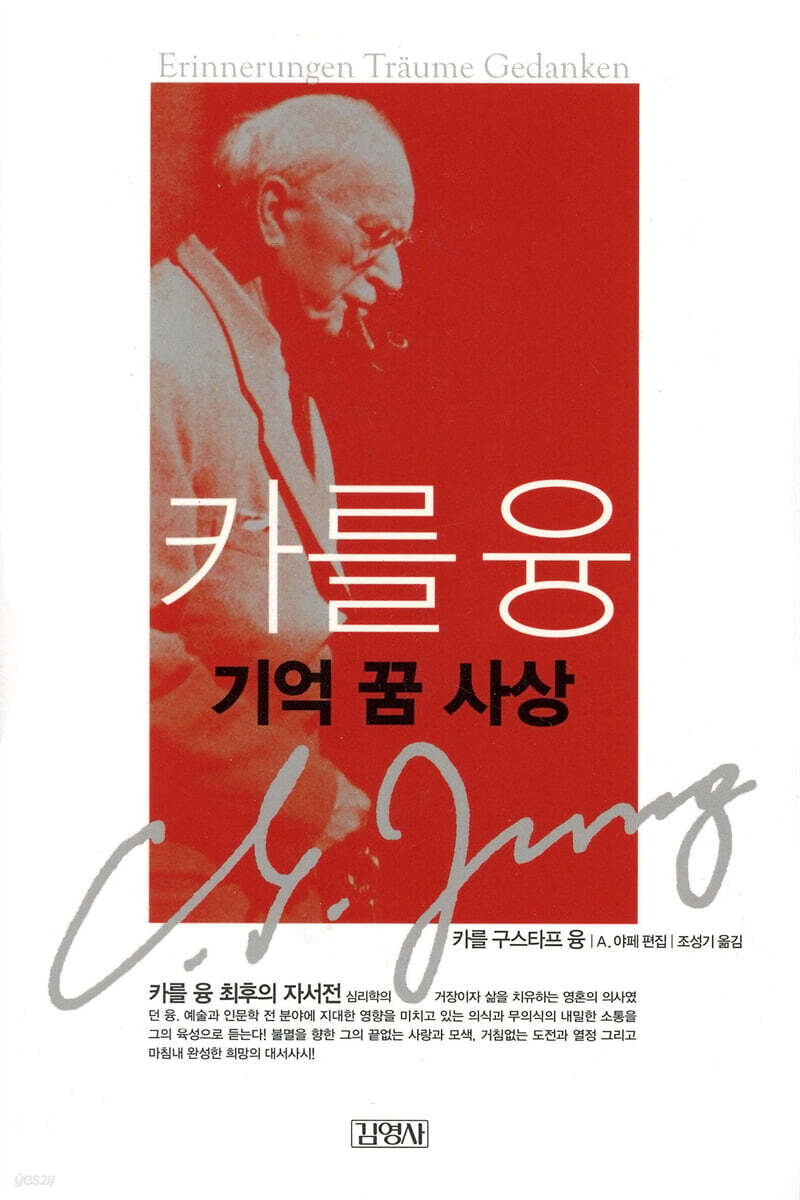
"Carl Jung's Memory, Dreams, and Thought" is the final autobiography of Carl Jung, a master of psychology and a soul-healing doctor who was extremely reluctant to come out into the living world.
My life is the history of unconscious self-realization - Carl Jung
This book is an autobiography compiled by Aniela Yaffe, who was Jung's disciple and secretary, and who had continuous conversations with him for nearly five years starting in 1957 when Jung was 82 years old. It is said that Jung edited every single sentence of the book.
The autobiography vividly describes the memories of childhood that remain vivid even after he is over eighty, the dreams that have captivated him throughout his life, and the visions he experienced before death, and meticulously depicts the process of analyzing and bringing them into consciousness.
Carl Jung says that external events cannot replace internal experiences.
In line with Jung's view, the autobiography focuses on inner events and is a book that deals with the peculiarities of Carl Jung's own life.
My life is the history of unconscious self-realization - Carl Jung
This book is an autobiography compiled by Aniela Yaffe, who was Jung's disciple and secretary, and who had continuous conversations with him for nearly five years starting in 1957 when Jung was 82 years old. It is said that Jung edited every single sentence of the book.
The autobiography vividly describes the memories of childhood that remain vivid even after he is over eighty, the dreams that have captivated him throughout his life, and the visions he experienced before death, and meticulously depicts the process of analyzing and bringing them into consciousness.
Carl Jung says that external events cannot replace internal experiences.
In line with Jung's view, the autobiography focuses on inner events and is a book that deals with the peculiarities of Carl Jung's own life.
- You can preview some of the book's contents.
Preview
index
Translator's Preface - The Pinnacle of Autobiographical Literature
prolog
A Lifelong Dream - Childhood
Now the rebel is near - School days
Beautiful Times - College Days
Only the wounded can heal others!
Encounter with Freud
The Anima within me
Discovering Alchemy
Ah, two souls live in my heart
travel
illusions
About life after death
The thought of ten thousand years
retrospect
Editor's Note
prolog
A Lifelong Dream - Childhood
Now the rebel is near - School days
Beautiful Times - College Days
Only the wounded can heal others!
Encounter with Freud
The Anima within me
Discovering Alchemy
Ah, two souls live in my heart
travel
illusions
About life after death
The thought of ten thousand years
retrospect
Editor's Note
Into the book
I can never forget that moment.
Because the eternity of my childhood dawned on me like a flash of lightning.
What this 'eternity' meant became clear to me when I was ten years old.
My discord with myself and the uncertainty of the vast world led me to take actions that didn't make sense at the time. ---p.48
At last I have come to the realization that there is and has always been someone who understands evil and its grip on the world, and furthermore, who understands the mysterious role that evil plays in saving humanity from darkness and suffering.
In that respect, Goethe was a prophet to me.
However, it was unforgivable that he had destroyed Mephistopheles in an instant through simple play or magic.
It seemed to me too theological, too frivolous, and too irresponsible.
I deeply regret that even Goethe fell into the cunning argument that evil is harmless. ---p.118
If you opened a door for me, you would slam it shut.
The door remained firmly closed for a long time.
I felt like an old farmer who discovered that two cows were under a goblin's spell and their heads were tied to the same rein.
The farmer's young son asked how such a thing could happen.
The farmer answered.
“Hey, that’s not what I’m talking about.”---p.201
What first impressed me was the negative aspect of the anima.
I felt a little intimidated in front of her, whom I could not see but felt was there.
I tried to relate to her differently, treating my fantasies as my letters to her.
It was like sending a letter to a part of myself that took a different perspective than my own.
But I received an unexpected and peculiar reply.
I felt like a patient being analyzed by a feminine spirit! ---p.340
As our minds need, the Middle Ages, Antiquity, and Primitive Ages are not yet over for us.
But on the contrary, we are being swept up in the category of development---p.奔流) and are being pushed towards the future with rough violence, and the more we do so, the more we are separated from our roots.
Once something old is destroyed, it usually disappears altogether.
And the destructive advance never ceases.
But it is precisely this loss of relationship, this disconnection from the source, that gives rise to 'irritability and impatience within the culture.'
So instead of living in the present, where the history of development is not yet fully complete, people live in the future, relying on the absurd promise of a golden age.
People are rushing towards something new without restraint, gripped by a deepening sense of need, dissatisfaction, and impatience.
Because the eternity of my childhood dawned on me like a flash of lightning.
What this 'eternity' meant became clear to me when I was ten years old.
My discord with myself and the uncertainty of the vast world led me to take actions that didn't make sense at the time. ---p.48
At last I have come to the realization that there is and has always been someone who understands evil and its grip on the world, and furthermore, who understands the mysterious role that evil plays in saving humanity from darkness and suffering.
In that respect, Goethe was a prophet to me.
However, it was unforgivable that he had destroyed Mephistopheles in an instant through simple play or magic.
It seemed to me too theological, too frivolous, and too irresponsible.
I deeply regret that even Goethe fell into the cunning argument that evil is harmless. ---p.118
If you opened a door for me, you would slam it shut.
The door remained firmly closed for a long time.
I felt like an old farmer who discovered that two cows were under a goblin's spell and their heads were tied to the same rein.
The farmer's young son asked how such a thing could happen.
The farmer answered.
“Hey, that’s not what I’m talking about.”---p.201
What first impressed me was the negative aspect of the anima.
I felt a little intimidated in front of her, whom I could not see but felt was there.
I tried to relate to her differently, treating my fantasies as my letters to her.
It was like sending a letter to a part of myself that took a different perspective than my own.
But I received an unexpected and peculiar reply.
I felt like a patient being analyzed by a feminine spirit! ---p.340
As our minds need, the Middle Ages, Antiquity, and Primitive Ages are not yet over for us.
But on the contrary, we are being swept up in the category of development---p.奔流) and are being pushed towards the future with rough violence, and the more we do so, the more we are separated from our roots.
Once something old is destroyed, it usually disappears altogether.
And the destructive advance never ceases.
But it is precisely this loss of relationship, this disconnection from the source, that gives rise to 'irritability and impatience within the culture.'
So instead of living in the present, where the history of development is not yet fully complete, people live in the future, relying on the absurd promise of a golden age.
People are rushing towards something new without restraint, gripped by a deepening sense of need, dissatisfaction, and impatience.
---p.421
Publisher's Review
The final autobiography that completes Jung's thoughts and life!
An exciting introduction to his world of thought!
This autobiography can be said to contain the essence of Jung's thoughts and life.
Aniela Yaffe, Jung's disciple and secretary, had conversations with him for nearly five years, starting in 1957 when he was 82, and Jung revised the text sentence by sentence.
If the self, which lies deep within the unconscious, is the archetypal world containing the collective unconscious, the more superficial ego is the world of consciousness and discernment.
Modern people living in the kingdom of reason mistakenly believe that the world of the ego is everything, but it is not our center.
The world of the circle, that is, the self, is constantly trying to convey its voice to the ego.
The medium is the symbols of dreams.
Dreams are the place where the world beyond me and my world connect, the place where the unconscious and the conscious are integrated, the place where the damaged life of the civilized world is completely restored.
Throughout this book, Jung vividly demonstrates his process of analyzing his own dreams and fantasies and those of many others, and in doing so, he captures the signals he sends to his ego.
This autobiography, which shows just how deep and wide the human mind can be, movingly describes the trajectory of Jung's life as he formed his own thoughts and analytical psychology.
Already in his childhood, Jung recognized the beauty of the bright daylight world, with golden sunlight filtering through green leaves, while at the same time foreseeing a world of inescapable darkness, filled with frightening and difficult-to-answer questions.
During his school days, he felt uneasy with his math teacher who insisted that algebra was self-evident, and he began to question the Bible and God, seeking answers in Goethe, Kant, Schopenhauer, and natural science. During his college years, he became impoverished after his father's death, but he read Nietzsche and eventually entered the path of psychiatry.
The story of a great man who achieved the integration of consciousness and unconsciousness, including the process of gaining fame as a famous doctor like a magician, opening up a new path in psychiatry by analyzing the dreams and fantasies of countless patients, his meeting and breakup with Freud, his approach to the truth of the human mind through myth and fantasy, his exploration of the 'problem of God' related to the immortality of the mind and the 'problem of death' related to the extinction of the mind, and the discovery of alchemy, is fully revealed.
Although Jung's autobiography has been translated and published in Korea several times before, it is not easy to accurately translate the life and thoughts of Carl Jung, which crosses not only medicine and natural science, which form the foundation of psychology, but also history, mythology, theology, and alchemy, into another language.
Jo Seong-gi, a novelist of our time, is the perfect translator for this book, not only because of his foreign language skills but also his knowledge of all humanities, his ability to use accurate Korean sentences, and his experience of conflict with God like Carl Jung. He has produced the definitive translation of Carl Jung's autobiography.
An exciting introduction to his world of thought!
This autobiography can be said to contain the essence of Jung's thoughts and life.
Aniela Yaffe, Jung's disciple and secretary, had conversations with him for nearly five years, starting in 1957 when he was 82, and Jung revised the text sentence by sentence.
If the self, which lies deep within the unconscious, is the archetypal world containing the collective unconscious, the more superficial ego is the world of consciousness and discernment.
Modern people living in the kingdom of reason mistakenly believe that the world of the ego is everything, but it is not our center.
The world of the circle, that is, the self, is constantly trying to convey its voice to the ego.
The medium is the symbols of dreams.
Dreams are the place where the world beyond me and my world connect, the place where the unconscious and the conscious are integrated, the place where the damaged life of the civilized world is completely restored.
Throughout this book, Jung vividly demonstrates his process of analyzing his own dreams and fantasies and those of many others, and in doing so, he captures the signals he sends to his ego.
This autobiography, which shows just how deep and wide the human mind can be, movingly describes the trajectory of Jung's life as he formed his own thoughts and analytical psychology.
Already in his childhood, Jung recognized the beauty of the bright daylight world, with golden sunlight filtering through green leaves, while at the same time foreseeing a world of inescapable darkness, filled with frightening and difficult-to-answer questions.
During his school days, he felt uneasy with his math teacher who insisted that algebra was self-evident, and he began to question the Bible and God, seeking answers in Goethe, Kant, Schopenhauer, and natural science. During his college years, he became impoverished after his father's death, but he read Nietzsche and eventually entered the path of psychiatry.
The story of a great man who achieved the integration of consciousness and unconsciousness, including the process of gaining fame as a famous doctor like a magician, opening up a new path in psychiatry by analyzing the dreams and fantasies of countless patients, his meeting and breakup with Freud, his approach to the truth of the human mind through myth and fantasy, his exploration of the 'problem of God' related to the immortality of the mind and the 'problem of death' related to the extinction of the mind, and the discovery of alchemy, is fully revealed.
Although Jung's autobiography has been translated and published in Korea several times before, it is not easy to accurately translate the life and thoughts of Carl Jung, which crosses not only medicine and natural science, which form the foundation of psychology, but also history, mythology, theology, and alchemy, into another language.
Jo Seong-gi, a novelist of our time, is the perfect translator for this book, not only because of his foreign language skills but also his knowledge of all humanities, his ability to use accurate Korean sentences, and his experience of conflict with God like Carl Jung. He has produced the definitive translation of Carl Jung's autobiography.
GOODS SPECIFICS
- Date of issue: December 4, 2007
- Format: Hardcover book binding method guide
- Page count, weight, size: 660 pages | 776g | 135*200*35mm
- ISBN13: 9788934927648
- ISBN10: 893492764X
You may also like
카테고리
korean


korean

![GQ KOREA Mark (Monthly): December [2025]](http://librairie.coreenne.fr/cdn/shop/files/8ef265dbbfbf186523ed75ba7319009d.jpg?v=1765340328&width=3840)


