

The Selfish Gene
 |
Description
Book Introduction
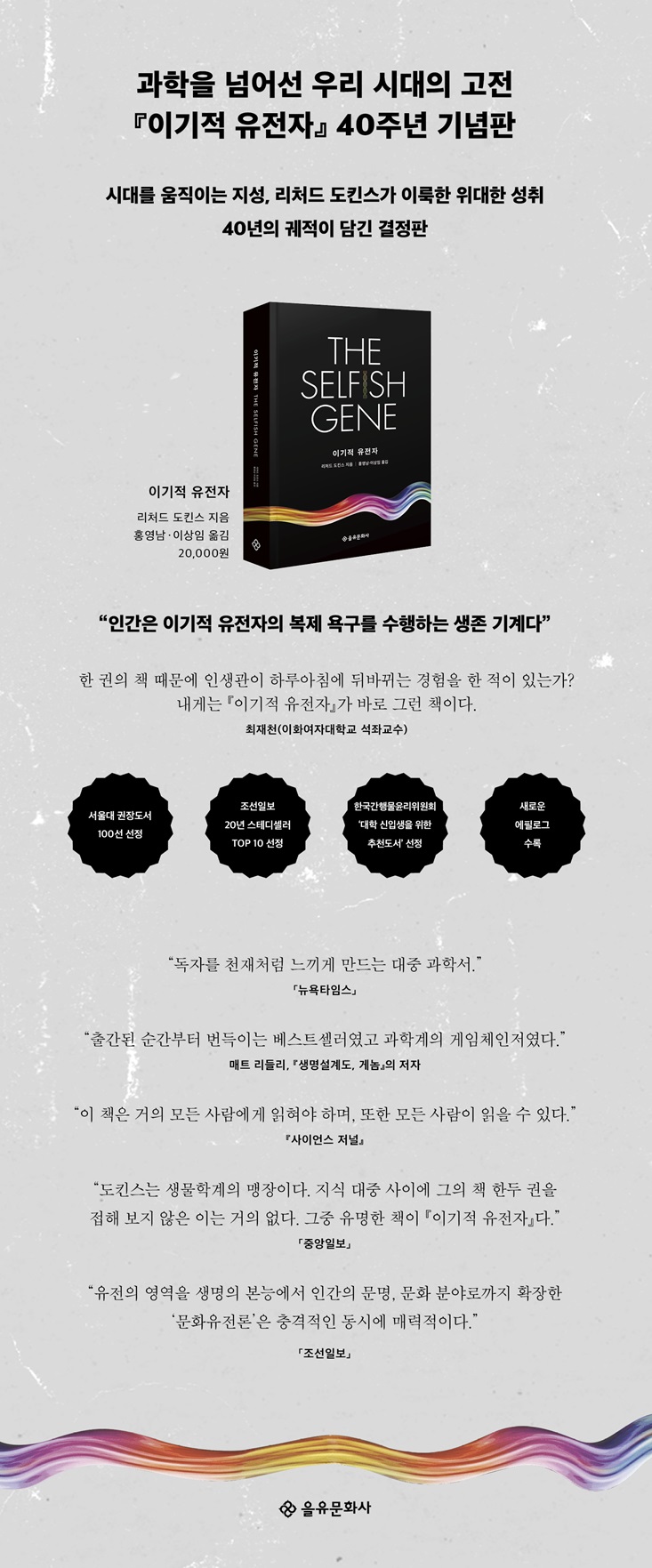
A classic of our time, transcending science: The Selfish Gene, 40th Anniversary Edition
Includes Richard Dawkins' 'New Epilogue' A global bestseller reborn with a new design The 40th anniversary edition of "The Selfish Gene," a masterpiece by world-renowned scholar Richard Dawkins, who opened new horizons in modern biology, has been published. This book, which presents a new paradigm for the theory of evolution, explains evolution by bringing Darwin's concept of 'survival of the fittest and natural selection' down to the genetic level. Dawkins, who was ranked first in the 'World's Greatest Intellectual' poll by the British political commentary magazine Prospect in 2013, has been recognized as a promising young scientist for his concise writing style, vivid metaphors, and logical development. Dawkins began to connect his research in animal ethology to the broader theoretical context of the central role of genes in evolutionary history, resulting in The Selfish Gene (first published in 1976, revised in 1989, 30th anniversary edition in 2006, 40th anniversary edition in 2016). When it was first published, The Selfish Gene caused an explosive sensation among both the scientific community and the general public, emerging as the controversial work of the century. In addition to its innovative insights, this book also displays outstanding writing skills and clear structure that captivate the human mind, and is worthy of being called the bible of science textbooks. As Professor Choi Jae-cheon of Ewha Womans University once said, "Have you ever had an experience where a book completely changed your outlook on life? For me, 'The Selfish Gene' is that book." This book, more than just a science book, raises fundamental questions about human nature and resonates deeply with readers, establishing itself as a must-read at some point in life. Now, Korean readers can also enjoy the latest edition of "The Selfish Gene," a book whose importance and depth have been further solidified over the past 40 years. In a new epilogue included in this 40th anniversary edition, Dawkins reflects on the book's message, arguing for the continued relevance of the concept of the "selfish gene." In addition to including a new epilogue, this 40th anniversary edition features a new design and a more portable format, allowing readers to experience the resonance of The Selfish Gene even more clearly. |
- You can preview some of the book's contents.
Preview
index
Translator's Note
Preface to the 30th Anniversary Edition
Preface to the Revised Edition
First edition preface
Preface to the first edition
Chapter 1.
Why do people exist?
Evolution - Answers to the Most Fundamental Questions
Selfishness and altruism
group selection theory
Chapter 2.
replicator
Towards stability
The Origin of Life and Replicators
Chapter 3.
Immortal Coil
What are genes?
Sexual reproduction and the definition of genes
immortal genes
Theory of Aging
Chapter 4.
genetic machine
The Beginning of a Survival Machine
animal behavior
simulation
communication
Chapter 5.
Attack - Stability and Selfish Machines
Other survival machines are part of the environment
Game Theory and Evolutionarily Stable Strategies
Asymmetrical fighting
Chapter 6.
How genes work
Selfish genes and altruism
Blood selection
Parent-child relationship
Chapter 7.
family planning
Having and raising children
Population control and population problems
Family planning theory
Chapter 8.
War between generations
conflicts of interest within the family
Winner of the conflict
Chapter 9.
War of the sexes
Conflict between partners
Strategies of the castle
Selfish Machines - Who Will Exploit Whom?
female choice
Females look for good genes
Differences between male and female
Sexual selection in humans
Chapter 10.
Scratch my back, I'll climb on yours
Benefits of group formation
social insects
The Evolution of Cooperation
Chapter 11.
Meme - The New Replicator
culture, cultural mutation
Memes and their evolution
Characteristics of memes
Chapter 12.
A kind-hearted person is first class
A kind-hearted guy, a bad-hearted guy
Prisoner's Dilemma
Zero-sum game and non-zero-sum game
Chapter 13.
The long arm of genes
Genes or Individuals?
Parasite and host
Genes or Individuals?
40th Anniversary Edition Epilogue
orb
References
Search
Reviews of this book
Preface to the 30th Anniversary Edition
Preface to the Revised Edition
First edition preface
Preface to the first edition
Chapter 1.
Why do people exist?
Evolution - Answers to the Most Fundamental Questions
Selfishness and altruism
group selection theory
Chapter 2.
replicator
Towards stability
The Origin of Life and Replicators
Chapter 3.
Immortal Coil
What are genes?
Sexual reproduction and the definition of genes
immortal genes
Theory of Aging
Chapter 4.
genetic machine
The Beginning of a Survival Machine
animal behavior
simulation
communication
Chapter 5.
Attack - Stability and Selfish Machines
Other survival machines are part of the environment
Game Theory and Evolutionarily Stable Strategies
Asymmetrical fighting
Chapter 6.
How genes work
Selfish genes and altruism
Blood selection
Parent-child relationship
Chapter 7.
family planning
Having and raising children
Population control and population problems
Family planning theory
Chapter 8.
War between generations
conflicts of interest within the family
Winner of the conflict
Chapter 9.
War of the sexes
Conflict between partners
Strategies of the castle
Selfish Machines - Who Will Exploit Whom?
female choice
Females look for good genes
Differences between male and female
Sexual selection in humans
Chapter 10.
Scratch my back, I'll climb on yours
Benefits of group formation
social insects
The Evolution of Cooperation
Chapter 11.
Meme - The New Replicator
culture, cultural mutation
Memes and their evolution
Characteristics of memes
Chapter 12.
A kind-hearted person is first class
A kind-hearted guy, a bad-hearted guy
Prisoner's Dilemma
Zero-sum game and non-zero-sum game
Chapter 13.
The long arm of genes
Genes or Individuals?
Parasite and host
Genes or Individuals?
40th Anniversary Edition Epilogue
orb
References
Search
Reviews of this book
Detailed image
Into the book
The argument of this book is that all animals, including humans, are machines created by genes.
Like the successful Chicago gangs, our genes have survived in a cutthroat world, sometimes for millions of years.
From this fact, we can expect that our genes have certain properties.
What I'm going to discuss now is that the most important quality we can expect from a successful gene is 'ruthless selfishness.'
This selfishness of genes is usually the cause of selfishness in individual behavior as well.
However, as we will see, there are special genes that best achieve their selfish goals by exhibiting altruism limited to the individual level.
The terms 'limited' and 'special' are very important in this sentence.
No matter how much we would like to believe otherwise, things like universal love or species-wide prosperity are evolutionarily impossible.
--- p.47
Let's understand what our own selfish genes are trying to do.
Then we might at least have a chance to overturn the genes' intentions, an opportunity no other species has ever considered.
In addition to teaching generosity and altruism, it is a mistake (and a very common mistake) to assume that inherited traits are fixed and cannot be changed.
Our genes may dictate selfish behavior, but we don't have to obey them our entire lives.
It's just that learning altruism is more difficult than being genetically programmed to do so.
Among animals, only humans are governed by a culture that has been learned and passed down.
--- p.48
Could there ever be an end to the gradual improvement of the technologies and strategies that replicators used to sustain themselves in this world? There would have been ample time for improvement.
What kind of bizarre self-preservation mechanism did the vast ages create? What was the fate of the ancient replicators over four billion years? They didn't go extinct.
Weren't they masters of survival skills in the past?
But it's futile to look for replicators floating leisurely in the ocean right now.
Because they gave up their freedom a long time ago.
Today, replicators live in swarms, safely isolated from the outside world inside giant, rattling robots, communicating with the outside world through complex indirect channels and controlling it by remote control.
They are in you and in me.
They created our bodies and minds.
And the fact that they are alive is the ultimate theoretical basis for our existence.
The replicator has come a long way to get here.
Now they will continue on in the name of genes, and we are their survival machines.
Like the successful Chicago gangs, our genes have survived in a cutthroat world, sometimes for millions of years.
From this fact, we can expect that our genes have certain properties.
What I'm going to discuss now is that the most important quality we can expect from a successful gene is 'ruthless selfishness.'
This selfishness of genes is usually the cause of selfishness in individual behavior as well.
However, as we will see, there are special genes that best achieve their selfish goals by exhibiting altruism limited to the individual level.
The terms 'limited' and 'special' are very important in this sentence.
No matter how much we would like to believe otherwise, things like universal love or species-wide prosperity are evolutionarily impossible.
--- p.47
Let's understand what our own selfish genes are trying to do.
Then we might at least have a chance to overturn the genes' intentions, an opportunity no other species has ever considered.
In addition to teaching generosity and altruism, it is a mistake (and a very common mistake) to assume that inherited traits are fixed and cannot be changed.
Our genes may dictate selfish behavior, but we don't have to obey them our entire lives.
It's just that learning altruism is more difficult than being genetically programmed to do so.
Among animals, only humans are governed by a culture that has been learned and passed down.
--- p.48
Could there ever be an end to the gradual improvement of the technologies and strategies that replicators used to sustain themselves in this world? There would have been ample time for improvement.
What kind of bizarre self-preservation mechanism did the vast ages create? What was the fate of the ancient replicators over four billion years? They didn't go extinct.
Weren't they masters of survival skills in the past?
But it's futile to look for replicators floating leisurely in the ocean right now.
Because they gave up their freedom a long time ago.
Today, replicators live in swarms, safely isolated from the outside world inside giant, rattling robots, communicating with the outside world through complex indirect channels and controlling it by remote control.
They are in you and in me.
They created our bodies and minds.
And the fact that they are alive is the ultimate theoretical basis for our existence.
The replicator has come a long way to get here.
Now they will continue on in the name of genes, and we are their survival machines.
--- p.74~75
Publisher's Review
With Noam Chomsky and Umberto Eco
The masterpiece of Richard Dawkins, who was selected as the world's greatest intellectual
“Humans are survival machines that fulfill the selfish genetic drive to replicate.”
In this book, Dawkins declares that “humans are puppets of their genes.”
Humans are “beings that carry out the mission of passing on their genes to future generations by eating, living, and loving as pre-programmed in their genes.”
This claim caused a stir in the scientific community, including the biological community, and the book has been translated into more than 25 languages, receiving numerous accolades and debates from both academics and the media over the past 40 years, and has become a scientific classic that young people must read.
This book argues that all living things, including humans, are 'survival machines' created by DNA or genes, and that they are beings that perform 'selfish' actions to pass on their genes to future generations.
This book also includes the theory of 'meme' (cultural inheritance), a concept that extends this, and the pioneering concept of the follow-up work, 'Extended Phenotype'.
To support this argument, Dawkins presents key issues (evolution of sex, nature of altruism, evolution of cooperation, scope of adaptation, origin of groups, family planning, kin selection, etc.) and a vast amount of modern research theory and experimentation (game theory, experiments on evolutionarily stable strategies, prisoner's dilemma, bat experiments, bee experiments, etc.).
The message this book delivers leads us to consider which of the genetic and environmental/cultural factors that have been the subject of debate in sociobiology can better explain human nature.
A controversial work of the century that has been the center of numerous praises and controversies for over 40 years.
"If I were to give Darwin one of my books, it would be The Selfish Gene."
Since Darwin proposed the theory of evolution, mankind has been exposed to various paradigms such as Darwinism or the theory of natural selection.
Indeed, Darwin's paradigm has had a profound impact and will continue to do so.
This book develops unique ideas and surprising arguments based on the fundamental concepts of Darwinian evolution and natural selection.
Dawkins introduces genes in the following terms:
“3.7 billion years ago, molecules with the power to make copies of themselves first appeared in the primordial oceans.
What was the fate of these ancient replicators? They did not go extinct, but rather became masters of survival techniques.
But they gave up showing off freely a long time ago.
Now they are safely contained within giant swarms of robots that waddle along like waddling creatures.
They are cleverly manipulating aliens by remote control, and they are also present in all of us.
They created our bodies and minds.
Preserving them is the only thing that makes our existence known.
They are called genes, and humans are survival machines of genes.”
Dawkins believes that living things, including humans, are nothing more than machines created by DNA or genes, and that the purpose of these machines is to preserve the genes that created them.
Therefore, the behavior of helping other organisms that have even slightly more genes similar to one's own and trying to pass on the genes to future generations is derived from selfish genes.
Likewise, the altruistic behavior of living beings, including humans, to help other living beings is simply an act to leave behind genes they share with themselves.
For this reason, the world of genes is full of ruthless competition, constant selfish exploitation, and deception.
This can be seen not only in attacks between competitors, but also in subtle fights between generations and between males and females.
Therefore, genes are inherently selfish because they seek to maintain themselves, and it is believed that through the self-replication of such selfish genes, we have come to the present by borrowing the bodies of living things.
Cultural Genetics - Memes
“We are made of genetic machines and raised as meme machines.”
Among Dawkins's arguments, one that is particularly noteworthy is the so-called meme theory, or cultural genetics, which extends the realm of heredity from the essential aspects of life to human culture.
Meme, the core concept of this theory, is a new term coined by Dawkins and means 'imitation'.
If the unit of genetic evolution is the gene, then the unit of cultural evolution is the meme.
Genes are copied from one organism to another, but memes are copied from one brain to another through imitation.
As a result, memes can be seen as cultural elements that are transmitted through the medium of imitation rather than genetic transmission.
Just as living organisms pass on their traits to future generations through self-replication of their genes, memes also spread widely and evolve through self-replication.
Thus, memes, in a narrow sense, enable the transmission of trends and culture in a society, and in a broader sense, they become the driving force behind the creation of diverse and very different cultures of humanity.
The word 'meme', coined by Dawkins, has been used so widely today that it has been included in the Oxford English Dictionary since 1988, and has even given birth to a new field called 'memetics'.
The Selfish Gene's Questions About Human Nature
The following questions might be raised about the author's claim that genes are superior to all life phenomena, a deterministic view of life that remains a subject of much debate.
At the heart of genetic self-replication and cultural genetics, aren't humans uniquely different from other living beings? Can humans, possessing a distinct cultural element that distinguishes them from other creatures, truly be blind beings? Couldn't humans, possessing free will, resist the tyrannical domination of genes?
This book logically examines these questions, drawing on practical experiments and theories on various animals and birds, to determine whether humans are merely machines programmed to perpetuate selfish genes.
Furthermore, with the advancement of cloning technology and the study of the human genome, the possibility of conquering various diseases has increased, and the influence of genes has become more significant than ever before. Now, we are forced to ponder what has a decisive influence on human nature.
The masterpiece of Richard Dawkins, who was selected as the world's greatest intellectual
“Humans are survival machines that fulfill the selfish genetic drive to replicate.”
In this book, Dawkins declares that “humans are puppets of their genes.”
Humans are “beings that carry out the mission of passing on their genes to future generations by eating, living, and loving as pre-programmed in their genes.”
This claim caused a stir in the scientific community, including the biological community, and the book has been translated into more than 25 languages, receiving numerous accolades and debates from both academics and the media over the past 40 years, and has become a scientific classic that young people must read.
This book argues that all living things, including humans, are 'survival machines' created by DNA or genes, and that they are beings that perform 'selfish' actions to pass on their genes to future generations.
This book also includes the theory of 'meme' (cultural inheritance), a concept that extends this, and the pioneering concept of the follow-up work, 'Extended Phenotype'.
To support this argument, Dawkins presents key issues (evolution of sex, nature of altruism, evolution of cooperation, scope of adaptation, origin of groups, family planning, kin selection, etc.) and a vast amount of modern research theory and experimentation (game theory, experiments on evolutionarily stable strategies, prisoner's dilemma, bat experiments, bee experiments, etc.).
The message this book delivers leads us to consider which of the genetic and environmental/cultural factors that have been the subject of debate in sociobiology can better explain human nature.
A controversial work of the century that has been the center of numerous praises and controversies for over 40 years.
"If I were to give Darwin one of my books, it would be The Selfish Gene."
Since Darwin proposed the theory of evolution, mankind has been exposed to various paradigms such as Darwinism or the theory of natural selection.
Indeed, Darwin's paradigm has had a profound impact and will continue to do so.
This book develops unique ideas and surprising arguments based on the fundamental concepts of Darwinian evolution and natural selection.
Dawkins introduces genes in the following terms:
“3.7 billion years ago, molecules with the power to make copies of themselves first appeared in the primordial oceans.
What was the fate of these ancient replicators? They did not go extinct, but rather became masters of survival techniques.
But they gave up showing off freely a long time ago.
Now they are safely contained within giant swarms of robots that waddle along like waddling creatures.
They are cleverly manipulating aliens by remote control, and they are also present in all of us.
They created our bodies and minds.
Preserving them is the only thing that makes our existence known.
They are called genes, and humans are survival machines of genes.”
Dawkins believes that living things, including humans, are nothing more than machines created by DNA or genes, and that the purpose of these machines is to preserve the genes that created them.
Therefore, the behavior of helping other organisms that have even slightly more genes similar to one's own and trying to pass on the genes to future generations is derived from selfish genes.
Likewise, the altruistic behavior of living beings, including humans, to help other living beings is simply an act to leave behind genes they share with themselves.
For this reason, the world of genes is full of ruthless competition, constant selfish exploitation, and deception.
This can be seen not only in attacks between competitors, but also in subtle fights between generations and between males and females.
Therefore, genes are inherently selfish because they seek to maintain themselves, and it is believed that through the self-replication of such selfish genes, we have come to the present by borrowing the bodies of living things.
Cultural Genetics - Memes
“We are made of genetic machines and raised as meme machines.”
Among Dawkins's arguments, one that is particularly noteworthy is the so-called meme theory, or cultural genetics, which extends the realm of heredity from the essential aspects of life to human culture.
Meme, the core concept of this theory, is a new term coined by Dawkins and means 'imitation'.
If the unit of genetic evolution is the gene, then the unit of cultural evolution is the meme.
Genes are copied from one organism to another, but memes are copied from one brain to another through imitation.
As a result, memes can be seen as cultural elements that are transmitted through the medium of imitation rather than genetic transmission.
Just as living organisms pass on their traits to future generations through self-replication of their genes, memes also spread widely and evolve through self-replication.
Thus, memes, in a narrow sense, enable the transmission of trends and culture in a society, and in a broader sense, they become the driving force behind the creation of diverse and very different cultures of humanity.
The word 'meme', coined by Dawkins, has been used so widely today that it has been included in the Oxford English Dictionary since 1988, and has even given birth to a new field called 'memetics'.
The Selfish Gene's Questions About Human Nature
The following questions might be raised about the author's claim that genes are superior to all life phenomena, a deterministic view of life that remains a subject of much debate.
At the heart of genetic self-replication and cultural genetics, aren't humans uniquely different from other living beings? Can humans, possessing a distinct cultural element that distinguishes them from other creatures, truly be blind beings? Couldn't humans, possessing free will, resist the tyrannical domination of genes?
This book logically examines these questions, drawing on practical experiments and theories on various animals and birds, to determine whether humans are merely machines programmed to perpetuate selfish genes.
Furthermore, with the advancement of cloning technology and the study of the human genome, the possibility of conquering various diseases has increased, and the influence of genes has become more significant than ever before. Now, we are forced to ponder what has a decisive influence on human nature.
GOODS SPECIFICS
- Date of publication: October 20, 2018
- Page count, weight, size: 632 pages | 716g | 145*210*35mm
- ISBN13: 9788932473901
- ISBN10: 8932473900
You may also like
카테고리
korean


korean

![ELLE 엘르 스페셜 에디션 A형 : 12월 [2025]](http://librairie.coreenne.fr/cdn/shop/files/b8e27a3de6c9538896439686c6b0e8fb.jpg?v=1766436872&width=3840)


