

Adult vocabulary
 |
Description
Book Introduction
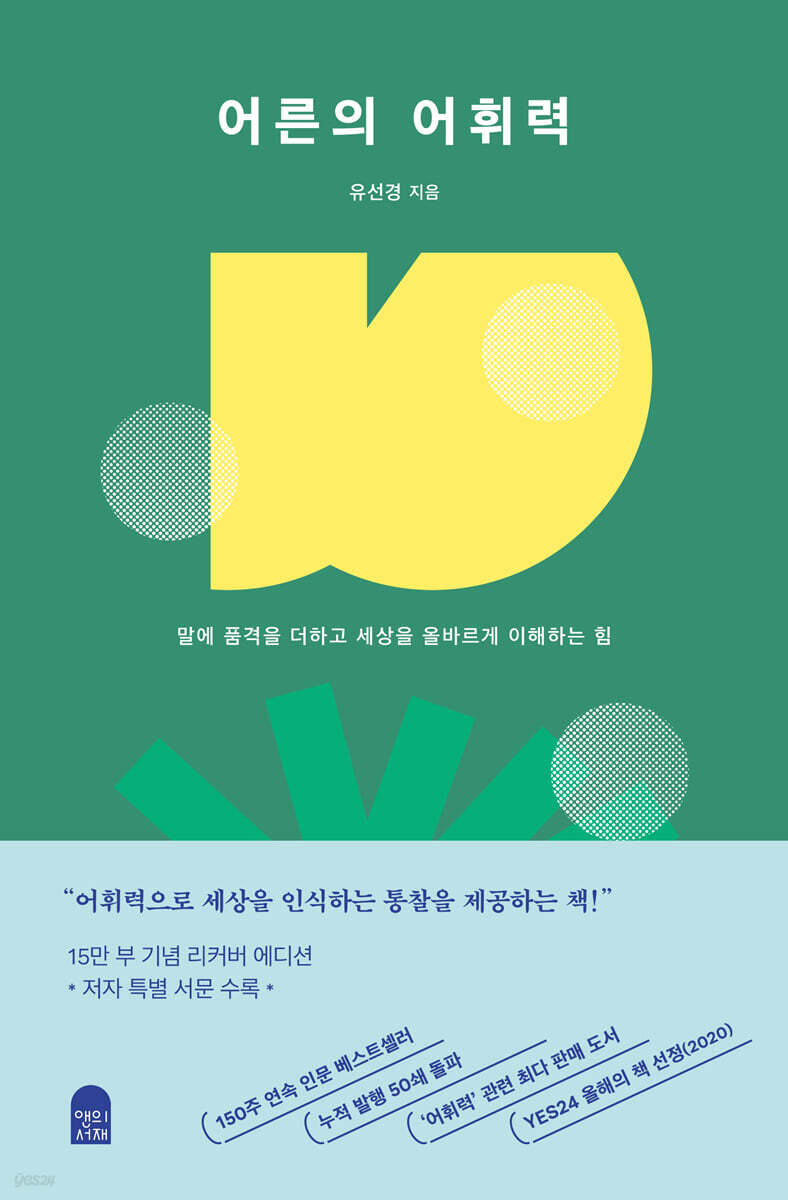
[150,000 copies commemorative hardcover edition]
Includes a special preface by author Yoo Seon-gyeong & a printed and signed copy
“A book that provides insight into a new way of perceiving the world through vocabulary!”
150 consecutive weeks of humanities bestseller
Cumulative publication exceeds 50 editions
Best-selling books on 'vocabulary' and 'literacy'
[Nordic with Carrier] Book Recommendations by Announcer Lee Geum-hee
YES24 Book of the Year (2020)
To those who express all their emotions with 'Wow' and 'Amazing'
I recommend this book!
Author Yoo Seon-gyeong says that the vocabulary needed by adults is not simply knowing a large number of words or being able to speak with a strong tongue.
It is more important to know words well and use them appropriately, and it is said that increasing vocabulary is the power to correctly understand the world, the ability to control one's emotions with dignity, the ability to increase empathy and communication skills, and the cultivation of humanities knowledge.
"Adult Vocabulary" is filled with the linguistic pleasure of examining and savoring words, the joy of expressing one's thoughts and feelings with appropriate vocabulary, the excitement of awakening new perspectives on objects and things, and the thrill of touching the hearts of others.
Furthermore, the author carefully selects both familiar and unfamiliar vocabulary, so that just by reading this book, you can experience the thrill of discovering countless words you hadn't noticed before.
In particular, through dictionary definitions of words encountered in over 270 annotations, you will experience firsthand how the meaning and nuance of words change when placed together with other words in a sentence, and develop the ability to understand context.
Let's also take a look at 12 ways to improve your vocabulary, filled with the author's know-how.
I recommend "Adult Vocabulary" right now to everyone: those who want to express their thoughts persuasively, those who are interested in reading and writing, office workers who find presentations and meetings burdensome, job seekers about to enter the workforce, and even college students worried about writing reports, assignments, and self-introductions.
Includes a special preface by author Yoo Seon-gyeong & a printed and signed copy
“A book that provides insight into a new way of perceiving the world through vocabulary!”
150 consecutive weeks of humanities bestseller
Cumulative publication exceeds 50 editions
Best-selling books on 'vocabulary' and 'literacy'
[Nordic with Carrier] Book Recommendations by Announcer Lee Geum-hee
YES24 Book of the Year (2020)
To those who express all their emotions with 'Wow' and 'Amazing'
I recommend this book!
Author Yoo Seon-gyeong says that the vocabulary needed by adults is not simply knowing a large number of words or being able to speak with a strong tongue.
It is more important to know words well and use them appropriately, and it is said that increasing vocabulary is the power to correctly understand the world, the ability to control one's emotions with dignity, the ability to increase empathy and communication skills, and the cultivation of humanities knowledge.
"Adult Vocabulary" is filled with the linguistic pleasure of examining and savoring words, the joy of expressing one's thoughts and feelings with appropriate vocabulary, the excitement of awakening new perspectives on objects and things, and the thrill of touching the hearts of others.
Furthermore, the author carefully selects both familiar and unfamiliar vocabulary, so that just by reading this book, you can experience the thrill of discovering countless words you hadn't noticed before.
In particular, through dictionary definitions of words encountered in over 270 annotations, you will experience firsthand how the meaning and nuance of words change when placed together with other words in a sentence, and develop the ability to understand context.
Let's also take a look at 12 ways to improve your vocabulary, filled with the author's know-how.
I recommend "Adult Vocabulary" right now to everyone: those who want to express their thoughts persuasively, those who are interested in reading and writing, office workers who find presentations and meetings burdensome, job seekers about to enter the workforce, and even college students worried about writing reports, assignments, and self-introductions.
- You can preview some of the book's contents.
Preview
index
Recover Edition Preface
Opening Remarks: Developing a Mature Vocabulary is Necessary
Chapter 1.
This is why vocabulary is important
1.
Why Books Don't Stick to Your Head
2.
Should I keep reading a book I don't understand?
3.
What Happens When Your Vocabulary Is Lacked
4.
The limits of language are the limits of imagination and perception.
5.
My world is as small or as big as the limits of language.
6.
Vocabulary decreases with inertia and increases with interest.
7.
Custom words to reduce side narratives
8.
Vocabulary, ability to control emotions with dignity
9.
Vocabulary is the sum total of words you have experienced.
Chapter 2.
Essentials for building vocabulary
1.
Accept that you may not understand each other.
2.
Understand the importance of linguistic intuition
3.
Distinguish between words used for objects and words used for people.
4.
Beware of forces that seek to exploit differences.
5.
Learn spelling and basic grammar first.
6.
Trust the power of words over mind control
7.
Recognize that your words affect the feelings of others.
8.
Empathy is the key to developing vocabulary.
9.
Words that can awaken the soul
10.
I thought it was a dialect, but it's actually Korean with a good flavor.
Chapter 3.
Ways to Build Your Vocabulary
1.
Get the hang of it
2.
Basic tips for writing easily
3.
Turn modifiers into verbs
4.
The first thing that comes to mind is to be full of thoughts.
5.
Practice making a frame
6.
Learn to write basic sentences fluently.
7.
Sentence collection and transcription
8.
Making good use of data and evidence
9.
Developing the power to create arguments
10.
Texts and lyrics that can be used to learn irregularities
11.
Reading books that develop perspective
12.
Practice reading context
Chapter 4.
The joy of encountering vocabulary
1.
Breaking free from fixed definitions can expand your vocabulary.
2.
You can expand your vocabulary by reviewing and savoring words.
3.
Expand your vocabulary and thinking skills by starting with phonemes.
4.
Why AI Will Never Surpass Human Vocabulary
5.
Start with questions to expand your vocabulary and thinking skills.
Opening Remarks: Developing a Mature Vocabulary is Necessary
Chapter 1.
This is why vocabulary is important
1.
Why Books Don't Stick to Your Head
2.
Should I keep reading a book I don't understand?
3.
What Happens When Your Vocabulary Is Lacked
4.
The limits of language are the limits of imagination and perception.
5.
My world is as small or as big as the limits of language.
6.
Vocabulary decreases with inertia and increases with interest.
7.
Custom words to reduce side narratives
8.
Vocabulary, ability to control emotions with dignity
9.
Vocabulary is the sum total of words you have experienced.
Chapter 2.
Essentials for building vocabulary
1.
Accept that you may not understand each other.
2.
Understand the importance of linguistic intuition
3.
Distinguish between words used for objects and words used for people.
4.
Beware of forces that seek to exploit differences.
5.
Learn spelling and basic grammar first.
6.
Trust the power of words over mind control
7.
Recognize that your words affect the feelings of others.
8.
Empathy is the key to developing vocabulary.
9.
Words that can awaken the soul
10.
I thought it was a dialect, but it's actually Korean with a good flavor.
Chapter 3.
Ways to Build Your Vocabulary
1.
Get the hang of it
2.
Basic tips for writing easily
3.
Turn modifiers into verbs
4.
The first thing that comes to mind is to be full of thoughts.
5.
Practice making a frame
6.
Learn to write basic sentences fluently.
7.
Sentence collection and transcription
8.
Making good use of data and evidence
9.
Developing the power to create arguments
10.
Texts and lyrics that can be used to learn irregularities
11.
Reading books that develop perspective
12.
Practice reading context
Chapter 4.
The joy of encountering vocabulary
1.
Breaking free from fixed definitions can expand your vocabulary.
2.
You can expand your vocabulary by reviewing and savoring words.
3.
Expand your vocabulary and thinking skills by starting with phonemes.
4.
Why AI Will Never Surpass Human Vocabulary
5.
Start with questions to expand your vocabulary and thinking skills.
Detailed image
.jpg)
Into the book
A friend who said he had difficulty reading books 10 years ago is slowly giving up on reading, and the reason I found on the anniversary of his death was this.
“It’s because I lack vocabulary.” My friend looked dumbfounded.
I've been working for nearly 30 years since graduating from college, and I've never even thought about hearing things like my vocabulary being lacking.
However, if your vocabulary is lacking, it is difficult to understand the content, and because it is difficult to understand the content, you cannot turn the page, and because the page cannot be turned, you become sleepy.
A book that has made you sleepy is not easy to open again.
--- pp.23~24
The reason we must use precise vocabulary is to reduce the room for interpretation.
In literature such as poetry and novels, the ambiguous expressions intentionally used by the author can lead to lingering feelings and thoughts.
Even the discussions that arise from the different interpretations that arise from that ambiguity are meaningful.
However, if a text intended to convey information or knowledge, such as a news article, a paper, an essay, a presentation, or a self-introduction, uses words and expressions that are open to interpretation and result in different interpretations for each reader or listener, we cannot help but question the reason for their existence.
--- p.39
I can only tell you what I have experienced, and the only way I can know what you have experienced is through language.
Language is the only means by which the human mind and heart, which are harder than steel, can be struck, cracked, and finally made a way through.
If we don't give up hope for communication, believing that the limitations of language stem from our different life experiences and environments, we can be a little more kind when choosing our vocabulary.
You will find words that are appropriate for the other person's situation.
--- p.44
Using tailored vocabulary not only reduces unnecessary side-storytelling and makes it more efficient, but it also allows you to confidently and freely develop your story using those words as a stepping stone.
Knowing a person's name doesn't guarantee you know everything about them, but knowing a person's name means you know almost everything about things and phenomena.
It's not just knowing the name, it's knowing a new world.
--- p.73
The gap between words experienced and words not experienced is as wide as the sound of nature rising and the sound of a dinosaur stamping the ground.
By using words that you have experienced physically and mentally, you can reduce the possibility of misunderstanding and construct sentences freely.
Sometimes, I want to show off and use words I have no experience with, but I have to spit them out without hesitation or get angry.
I hope that the number of words I have experienced will increase as the number of days I have lived.
--- pp.83~84
The problem is when we use adjectives as modifiers rather than verbs.
When you can't find the right noun or want to make it sound good, you tend to try to decorate it with modifiers.
If you overuse it, it becomes confusing to find the right word to use, and if it is noisy, it becomes like the belly is bigger than the stomach, making your speech and writing questionable.
If you don't use adjectives, it feels empty, so there are many cases where you use them out of habit, but the priority is to find a word that can convey the meaning without modifiers, and if you use adjectives as their original verbs, the sentence becomes concise and the meaning becomes clear.
--- p.179
Like clichés, common, worn-out words challenge us to reinterpret their meaning.
Delicious, sad, thankful, sorry, precious, good, bad, difficult, tiring.
It hurts, it was good, it wasn't good, it's good, it's bad, it's disgusting, it's painful, it's strange, it's weird, etc.
I wonder what words and expressions would convey the truth of that feeling without having to add words like 'too much', 'really', 'truly', 'amazing', 'completely', 'really', 'daebak', or 'dog' in front of them.
--- p.225
When your perspective is unclear, you choose cowardly words that leave many loopholes to escape from.
When your perspective is not correct, you tend to use extreme and narrow-minded vocabulary.
Speaking and writing are temptations and dangers.
If you are keenly aware of the correlation between perspective and vocabulary and do not avoid it, you can gradually become more sophisticated.
This takes courage.
“It’s because I lack vocabulary.” My friend looked dumbfounded.
I've been working for nearly 30 years since graduating from college, and I've never even thought about hearing things like my vocabulary being lacking.
However, if your vocabulary is lacking, it is difficult to understand the content, and because it is difficult to understand the content, you cannot turn the page, and because the page cannot be turned, you become sleepy.
A book that has made you sleepy is not easy to open again.
--- pp.23~24
The reason we must use precise vocabulary is to reduce the room for interpretation.
In literature such as poetry and novels, the ambiguous expressions intentionally used by the author can lead to lingering feelings and thoughts.
Even the discussions that arise from the different interpretations that arise from that ambiguity are meaningful.
However, if a text intended to convey information or knowledge, such as a news article, a paper, an essay, a presentation, or a self-introduction, uses words and expressions that are open to interpretation and result in different interpretations for each reader or listener, we cannot help but question the reason for their existence.
--- p.39
I can only tell you what I have experienced, and the only way I can know what you have experienced is through language.
Language is the only means by which the human mind and heart, which are harder than steel, can be struck, cracked, and finally made a way through.
If we don't give up hope for communication, believing that the limitations of language stem from our different life experiences and environments, we can be a little more kind when choosing our vocabulary.
You will find words that are appropriate for the other person's situation.
--- p.44
Using tailored vocabulary not only reduces unnecessary side-storytelling and makes it more efficient, but it also allows you to confidently and freely develop your story using those words as a stepping stone.
Knowing a person's name doesn't guarantee you know everything about them, but knowing a person's name means you know almost everything about things and phenomena.
It's not just knowing the name, it's knowing a new world.
--- p.73
The gap between words experienced and words not experienced is as wide as the sound of nature rising and the sound of a dinosaur stamping the ground.
By using words that you have experienced physically and mentally, you can reduce the possibility of misunderstanding and construct sentences freely.
Sometimes, I want to show off and use words I have no experience with, but I have to spit them out without hesitation or get angry.
I hope that the number of words I have experienced will increase as the number of days I have lived.
--- pp.83~84
The problem is when we use adjectives as modifiers rather than verbs.
When you can't find the right noun or want to make it sound good, you tend to try to decorate it with modifiers.
If you overuse it, it becomes confusing to find the right word to use, and if it is noisy, it becomes like the belly is bigger than the stomach, making your speech and writing questionable.
If you don't use adjectives, it feels empty, so there are many cases where you use them out of habit, but the priority is to find a word that can convey the meaning without modifiers, and if you use adjectives as their original verbs, the sentence becomes concise and the meaning becomes clear.
--- p.179
Like clichés, common, worn-out words challenge us to reinterpret their meaning.
Delicious, sad, thankful, sorry, precious, good, bad, difficult, tiring.
It hurts, it was good, it wasn't good, it's good, it's bad, it's disgusting, it's painful, it's strange, it's weird, etc.
I wonder what words and expressions would convey the truth of that feeling without having to add words like 'too much', 'really', 'truly', 'amazing', 'completely', 'really', 'daebak', or 'dog' in front of them.
--- p.225
When your perspective is unclear, you choose cowardly words that leave many loopholes to escape from.
When your perspective is not correct, you tend to use extreme and narrow-minded vocabulary.
Speaking and writing are temptations and dangers.
If you are keenly aware of the correlation between perspective and vocabulary and do not avoid it, you can gradually become more sophisticated.
This takes courage.
--- p.233
Publisher's Review
[150,000 copies commemorative hardcover edition]
Includes a special preface by author Yoo Seon-gyeong & a printed and signed copy
“A book that provides insight into a new way of perceiving the world through vocabulary!”
150 consecutive weeks of humanities bestseller
Cumulative publication exceeds 50 editions
Best-selling books on 'vocabulary' and 'literacy'
Books recommended by announcer Lee Geum-hee on the broadcast "Northern Europe with Carrier"
YES24 Book of the Year (2020)
To those who express all their emotions with 'Wow' and 'Amazing'
I recommend this book!
Reading, writing, speaking, empathy, and communication skills all come from vocabulary!
Now, why we need to focus on vocabulary again!
“Oh, what was it?
“I suddenly can’t think of a word.”
“Even when I read a book, I don’t really understand the meaning and I can’t concentrate!”
“I worry because I often feel uncomfortable communicating with people.”
“Every time I have to write at school or work, I get scared.”
Did you know that such common and everyday situations may be due to vocabulary?
Yes, that's right.
All of this discomfort, sometimes attributed to age, sometimes to personality, and sometimes to learning ability, may actually be a vocabulary problem.
In Korea, 'adults' generally do not make the effort to memorize vocabulary or develop their vocabulary after graduating from high school.
Since it is our native language that we see, hear, read, write, and speak every day, it is not easy to realize that the inconveniences we experience in our daily lives are due to a lack of vocabulary in our native language.
Writer Yoo Seon-gyeong has been writing every day for over 30 years, has been writing for radio broadcasts since 1993, and is an avid reader who reads more than five books a week. Through writing, reading, and meeting people, she has come to realize that a lack of vocabulary is not simply a problem with Korean language skills, but rather a huge inconvenience in daily life.
And I wrote this book out of a desperate need for a new perspective on the usefulness of vocabulary.
If you suddenly can't remember a word, it may not be a memory problem but a vocabulary problem.
If you have trouble grasping the meaning and nuance of certain words or texts, it may not be due to a lack of tact, but rather a lack of vocabulary.
If you say something that is strangely annoying, it may not be because you lack humanity, but because you lack vocabulary.
If you have trouble understanding what others are saying, you need to consider whether it's a problem with your vocabulary rather than a lack of communication skills.
If you experience these problems repeatedly, you will become psychologically discouraged and lose confidence in expressing your thoughts, emotions, and feelings, whether verbally or in writing.
If it becomes a daily routine to not think, organize, and express your thoughts and feelings in words, you will not be able to understand your own thoughts or feelings.
They lack confidence in their own thoughts, and sometimes this can manifest as aggressive behavior depending on the person.
“Vocabulary is the power that connects people and the perspective from which they view objects and things. Developing vocabulary means developing this power and perspective.
At the same time, it is important to understand that your words can affect the feelings of others.
“That’s what it means to have an ‘adult’ vocabulary.”
Author Yoo Seon-gyeong says that the vocabulary needed by adults is not simply knowing a large number of words or being able to speak well.
It is more important to know words well and use them appropriately, and it is said that increasing vocabulary is the power to correctly understand the world, the ability to control one's emotions with dignity, the ability to increase empathy and communication skills, and the cultivation of humanities knowledge.
"Adult Vocabulary" is filled with the linguistic pleasure of examining and savoring words, the joy of expressing one's thoughts and feelings with appropriate vocabulary, the excitement of awakening new perspectives on objects and things, and the thrill of touching the hearts of others.
Furthermore, the author carefully selects both familiar and unfamiliar vocabulary, so that just by reading this book, you can experience the thrill of discovering countless words you hadn't noticed before.
In particular, through dictionary definitions of words encountered in over 270 annotations, you will experience firsthand how the meaning and nuance of words change when placed together with other words in a sentence, and develop the ability to understand context.
Let's also take a look at 12 ways to improve your vocabulary, filled with the author's know-how.
I recommend "Adult Vocabulary" right now to everyone: those who want to express their thoughts persuasively, those who are interested in reading and writing, office workers who find presentations and meetings burdensome, job seekers about to enter the workforce, and even college students worried about writing reports, assignments, and self-introductions.
“My world is as small or as big as the limits of language!”
12 Ways to Build Your Adult Vocabulary
Chapter 1 explores the importance and various meanings of vocabulary that we often overlook in our daily lives.
Chapter 2 discusses the mindset that adults must have before acquiring the skills to build vocabulary.
You will learn how your perspective on objects and things is directly linked to your vocabulary.
Chapter 3 covers ways to build your vocabulary.
Since vocabulary cannot be separated from sentence structure, the author explains it in connection with writing.
Finally, Chapter 4 provides a practical example of how wondering about and savoring a single word can expand vocabulary and expand thinking skills.
If you read comfortably as if you were reading prose containing the author's perspective, you will become sensitive to vocabulary according to the situation and learn how to choose words appropriately.
Let's pay special attention to the 12 ways to improve vocabulary recommended by the author.
In addition to increasing vocabulary and reading extensively, which everyone is familiar with, it presents various specific methods, such as how to understand the taste of words, which is just as important as the meaning of words, basic writing tips to increase vocabulary, how to properly select and use modifiers, how to write basic sentences, how to create the structure of writing that is essential for selecting appropriate vocabulary, how to use materials, how to develop the ability to create arguments, practice reading in context rather than text, and reading books to develop perspectives.
Includes a special preface by author Yoo Seon-gyeong & a printed and signed copy
“A book that provides insight into a new way of perceiving the world through vocabulary!”
150 consecutive weeks of humanities bestseller
Cumulative publication exceeds 50 editions
Best-selling books on 'vocabulary' and 'literacy'
Books recommended by announcer Lee Geum-hee on the broadcast "Northern Europe with Carrier"
YES24 Book of the Year (2020)
To those who express all their emotions with 'Wow' and 'Amazing'
I recommend this book!
Reading, writing, speaking, empathy, and communication skills all come from vocabulary!
Now, why we need to focus on vocabulary again!
“Oh, what was it?
“I suddenly can’t think of a word.”
“Even when I read a book, I don’t really understand the meaning and I can’t concentrate!”
“I worry because I often feel uncomfortable communicating with people.”
“Every time I have to write at school or work, I get scared.”
Did you know that such common and everyday situations may be due to vocabulary?
Yes, that's right.
All of this discomfort, sometimes attributed to age, sometimes to personality, and sometimes to learning ability, may actually be a vocabulary problem.
In Korea, 'adults' generally do not make the effort to memorize vocabulary or develop their vocabulary after graduating from high school.
Since it is our native language that we see, hear, read, write, and speak every day, it is not easy to realize that the inconveniences we experience in our daily lives are due to a lack of vocabulary in our native language.
Writer Yoo Seon-gyeong has been writing every day for over 30 years, has been writing for radio broadcasts since 1993, and is an avid reader who reads more than five books a week. Through writing, reading, and meeting people, she has come to realize that a lack of vocabulary is not simply a problem with Korean language skills, but rather a huge inconvenience in daily life.
And I wrote this book out of a desperate need for a new perspective on the usefulness of vocabulary.
If you suddenly can't remember a word, it may not be a memory problem but a vocabulary problem.
If you have trouble grasping the meaning and nuance of certain words or texts, it may not be due to a lack of tact, but rather a lack of vocabulary.
If you say something that is strangely annoying, it may not be because you lack humanity, but because you lack vocabulary.
If you have trouble understanding what others are saying, you need to consider whether it's a problem with your vocabulary rather than a lack of communication skills.
If you experience these problems repeatedly, you will become psychologically discouraged and lose confidence in expressing your thoughts, emotions, and feelings, whether verbally or in writing.
If it becomes a daily routine to not think, organize, and express your thoughts and feelings in words, you will not be able to understand your own thoughts or feelings.
They lack confidence in their own thoughts, and sometimes this can manifest as aggressive behavior depending on the person.
“Vocabulary is the power that connects people and the perspective from which they view objects and things. Developing vocabulary means developing this power and perspective.
At the same time, it is important to understand that your words can affect the feelings of others.
“That’s what it means to have an ‘adult’ vocabulary.”
Author Yoo Seon-gyeong says that the vocabulary needed by adults is not simply knowing a large number of words or being able to speak well.
It is more important to know words well and use them appropriately, and it is said that increasing vocabulary is the power to correctly understand the world, the ability to control one's emotions with dignity, the ability to increase empathy and communication skills, and the cultivation of humanities knowledge.
"Adult Vocabulary" is filled with the linguistic pleasure of examining and savoring words, the joy of expressing one's thoughts and feelings with appropriate vocabulary, the excitement of awakening new perspectives on objects and things, and the thrill of touching the hearts of others.
Furthermore, the author carefully selects both familiar and unfamiliar vocabulary, so that just by reading this book, you can experience the thrill of discovering countless words you hadn't noticed before.
In particular, through dictionary definitions of words encountered in over 270 annotations, you will experience firsthand how the meaning and nuance of words change when placed together with other words in a sentence, and develop the ability to understand context.
Let's also take a look at 12 ways to improve your vocabulary, filled with the author's know-how.
I recommend "Adult Vocabulary" right now to everyone: those who want to express their thoughts persuasively, those who are interested in reading and writing, office workers who find presentations and meetings burdensome, job seekers about to enter the workforce, and even college students worried about writing reports, assignments, and self-introductions.
“My world is as small or as big as the limits of language!”
12 Ways to Build Your Adult Vocabulary
Chapter 1 explores the importance and various meanings of vocabulary that we often overlook in our daily lives.
Chapter 2 discusses the mindset that adults must have before acquiring the skills to build vocabulary.
You will learn how your perspective on objects and things is directly linked to your vocabulary.
Chapter 3 covers ways to build your vocabulary.
Since vocabulary cannot be separated from sentence structure, the author explains it in connection with writing.
Finally, Chapter 4 provides a practical example of how wondering about and savoring a single word can expand vocabulary and expand thinking skills.
If you read comfortably as if you were reading prose containing the author's perspective, you will become sensitive to vocabulary according to the situation and learn how to choose words appropriately.
Let's pay special attention to the 12 ways to improve vocabulary recommended by the author.
In addition to increasing vocabulary and reading extensively, which everyone is familiar with, it presents various specific methods, such as how to understand the taste of words, which is just as important as the meaning of words, basic writing tips to increase vocabulary, how to properly select and use modifiers, how to write basic sentences, how to create the structure of writing that is essential for selecting appropriate vocabulary, how to use materials, how to develop the ability to create arguments, practice reading in context rather than text, and reading books to develop perspectives.
GOODS SPECIFICS
- Date of issue: May 1, 2023
- Format: Hardcover book binding method guide
- Page count, weight, size: 308 pages | 488g | 135*204*22mm
- ISBN13: 9791190710589
- ISBN10: 1190710587
You may also like
카테고리
korean


korean

![GQ KOREA Mark (Monthly): December [2025]](http://librairie.coreenne.fr/cdn/shop/files/8ef265dbbfbf186523ed75ba7319009d.jpg?v=1765340328&width=3840)


