

E=mc²
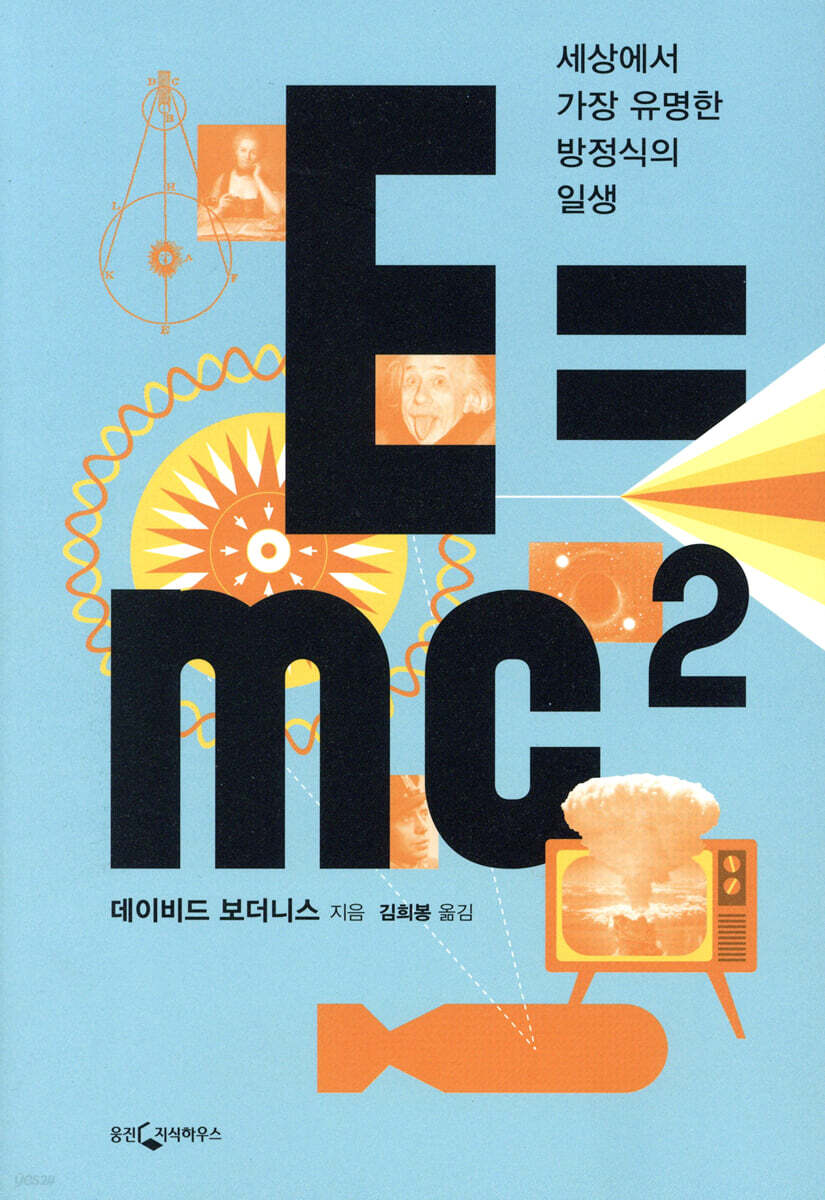 |
Description
Book Introduction
Solving the equation E=mc², which shook human history, as if it were a single person's life.
A classic of popular science that will help you learn the basics of science as you read along, like a mystery novel.
“Energy is equal to mass times the square of the speed of light.” The most famous and beautiful equation in the world, E=mc².
How did this simple equation, which floated through the mind of an unknown twenty-six-year-old scientist in 1905, at the dawn of the 20th century, come to shake the world? Over the decades, E=mc² would pass through the hands of countless scientists, becoming one of the most famous equations in human history.
Instead of writing a commentary on the theory of relativity or a biography of Einstein, David Bodanis, one of this century's greatest science journalists, presents a unique account of the life of this equation.
E energy, = equal sign, m mass, c speed of light, ² squared, trace the meaning and origin of each one like a detective novel.
It meticulously reconstructs the remarkable scientific discoveries of countless scientists, including Einstein, and their lives interwoven with passion, love, and revenge, and vividly depicts the tragedy of the atomic bomb during World War II.
It also adds to the interest by providing fun science facts such as the warmth of the sun, the deep darkness of a black hole, and the emergency exit signs in movie theaters.
A classic science textbook and a universally recommended book by teachers around the world for the past decade, E=mc² lays the foundations of science while highlighting some of the most fascinating moments in the history of science.
A classic of popular science that will help you learn the basics of science as you read along, like a mystery novel.
“Energy is equal to mass times the square of the speed of light.” The most famous and beautiful equation in the world, E=mc².
How did this simple equation, which floated through the mind of an unknown twenty-six-year-old scientist in 1905, at the dawn of the 20th century, come to shake the world? Over the decades, E=mc² would pass through the hands of countless scientists, becoming one of the most famous equations in human history.
Instead of writing a commentary on the theory of relativity or a biography of Einstein, David Bodanis, one of this century's greatest science journalists, presents a unique account of the life of this equation.
E energy, = equal sign, m mass, c speed of light, ² squared, trace the meaning and origin of each one like a detective novel.
It meticulously reconstructs the remarkable scientific discoveries of countless scientists, including Einstein, and their lives interwoven with passion, love, and revenge, and vividly depicts the tragedy of the atomic bomb during World War II.
It also adds to the interest by providing fun science facts such as the warmth of the sun, the deep darkness of a black hole, and the emergency exit signs in movie theaters.
A classic science textbook and a universally recommended book by teachers around the world for the past decade, E=mc² lays the foundations of science while highlighting some of the most fascinating moments in the history of science.
- You can preview some of the book's contents.
Preview
index
Introduction_ I decided to write the biography of E=mc²
Part 1 Birth
01 Bern Patent Office, 1905
Part 2: The Ancestors of E=mc²
02 Energy E
03 Equal sign =
04 mass m
05 Speed of light c
06 square ²
Part 3: Childhood
07 Einstein and Equations
08 Center of the atom
09 Unraveling the Secret on a Snowy Road
Part 4 Adulthood
10. The atomic bomb is developed in Germany.
11 Norwegian raids
12 America's Counterattack
8:16 a.m., over Japan
Part 5 Eternal Life
14 Flame of the Sun
15 Creating the Earth
16 The Brahmin Boy Who Saw the Darkness of a Black Hole
Epilogue_ Einstein's Other Achievements
Appendix_ Backstories of other major characters
main
Further Reading
Acknowledgements
Translator's Note
Search
Part 1 Birth
01 Bern Patent Office, 1905
Part 2: The Ancestors of E=mc²
02 Energy E
03 Equal sign =
04 mass m
05 Speed of light c
06 square ²
Part 3: Childhood
07 Einstein and Equations
08 Center of the atom
09 Unraveling the Secret on a Snowy Road
Part 4 Adulthood
10. The atomic bomb is developed in Germany.
11 Norwegian raids
12 America's Counterattack
8:16 a.m., over Japan
Part 5 Eternal Life
14 Flame of the Sun
15 Creating the Earth
16 The Brahmin Boy Who Saw the Darkness of a Black Hole
Epilogue_ Einstein's Other Achievements
Appendix_ Backstories of other major characters
main
Further Reading
Acknowledgements
Translator's Note
Search
Into the book
Instead of going on about rockets and flashes of light, I decided to use the electricity of E=mc2.
A biography covers a person's ancestry, childhood, adolescence, and adulthood.
The same goes for the electricity of the equation.
---pp.7-8
When Einstein's workday ended, all the scientific libraries in Bern were closed.
How could he conduct research without keeping up with the latest news? Whenever he had a moment's free time during work hours, he would scribble something on a piece of paper he kept in his desk drawer.
He joked that this drawer was his theoretical physics department.
But Haller kept a close watch on him, and the drawer was almost always kept closed.
---p.17
Light exists only when it moves.
This is Einstein's conclusion.
This insight was hidden in Maxwell's theory, but went unnoticed for over 40 years.
This new awareness of light changed everything.
The speed of light has now become the fundamental speed limit of the universe.
Nothing can be faster than this.
---p.67
At the age of 16 she entered the Palace of Versailles, but even here she continued to stand out.
Imagine Geena Davis, an actress and former action star who is a member of Mensa, in the 18th century.
Emily, with her long black hair flowing down, looked surprisingly innocent.
While high society girls, fresh out of the gate, are preoccupied with using their beauty to find a husband, Emily's reading of Descartes' Analytical Geometry keeps potential suitors at bay.
---p.76
Although the dust scattered by Madame Curie was only about one-hundred-thousandth of a gram, the radiation from it damaged the DNA in the bones, causing a fatal form of leukemia.
Decades later, this radiation, only slightly weakened, still sets off Geiger counters, startling document keepers.
---p.97
The atom was opened.
Everyone has been wrong so far.
The way to get into the nucleus was not to hit the pieces harder and harder.
A woman and her nephew, in the quiet snow of midday, now understood it.
There is no need to expend enormous amounts of energy to detonate a uranium atom.
Just prepare enough neutrons and wait for it to start.
---p.137
Mr. President: Recent, yet unpublished research suggests that the element uranium could become a new and important energy source in the very near future.
Accordingly, certain aspects of the situation must be closely monitored and, if necessary, the government must take swift action.
This new phenomenon could create a bomb, and while it's not yet clear what it is, it could lead to a new type of bomb that could be extremely powerful.
“If such a bomb were loaded onto a ship and detonated in a harbor, just one bomb would destroy the entire harbor and surrounding area.” ---p.144
But Oppenheimer knew why Feynman was so hostile.
His young wife had tuberculosis, and as antibiotics were not yet available, she was expected to die soon.
Oppenheimer arranged for her to travel to New Mexico, using train tickets that were as precious as gold during the war, and he cared for her in a nearby hospital in Los Alamos, so that Feynman could visit often.
According to Feynman's memoirs, he always had a way of teasing the managers he worked with.
But the two years I spent at Los Alamos were an exception.
He did everything Oppenheimer asked.
---p.178
If the train sank while it was on board, the lake would be too deep to retrieve the heavy water.
However, Lake Tinsø was a popular tourist destination for workers and their families from the Vemork factory on their way to other parts of Norway.
Ordinary families out on an outing always took this ferry.
Who will die for the greater good? The power proposed by E=mc2 forced physicists to make a terrible ethical compromise, a dire question no one could overcome.
---p.184
This object, which cannot be said to be of this world, burns at full strength for 0.5 seconds and then disappears in 2 or 3 seconds.
This 'slippage' occurs mainly as heat escapes.
Suddenly, a spark appears.
The surface of the mass of light tears open, creating a huge curtain that covers those below.
Hiroshima became a land of death.
---p.201
The red emergency exit signs in shopping malls and movie theaters also use E=mc2.
Emergency exit signs cannot use ordinary light sources because they must operate even if the power is cut off.
This light source contains radioactive tritium, which emits light by harnessing the energy released as the easily fragmented tritium nucleus loses mass.
Hospitals use this equation for medical diagnosis. During a powerful imaging device known as a PET scan (positron emission tomography), the patient breathes in a radioactive oxygen isotope.
This records the nucleus of the atom being split and energy rays from the lost mass escaping from the body.
This allows us to accurately determine tumors, blood flow, and drug absorption in the body.
A biography covers a person's ancestry, childhood, adolescence, and adulthood.
The same goes for the electricity of the equation.
---pp.7-8
When Einstein's workday ended, all the scientific libraries in Bern were closed.
How could he conduct research without keeping up with the latest news? Whenever he had a moment's free time during work hours, he would scribble something on a piece of paper he kept in his desk drawer.
He joked that this drawer was his theoretical physics department.
But Haller kept a close watch on him, and the drawer was almost always kept closed.
---p.17
Light exists only when it moves.
This is Einstein's conclusion.
This insight was hidden in Maxwell's theory, but went unnoticed for over 40 years.
This new awareness of light changed everything.
The speed of light has now become the fundamental speed limit of the universe.
Nothing can be faster than this.
---p.67
At the age of 16 she entered the Palace of Versailles, but even here she continued to stand out.
Imagine Geena Davis, an actress and former action star who is a member of Mensa, in the 18th century.
Emily, with her long black hair flowing down, looked surprisingly innocent.
While high society girls, fresh out of the gate, are preoccupied with using their beauty to find a husband, Emily's reading of Descartes' Analytical Geometry keeps potential suitors at bay.
---p.76
Although the dust scattered by Madame Curie was only about one-hundred-thousandth of a gram, the radiation from it damaged the DNA in the bones, causing a fatal form of leukemia.
Decades later, this radiation, only slightly weakened, still sets off Geiger counters, startling document keepers.
---p.97
The atom was opened.
Everyone has been wrong so far.
The way to get into the nucleus was not to hit the pieces harder and harder.
A woman and her nephew, in the quiet snow of midday, now understood it.
There is no need to expend enormous amounts of energy to detonate a uranium atom.
Just prepare enough neutrons and wait for it to start.
---p.137
Mr. President: Recent, yet unpublished research suggests that the element uranium could become a new and important energy source in the very near future.
Accordingly, certain aspects of the situation must be closely monitored and, if necessary, the government must take swift action.
This new phenomenon could create a bomb, and while it's not yet clear what it is, it could lead to a new type of bomb that could be extremely powerful.
“If such a bomb were loaded onto a ship and detonated in a harbor, just one bomb would destroy the entire harbor and surrounding area.” ---p.144
But Oppenheimer knew why Feynman was so hostile.
His young wife had tuberculosis, and as antibiotics were not yet available, she was expected to die soon.
Oppenheimer arranged for her to travel to New Mexico, using train tickets that were as precious as gold during the war, and he cared for her in a nearby hospital in Los Alamos, so that Feynman could visit often.
According to Feynman's memoirs, he always had a way of teasing the managers he worked with.
But the two years I spent at Los Alamos were an exception.
He did everything Oppenheimer asked.
---p.178
If the train sank while it was on board, the lake would be too deep to retrieve the heavy water.
However, Lake Tinsø was a popular tourist destination for workers and their families from the Vemork factory on their way to other parts of Norway.
Ordinary families out on an outing always took this ferry.
Who will die for the greater good? The power proposed by E=mc2 forced physicists to make a terrible ethical compromise, a dire question no one could overcome.
---p.184
This object, which cannot be said to be of this world, burns at full strength for 0.5 seconds and then disappears in 2 or 3 seconds.
This 'slippage' occurs mainly as heat escapes.
Suddenly, a spark appears.
The surface of the mass of light tears open, creating a huge curtain that covers those below.
Hiroshima became a land of death.
---p.201
The red emergency exit signs in shopping malls and movie theaters also use E=mc2.
Emergency exit signs cannot use ordinary light sources because they must operate even if the power is cut off.
This light source contains radioactive tritium, which emits light by harnessing the energy released as the easily fragmented tritium nucleus loses mass.
Hospitals use this equation for medical diagnosis. During a powerful imaging device known as a PET scan (positron emission tomography), the patient breathes in a radioactive oxygen isotope.
This records the nucleus of the atom being split and energy rays from the lost mass escaping from the body.
This allows us to accurately determine tumors, blood flow, and drug absorption in the body.
---pp.228-229
Publisher's Review
“The world is divided into before and after E=mc²!”
A must-read for liberal arts science recommended by teachers worldwide.
The Rebirth of "E=mc²" by David Bodanis, the Century's Greatest Science Journalist
The easiest book to understand the great equation E=mc² and the most widely read physics book of the past 10 years, 〈E=mc²〉 has been republished by Woongjin Knowledge House.
This book, published in the United States in 2000, has been translated and published in over 20 countries around the world, and was published in Korea in 2005.
Since then, it has established itself as a recommended book for teachers not only in Korea but also around the world, and has become a must-read and classic book for liberal arts science that has been read for nearly 10 years.
This re-release of 〈E=mc²〉 was completely retranslated by Kim Hee-bong, a physics expert who translated science bestsellers such as 〈Mr. Feynman, You're Good at Joking!〉, with great care so that even beginners to physics can easily understand the theoretical content. The footnotes and references were also faithfully translated so that readers who want to know more can refer to them.
The appeal of this book, which has been recognized for over a decade by parents who read it during their school years and recommended it to their children, is that it allows readers to easily understand difficult physics theories while also grasping the flow of scientific history at a glance.
Reimagined in a new translation, E=mc² will once again become a reliable must-read for young people new to physics and for science-loving readers.
Following E=mc², David Bodanis's "three-book set" of "The Secret House" and "The Secret Family" are also scheduled to be published in August.
The Life of E=mc²: A More Powerful Sustainer Than Mystery Novels
“Instead of explaining the theory of relativity or writing a biography of Einstein,
“I decided to write the equation E=mc²”
In the preface to this book, Bodanis states that in order to truly explain E=mc², “instead of explaining the theory of relativity or writing a biography of Einstein, I decided to write a biography of E=mc².”
The first part of the biography begins with a letter from a father begging for a job for his unemployed son.
Despite this desperate letter, the professor never responded, and Einstein eventually found a job as a civil servant at the patent office rather than a research position.
The birth of this great equation is based on the story of Einstein, a 26-year-old unknown scientist working at the patent office and becoming absorbed in his daily life.
But one fine spring day, struck by inspiration, he completed a paper and included a short equation in it.
“E=mc².” A child who was the beginning of the theory of relativity and took the form of an equation came out into the world.
Where did the inspiration that captivated Einstein to create this equation come from? And who will care for the nascent equation, E=mc², and what will it become? Bodanis embarks on a thrilling, detective-like investigation into all these questions and events.
The passionate lives of scientists who solve equations
From Lavoisier and Marat's revenge drama to Madame Châtelet and Voltaire's love of the century
The equation E=mc² can be simply expressed in words as “energy is equal to mass times the square of the speed of light.”
However, this explanation alone is not enough to understand the true meaning of E=mc².
What is energy E, and what is the equal sign =? What about mass m, the speed of light c, and its square? And what happens according to this equation? The scientific concepts contained in E=mc² are easily learned in school for modern people, but discovering its principle took a long time, and many scientists went through trial and error along the way.
Bodanis traces the footsteps of the many scientists who inspired Einstein and developed E=mc².
However, rather than simply covering the research achievements of these scientists, it depicts the process of inquiry that was ingrained in their lives, making equations and physics concepts, once abstract, into a tangible reality.
How did the poor bookbinder Michael Faraday come up with the idea that different types of energy are connected? What scientific debate led to Lavoisier's feud with Jean-Paul Marat, ultimately leading to his execution? Why did Ole Römer observe Jupiter's moon Io to determine the speed of light? How did the French noblewoman Émilie du Châtelet become a physicist? Bodanis meticulously reconstructs the research and lives of the scientists who established each concept, known as the "ancestors of E=mc²," revealing that the birth and growth of this equation were not solely Einstein's achievements, broadening our perspective on the history and research of science.
The Tragedy of the Equation Embroiled in War: The Birth of the Atomic Bomb
“Mr. President Roosevelt, a new, extremely powerful bomb may be built.”
When E=mc² was just beginning to mature through the hands of many scientists, the world was at war.
The equation made possible other technologies useful to human life, but the discovery during the war that 'mass can be converted into energy' also meant that bombs of unprecedented power could be built.
Now world-renowned for his theory of relativity, Einstein foresaw that his equations would become the seeds of tragedy and sent a letter to President Roosevelt warning against the development of the atomic bomb.
But all I got in return was the perfunctory reply, “Very interesting.”
At this time, Werner Heisenberg, the founder of quantum mechanics in Germany, took the lead in developing the atomic bomb, and the United States, which was late to realize the seriousness of the situation, also jumped into the development of the atomic bomb, beginning a breathtaking competition between the United States and Germany.
Now, E=mc² goes beyond the thrill of a detective novel and sucks readers into a breathtaking war documentary.
As World War II intensified, atomic bomb development technology also developed rapidly.
At a crucial moment, Allied commandos from Norway raid a heavy water plant in their Nazi-occupied homeland.
The heavy water produced at this plant was a key material used in the development of Germany's atomic bomb, and if this operation was successful, it could slow down Germany's development.
As the Norwegian agents undertook their mission, risking the tragedy of injuring their own people, the American J.
The Manhattan Project, the American atomic bomb development team led by Robert Oppenheimer and attended by the world's top physicists, including Richard Feynman and Niels Bohr, launches a counterattack in Los Alamos.
The completed atomic bomb was so small that it could be held in two hands.
The bomb creates a massive mushroom cloud that engulfs Hiroshima and Nagasaki, bringing an end to a tragic chapter in the war-torn history of E=mc².
From the flame of the sun and the creation of the earth to the darkness of a black hole
E=mc², the key to unlocking the secrets of the universe, grants immortality.
The process of developing the atomic bomb, in which Einstein did not participate, could be included because this book is a biography of E=mc², not a biography of Einstein.
The story now turns beyond the realm of the atomic bomb and into the extent to which this equation extends.
It traces how E=mc² not only operates on this earth where we live, but also controls everything in the universe, from the birth of stars to the death of life.
Cecilia Payne, who first discovered that the sun is made of hydrogen, which is converted into energy according to E=mc², freed E=mc² from its shackles and directed it out into space.
Next, Fred Hoyle's discovery that E=mc² implosion could be linked to stellar explosions led to an explanation of how the Earth was created, and Indian astronomer Subramanian Chandrasekhar provided a clue to how the E=mc² equation could create black holes when stars die.
As we come to realize how the operation of E=mc² governs the entire universe, including Earth, and how it permeates our lives, from nuclear submarines to emergency exit signs, fire alarms, and GPS satellites, we reach the end of our life's journey with E=mc².
Just as with the world's most famous equation, E=mc², this biography ends with the quiet and lonely later years of Einstein, who became the world's most famous scientist. However, readers who have accompanied this journey will be able to foresee that the life of this equation will not end with death, but will continue to operate eternally, becoming the ancestor of science for other great discoveries.
A must-read for liberal arts science recommended by teachers worldwide.
The Rebirth of "E=mc²" by David Bodanis, the Century's Greatest Science Journalist
The easiest book to understand the great equation E=mc² and the most widely read physics book of the past 10 years, 〈E=mc²〉 has been republished by Woongjin Knowledge House.
This book, published in the United States in 2000, has been translated and published in over 20 countries around the world, and was published in Korea in 2005.
Since then, it has established itself as a recommended book for teachers not only in Korea but also around the world, and has become a must-read and classic book for liberal arts science that has been read for nearly 10 years.
This re-release of 〈E=mc²〉 was completely retranslated by Kim Hee-bong, a physics expert who translated science bestsellers such as 〈Mr. Feynman, You're Good at Joking!〉, with great care so that even beginners to physics can easily understand the theoretical content. The footnotes and references were also faithfully translated so that readers who want to know more can refer to them.
The appeal of this book, which has been recognized for over a decade by parents who read it during their school years and recommended it to their children, is that it allows readers to easily understand difficult physics theories while also grasping the flow of scientific history at a glance.
Reimagined in a new translation, E=mc² will once again become a reliable must-read for young people new to physics and for science-loving readers.
Following E=mc², David Bodanis's "three-book set" of "The Secret House" and "The Secret Family" are also scheduled to be published in August.
The Life of E=mc²: A More Powerful Sustainer Than Mystery Novels
“Instead of explaining the theory of relativity or writing a biography of Einstein,
“I decided to write the equation E=mc²”
In the preface to this book, Bodanis states that in order to truly explain E=mc², “instead of explaining the theory of relativity or writing a biography of Einstein, I decided to write a biography of E=mc².”
The first part of the biography begins with a letter from a father begging for a job for his unemployed son.
Despite this desperate letter, the professor never responded, and Einstein eventually found a job as a civil servant at the patent office rather than a research position.
The birth of this great equation is based on the story of Einstein, a 26-year-old unknown scientist working at the patent office and becoming absorbed in his daily life.
But one fine spring day, struck by inspiration, he completed a paper and included a short equation in it.
“E=mc².” A child who was the beginning of the theory of relativity and took the form of an equation came out into the world.
Where did the inspiration that captivated Einstein to create this equation come from? And who will care for the nascent equation, E=mc², and what will it become? Bodanis embarks on a thrilling, detective-like investigation into all these questions and events.
The passionate lives of scientists who solve equations
From Lavoisier and Marat's revenge drama to Madame Châtelet and Voltaire's love of the century
The equation E=mc² can be simply expressed in words as “energy is equal to mass times the square of the speed of light.”
However, this explanation alone is not enough to understand the true meaning of E=mc².
What is energy E, and what is the equal sign =? What about mass m, the speed of light c, and its square? And what happens according to this equation? The scientific concepts contained in E=mc² are easily learned in school for modern people, but discovering its principle took a long time, and many scientists went through trial and error along the way.
Bodanis traces the footsteps of the many scientists who inspired Einstein and developed E=mc².
However, rather than simply covering the research achievements of these scientists, it depicts the process of inquiry that was ingrained in their lives, making equations and physics concepts, once abstract, into a tangible reality.
How did the poor bookbinder Michael Faraday come up with the idea that different types of energy are connected? What scientific debate led to Lavoisier's feud with Jean-Paul Marat, ultimately leading to his execution? Why did Ole Römer observe Jupiter's moon Io to determine the speed of light? How did the French noblewoman Émilie du Châtelet become a physicist? Bodanis meticulously reconstructs the research and lives of the scientists who established each concept, known as the "ancestors of E=mc²," revealing that the birth and growth of this equation were not solely Einstein's achievements, broadening our perspective on the history and research of science.
The Tragedy of the Equation Embroiled in War: The Birth of the Atomic Bomb
“Mr. President Roosevelt, a new, extremely powerful bomb may be built.”
When E=mc² was just beginning to mature through the hands of many scientists, the world was at war.
The equation made possible other technologies useful to human life, but the discovery during the war that 'mass can be converted into energy' also meant that bombs of unprecedented power could be built.
Now world-renowned for his theory of relativity, Einstein foresaw that his equations would become the seeds of tragedy and sent a letter to President Roosevelt warning against the development of the atomic bomb.
But all I got in return was the perfunctory reply, “Very interesting.”
At this time, Werner Heisenberg, the founder of quantum mechanics in Germany, took the lead in developing the atomic bomb, and the United States, which was late to realize the seriousness of the situation, also jumped into the development of the atomic bomb, beginning a breathtaking competition between the United States and Germany.
Now, E=mc² goes beyond the thrill of a detective novel and sucks readers into a breathtaking war documentary.
As World War II intensified, atomic bomb development technology also developed rapidly.
At a crucial moment, Allied commandos from Norway raid a heavy water plant in their Nazi-occupied homeland.
The heavy water produced at this plant was a key material used in the development of Germany's atomic bomb, and if this operation was successful, it could slow down Germany's development.
As the Norwegian agents undertook their mission, risking the tragedy of injuring their own people, the American J.
The Manhattan Project, the American atomic bomb development team led by Robert Oppenheimer and attended by the world's top physicists, including Richard Feynman and Niels Bohr, launches a counterattack in Los Alamos.
The completed atomic bomb was so small that it could be held in two hands.
The bomb creates a massive mushroom cloud that engulfs Hiroshima and Nagasaki, bringing an end to a tragic chapter in the war-torn history of E=mc².
From the flame of the sun and the creation of the earth to the darkness of a black hole
E=mc², the key to unlocking the secrets of the universe, grants immortality.
The process of developing the atomic bomb, in which Einstein did not participate, could be included because this book is a biography of E=mc², not a biography of Einstein.
The story now turns beyond the realm of the atomic bomb and into the extent to which this equation extends.
It traces how E=mc² not only operates on this earth where we live, but also controls everything in the universe, from the birth of stars to the death of life.
Cecilia Payne, who first discovered that the sun is made of hydrogen, which is converted into energy according to E=mc², freed E=mc² from its shackles and directed it out into space.
Next, Fred Hoyle's discovery that E=mc² implosion could be linked to stellar explosions led to an explanation of how the Earth was created, and Indian astronomer Subramanian Chandrasekhar provided a clue to how the E=mc² equation could create black holes when stars die.
As we come to realize how the operation of E=mc² governs the entire universe, including Earth, and how it permeates our lives, from nuclear submarines to emergency exit signs, fire alarms, and GPS satellites, we reach the end of our life's journey with E=mc².
Just as with the world's most famous equation, E=mc², this biography ends with the quiet and lonely later years of Einstein, who became the world's most famous scientist. However, readers who have accompanied this journey will be able to foresee that the life of this equation will not end with death, but will continue to operate eternally, becoming the ancestor of science for other great discoveries.
GOODS SPECIFICS
- Date of issue: July 25, 2014
- Page count, weight, size: 379 pages | 554g | 152*220*22mm
- ISBN13: 9788901165851
- ISBN10: 8901165856
You may also like
카테고리
korean


korean

![GQ KOREA Mark (Monthly): December [2025]](http://librairie.coreenne.fr/cdn/shop/files/8ef265dbbfbf186523ed75ba7319009d.jpg?v=1765340328&width=3840)


