

Studying Math While You're at It: Geometry
 |
Description
Book Introduction
Math is faster, easier, and more effective when taught through pictures! An innovative, illustrated math book that's easy to grasp and absorbs at a glance.
“Now I really understand math.”
In the AI era, the foundation of a future that is unpredictable is the foundation of lifelong math stamina.
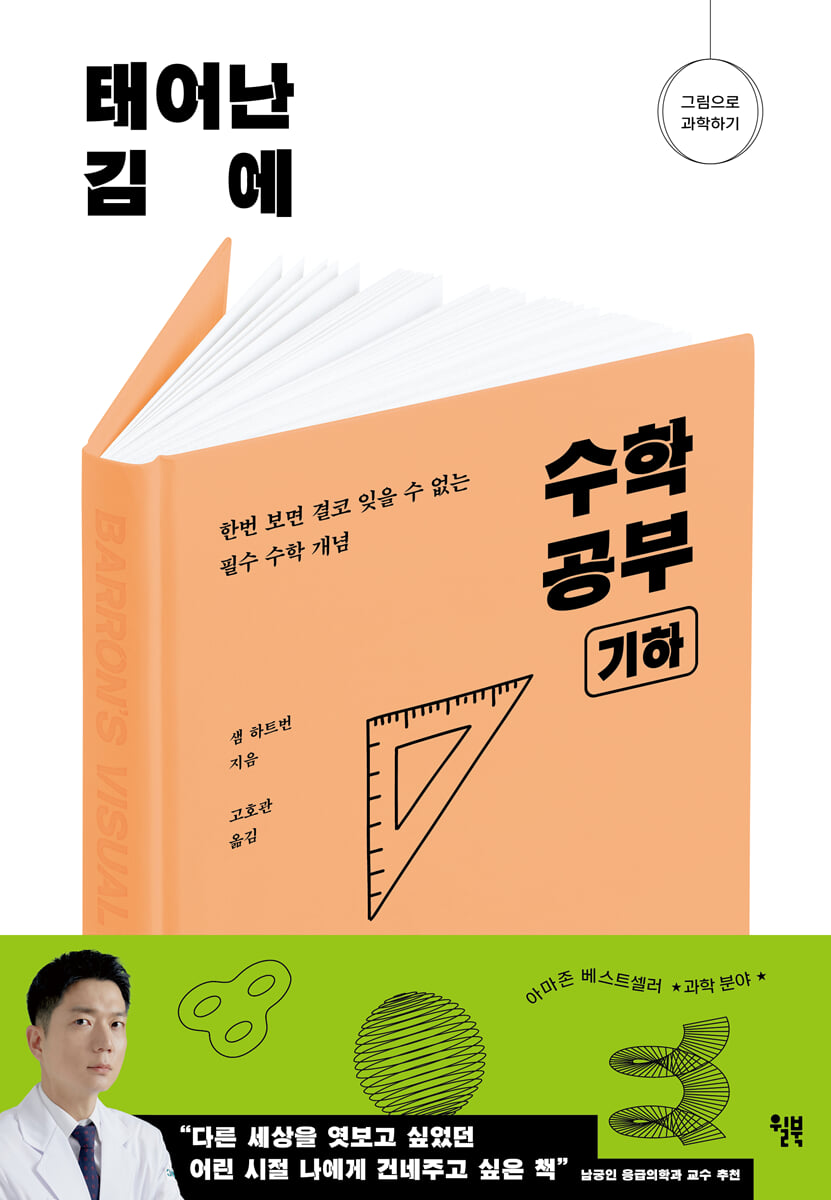
“The book I wish I had given myself as a child” - Highly recommended by Professor Namgung In, Department of Emergency Medicine!
The mathematics section of the "Science with Pictures" series recommended by Professor Kwak Jae-sik
The new books in the "Science with Pictures" series, which have captivated everyone from middle school students to adults seeking to develop their scientific knowledge, "Study Math While You're at It: Algebra" and "Study Math While You're at It: Geometry," have finally been published.
『Study Math While You're at It: Geometry』 is a book that explains the core concepts of geometry, the first field of mathematics to emerge, and the understanding of space and shapes, through illustrations.
By compressing numerous texts into a single image and providing simple and concise explanations of the essentials, you can quickly and easily memorize the geometry concepts you've always wanted to know without losing focus.
Organizing concepts into pictures not only allows you to understand them quickly and accurately, but also makes them less likely to be forgotten.
'Science with Pictures' is a series that emerged from a shift in approach to studying science through pictures rather than text.
More than half of the population is said to be visual learners who learn through pictures rather than text, and math and science are particularly effective subjects for visual learning.
Anyone who has ever despaired of studying science and math by reading, listening, and solving problems, or who has felt like they have no math acumen, will discover a new world with this series.
It is also famous as a book that has helped people with adult ADHD and concentration problems.
High-quality infographics using vivid colors, layouts that guide the flow of the eye according to importance, and short, friendly, one-point explanations are designed to help users find the information they need without giving them time to lose focus.
If you're someone who can't stand not having your attention robbed and can't stand not getting the information you need within 10 seconds, there's no better math book than this one.
It contains a selection of essential concepts of geometry, from the most basic of basics such as points, lines, circles, and triangles to construction, the Pythagorean theorem, trigonometry, symmetry, coordinates, and topology.
With just this one book, you can not only summarize the core of geometry covered in middle and high school curricula, but also prepare well for college major studies.
Namgung In, a professor of emergency medicine at Ewha Womans University Mokdong Hospital, said this book is the one he'd give to his younger self, who longed for a glimpse into another world. "Picture books are not just a one-time read; they have a charm that keeps you coming back for more," he said, praising the details in them, which linger in the memory. In a world of unpredictable change, including the rapid advancement of AI, living without a grasp of mathematics is a grave disadvantage.
Since we were born into a world that revolves around math and code, let's live as someone who knows math.
“Now I really understand math.”
In the AI era, the foundation of a future that is unpredictable is the foundation of lifelong math stamina.
“The book I wish I had given myself as a child” - Highly recommended by Professor Namgung In, Department of Emergency Medicine!
The mathematics section of the "Science with Pictures" series recommended by Professor Kwak Jae-sik
The new books in the "Science with Pictures" series, which have captivated everyone from middle school students to adults seeking to develop their scientific knowledge, "Study Math While You're at It: Algebra" and "Study Math While You're at It: Geometry," have finally been published.
『Study Math While You're at It: Geometry』 is a book that explains the core concepts of geometry, the first field of mathematics to emerge, and the understanding of space and shapes, through illustrations.
By compressing numerous texts into a single image and providing simple and concise explanations of the essentials, you can quickly and easily memorize the geometry concepts you've always wanted to know without losing focus.
Organizing concepts into pictures not only allows you to understand them quickly and accurately, but also makes them less likely to be forgotten.
'Science with Pictures' is a series that emerged from a shift in approach to studying science through pictures rather than text.
More than half of the population is said to be visual learners who learn through pictures rather than text, and math and science are particularly effective subjects for visual learning.
Anyone who has ever despaired of studying science and math by reading, listening, and solving problems, or who has felt like they have no math acumen, will discover a new world with this series.
It is also famous as a book that has helped people with adult ADHD and concentration problems.
High-quality infographics using vivid colors, layouts that guide the flow of the eye according to importance, and short, friendly, one-point explanations are designed to help users find the information they need without giving them time to lose focus.
If you're someone who can't stand not having your attention robbed and can't stand not getting the information you need within 10 seconds, there's no better math book than this one.
It contains a selection of essential concepts of geometry, from the most basic of basics such as points, lines, circles, and triangles to construction, the Pythagorean theorem, trigonometry, symmetry, coordinates, and topology.
With just this one book, you can not only summarize the core of geometry covered in middle and high school curricula, but also prepare well for college major studies.
Namgung In, a professor of emergency medicine at Ewha Womans University Mokdong Hospital, said this book is the one he'd give to his younger self, who longed for a glimpse into another world. "Picture books are not just a one-time read; they have a charm that keeps you coming back for more," he said, praising the details in them, which linger in the memory. In a world of unpredictable change, including the rapid advancement of AI, living without a grasp of mathematics is a grave disadvantage.
Since we were born into a world that revolves around math and code, let's live as someone who knows math.
- You can preview some of the book's contents.
Preview
index
introduction
1. Components of Geometry
The Geographer's Tools │ History of Geometry │ Points and Lines │ Angles │ Notation │ Algebra for Geometry
[Watch Again]
2 2-dimensional shapes
Circle │ Shapes made of curves │ Polygon │ Triangle │ Square │ Angles of polygons
[Watch Again]
3. Construction and alignment
Construction │ Constructible polygons │ Construction using origami │ Tessellation │ Aperiodic and non-periodic tessellation │ Stacking circles │ Stacking squares
[Watch Again]
4 3D shapes
Polyhedrons │ Development │ Spheres │ Cones and cylinders │ Space-filling │ Sections │ Projections and shadows │ 3D and above
[Watch Again]
5 measurements
Length │ Area │ Volume and Surface Area │ Measurement of Angles │ Trigonometry
[Watch Again]
6 coordinates
Cartesian coordinate system │ Polar coordinate system │ Geographic coordinate system │ Three-dimensional coordinate system │ Artistic equation
[Watch Again]
7 Transformations and Symmetry
Reflection │ Rotation │ Translation │ Magnification │ Symmetry │ Congruence and Similarity │ Fractal
[Watch Again]
8 Curves and Surfaces
What are curves and surfaces? │ Parabolas │ Lined surfaces │ Gaussian curvature │ Map projections │ Sectional surfaces │ Non-Euclidean geometry
[Watch Again]
9 Topology
What is Topology? │ Graph Theory │ Knot Theory
[Watch Again]
10 Geometric Proofs
What is a Geometric Proof? │ Geometric Theorems │ Visual Proofs of Abstract Ideas
[Watch Again]
11 Geometry Everywhere
Crafts │ Music │ Architecture │ Art │ Geometric Wisdom of Life
[Watch Again]
1. Components of Geometry
The Geographer's Tools │ History of Geometry │ Points and Lines │ Angles │ Notation │ Algebra for Geometry
[Watch Again]
2 2-dimensional shapes
Circle │ Shapes made of curves │ Polygon │ Triangle │ Square │ Angles of polygons
[Watch Again]
3. Construction and alignment
Construction │ Constructible polygons │ Construction using origami │ Tessellation │ Aperiodic and non-periodic tessellation │ Stacking circles │ Stacking squares
[Watch Again]
4 3D shapes
Polyhedrons │ Development │ Spheres │ Cones and cylinders │ Space-filling │ Sections │ Projections and shadows │ 3D and above
[Watch Again]
5 measurements
Length │ Area │ Volume and Surface Area │ Measurement of Angles │ Trigonometry
[Watch Again]
6 coordinates
Cartesian coordinate system │ Polar coordinate system │ Geographic coordinate system │ Three-dimensional coordinate system │ Artistic equation
[Watch Again]
7 Transformations and Symmetry
Reflection │ Rotation │ Translation │ Magnification │ Symmetry │ Congruence and Similarity │ Fractal
[Watch Again]
8 Curves and Surfaces
What are curves and surfaces? │ Parabolas │ Lined surfaces │ Gaussian curvature │ Map projections │ Sectional surfaces │ Non-Euclidean geometry
[Watch Again]
9 Topology
What is Topology? │ Graph Theory │ Knot Theory
[Watch Again]
10 Geometric Proofs
What is a Geometric Proof? │ Geometric Theorems │ Visual Proofs of Abstract Ideas
[Watch Again]
11 Geometry Everywhere
Crafts │ Music │ Architecture │ Art │ Geometric Wisdom of Life
[Watch Again]
Detailed image

Into the book
This book covers everything about geometry.
Geometry is the branch of mathematics that deals with shapes and space.
Geometry is everywhere around us.
In nature, in objects, and even in our bodies.
By studying geometry, we can gain a deeper understanding of how the world was created and even develop new technologies.
--- p.8
There are also many irregular polygons that can fill a plane.
All squares and triangles can fill a plane.
It's because of the cabinet's merger.
The angle that goes around a point once is 360 degrees.
Therefore, to tessellate a polygon, the sum of the interior angles that meet at the vertices must be 360 degrees.
--- p.55
In polar coordinates, the equation r=sin(kθ) creates a curve like a flower.
The number of petals depends on the k value.
If k is odd, the number of petals is k.
If it is even, the number of petals is 2k.
--- p.116
The Sierpinski triangle is a fractal made of equilateral triangles.
When constructing a Sierpinski triangle, you start with an equilateral triangle.
Divide the midpoints of the three sides into four triangles of equal size, then remove the middle triangle.
Repeating this process with the remaining three triangles will result in nine smaller triangles.
If we repeat this one more time, we get 27… .
--- p.136
Any planar graph can be colored with only four colors.
This means that at most four colors are sufficient to color the map so that adjacent countries do not have the same color.
But there are cases where you can't paint with fewer than that.
--- p.163
A musical scale consists of 12 notes.
A, A#, B, C, C#, D, D#, E, F, F#, G, G#.
After one full turn, it returns to A, but an octave higher.
It means that although it is the same note, the pitch is higher.
This pattern repeats.
Therefore, the scale is a translational symmetry, as seen in the pattern of black and white keys on a piano.
--- p.179
The triangle inequality helps us find the fastest way to our destination.
The longest side of a triangle is always shorter than the sum of the other two sides.
So if there is a straight path between two points and a path that requires a turn in the middle, the straight path is always shorter.
Geometry is the branch of mathematics that deals with shapes and space.
Geometry is everywhere around us.
In nature, in objects, and even in our bodies.
By studying geometry, we can gain a deeper understanding of how the world was created and even develop new technologies.
--- p.8
There are also many irregular polygons that can fill a plane.
All squares and triangles can fill a plane.
It's because of the cabinet's merger.
The angle that goes around a point once is 360 degrees.
Therefore, to tessellate a polygon, the sum of the interior angles that meet at the vertices must be 360 degrees.
--- p.55
In polar coordinates, the equation r=sin(kθ) creates a curve like a flower.
The number of petals depends on the k value.
If k is odd, the number of petals is k.
If it is even, the number of petals is 2k.
--- p.116
The Sierpinski triangle is a fractal made of equilateral triangles.
When constructing a Sierpinski triangle, you start with an equilateral triangle.
Divide the midpoints of the three sides into four triangles of equal size, then remove the middle triangle.
Repeating this process with the remaining three triangles will result in nine smaller triangles.
If we repeat this one more time, we get 27… .
--- p.136
Any planar graph can be colored with only four colors.
This means that at most four colors are sufficient to color the map so that adjacent countries do not have the same color.
But there are cases where you can't paint with fewer than that.
--- p.163
A musical scale consists of 12 notes.
A, A#, B, C, C#, D, D#, E, F, F#, G, G#.
After one full turn, it returns to A, but an octave higher.
It means that although it is the same note, the pitch is higher.
This pattern repeats.
Therefore, the scale is a translational symmetry, as seen in the pattern of black and white keys on a piano.
--- p.179
The triangle inequality helps us find the fastest way to our destination.
The longest side of a triangle is always shorter than the sum of the other two sides.
So if there is a straight path between two points and a path that requires a turn in the middle, the straight path is always shorter.
--- From p.185
Publisher's Review
A world returning to mathematics,
If you're going to do it, try to become someone who knows math.
Mathematics is the foundation of new technologies, including AI.
We live in a world that revolves around mathematics.
That's why mathematical literacy is more important than ever.
Just having a basic mathematical foundation will allow you to see the world in a much more logical way and deal more easily with future uncertainties.
But haven't you ever tried to study math, only to be discouraged by the tedium of problem-solving, and given up on unfamiliar terminology, concepts, and formulas that were difficult to understand? This is because you've left behind a "hole in your knowledge" due to missing fundamental concepts.
In mathematics, you need to have a solid understanding of the basic principles to advance to higher levels without giving up.
"Study Math While You're at It: Geometry" contains all the basic information and tools you need to explore the world of geometry.
All it takes is a little curiosity and the thought, “Since I’m born, why not learn math?”
Because math has to be studied through pictures!
Mind maps, flowcharts, and high-quality infographics
A completely new math book for visual learners
Do you ever organize your learning by taking notes or drawing pictures in your head? More than half of the population are visual learners, learning more effectively from visual aids like diagrams, pictures, and videos than from text or audio.
It is said that many people who excel in science and engineering fields are visual learners.
'Science with Pictures' is a series developed by Barron's, a renowned American educational book company, to enable 'visual learners' of all ages to study science on their own.
It features refreshing illustrations and clear explanations from expert professors.
Just by focusing on pictures instead of text, learning efficiency is noticeably improved.
Because dozens of lines of text are compressed into a single image, understanding the concept becomes faster, and because the screen is stored in the mind like taking a screenshot, it is not easily forgotten.
This series is known to be particularly suitable for adults who have trouble concentrating, or for teenagers who have a good understanding but find it difficult to study seriously.
First of all, it contains only the most important mathematical information among numerous mathematical information, and it is designed to naturally draw the eyes to the core with refreshing infographics.
The examples are familiar from everyday life, and the explanations are short, friendly, and clear.
『Study Math While You're at It: Geometry』 is a book from the 'Science with Pictures' series that collects the main concepts of geometry, which deals with shapes and space.
Geometry, along with algebra, is the foundation of other fields of mathematics and is the basis for studying architecture, physics, computer engineering, civil engineering, and mechanical engineering.
Starting with the basic concepts of geometry that are learned in elementary mathematics, such as points, lines, circles, triangles, construction, and polyhedra, we have carefully selected and organized the geometric concepts that must be covered, such as trigonometry, coordinates, non-Euclidean geometry, and topology.
From elementary school students to adults,
So that everyone can enjoy math
"Study Math While You're at It: Geometry" is a book for everyone who admires mathematics and wants to become familiar with it.
From elementary school students who are finishing elementary school math and preparing for middle school math centered on algebra and geometry, middle and high school students who want to solidify their math concepts before preparing for the college entrance exam, students who dream of going into science and engineering, and adults who liked math in the past but haven't looked back for a long time and want to start studying from the basics again, algebra is explained using simple and intuitive expressions and everyday materials such as music and knitting so that anyone can easily understand.
The core concepts for each subject of geometry, the oldest form of mathematics, are selected and organized into 1-4 pages.
No matter which page you open, the exciting world of mathematics unfolds before you.
At the end of each chapter, the content covered in that chapter is summarized in the form of a mind map.
It guides you through the relationships between individual concepts and terms and helps you draw the big picture of 'geometry'.
It's a good book to read from the beginning, but it's also a good book to keep on a corner of your desk and refer to whenever you get stuck while studying or whenever you have a question while watching a science documentary or YouTube video.
Just looking at the paintings without the burden of studying provides a sense of intellectual stimulation.
Let's travel the world of mathematics through pictures with 『Study Math While You're at It: Geometry』.
If you're going to do it, try to become someone who knows math.
Mathematics is the foundation of new technologies, including AI.
We live in a world that revolves around mathematics.
That's why mathematical literacy is more important than ever.
Just having a basic mathematical foundation will allow you to see the world in a much more logical way and deal more easily with future uncertainties.
But haven't you ever tried to study math, only to be discouraged by the tedium of problem-solving, and given up on unfamiliar terminology, concepts, and formulas that were difficult to understand? This is because you've left behind a "hole in your knowledge" due to missing fundamental concepts.
In mathematics, you need to have a solid understanding of the basic principles to advance to higher levels without giving up.
"Study Math While You're at It: Geometry" contains all the basic information and tools you need to explore the world of geometry.
All it takes is a little curiosity and the thought, “Since I’m born, why not learn math?”
Because math has to be studied through pictures!
Mind maps, flowcharts, and high-quality infographics
A completely new math book for visual learners
Do you ever organize your learning by taking notes or drawing pictures in your head? More than half of the population are visual learners, learning more effectively from visual aids like diagrams, pictures, and videos than from text or audio.
It is said that many people who excel in science and engineering fields are visual learners.
'Science with Pictures' is a series developed by Barron's, a renowned American educational book company, to enable 'visual learners' of all ages to study science on their own.
It features refreshing illustrations and clear explanations from expert professors.
Just by focusing on pictures instead of text, learning efficiency is noticeably improved.
Because dozens of lines of text are compressed into a single image, understanding the concept becomes faster, and because the screen is stored in the mind like taking a screenshot, it is not easily forgotten.
This series is known to be particularly suitable for adults who have trouble concentrating, or for teenagers who have a good understanding but find it difficult to study seriously.
First of all, it contains only the most important mathematical information among numerous mathematical information, and it is designed to naturally draw the eyes to the core with refreshing infographics.
The examples are familiar from everyday life, and the explanations are short, friendly, and clear.
『Study Math While You're at It: Geometry』 is a book from the 'Science with Pictures' series that collects the main concepts of geometry, which deals with shapes and space.
Geometry, along with algebra, is the foundation of other fields of mathematics and is the basis for studying architecture, physics, computer engineering, civil engineering, and mechanical engineering.
Starting with the basic concepts of geometry that are learned in elementary mathematics, such as points, lines, circles, triangles, construction, and polyhedra, we have carefully selected and organized the geometric concepts that must be covered, such as trigonometry, coordinates, non-Euclidean geometry, and topology.
From elementary school students to adults,
So that everyone can enjoy math
"Study Math While You're at It: Geometry" is a book for everyone who admires mathematics and wants to become familiar with it.
From elementary school students who are finishing elementary school math and preparing for middle school math centered on algebra and geometry, middle and high school students who want to solidify their math concepts before preparing for the college entrance exam, students who dream of going into science and engineering, and adults who liked math in the past but haven't looked back for a long time and want to start studying from the basics again, algebra is explained using simple and intuitive expressions and everyday materials such as music and knitting so that anyone can easily understand.
The core concepts for each subject of geometry, the oldest form of mathematics, are selected and organized into 1-4 pages.
No matter which page you open, the exciting world of mathematics unfolds before you.
At the end of each chapter, the content covered in that chapter is summarized in the form of a mind map.
It guides you through the relationships between individual concepts and terms and helps you draw the big picture of 'geometry'.
It's a good book to read from the beginning, but it's also a good book to keep on a corner of your desk and refer to whenever you get stuck while studying or whenever you have a question while watching a science documentary or YouTube video.
Just looking at the paintings without the burden of studying provides a sense of intellectual stimulation.
Let's travel the world of mathematics through pictures with 『Study Math While You're at It: Geometry』.
GOODS SPECIFICS
- Date of issue: October 10, 2025
- Page count, weight, size: 192 pages | 574g | 178*257*14mm
- ISBN13: 9791155818688
- ISBN10: 1155818687
You may also like
카테고리
korean


korean

![GQ KOREA Mark (Monthly): December [2025]](http://librairie.coreenne.fr/cdn/shop/files/8ef265dbbfbf186523ed75ba7319009d.jpg?v=1765340328&width=3840)


