

Nonviolent communication
 |
Description
Book Introduction
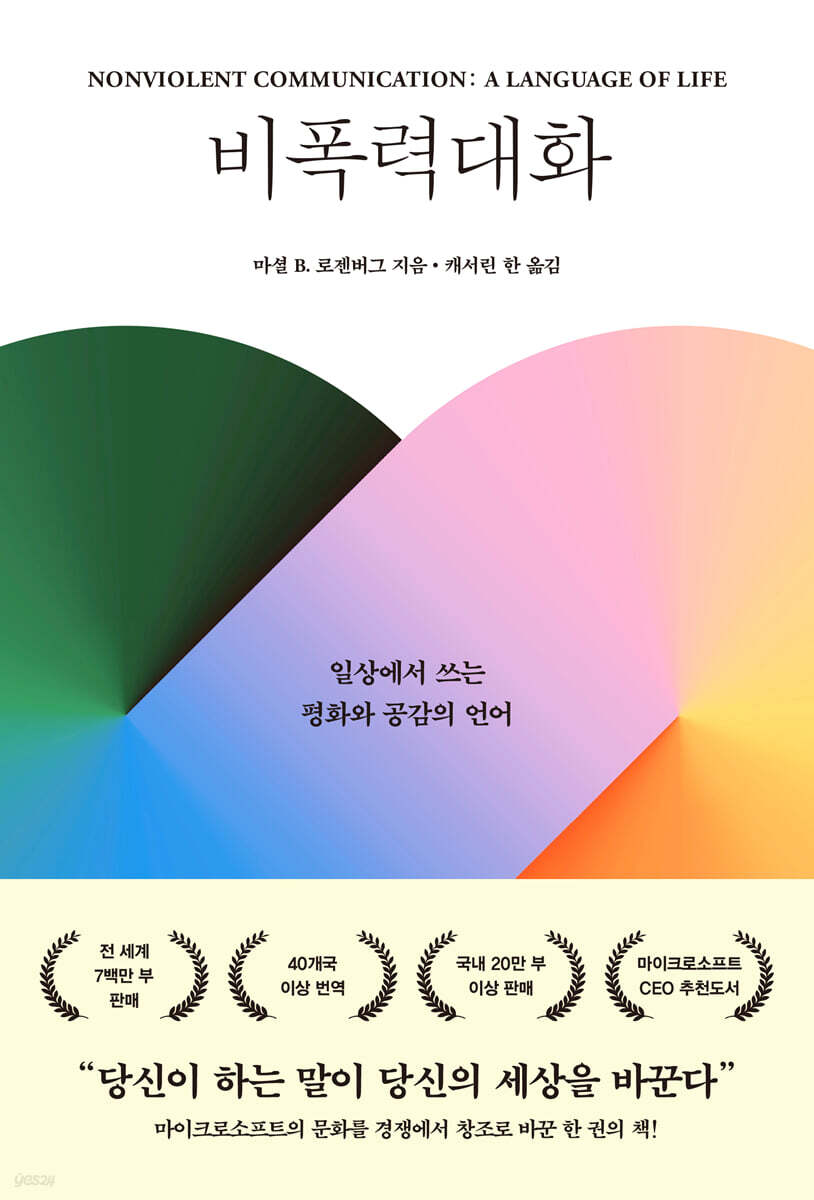
“What you say changes your world.”
This is the revised second edition of 『Nonviolent Communication: The Language of Peace in Everyday Life, the Language of Life』, which has been a steady seller since its first publication in the fall of 2004.
We have refined and revised sentences and content to make it easier and more comfortable for readers, and have supplemented vocabulary lists to express feelings, thereby increasing practicality and completeness.
Nonviolent Communication (NVC) is a method of expressing one's feelings honestly without blaming or criticizing the other person.
And it is a conversation method that allows you to hear the feelings and true desires of the other person behind their words, no matter how they express them.
The goal of nonviolent communication is to build quality human relationships based on mutual empathy. It focuses on understanding and respecting each other's needs, connecting heart to heart, and finding ways to meet everyone's needs.
Author Marshall Rosenberg notes how much the language we use plays a role in our relationships.
He was keenly aware of the adage, “The next thing you say will change your world.”
Arun Gandhi, who wrote the preface to the first edition, said, “If we change ourselves, we can change the world.
“Changing ourselves begins with changing the language we use and the way we communicate every day,” he said.
This is the revised second edition of 『Nonviolent Communication: The Language of Peace in Everyday Life, the Language of Life』, which has been a steady seller since its first publication in the fall of 2004.
We have refined and revised sentences and content to make it easier and more comfortable for readers, and have supplemented vocabulary lists to express feelings, thereby increasing practicality and completeness.
Nonviolent Communication (NVC) is a method of expressing one's feelings honestly without blaming or criticizing the other person.
And it is a conversation method that allows you to hear the feelings and true desires of the other person behind their words, no matter how they express them.
The goal of nonviolent communication is to build quality human relationships based on mutual empathy. It focuses on understanding and respecting each other's needs, connecting heart to heart, and finding ways to meet everyone's needs.
Author Marshall Rosenberg notes how much the language we use plays a role in our relationships.
He was keenly aware of the adage, “The next thing you say will change your world.”
Arun Gandhi, who wrote the preface to the first edition, said, “If we change ourselves, we can change the world.
“Changing ourselves begins with changing the language we use and the way we communicate every day,” he said.
- You can preview some of the book's contents.
Preview
index
Foreword | Deepak Chopra
Preface to the First Edition | Arun Gandhi
Chapter 1: Giving with Your Heart—The Core of NVC
Chapter 2: Conversations That Interfere with Compassion
Chapter 3: Observing Things as They Are
Chapter 4: Recognizing and Expressing Feelings
Chapter 5: Taking Responsibility for Your Feelings by Becoming Aware of Your Needs
Chapter 6: Asking for Enrichment
Chapter 7: Listening with Empathy
Chapter 8: The Power of Empathy
Chapter 9: Connecting with Ourselves and Compassion
Chapter 10: Expressing Anger Fully
Chapter 11 Conflict Resolution and Mediation
Chapter 12: Using Your Power to Protect
Chapter 13: Free Yourself and Help Others
Chapter 14: Expressing Gratitude with NVC
Epilogue
Further reading material
Translator's Note
List of feelings
List of universal desires
Preface to the First Edition | Arun Gandhi
Chapter 1: Giving with Your Heart—The Core of NVC
Chapter 2: Conversations That Interfere with Compassion
Chapter 3: Observing Things as They Are
Chapter 4: Recognizing and Expressing Feelings
Chapter 5: Taking Responsibility for Your Feelings by Becoming Aware of Your Needs
Chapter 6: Asking for Enrichment
Chapter 7: Listening with Empathy
Chapter 8: The Power of Empathy
Chapter 9: Connecting with Ourselves and Compassion
Chapter 10: Expressing Anger Fully
Chapter 11 Conflict Resolution and Mediation
Chapter 12: Using Your Power to Protect
Chapter 13: Free Yourself and Help Others
Chapter 14: Expressing Gratitude with NVC
Epilogue
Further reading material
Translator's Note
List of feelings
List of universal desires
Into the book
Nonviolence allows the positive aspects within us to manifest themselves.
So, instead of the selfishness, greed, hatred, prejudice, suspicion, and aggression that usually dominate our thoughts, let us fill our hearts with love, respect, understanding, gratitude, compassion, and consideration for others.
We sometimes hear this:
“This world is so cruel that we must become cruel to survive.” I don’t agree with this argument.
--- p.13
While researching what turns us away from our natural compassion, I discovered that certain words and conversational styles can lead people to act violently.
I call this a “life-alienating conversation.”
One type of conversation that alienates life is moralistic judgment.
This is saying that someone else's behavior that doesn't match your values is bad or wrong.
--- p.45
The second element needed to express yourself is feeling.
As we expand our vocabulary to express our feelings clearly and specifically, we can connect more easily with each other.
And acknowledging our true inner selves by expressing our feelings can help resolve conflict. NVC distinguishes between words expressing feelings and words expressing thoughts, evaluations, and interpretations.
--- p.91
To make a genuine request, we need to be clear about the purpose of our request.
If your goal is simply to change the other person or their behavior, or to get them to do what you want, NVC is not an appropriate method. NVC was created for those who want others to change of their own accord and respond with compassion. The goal of NVC is to build relationships based on honesty and empathy.
--- p.148
Empathy is understanding and respecting what another person is experiencing.
But instead of empathizing, we feel a strong urge to explain our views or feelings, give advice, or reassure the other person.
But empathy requires us to empty our hearts and listen to the other person with our whole being.
--- p.185
Resolving conflicts using NVC is different from traditional mediation methods.
Instead of focusing on issues, solutions, or compromises, the first thing to do is to identify the needs of both parties, and only then find ways to meet those needs.
--- p.307
NVC recommends listening with empathy when receiving words of gratitude, just as you would when listening to anything else.
Soon, you will be asked to listen to how your actions contributed to the happiness of others, how those people felt and how their needs were met as a result of those actions.
By doing so, we can joyfully embrace the fact that we all have the power to improve the quality of each other's lives.
So, instead of the selfishness, greed, hatred, prejudice, suspicion, and aggression that usually dominate our thoughts, let us fill our hearts with love, respect, understanding, gratitude, compassion, and consideration for others.
We sometimes hear this:
“This world is so cruel that we must become cruel to survive.” I don’t agree with this argument.
--- p.13
While researching what turns us away from our natural compassion, I discovered that certain words and conversational styles can lead people to act violently.
I call this a “life-alienating conversation.”
One type of conversation that alienates life is moralistic judgment.
This is saying that someone else's behavior that doesn't match your values is bad or wrong.
--- p.45
The second element needed to express yourself is feeling.
As we expand our vocabulary to express our feelings clearly and specifically, we can connect more easily with each other.
And acknowledging our true inner selves by expressing our feelings can help resolve conflict. NVC distinguishes between words expressing feelings and words expressing thoughts, evaluations, and interpretations.
--- p.91
To make a genuine request, we need to be clear about the purpose of our request.
If your goal is simply to change the other person or their behavior, or to get them to do what you want, NVC is not an appropriate method. NVC was created for those who want others to change of their own accord and respond with compassion. The goal of NVC is to build relationships based on honesty and empathy.
--- p.148
Empathy is understanding and respecting what another person is experiencing.
But instead of empathizing, we feel a strong urge to explain our views or feelings, give advice, or reassure the other person.
But empathy requires us to empty our hearts and listen to the other person with our whole being.
--- p.185
Resolving conflicts using NVC is different from traditional mediation methods.
Instead of focusing on issues, solutions, or compromises, the first thing to do is to identify the needs of both parties, and only then find ways to meet those needs.
--- p.307
NVC recommends listening with empathy when receiving words of gratitude, just as you would when listening to anything else.
Soon, you will be asked to listen to how your actions contributed to the happiness of others, how those people felt and how their needs were met as a result of those actions.
By doing so, we can joyfully embrace the fact that we all have the power to improve the quality of each other's lives.
--- p.353
Publisher's Review
Nonviolent communication, simple in form but fundamentally transforming lives.
This book is a basic text that covers in detail the basic concepts of nonviolent communication, the NVC model, and the process of applying the model.
In other words, it can be said to be a textbook on NVC that provides specific explanations and guidelines on theory and practice.
The strength of this book is that it presents practical methods through specific examples.
Nonviolent Communication (NVC) is a communication method that allows us to express ourselves and listen to others in new ways. It's also called "the language of compassion." Learning NVC allows us to become more aware of what we observe, feel, and desire, rather than reacting automatically and habitually.
It allows us to see human relationships from a new perspective based on four elements: observation, feeling, need, and request. Although the format is simple, it has the power to bring about very effective change.
The book that changed Microsoft's culture from "competitive" to "creative."
- Books recommended by Microsoft CEO Satya Nadella
There are many empirical examples showing that applying the NVC conversation model introduced in the book to daily life and organizational culture can help resolve conflicts and foster stronger bonds.
Since its publication in Korea in 2004, this book has been consistently sought out by over 10,000 readers and businesses every year, likely due to the power of nonviolent communication to bring about real change in human relationships.
In particular, the management case of Microsoft (MS) can be cited as the most famous example of how applying nonviolent communication to organizational culture led to corporate innovation.
When Satya Nadella took office as the third CEO of Microsoft, he presented a copy of "Nonviolent Communication" to senior executives and presented a vision for moving forward into a new Microsoft through the values of communication, cooperation, and empathy.
Since then, Microsoft's culture has shifted from competition to creativity, laying the foundation for a new leap forward and revival.
This book is a basic text that covers in detail the basic concepts of nonviolent communication, the NVC model, and the process of applying the model.
In other words, it can be said to be a textbook on NVC that provides specific explanations and guidelines on theory and practice.
The strength of this book is that it presents practical methods through specific examples.
Nonviolent Communication (NVC) is a communication method that allows us to express ourselves and listen to others in new ways. It's also called "the language of compassion." Learning NVC allows us to become more aware of what we observe, feel, and desire, rather than reacting automatically and habitually.
It allows us to see human relationships from a new perspective based on four elements: observation, feeling, need, and request. Although the format is simple, it has the power to bring about very effective change.
The book that changed Microsoft's culture from "competitive" to "creative."
- Books recommended by Microsoft CEO Satya Nadella
There are many empirical examples showing that applying the NVC conversation model introduced in the book to daily life and organizational culture can help resolve conflicts and foster stronger bonds.
Since its publication in Korea in 2004, this book has been consistently sought out by over 10,000 readers and businesses every year, likely due to the power of nonviolent communication to bring about real change in human relationships.
In particular, the management case of Microsoft (MS) can be cited as the most famous example of how applying nonviolent communication to organizational culture led to corporate innovation.
When Satya Nadella took office as the third CEO of Microsoft, he presented a copy of "Nonviolent Communication" to senior executives and presented a vision for moving forward into a new Microsoft through the values of communication, cooperation, and empathy.
Since then, Microsoft's culture has shifted from competition to creativity, laying the foundation for a new leap forward and revival.
GOODS SPECIFICS
- Date of issue: August 5, 2024
- Page count, weight, size: 380 pages | 592g | 152*225*23mm
- ISBN13: 9791185121505
- ISBN10: 1185121501
You may also like
카테고리
korean


korean

![ELLE 엘르 스페셜 에디션 A형 : 12월 [2025]](http://librairie.coreenne.fr/cdn/shop/files/b8e27a3de6c9538896439686c6b0e8fb.jpg?v=1766436872&width=3840)


